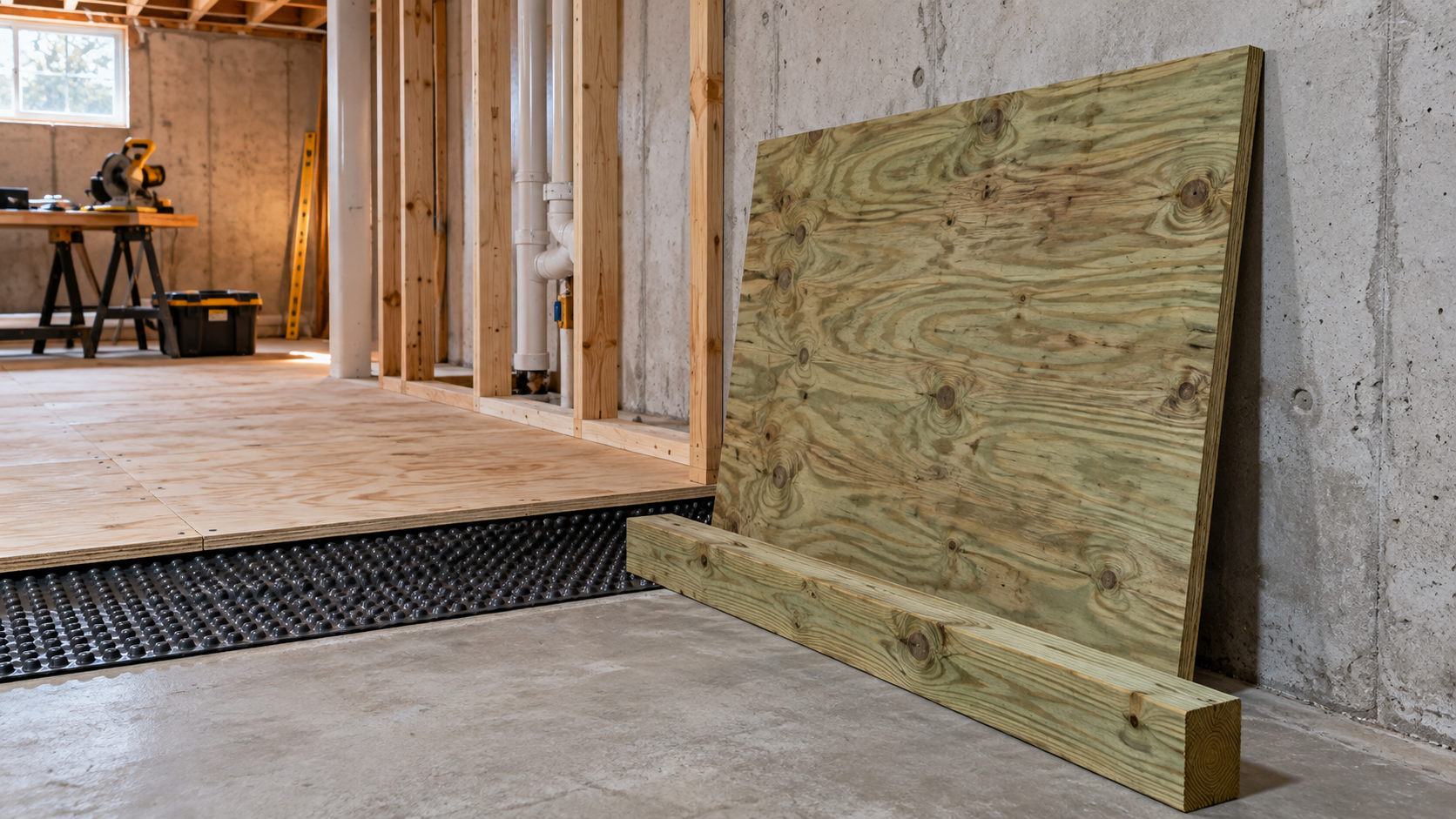
You can — but almost nobody needs it where they think they do, and using it everywhere is one of the more expensive ways to not solve a basement moisture problem.
Short answer: Pressure-treated plywood is the right call for wood that sits directly on the slab or within a few inches of soil — sleepers, a sill under a stud wall, blocking that faces real moisture. For a finished-basement subfloor, basement wall panels, or general sheathing, it’s usually the wrong tool: it doesn’t stop moisture, it requires compatible fasteners, and it often shows up wet from the yard. Fix the water first, then most of your basement plywood can be standard.
That’s the whole thing in a paragraph. The rest of this page is where the line falls, and how people cross it and pay for it.
Where pressure-treated plywood actually belongs in a basement
The reason PT exists is decay resistance, not moisture control. Those are two different jobs, and mixing them up is where most of the money gets wasted. Preservative treatment slows fungal decay under the AWPA Use Category system — UC2 covers interior, above-ground damp service, while UC4A is meant for ground contact and comparable severe exposures. Not every basement component located near soil needs UC4 treatment. And none of it makes a panel waterproof, dimensionally stable, or a vapor retarder.
So PT earns its place only where wood faces real decay exposure:
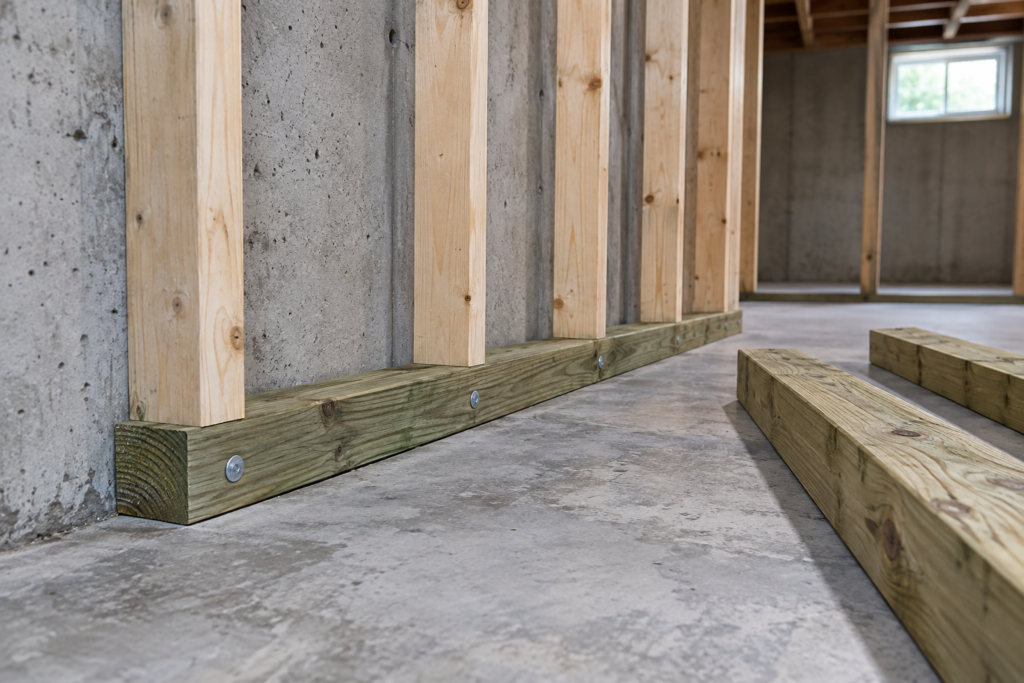
Sleepers and sills sitting on the slab
Building-code requirements vary by jurisdiction and assembly. IRC provisions generally require naturally durable or preservative-treated wood in specified locations where wood contacts concrete or masonry and is exposed to moisture or decay risk. An approved impervious barrier may change the requirement in some assemblies. Confirm the locally adopted code and treatment label before purchasing material. A sleeper system, or a bottom plate framed tight to the slab, is the clearest case for PT.
Blocking and furring low on a below-grade wall
Wood strapped to foundation masonry near the floor can pick up capillary moisture, so it’s sometimes a PT candidate — but the actual exposure and the assembly decide that, not a blanket rule. Dry, separated, above-grade furring usually isn’t.
Anywhere a known water event is likely
Sump pit surrounds, the base of a mechanical area that’s flooded before — spots with a history, not spots with a fear.
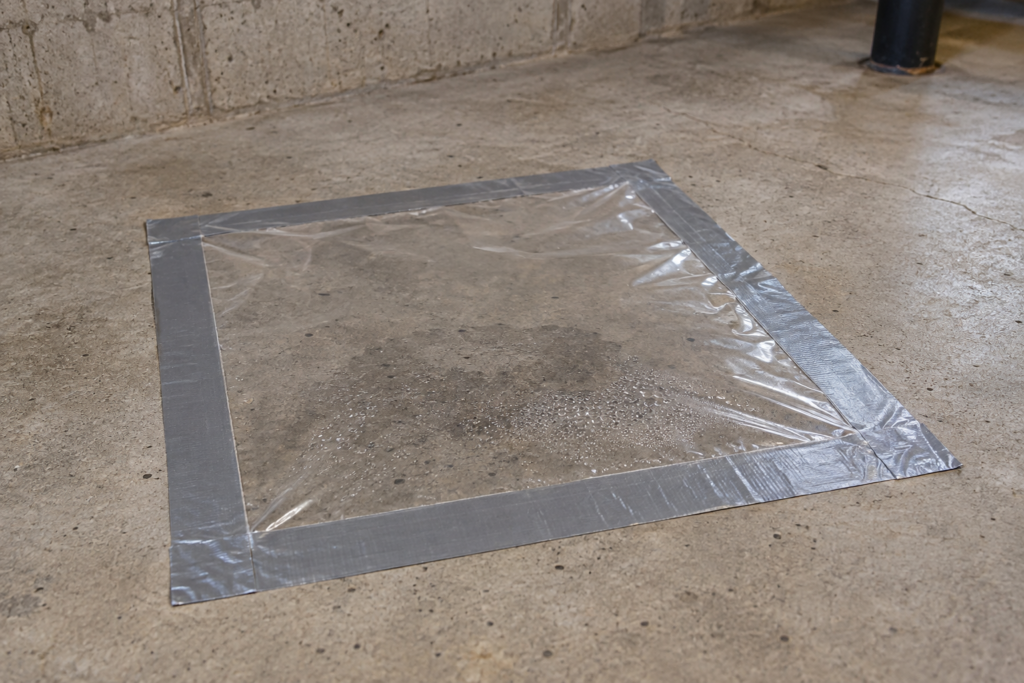
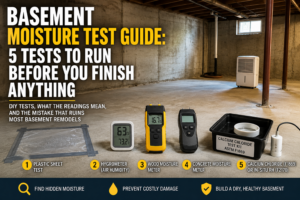
🧪 Test the slab before you decide anything: Tape an 18 × 18-inch sheet of clear polyethylene to the bare slab, seal all four edges, and leave it in place for at least 16 hours (ASTM D4263). Condensation beneath the sheet or darkening of the concrete indicates moisture, but the test does not measure the slab’s internal moisture condition or prove that a floor covering is safe to install. For an actual number, a calcium chloride test kit measures moisture-vapor emission — but only when run under the required conditions, and the result has to be checked against your flooring and adhesive manufacturer’s limits.
Where you should not use it — and the mistake people make
❌ The mistake: “My basement gets damp, so I’ll build the whole subfloor and the stud walls out of pressure-treated plywood to be safe.”
That instinct feels responsible. It’s actually three problems stacked on top of each other, and it doesn’t touch the real issue.
PT plywood doesn’t manage moisture — it just survives it longer. If vapor is coming through your slab, a PT subfloor still traps it, still lets mold grow on the drywall and carpet above it, and still needs the moisture assembly you were trying to skip. You’ve paid a premium for wood that decays slowly while everything around it fails.
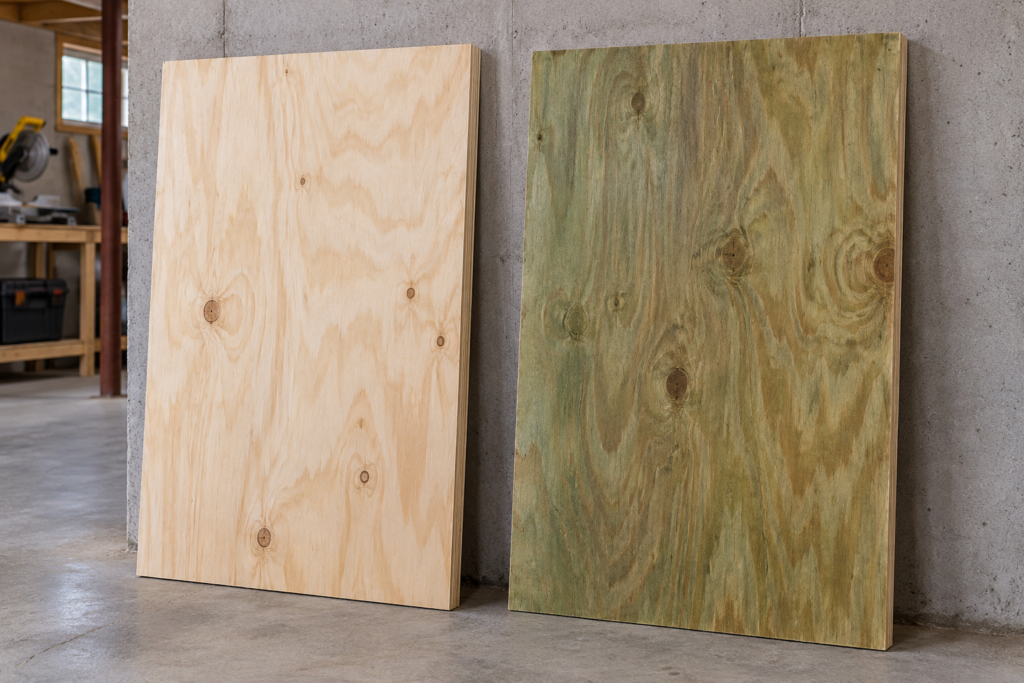
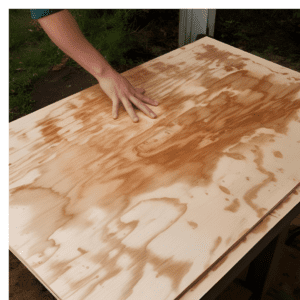
It often arrives wet. Freshly treated panels carry high moisture content out of the yard unless you specifically buy KDAT (kiln-dried after treatment), which costs more and isn’t always stocked. Screw a wet PT panel down in a closed basement and it dries in place — cupping, gapping, telegraphing every seam through your finish floor.
It rarely helps on finished interior surfaces. Treated wood can legitimately be specified for interior-damp service (that’s what UC2 is), so “never indoors” would be too strong. The real point: on an exposed, finished surface it usually buys you nothing, and it should be used only where the assembly, code, or genuine decay exposure justifies it.
If the concern is “damp basement,” PT plywood is treating the symptom’s neighbor. Keep reading for what actually fixes it.
Pressure-treated vs. standard plywood in a basement: cost and where each wins
💸 Cost difference: Pressure-treated plywood generally costs substantially more than comparable untreated structural panels — and that’s before the fastener upgrade PT forces on you (next section). Sheathing a whole basement in PT “to be safe” adds real cost that buys zero moisture protection.
Comparison
Standard structural panel
Pressure-treated plywood
Primary purpose
Subflooring or sheathing after moisture is controlled
Decay resistance where treatment is required
Stops water vapor?
No
No
Typical cost
Lower
Higher
Fasteners
Follow panel and assembly specifications
Use treatment-compatible fasteners
Initial moisture
Normally lower
May be high unless KDAT
Best basement use
Rated panel above a suitable moisture-control system
Approved slab-contact or code-required applications
For the deck itself, spec an appropriately rated panel — APA Rated Sturd-I-Floor or Rated Sheathing matched to your span and flooring system — rather than reaching for whatever “CDX” happens to be in the rack. APA distinguishes rated subfloor products from generic plywood descriptions for a reason: the rating ties the panel to a span and a use.
And keep two specs separate: a panel’s glue bond (Exposure 1 vs. Exterior) tells you how the adhesive handles construction moisture; the preservative treatment tells you how the wood handles decay. A single panel can be Exposure-1-bonded and pressure-treated. Don’t let those blur — you can overpay for “Exterior” bond when Exposure 1 was fine, or assume “treated” means “waterproof” when it never did.
The fastener warning most people miss
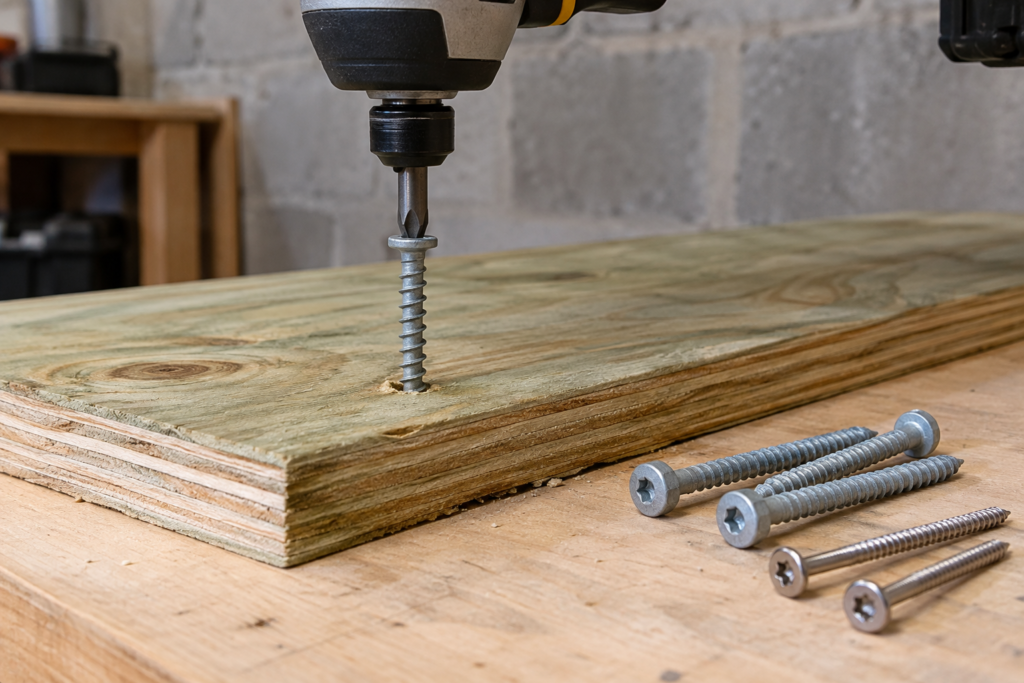
⚠️ Warning: Some preservative systems are highly corrosive to ordinary steel.
Use fasteners and connectors approved by both the treated-wood manufacturer and the hardware manufacturer — commonly hot-dip galvanized or stainless steel — and don’t mix incompatible metals (keep bare aluminum off copper-based treatments). Hot-dip galvanized structural screws or stainless deck screws are the usual answers. This is a real cost line — budget it in before you decide PT is “cheap insurance.”
Cutting PT plywood also releases treated dust. Wear a P100 respirator, cut outside, and don’t burn the offcuts.
What can go wrong when PT stands in for a moisture plan
😬 A cautionary scenario: Consider a basement where treated sleepers and panels are installed over a damp slab with no capillary break, no slab test, and no vapor strategy — chosen because the floor “felt cold and a little damp.” Months after the drywall goes up, there’s a musty smell and a dark line at the base of the wall. The treated wood itself is fine — it isn’t rotting. But the drywall, insulation, and trim above it are wet, because vapor kept rising through the slab with nowhere to go. The expensive pressure-treated plywood ends up being the one thing worth keeping.
The lesson isn’t “PT is bad.” It’s that PT answered a question nobody was actually asking. Damp like that is a vapor-and-drainage problem, and no plywood grade solves it.
What to use instead when moisture is the real problem
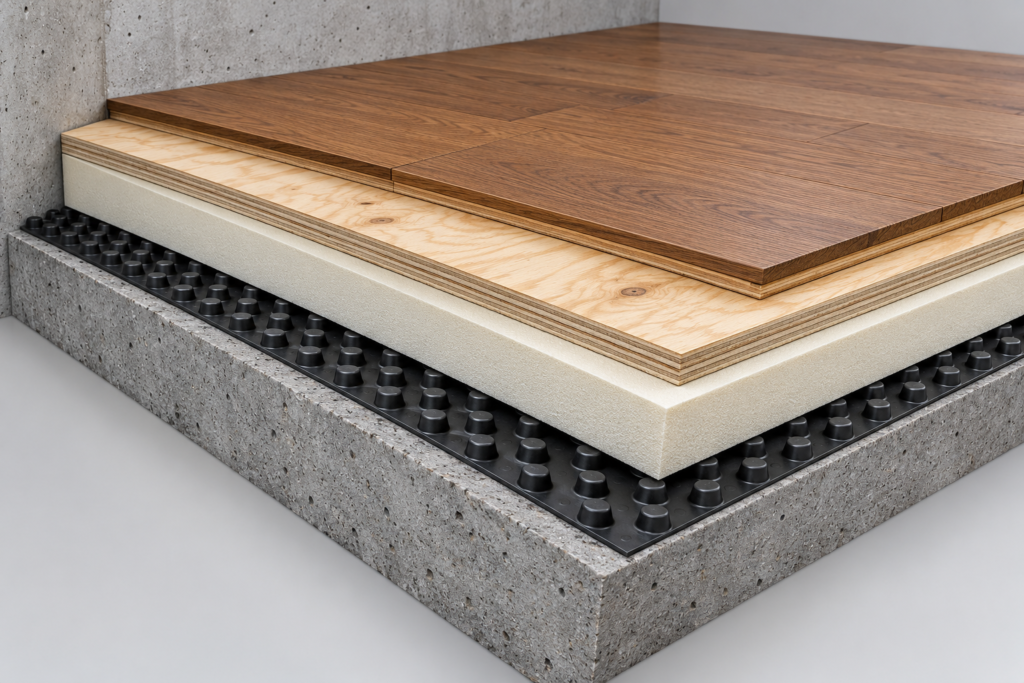
Control the water, then most of your plywood can be ordinary. A dependable basement floor assembly, from the slab up:
Test and dry the slab (the poly test above), and fix obvious water entry (grading, gutters, a failing sump) before anything goes down — moisture control comes before materials, every time.
Break the capillary path with a dimpled underlayment membrane or an insulated subfloor panel that holds the wood off the concrete and lets moisture drain and breathe. That’s the layer PT was pretending to be.
Get the vapor retarder class right for your climate and assembly per current IRC — a random sheet of poly in the wrong spot traps moisture instead of managing it, so match the vapor retarder class to the assembly.
Then set the rated subfloor panel, with PT reserved only for wood landing directly on the slab.
Do it in that order and the plywood question mostly answers itself — and you stay out of wood rot repair territory later.
The gear that makes this job right
Skip this if you’re already stocked. If not, this is the short list that keeps a basement build out of trouble:
As an Amazon Associate, theplywood.com earns from qualifying purchases.
Frequently Asked Questions
Is pressure-treated plywood waterproof? No. Pressure treatment resists fungal decay and insects; it does not waterproof the panel or stop water vapor. A treated panel still absorbs moisture and swells — it just rots more slowly while doing it.
Do I need pressure-treated plywood for a basement subfloor? Usually not. If you break the capillary path with a dimple membrane or insulated panel and get the vapor retarder right, an appropriately rated structural panel is fine for the deck. Reserve pressure-treated for wood resting directly on the slab.
Does code require pressure-treated wood in a basement? In specified locations, yes. IRC provisions generally require naturally durable or preservative-treated wood where wood contacts concrete or masonry and is exposed to moisture or decay risk; an approved impervious barrier can change that in some assemblies. Confirm your locally adopted code and the treatment label.
What screws do I use with pressure-treated plywood? Use fasteners and connectors approved by both the treated-wood manufacturer and the hardware manufacturer — commonly hot-dip galvanized or stainless steel — and don’t mix incompatible metals, including keeping bare aluminum off copper-based treatments.
Does pressure-treated plywood off-gas indoors? Modern waterborne treatments are far lower in volatile compounds than old creosote or penta. Treated wood can be specified for interior-damp service, but it offers no benefit on exposed finished surfaces, so use it only where the assembly, code, or decay exposure calls for it.
Can I use regular structural plywood in a basement instead? Yes, once moisture is controlled. An appropriately rated subfloor panel — such as APA Rated Sturd-I-Floor, matched to your span and flooring — is the standard deck choice, at a fraction of PT’s cost.
Related Posts:
Can You Use Plywood for a Deck? Pros, Cons & Costs by Admin June 2, 2026 DIY Choosing the right material for a deck determines how long the structure will last, how much maintenance it will require, and how safe it will…
Dealing with Wet and Warped Plywood: What You Can Do by Admin March 21, 2025 Repairs Dealing with Wet and Warped Plywood: A Practical Guide We have prepared a reference guide for you—an easy checklist for your convenience. Wet_and_Warped_Plywood_Checklist_ThePlywoodDownload If you’ve…