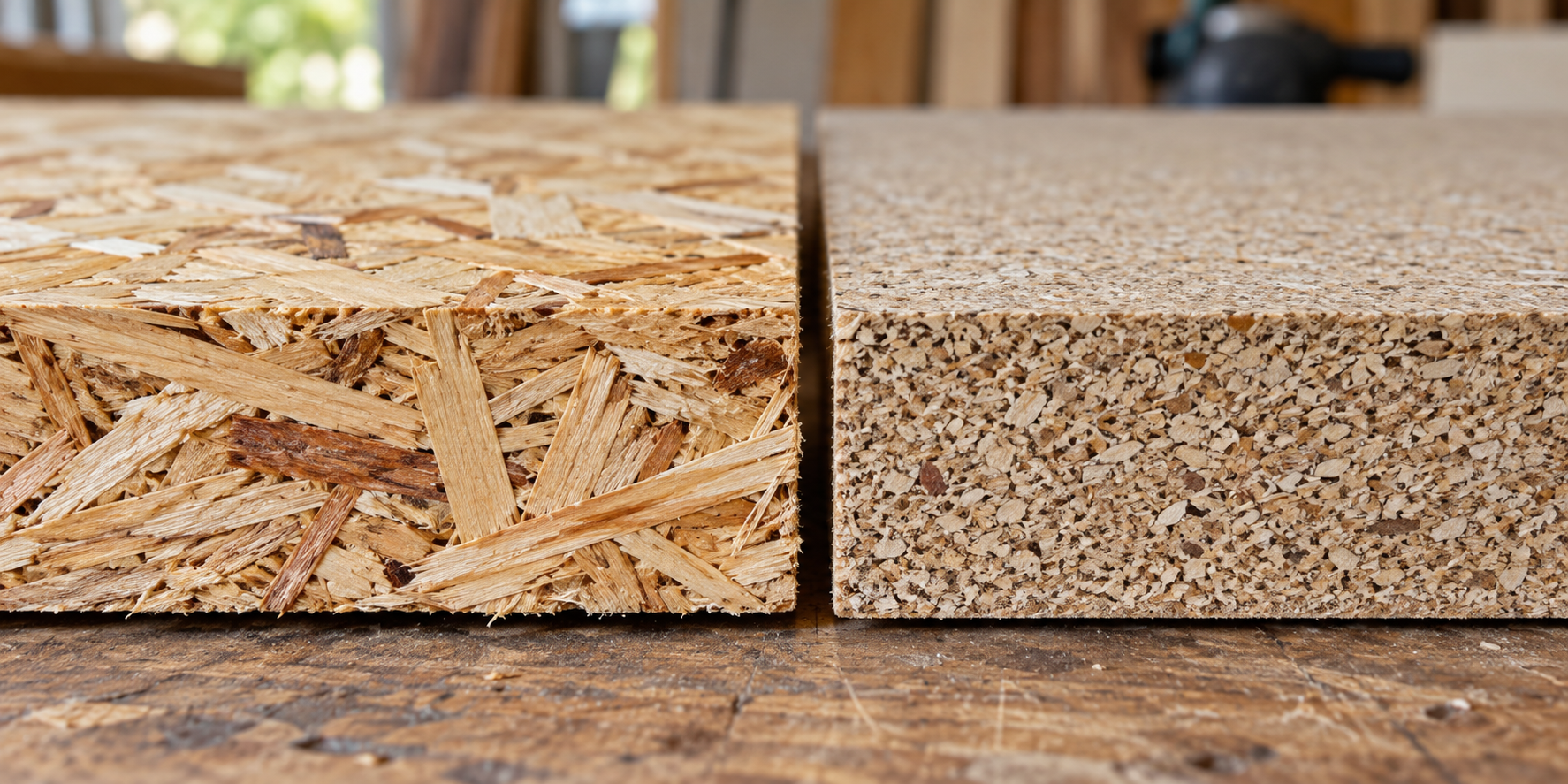
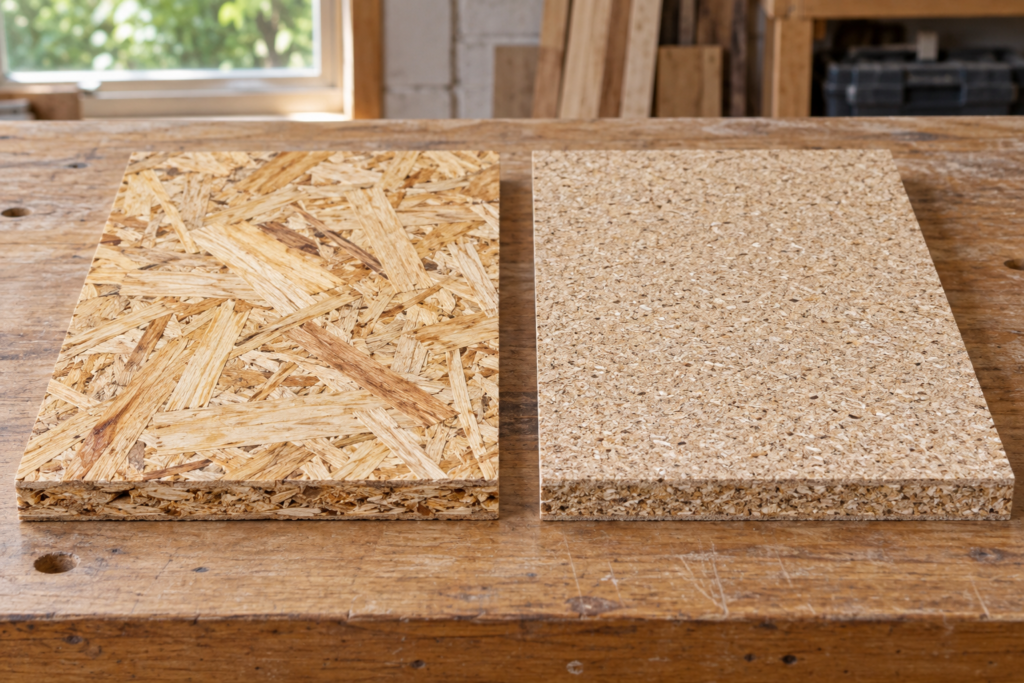
OSB is the stronger panel. It is made and stamped as a structural sheet for subfloors, roof decking, wall sheathing and shed floors. Particle board is a non-structural panel for dry indoor work like cabinet boxes, shelving cores and countertop substrate, where a smooth, flat face matters more than strength. Below you’ll find a side-by-side chart, the grade numbers that actually matter, a simple soak demonstration you can run yourself, and the mistakes that lead to tearing a job out a year later.
Anything that carries weight on joists or rafters: span-rated OSB. Ordinary particle board has no span rating and isn’t a structural panel.
Anything that might get wet during construction: OSB rated Exposure 1 can handle rain before the roof goes on, but neither panel is made for ongoing dampness.
Paint-grade or laminate-faced furniture in a dry room: particle board, ideally melamine-faced or M-2 grade.
OSB vs Particle Board Comparison Chart
What you care about
OSB (oriented strand board)
Particle board
Made from
Long wood strands, laid in cross-oriented layers
Small chips, shavings and sawdust pressed with resin
Governing standard (US)
PS 2 (performance-rated structural panel)
ANSI A208.1 (classified by grade and density, e.g., M-2)
Structural use
Yes. Span-rated for floors, roofs and walls
No. Classed as non-structural
Grade stamp tells you
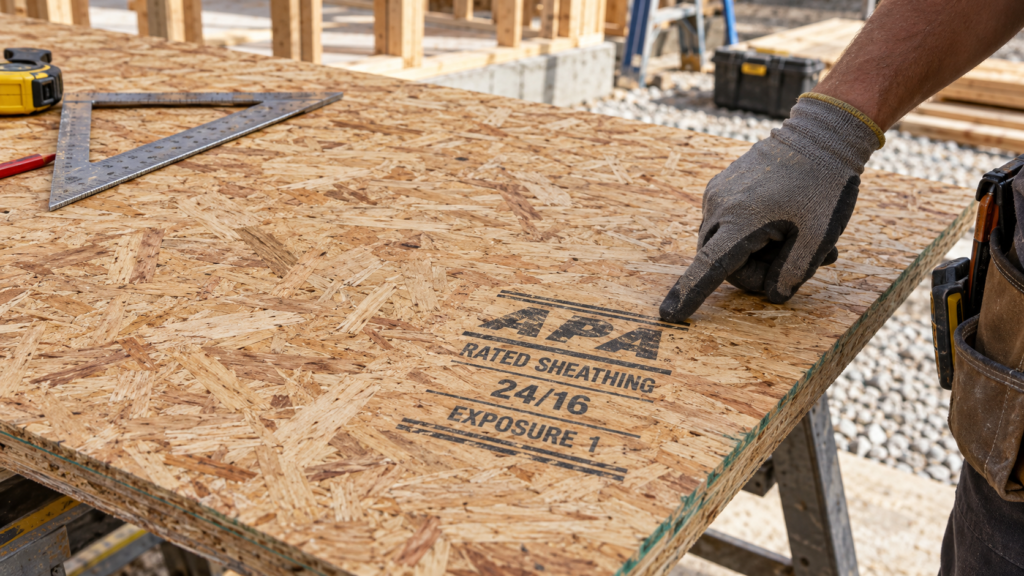
Span rating (e.g., 24/16), bond classification (Exposure 1 or Exterior), thickness
Grade (M-S, M-2, M-3)
Short-term wetting
Exposure 1 panels tolerate construction delays
Edges swell quickly; damage is usually permanent
Surface
Rough, textured strand face
Smooth and flat; takes laminate and melamine well
Screw holding
Made to hold framing fasteners
Better in the face than the edge
Typical price
Usually the cheaper structural sheet
Often cheaper per sheet, but depends on thickness and grade. Check local pricing
Floors over joists, outdoor projects, splash zones
Strength: What the Standards Actually Say
The gap between these panels is wide. The two are tested under different standards for different jobs, so comparing one “strength number” to another doesn’t tell you much.
OSB is rated by what it can span
Construction OSB is made to PS 2, a performance standard. Panels are tested as floor, roof or wall sheathing, and the stamp gives a span rating. A stamp reading 24/16 means the panel is rated for roof framing up to 24 inches on center and floor framing up to 16 inches on center. That rating is the number to check, because thickness alone doesn’t tell you. The plywood thickness guide explains why panels of the same nominal thickness can carry different ratings.
Particle board is graded by bending strength
Under ANSI A208.1-2022, the common M-2 grade must reach a minimum modulus of rupture (bending strength) of 1,885 psi and a minimum internal bond of 58 psi. Those are floor values, not typical ones. Density isn’t a pass/fail requirement for M-2. One major mill, Uniboard, lists its M-2 sheets at roughly 38.7–41.8 lb per cubic foot. These figures qualify a sheet for cabinets and furniture. Nothing in A208.1 gives particle board a span rating over joists.
Screws hold better in the face than the edge
Particle board generally holds screws better through its face than through its edge. Actual holding strength depends on the panel’s density and thickness, the fastener type, and how it’s installed. Use screws made for particle board, keep fasteners back from edges, and add blocking or brackets on heavily loaded joints. Weak edge connections can contribute to joint failure, especially in heavily loaded shelving.
⚠️ Warning: Underlayment-grade particle board (PBU) is made to go over a structural subfloor, not to replace one. Laying it directly across joists does not make a code-approved floor.
Moisture: Where Particle Board Loses Badly
Water is where these two panels separate fastest.
OSB rated Exposure 1 uses a glue bond designed to survive weather during normal construction delays and then dry out. That rating describes the glue, not rot resistance. OSB that stays wet can still swell at the edges and eventually decay. Exposure 1 means “can get rained on before the roof goes on,” not “can live outside.”
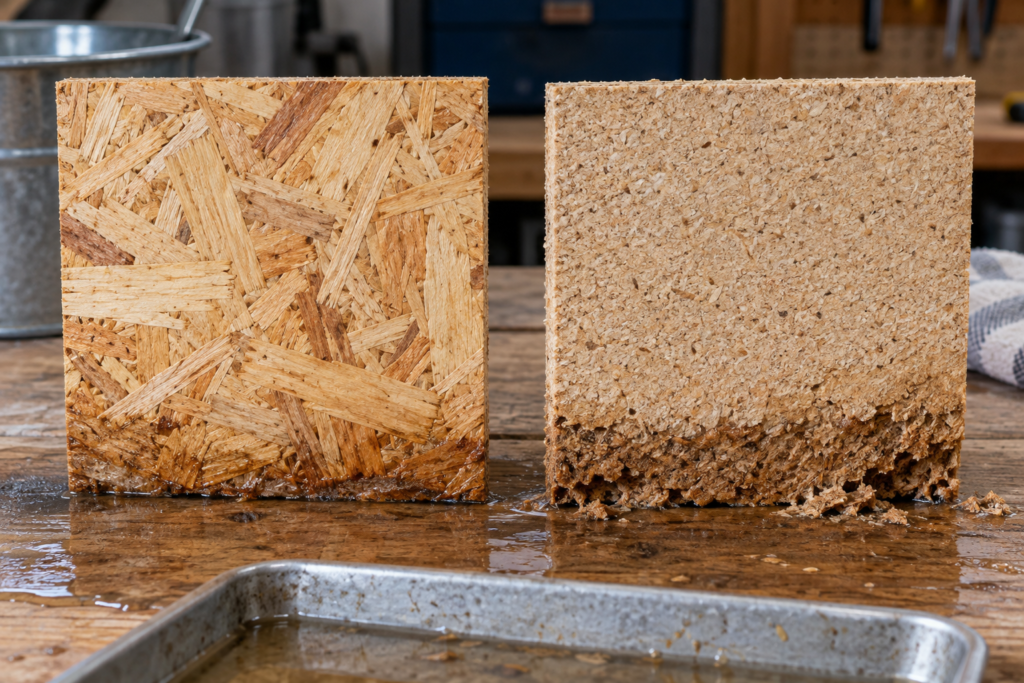
Particle board soaks up water at its cut edges and swells. Once the chips separate, drying the panel doesn’t pull them back together. ANSI A208.1 doesn’t even require a thickness-swell test for M-2 grade, which tells you the standard assumes the panel stays dry. Moisture-resistant particle board exists, but it’s a specialty product and still isn’t an exterior panel.
🧪 Soak demonstration you can run: Cut a 6-inch square of each panel, measure one edge with a caliper, and stand both in an inch of water overnight. Measure again after 24 hours, then let them dry for a few days and measure once more. The particle board edge will very likely stay swollen, which is exactly what happens under a leaking sink. This is a simple side-by-side demonstration, not a standardized test, and results vary by product and brand.
Best Uses: Which One to Use for Your Project
Project
Use
Why
Subfloor over joists
Span-rated OSB (tongue-and-groove)
Needs a structural rating
Roof deck / wall sheathing
Span-rated OSB
Needs a structural rating
Shed floor
OSB or exterior-glue plywood
Particle board swells from ground moisture; see our shed floor guide
Garage shelving, heavy loads
Plywood, or OSB if looks don’t matter
Particle board sags under sustained load
Closet or bookcase shelving, light loads
Particle board (M-2 or melamine)
Smooth, flat and inexpensive; keep spans short
Cabinet boxes in a dry room
Melamine-faced particle board
Flat, consistent, takes laminate
Sink base cabinets
Plywood preferred
One slow leak can ruin particle board
Laminate countertop substrate
Particle board
Standard substrate for dry areas
Painted furniture
Particle board or MDF
OSB’s strand texture shows through paint
Unprotected outdoor projects
Neither ordinary OSB nor standard particle board
Use an exterior-rated panel suited to the job; our plywood types guide covers the options
Weighing OSB against plywood for a structural job? Our OSB alternatives guide walks through the trade-offs.
💸 Cost difference: Particle board’s lower price only pays off on furniture-scale, indoor jobs. On a three-sheet shed floor, saving a few dollars per sheet adds up to a small number. Replacing a swollen floor means tearing it out and rebuilding, which costs far more than the sheets did. Price both at your local yard and multiply by the sheet count before deciding.
Products That Help
As an Amazon Associate, theplywood.com earns from qualifying purchases.
Iron-on edge banding: seals particle board shelf edges, which is where water gets in first.
❌ Mistake: using particle board as a subfloor. It has no span rating. Expect sagging between joists, fasteners working loose and a floor that fails inspection.
❌ Mistake: building a shed floor from particle board. Ground moisture and wet boots reach the edges. Swelling and crumbling usually follow within a season or two.
😬 Regret: particle board under the kitchen sink. A slow drip that goes unnoticed for a month can turn the cabinet floor soft. It can’t be dried back into shape, only replaced.
❌ Mistake: painting OSB and expecting a smooth finish. The strand pattern shows through the paint. If the face will show, use particle board, MDF or melamine.
❌ Mistake: long shelf spans in particle board. It sags slowly under constant load. Keep spans short or stiffen the front edge. Our shelf building guide covers support spacing.
⚠️ Warning: treating Exposure 1 OSB as an outdoor panel. The rating covers the glue bond during construction delays, not years of weather. It still needs siding or roofing over it.
When Neither Panel Is the Right Call
Wet areas (bathroom floors, unprotected outdoor projects, boat decks): use an exterior-rated or treated panel.
Fine furniture with exposed edges: hardwood or veneer-core plywood holds screws better and looks better at the edge.
Heavy, long-term shelf loads like books or tools: plywood or solid wood resists sag better than either.
FAQ
Is OSB stronger than particle board? Yes, for structural work. OSB is made to PS 2 and carries a span rating for floors, roofs and walls. Particle board is a non-structural panel graded under ANSI A208.1, with no span rating.
Can particle board be used for a subfloor? Not as the structural layer. Underlayment-grade particle board can go over a structural subfloor in dry areas, but it can’t span joists on its own.
Which handles water better, OSB or particle board? OSB. Exposure 1 OSB is bonded to handle weather during construction delays. Particle board edges swell when wet and usually stay swollen. Neither panel should stay wet for long.
Is particle board cheaper than OSB? Often, but not always. It depends on the thickness, grade and product, and prices shift by region and season. Particle board’s lower price only makes sense for dry, indoor, non-structural jobs.
Which is better for shelves? For light loads in a dry room where looks matter, melamine-faced particle board works well. For heavy loads in a garage, use plywood or OSB, since particle board sags over time.
Does particle board give off formaldehyde? Particle board sold in the US must meet the formaldehyde emission limits in EPA’s TSCA Title VI rule, and compliant panels carry a TSCA Title VI label. Look for that label on the sheet or packaging.
Bottom Line
Choose span-rated OSB for structural floors, roof decking and wall sheathing. It handles temporary construction moisture better than ordinary particle board, but it still needs protection from prolonged wetting. Choose particle board for dry, interior furniture, cabinets and laminate substrates where a smooth surface matters. Never substitute ordinary particle board for structural subflooring.
Related Posts:
OSB Board: Pros, Cons and Best Uses by Admin August 25, 2026 DIY OSB is everywhere in modern construction and barely gets a second thought — until something goes wrong with it. It sheathes the walls and roofs…