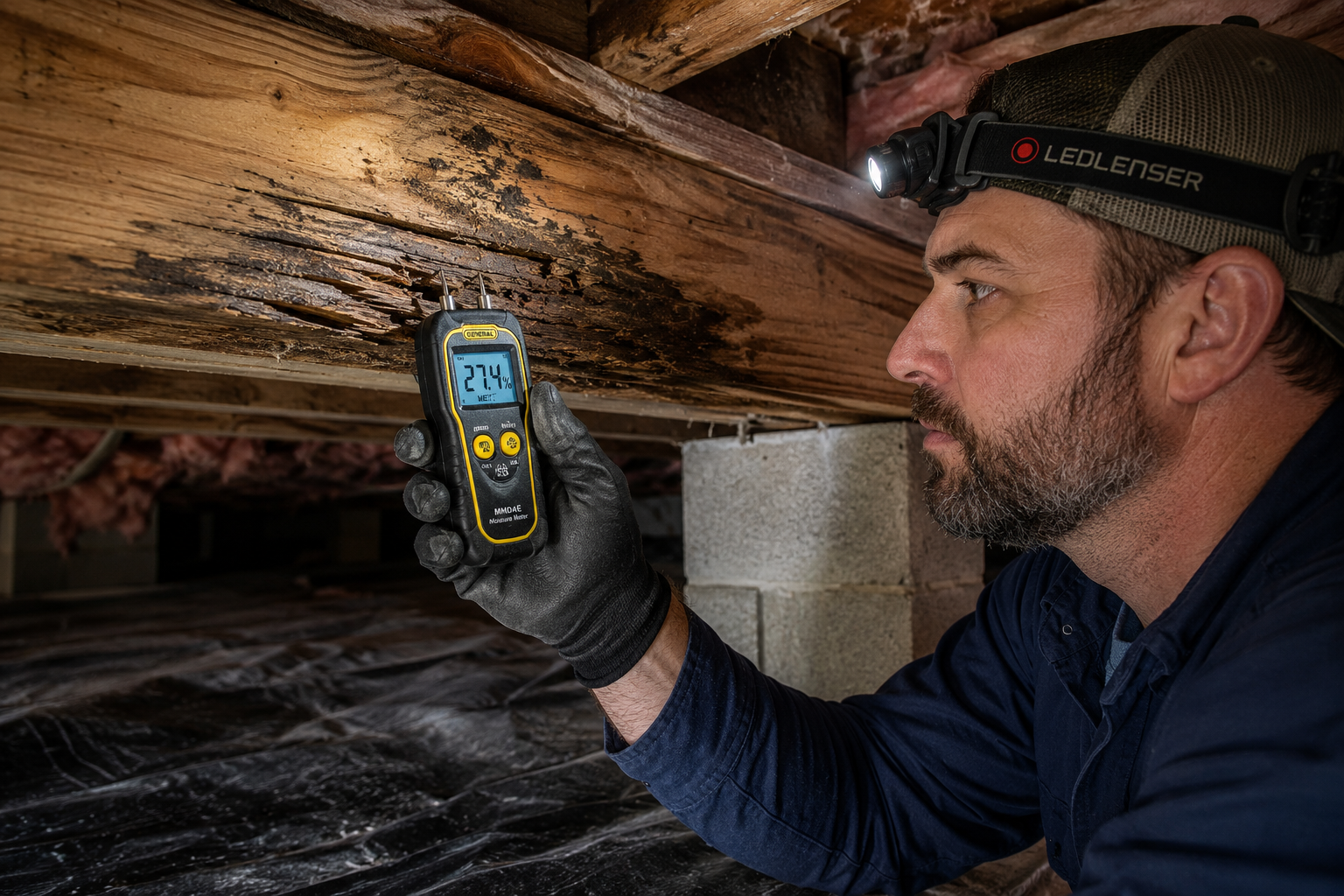
In rot repair work, the tool matters less than most buyers think and more than most sellers admit. A $20 pin meter from Amazon does a legitimate job on softwood framing. A $250 Protimeter does a better job in harder situations. What separates a useful reading from a misleading one — after reviewing contractor recommendations and remediation practices across subfloor repairs, crawlspace rot investigations, and rim joist diagnostics — isn’t usually the tool. It’s knowing how to use it.
This guide covers what to look for in a moisture meter for rot detection specifically, the best models at each price point, and how to use one correctly so you’re reading the wood, not the finish on top of it.
Quick Answer: Best Moisture Meter for Wood Rot by Category
Category
Pick
🏆 Best Overall
General Tools MMD7NP
💰 Best Budget
General Tools MMD4E
🎯 Best Value
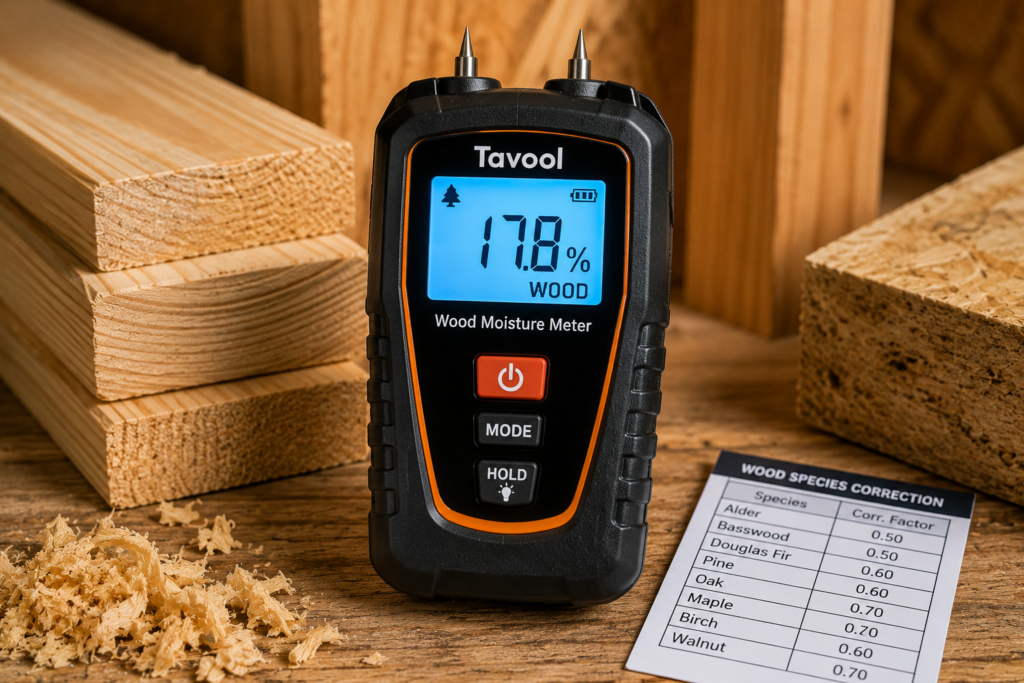
Tavool Wood Moisture Meter
🔬 Best Professional
Protimeter Surveymaster
🪵 Best for Subfloors
General Tools MMD7NP
Why Moisture Meters Matter for Wood Rot
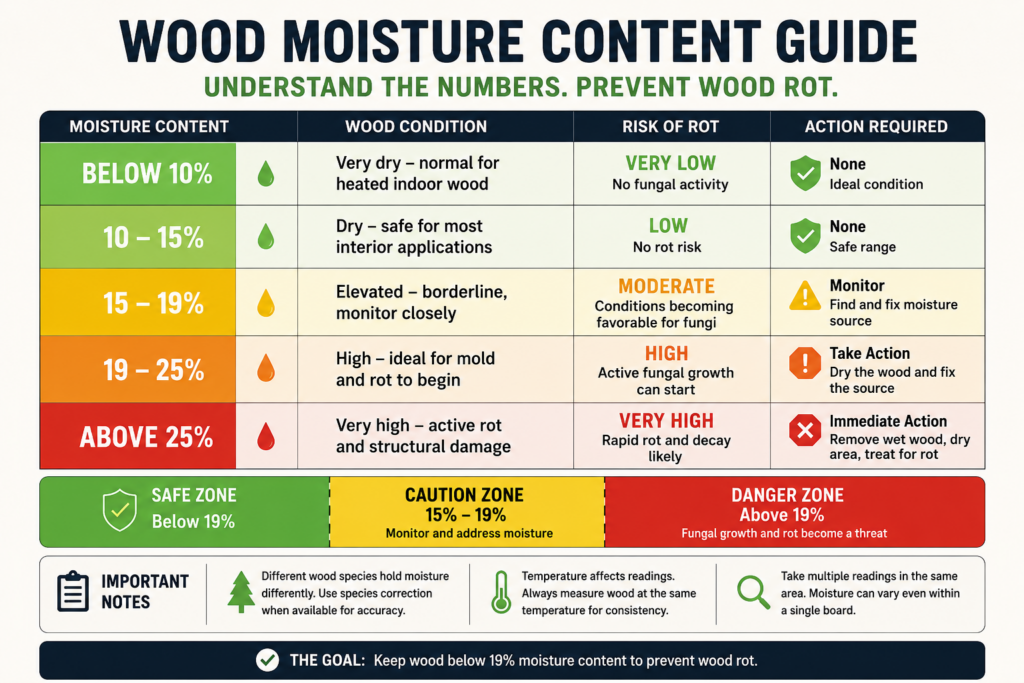
Wood rot is a fungal process. Fungi need moisture to grow, reproduce, and digest wood fibers — and they need it consistently, not just occasionally. The fungal species responsible for the most destructive rot, brown rot and white rot, both require wood moisture content above roughly 19–20% to establish and spread. Below that threshold, the wood may be damp but it won’t support active rot growth.
That threshold is exactly what a moisture meter measures. It tells you where the wood actually sits relative to the rot danger zone — which is information you can’t get any other way without a lab.
There are three specific situations where a moisture meter is essential in rot work:
Before a repair: If the wood reads above 15–16% moisture, it’s not dry enough to fill, prime, or seal. Enclosing moisture inside an epoxy repair or under new paint is one of the most common reasons rot repairs fail — the moisture stays trapped, the fungi continue working, and the repair fails from the inside out. Our guide on how to stop wood rot before it spreads covers the full treatment sequence, and a dry reading is the prerequisite for every step.
After fixing a moisture source: If you’ve rerouted a downspout, resealed a window, or dried out a subfloor, a moisture meter is how you confirm the fix actually worked before closing anything up. Our guide on getting moisture out of a plywood subfloor specifically references achieving a dry meter reading as the benchmark for when it’s safe to reinstall flooring — and that benchmark applies to every moisture remediation job, not just subfloors.
For ongoing monitoring: In crawlspaces, basements, and anywhere wood is close to grade or exterior walls, periodic moisture readings catch problems before they become visible. Wet wood at 22% doesn’t look different from dry wood at 10% — but it’s behaving very differently biologically.
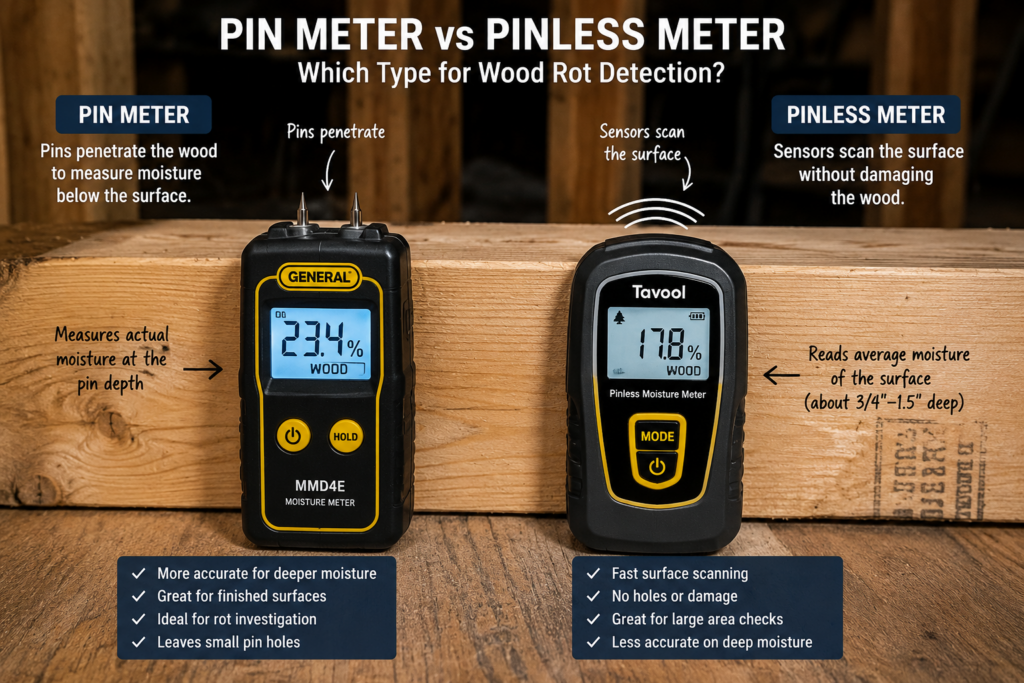
Pin vs. Pinless: Which Type for Rot Detection
This is the first decision when buying a moisture meter, and it matters more for rot work than for most other applications.
Pin-Type Meters
Pin meters work by driving two small metal pins into the wood surface and measuring electrical resistance between them. Water conducts electricity; dry wood doesn’t. The meter reads the resistance and converts it to a moisture content percentage.
For rot detection specifically, pin meters have one major advantage: they read the actual moisture at the depth the pins penetrate, not an averaged reading of the surface. If you’re trying to determine whether wood beneath a paint layer or a finished floor surface is dry, pins get through the surface layer and read what’s underneath. They also work well for reading end grain, edges, and irregular surfaces where a pinless meter can struggle to get consistent contact.
The downside is the holes. On finish work or visible trim, pin holes are a cosmetic issue. On framing or subfloor, they don’t matter.
Pinless Meters
Pinless meters use electromagnetic sensors to read moisture content through the wood surface without penetrating it. They’re faster for scanning large areas — running a pinless meter across a subfloor to find wet spots is much faster than driving pins every few inches — and they leave no marks.
The limitations of rot work are depth and accuracy on irregular surfaces. Most pinless meters read to a depth of 3/4 inch to 1.5 inches. They can miss moisture deeper in a thick joist or post, and they can give false readings on surfaces with paint, varnish, or other coatings.
The Verdict for Rot Work
For rot detection, pin meters are generally more reliable. The reading is direct, depth-specific, and not affected by surface coatings. For initial scanning of large areas like subfloors or crawlspace framing, a combination meter — pinless for scanning, pins for confirming specific spots — gives you the best of both. Several of the models below offer both modes in one unit.
What Moisture Levels Mean for Wood Rot
Moisture Content
Wood Condition
Action Required
Below 10%
Very dry — normal for heated indoor wood
None
10–15%
Dry — safe for most interior applications
None
15–19%
Elevated — borderline, monitor for trend
Identify and address moisture source
19–25%
Danger zone — active rot risk, fungi can establish
Immediate source investigation and drying
25–30%
High — active rot likely if consistent
Remove source, dry, treat, assess for damage
Above 30%
Saturated — rot is almost certainly active
Structural assessment, likely replacement
These thresholds apply to softwood framing lumber. Hardwoods have slightly different thresholds. The readings also represent equilibrium moisture content — a single reading after a rain event is less meaningful than a pattern of readings taken over days or weeks.
Full Specs Comparison: Best Moisture Meters for Wood Rot
Model
Type
Measurement Range
Accuracy
Pin Depth
Backlight
Species Correction
Warranty
Approx. Amazon Rating
General Tools MMD4E
Pin
6–99%
±3%
5/16″ standard
No
No
1 year
4.3★
Tavool Wood Moisture Meter
Pin
5–99%
±2%
5/16″ standard
Yes
Yes (14 species)
1 year
4.4★
Klein Tools ET140
Pin
5–50%
±3%
5/16″ standard
No
No
Lifetime
4.5★
General Tools MMD7NP
Pin + Pinless
5–99% (pin) / 0–100 rel (pinless)
±3%
5/16″ pin / 3/4″ pinless depth
Yes
Yes (3 groups)
1 year
4.2★
Protimeter Surveymaster
Pin + Pinless
6–100% WME
±1.5%
5/16″ standard + deep probe option
Yes
Yes (comprehensive)
2 years
4.6★
Tramex MEP
Pinless
0–100 rel
±2%
N/A — 3/4″ scan depth
Yes
Yes
2 years
4.5★
WME = Wood Moisture Equivalent. Accuracy figures represent typical manufacturer specs at mid-range readings; tolerance widens at extremes.
Best Moisture Meters: Full Reviews
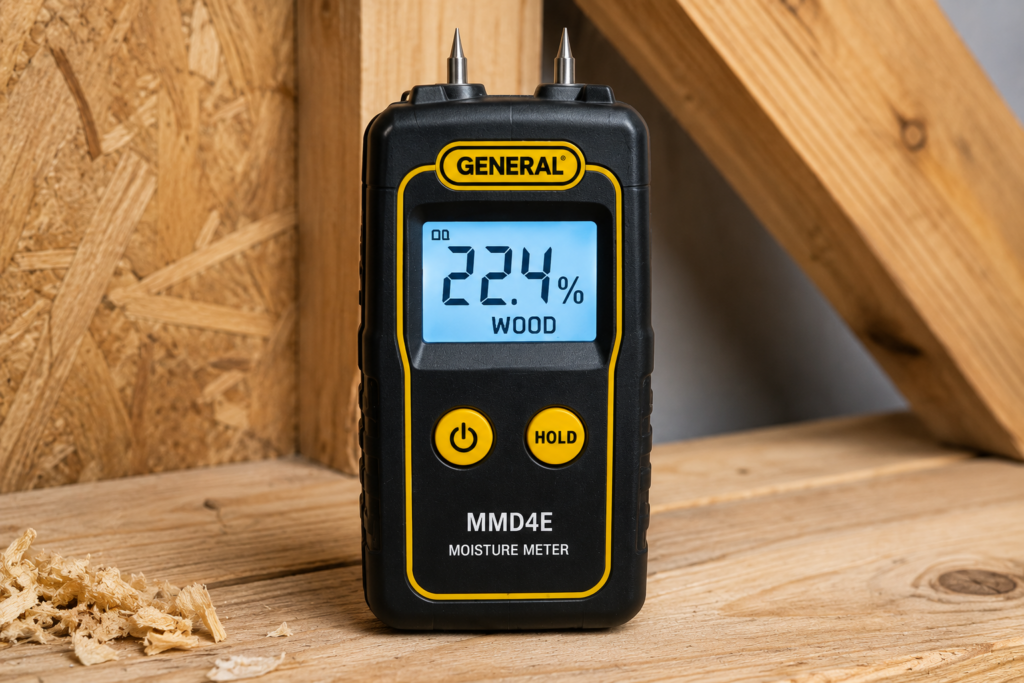
💰 Best Budget Pick: General Tools MMD4E
The MMD4E is a no-frills pin meter that does the basic job well. Two pins, a clear LCD display, and a color-coded LED strip that puts the reading instantly into a low/medium/high zone without requiring you to remember threshold numbers while you’re in a crawlspace with a headlamp on. It won’t correct for wood species, which introduces a small error margin on denser species, but for typical softwood framing checks it reads accurately enough to be useful.
The lack of a backlight is a real limitation in the dark crawlspace environments where you’ll most often need it — keep a headlamp pointed at the display. No case included.
Best for: Homeowners doing occasional checks, first-time rot diagnostics. Pin depth: 5/16″ standard | Range: 6–99% | Backlight: No | Species correction: No
[Check Price on Amazon →]
🎯 Best Value: Tavool Wood Moisture Meter
The Tavool meter stands out in its price range because it includes 14-species correction settings — an important feature for accurate readings in framing lumber, where the difference between Douglas fir and Southern yellow pine at the same moisture content can appear as different readings on a meter without correction. It also has 0.5% resolution, compared to 1% on cheaper meters, which matters when you’re trying to determine whether a board at 18.5% is trending toward the danger threshold or pulling away from it.
Backlit display works well in dark crawlspaces. Build quality is solid for the price, and the carrying case is genuinely useful. At $25–$40, it’s the best value in the guide for a homeowner who wants real accuracy.
Best for: Serious DIYers, renovation contractors who want accuracy without pro pricing. Pin depth: 5/16″ standard | Range: 5–99% | Backlight: Yes | Species correction: Yes (14 species)
[Check Price on Amazon →]
🛡️ Best Lifetime Warranty Pick: Klein Tools ET140
Klein’s ET140 is built to contractor-grade durability standards and carries a lifetime warranty — the only meter on this list that does. It’s a pin-only meter without species correction or backlight, which limits its precision, but the build quality is noticeably better than comparable budget meters. The rubberized housing survives the kind of daily abuse that kills cheaper units, and the Klein brand means replacement support is straightforward if something does go wrong.
For a contractor who uses a moisture meter constantly and wants one they won’t have to replace every two years, this is the pick. For a homeowner doing occasional checks, the Tavool gives more accuracy for less money.
Best for: Contractors prioritizing durability and warranty over features Pin depth: 5/16″ standard | Range: 5–50% | Backlight: No | Species correction: No
[Check Price on Amazon →]
🏆 Best Overall (Editor’s Choice): General Tools MMD7NP
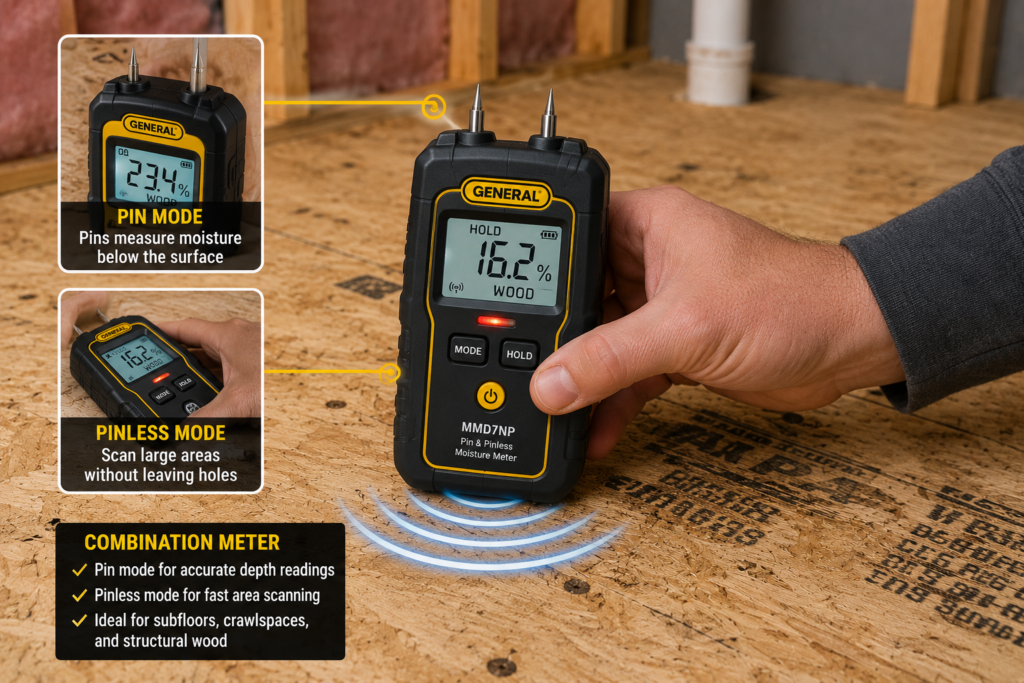
The MMD7NP offers both pin and pinless modes in a single unit, making it the most practical single tool for rot work. Use pinless mode to quickly sweep a subfloor or wall to find wet zones, then switch to pins to confirm the reading and get a depth-specific number on anything that flags. The pinless mode reads to about 3/4 inch depth, which is sufficient for identifying surface and near-surface moisture issues. Pin mode reads to the standard 5/16 inch depth.
Species correction is included for 3 wood groups — not as granular as the Tavool’s 14 species, but adequate for most framing work. Backlit display. This is the meter I’d buy if I could only own one.
Best for: Contractors and advanced DIYers who want scanning speed plus pin accuracy. Pin depth: 5/16″ | Pinless scan depth: ~3/4″ | Range: 5–99% | Backlight: Yes | Species correction: Yes (3 groups)
[Check Price on Amazon →]
🔬 Best Professional Pick: Protimeter Surveymaster
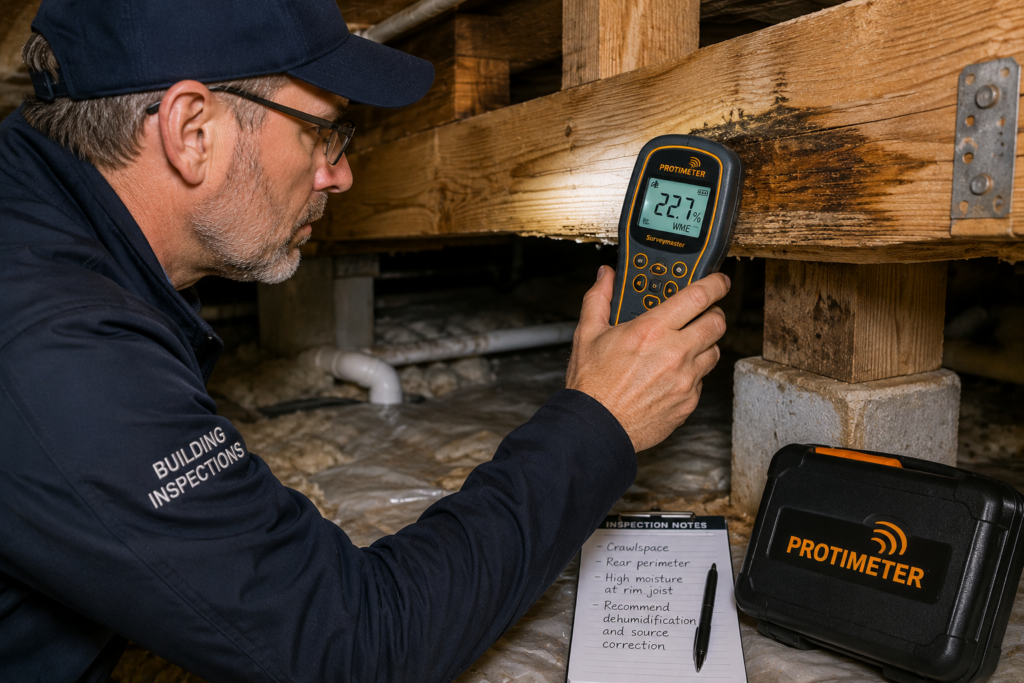
The Surveymaster is the standard tool in professional building surveys and insurance remediation work. It offers pin and pinless modes, deep-wall readings with optional hammer-electrode probes that can penetrate several inches into timber, and a relative humidity mode for assessing conditions in enclosed spaces. The build quality is commercial-grade. Calibration is traceable. The species correction database is comprehensive.
At $180–$250, it’s overkill for a homeowner doing a one-time rot investigation. For a contractor who regularly performs rot assessments, or anyone investigating serious structural rot where getting the reading wrong has real consequences, it’s the right tool. It’s also the meter most often referenced in remediation reports and insurance claims — relevant if you’re documenting a problem for an adjuster. This is the level of tool you’d want when diagnosing the kind of framing damage covered in our guide to reinforcing joists after moisture damage.
Best for: Contractors, remediation professionals, insurance documentation. Pin depth: 5/16″ standard + deep probe option | Range: 6–100% WME | Backlight: Yes | Species correction: Yes (comprehensive) | Warranty: 2 years
Subfloor moisture checking has slightly different priorities than general rot detection. The areas you need to read are large, access is often awkward (on your hands and knees, from below in a crawlspace, or working around finished flooring), and the question you’re usually asking is either “where is the wet spot?” or “is this dry enough to re-install flooring over?”
For subfloor scanning, the best pick is the General Tools MMD7NP. The pinless mode lets you sweep large subfloor areas quickly without leaving hundreds of pin holes in panels that may still be usable. When the pinless scan identifies a wet zone, switch to pins for a precise reading. The combination covers both phases of a subfloor investigation in one tool.
For subfloor work from below in a crawlspace — reading joists and the underside of panels without easy access to the display — the Tavool wins on the backlight and ergonomics. It’s easier to read one-handed in a tight space.
The target reading for subfloor panels before re-installing hardwood, tile, or laminate flooring is 12% or below in most manufacturer specs, and no more than 15% for vinyl or carpet. Our guide on how to get moisture out of a plywood subfloor walks through the drying process step by step — the moisture meter is how you know when the process is actually complete, not just when it feels like enough time has passed.
For bathroom subfloor investigations specifically, where the failure mode is almost always a slow leak rather than bulk water, a combination meter is worth the extra cost. Slow leaks create localized wet zones that spread slowly — a pinless scan catches the pattern faster than random pin readings would.
How to Use a Moisture Meter Correctly
Getting an accurate reading takes more than pressing a meter against wood and reading the number. These are the steps that separate reliable readings from misleading ones.
Set the species correction if your meter has it. Most residential framing is Douglas fir, Southern yellow pine, or spruce-pine-fir. Using the wrong species setting can shift readings by 2–4 percentage points — enough to put a borderline board in the wrong category.
Read bare wood, not coated surfaces. Paint, varnish, and sealants can affect pinless readings, causing pin meters to read the coating rather than the wood beneath it. For finished surfaces, either push pins through the coating into bare wood or use a sharp awl to create a small access point first.
Take multiple readings and look for the pattern. One reading tells you what’s happening at one spot. Three readings across a joist tell you whether moisture is concentrated at one end (likely a point source — a leak or a grade issue) or spread evenly (more likely humidity or condensation). The pattern matters as much as the number. This is particularly important when checking subfloor panels after a leak, where the damage footprint often tells you more about the source than the reading itself, as described in our guide to dealing with wet and warped plywood.
Read at different depths if the meter allows it. Surface moisture from condensation or a recent rain event can look alarming on a shallow reading but be completely normal half an inch deeper. Deep moisture that’s dry on the surface is the more dangerous pattern — it means moisture is trapped inside the wood and hasn’t found a way out.
Let the wood come to room temperature before reading. Cold wood from an unheated crawlspace reads differently than wood that’s been at room temperature. If you’re testing wood that’s been cold, give it 20–30 minutes to equilibrate before relying on the reading.
Document your readings. If you’re tracking a drying situation over days or weeks — after a plumbing leak, after installing a vapor barrier — write down the readings with the date and location. A declining trend from 24% to 18% to 14% over two weeks tells you the fix is working. A flat line at 22% indicates that something is still feeding moisture.
Common Moisture Meter Mistakes
Reading the finish instead of the wood. A painted sill or a varnished floor joist gives unreliable pinless readings. Pins need to penetrate the coating layer to read the actual wood. If you can’t push pins through a finish coat, score through it with a knife first.
Taking one reading and concluding the wood is dry. One dry reading in the center of a joist is not a clean bill of health. Moisture in framing tends to concentrate at joints, ends, and anywhere wood contacts masonry or concrete. Check the corners, ends, and the bottom face of the joists before concluding that a structure is dry.
Not checking beyond the visible damage boundary. When you find visibly soft or discolored wood, the wet zone almost always extends beyond what’s visible. Take readings 6–12 inches beyond the visible damage in every direction. Our wood rot prevention guide makes this point explicitly — the visible rot is the tip of the problem, not the whole picture.
Declaring the repair site dry too soon. The surface of wood dries faster than its core. A board that reads 14% on the face may still be 22% two inches deeper. For any repair that will be sealed or covered, let the wood dry longer than the surface reading suggests.
Ignoring the ambient conditions. A crawlspace at 85% relative humidity will keep even structurally dry wood elevated in moisture content because the wood is in equilibrium with the surrounding air. Fixing the wood without addressing the crawlspace environment will mean the readings creep back up. Vapor barriers, ventilation, and dehumidifiers are part of the solution, not just the repair itself.
When a Moisture Meter Isn’t Enough
A moisture meter tells you the moisture content of the wood it’s reading. It doesn’t tell you whether the wood is structurally compromised, whether rot is still active, or whether the damage extends into areas you can’t reach with the meter.
For structural assessments — determining whether a joist, rim joist, or sill plate needs replacement rather than treatment — the screwdriver test and visual inspection remain essential alongside the meter reading. A joist at 14% moisture that’s already been significantly eaten by rot is dry but still structurally compromised. The meter clears it for repair; your eyes and hands tell you whether the repair is sufficient or replacement is necessary.
For hidden rot inside wall cavities, behind tile, or under shower pans, a pinless meter can detect elevated moisture through surfaces but can’t fully characterize what’s happening behind them. Infrared thermal cameras can identify moisture patterns through walls without opening them, and are a better tool than a moisture meter alone for situations where opening the wall is a significant undertaking.
If you’re dealing with rot in pressure-treated framing, the moisture thresholds are the same — treatment doesn’t change the moisture content that supports fungal growth; it changes the fungus’s ability to consume the wood. Our guide to pressure-treated plywood explains the chemistry, but a reading above 20% in treated framing still warrants investigation.
What to Buy Alongside Your Meter
A moisture meter diagnoses the problem. These are the tools and products that fix it — all natural extensions of the same rot investigation workflow and stronger affiliate opportunities than the meter itself.
Abatron LiquidWood + WoodEpox (Epoxy Repair Kit). Once the meter confirms the wood is dry enough, this is the repair material. LiquidWood consolidant soaks into soft fibers and hardens them; WoodEpox fills the void with structural epoxy that won’t shrink. The standard repair sequence after any rot diagnosis. [Check Price on Amazon →]
Bora-Care Borate Wood Preservative: Applied to bare wood after drying and before filling, borate treatment kills remaining fungal spores at the source. Works on wood that still tests slightly elevated — the borate penetrates and neutralizes rather than waiting for the wood to reach a perfectly dry reading. [Check Price on Amazon →]
Santa Fe Compact 70 Crawlspace Dehumidifier (or equivalent): If your meter readings stay elevated despite fixing the visible moisture source, the problem is often ambient crawlspace humidity rather than a direct water leak. A crawlspace-rated dehumidifier running continuously is often what finally moves the needle on persistent elevated readings in framing. Look for a unit rated for crawlspace use specifically — standard room dehumidifiers are not built for the low clearance, temperature range, or continuous-drain requirements of a crawlspace environment. [Check Price on Amazon →]
Flex Seal Liquid Rubber (Supplemental Moisture Control for Small Problem Areas) Not a substitute for a proper crawlspace vapor barrier — professionals will rightly point out that a full ground cover vapor barrier is always the correct long-term solution. For small problem areas, such as a damp rim joist bay or a localized concrete wall section, a rubberized coating applied as a supplemental measure can reduce moisture wicking while a more complete solution is planned. [Check Price on Amazon →]
DeWalt Headlamp (DWHT70440): This sounds minor, but it’s genuinely useful: crawlspace moisture-meter work requires both hands to be free and a bright, adjustable light source. A dedicated headlamp is the difference between a quick crawlspace check and a frustrating one. [Check Price on Amazon →]
FAQ
What moisture level indicates wood rot? Wood rot fungi begin establishing when moisture content reaches approximately 19–20%. Below that threshold, wood may be damp but won’t support active decay. Readings above 25% indicate moisture levels at which rot is likely to be actively progressing if conditions have been sustained. The target for any wood that will be sealed or covered in a repair is below 15%, and ideally below 12%.
Can a moisture meter detect rot? A moisture meter detects moisture content, not rot directly. However, since rot requires sustained elevated moisture to grow, a consistently high reading in the rot range (above 19–20%) is strong evidence of active or recent rot conditions. The screwdriver test and visual inspection are still needed to assess whether wood fibers are actually compromised.
What is a good moisture reading for wood before painting or sealing? Most paint and sealant manufacturers specify a maximum moisture content of 15% before application. For epoxy wood fillers used in rot repairs, 15% or below is the standard threshold, and lower is better — some structural epoxy systems specify 12% or below for full bond strength.
Are cheap moisture meters accurate enough for rot detection? For softwood framing lumber, a budget pin meter ($15–$30) is accurate enough to identify whether wood is in a safe range, a borderline range, or clearly elevated. The main limitation is the lack of species-correction settings, which introduces a 1–3% error margin. For most rot diagnostic work, that margin is acceptable.
How do I know if my moisture meter is reading correctly? Compare it against a known-dry piece of kiln-dried lumber from a hardware store — it should read 6–10% if the meter is working correctly. If it reads significantly outside that range on fresh KD lumber, the meter needs recalibration or replacement.
What is the best moisture meter for subfloor checking? The General Tools MMD7NP combination meter is the best single tool for subfloor work — pinless mode for fast area scanning, pin mode for confirming specific readings. For crawlspace work from below where display visibility is limited, the Tavool’s backlit display and ergonomics give it an edge.
For publishing — Schema (JSON-LD):
<script type="application/ld+json">
[
  {
    "@context": "https://schema.org",
    "@type": "Article",
    "headline": "Best Moisture Meter for Wood Rot: What Actually Works and What to Look For",
    "description": "Best moisture meter for wood rot: pin vs. pinless explained, full specs comparison, top picks at every price, and how to use one so the reading is actually accurate.",
    "author": {
      "@type": "Person",
      "name": "Admin"
    },
    "publisher": {
      "@type": "Organization",
      "name": "ThePlywood.com"
    },
    "mainEntityOfPage": "https://theplywood.com/best-moisture-meter-wood-rot/",
    "datePublished": "2026-07-01",
    "dateModified": "2026-07-01"
  },
  {
    "@context": "https://schema.org",
    "@type": "BreadcrumbList",
    "itemListElement": [
      {
        "@type": "ListItem",
        "position": 1,
        "name": "Home",
        "item": "https://theplywood.com/"
      },
      {
        "@type": "ListItem",
        "position": 2,
        "name": "Tools",
        "item": "https://theplywood.com/category/tools/"
      },
      {
        "@type": "ListItem",
        "position": 3,
        "name": "Best Moisture Meter for Wood Rot",
        "item": "https://theplywood.com/best-moisture-meter-wood-rot/"
      }
    ]
  },
  {
    "@context": "https://schema.org",
    "@type": "FAQPage",
    "mainEntity": [
      {
        "@type": "Question",
        "name": "What moisture level indicates wood rot?",
        "acceptedAnswer": {
          "@type": "Answer",
          "text": "Wood rot fungi begin establishing when moisture content reaches approximately 19 to 20 percent. Below that threshold, wood may be damp but will not support active decay. Readings above 25 percent indicate moisture levels where rot is likely actively progressing. The target for any wood that will be sealed or covered in a repair is below 15 percent, and ideally below 12 percent."
        }
      },
      {
        "@type": "Question",
        "name": "Can a moisture meter detect rot?",
        "acceptedAnswer": {
          "@type": "Answer",
          "text": "A moisture meter detects moisture content, not rot directly. However, since rot requires sustained elevated moisture to grow, a consistently high reading above 19 to 20 percent is strong evidence of active or recent rot conditions. The screwdriver test and visual inspection are still needed to assess whether wood fibers are actually compromised."
        }
      },
      {
        "@type": "Question",
        "name": "What is a good moisture reading for wood before painting or sealing?",
        "acceptedAnswer": {
          "@type": "Answer",
          "text": "Most paint and sealant manufacturers specify a maximum moisture content of 15 percent before application. For epoxy wood fillers used in rot repairs, 15 percent or below is the standard threshold, and lower is better — some structural epoxy systems specify 12 percent or below for full bond strength."
        }
      },
      {
        "@type": "Question",
        "name": "Are cheap moisture meters accurate enough for rot detection?",
        "acceptedAnswer": {
          "@type": "Answer",
          "text": "For softwood framing lumber, a budget pin meter costing $15 to $30 is accurate enough to identify whether wood is in a safe, borderline, or elevated range. The main limitation is the absence of species correction settings, which introduces a 1 to 3 percent error margin. For most rot diagnostic work, that margin is acceptable."
        }
      },
      {
        "@type": "Question",
        "name": "What is the best moisture meter for subfloor checking?",
        "acceptedAnswer": {
          "@type": "Answer",
          "text": "The General Tools MMD7NP combination meter is the best single tool for subfloor work — pinless mode for fast area scanning, pin mode for confirming specific readings. For crawlspace work from below where display visibility is limited, the Tavool's backlit display and ergonomics give it an edge."
        }
      }
    ]
  }
]
</script>
SEO Metadata
Title (pixel-width checked): Best Moisture Meter for Wood Rot: Top Picks and How to Use One Meta Description: Best moisture meter for wood rot: pin vs. pinless, full specs compared, top picks at every price, and how to get a reading that’s actually accurate. URL Slug: /best-moisture-meter-wood-rot/ Categ
Best Plyo Box : Foam vs Wood + Top Picks by Admin April 13, 2026 DIY What Is the Best Plyo Box for Home Gyms? The best plyo box for most home gyms in 2026 is a heavy foam box with…
Best Coping Saw: Reviews, Buying Guide & Top Picks by Admin June 11, 2026 DIY A coping saw is a thin-bladed, C-frame handsaw used to cut tight curves, cope joints, and intricate shapes in wood, trim, and plastic. It's one…