Not all epoxy wood fillers are the same product. The one that works well on a painted window sill is not the one you want on a rotted rim joist. The one that’s easy to sand smooth on trim is not the one rated for load-bearing repairs. Picking the wrong product doesn’t always fail immediately — it fails two or three years later, after you’ve painted over it, when the underlying problem reasserts itself.
This guide covers the best epoxy wood fillers for each specific application, what the specs actually mean, and how to match the product to the repair so the job holds long-term.
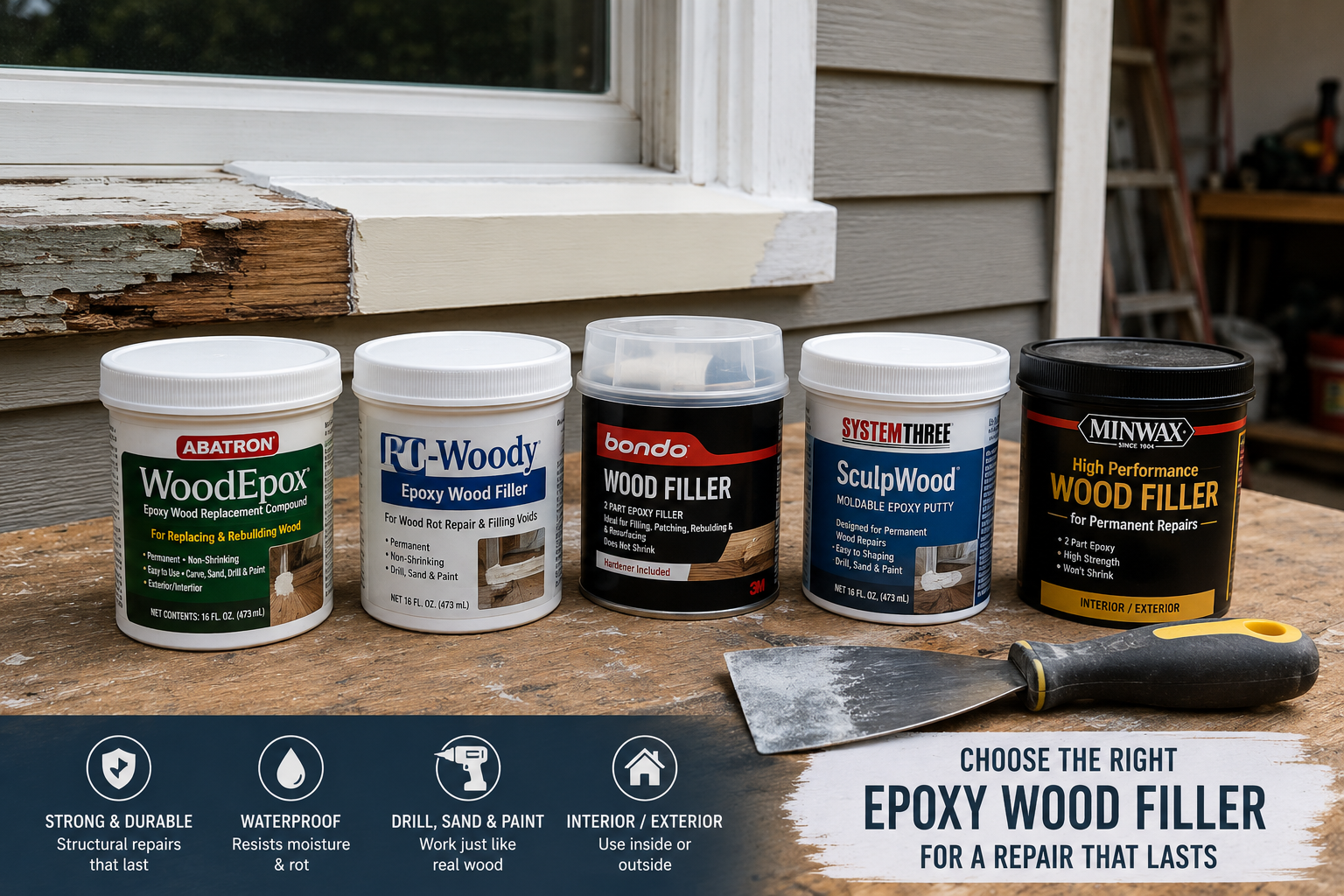
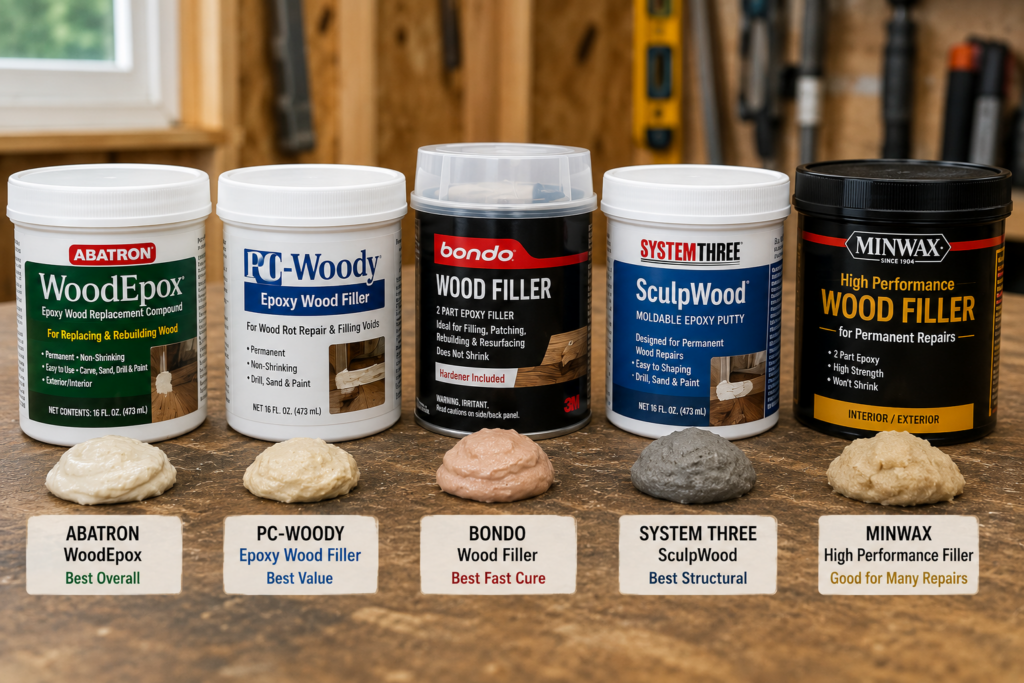
At a Glance: Best Epoxy Wood Filler by Category
Category
Pick
🏆 Best Overall
Abatron WoodEpox
💰 Best Budget
PC-Woody
🔬 Best Structural
System Three SculpWood
⚡ Best Fast Cure
Bondo Wood Filler (non-structural only)
👷 Best for Professionals
System Three SculpWood
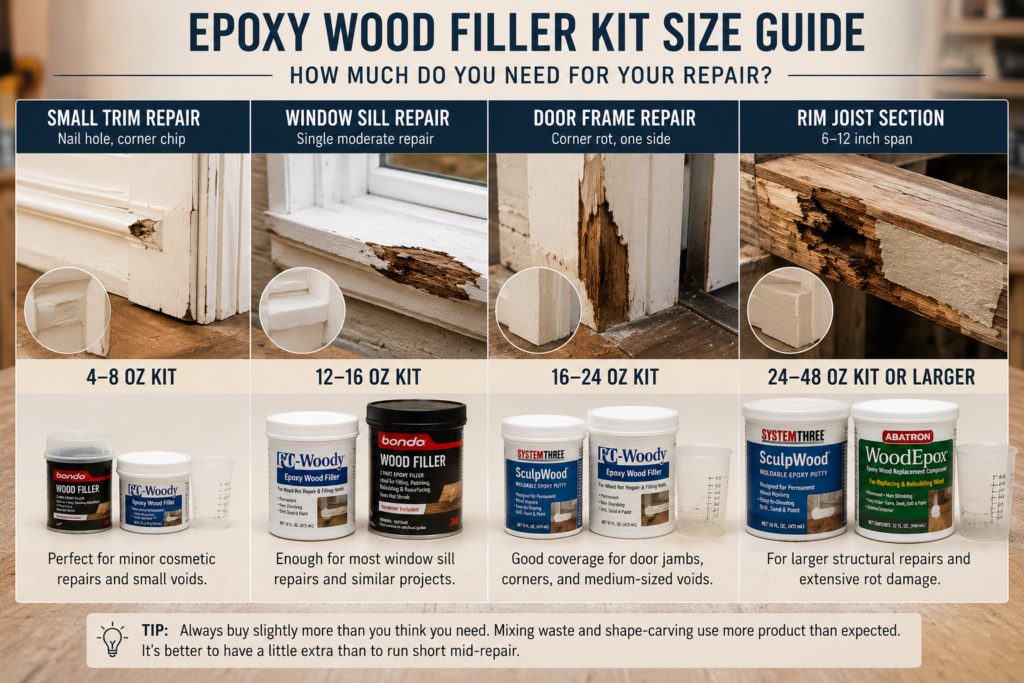
Estimated Product Quantity by Repair Size
Repair
Kit Size Needed
Small trim repair (nail hole, corner chip)
4–8 oz kit
Window sill (single moderate repair)
12–16 oz kit
Door frame (corner rot, one side)
16–24 oz kit
Rim joist section (6–12 inch span)
24–48 oz kit or larger
Epoxy fillers are sold by volume. Always buy slightly more than you estimate — off-cuts and mixing waste add up, and running short mid-repair forces a second mixing that won’t bond as cleanly to a partially cured first pass.
Why Epoxy Filler and Not Regular Wood Filler
Standard wood fillers — the latex or vinyl-based products in most hardware stores — are designed for small interior gaps, nail holes, and cosmetic repairs on dry, stable wood. They shrink slightly as they cure, absorb moisture, don’t bond well to degraded wood, and aren’t rated for outdoor use in any real-world sense. Put them in an exterior rot repair, and you’re buying yourself two or three seasons before the patch falls out.
Epoxy wood filler cures through chemical cross-linking rather than drying. It doesn’t shrink. It doesn’t absorb moisture after curing. It bonds mechanically and chemically to the surrounding wood and, when applied over an epoxy consolidant, to that substrate as well. It can be drilled, screwed, sanded, shaped, and painted like wood. It’s the only filler category that’s actually rated for structural exterior rot repair, which is why it’s the product called out in our wood filler guide for any application that needs to last. Whether the wood is even worth repairing versus replacing is a separate question — our guide on how to stop wood rot and save damaged wood covers the threshold where epoxy repair is a legitimate fix versus where replacement is the only correct answer.
The tradeoff is cost, working time, and mixing. Epoxy fillers require precise two-part mixing, have a limited open time once mixed, and cost significantly more per repair than standard fillers. For a nail hole in an interior door casing, that tradeoff doesn’t make sense. For a rotted sill, joist end, or door frame, it’s the only product worth using.
Types of Epoxy Wood Filler
Two-Part Paste Epoxy (Most Common)
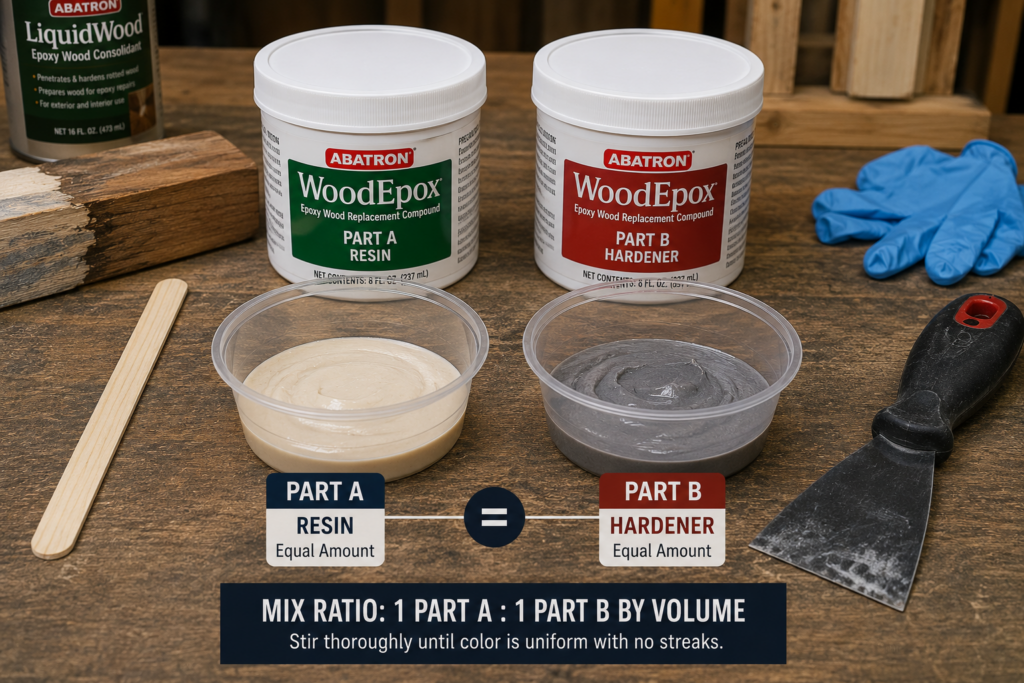
The standard product category. Part A (resin) and Part B (hardener) are mixed in a specified ratio — usually 1:1 by volume — and the resulting paste is applied to the repair area. Cures to a hard, sandable solid. Best for filling voids, rebuilding missing sections of trim or framing, and any repair that requires shaping the material after application. Abatron WoodEpox and PC-Woody are the most widely used products in this category.
Two-Part Liquid Epoxy Consolidant (Not a Filler)
This is what gets applied before the paste filler — it penetrates degraded wood and hardens it. Covered in detail in our wood hardener vs epoxy consolidant guide. Used as a base coat, not to fill voids.
Mortar-Style Epoxy Filler (High-Build)
Thicker consistency than standard paste epoxy, designed for large voids and deep fills. Takes longer to cure, can be applied in thicker single passes without slumping. Good for significant rot damage that a standard paste product would require multiple applications to address. System Three products and some Rot Doctor formulations fall into this category.
Lightweight Epoxy Filler
Some epoxy fillers are formulated with microballoons or lightweight aggregate to reduce density and make sanding easier. Useful on large repairs where full-density epoxy would be difficult to sand back. Less structural than standard formulations — good for trim and cosmetic repairs, not structural framing.
Full Specs Comparison
Product
Type
Mix Ratio
Open Time (70°F)
Sandable In
Structural Rating
Shrinkage
Price Range
Abatron WoodEpox
2-part paste
1:1 volume
30–45 min
4–6 hrs
Yes
None
$45–$60
PC-Woody
2-part paste
1:1 volume
20–30 min
3–5 hrs
Yes
None
$25–$35
Bondo Wood Filler
2-part paste
Base + cream hardener
10–15 min
20–30 min
No
Minimal
$10–$15
System Three SculpWood
2-part paste
1:1 volume
45–60 min
6–8 hrs
Yes
None
$50–$70
Minwax High Performance Filler
2-part paste
Base + hardener
15–20 min
30–45 min
Moderate
Minimal
$18–$28
Rot Doctor Fill-It Epoxy
2-part paste
1:1 volume
35–50 min
5–7 hrs
Yes
None
$45–$65
Open times shorten significantly in warm weather. At 90°F, most products work 30–40% faster than spec.
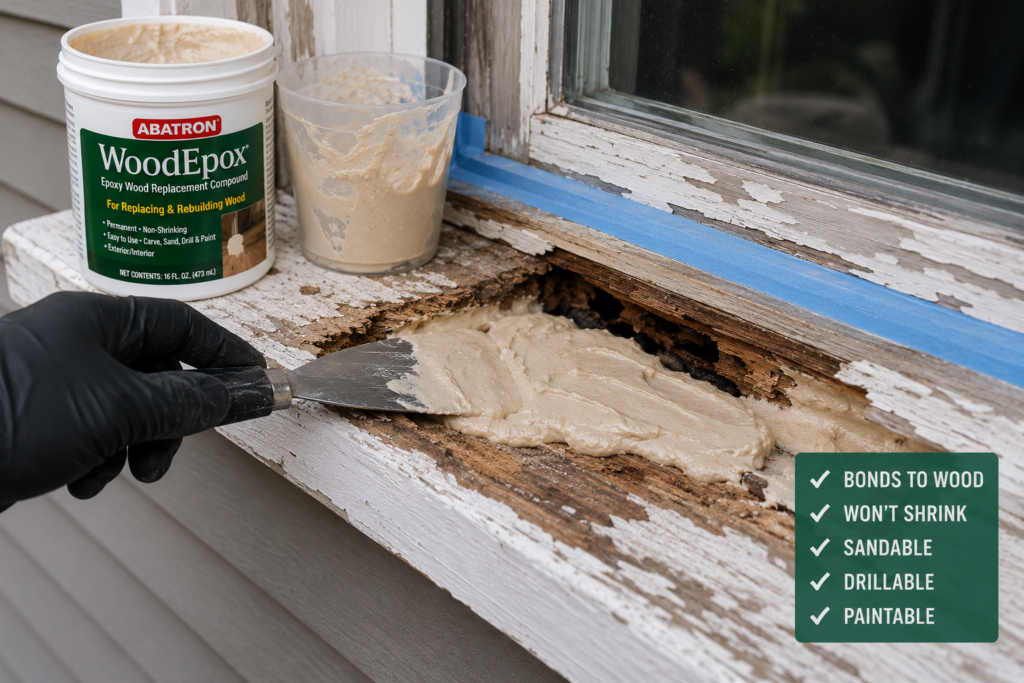
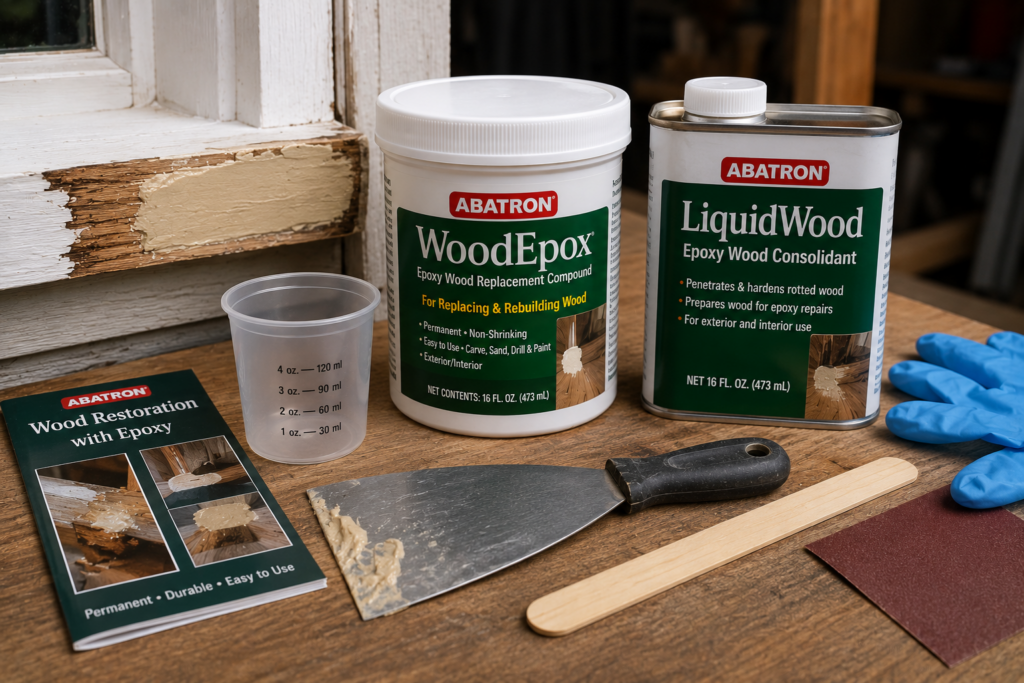
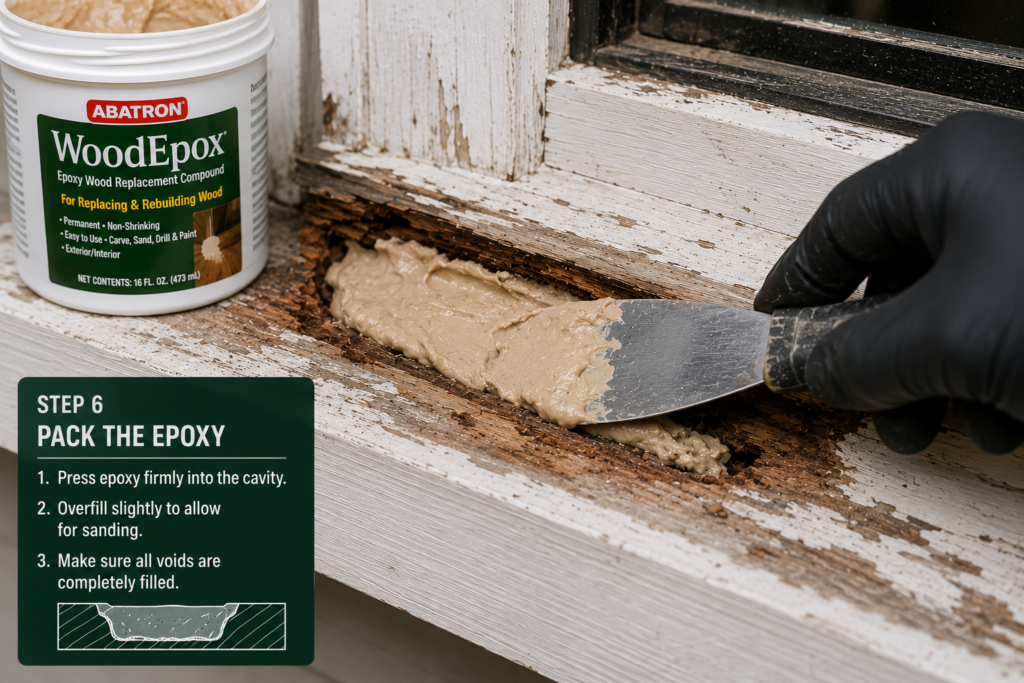
WoodEpox is the industry standard for serious rot repair. It’s designed to be used as a system with Abatron LiquidWood consolidant — the consolidant penetrates and hardens the degraded wood first, and WoodEpox bonds chemically to the consolidant during the tacky window before full cure. The result is a repair that behaves as a single integrated unit rather than a filler sitting on top of a substrate.
It mixes 1:1 by volume, has a comfortable 30–45 minute working time at room temperature, cures hard with zero shrinkage, and can be drilled, sawed, screwed, and sanded after full cure. It accepts paint well. It does not accept stain — this is a paint-only repair product.
The limitation is cost. WoodEpox is one of the more expensive options in the category, and it’s sold in relatively small quantities. For large voids, the cost per repair adds up. For a rim joist repair, a window sill, or a door frame — the kinds of repairs covered in our rotted window sill repair guide and rotted door frame repair guide — it’s the right call.
Best for: Any exterior structural or semi-structural rot repair Price: ~$45–$60 per kit | Mix ratio: 1:1 volume | Open time: 30–45 min | Shrinkage: None | Structural: Yes
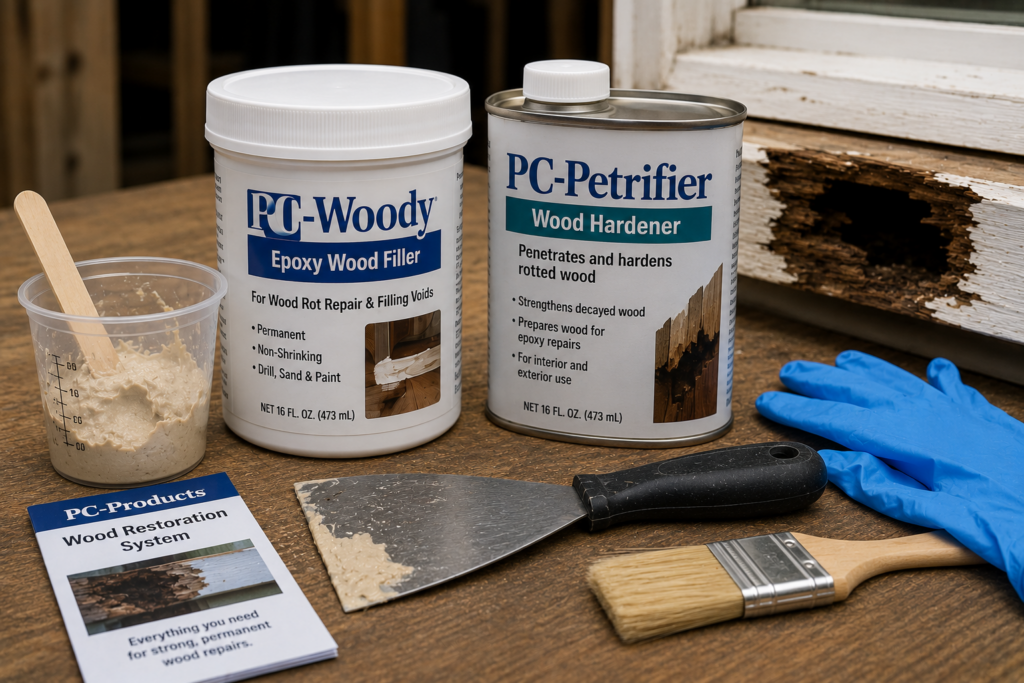
PC-Woody is a two-part epoxy paste that performs close to Abatron WoodEpox at a meaningfully lower price point. It mixes 1:1, cures hard with no shrinkage, and is fully rated for exterior use. The working time is slightly shorter than WoodEpox — 20–30 minutes at 70°F — which is a real constraint for large or complex repairs that require more shaping time.
It’s often used alongside PC-Petrifier consolidant (same manufacturer), which gives it a similar system-repair advantage to the Abatron lineup. For a homeowner doing a single window sill or door frame repair who doesn’t want to spend on the Abatron kit, PC-Woody is the honest recommendation.
Best for: Exterior trim and sill repairs, budget-conscious buyers who still need exterior durability Price: ~$25–$35 per kit | Mix ratio: 1:1 volume | Open time: 20–30 min | Shrinkage: None | Structural: Yes
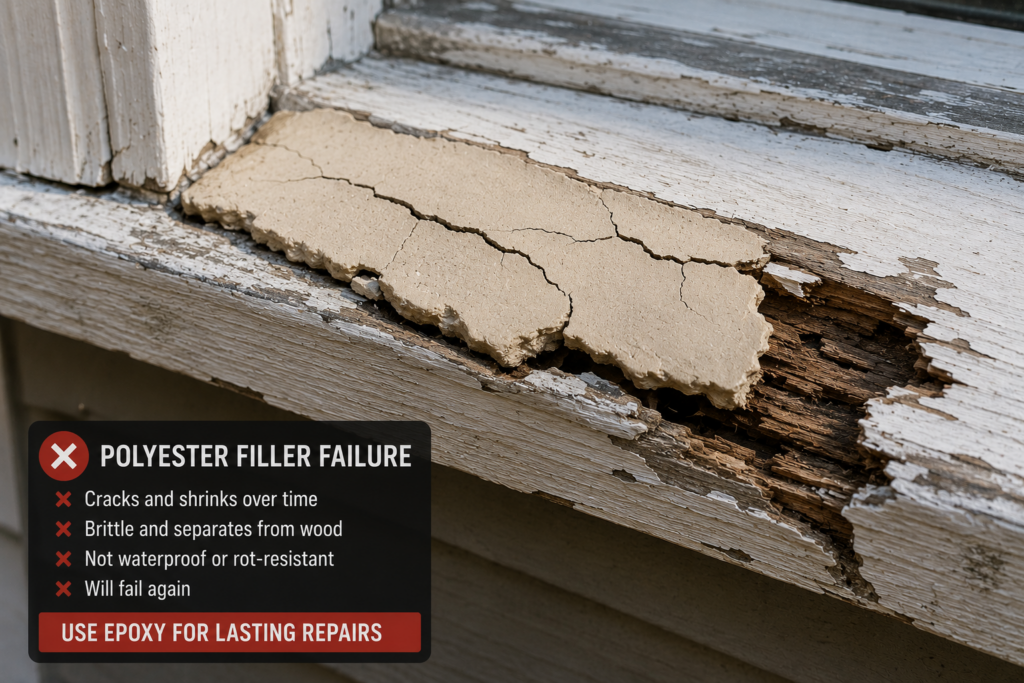
⚠️ Warning: Do Not Use Polyester-Based Fillers for Exterior Rot Repair
Polyester fillers — including Bondo auto body filler and many general-purpose wood fillers — are not suitable for exterior rot repair. They absorb moisture over time, are not rated for sustained outdoor exposure, and exhibit more meaningful shrinkage than two-part epoxy systems. A polyester filler in an exterior rot cavity will look fine for one or two seasons and then fail as moisture cycling breaks the bond between the filler and the surrounding wood.
The only filler category appropriate for exterior rot repair on structural or semi-structural components is two-part epoxy. If you are at a hardware store choosing between a polyester paste and an epoxy paste for a window sill, door frame, or framing component, the polyester product is not a substitute regardless of what the label says.
Bondo’s two-part wood filler is not an epoxy — it’s a polyester-based product — but it frequently appears in epoxy filler searches and comparisons, so it belongs in the guide with an honest assessment. It cures in 15–20 minutes and can be sanded in under 30 minutes, which makes it the fastest option for cosmetic repairs where speed matters more than longevity.
What it is not: a structural or exterior-rated product. Bondo wood filler absorbs moisture over time, is not rated for rot repair, and is not appropriate for any load-bearing component. Use it for interior trim touch-ups, nail holes in dry environments, and cosmetic repairs that will be painted. Don’t use it on exterior sills, joists, or framing.
Best for: Interior cosmetic repairs, fast turnaround on non-structural trim Price: ~$10–$15 | Mix ratio: Base + cream hardener | Open time: 10–15 min | Shrinkage: Minimal | Structural: No
SculpWood is a two-part epoxy paste formulated for large fills and structural repairs. It has the longest open time among the products in this guide — 45–60 minutes at 70°F — which is a real advantage for complex repairs that require extended shaping time. It can be applied in thicker single passes than most paste epoxies without slumping, reducing the number of applications needed for deep voids.
System Three also makes a matching primer and compatible consolidant, giving it a complete system similar to Abatron. The price is comparable to WoodEpox, and the longer working time makes it the preferred choice for professional restorers and anyone dealing with a large, complex repair cavity.
Best for: Large voids, deep rot cavities, complex shaping work, professional restoration Price: ~$50–$70 per kit | Mix ratio: 1:1 volume | Open time: 45–60 min | Shrinkage: None | Structural: Yes
Minwax’s two-part filler is the most accessible structural-rated option available at most hardware stores, which is its main advantage — you can buy it at Home Depot on the way to a job rather than waiting for Amazon delivery. Performance-wise, it’s not quite at the level of Abatron or SculpWood: the open time is shorter, it has slightly more shrinkage than full epoxy systems, and it’s better suited to moderate repairs than heavy structural fills.
For a homeowner who needs a product today, who’s repairing a painted trim piece rather than a structural component, and who wants to buy locally, Minwax is a legitimate choice. For structural framing repairs or any repair where longevity under weather cycling is critical, spend the extra money on WoodEpox.
Best for: Hardware-store availability, non-critical exterior trim repairs Price: ~$18–$28 | Mix ratio: Base + hardener | Open time: 15–20 min | Shrinkage: Minimal | Structural: Moderate
The steps below apply to exterior rot repairs — the most demanding application for these products. Interior cosmetic repairs follow a simplified version of the same sequence.
Remove all soft, degraded wood down to solid material. Leaving soft wood beneath the repair is the most common reason rot repairs fail — the filler bonds to the soft material rather than the solid wood, and the repair separates as the soft material continues to degrade.
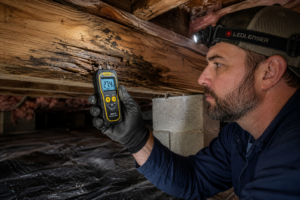
Confirm moisture is below 15% with a moisture meter before applying any product. Neither consolidant nor filler cures correctly in wet wood. Our guide to the best moisture meters for wood rot covers the right tools for this check.
Apply borate preservative and allow it to dry fully. This step kills remaining fungal biology before you seal it in. Skipping it is skipping the actual fix — covered in our wood rot prevention guide.
Apply epoxy consolidant (LiquidWood, PC-Petrifier, or equivalent) and allow it to reach the tacky stage — gelled but not fully cured. The paste filler bonds chemically to the consolidant during this window.
Mix the epoxy filler precisely according to the manufacturer’s ratio. Off-ratio mixing — slightly more of Part A or Part B — is the most common cause of soft spots or incomplete cure. Use a scale for large repairs; use equal-portion dispenser guns for smaller ones.
Pack the filler into the cavity, slightly overfilling. Epoxy doesn’t shrink, so the slight overfill gives you material to sand back without underfilling the repair.
Shape before full cure if you need to match a profile. Epoxy paste can be carved and shaped with tools while it’s still in the green stage — firm enough to hold shape but not yet fully hard. After full cure, you’re sanding and grinding rather than carving.
Sand, prime, and paint. Epoxy is not UV-stable — direct sun exposure degrades uncovered epoxy over time. Prime before the topcoat, and treat the primed surface like any exterior-painted wood.
Common Mistakes
Not applying consolidant first. Epoxy paste applied directly to degraded wood bonds to the soft fibers, not the surrounding solid wood. The repair looks fine for a year and then separates. Consolidant first — always.
Off-ratio mixing. Two-part epoxy systems are chemistry, not cooking. A 1:1 system mixed at 55/45 produces soft spots, incomplete cure, and adhesion failure. Measure or use a dispenser gun.
Applying in cold weather. Most epoxy fillers won’t cure correctly below 50°F. Working in a cold garage or on an unheated exterior in fall or winter without warming the work area results in a soft, never fully cured repair. Heat lamps or enclosures help on cold-weather exterior work.
Leaving unpainted. Epoxy is UV-sensitive. An unprimed, unpainted epoxy repair left exposed to sun will chalk and degrade at the surface. Prime within a few days of application on exterior work.
Using too much at once in hot weather. Epoxy cure is exothermic — mixing a large batch in hot weather can cause it to heat up and kick off in the mixing container before you can apply it. Mix smaller batches in warm conditions and work faster.
Skipping the moisture check. Visible dryness is not a reliable indicator. Wood can appear dry on the surface and still read 20–22% moisture content at depth. A meter reading below 15% is the benchmark — the same one used in our rim joist rot repair guide before any filler or sealer goes on.
What to Use Alongside Epoxy Filler
A complete rot repair system involves more than just the filler. These are the companion products that complete the repair correctly.
Abatron LiquidWood Epoxy Consolidant: The base coat that goes on before WoodEpox. Penetrates degraded fibers, hardens them, and provides the chemical bond surface the filler needs. Buy these together.
Bora-Care Borate Wood Preservative: Applied before the consolidant to kill remaining fungal spores. The step most DIY repairs skip and the reason most DIY repairs eventually need redoing.
General Tools MMD7NP Moisture Meter For confirming the wood is dry enough before any product goes on. A $50 purchase that prevents the most common reason repairs fail — sealing moisture in.
DAP Dynaflex 230 Exterior Caulk: For sealing joints after the filler repair is primed — the perimeter where repaired trim meets adjacent siding, casing, or masonry. Flexible enough to handle seasonal movement.
If you’re replacing a heavily rotted section rather than repairing it, the choice of replacement material matters as much as the filler system. Our guide to rot-resistant wood species covers which species are worth specifying for exposed replacement sections versus standard framing lumber that will need the full protect-treat-seal sequence to last.
When to Replace Instead of Repair
Epoxy filler is a legitimate structural repair — but only up to a point. There are situations where repair is the wrong answer and replacement is the only correct one. Being clear about this threshold is part of giving honest advice, and it’s the kind of guidance that builds trust with readers who are trying to make a real decision.
Replace rather than repair when:
More than 30–40% of the section’s cross-section is gone. Epoxy filler restores surface profile and moderate structural capacity — it doesn’t restore a joist or sill that’s lost half its depth. At that point the math on load capacity doesn’t work regardless of what filler you use.
Active fungal spread has reached adjacent framing. If rot has traveled from the original component into surrounding structure — from a rim joist into floor joists, from a sill into the bottom plate — the repair perimeter keeps expanding. Cut out the damaged section and replace it cleanly rather than chasing it with filler.
The moisture source hasn’t been fixed. A perfectly executed epoxy repair will fail if the wood keeps getting wet. Before committing to a filler repair, confirm the source — flashing, grading, plumbing, condensation — has been addressed. Our wood rot prevention guide covers that assessment in detail.
There’s hidden structural damage you can’t fully assess. If a joist or post feels solid on the accessible faces but you can’t check the interior, treat it as suspect. Epoxy on the outside of a hollow-core rot cavity is cosmetic, not structural.
The repair has already been done once and failed. A rot repair that’s failing for the second time in the same location almost always means the moisture source was never fixed. A second filler repair won’t hold either. Replace the component and fix the source.
For the broader question of when rotted wood can be saved versus when it needs to come out, our article on how to stop wood rot and save damaged wood covers the decision criteria in more depth — including the difference between wet rot and dry rot, which affects both repairability and the urgency of replacement.
Epoxy Filler vs. Other Products: Common Comparisons
Epoxy Wood Filler vs. Wood Hardener
These are not interchangeable products — they do different jobs in sequence. Wood hardener is a penetrating liquid that soaks into degraded wood fibers and stiffens them. Epoxy filler is a paste that rebuilds missing wood volume. In a proper rot repair, the hardener (or epoxy consolidant) goes on first to stabilize the substrate; the filler goes on second to rebuild the shape and surface. Using filler without a consolidant risks bonding to soft, degraded fiber that will continue to fail beneath the surface. Using hardener without filler leaves a stabilized cavity with no material to fill the void. Our full breakdown of wood hardener vs. epoxy consolidant covers the complete sequence and when to use each.
Epoxy Wood Filler vs. Bondo
Bondo’s wood product line is polyester-based, not epoxy. Polyester and epoxy are completely different chemistry. Polyester cures faster and costs less — it’s why Bondo is popular for quick auto body and interior cosmetic repairs. For exterior rot repair, the differences matter: polyester absorbs more moisture over time, shrinks slightly more during cure, and is not rated for structural applications. Epoxy cures to a harder, more moisture-resistant result with zero shrinkage and structural capacity Bondo cannot match. The right answer: Bondo for fast interior cosmetic work, epoxy for anything outdoor or structural.
Epoxy Wood Filler vs. Wood Putty
Wood putty is a finishing product — a flexible, oil-based material designed to fill nail holes and small surface imperfections over finished wood. It stays slightly flexible after cure, doesn’t sand well, and is not designed to bond to bare or degraded wood. It has no place in a rot repair sequence. Our wood filler guide explains the full hierarchy: putty after finishing, filler before finishing, epoxy for structural and exterior repairs. If you’re reading a rot repair guide and wondering whether wood putty will do the job — it won’t.
What is the best epoxy wood filler for rot repair? For exterior structural rot repair, Abatron WoodEpox is the most consistently recommended product, particularly when used with Abatron LiquidWood consolidant as a system. For budget-conscious buyers doing exterior trim repairs, PC-Woody performs well at a lower price. For large voids that require extended working time, System Three SculpWood offers the longest open time of any major brand.
Can epoxy wood filler be used outdoors? Yes — structural-grade two-part epoxy fillers like WoodEpox, PC-Woody, and SculpWood are all rated for exterior use. They must be painted after curing since epoxy is UV-sensitive. Standard latex or vinyl wood fillers should not be used for exterior rot repair regardless of what the label suggests.
Does epoxy wood filler shrink? No. Properly mixed two-part epoxy filler cures through chemical cross-linking with zero shrinkage, which is one of its primary advantages over latex and polyester-based fillers. The slight overfill applied during the repair is sanded back after cure, not a function of shrinkage compensation.
How long does epoxy wood filler last? A correctly applied epoxy repair — dry wood, consolidant base coat, proper mix ratio, paint topcoat — should last 15–20 years or more in exterior applications. The repair material itself doesn’t degrade in normal conditions; failures are almost always the result of skipped prep steps, moisture sealed in, or a repair left unpainted.
Can you screw or nail into cured epoxy wood filler? Yes. Cured epoxy filler accepts screws and nails and holds them well, though not quite as strongly as solid wood. For repairs in which fasteners must be placed into the filled area, pilot holes are recommended to prevent splitting.
Is epoxy wood filler paintable and stainable? Paintable, yes. Stainable, no. Epoxy filler doesn’t absorb stain the way wood does — the repaired area will show as a different shade regardless of stain applied. Any repair area that will be stained rather than painted needs to be addressed with a matched patch or splice, not filler.
Best Plyo Box : Foam vs Wood + Top Picks by Admin April 13, 2026 DIY What Is the Best Plyo Box for Home Gyms? The best plyo box for most home gyms in 2026 is a heavy foam box with…
Best Coping Saw: Reviews, Buying Guide & Top Picks by Admin June 11, 2026 DIY A coping saw is a thin-bladed, C-frame handsaw used to cut tight curves, cope joints, and intricate shapes in wood, trim, and plastic. It's one…