Choosing the right material for a deck determines how long the structure will last, how much maintenance it will require, and how safe it will be for your family. While traditional pressure-treated lumber, natural cedar, and modern composites dominate backyard construction, many DIYers and budget-conscious homeowners wonder if they can utilize a more affordable, readily available option: Can you use plywood for a deck project?
The short answer is yes, but only under very specific conditions. Plywood is an excellent engineering material, but it is fundamentally unsuited to serve as the bare, exposed walking surface of a standard backyard deck.
Below is the definitive, comprehensive guide to using plywood in deck construction, featuring construction insights, cost breakdowns, building code requirements, and structural best practices to ensure your project stands the test of time.
Quick Answer: Can You Use Plywood for a Deck?
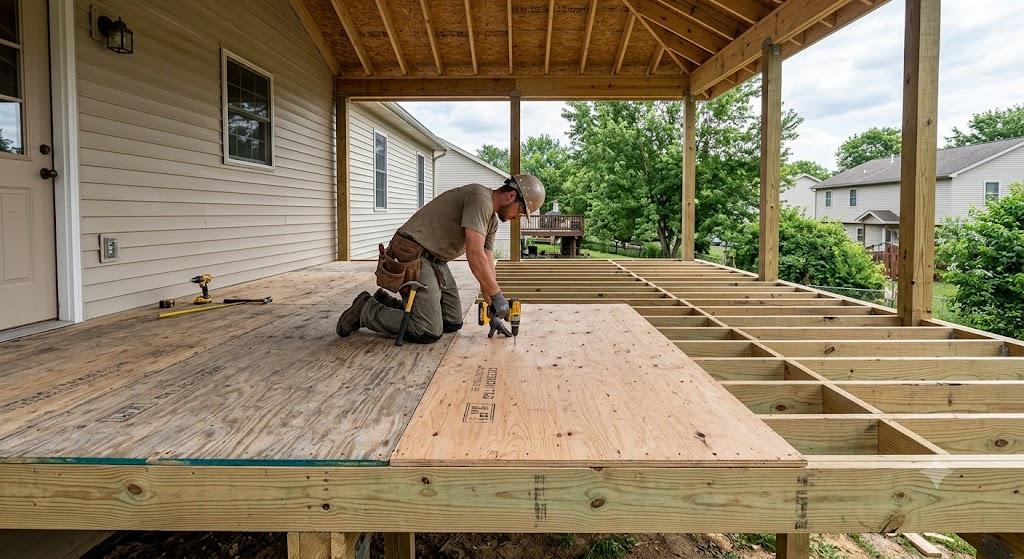
The Short Answer: Yes, but only as a subfloor. Plywood works exceptionally well for covered porches, waterproof rooftop decks, and balcony systems that will be sealed with a professional-grade waterproof membrane. It should never be used as the exposed, bare walking surface on a traditional outdoor deck. Unprotected exposure to rain, snow, and UV rays causes rapid rot, delamination, warping, and catastrophic structural failure.
Featured Snippet Summary
Can you use plywood for a deck? Yes, but only as a structural subfloor beneath a waterproof membrane. Plywood should not be used as the exposed walking surface of a traditional outdoor deck because moisture causes rot, delamination, and structural failure.
Best Plywood Options for Deck Projects
To maximize your budget and optimize material performance, choose a structural panel tailored directly to your assembly type. This matrix features top choices alongside reliable waterproofing solutions:
Chemical saturation wards off active rot and termites
3/4-inch
Best Waterproofing
Fiberglass Deck Coating System
Seals structural wood under a seamless walking skin
N/A (Liquid/Mesh)
When Is Plywood Acceptable for a Deck?
Definition: Plywood is acceptable for a deck when it functions strictly as a structural subfloor beneath a certified waterproof membrane in a covered porch, rooftop deck, balcony, or sunroom. It must never be used as the exposed walking surface of an open-air deck because water infiltration causes rapid ply separation, fungal decay, and localized collapse.
Plywood vs. Traditional Decking Materials
When evaluating materials for your deck project, it helps to see how various grades of exterior plywood compare with traditional open-air decking options in terms of cost, durability, and application.
Material
Cost
Lifespan
Good for Open Decks?
Best Used For
CDX Plywood
Low ($30–$50 per sheet)
5–10 years (Unprotected)
No
Interior subfloors or temporary covered structures.
Marine Plywood
Very High ($90–$150+ per sheet)
20+ years (If sealed)
Only with waterproofing
High-moisture subfloors, boats, and coastal balconies.
PT Plywood
Moderate ($45–$70 per sheet)
15–20 years
No
Exterior subfloors vulnerable to moisture from below.
Premium, naturally rot-resistant traditional decks.
Composite Decking
Highest ($5–$12+ per linear foot)
25–50 years
Yes
Low-maintenance, long-term open-air living spaces.
The Reality of Plywood Outdoors
Standard plywood panels are manufactured by gluing thin layers of wood veneer (plies) together under high heat and pressure, alternating the grain direction of each layer for stability. While this cross-graining technique makes plywood incredibly strong as a structural option, it leaves the edges highly vulnerable to moisture infiltration. For a deep dive into how various panels are manufactured, review our complete breakdown on Plywood Types Explained.
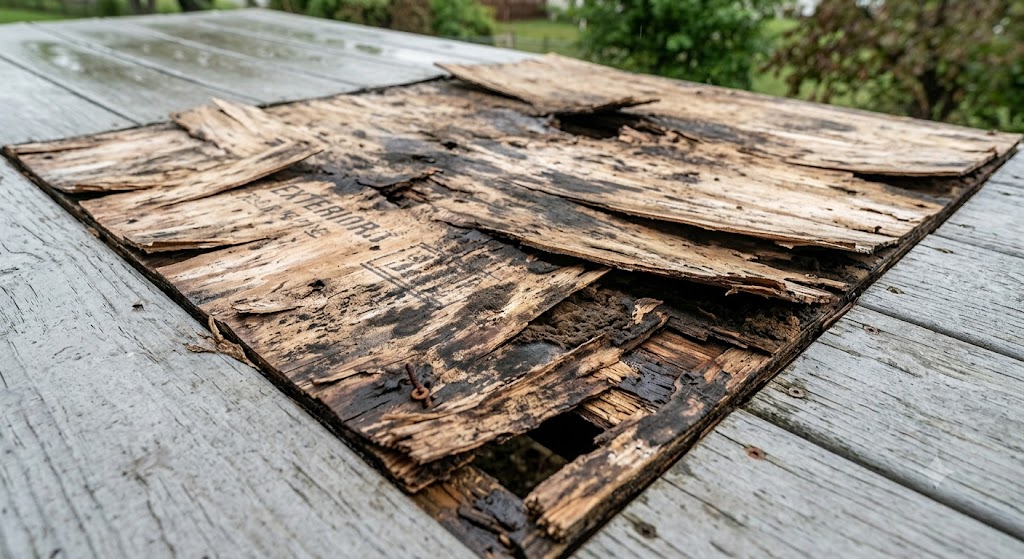
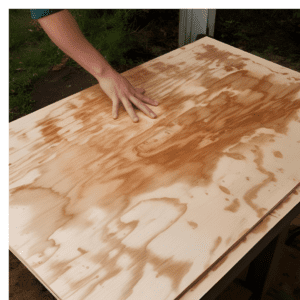
When raw plywood panels are exposed to outdoor elements, water seeps between the veneer layers. This softens the glue, causing delamination—a process where the layers split apart. Furthermore, because a solid sheet creates a continuous floor, rainwater cannot drain away naturally as it does through the gaps of a standard board deck. Instead, water pools on the surface, accelerating fungal growth, wood rot, and structural sagging.
If your project requires a traditional “slat-style” deck where rainwater can fall through the cracks, do not use plywood. In many climates, exposed plywood can begin showing significant deterioration within a few years, creating a severe safety hazard. Structural panels are strictly a subfloor material meant to be sealed off from atmospheric exposure.
Best Types of Plywood for Deck Projects
If your deck design features a completely covered roof, an enclosed sunroom, or a solid footprint utilizing an exterior walking membrane, you must select the correct grade of exterior plywood.
Marine-Grade Plywood
Marine-grade sheets are the gold standard for outdoor subfloors. They are built using premium Douglas Fir or Western Larch veneers. Unlike standard panels, the core layers are entirely free of voids (internal holes or gaps), meaning water cannot be trapped inside the sheet. It is bound using high-performance, fully waterproof structural adhesive.
Best For: Luxury rooftop decks, lakeside balconies, and high-end waterproof walkable surfaces. Read our full Marine Plywood Guide.
CDX Plywood (Exterior Grade)
The “C-D” grade means one side is rougher (D-grade) while the other is slightly smoother (C-grade). The “X” stands for exposure, meaning the sheet uses an exterior glue that withstands temporary moisture during construction. It is not designed to be permanently exposed to weather.
Best For: Highly budget-conscious projects where the plywood serves as a subfloor completely isolated from moisture by a thick, heavy-duty vinyl top layer. Get more insights from our Exterior Plywood Guide.
Pressure-Treated (PT) Plywood
PT sheets are infused with chemical preservatives (like copper azole) under immense pressure to ward off fungal decay, termites, and wood-boring insects. While highly durable, PT plywood retains a lot of chemical moisture from the factory, causing it to warp, shrink, and cup significantly as it dries in the sun.
Best For: Roofed porch decks where the underside of the framing is exposed to damp ground or high humidity. Learn more about Pressure-Treated Plywood care and maintenance.
Marine Plywood vs. Pressure-Treated Plywood
Homeowners often confuse these two premium options. While both handle tough environments, they do so through different engineering methods:
Treatment vs. Construction: Pressure-treated sheets rely on chemical saturation to stop rot, but they contain internal voids and knots that can hold water. Marine panels rely on flawless structural construction—zero internal voids and premium wood selection—combined with waterproof resins to prevent moisture from compromising the core.
Surface Quality: PT panels are notoriously rough, oily, and prone to splintering. They can warp violently as they dry out. Marine sheets are smooth, stable, and retain their flat shape, making them the superior option for laying down fine finishes, tiles, or thin membranes.
Adhesive Compatibility: The chemical salts inside PT wood can interfere with specific adhesives, glues, and liquid membranes. Marine wood accepts glue, epoxy, and fiberglass resin perfectly.
How Much Does Plywood Cost for a Deck?
Estimating the cost of a plywood deck project requires factoring in sheet counts, waste margins, and the specific wood grade. Plywood is sold in 4×8-foot sheets (32 sq ft per sheet).
Standard 3/4-inch CDX Plywood: Expect to pay $35 to $55 per sheet, depending on your local lumber market. For a standard 16×20-foot deck (320 sq ft), you will need roughly 10 to 11 sheets, totaling $350 to $600 in subfloor material.
3/4-inch Pressure-Treated Plywood: Typically ranges from $50 to $75 per sheet, bringing the cost of a 320 sq ft deck subfloor to $500 to $825.
3/4-inch Marine-Grade Plywood: This premium material commands anywhere from $95 to $160+ per sheet. Outfitting a 320 sq ft deck with marine panels will run $950 to $1,760 just for the wood layers.
Keep in mind that these prices represent the raw subfloor alone. To complete a plywood deck, you must factor in the cost of fasteners, flashing, joist tape, and the mandatory waterproof top membrane system. For updated seasonal market figures on structural panels, check out our comprehensive overview of Plywood Prices.
Deck Building Code Considerations
When incorporating structural panels into an exterior deck footprint, construction assemblies must abide by the standards enforced by the International Code Council (ICC) and local residential building codes (IRC) to ensure safety and structural compliance:
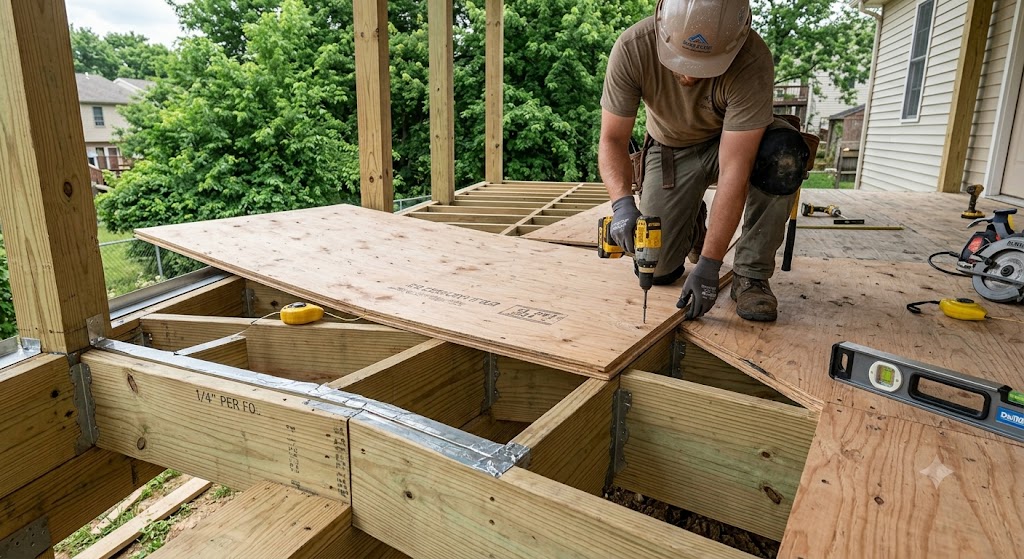
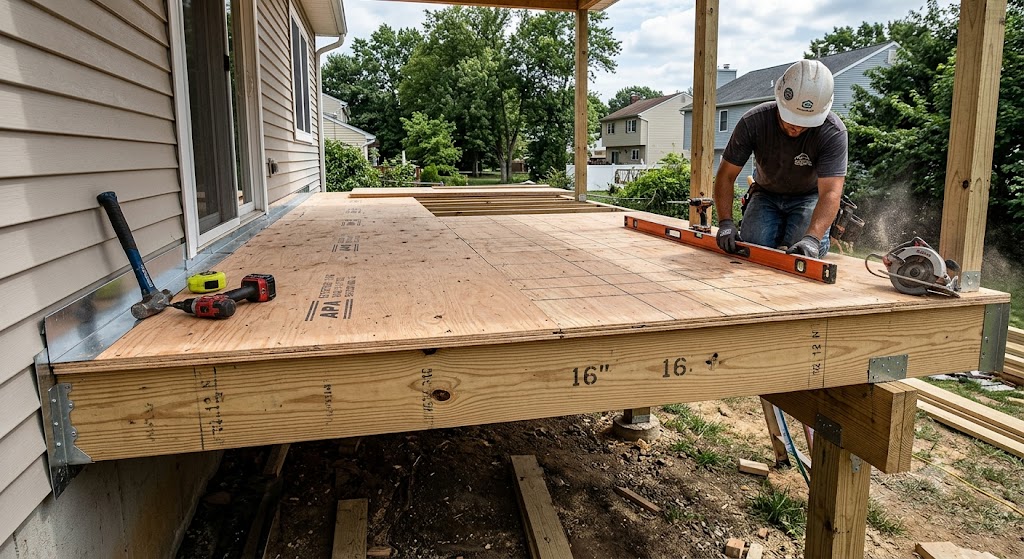
Minimum 3/4-Inch Thickness: Standard subfloor codes require a minimum thickness of 3/4-inch tongue-and-groove (T&G) exterior plywood, with joists spaced 16 inches on-center. Square-edge boards fail to meet load-transfer codes at panel margins unless continuously blocked from below.
Deck Slope Requirements: Unlike interior floors, solid-surface exterior decks require a minimum structural slope of 1/4 inch of drop for every linear foot of deck run (1:48 pitch) directed away from the residential foundation wall to mitigate standing water hazards.
Corrosion-Resistant Fasteners: The code mandates the use of hot-dip galvanized or stainless-steel fasteners. Standard drywall or interior construction screws are strictly prohibited due to the risk of shear failure and immediate chemical breakdown when paired with treated framing lumber.
Proper Flashing Assemblies: Continuous L-flashing and Z-flashing must be integrated at the house ledger line and outer rims to permanently prevent capillary water migration into structural panels.
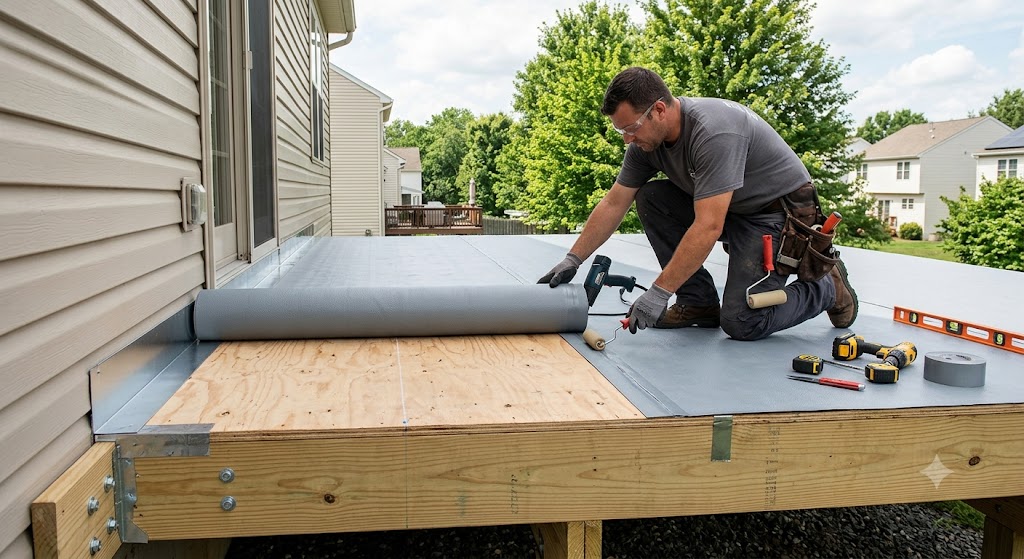
Manufacturer-Approved Membrane Systems: To qualify as an exterior pedestrian deck surface, the panel subfloor must be wrapped in a code-approved, walkable waterproof membrane system that carries an ICC-ES evaluation report.
Crucial Rules for Installing a Plywood Deck Subfloor
If your deck footprint requires a solid plywood subfloor system, you must follow strict construction protocols to prevent future structural failure.
Rule 1: Apply a Reliable Waterproof Membrane
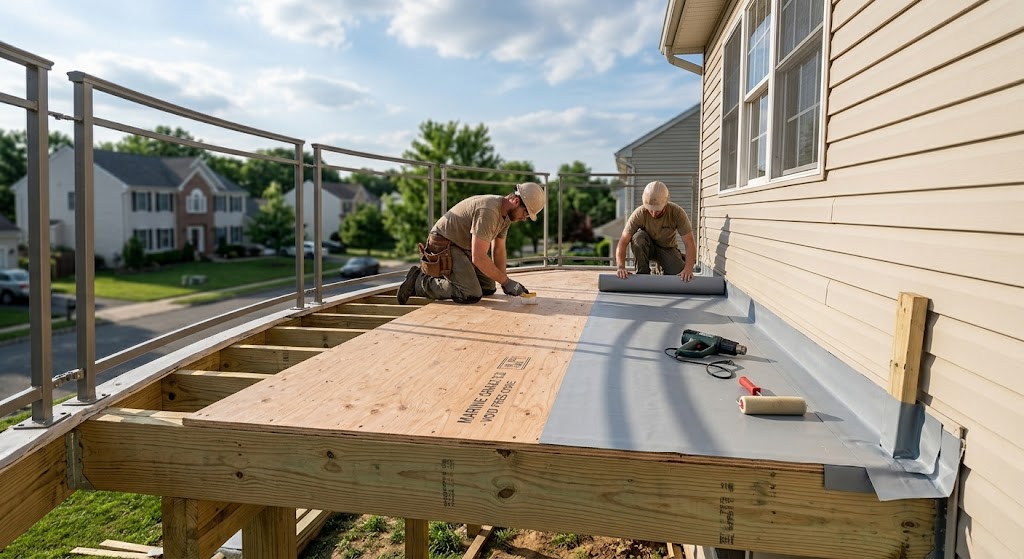
You cannot leave the panels raw, and you cannot rely on paint. The wood must be completely encapsulated by a walkable, commercial-grade waterproof barrier. Popular solutions include thick vinyl sheet systems (such as Duradek), multilayer fiberglass coatings, or liquid-applied elastomeric waterproofing systems designed specifically for foot traffic. For an evaluation of options, see our guide to Waterproof Plywood Types.
Rule 2: Ensure Proper Sloping
Traditional board decks allow rain to fall straight through the joists. Because a plywood deck acts as a solid floor, you must slope the entire joist framework away from your house. Build the structure with a minimum slope of 1/4 inch of drop for every linear foot of deck run (1:48 pitch). This forces rainwater to shed off the outer edge rather than pooling in place.
Rule 3: Use 3/4-Inch Tongue-and-Groove Sheets
Never use thin 1/2-inch or standard square-edge sheets. To prevent your floor from bouncing, sagging, or shifting under heavy foot traffic, always use a minimum thickness of 3/4-inch tongue-and-groove (T&G) exterior plywood. The interlocking T&G edges distribute weight seamlessly across adjacent sheets, preventing individual edges from flexing and tearing your waterproof membrane.
Rule 4: Protect Joists with Flashing Tape
Before laying your panels down, apply high-quality butyl joist flashing tape along the top of all framing lumber. This seals around the fasteners and prevents water from traveling down into the structural joists if moisture ever bypasses the top membrane.
Can You Paint or Seal Plywood Instead of Using a Membrane?
It is incredibly tempting to buy standard sheets, screw them down, and coat them with high-quality exterior deck paint or concrete sealer to save money. Do not do this.
Exterior paint, solid stains, and clear wood sealers are designed to breathe; they form a microscopically thin film over the wood surface. Over the course of a single season, foot traffic, patio furniture, and solar expansion will scratch, crack, and wear down this thin barrier.
Once water gets beneath a painted layer on a horizontal plywood surface, it gets trapped. The sun bakes the wet wood, creating bubbles in the paint, causing it to peel, and accelerating wood rot from the inside out. For long-term durability metrics, discover How to Seal Plywood effectively using industrial-grade membranes. Painting or staining raw sheets on an open structure will result in a rotted, structurally compromised floor in short order. A dedicated, commercial-grade waterproof membrane is non-negotiable.
Common Mistakes When Using Plywood Outdoors
Avoiding these critical installation errors will save you thousands of dollars in premature teardown and reconstruction costs:
Using Interior Structural Adhesives: Accidentally purchasing interior-rated panels (like standard underlayment) guarantees catastrophic failure. The interior glues dissolve rapidly when exposed to atmospheric humidity.
Jamming Sheets Tightly Together: Plywood expands and contracts as humidity changes. Always leave a 1/8-inch gap at all panel edges and end joints to allow for natural movement unless installing specific tongue-and-groove profiles designed with built-in expansion spacing.
Using Inferior Fasteners: Standard drywall screws or interior construction nails rust out immediately when exposed to exterior moisture or the corrosive chemicals found in pressure-treated lumber. Always use hot-dip galvanized or premium stainless-steel deck screws.
Neglecting Under-Deck Ventilation: If your subfloor sits close to the ground, moisture evaporating from the soil beneath the structure can rot the wood from the underside. Ensure adequate cross-ventilation underneath the framing structure.
Case Study: Covered Porch Renovations
During a covered porch renovation project, I observed the stark consequences of using the wrong structural panels in an outdoor climate. The previous installer had attempted to save money by utilizing standard 1/2-inch CDX plywood sheets as the primary subfloor, covered only by indoor/outdoor carpet. Because the carpet absorbed moisture like a sponge and lacked a true drainage mechanism, water remained permanently trapped against the wood. Within three years, the floor suffered from deep rot and unsafe deflection.
To correct this error, the framing had to be reconstructed to integrate a distinct 1/4-inch-per-foot drainage slope away from the home’s foundation. We then applied thick butyl joist tape and laid down robust 3/4-inch tongue-and-groove marine plywood.
Instead of reapplying the carpet, the marine panels were completely sealed with an industrial multi-layer fiberglass coating system topped with a UV-resistant gel coat. This created a completely seamless, shielded barrier. Over a decade later, the porch subfloor remains as structurally rigid and level as the day it was fastened down, demonstrating that plywood can succeed in the long term only when paired with appropriate sloping and an absolute waterproofing strategy.
Better Alternatives for Traditional Open-Air Decks
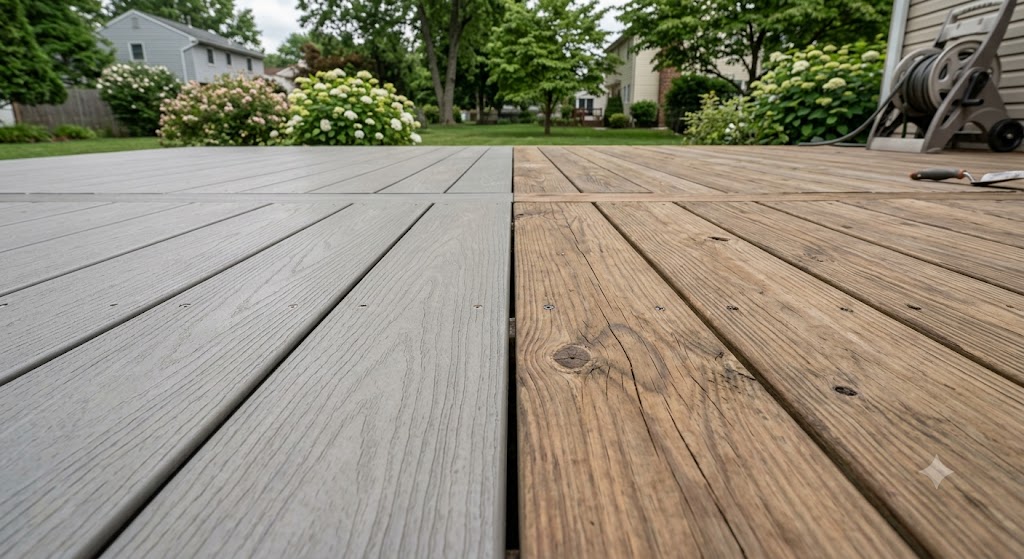
If you are building an uncovered, traditional backyard deck for grilling, hosting, and lounging in the open air, skip the exterior plywood entirely. Instead, look to materials engineered to handle direct weather contact:
Pressure-Treated Wood Lumber
The most common and economical solution for open decks. Standard 5/4×6-inch pressure-treated pine decking allows water to drain naturally through the gaps between boards. It resists insects and rot effectively but requires annual washing and sealing to minimize splitting and cracking.
Natural Cedar or Redwood
Cedar provides a gorgeous, classic look with excellent natural resistance to rot and insect damage without harsh chemical treatments. It is more stable than pressure-treated pine, meaning it warps and splits less, but it requires regular staining to maintain its natural hue.
Composite Decking
For a true “set-it-and-forget-it” deck, composite boards are the modern standard. Made from a blend of recycled plastics and wood fibers, composite decking will never rot, warp, crack, or splinter. It requires no sanding, staining, or painting—simply spray it down with a hose occasionally to keep it looking pristine.
Performance Breakdown: Deck Alternatives
Feature
Plywood Subfloor + Membrane
Pressure-Treated Deck Boards
Composite Decking
Waterproof Surface
Yes
No
Moderate
Maintenance Level
High (Inspections/Recoating)
Moderate (Staining/Sealing)
Low (Washing Only)
Lifespan
Low (Vulnerable if punctured)
Good (15–25 Years)
Excellent (25–50 Years)
Upfront Cost
Low to Moderate
Moderate
High
Recommended Tools & Materials for Your Deck Project
To build a secure, lasting exterior subfloor, you need the right trade-grade gear. Here are highly recommended products available on Amazon to ensure your build is a success:
For Cutting Structural Panels: Get clean, splinter-free cuts across thick marine plywood sheets using a DEWALT 7-1/4-Inch Circular Saw.
Frequently Asked Questions
Can I use regular plywood for an outdoor deck if I paint it with outdoor deck paint?
No. Standard exterior paints and solid stains form a superficial layer that easily scratches and cracks under foot traffic and thermal movement. Water inevitably penetrates these micro-cracks, becomes trapped on the horizontal surface, and quickly rots the wood beneath the paint.
What happens if plywood gets wet during construction?
If you are using exterior-rated panels (such as CDX or Marine-grade), the sheets can withstand light rain during construction without compromising structural integrity. However, you must allow the wood to dry completely, down to its core, before applying any waterproof membranes, glues, or underlayment coatings. For structural safety thresholds and handling techniques, see our guide, “Can Plywood Get Wet?”
Is OSB (Oriented Strand Board) better than plywood for an outdoor deck?
No. OSB should never be used anywhere near an exterior deck structure. OSB is made of compressed wood strands bonded with wax and resin. When OSB edges are exposed to outdoor moisture, they swell severely, absorb water like sponges, and lose all structural integrity much faster than traditional panels do.
Can pressure-treated plywood be used for a deck?
Yes, but only as a subfloor system. Pressure-treated plywood is structurally sound and chemically protected against fungal rot and insects, but it shouldn’t serve as your final, exposed walking surface. It must still be sloped correctly and overlaid with an approved waterproof membrane or a traditional decking finish.
What thickness of plywood should I use on a deck?
Per residential building codes, you should always use a minimum of 3/4-inch tongue-and-groove (T&G) exterior plywood for joists spaced 16 inches on-center. Using thin 1/2-inch or square-edged panels leads to dangerous floor flexing and structural bouncing, and can cause the top waterproof membrane to puncture or tear over time.
Is marine plywood worth the extra cost?
Yes, if you are building an unheated rooftop deck or an upscale, fully exposed balcony system. Marine plywood contains zero internal core voids and uses highly refined, waterproof phenolic resins. This flawless construction completely eliminates internal pockets where moisture can trap and rot the panel from the inside out.
Yes, plywood is the standard subfloor choice for modern walkable rooftop decks. The engineering process requires fastening 3/4-inch T&G marine or exterior panels to a sloped joist framework, then immediately wrapping the entire surface with a thick structural PVC vinyl sheet layout or a commercial-grade multi-layered fiberglass laminate system.
Can I put composite decking over plywood?
You can, but you must never lay composite deck boards flat against a plywood surface. Doing so traps water between the composite boards and the plywood, leading to immediate rot. If you want to lay composite over a plywood floor, you must first waterproof the plywood with a membrane, install a network of vertical wood furring strips (sleeper joists) to create a drainage gap, and then fasten your composite boards to those sleepers.
Final Verdict
If you’re building a traditional backyard deck, plywood is not the right choice for the exposed walking surface. However, it can be an excellent structural subfloor for covered porches, balconies, and rooftop decks when paired with a professional waterproof membrane. For most homeowners, pressure-treated lumber or composite decking remains the safer and longer-lasting option.
Dealing with Wet and Warped Plywood: What You Can Do by Admin March 21, 2025 Repairs Dealing with Wet and Warped Plywood: A Practical Guide We have prepared a reference guide for you—an easy checklist for your convenience. Wet_and_Warped_Plywood_Checklist_ThePlywoodDownload If you’ve…