If you have ever built a cabinet drawer, routed a seamless sign on a CNC machine, or tried to laser-cut intricate models, you know that standard big-box store plywood can be a recipe for heartbreak. The minute you cut it, you may discover hidden voids, tear-out, or sheets that refuse to stay flat.
That is why woodworkers rely on Baltic Birch plywood. It is dense, incredibly stable, and typically composed entirely of birch plies without the softwood cores commonly found in domestic plywood.
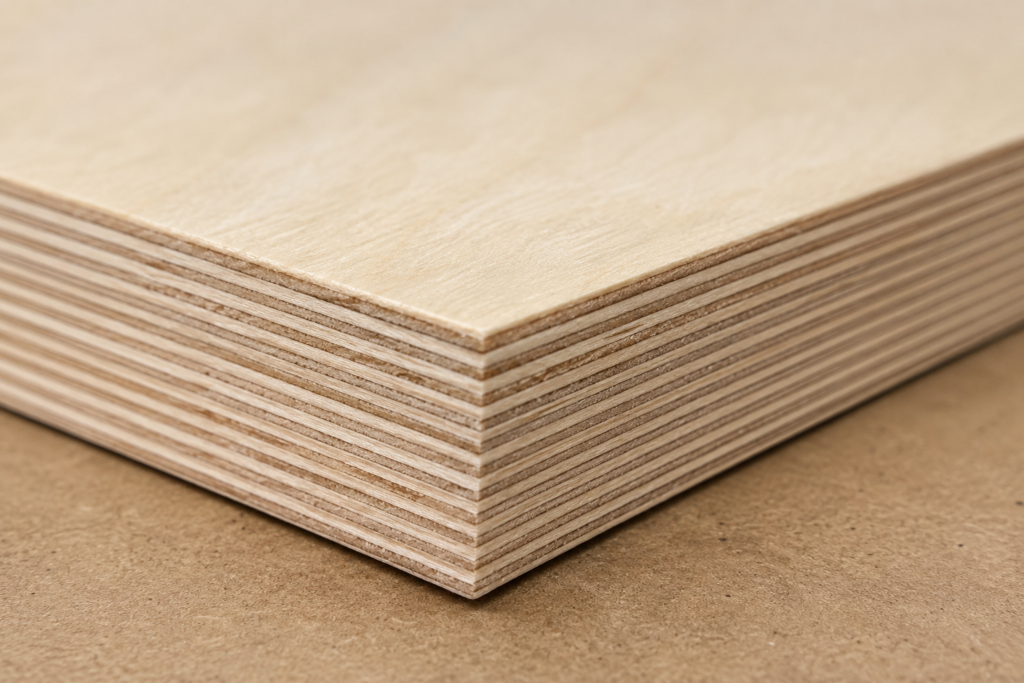
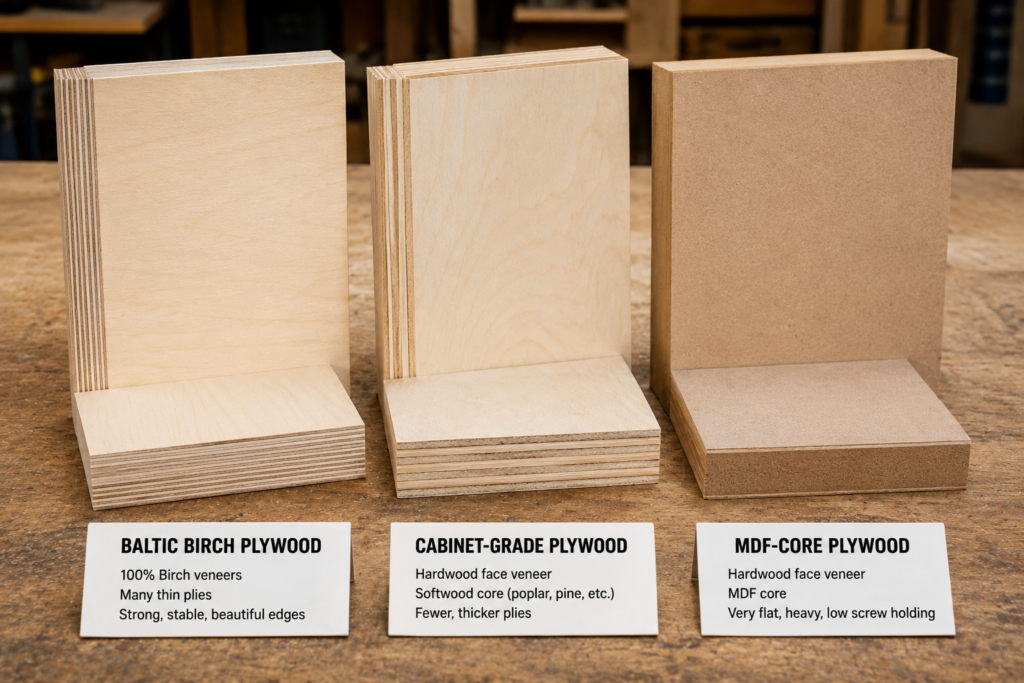
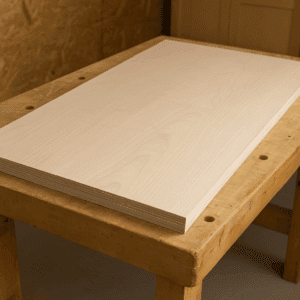
Notice the signature pinstripe edge structure created by the high ply count. Source: Total Wood Store
Before you drop hundreds of dollars on a stack of sheets, let’s look at how true Baltic Birch compares to the standard domestic alternatives you find at local home centers.
Is Baltic Birch Better Than Regular Birch Plywood?
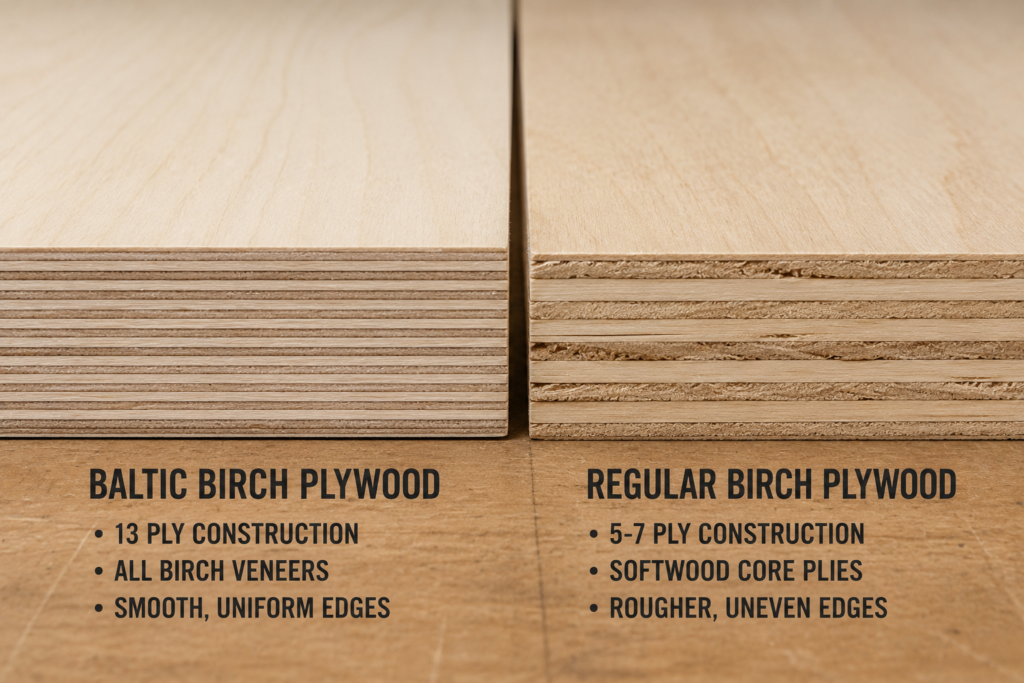
Yes. Baltic Birch is stronger, more stable, contains more plies, and typically has fewer internal voids than standard domestic birch plywood. However, it costs significantly more and is not necessary for every woodworking project.
✅ The Quick-Check Comparison
Feature
Premium Baltic Birch Plywood
Standard Domestic Birch Plywood
Typical Sheet Sizes
Traditional 5′ x 5′ (Metric); some modern 4′ x 8′ panels
Standard 4′ x 8′
Core Plies
Typically all-birch construction with no softwood core layers
Softwood cores (Pine, fir, or poplar)
Veneer Count (3/4″)
13 ultra-thin, uniform plies
5 to 7 thick, variable plies
Internal Voids
Typically contains far fewer voids than domestic plywood
More likely to contain internal voids and gaps
Exposed Edge Appeal
Beautiful, uniform striped appearance
Rough, uneven layers needing edge banding
Screw-Holding Power
Exceptional (Heavy-duty density)
Moderate to poor (Screws strip easily)
Approximate Weight (3/4″ Sheet)
~45 lbs (for 5′ x 5′) / ~72 lbs (for 4′ x 8′)
~60 lbs (for 4′ x 8′)
Average Cost (Per Sheet)
$100 – $150+
$55 – $85
😬 The $150 Regret: My Personal Blind Spot
A couple of years ago, I was building a set of heavy-duty shop drawers. I wanted to save a few bucks, so I bought standard construction-grade birch from a local box store instead of authentic Baltic Birch. I figured, “It’s all birch, right?”
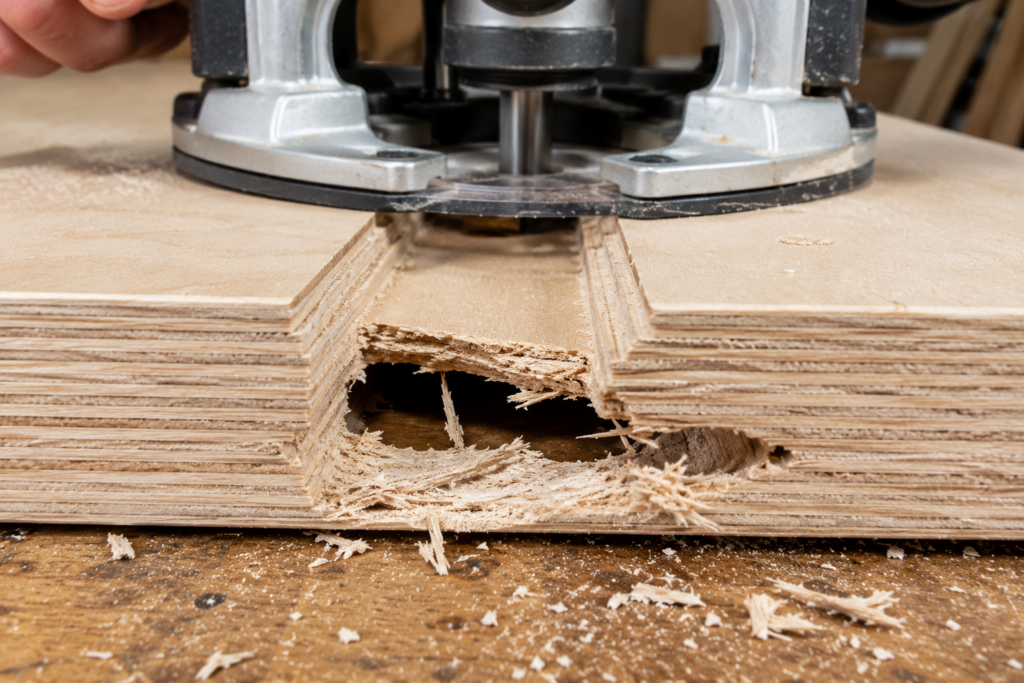
That was my big mistake. Halfway through routing my dado joints (the channels where wood pieces lock together), my router bit struck a massive hidden void inside the core. The face veneer instantly splintered, ruining an entire sheet of wood.
Worse yet, within three days of bringing the boards into my shop, the uneven internal moisture caused the sheets to cup like a potato chip. I wasted $150 and a full weekend. If you want to avoid this headache, check out the definitive guide to plywood troubleshooting on theplywood.com to spot bad sheets before you make your first cut.
🪵 Baltic Birch vs. Cabinet-Grade Plywood
When walking through a professional lumber yard, you will often find Baltic Birch stacked right next to premium “cabinet-grade” hardwood plywoods like domestic maple, cherry, or walnut. While both are high-quality options, their internal DNA and ideal use cases are completely different.
Veneer-Core Cabinet Plywood
Standard domestic cabinet-grade sheet goods typically feature a decorative hardwood face veneer bonded over a softwood core composed of thick layers of poplar, fir, or pine. Because these internal layers are relatively thick, the sheet is lighter and easier to muscle around a workshop. However, when you cut cross-sections, you expose those alternating softwood layers, which lack visual appeal and require edge banding.
MDF-Core and Particleboard-Core Plywood
For high-end architectural cabinetry and commercial fixtures, suppliers frequently stock hardwood veneers pressed onto a Medium-Density Fiberboard (MDF) or particleboard core.
MDF-Core: This core offers unparalleled flat stability and thickness consistency. It will not cup or warp, making it perfect for large, flat cabinet doors. The trade-off? It weighs an absolute ton, is susceptible to water damage, and has practically zero screw-holding power on the raw edges.
Particleboard-Core: Often used in lower-cost commercial shelving, particleboard is highly susceptible to sagging under heavy, continuous loads.
When Cabinet-Grade Wins
If you are building classic kitchen wall cabinets with large flat surfaces to be veneered in matching walnut or white oak, standard cabinet-grade plywood is the smarter, more economical choice. It yields traditional 4′ x 8′ dimensions, integrates easily with standard hardware, and results in a lighter assembly for wall hanging.
When Baltic Birch Wins
Baltic Birch takes the crown the moment your project demands structural joinery, structural edge exposure, or heavy impact resistance. If you plan to cut exposed box joints, rabbit cuts, or complex nested parts on a CNC, Baltic Birch handles the stress effortlessly. Because its core is entirely hardwood, it stays structurally sound even when carved into thin, intricate webbing.
⚠️ Warning: The Complex Global Birch Supply
Because true Baltic Birch has historically been natively grown and manufactured in regions deeply affected by recent geopolitical trade restrictions, the supply chain has shifted dramatically.
Historically, Baltic Birch and Russian Birch shared the exact same supply chains. Today, it can be tricky to know exactly what you are buying. Most traditional Baltic Birch is still sold in 5′ × 5′ sheets, although some manufacturers now offer similar high-quality, 100% birch-core panels in standard 4′ × 8′ formats to fit local workshop standards.
The real danger comes from cheap imitations that use authentic birch on the outer face but pack the inner core with soft poplar or eucalyptus. You lose the high ply count, and you will hit voids. If you are hunting for a reliable supplier, take a look at our lumber yard sourcing handbook at theplywood.com to ensure you get premium core plies.
📐 Common Baltic Birch Thicknesses and Their Uses
Unlike domestic plywood, which is manufactured to imperial fractions (and often falls short of them), true Baltic Birch is manufactured to strict metric tolerances. Understanding how thickness translates into structural performance can save you from buying the wrong stock for your project.
Cabinet drawer bottoms, frame-and-panel door centers, furniture back panels
1/2″
12mm
Standard kitchen drawer boxes, small storage organizers, nested CNC storage bins
5/8″
15mm
Heavy-duty shop furniture, mobile machine bases, structural cabinet carcasses
3/4″
18mm
Workbench tops, assembly tables, high-end furniture, European frameless cabinetry
Matching the Thickness to the Task
1/8″ (3mm) & 1/4″ (6mm): These thin sheets are incredibly flexible yet retain high tensile strength. They are heavily favored by laser engraving hobbyists because the uniform core allows clean, uniform beam penetration without hitting dense pitch pockets that halt laser cuts.
1/2″ (12mm): This is the gold standard for custom drawer construction. It provides the perfect balance between keeping the overall drawer box lightweight and maintaining dense, robust edges that accept crisp dovetails or lock joints beautifully.
3/4″ (18mm): The heavy hitter. When you need a flat, rock-solid surface for a table saw sled or a modular router station, 18mm Baltic Birch delivers the damping mass and rigidity needed to eliminate machine vibrations.
🔍 How to Identify Authentic Baltic Birch
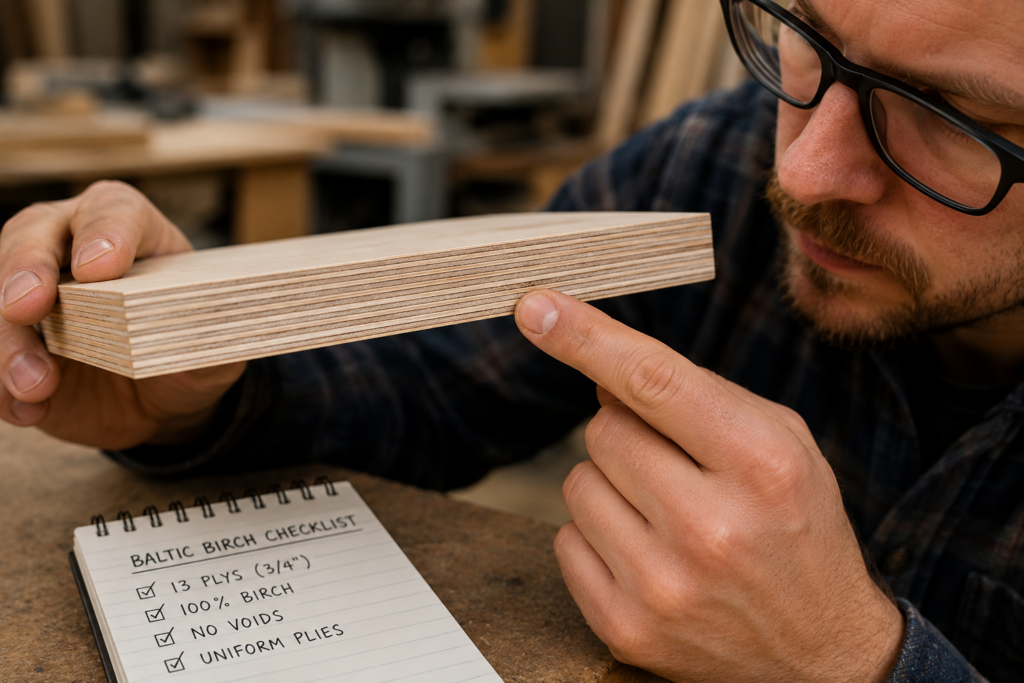
As cheap imitation boards flood home centers, you have to play wood detective to ensure you are getting what you pay for. Use this strict checklist when inspecting a stack at the lumber yard to confirm its authenticity.
This is your fastest, most reliable test. Grab your tape measure and look closely at the raw edge of a 3/4″ (18mm) panel. A standard domestic box-store panel will show 5 to 7 uneven, chunky layers. An authentic piece of 3/4″ Baltic Birch will feature 13 ultra-thin, perfectly uniform layers pressed tightly together.
2. Check the Sheet Size
Traditional Baltic Birch mills operate in accordance with European sizing guidelines. The standard footprint for an authentic panel is a distinct 5′ x 5′ square (60 inches by 60 inches). While modern global supply chains do produce some specialized 4′ x 8′ birch-core panels, seeing a 5′ x 5′ footprint is an immediate indicator of a traditional European mill heritage.
3. Scan the Edges for Core Consistency
Run your eyes along the long edges of the panel. Authentic Baltic Birch displays razor-sharp, distinct parallel lines that look like a uniform stack of pinstripes. If you spot thick, wavy layers, random cross-grain overlaps, or large gaps where core wood split away during pressing, step away. You are looking at a low-grade utility panel.
4. Look for the Grading Stamps
Inspect the outer face veneers for crisp, stamped grading letters like B/BB, BB/BB, or BB/CP. These metric-standard stamps indicate the patch allowances for each face. Furthermore, check the wood surface for the iconic, football-shaped veneer patches. A lack of structural patches on lower-grade backs, combined with imperial sizing stamps, points toward an imitation panel.
5. Ask Your Supplier for Mill Origin Documentation
Do not hesitate to talk to the commercial desk manager at your local lumber outlet. Ask them directly whether the panel features a 100% birch hardwood core throughout or a blended core. Reputable yards will confidently trace their inventory back to legitimate European or high-spec global manufacturers.
🧪 Real Test: The Screw-Strip Showdown
To see how the density difference plays out in assembly, I ran a crude but effective stress test in my workshop. I took a 3/4″ scrap piece of home-center domestic birch and a scrap piece of 18mm (3/4″) 13-ply Baltic Birch.
I drilled a pilot hole into the face of both boards.
I drove a standard 1-1/2″ woodscrew into each until flush.
Using a torque wrench, I intentionally over-tightened both screws to see when the wood fibers would give up.
The domestic plywood stripped out under relatively light hand pressure because the screw threads sank into soft, porous pine core layers. In my test, the screw in the Baltic Birch held significantly longer before stripping, requiring a massive force to break loose. If you are building structural furniture or high-stress shop fixtures, the 💸 cost difference is entirely justified by the structural integrity.
🛠️ The Right Tools For The Job
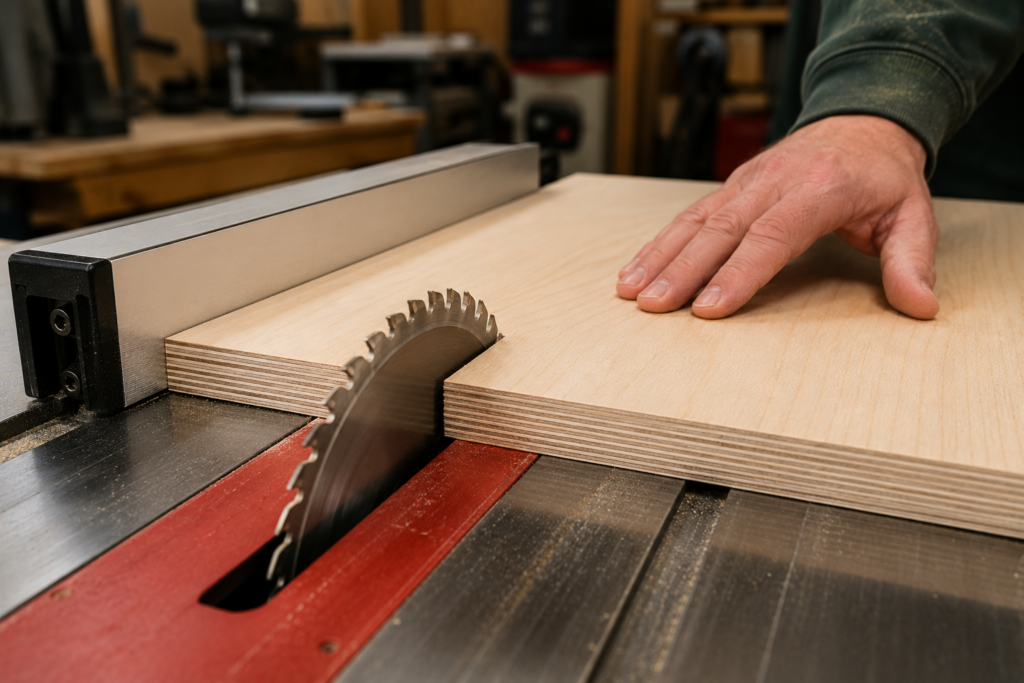
Because Baltic birch is so dense and highly packed with adhesive layers, it can easily burn or chip if you use dull, cheap blades. To get glassy-smooth edges with minimal splinters, I highly recommend using premium, high-tooth-count blades and dedicated bits.
For Cleaner Router Work: Use a solid-carbide down-cut spiral bit, such as the Amana Tool Solid Carbide Down-Cut Spiral Router Bit. Down-cut bits push wood fibers downward as they spin, helping produce cleaner top edges on your Baltic birch panels.
📐 Understanding the Baltic Grading System
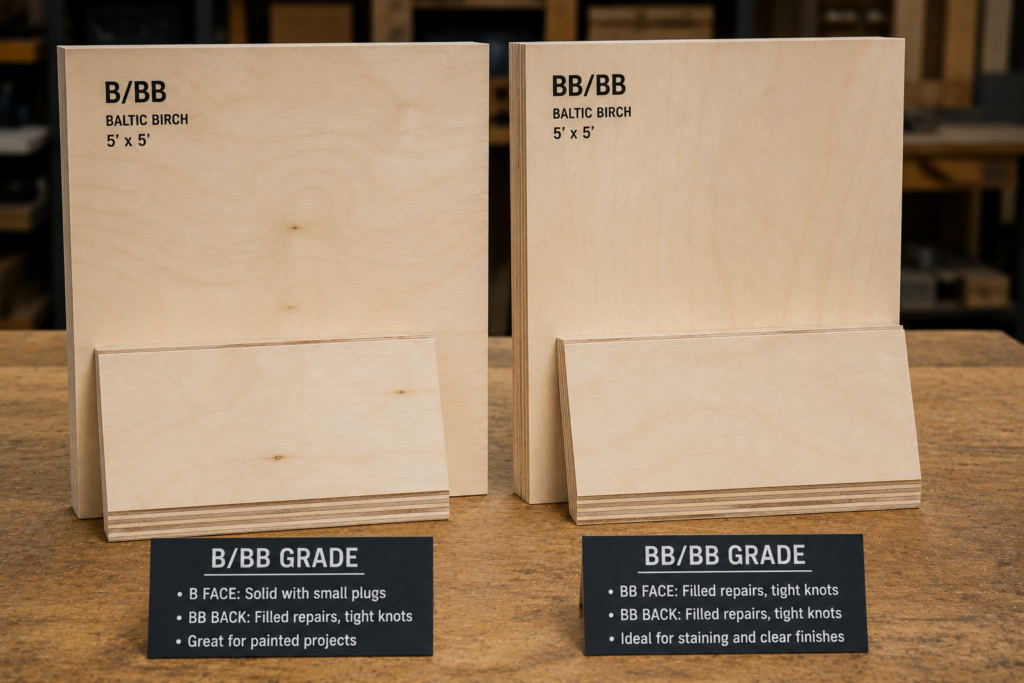
When buying your sheets, you will notice letters stamped on the edges (like BB/BB or B/BB). These indicate the quality of the face and back veneers.
B/BB: The highest common grade. The “B” face is a single, beautiful piece of clear birch veneer with uniform light color and zero patches. The “BB” back allows for 3 to 6 small, color-matched patch shapes (often called “footballs”). This is perfect for cabinets where only one side is highly visible.
BB/BB: Both sides allow for small, sound, football-shaped wood patches. This is the ultimate choice for shop fixtures, drawer boxes, and router templates where structural soundness matters more than an absolutely pristine face.
BB/CP: One face is BB grade, while the back allows for an unlimited number of sound knots and patches (CP grade), though no open holes are permitted. It is great for hidden structural shelves.
🚀 Best Uses for Baltic Birch Plywood
Because of its unique construction, Baltic Birch outperforms other sheet goods in specific, high-demand applications. It is the material of choice for:
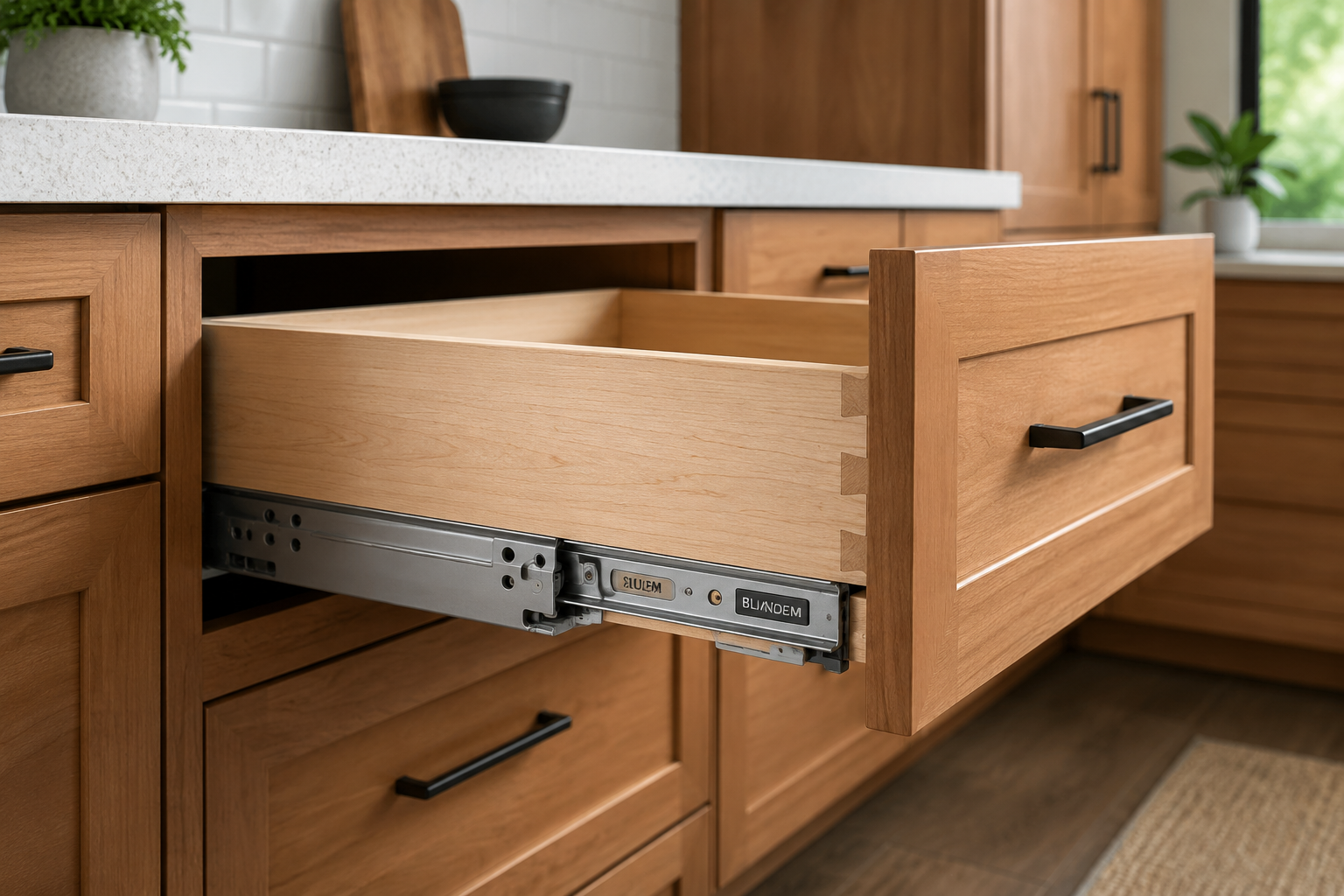
Cabinet Drawer Boxes: The uniform, attractive edges look great when dovetailed or dadoed, eliminating the need for tedious edge banding.
CNC Projects: The lack of large internal voids means your CNC router bits won’t chew into empty air or splinter the edges of intricate cuts.
Laser-Cut Models: It cuts consistently under laser power, making it a staple for thin architectural models, puzzles, and craft projects.
Shop Furniture, Jigs, and Fixtures: When you need a table saw sled or a router template that stays dead flat over years of workshop temperature swings, this is what you use.
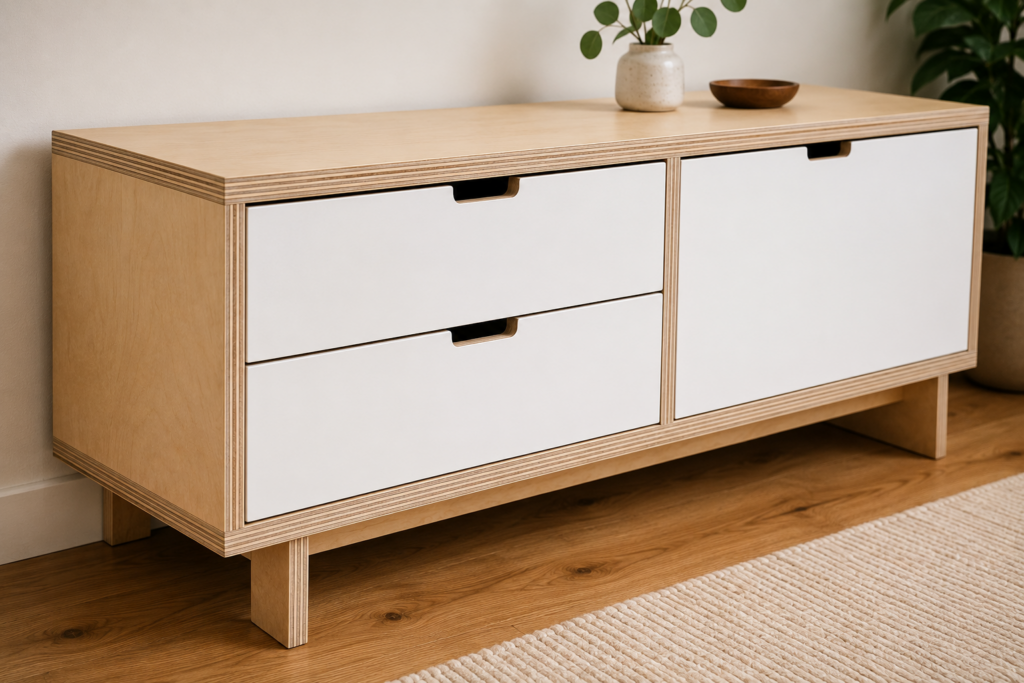
Exposed-Edge Furniture: Mid-century modern furniture builders frequently leave the multi-layered edges exposed and sealed with a clear coat as a deliberate design feature.
Speaker Boxes: The dense, consistent core makes it a popular choice for custom audio enclosures.
🛑 When Baltic Birch Is NOT Worth the Extra Money
Let’s be completely honest: Baltic Birch is overkill for many everyday projects. Given the higher weight and premium price tag, you should skip it for:
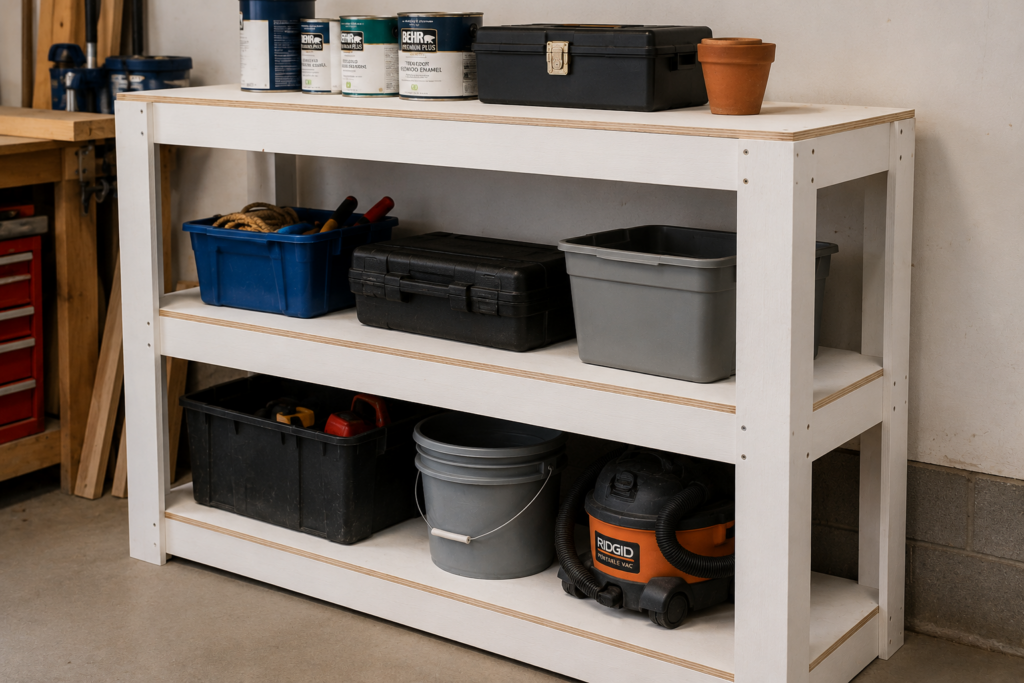
Painted Utility Shelving: If you are painting the final project, you don’t need the flawless grain pattern or pretty exposed edges of Baltic Birch. Standard MDF or domestic hardwood plywood holds paint beautifully at a fraction of the cost.
Temporary Shop Jigs: For quick fences, router templates, or support cradles that you’ll throw away next month, don’t waste your premium lumber stack.
Garage & Basement Storage: Standard 4×8 domestic fir or pine plywood is perfectly fine for holding plastic bins and car oil.
Hidden Cabinet Backs: If a panel is going to be screwed flat against a wall where nobody will ever see it, use cheap, lightweight 1/4″ underlayment instead.
📊 Baltic Birch Pros and Cons
Pros
Excellent dimensional stability: Resists warping, cupping, and twisting better than standard domestic options.
High screw-holding strength: Dense hardwood layers prevent fasteners from stripping out under load.
Attractive exposed edges: Pinstripe layered pattern looks striking when left exposed and finished.
Consistent all-birch core: Minimizes unpredictable splintering and structural failure during cutting.
Ideal for CNC and laser cutting: Carves seamlessly and burns cleanly without hitting hidden large resin or air pockets.
Available in multiple grades and thicknesses: Ranges from paper-thin 1/8″ sheets to heavy structural panels.
Cons
More expensive than domestic plywood: Significantly raises the baseline material cost of a build.
Heavier than many alternatives: Fully dense hardwood plies require more physical effort to transport and process.
Limited availability in some regions: Often requires a trip to a specialized architectural mill rather than a neighborhood big-box store.
Not naturally waterproof: Will deteriorate over time if regularly soaked or kept outdoors without protection.
Traditional 5×5 sheets can create more waste on large projects: Cutting long cabinet components from square sheets can yield awkward, unusable leftover off-cuts.
❓ Frequently Asked Questions
Why is Baltic Birch so expensive?
Baltic Birch is priced at a premium because of its completely non-compromised construction. It uses high-quality, select hardwood throughout every internal layer rather than masking cheap softwood fillers behind a thin face veneer. The manufacturing process requires nearly twice as many veneers—and additional adhesive layers—as a standard sheet of plywood, along with complex global shipping logistics.
Is Baltic Birch waterproof?
No, Baltic Birch is not waterproof. While many Baltic Birch panels use moisture-resistant glue lines, the birch wood itself can still absorb water, swell, stain, and eventually decay if exposed to prolonged moisture. For outdoor projects, every surface and edge should be thoroughly sealed, and marine-grade plywood is usually the better choice for direct exposure to weather.
Can Baltic Birch be used outdoors?
Only if it is completely sealed and shielded from direct contact with the ground. If you intend to use it for an outdoor sign or a covered patio installation, you must seal every square inch—especially the open end grain of the cut edges—with a heavy-duty, marine-grade exterior varnish or epoxy coating. For raw outdoor exposures, marine-grade fir or treated plywood remains a safer choice.
Visually, no. One of the main reasons woodworkers spend the extra cash on Baltic Birch is to proudly show off the clean, alternating “pinstripe” edge grain. Sanding those raw edges to 220 grit and applying a simple, clear oil or lacquer finish results in an incredibly clean look. You only need edge banding if your design specifically requires a solid, uniform wood profile.
What is the best grade for fine cabinets?
For premium furniture and high-end cabinetry, look for B/BB grade stock. This gives you one completely flawless, patch-free face (the “B” side) to point toward the exterior world, while hiding the patch-heavy “BB” side inside cabinet cavities or beneath drawer boxes where it will never catch the light.
Final Thoughts
If your project demands maximum stability, clean-machined edges, excellent screw-holding power, and long-term durability, Baltic Birch remains one of the best sheet goods available. While the higher cost isn’t justified for every project, cabinet makers, furniture builders, CNC users, and serious woodworkers often find the performance difference worth every penny.
Related Posts:
Luan vs Baltic Birch: Which Plywood Is Better? by Admin October 30, 2025 Hardwood If you’ve ever compared Luan vs Baltic Birch plywood at your local hardware store, you know they look similar but perform very differently once you…
Maple Plywood DIY Guide: Projects & Finishing Tips by Admin August 23, 2025 Hardwood My First Experience With Maple Plywood When I first started messing with plywood, I honestly didn’t care what I was buying. Pine was cheap, easy…