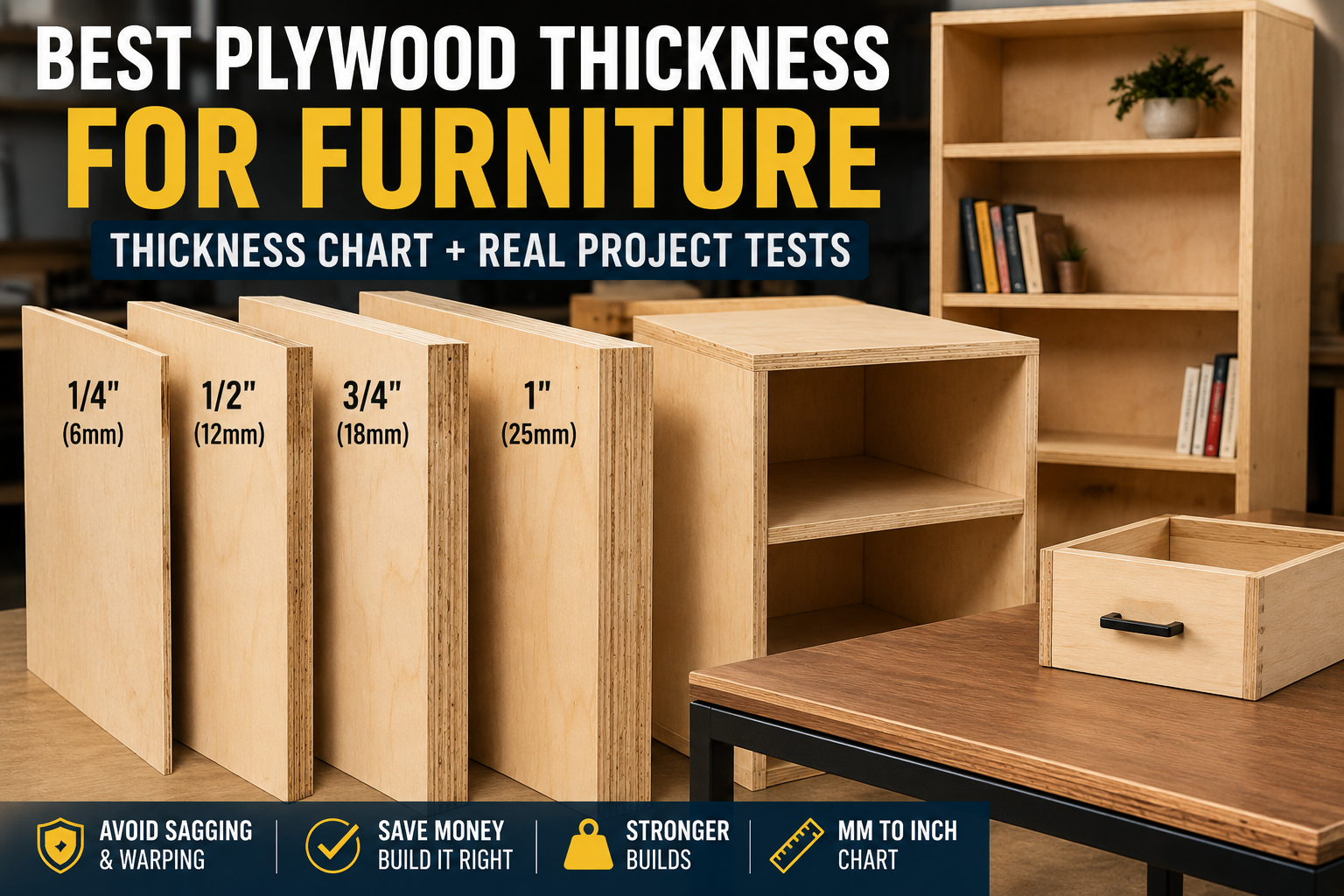
If you’ve ever stood in the lumber aisle staring at 1/4″, 1/2″, 3/4″, and 1″ plywood, wondering which one won’t sag, warp, or eat your budget — you’re not alone. I’ve built enough furniture (and fixed enough furniture I built wrong the first time) to tell you the honest answer: the best plywood thickness for furniture depends on the piece, the span, and the load — and guessing wrong is the single most expensive mistake first-time furniture builders make.
Below is the quick-answer table, then we’ll go deep into the chart, the real-world tests, the cost differences, and the regret stories that taught me this the hard way.
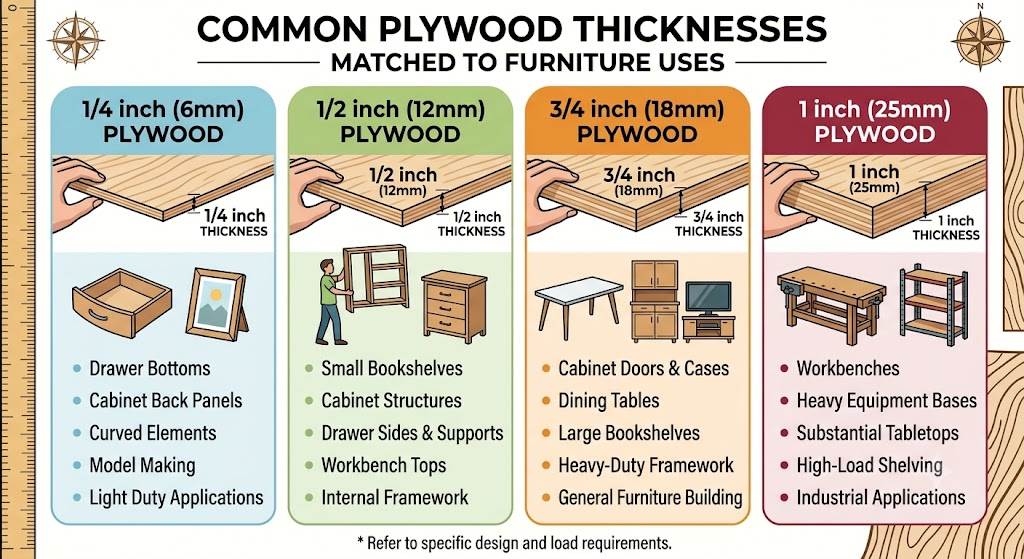
Quick Answer: Plywood Thickness by Furniture Type
Furniture Piece
Recommended Thickness
Why
Bookshelf shelves (unsupported span 24″+)
3/4″ (18mm)
Anything thinner sags within a year
Cabinet sides/carcasses
3/4″ (18mm)
Holds screws, hinges, and weight
Drawer boxes (sides/back)
1/2″ (12mm)
Strong enough, lighter, cheaper
Drawer bottoms
1/4″ (6mm)
No load-bearing needed, saves cost
Cabinet backs (non-structural)
1/4″–3/8″ (6–9mm)
Just needs to close the box
Tabletops (small, supported)
3/4″ (18mm)
Rigid enough without a frame
Tabletops (large, unsupported)
3/4″–1″ (18–25mm) doubled or with apron
Prevents flex and bounce
Furniture legs/structural supports
3/4″–1″ (18–25mm), often laminated
Carries weight without bowing
Decorative panels/trim
1/4″ (6mm)
Cosmetic only, no structural job
That table alone will save most people from the #1 plywood mistake: using one thickness for an entire project because it’s “easier to buy.” It isn’t easier — it’s expensive in the wrong places and weak in others.
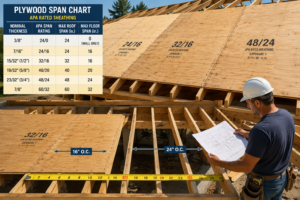
The Plywood Thickness Chart (mm to Inches)
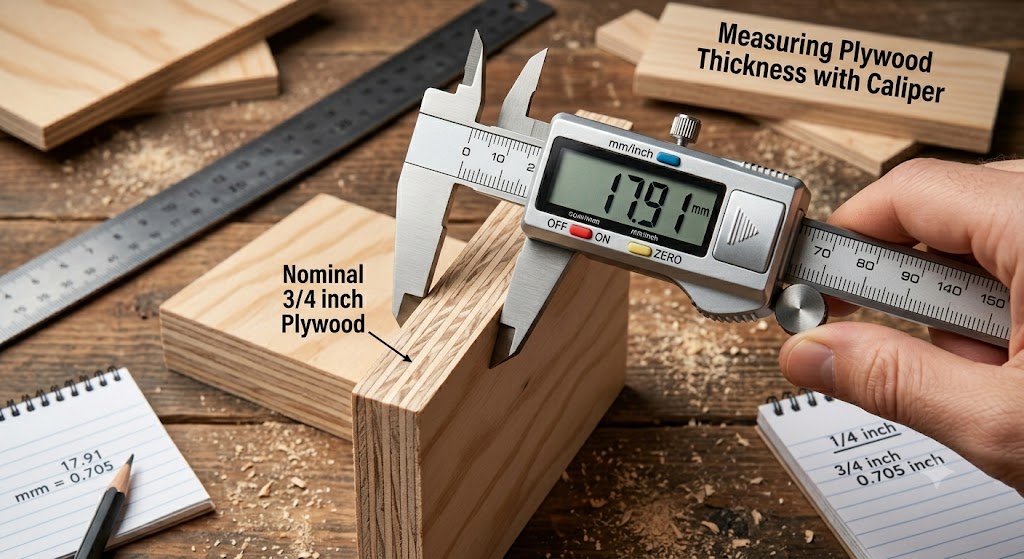
Plywood thickness is sold in nominal sizes, but actual thickness is almost always slightly less. This trips up more builders than anything else, because cut lists are written in nominal sizes while your dado blade and hardware care about actual size.
Heavy load tabletops, workbenches, structural beams
⚠️ Warning: If you build hardware pockets, dado joints, or pocket-hole cabinets based on the nominal size instead of the actual size, your joints will be loose. This is one of the most common — and most avoidable — furniture-building errors, and most plywood thickness guides skip it entirely.
Real Test #1: I Bought Two “3/4 Inch” Sheets — They Weren’t the Same Plywood
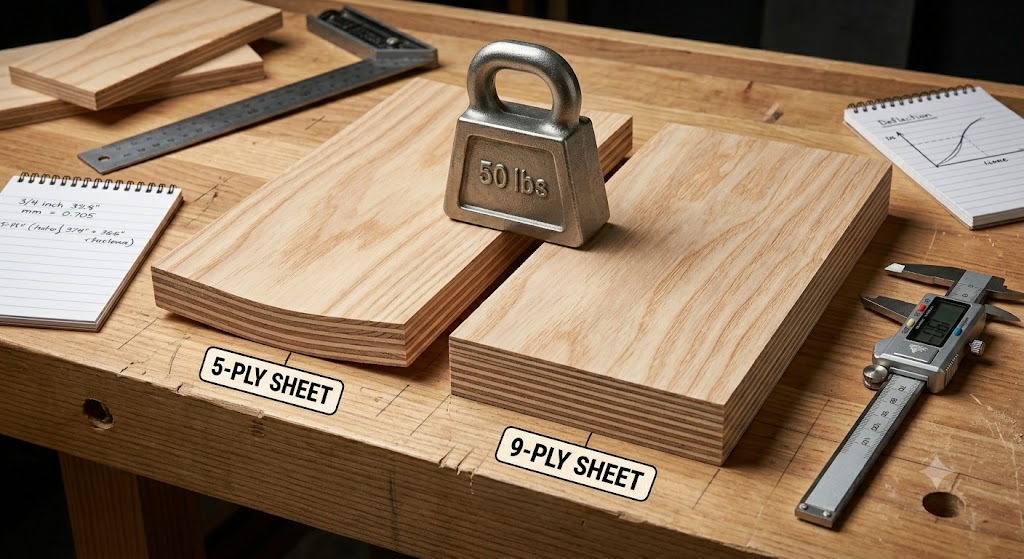
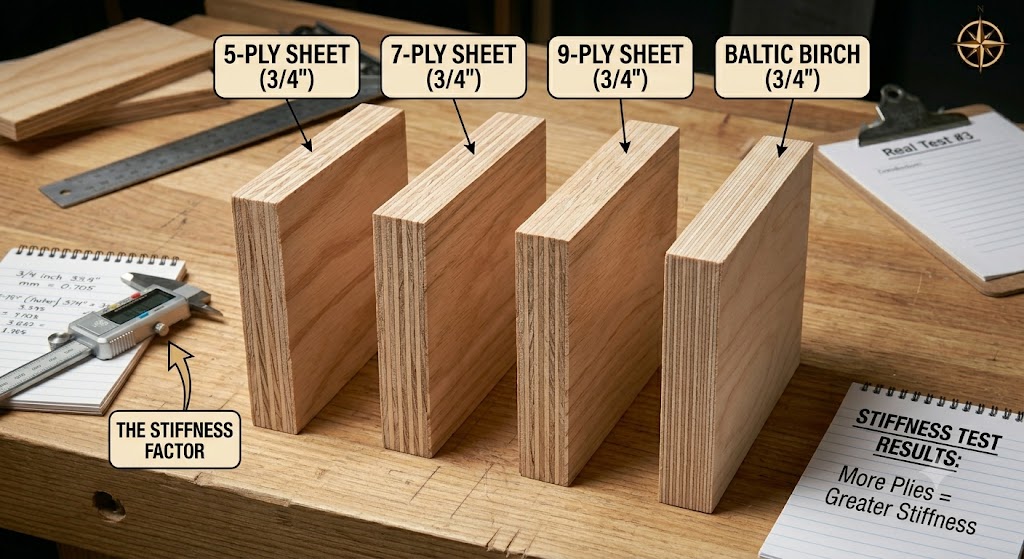
This is the test that entirely changed how I shop for plywood. I bought two sheets, both labeled 3/4″, both from the same lumber yard, on the same day. One was a 5-ply sheet, the other a 9-ply sheet. Same nominal thickness. Same price bracket, within a few dollars.
🧪 Real test results (32″ unsupported span, center load):
5-ply 3/4″ sheet: visible deflection under load, measurable bounce when tapped
9-ply 3/4″ sheet: noticeably stiffer, almost no perceptible flex at the same load
😬 Regret: I’d already built a shelf unit with the 5-ply sheet before running this comparison, assuming “3/4 inch is 3/4 inch.” It sagged within four months under the weight of books. The thickness number on the label told me nothing about how the sheet was actually built.
Lesson: thickness is the headline number, but ply count is what actually determines stiffness at that thickness. Two sheets can share a thickness and perform completely differently.
Real Test #2: Same Thickness, Same Span, Different Grain Direction
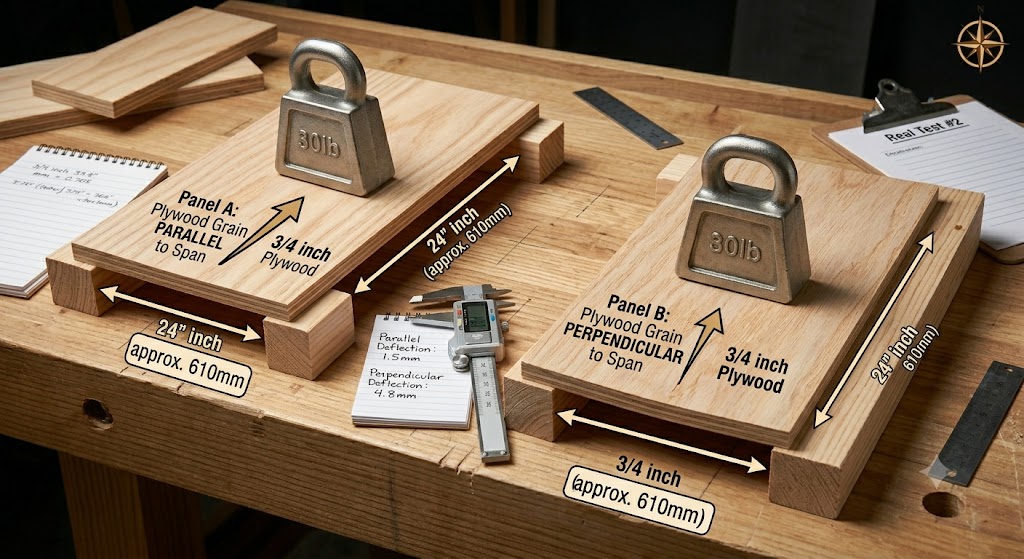
For a second test, I cut two pieces from a single 3/4″ sheet and set them up with the same 36″ unsupported span and the same 40 lb. center load — the only variable was the direction of the face grain relative to the span.
🧪 Real test results:
Face grain running parallel to the span: roughly 1/8″ deflection
Face grain running perpendicular to the span: noticeably stiffer, less than half the deflection of the parallel orientation
Takeaway: plywood is directional. The same thickness, same sheet, same span yielded meaningfully different results simply by rotating the panel’s orientation. Most thickness charts never mention this, and it costs builders rigidity that they think they’re paying for with a thicker sheet.
Plywood Grade vs. Thickness: They Are Not the Same Decision
A mistake I see constantly (and made myself early on): people upgrade thickness when their real problem is grade, or upgrade grade when their real problem is thickness.
Comparison
Thickness Solves
Grade Solves
Sagging shelves
✅ Yes
❌ No
Visible voids/gaps on edges
❌ No
✅ Yes
Screws stripping out
✅ Yes (thicker = more bite)
✅ Partially (better core = denser holding)
Warping over time
✅ Partially
✅ Yes (better core, fewer voids)
Surface finish quality
❌ No
✅ Yes
If you’re chasing a smoother, void-free face for a visible piece, that’s a grade conversation, not a thickness conversation — see our breakdown on choosing plywood grades for furniture before you spend more on thickness you don’t need.
Plywood Type Also Changes the Thickness You Need
Not all 3/4″ plywood performs the same. Hardwood plywood (like birch or maple-faced) is stiffer per inch than softwood or construction-grade plywood, which means you can sometimes use a thinner sheet of hardwood plywood and get the same rigidity as a thicker sheet of cheaper plywood.
How Plywood Thickness Affects Cost (The Part Nobody Budgets For)
This is where the “just go thicker to be safe” advice falls apart financially. Thickness doesn’t scale linearly — it scales with weight, hardware needs, and waste.
💸 Real cost differences I’ve tracked across builds:
1/2″ to 3/4″ ply: typically 30–50% more per sheet
3/4″ to 1″ ply: typically 60–90% more per sheet, plus you often need different hinges, slides, and fasteners rated for the extra weight
Doubling 3/4″ sheets (lamination) instead of buying 1″ stock: sometimes cheaper per sheet, but doubles labor time and glue-up cost
If you’re pricing out a full project, this is exactly the kind of math worth doing before you buy a single sheet — our plywood cost calculator guide walks through it with real sheet pricing.
Where Builders Get the Mistake Wrong: “Thicker Is Always Safer”
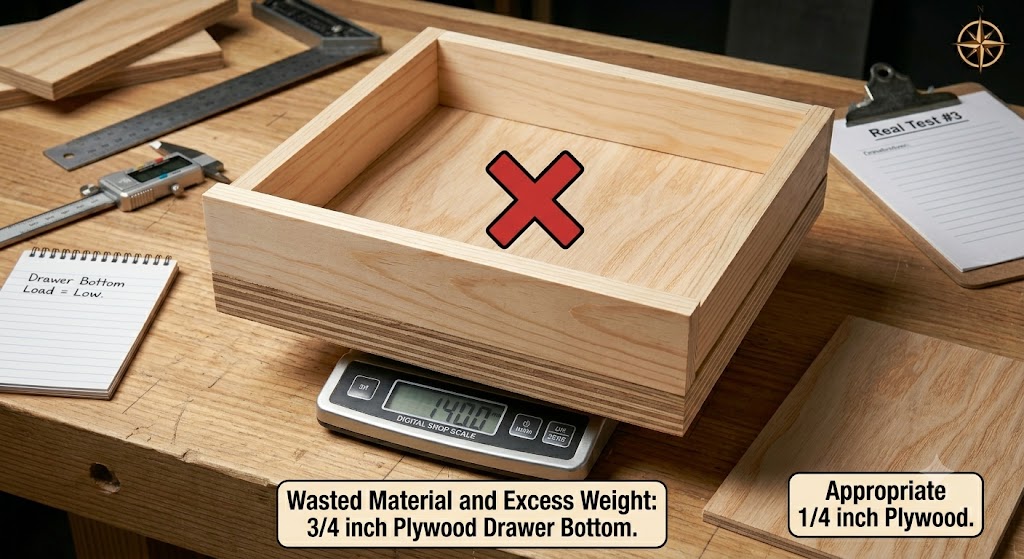
❌ Mistake: Defaulting to 3/4″ or even 1″ plywood “just to be safe” on every panel in a project, including drawer bottoms, cabinet backs, and decorative trim.
This single habit is responsible for more wasted budget than almost any other plywood decision. Drawer bottoms don’t need 3/4″ plywood. Cabinet backs that aren’t structural don’t need it either. You end up paying premium thickness pricing on parts of the project where it adds zero functional benefit — weight, yes; benefit, no.
The fix is to match thickness to the job, not to default to “the strong one” everywhere. Revisit the quick-answer table above before you finalize a cut list.
Ply Count: The Number That Actually Determines Stiffness
Every sheet of plywood gets its thickness by stacking thin veneer layers, and the number of layers in that stack is the variable most thickness charts ignore completely. A 3/4″ sheet can be built from as few as 5 plies or as many as 13, and more (thinner) plies generally outperform fewer (thicker) plies at the same overall thickness.
Long shelf spans, tabletops, anything load-bearing
13-ply (Baltic birch)
Stiffest, also priciest
High-end furniture, anywhere flex is unacceptable
If you’re spec’ing a long shelf span, this is the number to check before you check thickness — our shelf plywood thickness guide breaks down ply count by span length in more detail.
Thickness also doesn’t tell you what’s inside the sheet. Plywood is sold with different core constructions, and at the same nominal thickness, it holds screws, resists warping, and weighs differently.
Core Type
Screw Holding
Warp Resistance
Weight
Best Use
Veneer core (all wood plies)
Strong
High
Lighter
Drawer boxes, structural legs, or anywhere hardware is repeatedly used
MDF core (veneer face, MDF center)
Weaker at edges
Lower in humidity swings
Heavier
Flat panels, painted faces, low-hardware-stress parts
Combo core (mixed veneer/particle)
Moderate
Moderate
Mid-weight
Budget cabinet boxes, non-critical panels
This matters most anywhere hardware is subject to repeated stress — drawer slides being the clearest example. Our drawer box plywood guide and plywood for furniture legs guide both go deeper into core selection for those specific stress points.
Grain Direction: The Variable Thickness Charts Leave Out
Plywood is directional by construction — the face veneer runs one way, and the cross-band layers beneath it run perpendicular. Strength along the face grain is higher than strength across it, which means the same thickness sheet can perform very differently depending on which way you orient it relative to the span, as shown in the grain-direction test above.
The practical rule: run the face grain parallel to the short dimension of an unsupported span whenever possible. This single orientation choice can do more for rigidity than jumping up a thickness size, and it costs nothing. It’s especially relevant on long, narrow panels like the ones covered in our best plywood for tabletops breakdown.
Void Content vs. Thickness: Where Grade and Thickness Collide
This is the spot where thickness and grade stop being separate conversations. A thicker sheet doesn’t automatically mean fewer internal voids — void content is a function of grade and core quality, not thickness. That means a cheap, void-heavy 3/4″ sheet can flex and creak in ways a denser, lower-void 1/2″ sheet of better grade won’t.
Scenario
Thickness
Grade/Void Level
Real-World Result
Budget 3/4″ sheet, low grade
High
High void content
Edges chip, screws can hit gaps, and surprising flex for the thickness
Cabinet-grade 1/2″ sheet
Lower
Low void content
Denser, more predictable performance than the thicker budget sheet
Premium 3/4″ sheet, high grade
High
Low void content
Best of both — but priced accordingly
The takeaway: don’t assume a thicker sheet has “more wood” backing it up. Check the grade alongside the thickness, especially on cut edges where voids are more visible. Revisit our plywood grades for furniture guide if you skipped it above — it’s the other half of this decision.
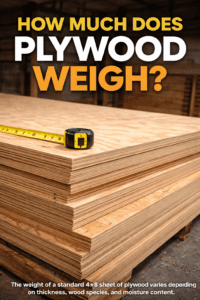
Plywood Thickness vs. Plywood Weight (Don’t Skip This)
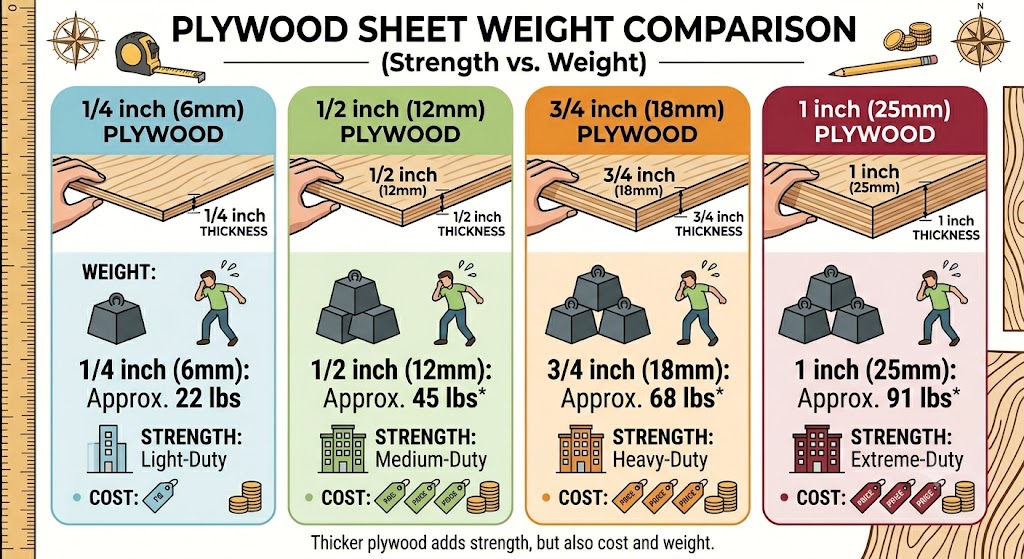
Heavier furniture isn’t always better furniture. If you’re building anything that needs to move — wall-mounted shelving, furniture for rentals, modular pieces — thickness adds weight fast, and weight adds cost to hardware (wall anchors, hinges, slides all have weight ratings).
Thickness
Approx. Weight per 4×8 Sheet
1/4″
~25 lbs
1/2″
~48 lbs
3/4″
~70 lbs
1″
~95 lbs
If a piece is wall-mounted, check our wall-mounted shelf plywood thickness guide before assuming “thicker is sturdier” — sometimes thinner plywood with proper blocking outperforms thick plywood with weak anchors.
Recommended Tools and Plywood for This Project (Affiliate Picks)
If you’re heading into a build based on this guide, these are the tools and materials that consistently make the thickness decision easier to execute correctly:
What is the best all-around plywood thickness for furniture? 3/4″ (18mm) is the closest thing to a universal default for cabinets, shelving, and tabletops, but it’s not correct for drawer bottoms, cabinet backs, or decorative panels, which can use thinner stock without losing strength.
Is 1/2 inch plywood strong enough for shelves? Yes, for spans of roughly 24 inches or less with moderate loads. Beyond that span, or under heavy loads like books, 1/2″ plywood is prone to visible sagging within months, not years.
Should I use 3/4 inch plywood for a tabletop? For tabletops under 30 inches with full support, 3/4″ alone is usually fine. For larger unsupported spans, either add an apron/frame or step up to laminated 3/4″ sheets (roughly 1.5″ total) for rigidity.
Does plywood thickness affect screw holding power? Yes. Thinner plywood, especially under 1/2″, has less material for screws to bite into, which increases the chance of stripped holes over time, particularly with repeated drawer or hinge use.
Is thicker plywood always better for furniture? No. Thicker plywood adds cost and weight without functional benefit on non-structural parts like drawer bottoms, cabinet backs, and decorative trim. Matching thickness to the specific job outperforms defaulting to the thickest option.
What thickness of plywood do professional furniture makers use most? 3/4″ for structural components (cabinets, shelving, tabletops) and 1/2″ for drawer boxes are the most common professional defaults, with 1/4″ reserved for backs, bottoms, and decorative panels.
Final Take
The real lesson from every sagging shelf and flexing tabletop I’ve built is this: plywood thickness is a job-by-job decision, not a project-wide one. Use the chart, match thickness to span and load, and save your money for the parts of the build where thickness actually does the work — not the parts where it’s just adding weight to your cart.
For the next step in your build, check our plywood vs. MDF for furniture comparison and our complete plywood buying guide to round out your material decisions before you cut a single sheet.
Related Posts:
Plywood Thickness Guide: Don’t Guess—Use This Chart by Admin March 9, 2026 More About Selecting the correct plywood thickness is one of the most important decisions in woodworking and construction. The thickness of the sheet determines how strong the…
How Much Does Plywood Weigh? 4×8 Sheet Weight Chart by Admin March 3, 2026 More About Plywood weight depends mainly on thickness, wood species, and moisture content. As a general rule, plywood weighs about 2.5 to 3 pounds per square foot…