An unfinished basement is the most tempting storage space in the house and the one most likely to quietly ruin what you put down there. The problem usually isn’t a leak you can see. It’s the moisture you can’t — humidity in the air and dampness moving up through the concrete slab. Both work slowly, and by the time you notice the warped shelf or the musty box, the damage is done.
These unfinished basement storage ideas focus on setups that tolerate humidity, materials that fail quickly, and a simple test worth running before you carry a single box downstairs.
Why Unfinished Basements Wreck Stored Belongings
Two things are working against you, and they’re different problems with different fixes.
The first is air humidity. Basements sit below grade against cool soil, so warm household air hitting cool surfaces condenses — the same reason a cold glass sweats in summer. High relative humidity feeds mold, corrodes metal, and swells anything made of compressed wood fiber. The EPA recommends keeping indoor humidity below 60%, and ideally between 30% and 50%, to hold mold growth down.
The second is moisture in the slab itself. Concrete is porous, and unless there’s an intact capillary break beneath it, ground moisture rises straight through — a process called capillary action. That’s why cardboard boxes set directly on a basement floor go soft at the bottom corners first.
Keep those two separate in your head, because you fix them separately: you cut air humidity with dehumidification and ventilation, and you defeat slab moisture by getting everything up off the floor.
The Biggest Mistake People Make with Basement Storage
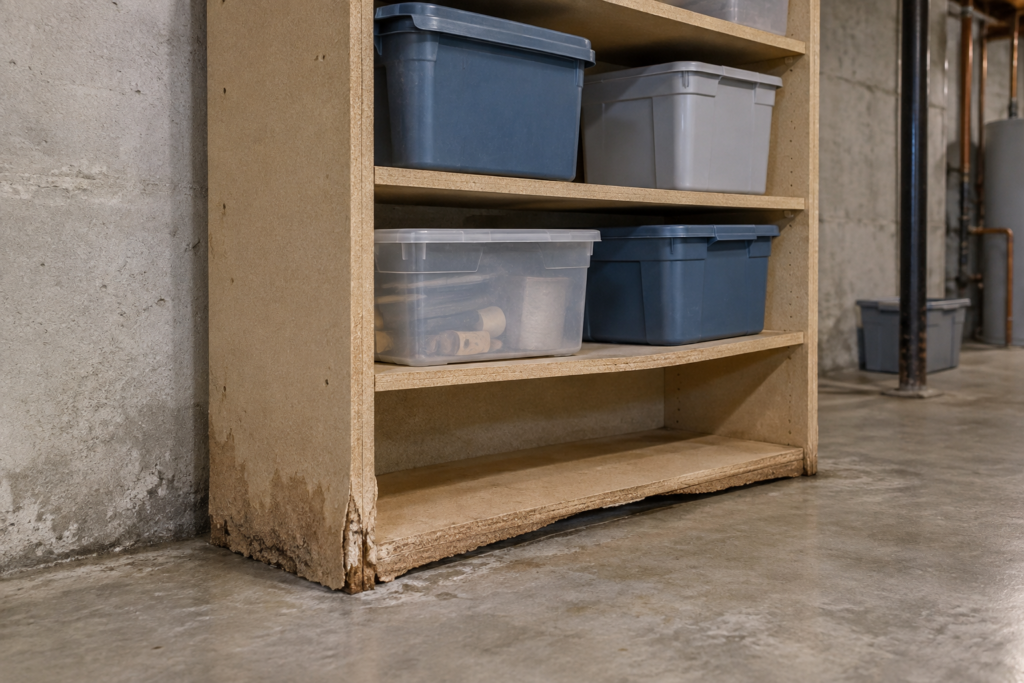
The single most common — and most expensive — mistake is storing on particleboard or MDF shelving, usually the cheap ready-to-assemble units, set right on the concrete.
Particleboard and MDF are wood fibers held together with resin, and they have almost no resistance to humidity. In a damp basement they don’t just get “a little swollen.” The bottom shelf drinks moisture from the slab, the edges puff and crumble, the whole unit sags under load, and within a season or two it’s garbage. Worse, it becomes a mold host — and once mold takes hold, the right basement materials matter far more than you’d think, because now the fungus has a food source sitting right next to your belongings.
Cardboard directly on the floor is the same mistake in a different costume.
Best Unfinished Basement Storage Ideas for Damp Spaces
Here’s what actually survives down there, roughly best to worst.
Coated wire and steel shelving
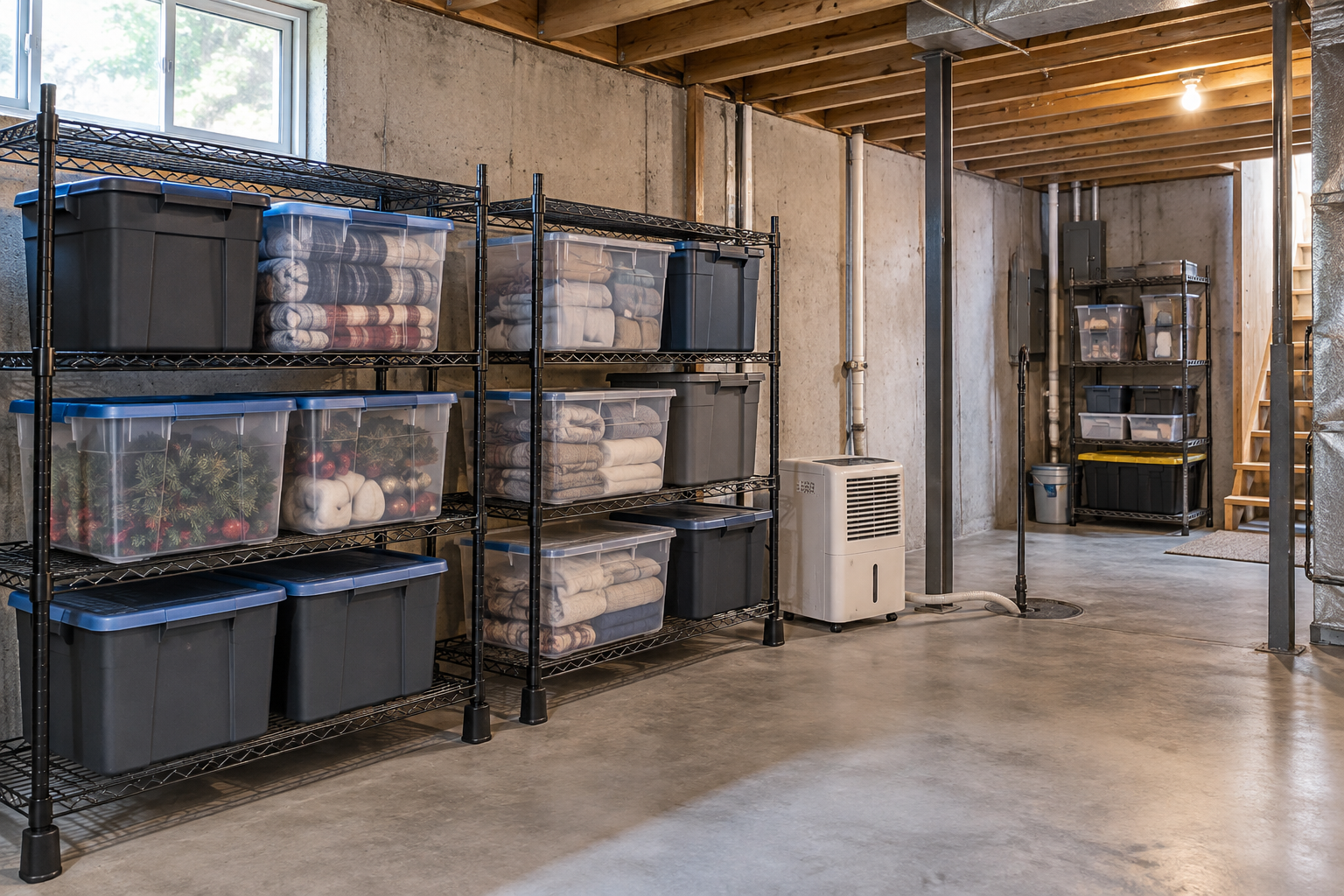
Powder-coated or chrome wire shelving is the workhorse of a damp basement. Air moves freely through it, so nothing traps condensation against a solid surface, it doesn’t absorb water, and coated steel resists rust far better than bare metal. Adjustable, load-rated units on leveling feet keep everything off the slab by design. This is the first thing I’d reach for.
Watch the coating, though: a scratched or chipped powder coat exposes bare steel, and that’s where surface rust starts in humid air. Buy the rated units, not the decorative ones.
Sealed plastic totes (not cardboard)
For anything boxed — holiday decorations, documents, off-season clothes — heavy-duty polypropylene totes with gasketed or tight-snap lids are the answer. Plastic doesn’t absorb moisture, and a good seal keeps humid air off the contents. Clear totes save you opening every lid to find one thing.
Two cautions. First, totes still shouldn’t sit on bare slab — condensation can form under a sealed tote and pool. Second, a sealed tote traps whatever humidity was in the air when you closed it, so pack on a dry day or drop in a desiccant pack.
Plywood shelving, done right
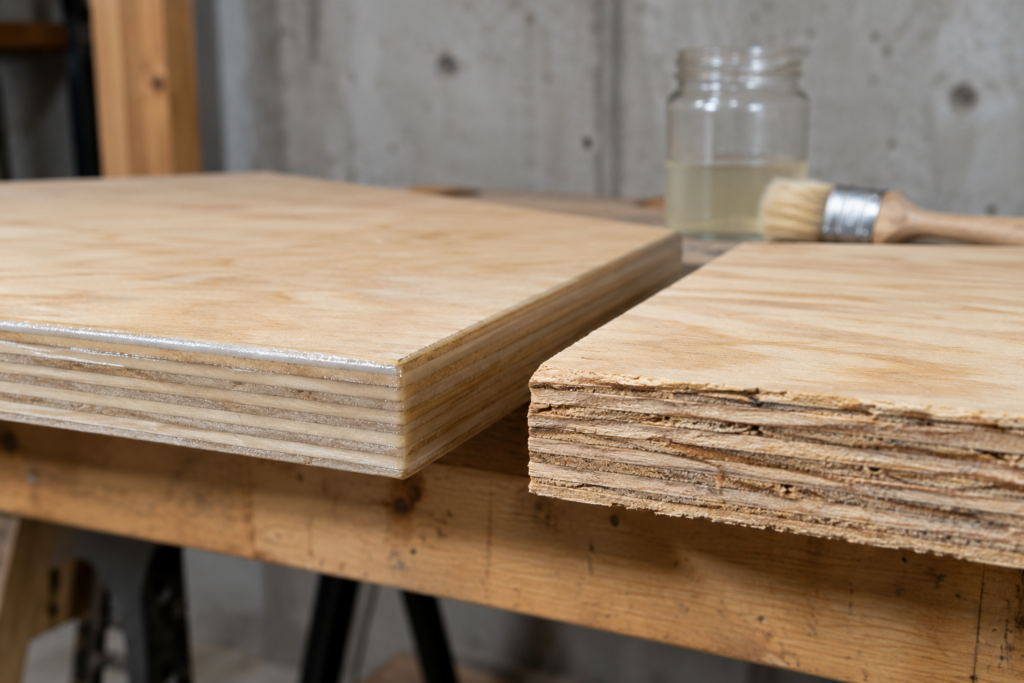
Plywood can work in a basement, but only if you build it correctly — and this is where most people get the material science backwards (more on that in the warning below). If you’re building fixed shelving in a basement that’s kept reasonably dry, use a quality panel with an Exterior or Exposure 1 bond classification, seal every face and cut edge, and keep the wood from touching concrete. For basement shelving, panel thickness depends on the shelf span, expected load, and amount of framing underneath it.
Sealing matters most at the edges, because that’s where plywood drinks water fastest. A quality primer/paint or a penetrating sealer on every cut edge is what turns a raw panel into a shelf that lasts. And be clear-eyed about the limits: Exposure 1 is not meant for continuously wet service. If the spot stays wet, fix the water problem — a different plywood grade won’t save shelving that lives in a puddle.
Marine plywood gets suggested for jobs like this, but it is usually unnecessary. Marine-grade plywood uses higher-quality veneers, has strict limits on core gaps, and has a durable exterior bond. However, it is not automatically treated against fungal decay. For ordinary basement shelving, properly sealed exterior-bond plywood in a dry, controlled basement is usually the better value.
What to avoid
Particleboard, MDF, and bare cardboard, as covered above. Also skip untreated softwood lumber sitting on or near the slab long-term without a finish — it’ll cup and can host mold at the contact points.
Storage Options at a Glance
Storage option
Moisture resistance
Best use
Main drawback
Coated-wire steel shelving
High
General open storage
Coating can chip and rust
Plastic shelving
High
Lightweight totes and bins
Lower load capacity
Sealed plywood shelving
Moderate
Custom built-ins
Must be sealed and elevated
Gasketed plastic totes
High
Clothing and decorations
Can trap existing moisture
MDF or particleboard
Poor
Avoid in damp spaces
Swells, sags, and can support mold
Cardboard boxes
Poor
Dry rooms only
Absorbs moisture quickly
Warning: “Waterproof Glue” Is Not “Rot-Proof Wood”
This is the misconception that costs people the most, so it gets its own section.
A plywood panel’s bond classification (Exposure 1 vs. Exterior) tells you about the glue holding the layers together — how much moisture the panel can take before the plies separate. It tells you nothing about whether the wood itself will rot. The APA states this plainly: bond classification relates to the glue bond, not to biological resistance like mold or fungal decay.
Decay resistance is a completely separate property. It comes from either the natural durability of the wood species or from preservative treatment applied to AWPA standards. So an Exposure 1 panel with a fully waterproof adhesive can still rot if it stays wet, because the wood fiber isn’t protected even though the glue is.
Practical translation for your basement: don’t assume a panel labeled with waterproof glue is safe to leave damp. If it’s going somewhere that stays wet, it needs to be treated for decay and sealed — not just bonded with exterior adhesive. Keep bond and decay in separate boxes and you’ll buy the right panel every time.
Get Your Stuff Off the Slab
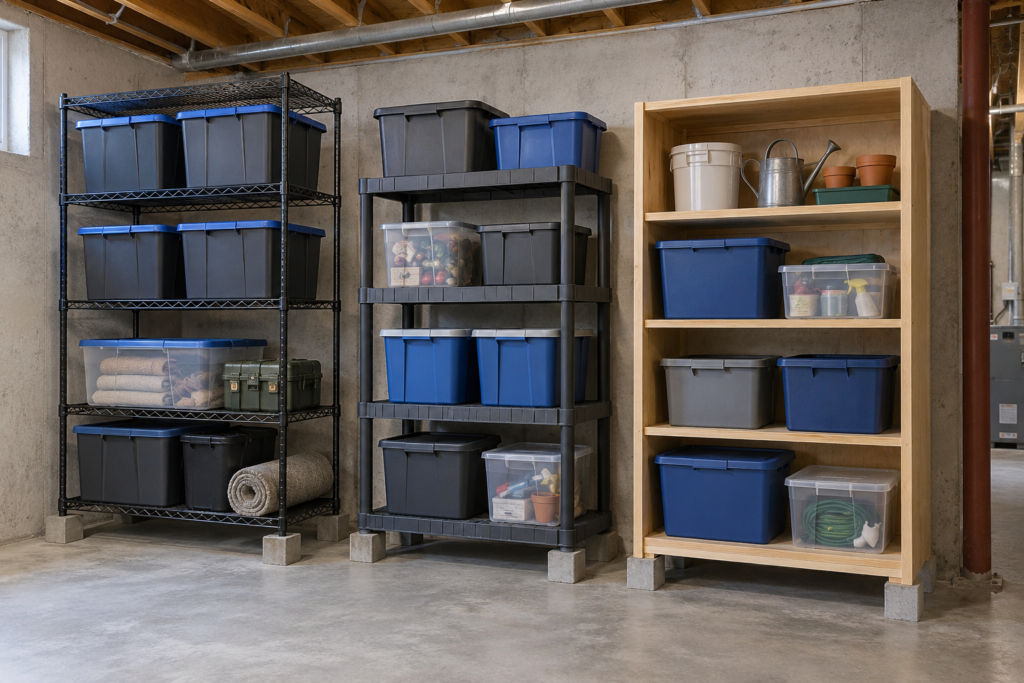
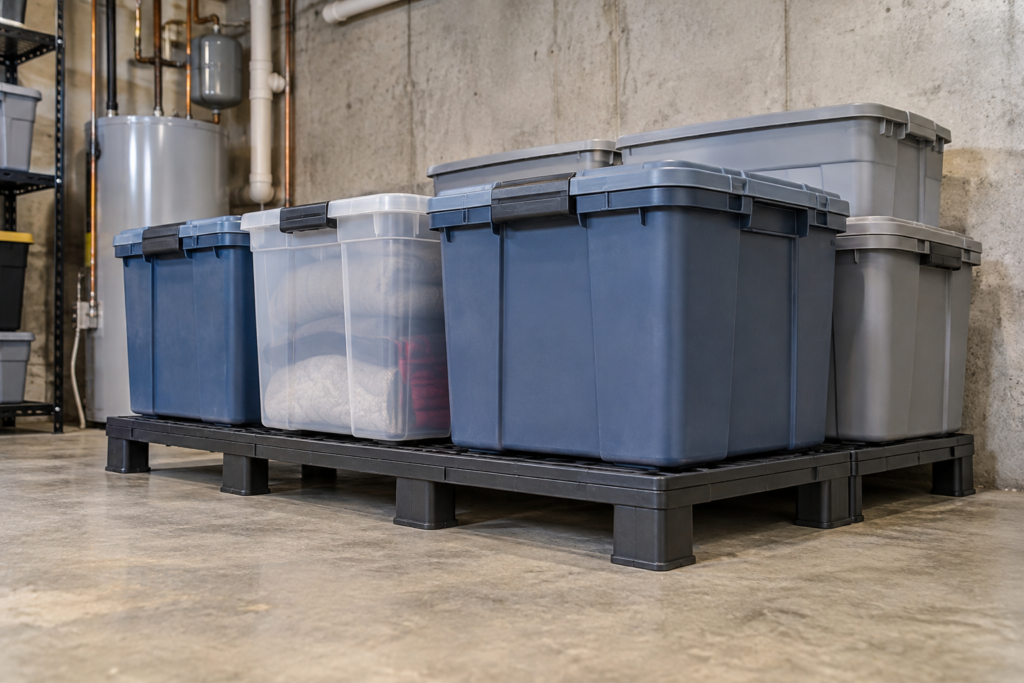
Whatever you store on, one rule sits underneath all of it: keep cardboard, wood, textiles, furniture, and belongings off the concrete. Use nonabsorbent plastic risers, shelving feet, or plastic pallets to create separation.
Some basement slabs transmit moisture intermittently or continuously. Elevating stored materials does not fix the slab, but it reduces direct contact and allows air to move beneath your belongings. I’d treat about four inches as a sensible minimum for stored goods — that’s a practical storage habit, not a building code figure. Options, cheapest first: plastic pallets (not wood pallets, which absorb moisture and can mold), composite risers, shelving with tall leveling feet, or a run of pressure-treated sleepers under a sealed plywood platform. If you’re going the plywood-platform route, our basement subfloor plywood guide walks through the same slab-moisture problem in detail. Shelving feet and properly designed plastic risers are fine to sit on the concrete themselves — the point is that nothing absorbent does.
Cut the Humidity at the Source
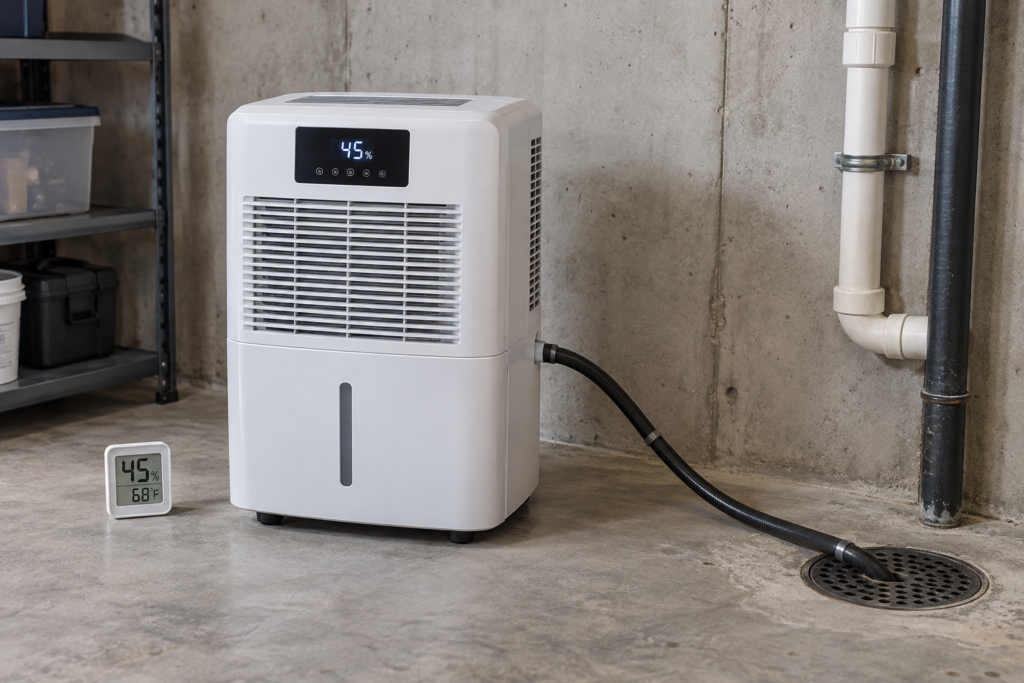
Elevation handles slab moisture. A dehumidifier handles the air.
Aim to hold basement relative humidity in the 30% to 50% range — low enough to starve mold and stop condensation, without over-drying. A basement-rated dehumidifier with a built-in humidistat, ideally plumbed to a drain so you’re not emptying a bucket, does most of the work. Pair it with whatever ventilation the space allows.
If your basement is damp because water is actually coming through the walls or floor, a dehumidifier is treating the symptom. But be careful about assuming a masonry coating is the cure. Products like Drylok can reduce dampness passing through basement walls, but they are not substitutes for exterior drainage, foundation waterproofing, or proper under-slab moisture control. Hydrostatic pressure, poor grading, clogged gutters, foundation cracks, and missing slab vapor control each call for a different repair. Diagnose the source before you coat anything — our basement vapor barrier guide breaks down which product solves which problem.
Building codes generally use the term “vapor retarder” and classify qualifying materials according to their vapor permeance. A masonry coating should not be treated as a complete vapor-control system unless its tested rating and intended application support that use.
A Simple Moisture Test Before You Store Anything
Before you invest in shelving or move anything valuable down, run the plastic sheet test — the informal version of ASTM D4263.
Tape an 18-by-18-inch square of clear plastic sheeting flat to the slab, sealing all four edges with tape. Leave it 24 to 48 hours, then pull it up. Moisture or darkening beneath the plastic suggests moisture is present beneath the sheet. Keep absorbent storage off the slab and investigate the moisture source before deciding whether the concrete needs coating, drainage work, or another repair.
One honest caveat: a dry result during a single test doesn’t guarantee the slab always stays dry. Concrete moisture shifts with weather, season, and groundwater, and this method only indicates presence — it doesn’t measure how much or how deep. If your basement has any history of dampness, repeat the test in several spots, or during a wetter stretch of the year, before you trust it.
What Not to Store in an Unfinished Basement
Some things don’t belong down there at all, no matter how good your shelving is:
Original documents, irreplaceable photos, and anything paper you can’t replace
Electronics, which corrode and fail in humid air
Mattresses and untreated fabrics, which absorb moisture and mold
Food in paper or cardboard packaging
Paint and household chemicals exposed to temperature swings
Propane, gasoline, and other flammable fuels — a safety issue, not just a moisture one
Valuable wood furniture and musical instruments, which move and crack with humidity
If it’s valuable, sentimental, or dangerous when damp, store it in conditioned space upstairs.
The Cost Difference Over Time
The math is where the cheap route loses. A budget particleboard shelving unit is genuinely inexpensive up front, but in a damp basement it’s a consumable — plan on replacing it as the shelves sag and the edges crumble. Buy it three times and you’ve matched or beaten the price of one coated-wire steel unit that outlasts all three and does not provide the same absorbent food source for mold. In a dry closet, cheap shelving is fine. In an unfinished basement, cheap shelving is a recurring bill.
Recommended Gear
A short list of what actually earns its place in a damp basement:
Coated or chrome wire shelving (load-rated, with leveling feet) — the basement default
Can you store furniture in an unfinished basement? Yes, if you protect it. Keep it off the slab on risers, hold humidity in the 30–50% range with a dehumidifier, and cover it with breathable fabric rather than plastic sheeting, which traps condensation against the finish. Valuable or antique pieces are better off upstairs.
Is plywood or particleboard better for basement shelving? Plywood, by a wide margin — but only sealed and elevated. Particleboard and MDF absorb moisture and fail fast in a damp basement. Use a quality Exterior or Exposure 1 panel, seal every edge and face, and keep it off the concrete.
Do I need to seal my basement before storing things? Not necessarily to store things, but reducing the moisture load makes everything last longer. Before sealing, find out where the moisture is coming from — a coating won’t fix drainage, grading, or hydrostatic pressure, and may just hide the real problem.
Are plastic totes safe for a damp basement? Yes, when they seal well and sit off the floor. A gasketed lid keeps humid air off the contents, and a desiccant pack handles whatever you sealed in. Just don’t set them directly on the slab, where condensation can pool underneath.
What humidity level should a storage basement be? Between 30% and 50% relative humidity, per EPA guidance, with 60% as the upper limit you don’t want to cross. A basement-rated dehumidifier with a humidistat will hold it there.
Related Posts:
How to Clean Old Unfinished Wood Floors by Admin May 20, 2025 More About Cleaning old unfinished wood floors can feel intimidating—after all, they’re raw, porous, and prone to staining or warping. But the good news is: with the…