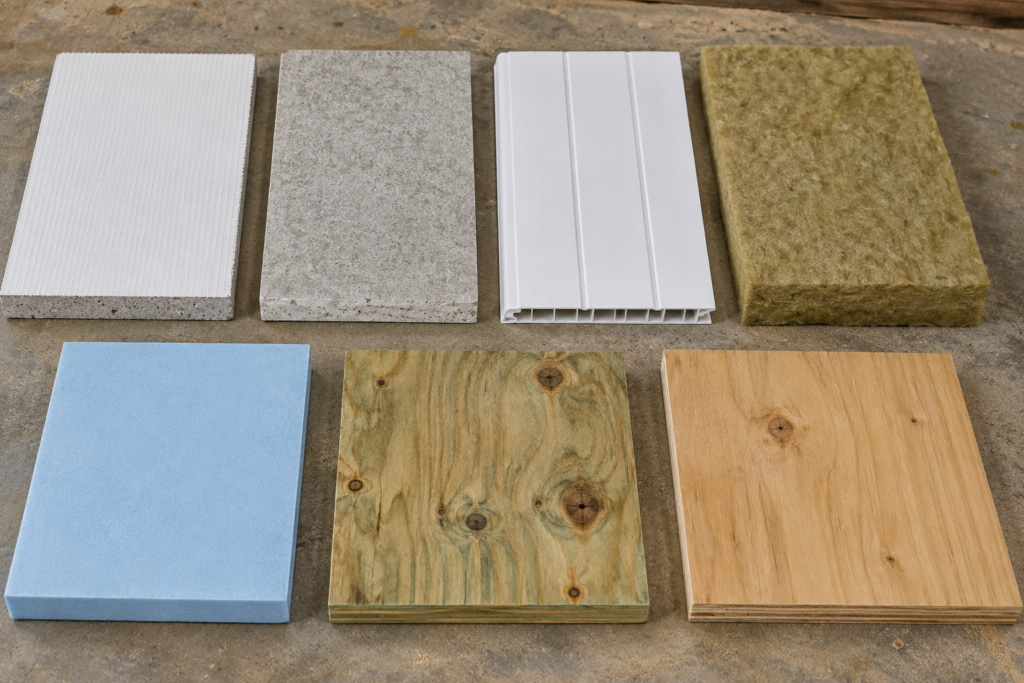
The best mold resistant basement materials are inorganic or moisture-tolerant products: fiberglass-faced (paperless) drywall, cement board, PVC wall panels, mineral wool insulation, closed-cell rigid foam (XPS or EPS), and pressure-treated or Exterior-rated plywood. The rule is simple — mold needs organic food and moisture to grow, so every material you put in a basement should either contain no food source or shrug off moisture when it arrives. Standard paper-faced drywall, fiberglass batts against concrete, and untreated interior plywood fail on both counts, which is why they’re behind most moldy basement teardowns.
Below is how each material performs, where it belongs in the wall and floor assembly, and the mistakes that turn a “mold resistant” product into a mold farm anyway.
Mold Resistant Basement Materials Compared
Material
Mold Resistance
Best Use
Relative Cost
Notes
Fiberglass-faced (paperless) drywall
High
Finished walls, ceilings
$$
No paper facing = no food source
Cement board
Very high
Walls, wet areas, behind tile
$$$
Inorganic; heavy to hang
PVC wall panels
Very high
Damp or flood-prone walls
$$$
Waterproof; wipes clean
Mineral wool insulation
Very high
Stud cavities
$$
Resists water absorption and dries without supporting mold
Rigid foam (XPS/EPS)
Very high
Against foundation walls, under subfloors
$$
Closed-cell; acts as vapor control layer
Pressure-treated plywood
High
Furring, sill plates, subfloor near slab
$$
Treated against fungal decay
Exterior / Exposure 1 plywood
Moderate–High
Subfloors, utility walls (sealed)
$$
Exterior-type adhesive; wood face can still mold if kept wet
Standard paper-faced drywall
Low
Avoid in basements
$
Paper facing is mold food
Fiberglass batts (against concrete)
Low
Avoid against foundation walls
$
Traps moisture, sags, hides mold
Why Basements Grow Mold in the First Place
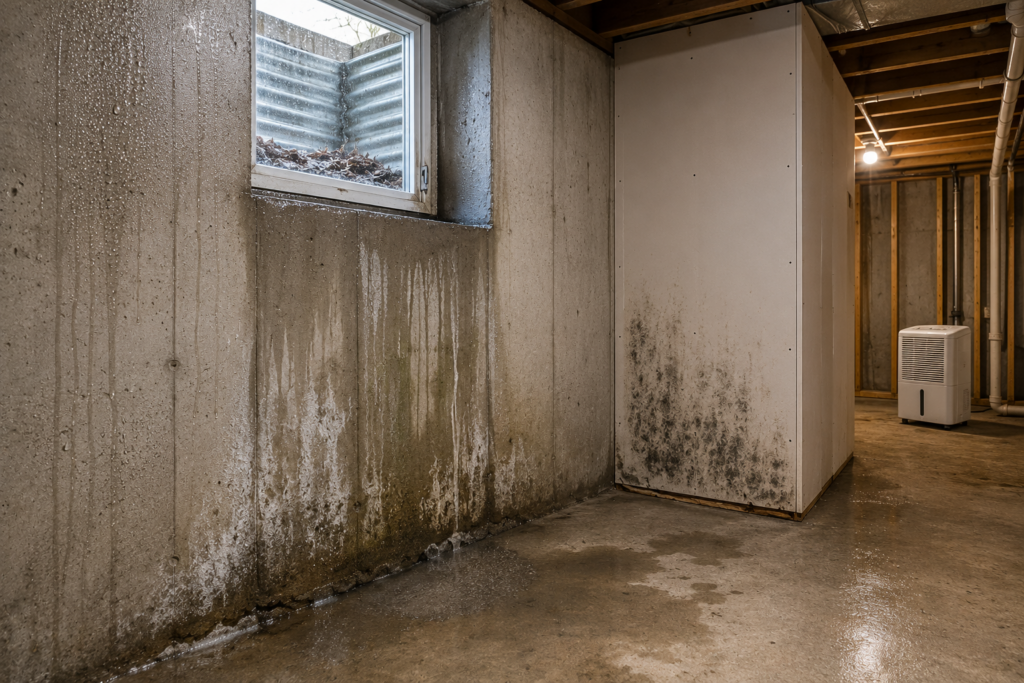
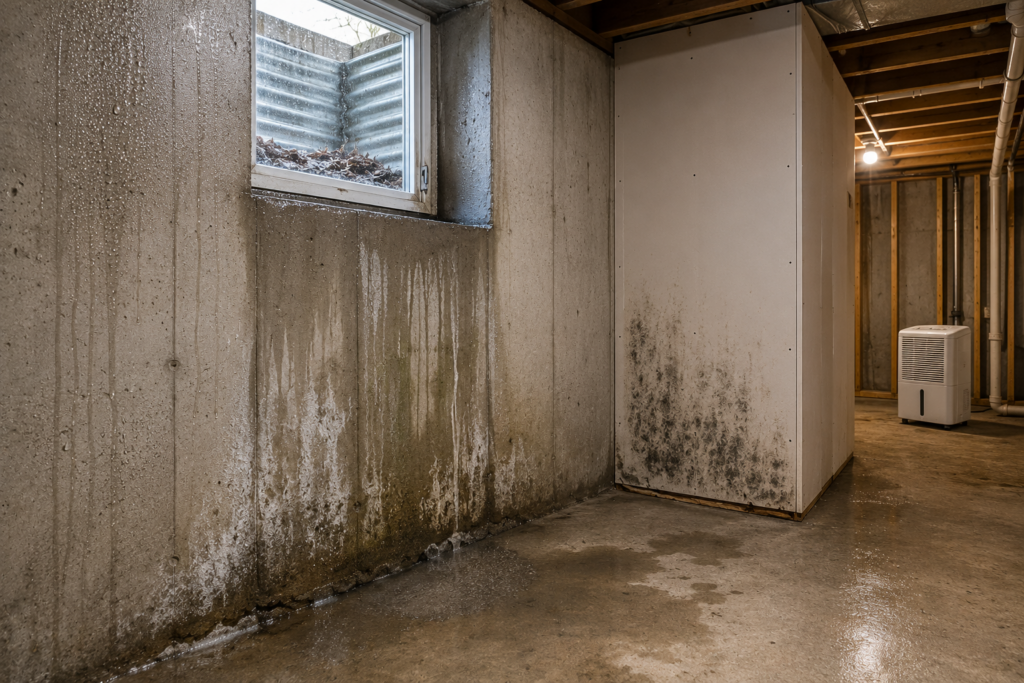
Mold needs three things: spores (always present), a food source, and moisture. You can’t eliminate spores. You cancontrol the other two.
Basements supply moisture from multiple directions at once. Water vapor migrates through the concrete itself — foundations wick ground moisture continuously, even when walls look bone dry. Warm interior air condenses on cool below-grade surfaces. And occasional bulk water shows up through cracks, floor joints, and window wells.
That’s why “mold resistant” is really two strategies working together:
Choose materials with no food value — cement, fiberglass, mineral wool, foam, and PVC do not readily support mold growth, although mold can still grow on dust, adhesives, or other organic material deposited on their surfaces.
Control the moisture — sealed foundation walls, vapor management, and drainage keep organic materials (like framing lumber and plywood) below the moisture threshold where mold activates.
❌ The #1 mistake: treating material selection as a substitute for moisture control. Mold resistant products buy you forgiveness, not immunity. If water is actively entering the basement, fix that first — before a single stud goes up. A wall assembly built over an unsolved leak fails no matter what it’s made of.
Wall Materials
Fiberglass-Faced (Paperless) Drywall
Standard drywall fails in basements because of its paper facing — paper is processed wood fiber, and mold colonizes it readily at sustained humidity. Paperless drywall replaces the paper with fiberglass mats, removing the food source while installing and finishing almost identically to regular drywall.
This is the best “looks like a normal finished room” option for basements. It costs more per sheet than standard drywall, but it’s cheap insurance compared to a teardown.
❌ Don’t confuse “mold resistant” green board with paperless drywall. Green board is still paper-faced — it’s treated for humidity, not built for it. In a basement, fiberglass-faced is the stronger choice.
Cement Board
Cement board is highly water-durable and contains little material that supports mold growth. However, it is not a waterproofing membrane, and mold can still grow on dirt, adhesive, paint, or other organic material deposited on its surface. It’s the standard backer behind tile in wet areas, and it works as a wall surface in utility basements where finish quality matters less than durability. The tradeoffs are weight, dust when cutting, and a rougher finished look unless you skim coat or tile over it.
PVC Wall Panels
For chronically damp basements or homes with flood history, PVC panels are the most forgiving surface available. They’re waterproof top to bottom, wipe clean, and don’t care if they get soaked. Interlocking systems install over furring strips and can be removed for access. The cost is higher than drywall, and the look is more utilitarian, but nothing on this list survives a wet basement better.
Plywood on Basement Walls
Plywood can work on basement walls — but only the right plywood, installed the right way. Use Exterior-rated plywood where repeated moisture exposure is possible. Exposure 1 plywood uses an exterior-type adhesive but is intended mainly to withstand temporary exposure during construction (APA – The Engineered Wood Association terminology). Neither classification makes the wood surface mold-proof — the panel must still be sealed on all sides and installed over a dry, vapor-controlled wall, never directly against concrete. For a full breakdown of plywood and other panel options for below-grade walls, see our guide to finishing basement walls without drywall.
For furring strips and any wood in contact with concrete, use pressure-treated lumber or pressure-treated plywood. Pressure treatment improves resistance to wood-decay fungi and insects, but pressure-treated lumber can still develop surface mold when stored or installed in persistently damp conditions.
Insulation
Mineral Wool
Mineral wool is spun from rock — it’s water-repellent, vapor-permeable, and does not readily wick or hold bulk water, and it gives mold nothing to feed on. If it becomes wet, it should be thoroughly dried; once dry, it can retain its original insulation performance. It’s also fire resistant. For basement stud cavities, it’s the clear upgrade over fiberglass batts.
Rigid Foam (XPS and EPS)
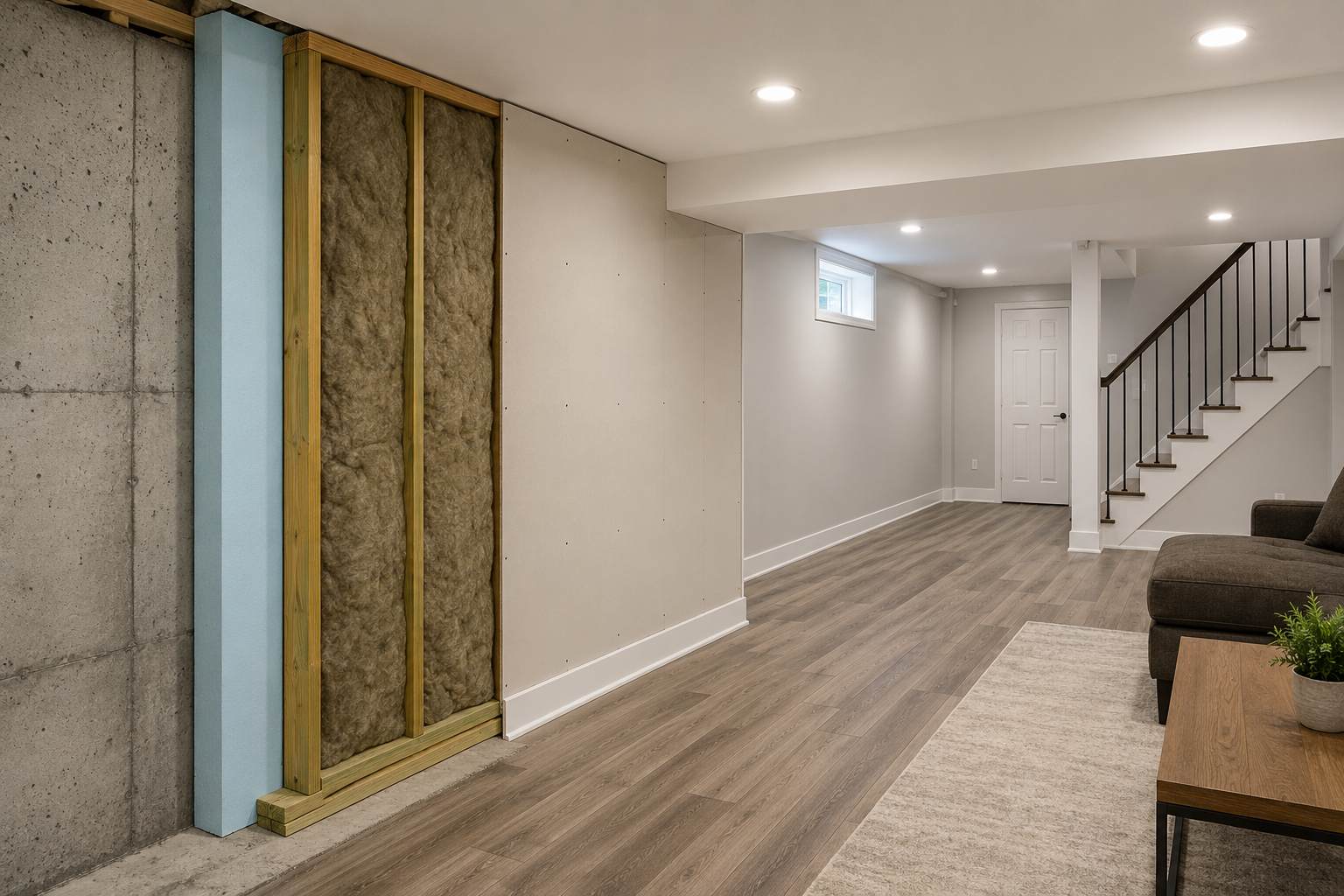
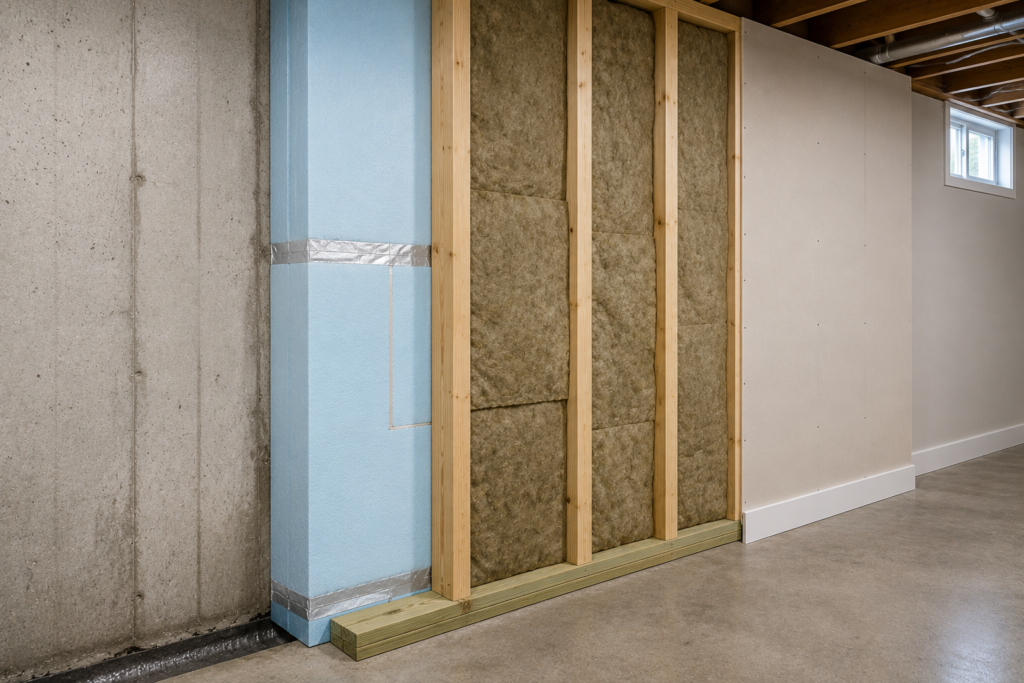
Closed-cell rigid foam board installed directly against the foundation wall does two jobs: it insulates, and it keeps warm interior air from ever touching the cold concrete. When the foam is continuous, properly air-sealed, and thick enough for the climate, it greatly reduces the risk of interior air reaching cold concrete and creating condensation inside the wall cavity. Tape the seams, then frame your stud wall inboard of the foam. This assembly — foam against concrete, framing in front, mineral wool in the cavities if you need more R-value — is the modern standard for a mold-resistant basement wall.
❌ Never install fiberglass batts directly against a foundation wall without a continuous air and moisture-control layer. Fiberglass batts are air-permeable and do not stop humid interior air from reaching cold concrete, where condensation can occur. Wet or contaminated insulation can then lose performance and develop mold on accumulated dust, facings, or other organic material.
❌ Don’t sandwich the wall between two vapor barriers. Rigid foam against the concrete already controls vapor. Adding interior poly sheeting behind the drywall traps any moisture that gets in with no way to dry. One vapor control layer, on the concrete side — then let the assembly dry inward.
Concrete slabs wick ground moisture continuously through capillary action, so anything organic laid directly on the slab is at risk — the same reason we cover moisture prep in detail in our guide to installing flooring over concrete.
The mold-resistant approach is to break contact with the concrete:
Dimpled subfloor membranes or subfloor panel systems create an air gap between the slab and the finished floor, letting incidental moisture drain and dry.
Rigid foam under plywood insulates the floor and blocks vapor; use tongue-and-groove Exposure 1 subfloor panels over the foam, sized per our guide to the best plywood thickness for subfloors.
Inherently waterproof finished floors — luxury vinyl plank, tile — tolerate slab moisture far better than carpet or solid hardwood.
❌ Skip wall-to-wall carpet on below-grade slabs. Carpet and pad absorb slab moisture and condensation, and the backing is a food source. If you want softness, use area rugs you can lift and dry.
If you’re building out the full space, get the sequencing right: moisture control first, then framing, then insulation and surfaces. Our step-by-step guide on how to frame a basement covers the pre-framing moisture inspection and the gap you should leave between framing and foundation walls.
Sealers and Coatings
Masonry waterproofing coatings (Drylok is the best-known brand) bond to and seal properly prepared porous masonry, blocking moisture from passing through the wall. They’re a legitimate layer of defense on poured concrete and block walls — with two caveats:
They must go on bare, clean masonry. They don’t bond over paint, efflorescence, or previously sealed surfaces without prep.
They handle vapor and seepage, not structural water problems. Active leaks, hydrostatic pressure, and drainage failures need exterior grading, gutters, French drains, or a sump system — a coating won’t hold back what the ground keeps pushing in.
If you’re comparing products, note that the manufacturer’s lines differ: Drylok Extreme carries a longer warranty and higher hydrostatic pressure rating than the original formula. Those are manufacturer claims, and they depend on correct surface preparation and application — so match the product to your wall’s actual moisture load and follow the prep instructions on the can rather than grabbing the cheapest option.
The Assembly That Puts It All Together
For a finished, livable, mold-resistant basement, this is the wall from concrete to paint:
Fix bulk water first — grading, gutters, crack repair, drainage.
Seal bare masonry with a waterproofing coating (optional belt-and-suspenders on dry walls; worthwhile on damp-prone ones).
Rigid foam board against the concrete, seams taped — insulation and vapor control in one layer.
Pressure-treated bottom plate, stud wall framed in front of the foam with a gap from the concrete.
Mineral wool in the cavities if additional R-value is needed.
Fiberglass-faced drywall (or PVC panels in damp-prone spaces), painted with mold-resistant primer and paint.
No interior poly vapor barrier.
Exact insulation thickness, vapor-retarder requirements, and required thermal or ignition barriers vary by climate zone and local building code. Confirm the proposed assembly with the applicable code and foam-panel manufacturer before construction.
Together, these layers limit moisture accumulation, reduce exposed organic surfaces, and give the assembly a better opportunity to dry.
FAQ
What is the most mold resistant material for basement walls?
PVC wall panels and cement board are among the most moisture-tolerant basement wall materials. PVC is nonabsorbent, while cement board remains dimensionally durable when exposed to moisture. Neither eliminates the need for drainage, drying, and moisture control. For a conventional finished look, fiberglass-faced (paperless) drywall is the best choice, since it removes the paper facing that mold feeds on.
Can I use regular drywall in a basement?
You can, but it’s the material most likely to fail. Standard drywall’s paper facing is a food source for mold, and basements supply the moisture. Fiberglass-faced drywall installs the same way and reduces the risk for a modest cost increase.
Is plywood mold resistant?
Plywood with an Exterior or Exposure 1 bond classification uses exterior-type adhesive, so the glue line resists moisture — but Exposure 1 is intended mainly for temporary construction exposure, and neither rating makes the wood surface mold-proof. Pressure-treated plywood adds resistance to wood-decay fungi and insects, though surface mold can still appear if the wood stays damp. Either way, plywood in a basement should be sealed and kept off direct concrete contact.
What insulation doesn’t grow mold in basements?
Mineral wool and closed-cell rigid foam (XPS or EPS). Both resist moisture absorption and do not readily support mold growth. Mineral wool should still be thoroughly dried if it becomes wet, and the water resistance of rigid foam varies by product type and installation. Avoid fiberglass batts placed directly against foundation walls without a continuous air and moisture-control layer — humid interior air can reach the cold concrete and condense inside the assembly.
Do I need a vapor barrier with mold resistant materials?
You need vapor control, not necessarily a plastic sheet. Rigid foam sealed against the foundation wall handles it. What you must avoid is a poly vapor barrier on the interior side of the wall — it traps moisture inside the assembly and causes the failures it’s supposed to prevent.
Will mold resistant paint stop mold?
Mold-resistant primer and paint help on the surface they coat, but they can’t compensate for a wet wall assembly behind them. Treat them as the final layer of a dry system, not a fix for a moisture problem.
Rot-Resistant Woods: The Best Choices by Admin May 16, 2025 Grades Wood has always been prized for its natural charm and durability. But when used outdoors, not all wood holds up the same. Some species begin…
Heat Resistant Plywood: Safe, Durable, DIY-Ready by Admin October 26, 2025 More About The Moment I Learned Regular Plywood Has Limits Years ago, I trimmed out a wall beside a freestanding wood stove using “good” birch cabinet-grade plywood.…