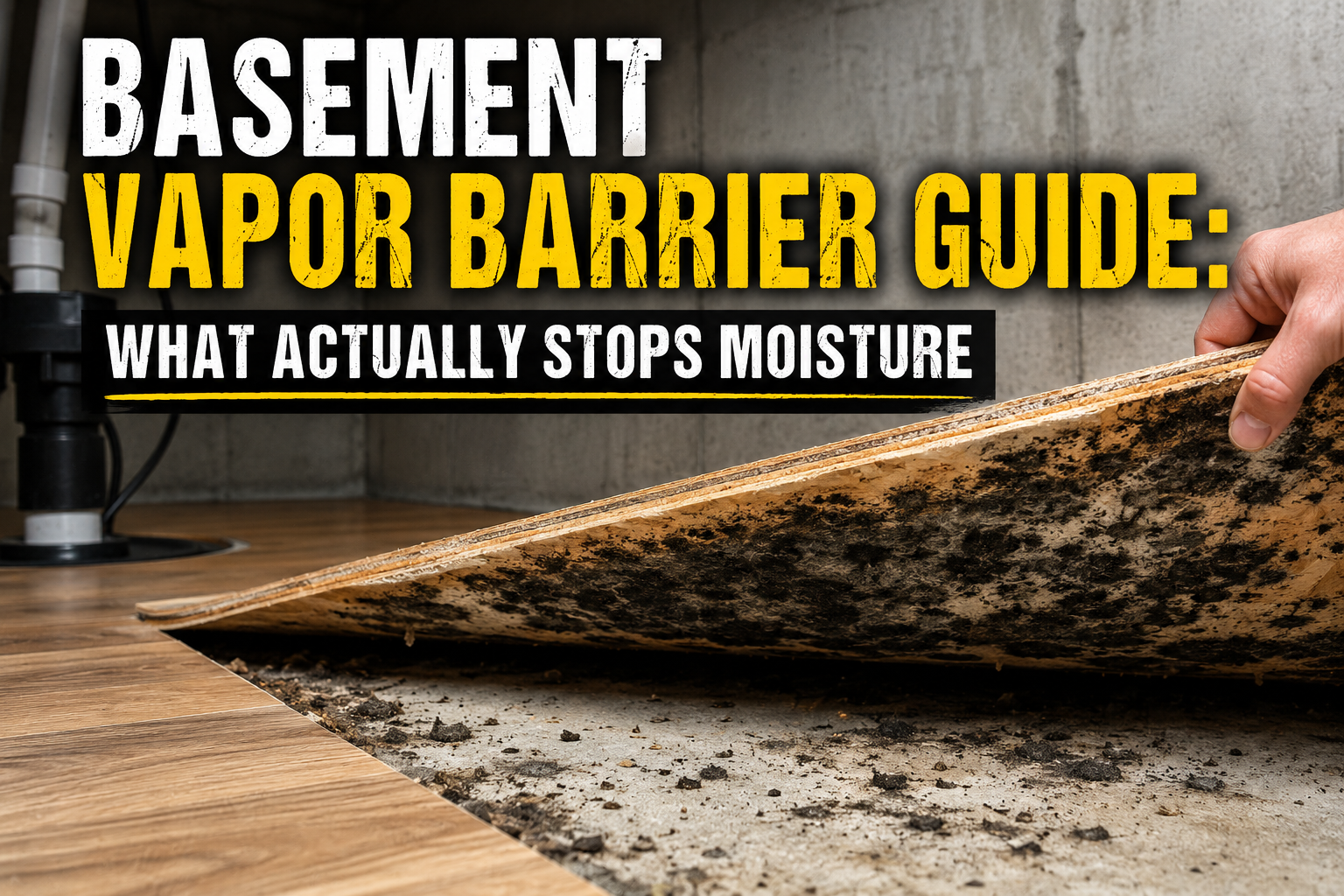
I learned about basement vapor barriers the expensive way — by not installing one. I finished a basement, laid laminate flooring over plywood subfloor panels, and felt pretty proud of myself for about fourteen months. Then I pulled up a corner near the sump pump and found black mold growing on the underside of the plywood. The slab looked bone dry. It wasn’t.
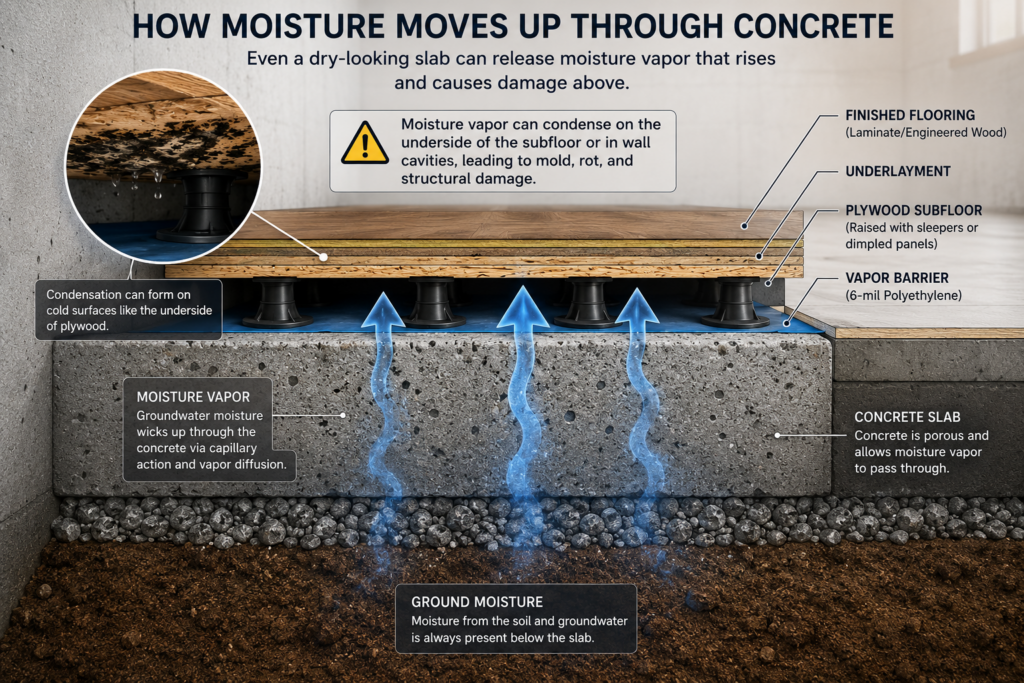
Concrete moves moisture upward constantly, even when it looks and feels completely dry to the touch, and if you don’t interrupt that path, everything you build on top of it eventually pays the price.
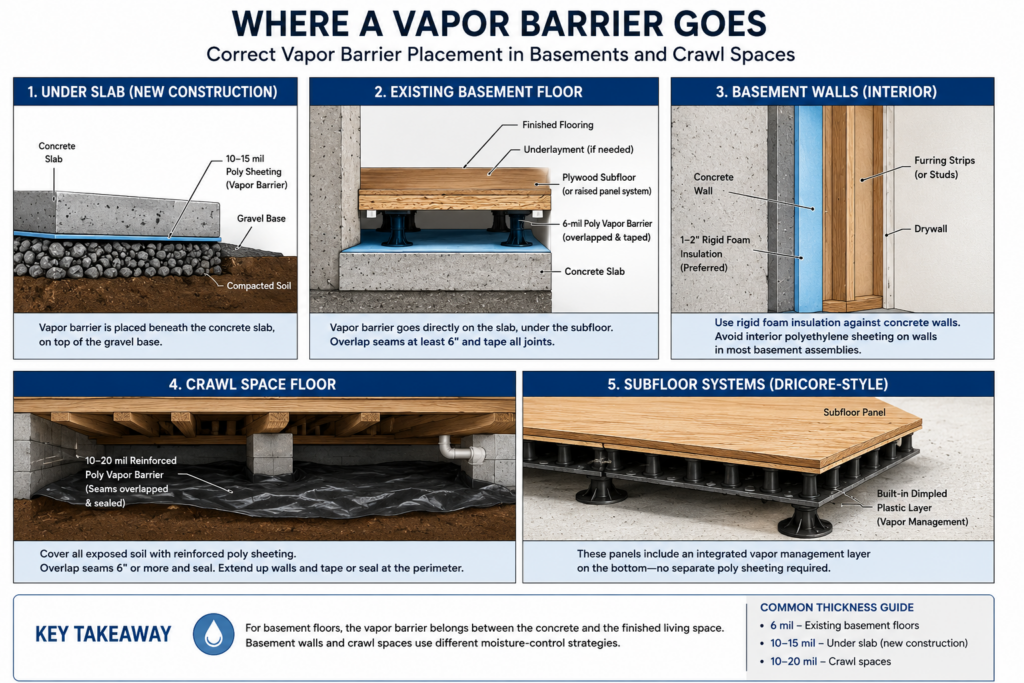
A basement vapor barrier is installed between the concrete and the finished living space on the floors, while basement walls typically use rigid foam insulation against the concrete rather than interior polyethylene sheeting.
This guide covers where vapor barriers go, which type to use in each location, and the mistakes that turn a “finished” basement into a mold problem waiting to happen.
Where a Vapor Barrier Actually Goes
Location
Vapor Barrier Type
Typical Thickness
Where It Sits
Under the slab (new construction)
Poly sheeting
10–15 mil
Beneath concrete, on top of gravel
Existing slab floor
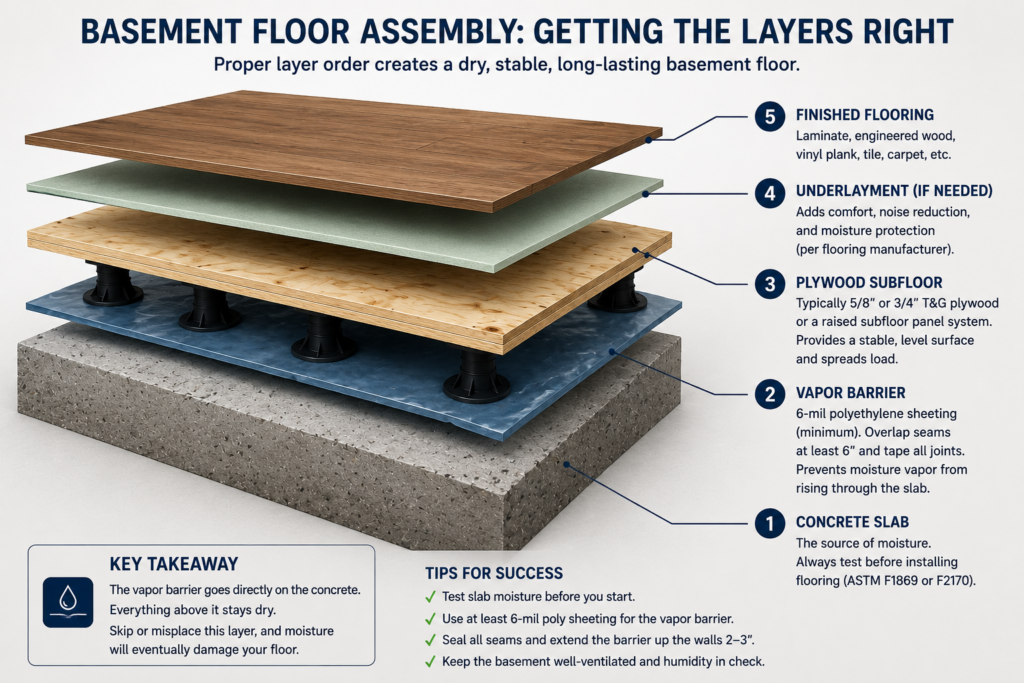
6-mil poly or vapor barrier subfloor panels
6 mil / varies
Directly on slab, under subfloor
Basement walls
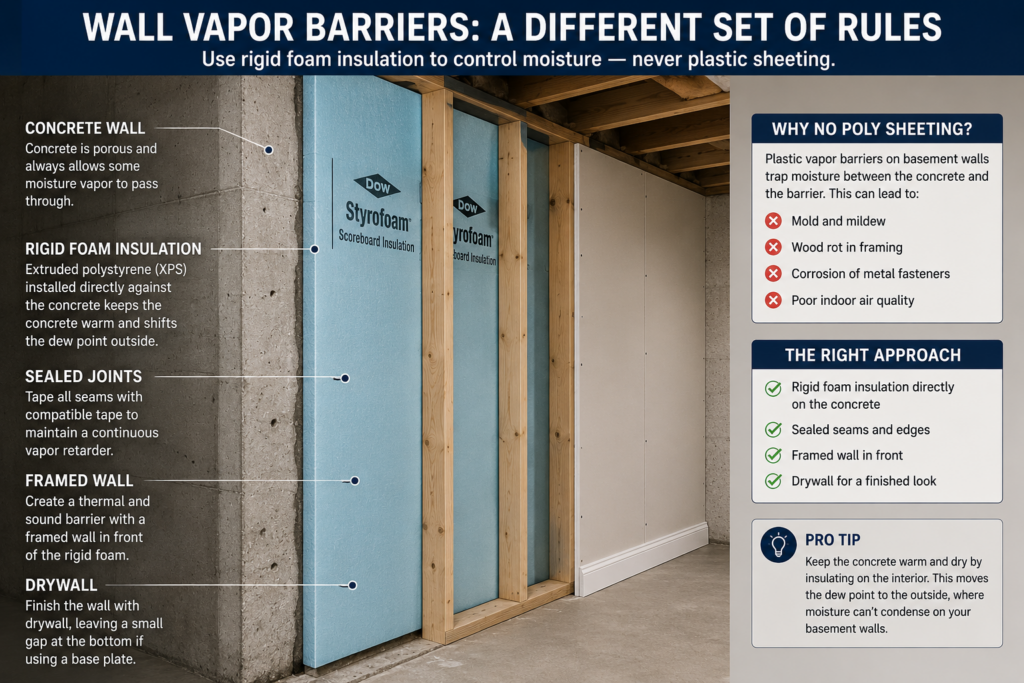
Rigid foam insulation against concrete
1–2 inch foam
Directly on the wall, under furring/drywall
Crawl space floor
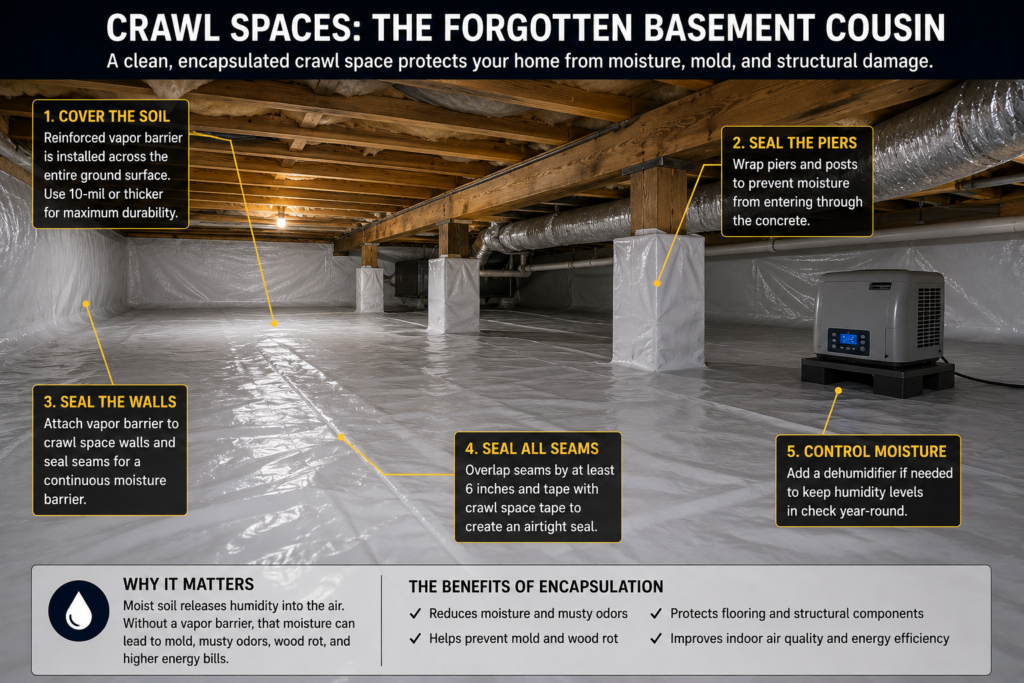
Reinforced poly sheeting
10–20 mil
Covering exposed dirt/gravel
Subfloor systems (DRIcore-style)
Built-in dimpled plastic layer
N/A
Bottom of the panel itself
👉 The floor and wall rules are not the same. For basement floors, the vapor barrier should be installed between the concrete and the finished living space. Basement walls follow different moisture-management rules, and in most modern basement assemblies, installing interior polyethylene is best avoided.
Do This / Don’t Do This
Do
Don’t
Use 6-mil poly under basement floors
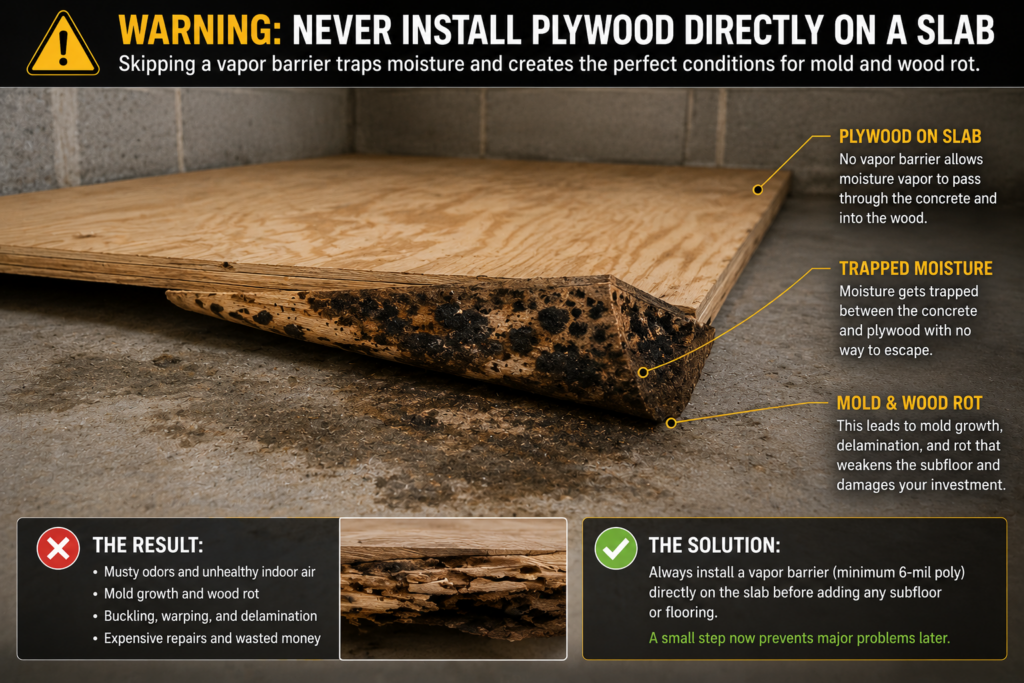
Install plywood directly on concrete
Tape all seams
Butt seams together
Use rigid foam on basement walls
Install interior poly by default
Test slab moisture first
Assume a dry floor means a dry slab
Why Basements Need This in the First Place
Concrete is porous. Even a slab that was poured correctly, with a proper gravel base and footing drains, will continue to wick groundwater moisture upward through capillary action for the life of the house. You won’t see puddles. You’ll see something worse: slow, invisible vapor transmission that condenses the moment it hits a colder surface — like the underside of plywood, the back of drywall, or a stud bay with poor airflow.
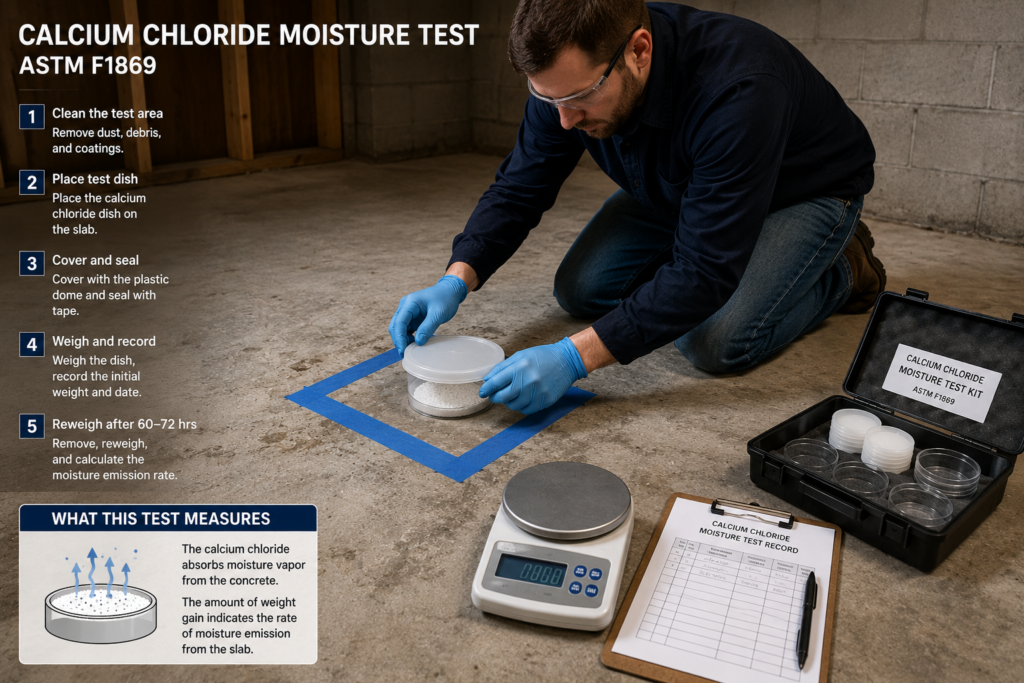
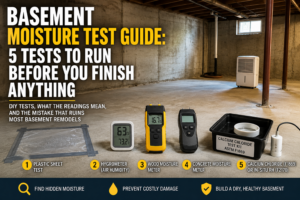
❌ The mistake almost everyone makes: treating “the basement feels dry” as proof there’s no moisture problem. Relative humidity and vapor transmission aren’t things you can feel with your hand. ASTM F1869 calcium chloride testing and ASTM F2170 in-situ relative humidity testing are the two most common methods professionals use to evaluate slab moisture before flooring installation — and increasingly, in-situ
RH probes are preferred over calcium chloride because they account for moisture conditions deeper in the slab, not just at the surface. Either way, the test result should decide whether you’re clear to install flooring, not how the floor feels underfoot.
If you’re planning to put down a plywood subfloor over that slab — which is the standard approach for a finished basement — the moisture conversation has to happen before a single panel goes down. The guide on preparing a subfloor for tile covers moisture testing in detail, and the same testing logic applies whether you’re tiling or installing laminate over plywood.
Vapor Barrier vs. Vapor Retarder (They’re Not the Same)
This distinction trips up a lot of DIYers, and manufacturers don’t always make it obvious on the packaging.
Vapor barrier: Essentially impermeable. Poly sheeting at 6 mil or thicker. Stops moisture transmission almost completely.
Vapor retarder: Slows moisture transmission but allows some to pass through over time.
💸 The cost difference that actually matters: a roll of 6-mil poly sheeting runs $20–$40 for a basement-sized floor area. That’s cheap insurance compared to tearing out flooring two years later because a slower-acting retarder approach let moisture through gradually. For basement floors specifically, skip the half-measures. Use an actual barrier, and test the slab first so you know what you’re dealing with.
Subfloor Plywood Over a Vapor Barrier: Getting the Layers Right
If you’re building a basement floor system rather than going straight to carpet tile or vinyl plank, the typical stack from bottom to top looks like this:
Plywood subfloor (often a dimpled, raised subfloor panel)
Underlayment (if needed)
Finished flooring
This is one of the few places where plywood selection actually changes based on what’s underneath it. Panel thickness matters here too — a basement floor system doesn’t carry the same load profile as a typical joisted subfloor, and the standard guidance in a plywood thickness chart is worth reviewing before you assume a thinner panel will hold up under a raised subfloor system.
A basement floor that’s even partially exposed to residual slab moisture is also a poor candidate for standard interior-grade plywood. If there’s any chance of ongoing dampness — and in a basement, there usually is — it’s worth reviewing the breakdown in pressure-treated plywood: uses, types, and mistakes before you commit to a panel type. That same article walks through the mistakes that cause pressure-treated panels to underperform in damp, low-airflow spots like basements — not every treated sheet is rated for the kind of sustained ground-level moisture exposure a basement floor deals with, and using the wrong rating is one of the most common reasons people end up redoing the job within a few years.
⚠️ Warning: never install plywood directly on a slab with no barrier at all “because it’s just a basement.” Standard plywood sitting flush against concrete with no vapor break is one of the fastest ways to trigger wood rot — and because it’s hidden under finished flooring, you often won’t smell or see it until the damage has already spread across multiple panels.
Basement walls deserve their own section because the floor logic doesn’t carry over, and getting this wrong causes the worst basement failures.
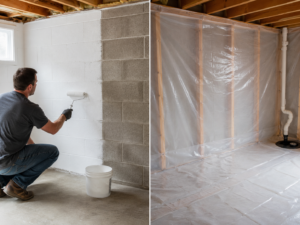
Many building codes have moved away from sealed interior polyethylene on basement walls, and for good reason: a poly sheet behind drywall can trap moisture that gets into the wall cavity from a small foundation crack or a humid summer, with nowhere for it to go. Building scientists increasingly recommend rigid foam insulation installed directly against the concrete instead. Rigid foam doesn’t hold moisture the way fiberglass batts do, and because it goes against the concrete rather than behind a vapor-sealed cavity, any incidental moisture has a path to dry out rather than getting sealed in on both sides.
😬 The regret homeowners run into most: wrapping a basement wall in interior poly, insulating with fiberglass batts, then drywalling — only to open the wall five years later and find the studs soft and the insulation moldy.
In very cold climates or specialized wall assemblies, local code requirements may differ from these recommendations — some northern jurisdictions and certain insulation systems still call for a vapor retarder in a specific location within the wall, and the correct detail depends on climate zone, the wall assembly itself, and local code.
This is genuinely one of the areas where it’s worth a quick call to a local building inspector or a building-science-literate contractor before finishing a basement wall, rather than copying a one-size-fits-all rule off the internet. If wood framing is involved anywhere near a damp wall, protecting plywood and framing from mold-causing fungi becomes just as important as the insulation choice itself — moisture control and fungal control are really the same problem approached from two angles.
Crawl Spaces: The Forgotten Basement Cousin
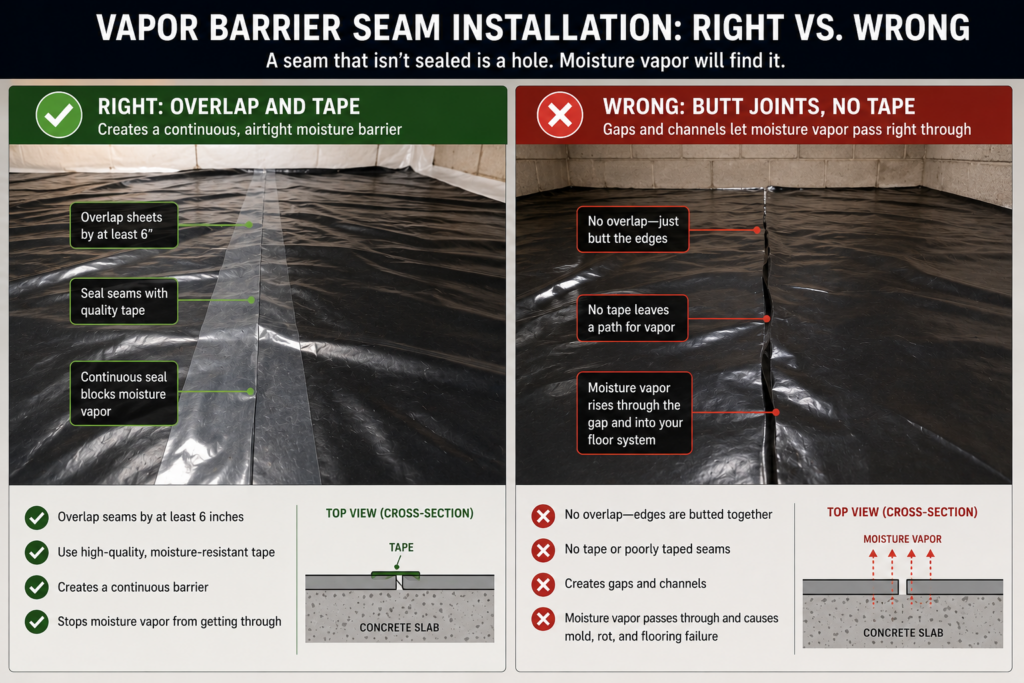
If your basement connects to or sits beside a crawl space, that crawl space needs its own vapor barrier — reinforced poly sheeting laid directly over exposed dirt or gravel, seams overlapped by at least 6 inches and taped or sealed.
Crawl spaces and basements share the same fundamental problem: high humidity and poor airflow create ideal conditions for rot in nearby wood framing, and a sealed sump or crawlspace basin helps cut off another pathway for damp air to migrate into the living space above.
🧪 Real test: I’ve measured relative humidity in an unsealed crawl space at 75–80% on a summer afternoon, then dropped it under 50% within two weeks of installing a proper ground barrier and adding basic ventilation.
That swing is the difference between wood framing that lasts decades and wood framing that needs a rotten-wood window frame or sill repair sooner than it should — crawl-space moisture migrates upward into floor joists and sill plates far more often than people expect.
Common Mistakes That Undo a Good Vapor Barrier
Not overlapping seams. A 6-mil sheet with butted, untaped seams is barely better than no barrier at all. Overlap by at least 6 inches and tape every seam.
Puncturing the barrier with fasteners. Every nail or screw that goes through poly sheeting is a tiny moisture pathway. Seal penetrations or design the layer so fasteners don’t need to go through it.
Using interior poly on a basement wall by default. Copying an above-grade, cold-climate wall detail onto a below-grade basement wall is one of the most common basement-finishing mistakes, and it’s the one most likely to cause hidden rot behind drywall.
Carpeting directly over a damp slab. This creates a moisture trap between an impermeable backing and the floor below, with nowhere for moisture to evaporate — the same trapped-moisture failure mode that shows up when builders skip proper edge sealing in marine-grade plywood applications.
Skipping the barrier because the basement “never floods.” Vapor transmission and flooding are two completely different problems. A basement can be flood-free for thirty years and still have a chronic vapor problem that destroys flooring from beneath.
Assuming all subfloor panels are vapor-rated. Some raised subfloor panel systems include a built-in vapor layer; others don’t. Always check before assuming the product is doing the job that a separate poly sheet would.
Do I need a vapor barrier in a basement that’s never had water issues? Yes. Vapor transmission through concrete happens regardless of whether the basement has ever flooded. A dry-looking slab can still push enough moisture upward to damage flooring and cause mold over time.
What mil thickness of poly should I use for a basement floor? 6 mil is the standard minimum for basement floor applications. Under-slab applications in new construction typically use thicker 10–15 mil sheeting.
Should basement walls have a poly vapor barrier like above-grade walls? Not usually. Many basement assemblies now use rigid foam directly against the concrete instead of interior polyethylene, since sealing both sides of a wall cavity can trap moisture and cause hidden rot. Very cold climates and certain wall assemblies may require a different detail under local code, so it’s worth confirming with a local inspector or a building-science-literate contractor.
How do I know if my basement has a moisture problem before flooring? ASTM F1869 calcium chloride testing and ASTM F2170 in-situ relative humidity testing are the two standard methods for checking slab moisture before flooring goes down, giving you an actual measurement rather than relying on how the floor feels to the touch.
Is plastic sheeting under carpet in a basement a vapor barrier? Only if it’s a continuous, properly sealed layer with taped seams. A loose sheet of plastic with gaps and unsealed edges offers little real protection and can sometimes trap moisture rather than block it.
Related Posts:
Drylok vs Vapor Barrier: Which Actually Stops Moisture? by Admin July 8, 2026 DIY Drylok and a vapor barrier are not interchangeable — they solve two different moisture problems. Drylok is a waterproofing coating that seals the masonry wall…