For most budget furniture, hardwood plywood costs less than solid hardwood per square foot of finished part. The gap is biggest on wide panels like case sides, shelves and backs. The exception is plain pine boards: when every part fits within an 11-1/4-inch-wide board, they can match or beat a sheet. Below you’ll find a fair way to compare a sheet price with a board-foot price, a bookcase priced three ways, and the hidden costs that change the answer.
This post contains affiliate links. As an Amazon Associate, ThePlywood.com earns from qualifying purchases at no extra cost to you.
Quick answer
Wide parts (sides, shelves, tops wider than about 11 inches): plywood is usually cheaper and needs no glue-up.
Narrow parts (legs, rails, face frames, edging strips): solid wood is often cheaper, because you buy only what you use.
Paint-grade pieces that fit 1×12 widths: S4S pine boards can compete with plywood. Run the break-even check below with your local prices.
The main catch: plywood needs edge banding or solid-wood edging, and its face veneer only takes light sanding.
Plywood vs Solid Wood Cost: The Comparison at a Glance
Prices change quickly and vary by region, so this table compares the cost structure rather than store prices. Plug in your local prices using the formulas in the next section.
Factor
3/4″ hardwood plywood
S4S pine boards (1×12)
Hardwood lumber (poplar, oak, maple)
How it’s priced
Per 4×8 sheet (32 sq ft)
Per piece or linear foot
Per board foot
Thickness you actually get
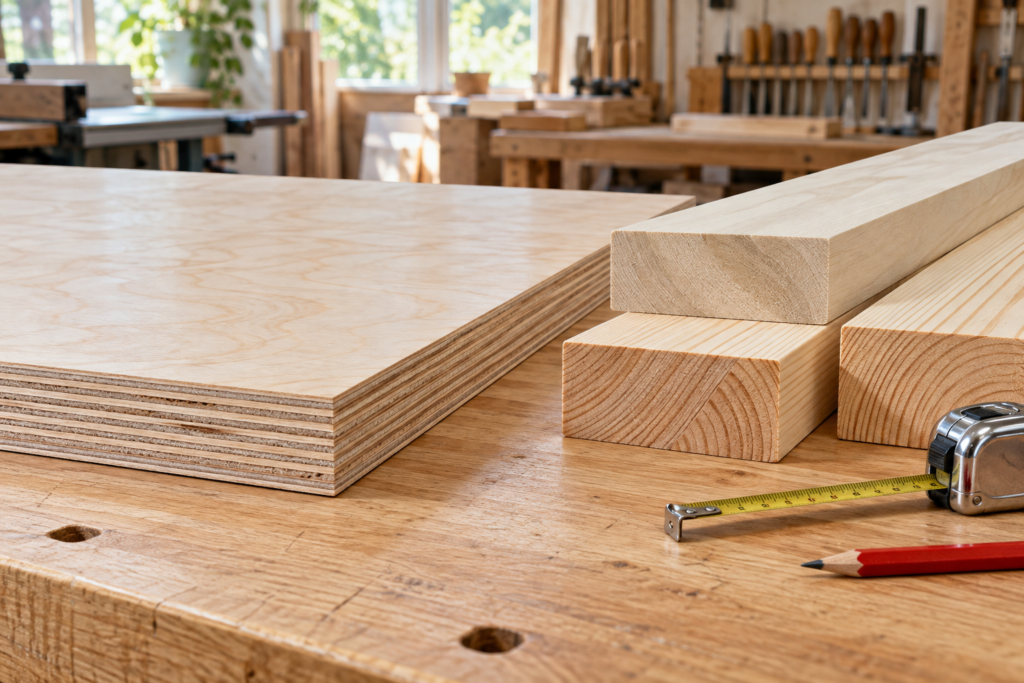
Often 23/32″ or 18 mm, not a full 3/4″
3/4″
4/4 surfaced two sides is 13/16″; plane it to 3/4″
Widest part without a glue-up
48″
11-1/4″
Whatever width boards you can find, often 4–8″
Edge treatment needed
Yes: banding or solid edging
No
No
Extra tools or labor
Track saw, circular saw guide, or store cuts
Minimal
Jointer/planer or paid milling, plus clamps for glue-ups
Seasonal width change
Very small across the panel
Moderate
Moderate to high, depending on species
Can be sanded or refinished
Lightly, because the face veneer is thin
Many times
Many times
Best budget use
Case sides, shelves, backs, drawer bottoms
Painted shelves and simple cases
Legs, rails, face frames, tabletops you want to last
How to Compare a Sheet Price With a Board-Foot Price
This is where most cost comparisons go wrong. A board foot is 144 cubic inches, for example 12″ × 12″ × 1″. Hardwood is priced by its rough thickness, so one board foot of 4/4 lumber gives you roughly one square foot of face before waste. After surfacing to 13/16″ and planing to 3/4″, you lose thickness you already paid for.
The fair comparison is cost per square foot of finished part:
Material
Formula
What the letters mean
Plywood
Sheet price ÷ (32 × cut yield)
Cut yield = share of the sheet that ends up as parts
Pine 1×12
Price per linear foot ÷ (0.94 × board yield)
One linear foot of 1×12 gives 0.94 sq ft of face (11.25 ÷ 12)
Hardwood (4/4)
Price per board foot ÷ board yield
Board yield = share left after cutting out defects, jointing and trimming
The yields matter more than most guides admit. Plywood has no knots to cut around, so a good cut list can use 70–85% of a sheet. Rough or surfaced hardwood loses more to defects, end checks and squaring. A 25–35% waste allowance is a common planning assumption, not a fixed rule. Lower grades waste more and clear grades waste less.
Break-even rule (hardwood vs plywood): hardwood is cheaper only when
With an assumed 70% hardwood yield and 80% plywood yield, that works out to about 2.7% of the sheet price per board foot. Hardwood would have to cost less than about 1/37 of the sheet price per board foot just to match plywood on material alone. That is rare for surfaced hardwood at retail. It’s also why the old shop rule “a board foot costs about the same as a square foot of plywood” understates the gap once waste is counted.
Worked Example: One Budget Bookcase, Three Ways
This scenario uses real dimensions with stated assumptions. It is illustrative, not a measured test.
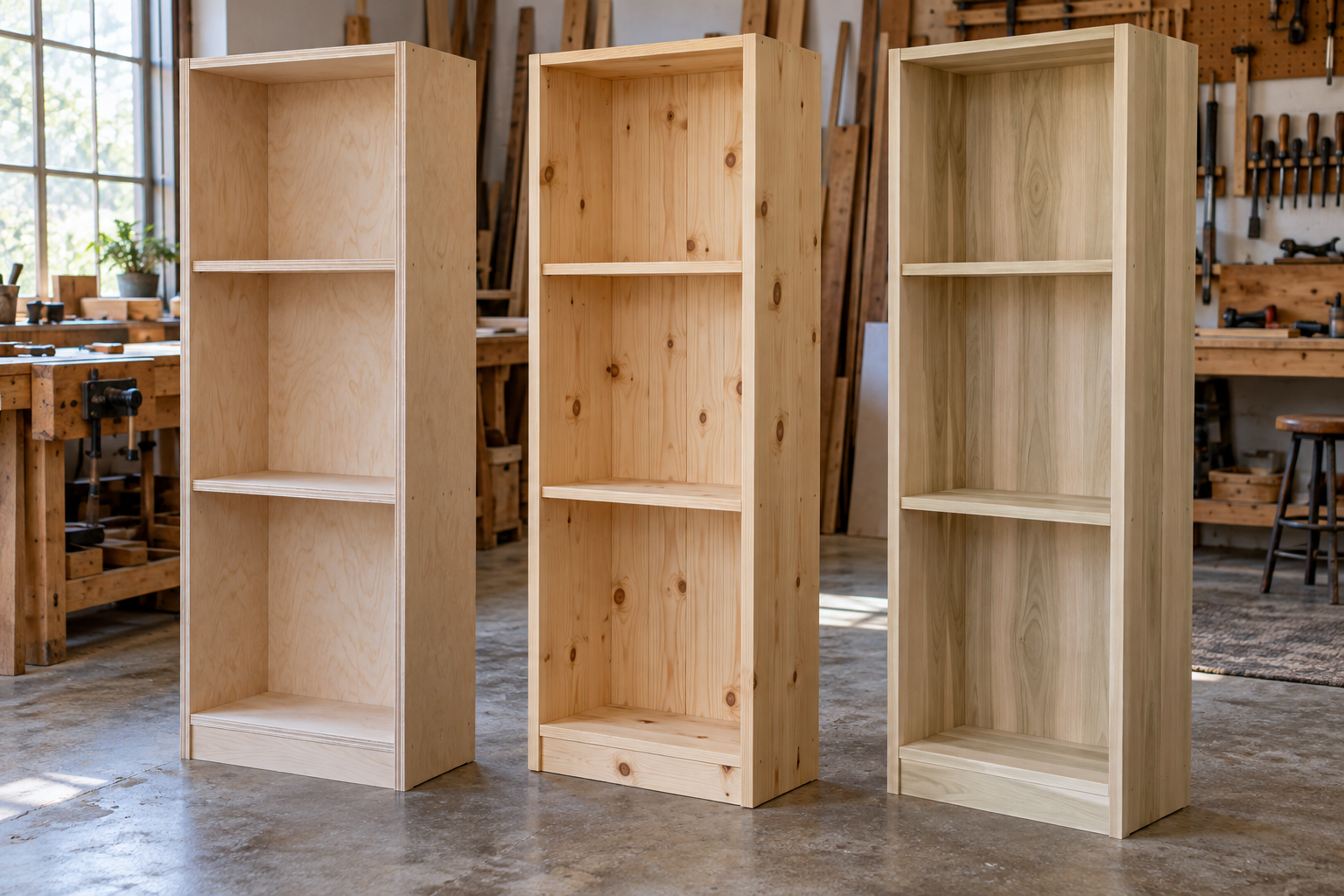
The bookcase: 36″ wide × 72″ tall × 11-1/4″ deep, with two sides, a top, a bottom and two fixed shelves. Both versions use the same 1/4″ back panel, so the back is left out of the comparison.
Parts list:
2 sides: 11-1/4″ × 72″
4 horizontal pieces: 11-1/4″ × 34-1/2″
Total finished part area: 22.0 sq ft
Version 1: One sheet of 3/4″ hardwood plywood
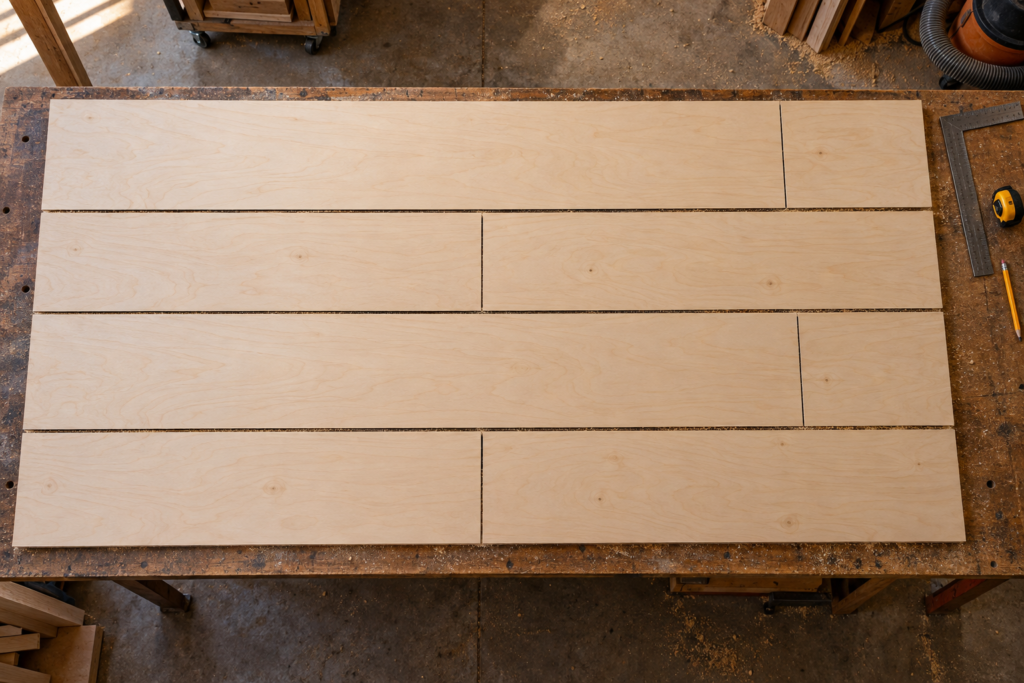
Rip the 48″ sheet into four 11-1/4″ strips (45″ plus three saw kerfs fits within 48″):
Strips 1 and 2: one 72″ side each, leaving a 24″ offcut
Strips 3 and 4: two 34-1/2″ shelves each
Material: 1 sheet. Cut yield: 22.0 ÷ 32 = 69%. The two 24″ × 11-1/4″ offcuts are still usable for a small shelf or drawer parts. Extra: about 24 linear feet of front edges to band (2 × 72″ + 4 × 34-1/2″ = 282″).
Version 2: S4S pine 1×12 boards
2 × 1×12 at 8 ft for the sides (each leaves a 24″ offcut, plus room to square the ends)
2 × 1×12 at 6 ft for the four shelves (2 × 34-1/2″ = 69″ per board)
Material: 28 linear feet. The finished parts require approximately 23.5 linear feet of 11-1/4-inch-wide board (2 × 72″ sides + 4 × 34-1/2″ shelves = 282″, or 23.5 ft), out of 28 linear feet purchased. Board yield: 23.5 ÷ 28 = 84%, before rejecting any warped or badly knotted boards. Extra: no edge banding and no glue-up.
Version 3: 4/4 poplar (paint-grade hardwood)
Poplar is rarely sold 11-1/4″ wide, so each part is usually glued up from two narrower boards. At an assumed 70% yield, 22.0 sq ft of parts needs about 31.5 board feet of 4/4 stock. Extra: jointing and planing (or a milling fee), glue, clamps, and flattening each glue-up.
Break-even prices for this bookcase
Take your local price for one sheet of 3/4″ hardwood plywood and call it S:
Option
It beats the plywood sheet on material when…
Pine 1×12
Price per linear foot is below S ÷ 28
Poplar 4/4
Price per board foot is below S ÷ 31.5
Example with round, made-up numbers (not a price quote): if a sheet costs $60, pine 1×12 has to cost under about $2.14 per linear foot to win, and poplar under about $1.91 per board foot. Before counting edge banding, plywood wins against poplar in almost any market. Pine is the one to check against your local store, and in some regions it will come out ahead for this exact build.
Hidden Costs That Change the Answer
Hidden cost
Applies to
Why it matters
Edge banding or solid edging
Plywood
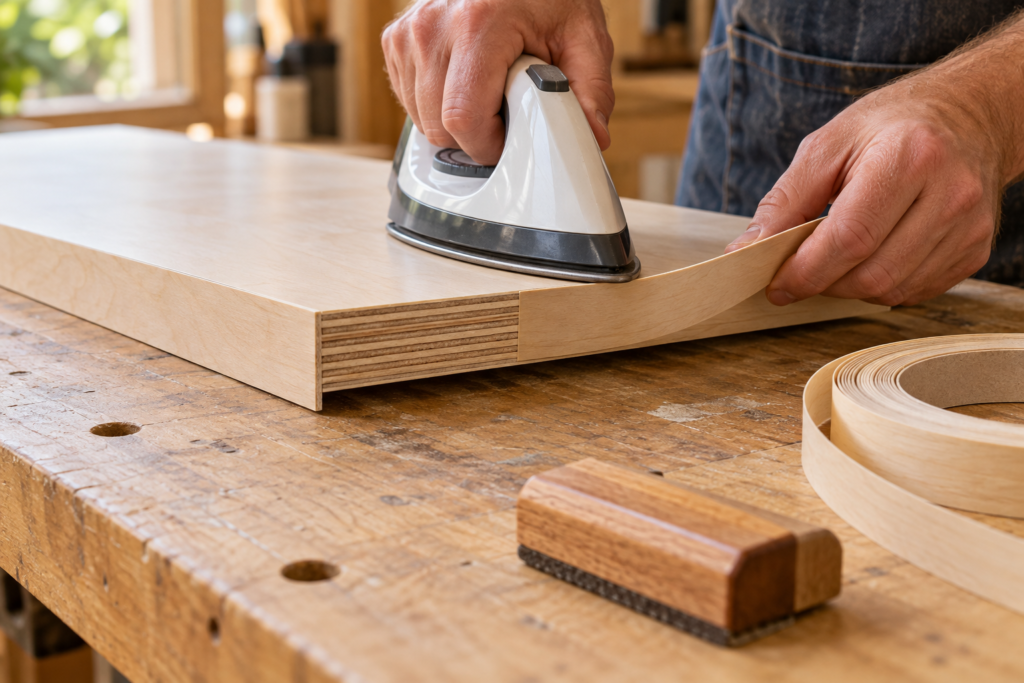
Exposed plies look unfinished. Iron-on veneer banding is cheap; solid edging strips cost more but hold up better.
Breaking down full sheets
Plywood
A 4×8 sheet is hard to cut accurately on a table saw alone. Store cuts or a straightedge guide solve it.
Milling
Hardwood
Rough or S2S boards need jointing and planing. Without those tools, you pay for milling or buy pricier S4S stock.
Glue-ups
Hardwood, sometimes pine
Wide panels mean extra boards, glue, clamps, flattening time and more waste.
Wood-movement hardware
Solid tops
Solid tops must be fastened so they can move across their width (see below).
Blotchy stain
Pine and birch, solid or veneer
Both can absorb stain unevenly. A pre-stain conditioner or paint adds cost and a step.
Repair later
Plywood
A deep scratch can’t be sanded out of a thin face veneer. Solid wood can be sanded and refinished.
Wood Movement: The Cost Nobody Prices In
Solid wood swells and shrinks across its width as indoor humidity changes. Plywood barely does, because its alternating grain layers restrain one another. The USDA Forest Products Laboratory’s Wood Handbook (2021 edition)publishes dimensional change coefficients for estimating movement across the width of a board:
For an 11-1/4″-wide flat-sawn part over a 4-point swing in moisture content (an illustrative indoor range; yours may be larger or smaller):
Species (flat-sawn)
Coefficient per 1% MC
Estimated width change
Red oak
0.00369
about 0.17″ (just over 5/32″)
Yellow poplar
0.00289
about 0.13″ (1/8″)
Eastern white pine
0.00212
about 0.10″ (3/32″)
That movement is why a glued-down solid tabletop can crack and a solid panel trapped in a tight frame can split. The fix is cheap but real: slotted holes, tabletop fasteners or a floating panel. For the method, see our guide to attaching a solid wood table top. Plywood skips this step entirely, which is part of its real savings on wide parts.
When Solid Wood Is the Better Budget Choice
Narrow parts. Legs, aprons, rails, face frames and edging strips. You buy only the width you need, so there’s no wasted sheet.
Parts that take a beating. Tabletops and desk surfaces you may sand and refinish years from now.
Painted cases that fit 1×12 widths. Simple pine bookcases, as the worked example shows.
You already own a jointer and planer. Rough lumber gets much cheaper when you do the milling yourself.
Visible edges and profiles. Solid wood can be shaped, rounded or routed on any edge with no plies showing.
When Plywood Saves the Most
Anything wider than about 11 inches: case sides, cabinet boxes, wide shelves, dresser carcasses.
Backs and drawer bottoms, where thin, stable panels are hard to make from solid wood.
Built-ins and storage furniture, where flat, stable panels matter more than repairability.
Painted furniture, where a smooth-faced panel saves sanding and filler.
The cheapest good-looking build is usually a hybrid: a plywood carcass with solid-wood edging, a face frame, legs or a top. You get plywood’s low cost and flat, stable wide panels, and solid wood covers the edges where plies would show. This is also how most quality factory casework is built. If you’re also weighing cheaper sheet goods, see plywood vs MDF vs particleboard.
Buying Ready-Made Instead of Building?
The same cost logic applies to store-bought furniture. Pieces sold as “wood” or “real wood” often have plywood or MDF case parts with a wood veneer, and that isn’t automatically a flaw. Ask what the case sides, shelves and drawer bottoms are made of. Hardwood plywood, MDF and particleboard used in furniture sold in the U.S. must meet EPA formaldehyde emission standards under TSCA Title VI, and compliant products carry a label. Solid lumber and softwood plywood are outside that rule. For more, see our page on formaldehyde emissions.
Common Mistakes That Make “Cheap” Furniture Expensive
1. Comparing the sheet price to the board-foot price directly. A board foot is volume priced by rough thickness, not finished area. Skipping the waste and surfacing loss makes solid wood look cheaper than it is. Use cost per finished square foot.
2. Assuming 3/4″ plywood is a full 3/4″. Much hardwood plywood is 23/32″ or 18 mm (about 0.709″). Dadoes cut for 3/4″ will be loose, which means weak joints and racking shelves. Measure the sheet and cut joinery to fit it.
3. Skipping edge treatment to save money. Raw plywood edges chip, soak up finish unevenly and look unfinished. Budget for banding or solid edging from the start. It’s a small cost compared with redoing the finish.
4. Gluing a solid top down tight. A solid top fixed on all sides has nowhere to move. Cracks or gaps can show up after the first change of season. Use fasteners that let the top move across its width.
5. Buying the cheapest wide pine boards without sighting them. Wide boards can cup or twist, especially lower grades. A cupped shelf rocks and a twisted side pulls the case out of square. Pick boards by sighting down each edge, and let them sit indoors before cutting.
6. Using thin or long shelves to save material. Thinner stock or longer spans sag over time in both materials. Fixing sagging shelves later costs more than buying the right thickness. See how to fix a sagging plywood shelf for spans and fixes.
Tools and Supplies That Keep Budget Builds Looking Good
Iron-on birch edge banding: the cheapest way to hide plywood edges. Match the species to your sheet face.
Edge banding trimmer: trims banding flush without a router and cuts down on sanding through the veneer.
Pre-stain wood conditioner: helps reduce blotching on pine and birch if you’re staining rather than painting.
Bar clamps: needed for any solid-wood glue-up and for gluing on solid edging.
Pin-type moisture meter: checks that solid lumber has settled to indoor conditions before you cut it.
FAQ
Is plywood cheaper than solid wood for furniture?
For wide parts, usually yes, once you compare cost per finished square foot including waste. For narrow parts like legs and frames, solid wood is often cheaper, and plain pine boards can compete for simple painted cases.
Is plywood furniture as good as solid wood furniture?
It depends on the part. Plywood is more stable across its width and works well for case sides, shelves and backs. Solid wood is better for surfaces you may sand and refinish, and for shaped edges. Quality depends on the grade, joinery and edge treatment more than on the label “solid wood.”
How many board feet equal a sheet of 3/4″ plywood?
A 4×8 sheet has 32 square feet of face. To make the same finished area from 4/4 hardwood, you’d typically need well over 32 board feet once waste is counted. Our bookcase example needed about 31.5 board feet for just 22 square feet of parts.
Sometimes. S4S pine 1×12 boards can beat a plywood sheet for painted projects where every part fits 11-1/4″ wide, because they need no edge banding or glue-ups. Use the break-even check: pine wins when its price per linear foot is below the sheet price divided by the linear feet you need.
Does plywood last as long as solid wood?
Indoors, good plywood furniture can last for decades. The limits are the thin face veneer, which can’t be sanded deeply, and exposed edges, which need protection. Solid wood is easier to repair and refinish over a long service life.
Bottom Line
For budget furniture, build wide panels from plywood and use solid wood where it’s narrow, visible or likely to be refinished. Before you buy, convert every price to cost per finished square foot with a realistic waste allowance. That one step settles most plywood vs solid wood cost questions. Plain pine boards are the one solid-wood option that regularly competes with a sheet, so price them for any simple painted build.
Related Posts:
Marine Plywood vs. Pressure-Treated Wood: Which Is Better? by Admin June 20, 2026 DIY Marine plywood is the best choice for boats, transoms, stringers, and other applications exposed to constant moisture because it uses waterproof glue and tightly controlled…