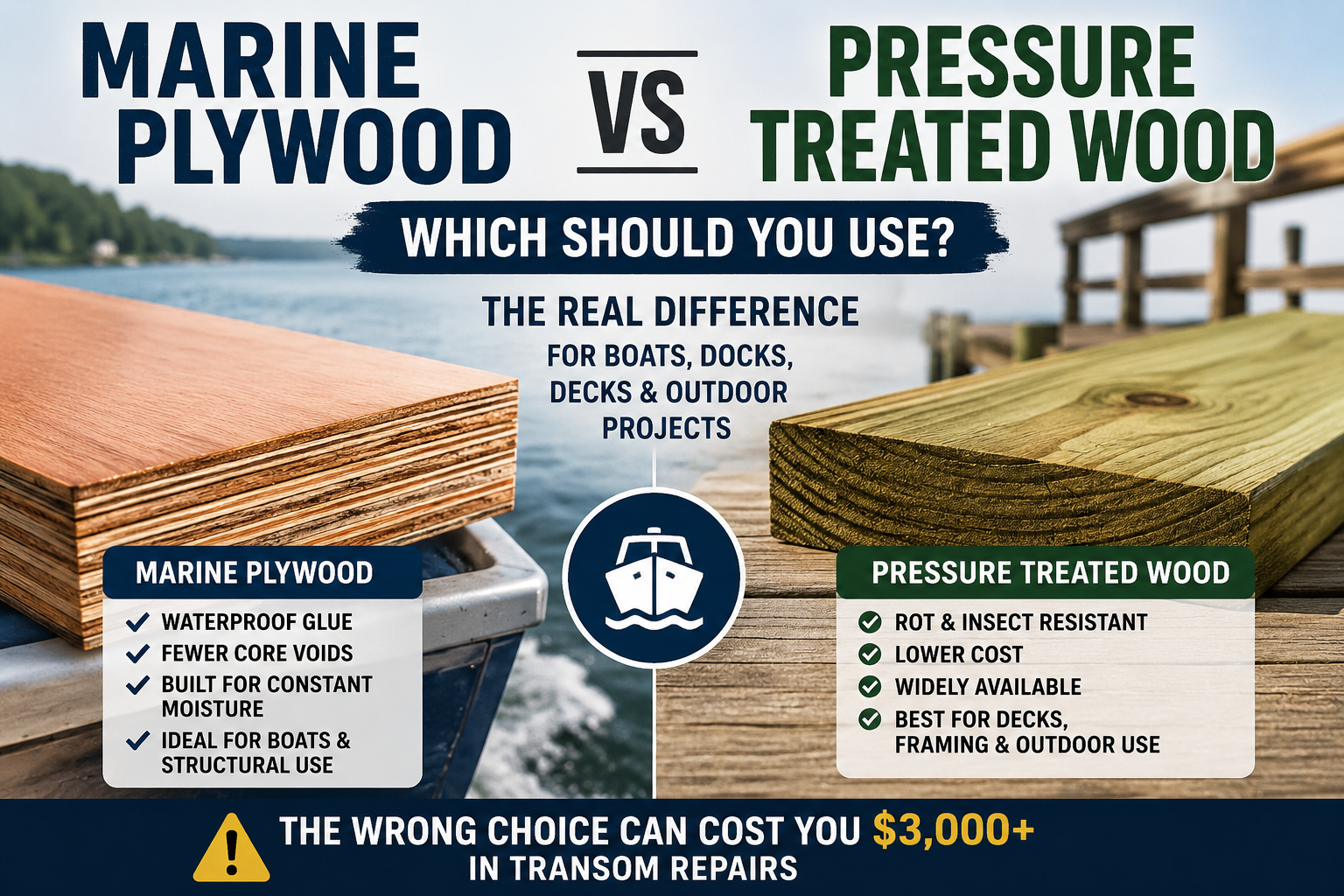
Marine plywood is the best choice for boats, transoms, stringers, and other applications exposed to constant moisture because it uses waterproof glue and tightly controlled core construction. Pressure-treated wood is better suited for decks, fences, dock framing, and outdoor structures where rot resistance is more important than delamination resistance.
The wrong call here can cost a boat owner $3,000+ in transom repairs — here’s how to make the right one.
If you’re building a boat transom, a dock, an outdoor bar, or anything that’s going to live near water, you’ve probably typed “marine plywood vs pressure treated” into Google at 11 PM, staring at a Home Depot receipt, wondering if you just wasted $400.
Here’s the short, uncomfortable answer: they are not interchangeable, and using the wrong one is one of the most expensive mistakes in DIY boat and outdoor builds. Marine plywood vs. pressure-treated wood is really a question of panel construction, glue durability, rot resistance, and how wet the project will stay. I’ve seen transoms rot out in two seasons because someone grabbed pressure-treated lumber off the shelf instead of marine-grade plywood — and I’ve seen people overpay for marine ply on a project that never needed it. Both mistakes cost money. Let’s fix that.
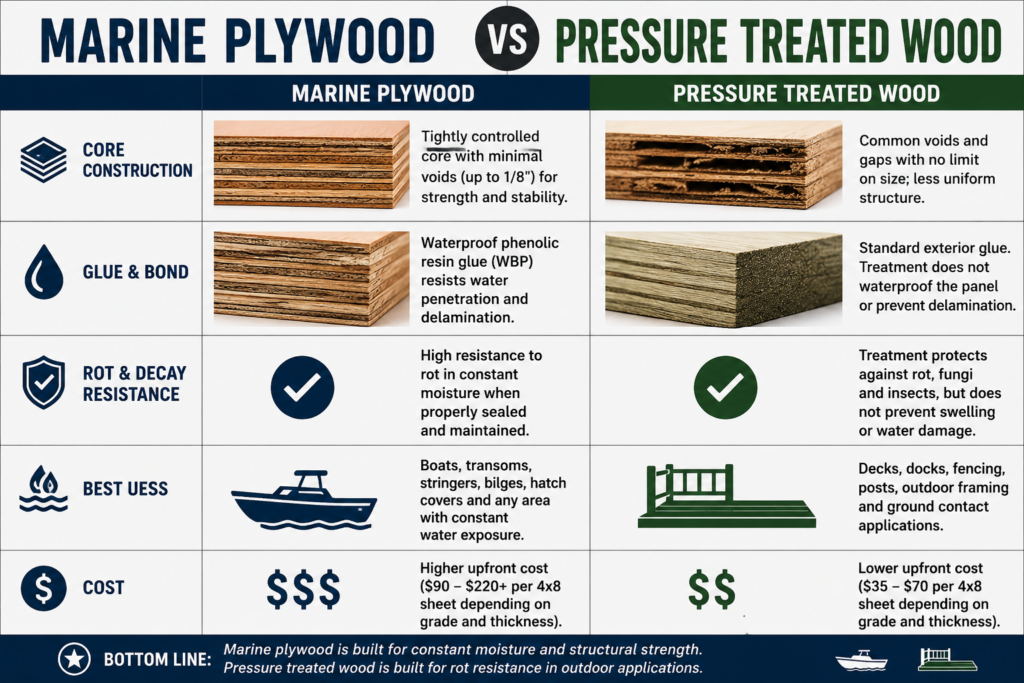
Quick Comparison Table
Feature
Marine Plywood
Pressure Treated Plywood/Lumber
Core voids
Tightly controlled — limited gaps (up to ~1/8″ under specs like APA marine grade)
Common, especially in cheaper sheets, with no limit on gap size
Glue type
Waterproof phenolic resin (WBP)
Treatment fights decay/insects — does not waterproof the panel or prevent swelling/delamination
Wood species
Douglas fir, okoume, marine-grade hardwoods
Southern yellow pine (usually)
Chemical treatment
None — relies on glue/wood quality
Pressure-injected preservatives (fight rot/insects, not water intrusion)
Best for
Boat hulls, transoms, hatches, bilges, constant water contact
Moderate — treatment fights fungus/insects, not swelling
Worst-case failure mode
Delamination if poor quality/fake “marine” ply
Swelling, cupping, and splitting from moisture cycling
If you only read one row, read this: marine plywood is engineered with tightly controlled core gaps and waterproof glue between layers. Pressure-treated wood is engineered to resist rot and insects — the treatment doesn’t waterproof the panel or prevent it from swelling and delaminating when it’s constantly wet. People confuse “treated for outdoors” with “treated for boats,” and that mix-up is where the regret starts.
Marine Plywood vs. Pressure-Treated Wood: Pros and Cons
Marine Plywood
Pressure Treated Wood
Excellent for boats
Excellent for decks and framing
Waterproof glue
Rot and insect resistant
Fewer core voids
Lower cost
Lightweight options available
Widely available
Expensive
Can swell and delaminate
Marine Plywood vs Exterior Plywood vs Pressure Treated
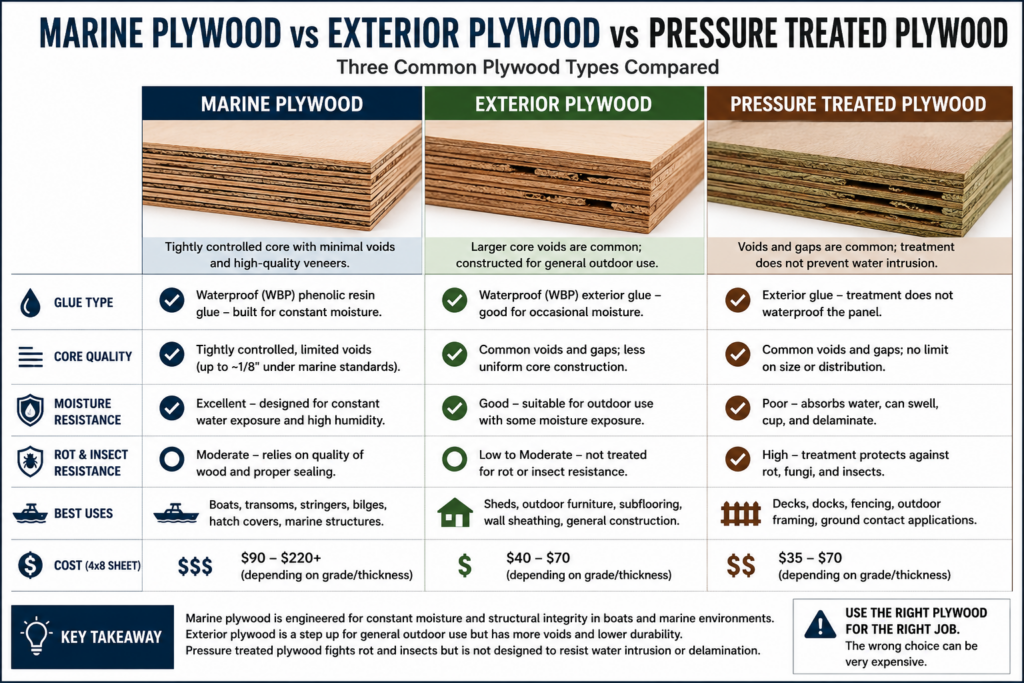
A lot of search traffic on this topic actually has a third material in the mix: standard exterior plywood. It’s worth a separate look because exterior plywood is mistaken for “good enough” almost as often as pressure-treated plywood is.
Feature
Marine Plywood
Exterior Plywood
Pressure Treated Plywood
Waterproof Glue
Yes
Yes
Usually Yes
Core Voids
Minimal
Common
Common
Rot Resistance
Moderate
Low
High
Boat Use
Excellent
Poor
Poor
Cost
Highest
Lowest
Moderate
The pattern worth noticing: pressure-treated plywood actually wins on rot resistance, because of the chemical treatment — but it still loses on boat use, because rot resistance isn’t the same problem as water intrusion and delamination. Exterior plywood has the waterproof glue line of marine ply but skips the void control, so it’s a step up from pressure-treated for general outdoor use, but still not boat-grade. For a deeper breakdown, see our Exterior Plywood Guide and Best Plywood for Outdoor Projects.
The Mistake: Why Pressure-Treated Plywood Fails on Boats
Here’s what actually happens when someone uses pressure-treated plywood for a transom or stringer repair instead of marine plywood: most pressure-treated sheet goods are made from standard sheathing-grade veneers, which can have larger, uncontrolled internal voids than marine-grade panels allow. The chemical treatment protects the wood fiber from rot fungus and wood-boring insects — that’s it. It does nothing to waterproof the panel, prevent the glue bond from failing, or prevent the wood from absorbing water and swelling.
So water gets in through screw holes, edge grain, or a scratch in the gelcoat. It sits inside those voids or works into the glue line. It can’t dry out because it’s sandwiched between layers of wood and fiberglass. The plywood doesn’t rot from insects — it swells, delaminates, and turns soft from the inside, often while the outside still looks fine. By the time you notice soft spots with a screwdriver, you’re not looking at a patch job. You’re looking at pulling the whole transom.
I have repaired and inspected multiple water-damaged plywood structures over the years, and the most expensive failures almost always started with the wrong sheet material rather than the wrong coating.
⚠️ Warning: if a “marine plywood” sheet costs less than $60 for a 3/4″ 4×8 sheet, ask what it actually is before you buy it. A lot of “marine ply” sold at general hardware stores is just exterior-grade plywood with a marketing label slapped on — larger, uncontrolled internal voids, standard glue, none of the WBP (weather-and-boil-proof) bonding that actual marine plywood requires under BS 1088 or similar specs.
Marine plywood is not a magic waterproof wood. It still needs sealed edges, sealed screw holes, and proper coating. What you are paying for is better core construction, fewer voids, and waterproof adhesive bonds — not permission to leave raw plywood exposed to water.
Boat Examples: Where Each Material Actually Belongs
Transoms, stringers, bilge stringers, hatch covers — marine plywood is strongly recommended. These parts sit in standing water, flex under load, and are nearly impossible to inspect once glassed over. This is not the place to save $150.
Swim platforms, dock boxes that stay dry most of the time, non-structural trim — pressure-treated can work, especially if it’s sealed and not constantly submerged. The keyword is “not constantly submerged.”
Floating dock frames and pilings — pressure-treated lumber (not plywood) is the standard here, because it’s solid wood, not laminated veneers with internal seams. Solid pressure-treated lumber handles ground/water contact far better than pressure-treated plywood does.
😬 Regret moment: the classic one is someone replacing a rotted transom core, finding pressure-treated plywood at the local lumber yard, thinking “treated = waterproof,” and using it because it’s $180 cheaper than ordering actual marine ply. Two boating seasons later, the transom is soft again, except now they’re also paying to remove fiberglass a second time. The “savings” disappeared and then some.
Outdoor Examples: Decks, Furniture, and Structures
For projects that aren’t boats — decks, raised garden beds, fence posts, outdoor stair stringers — pressure-treated lumber is usually the right, economical call. It’s designed for exactly that: intermittent moisture, ground contact, UV exposure, and insect pressure.
Marine plywood becomes the right call outdoors when you need a flat panel that will get rained on repeatedly and needs minimal internal voids — think outdoor kitchen cabinetry, boat-adjacent dock boxes, or any sheet good that will sit in a puddle after a storm instead of just getting splashed.
🧪 Real test: a simple way to tell the difference between a quality marine sheet and a “marine-labeled” pretender — submerge a cut-off scrap in a bucket of water for 48–72 hours. Real marine plywood with phenolic glue won’t delaminate at the edges. Cheaper “marine” ply with standard glue will often show the layers starting to separate at the cut edge within a few days. This test has saved more than one builder from gluing $300 of bad material into a hull.
Cost Breakdown: What You’re Actually Paying For
Item
Pressure Treated
Marine Plywood
3/4″ 4×8 sheet
$40–$65
$110–$220
Solid 2x lumber (per linear ft)
$1.50–$3
N/A (plywood only)
Lifespan in constant wet/structural use
3–7 years before failure risk
15–25+ years if properly sealed/glassed
Cost per year of service (structural marine use)
Misleading — looks cheap, fails early
Higher upfront, lower long-term cost
💸 Cost difference that actually matters: on a transom rebuild, the material cost gap between treated plywood and real marine plywood is typically $150–$400, depending on thickness and sheet count. The labor to redo a failed transom — cutting out old glass, removing rotted core, reglassing, and refinishing — routinely runs $2,500–$6,000+ at a boatyard. That’s the real comparison: a few hundred dollars upfront vs. thousands later. This is the math that should drive the decision, not the sticker price at the lumber yard.
Buying the Right Material
If you’re buying for a boat build or repair, look for sheets explicitly rated to BS 1088 or marketed as okoume or sapele marine plywood — these specs guarantee tightly controlled core gaps and WBP glue. Remember: even with the right plywood, you still need an epoxy/glass or paint sealing system — the plywood spec and the sealing system are two separate jobs. For the sealing side of the job, see our Waterproof Plywood Types guide, and for transom-specific sizing and layup advice, see Plywood for Boat Transoms.
Marine Plywood vs. Pressure-Treated: Which Should You Buy?
If the project sits in standing water, flexes structurally, or is hard to inspect once sealed — a transom, a stringer, a hull component — buy marine plywood. The upfront cost is higher, but the cheaper option’s failure mode is a multi-thousand-dollar repair rather than a quick fix.
If the project is ground-contact framing, decking, fence posts, or anything that gets wet intermittently but dries out and isn’t a structural water barrier — buy pressure-treated. Marine plywood would be overkill and the wrong tool for that job.
When in doubt, ask one question: if this panel fails, can I see it before it becomes a serious problem, or is it buried where I won’t know until it’s too late and it’s expensive? Buried and structural means marine plywood. Visible and replaceable means pressure-treated is fine.
Marine Plywood vs. Pressure Treated: Quick-Answer FAQ
Is pressure-treated plywood waterproof? No. It’s treated to resist rot and insects, not to stop water absorption or delamination. The internal glue and veneer voids are usually no better than standard exterior plywood.
Can I use pressure-treated lumber on a boat? Solid pressure-treated lumber can work for non-structural, non-submerged parts. Pressure-treated plywood should not be used for transoms, stringers, or hull components.
Is marine plywood overkill for a backyard deck? Usually, yes. Pressure-treated lumber is the standard, cost-effective choice for decks, posts, and outdoor framing that isn’t constantly wet or load-bearing in water.
How do I know if “marine plywood” is real? Check for a BS 1088 rating or species like okoume/sapele, and do the 48-hour water-soak edge test if you’re unsure.
Is marine plywood rot-proof? No. Marine plywood resists delamination and has fewer, smaller core voids than standard plywood, but it’s not chemically rot-proof. It still needs epoxy, fiberglass, paint, or another sealing system on every exposed surface to actually keep water out over the long term.
Luan vs Baltic Birch: Which Plywood Is Better? by Admin October 30, 2025 Hardwood If you’ve ever compared Luan vs Baltic Birch plywood at your local hardware store, you know they look similar but perform very differently once you…