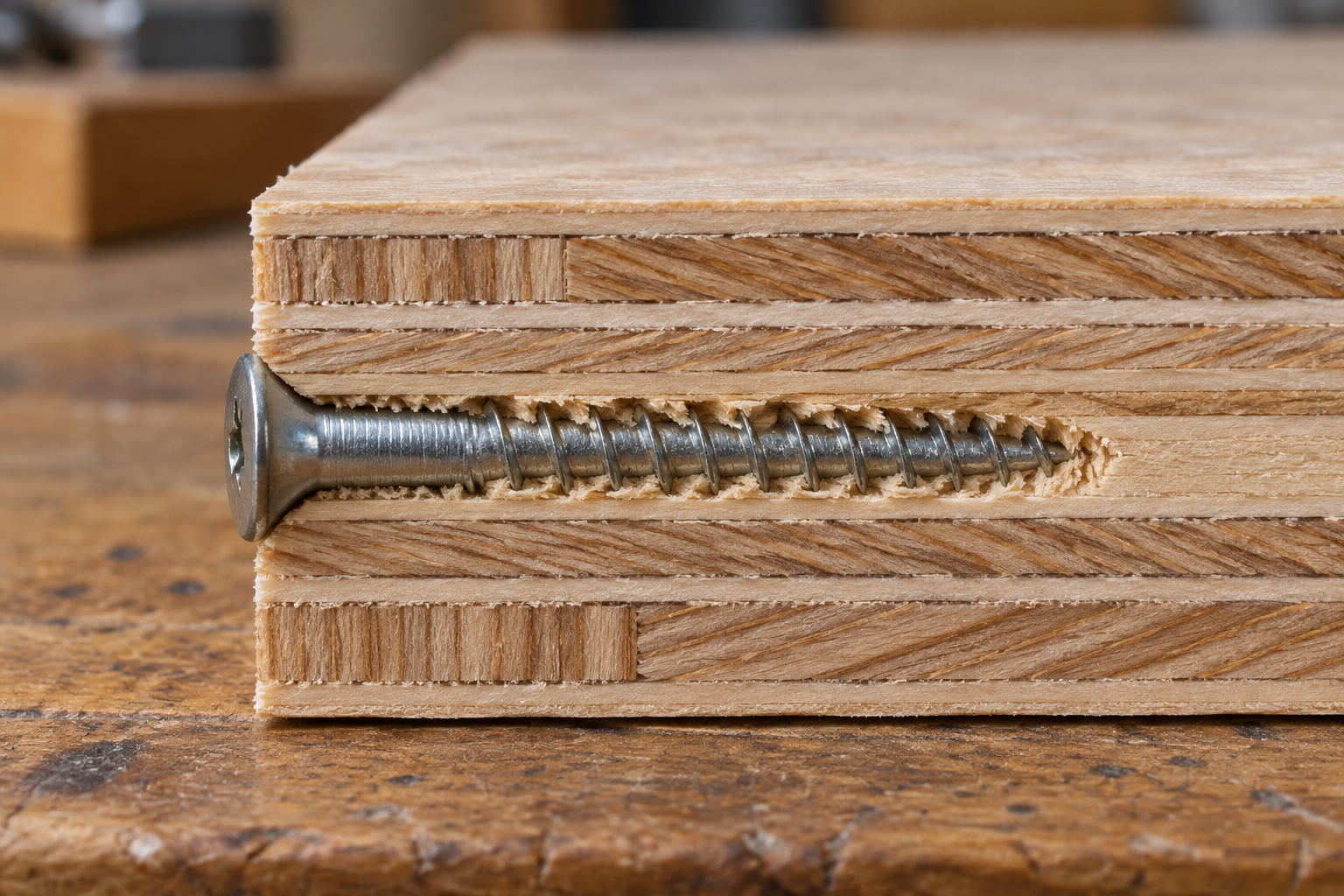
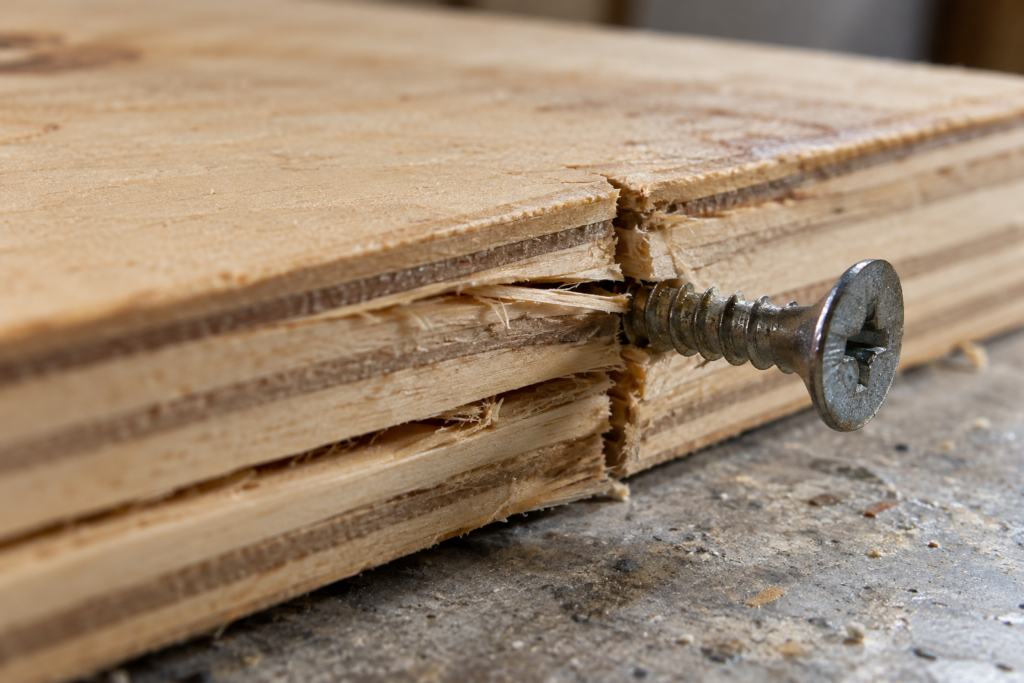
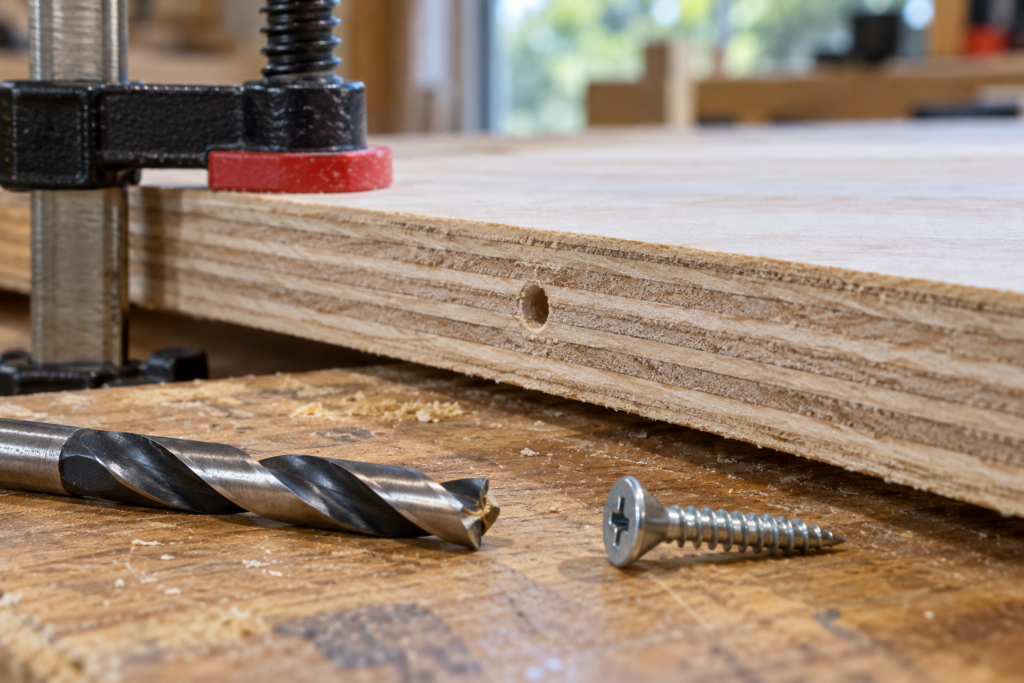
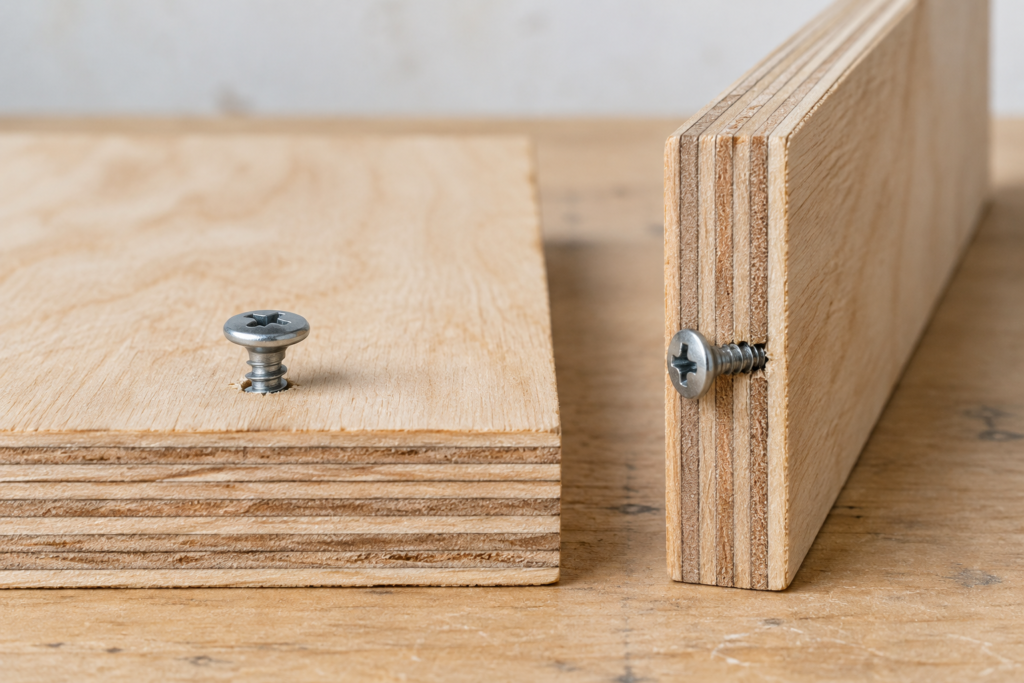
A screw driven into the face of plywood holds better than the same screw driven into its edge. In a controlled study of 12 mm plywood, at the tested penetration depth, edge screws held about 70–78% of the face value. That’s roughly a quarter less. The edge can still make a solid joint if you use the right screw, drill the right holes and center the screw in the panel. This guide covers the test data, what changes the result, and when to stop relying on the edge altogether.
Quick answer
Face wins. At the same tested depth, edge withdrawal ran about 22–30% lower than face withdrawal.
Edge screws need: a clearance hole in the first panel, a pilot hole in the receiving edge, coarse threads, the screw centered in the thickness, and at least 1/2″ plywood (3/4″ is better).
This data is about pull-out only. Pull-out strength is not the same as shear strength, so don’t read the table as a load chart.
Biggest limitation: edges split and delaminate, and moisture weakens edge grip faster than face grip.
Screw Holding Strength in Plywood: Face vs Edge Test Data
The clearest side-by-side data comes from a 2023 study published in Forests (Birinci & Kaymakci). They tested 12 mm (about 1/2″), 7-ply panels with 3.5 mm universal screws driven 12 mm deep into 3 mm pilot holes, following EN 13446.
Plywood species
Face hold
Edge hold
Edge as % of face
Beech
1,279 N (≈288 lbf)
943 N (≈212 lbf)
74%
Ozigo
726 N (≈163 lbf)
563 N (≈127 lbf)
78%
Okoume
691 N (≈155 lbf)
487 N (≈110 lbf)
70%
Source: Birinci & Kaymakci, Forests 14(6):1243, 2023. Control samples only (no freeze–thaw). These are lab maximum pull-out values at one fixed depth, not safe working loads.
Other sources point the same way:
The USDA Wood Handbook says screws in the end grain of solid wood average about 75% of what they hold in side grain, as long as the wood doesn’t split.
For particleboard and fiberboard, the Handbook’s withdrawal formulas put edge values at about 77% of face values.
Wu (1999) tested southern pine and sweetgum furniture-grade plywood and found face withdrawal significantly higher than edge withdrawal in both species.
One honest exception: in a 2013 study of 19 mm hardwood plywood (Eshaghi et al.), a #8 sheet-metal screw held slightly more in the edge than in the face. With a #10 screw, the edge held about 88% of the face. Panel build and screw type can narrow the gap, so treat “about a quarter less” as a typical result, not a fixed rule.
Why the Edge Holds Less
In the face, a screw crosses every ply. Its threads bite into dense, pressed wood, and the grain switches direction from one layer to the next. In the edge, the screw runs between layers:
Fewer plies do the work. The threads only catch the two or three plies around the hole.
Threads cut through glue lines. Instead of digging deep into wood, the screw partly breaks the adhesive bond between layers.
Half the edge is end grain. Plies run in alternating directions, so roughly every other layer offers end grain, which grips threads poorly.
The core is often the weakest wood. Many panels put lower-grade veneers in the middle, which is exactly where an edge screw lands. Core gaps and voids make this worse.
Pull-Out vs Shear: What the Numbers Do and Don’t Tell You
Every figure above measures withdrawal: how hard you have to pull straight along the screw before it comes out. Many real joints load the screw a different way. Take a shelf screwed through a cabinet side into the shelf’s edge. The shelf’s weight pushes across the screw, which is lateral (shear) loading. That’s a separate property, and these tests didn’t measure it.
APA – The Engineered Wood Association lists withdrawal and lateral loads in separate tables in its Technical Note E830, Fastener Loads for Plywood – Screws, including lateral loads for plywood-to-plywood joints into panel edges. If a joint carries real weight, especially overhead or where people are involved, use published lateral values or an engineered connection. Don’t scale up the pull-out table.
What Changes the Result
Screw Length
The Wood Handbook says withdrawal load rises with how much thread is buried in the wood. That finding comes from solid wood side grain. An edge has room for a longer screw than a face screw can get through a 3/4″ panel, so a longer edge screw buries more thread. No study we found has measured how far that closes the edge-vs-face gap in plywood. Use a longer screw as a sensible margin, not as a guarantee that the edge will match the face.
Moisture
In Wu’s study, both face and edge holding dropped as moisture rose, but the edge got worse faster. Edge-screwed joints in damp sheds, bathrooms or outdoor furniture lose more strength than face-screwed ones. Exterior-rated glue doesn’t change this: the bond classification describes the glue line, not how well the panel grips a screw. See our WBP plywoodguide for what bond ratings do and don’t cover.
Screw Diameter and Thread
In both the 2013 and 2017 studies, larger-diameter screws held more. The Wood Handbook puts sheet-metal (Type A tapping) screws at roughly 10% above wood screws of similar size. Coarse threads are the usual pick for softwood plywood because they grab more wood per turn. For when a nail is the better choice, see nails or screws for plywood.
Clearance Hole and Pilot Hole
An edge joint needs two different holes:
Clearance hole (first panel): sized so the screw passes through freely. The threads then grab only the receiving edge, and the screw pulls the joint tight. If the threads also catch the first panel, they can hold the two panels apart.
Pilot hole (receiving edge): sized according to the screw manufacturer’s recommendation, so the threads cut into the wood without wedging the plies apart.
Pilot sizes depend on the screw’s thread design and the wood, so check the screw maker’s chart. One example: McMaster-Carr lists a 1/16″ bit for its #6 and a 5/64″ bit for its #8 plywood/OSB screws. Those sizes apply to those particular screws, not to every screw. For more detail on sizing and drilling, see our guide to Pilot Holes. Drill the pilot hole the full depth of the screw.
Panel Quality
Voids in the core leave nothing for the threads to grab. Panels with more plies and solid cores give an edge screw more wood to bite into. That’s one reason cabinet-grade plywood and Baltic birch usually take edge screws better than sheathing grades like CDX. Our luan vs Baltic birch comparison explains the difference in core build.
Glue plus #8 coarse-thread screws centered in the edge, with clearance and pilot holes
Shelf held up only by screws in its edge
Risky
Dado, cleat or shelf pins; screws then only hold the shelf in place
Hinge or hardware screwed into an edge
Avoid when it will pull out
Mount hardware on the face, or add a solid-wood edge strip
1/2″ plywood drawer box
Careful
#6 screws, exact centering, correct holes; consider a rabbet joint
1/4″–3/8″ plywood
No
Glue in a groove or rabbet; brads only to hold parts while the glue dries
Outdoor or damp location
Reduce reliance
Face-fasten where possible; use corrosion-rated screws
Repeated assembly and disassembly
No
Threaded inserts or connector bolts
For box layouts that avoid weak edge joints, see our cabinet construction guide.
Edge-Screwing Checklist
Center the screw in the thickness. A #8 screw in 3/4″ plywood leaves only about 0.29″ of wood on each side. Any drift risks a blowout.
Drill both holes. Clearance in the first panel, pilot in the edge, to the full screw depth.
Keep screws away from the ends of the edge. Splitting starts more easily near corners.
Stop driving when the head is snug. Over-tightening strips the threads in the edge, and the hole rarely recovers.
Glue the joint. The glue carries the load across the whole joint; the screws clamp it and stop it from coming apart. See our wood glue guide for which glue to use.
Common Mistakes
1. Skipping the pilot hole in the edge. A screw forced between plies acts like a wedge. You’ll see a bulge or a hairline crack on one face, and the joint may feel tight at first, then loosen. Drill the pilot hole every time.
2. Skipping the clearance hole. If the threads grip both panels, the screw can hold them apart instead of pulling them together, leaving a gap you can’t close.
3. Hanging loads from edge screws alone. A shelf, a TV mount or a wall cabinet held up only by screws in an edge depends on the weakest direction in the panel. And the pull-out data above doesn’t describe that load. Put the weight on a cleat, dado or the face.
4. Screwing into a stripped edge hole. A second try in the same hole has little wood left to grip. Move the screw to fresh wood, or repair the hole before you re-drive.
5. Edge-screwing thin or void-filled panels. On 1/4″ or 3/8″ panels, or panels with visible core gaps, use joinery instead.
6. Assuming exterior plywood fixes the moisture problem. Exterior glue bonds survive wetting, but the edge still loses grip as moisture rises. Seal the edges and keep loads modest outdoors.
Tools and Fasteners That Help
Affiliate disclosure: ThePlywood.com earns from qualifying Amazon purchases. This costs you nothing extra.
Pocket-hole jig. The screw enters at an angle, so the threads land in the face of the mating panel instead of its weakest edge. Our guide to drilling angled holes shows how.
PVA wood glue. Glue carries the load across the whole joint, so the screws aren’t doing all the work.
FAQ
How much weaker is a screw in the edge of plywood?
In a 2023 controlled test, edge screws held about 70–78% of the face value at the same penetration depth. Other data ranges from about 88% to slightly more than face, depending on panel build and screw type.
Can you screw into the edge of 1/2″ plywood?
Yes, with #6 screws, correct clearance and pilot holes, and careful centering. There’s less wood on each side of the screw, so splitting is more likely than in 3/4″ plywood. For drawers, a rabbet or glued joint is more forgiving.
Is a longer screw better in a plywood edge?
Usually, yes. A longer screw buries more thread, and in solid wood that raises holding power. It hasn’t been tested whether that fully makes up the edge-vs-face gap in plywood. The pilot hole also has to go the full depth, or the longer screw just splits the panel deeper.
Is screw holding strength the same as how much weight a joint can carry?
No. Withdrawal is resistance to pulling straight out. Most shelf and cabinet joints load screws sideways (shear), which is a separate value. APA Technical Note E830 lists the two separately.
Does moisture affect edge screws more?
Yes. In Wu’s 1999 study, edge holding dropped faster than face holding as moisture content rose.
Bottom Line
When you have a choice, fasten through the face: it holds more and resists moisture better. When the joint calls for edge screws, use 3/4″ plywood, a clearance hole plus a full-depth pilot hole, coarse-thread screws centered in the thickness, and glue. Never let edge screws alone carry a hanging load.
Related Posts:
How to Remove a Stripped Screw From Wood by Amy Reed May 22, 2025 DIY A stripped screw is every woodworker’s nemesis. It usually happens when the head of a flathead or Phillips screw becomes too worn or damaged to…
Best Budget Track Saw for Plywood: 5 Picks Compared by Admin October 13, 2026 DIY Affiliate disclosure: ThePlywood.com is reader-supported. As an Amazon Associate, we earn from qualifying purchases at no extra cost to you. Links to other retailers are…
Best Basement Wall Systems: 7 Options Compared by Admin August 27, 2026 DIY The best basement wall systems do more than cover bare concrete. A properly designed wall assembly must control moisture, reduce condensation, insulate the foundation, provide…