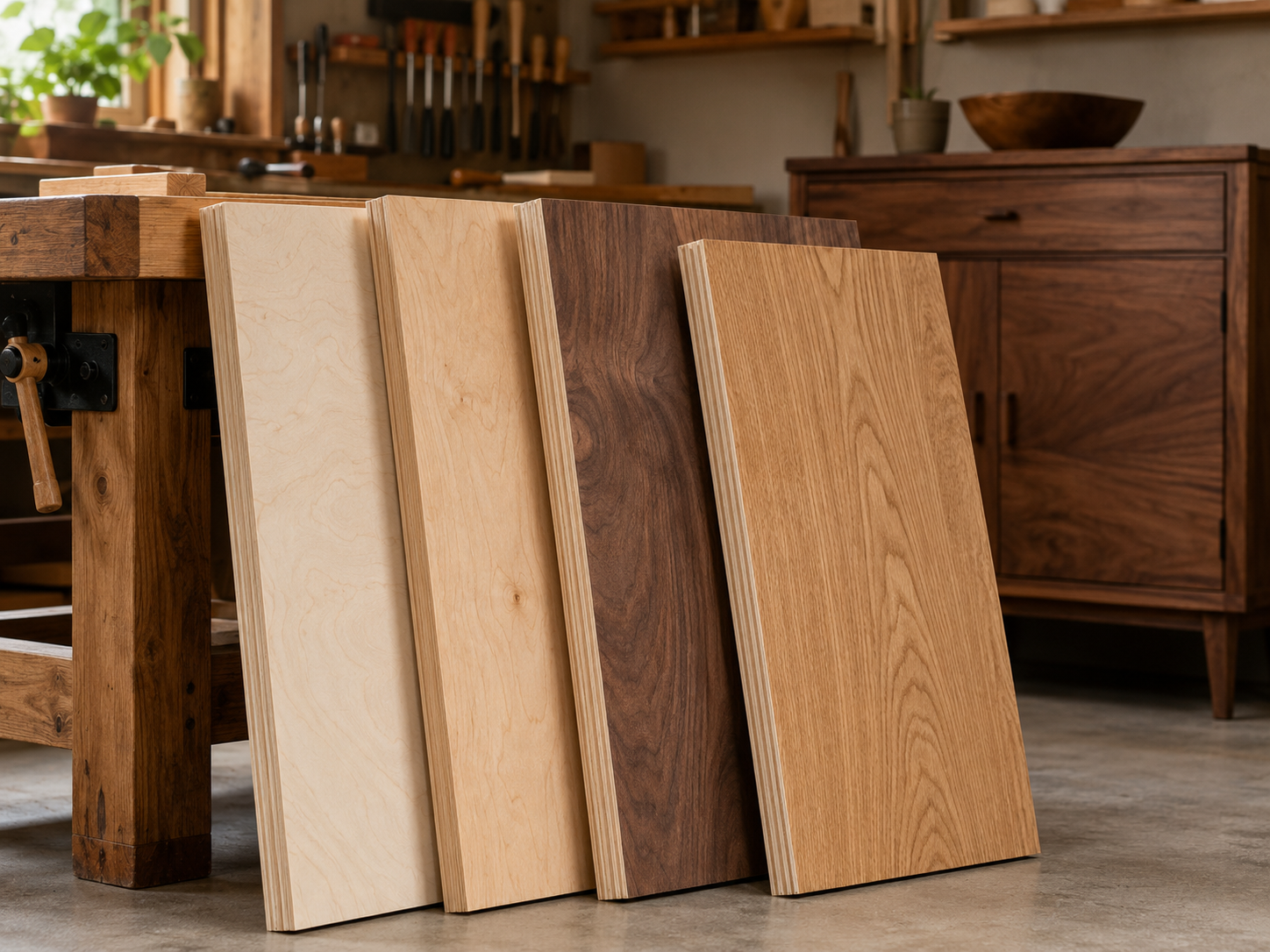
Furniture-grade plywood is a trade term for decorative hardwood plywood selected for furniture, cabinetry and other visible interior projects. It is not an official plywood grade, and the label alone does not guarantee a void-free core, a particular face grade or perfect flatness. Quality depends on the face and back grades, core construction, thickness consistency and manufacturer specifications.
The relevant standard is ANSI/HPVA HP-1-2024, the current North American standard covering hardwood-plywood face, back and inner-ply grades, tolerances, sanding and grade marking. This guide shows what to actually look for, the types worth paying for, and the ones that lead to a redo.
Save this for your next build — the comparison table below is the fastest way to pick the right panel before you’re standing in the aisle second-guessing yourself.
Furniture Grade Plywood at a Glance (Comparison Table)
Type
Core
Typical Face
Typical Core-Gap Risk
Best For
Relative Cost
Baltic Birch
Birch veneer, many thin plies
Birch (B / BB)
Low when genuine; verify grade and supplier
Drawer boxes, jigs, boxes, exposed edges
$$$
Domestic Veneer-Core Hardwood Ply
Softwood/hardwood veneer
Oak, maple, birch, walnut, cherry
Varies
Cabinets, casework, panels
$$
MDF-Core Hardwood Ply
MDF
Decorative hardwood veneer
No veneer gaps within the MDF core
Flat doors, veneer/paint-grade panels
$$
Combination Core
Veneer + MDF crossbands
Hardwood
Low near faces; inner veneer plies vary
Large flat cabinet doors and panels
$$$
Domestic Multi-Ply (e.g., ApplePly)
Birch/alder multi-ply
Maple, birch
Usually low; verify manufacturer spec
High-end furniture, exposed edges
$$$$
Utility / Sanded Project Panel
Softwood or unspecified
Birch or sande face
Varies widely
Shop fixtures, utility, paint-grade
$
Rule of thumb: if the edge will show, you want a many-ply panel with a low core-gap risk (Baltic birch or a domestic multi-ply). If it’s painted or hidden behind a face frame, you have more room to save money.
What Actually Makes Plywood “Furniture Grade”?
Three things, in order of importance:
A clean, appearance-quality face. Fewer patches, tight color match, no open knots on the show side.
A stable core with few internal gaps. Hollow gaps between the inner plies can swallow screws or telegraph a dimple through the veneer.
Good flatness and dimensional stability. A furniture-quality panel should be flat when purchased and remain reasonably stable when stored, cut and finished correctly.
None of those are guaranteed by a printed word — which is exactly the problem. Real hardwood plywood is graded under ANSI/HPVA HP-1, which rates the face and back separately. A sheet labeled “furniture grade” might carry a refined face grade, or it might be marketing on a more permissive panel. So it pays to understand what the actual grades promise.
Furniture Plywood Grades: AA–E Faces and 1–4 Backs
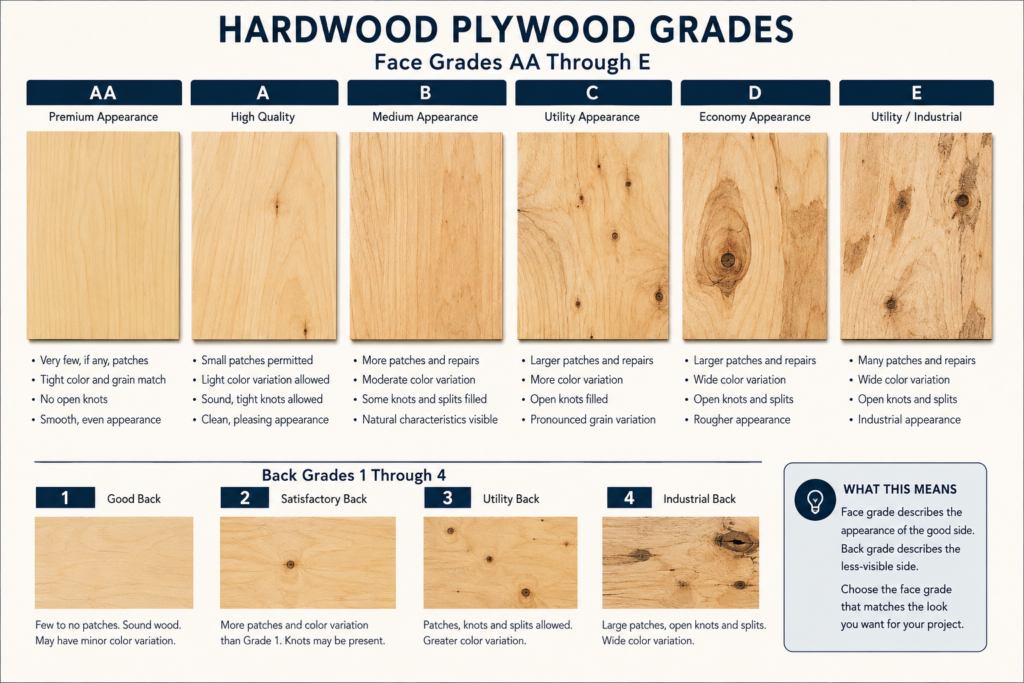
Under HP-1-2024, faces and backs are graded separately.
Face grades run AA, A, B, C, D and E. AA is the most restrictive appearance grade, followed by A, B, C, D and E. More restrictive appearance grades allow fewer defects, tighter color and grain matching, and fewer patches.
Back grades run 1 through 4, describing the less-visible side.
So a common panel might be listed as something like “A-1” (refined face over a sound back) or “B-2.” Two points worth holding onto: these are appearance classifications, not simple strength rankings — a more permissive face grade isn’t weaker wood, it just shows more character (color streaks, splices, small patches). Pick the face to match the look you want. For the full defect-by-defect breakdown of each letter and number, see how hardwood plywood is really graded.
The Mistake: Buying by the Sticker, Not the Spec
The most common furniture-grade plywood mistake is trusting the shelf tag. A label such as “furniture grade,” “cabinet grade” or “premium” does not replace an actual face grade, core specification or manufacturer identification. The same word can appear on panels that were never independently graded — one with a thick, forgiving face over a clean core, another with a thin face veneer that can sand through quickly.
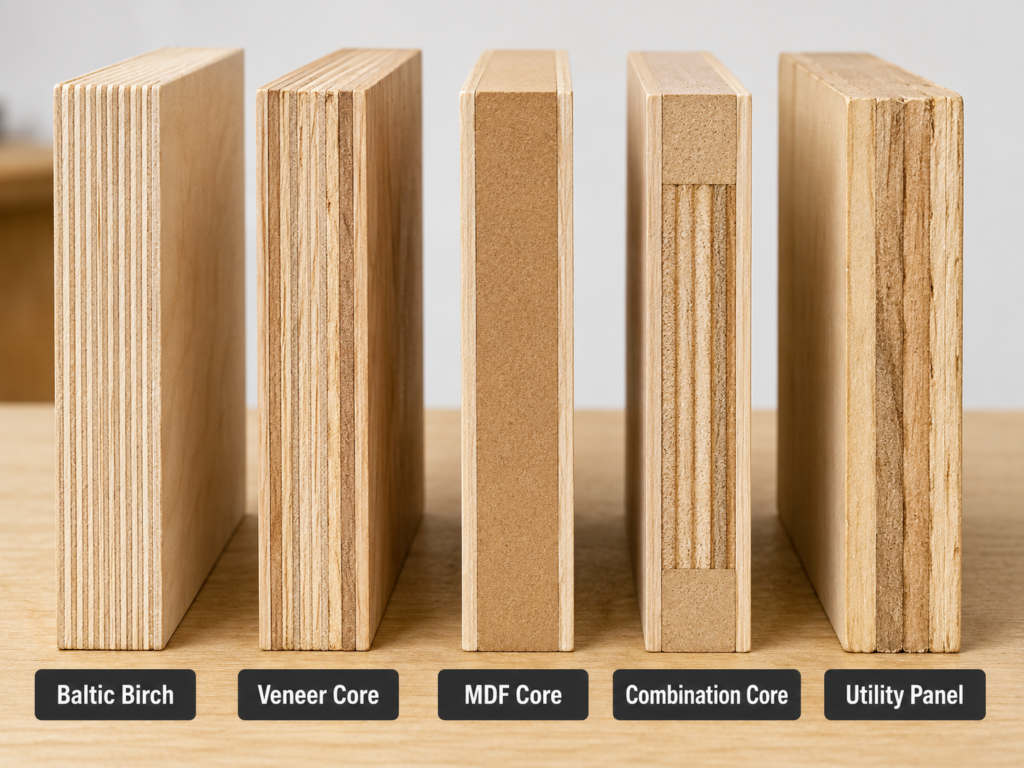
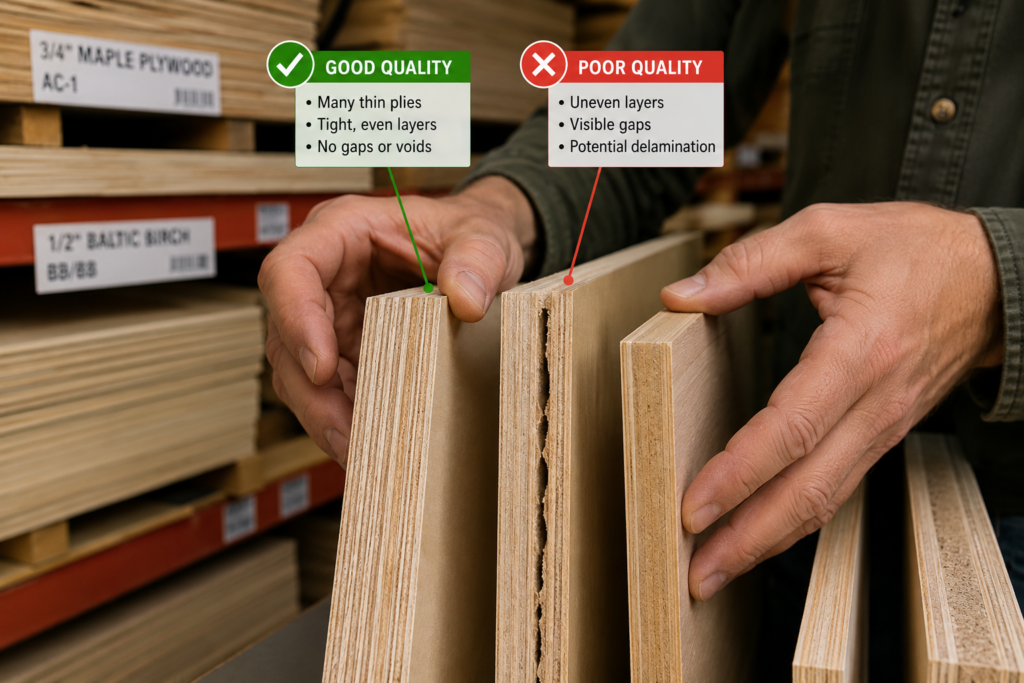
What to do instead: flip the sheet on edge and inspect the core. On veneer-core and multi-ply panels, look for tight, even layers without visible gaps or delamination. On MDF- or combination-core panels, look for a uniform core, intact edges and no separation between the face veneer and core.
The Types Worth Knowing
Baltic Birch — the shop favorite
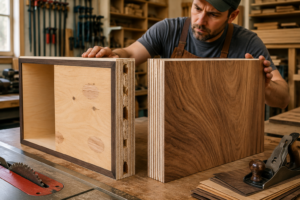
Genuine Baltic birch is typically constructed from numerous thin birch veneers and is valued for its consistent multi-ply edge and low incidence of core gaps. That’s why drawer boxes and jigs are so often made from it — you can leave the edges exposed. Verify the actual product specification, though, because construction and quality vary among suppliers.
Two things trip people up: it usually comes in 5×5 ft sheets, not 4×8, and it’s sold in metric thicknesses (3, 6, 9, 12, 18mm). And the supply picture has shifted — see the sourcing note below.
Domestic Veneer-Core Hardwood Plywood — the cabinet workhorse
This is your red oak, maple, birch, cherry, hickory and walnut plywood in 4×8 sheets. Lighter than MDF-core, holds screws well, and takes stain nicely because the face is real hardwood. The trade-off is that a veneer core can occasionally hide a void, so it’s better for cabinet boxes and panels than for edges left bare.
MDF-Core & Combination-Core — flat and stable
When flatness matters more than edge screw-holding — big painted doors, a panel you’re veneering — an MDF or combination core is often the better choice. An MDF core has no veneer-layer gaps and provides a particularly smooth, consistently flat substrate for paint or decorative veneer. A combination core adds MDF crossbands near the faces for flatness while keeping veneer inner plies in the center. The downsides are weight and poor edge-screw holding, so plan for pocket screws, dominoes or a face frame.
Domestic Multi-Ply (ApplePly and similar) — the premium tier
Think Baltic birch made in North America: many thin plies, a clean edge, and a maple or birch face. It costs the most, but for exposed-edge furniture where the plywood is the aesthetic, it’s the top of the range. Verify the manufacturer spec for ply count and grade.
Utility & Sanded Project Panels — inspect before you trust
Utility and sanded project panels vary widely in face quality, core construction and intended use. Inspect the grade, manufacturer specification and the actual panel rather than judging solely by the store or country of origin. Used well, they’re fine for shop fixtures, jigs and paint-grade parts.
A Note on Baltic Birch Sourcing
Since 2022, trade restrictions, elevated duties and supply-chain disruption have reduced the predictable availability of traditional Russian and Belarusian Baltic birch in North America. Panels sold under similar names may now come from different countries and use different constructions. Verify the manufacturer, country of origin, grade and ply count before you assume you’re getting the classic product.
Furniture Grade Plywood Cost: What Raises the Price
Here’s the spread that surprises people. For a nominal 3/4″ panel:
Utility / sanded project panel: the cheapest option — and priced like it.
Domestic veneer-core hardwood (oak/maple/birch): normally substantially more than utility or sanded panels, with premium species such as walnut and white oak commanding the highest prices.
Baltic birch: premium, and less predictable in price since 2022 supply shifts.
Domestic multi-ply (ApplePly and similar): the top of the range, often well north of a standard hardwood sheet.
Pricing varies significantly by region, species, core, face grade and panel dimensions — compare current local prices rather than relying on a fixed national range. The number that matters isn’t sticker price — it’s cost per usable panel. A cheap sheet with a face that sands through, gaps you have to fill, and a cup you can’t flatten out means scrapped parts and a second trip. Paying more once often beats paying less twice.
Why Utility Plywood Often Fails in Visible Furniture
A frequent “I wish I’d known” story: someone builds a bookshelf, media console or table from utility or construction-grade plywood to save money, then stains it. A soft or thin face can drink stain unevenly and blotch, an edge can telegraph the core, and a panel that wasn’t intended for interior furniture can cup after it’s cut.
The fix: the moment a plywood face will be seen and finished clear, step up to appearance-grade hardwood plywood. Reserve utility panels for paint-grade and hidden parts. If a small blemish or nail hole does need hiding, the right product matters — wood filler and wood putty aren’t interchangeable, so match the choice to the repair.
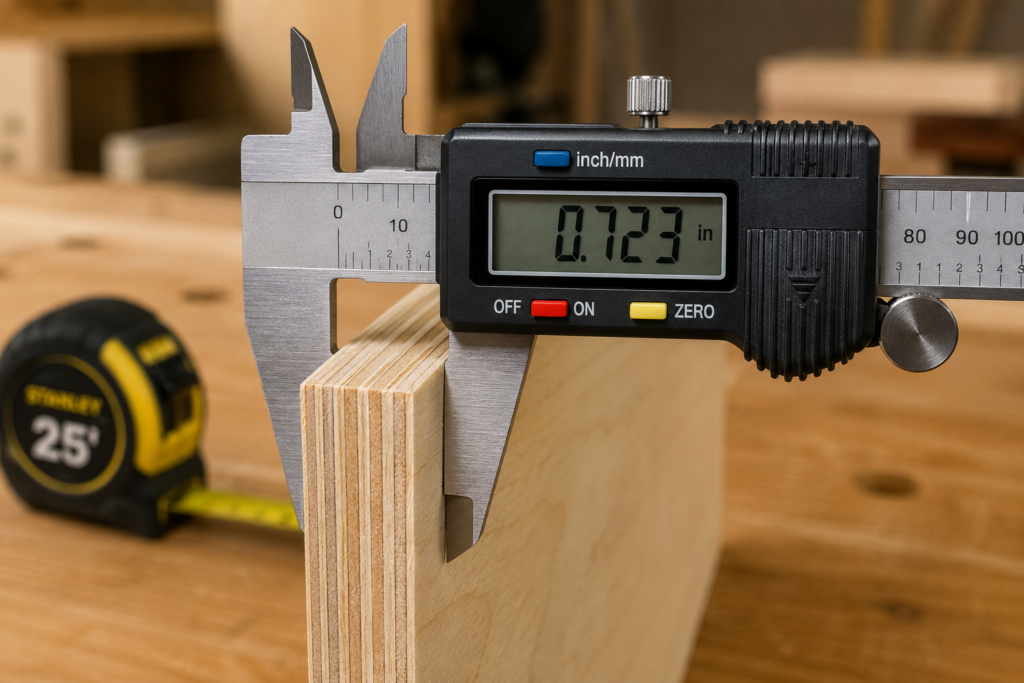
This one bites everybody once. Nominal plywood thickness is not always the panel’s exact measured thickness. A panel sold as 3/4 inch may measure several hundredths under 0.750 (some constructions land around 0.72″), and imported metric panels may differ again. Actual thickness varies by manufacturer, core and product specification.
Why it matters: if you cut a 3/4″ dado for a shelf that’s actually a hair under, the joint is sloppy. If your hardware or joinery assumes true 3/4″, nothing lines up. Measure every sheet with calipers before cutting dados, grooves or hardware-dependent joinery — or use undersized router bits made specifically for plywood.
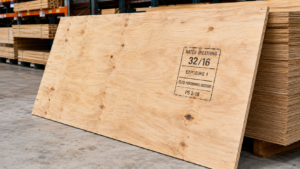
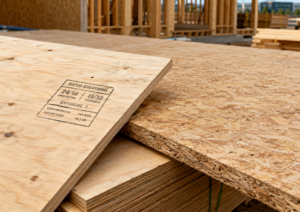
This is a different world from the softwood sheathing grades like CDX at the lumberyard, which follow their own thickness and bond rules — if you’re comparing the two, my breakdown of the softwood sheathing grades like BCX and CDX sorts out where each belongs.
The 30-Second Store Inspection
Before buying any sheet claiming to be furniture grade, run a quick check right in the aisle:
Sight along the sheet for bow or twist.
Inspect the exposed edges for visible gaps or delamination.
Check the face and back for defects and patches.
Read the grade / manufacturer label where one exists.
Measure the actual thickness when precision matters.
Many-ply panels often show numerous thin, uniform layers, while lower-spec veneer-core panels may use fewer, thicker plies and may show visible gaps. Price alone does not determine core quality, so inspect the actual sheet.
Furniture Grade vs. Cabinet Grade vs. Construction Grade
Furniture grade / cabinet grade — overlapping, non-standardized trade terms. “Cabinet grade” often describes appearance-quality hardwood plywood for casework, while “furniture grade” may imply stricter expectations for exposed faces, edges or flatness. Suppliers don’t always use them identically — check the actual face grade, back grade and core.
Construction / sheathing grade — structural softwood plywood (CDX and friends). Strong and cheap, but rough-faced and not meant to be stained and shown.
And one myth to kill: furniture grade plywood is not automatically waterproof. Adhesive and moisture-resistance specs vary by product, but most decorative hardwood plywood sold for furniture is made for protected interior use. A bond rating also isn’t the same thing as decay resistance — check the manufacturer’s bond and application specification if moisture exposure is possible, and keep the panel dry.
How to Choose (and Where to Buy)
Match the panel to the job:
Exposed edges, drawers, boxes, “the plywood is the look” → Baltic birch or a domestic multi-ply like ApplePly.
Cabinet boxes and stain-grade casework → domestic veneer-core hardwood in your species.
Big flat doors or panels, painted or veneered → MDF or combination core.
Jigs, shop fixtures, hidden or paint-grade parts → save money with a utility or sanded panel (inspect it first).
For online buys where a local hardwood dealer isn’t handy, these categories cover most furniture projects:
A fine-tooth plywood/veneer saw blade (kills tear-out on nice faces) → see plywood blades
As an Amazon Associate, theplywood.com earns from qualifying purchases.
Frequently Asked Questions
Is furniture grade plywood the same as cabinet grade? Furniture grade and cabinet grade are overlapping trade terms, but they are not standardized and suppliers do not always use them identically. “Cabinet grade” often describes appearance-quality hardwood plywood intended for casework, while “furniture grade” may imply stricter expectations for exposed faces, edges or flatness. In either case, check the actual face grade, back grade and core construction.
What is the best plywood for furniture? It depends on the part. For exposed edges and drawer boxes, Baltic birch or a domestic multi-ply like ApplePly is hard to beat. For stain-grade cabinet boxes, domestic veneer-core hardwood plywood in your chosen species is the sweet spot. For big painted or veneered panels, an MDF or combination core often provides the best flatness.
Is Baltic birch furniture grade? Yes — it’s one of the go-to furniture-grade choices thanks to its consistent multi-ply edge and low incidence of core gaps. Just remember it usually comes in 5×5 ft sheets and metric thicknesses, and confirm the manufacturer, origin and grade since supply shifted after 2022.
How thick should plywood be for furniture? Common choices include nominal 3/4-inch plywood for cabinet cases, shelves and larger structural parts; 1/2-inch plywood for some drawer boxes and smaller components; and 1/4-inch plywood for cabinet backs and lightly loaded drawer bottoms. Design, span and expected load determine the correct thickness. Always measure the panel’s actual thickness before cutting joinery.
Can you stain furniture grade plywood? Yes, when it has a real hardwood face such as oak, maple or walnut. Sand appropriately, use a pre-stain conditioner on blotch-prone species such as birch or maple, and test the complete finishing system on an offcut. Utility-grade sanded softwood panels may stain unevenly and show patches, grain variation or other defects.
Is furniture grade plywood waterproof? No. Furniture-grade plywood is not automatically waterproof or suitable for exterior use. Adhesive and moisture-resistance specifications vary by product, but most decorative hardwood plywood sold for furniture is intended for protected interior applications. Check the manufacturer’s bond and application specification if moisture exposure is possible.
Related Posts:
Plywood Grade Stamp Explained: What It Means by Admin August 12, 2026 DIY Look at almost any sheet of structural plywood and you'll find a grade stamp inked onto the back or edge of the panel. Most buyers…