Meta Description: Compare Exposure 1 and Exterior plywood, learn what the grade stamp means, and choose the right panel for sheds, roofs, subfloors, and outdoor projects.
Selecting structural panels for a building or a weekend project requires understanding how the American Plywood Association (APA) classifies plywood based on its moisture resistance, veneer quality, and intended application. Selecting an incorrect panel grade or bond classification can lead to premature material degradation or structural deformation.
The letters printed on a plywood sheet do not tell the entire story. Before choosing a panel, it helps to understand how plywood grades are assigned and what the bond classification on the grade stamp actually means.
Exposure 1 plywood can tolerate temporary moisture during construction, but it should eventually be protected by roofing, siding, flooring, or another weather barrier. Exterior-classified plywood is the appropriate choice when a panel will face long-term weather exposure, although it still requires proper finishing, drainage, and maintenance.
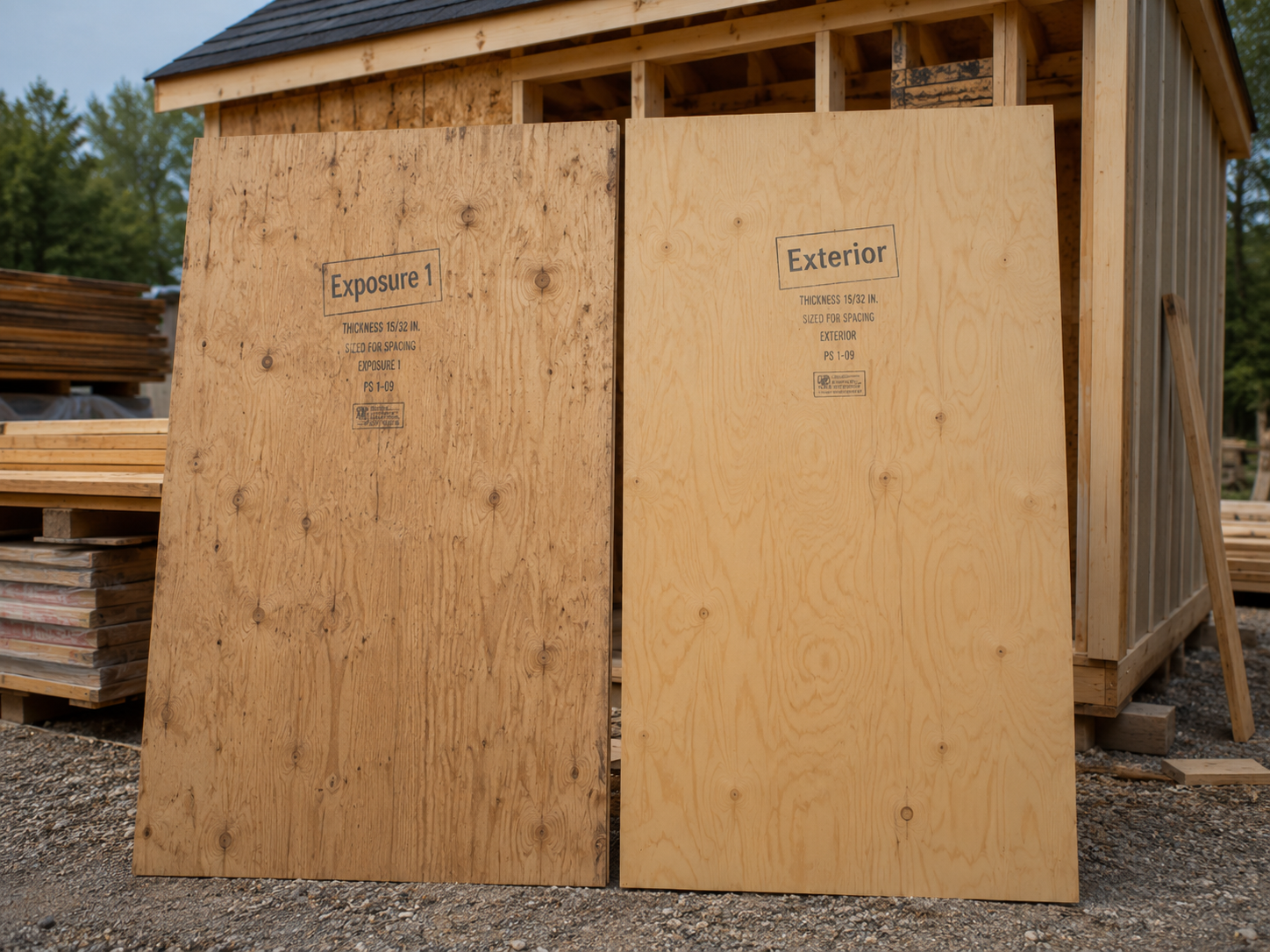
Exposure 1 vs. Exterior Plywood: Quick Comparison
The primary distinction between Exposure 1 and Exterior plywood lies in their veneer specifications and long-term tolerance to weather. While both are manufactured to withstand moisture during different phases of use, their performance limits vary considerably.
Category
Exposure 1 Plywood
Plywood Carrying an Exterior Bond Classification
Intended Moisture Exposure
Temporary construction moisture and humidity delays before being enclosed or protected.
Long-term exposure to weather or moisture when the panel is properly detailed, finished, and maintained.
Glue Bond Classification
Exterior-type structural adhesive, with the overall panel intended for temporary weather exposure.
Exterior-type structural adhesive combined with panel construction suitable for repeated wetting and drying or long-term weather exposure.
Decay Protection from Bond Classification
None. Preservative treatment may be required for decay-prone applications.
None. Preservative treatment may be required for decay-prone applications.
Finishing Required Outdoors
Not normally recommended for continuously exposed outdoor use.
Usually requires appropriate finishing, edge protection, and periodic maintenance.
Minimum Allowed Veneer Grade
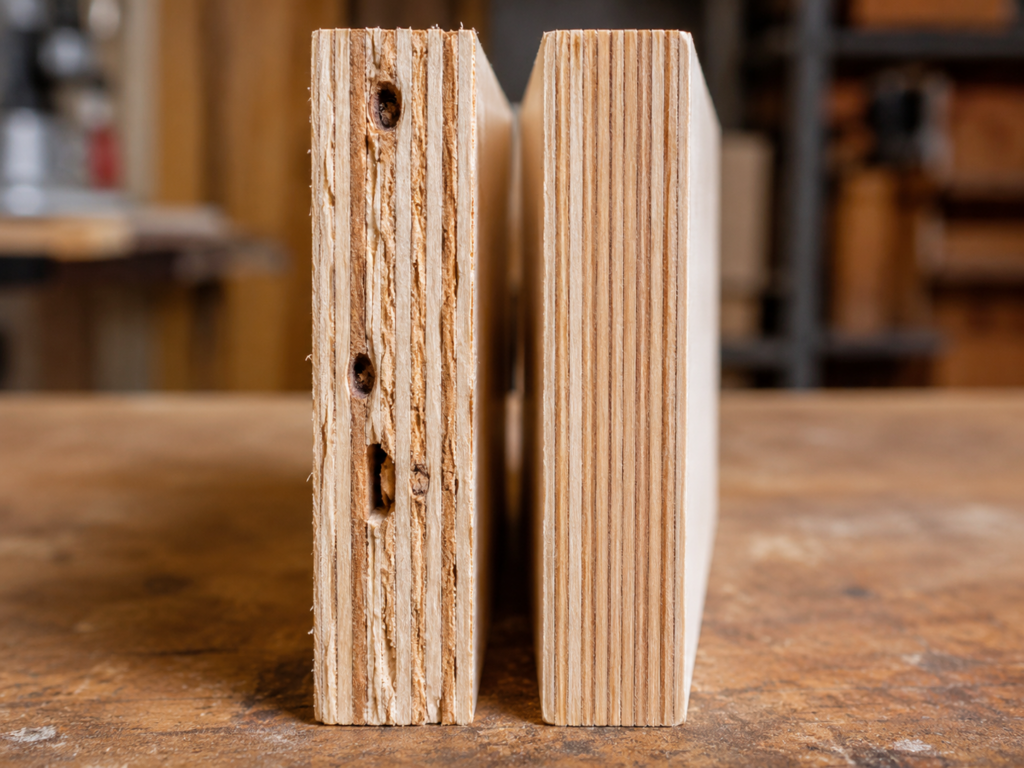
Permits D-grade veneer, including larger knot holes and natural defects.
Requires minimum C-grade veneer across all internal and face layers.
Common Designations
Stamped “Exposure 1,” often seen on structural sheathing such as C-D panels.
Stamped “Exterior,” found on appropriately stamped A-C, B-C, or C-C panels.
Quick Decision: Which One Should You Buy?
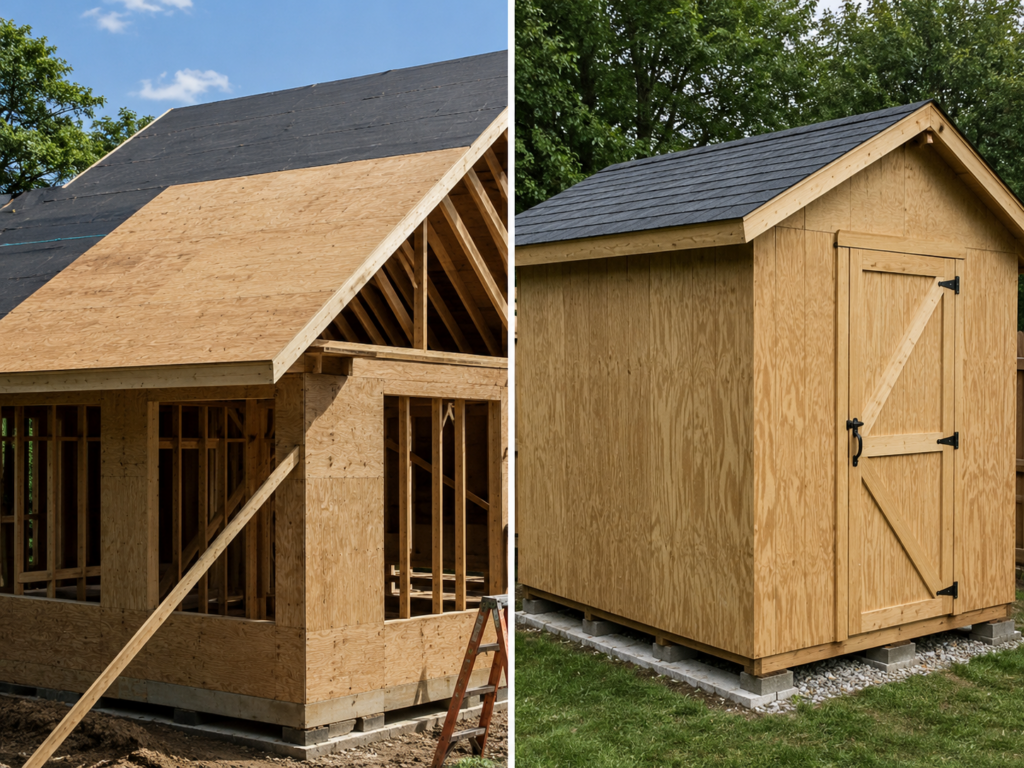
Use Exposure 1 plywood for roof sheathing, wall sheathing, and subfloors that may get temporarily wet during construction but will later be protected.
Use Exterior-classified plywood when the panel will face repeated humidity, rain, or seasonal weather after installation.
Use preservative-treated plywood when decay or insect exposure is the main concern, particularly near soil, damp masonry, or poorly ventilated spaces.
Use marine-grade plywood when the project requires high-quality veneers and tightly restricted core gaps. Marine plywood is not automatically treated against decay.
Always make the final decision from the panel stamp rather than a shelf label or abbreviation.
What Exposure 1 Actually Means
An Exposure 1 rating indicates that a panel is engineered to withstand temporary moisture and humidity. The primary intent behind this classification is to protect structural panels during active building construction delays, such as when a framing crew gets caught in a heavy rainstorm before the roof shingles, house wrap, or siding can be installed.
Exposure 1 panels are manufactured using the same exterior-type structural adhesives found in Exterior-rated panels. However, the designation is an exposure classification for the overall panel, not a license for permanent weathering.
Because the wood veneers inside are permitted to have lower structural grades, the panel must eventually be enclosed, dried out, and protected from the elements within the finished building envelope.
What Exterior Classification Actually Means
Plywood carrying an Exterior bond classification is manufactured for projects that will face long-term, repeated exposure to weather, liquid water, or high humidity.
Crucially, the “Exterior” stamp refers primarily to the bond durability and panel construction. It does not imply that the panel is fully waterproof, rot-proof, or immune to the elements.
The APA states that a bond classification does not establish resistance to wood-destroying fungi, ultraviolet degradation, physical erosion, or wood-boring insects.
Without appropriate paint, solid stains, edge-protective sealers, and proper detailing to shed water, even an Exterior-classified panel can undergo surface checking, veneer swelling, and eventual decay when left raw in the elements.
The Core Technical Differences: Veneer Grades
To choose the right panel, you must look past the adhesive and examine how the APA defines material standards.
Plywood performance is dictated by both the bond classification and the veneer grade, which describes the physical quality of the wood plies.
Plywood is constructed by laminating thin sheets of wood veneer together. These veneers are graded from A to D based on surface cleanliness, knot size, splits, repairs, and other defects.
Grade C: Permits tight knots up to approximately 1.5 inches across and small splits. It represents the minimum quality allowed for any layer in an Exterior-rated panel.
Grade D: Permits larger open knot holes up to approximately 2.5 inches wide and more pronounced defects. D-grade veneers are permitted in Exposure 1 panels.
Exterior Bond Classification
A typical Exterior-classified panel may have:
Face ply: Grade A, B, or C
Inner plies: Minimum Grade C
Back ply: Grade C or better
Exterior-type structural adhesive
Exposure 1 Bond Classification
A typical Exposure 1 panel may have:
Face ply: Grade determined by the panel stamp
Inner plies: May include D-grade veneers and larger defects
Back ply: Grade determined by the panel stamp
Exterior-type structural adhesive
Lower-grade veneers can contain larger knots, openings, and defects. Repeated wetting and drying causes wood fibers to swell and shrink, increasing the risk of surface checking, edge deterioration, and moisture retention.
A frequent error in construction and DIY planning is treating common retail terms as an absolute guarantee of performance.
Retail terms such as “CDX” and “ACX” are not substitutes for the bond classification printed on the panel stamp. Do not assume that the letter X proves the panel has an Exterior classification. Verify that the stamp explicitly says Exterior.
CDX is commonly misunderstood as permanent exterior plywood. Our complete guide to what CDX plywood actually means explains the face grades, back grade, and exposure classification in more detail.
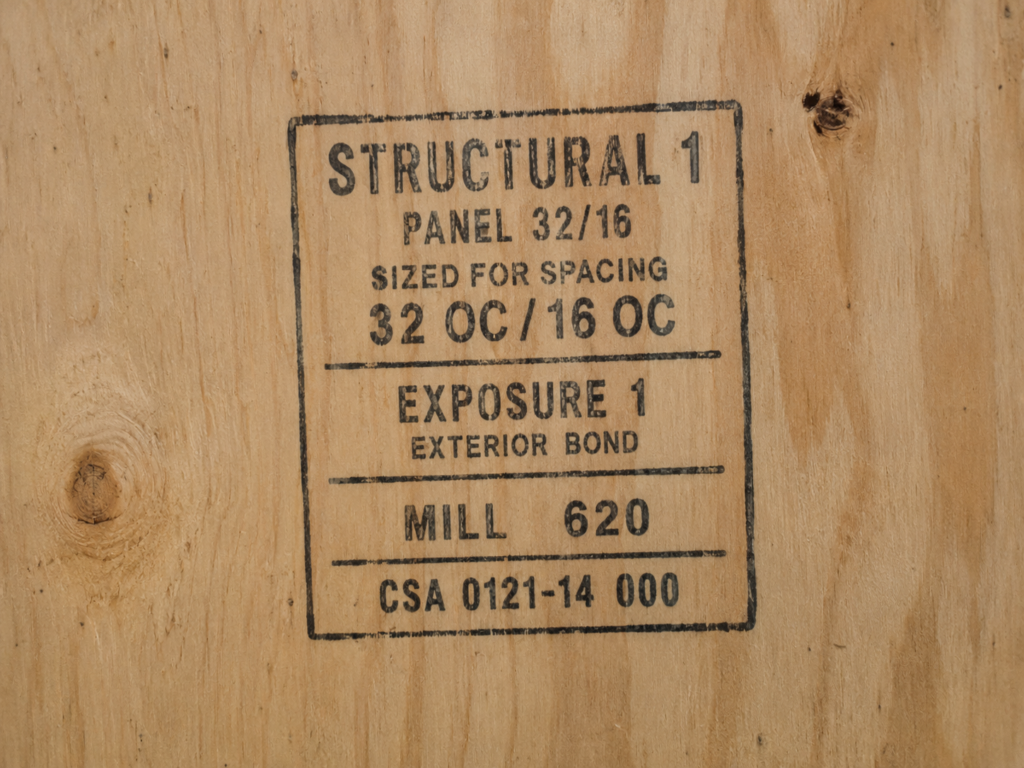
A typical APA grade stamp may include:
Panel grade
Span rating
Bond classification
Mill number
Product standard
Panel Grade
The panel grade indicates the overall performance category, such as Rated Sheathing or Underlayment.
Span Rating
The span rating shows the maximum recommended spacing of supports for roof and subfloor applications.
For example, a 32/16 rating generally indicates:
Up to 32-inch support spacing for roof sheathing
Up to 16-inch support spacing for subfloor applications
The correct installation still depends on panel thickness, loads, project plans, and applicable building codes.
Bond Classification
This field explicitly states whether the panel is classified as Exposure 1 or Exterior.
Mill Number
The mill number identifies the manufacturing source for quality-control and product-tracking purposes.
Product Standard
The stamp may indicate compliance with a recognized product standard such as PS 1 or PS 2.
Exposure 1 vs. Exterior Plywood for Specific Projects
Choosing between these panels requires evaluating the microclimate of your specific build site.
For sheds, panel selection also depends on whether the plywood will be used for flooring, structural sheathing, exposed siding, or roofing. See our guide to choosing plywood for shed floors, walls, and roofs for a more complete breakdown.
Shed Walls
Consider an 8-by-10 shed sided with Exposure 1 sheathing and protected only by paint. Repeated splashback and wetting can cause the panel edges to swell and deteriorate because Exposure 1 is not designed for frequent moisture cycles.
A shed exterior should normally use properly rated siding, cladding installed over structural sheathing, MDO panels approved for the application, T1-11 plywood siding, or another weather-rated exterior system.
Shed Floors
Shed floors constructed near the ground run a high risk of trapping soil moisture beneath the building frame.
Standard Exterior plywood alone does not provide protection against wood-destroying fungi or persistent dampness. Shed floors near the ground may require pressure-preservative-treated plywood rather than standard Exterior plywood.
Roof Sheathing
Exposure 1 panels are commonly used for home and utility roof decks.
Once the roofing system is installed, the panels are protected from direct weather exposure, although roof leaks, failed flashing, or condensation can still introduce moisture.
Subfloors
Subfloors are routinely specified as Exposure 1. They are used beneath finished flooring where the panel will ultimately remain protected from direct weather exposure.
A subfloor does not necessarily sit within a conditioned thermal envelope. It may be installed over an unconditioned crawlspace or damp basement, but it must still be shielded from driving rain and persistent moisture.
Outdoor Furniture
Patio chairs, tables, and benches should be built with panels carrying an Exterior bond classification.
Because these assemblies feature exposed horizontal surfaces where water can pool, Exposure 1 panels are more vulnerable to checking, edge swelling, and deterioration when repeatedly exposed to rain and standing water.
Review the available types of exterior plywood to select a clean face grade such as A-C Exterior for a smooth painted finish.
Soffits
Panel requirements depend on the soffit design.
APA permits Exposure 1 panels for open soffits, while closed soffits should use Exterior-classified panels. Any exposed roof-sheathing edges should be protected with properly installed fascia trim.
Planter Boxes
Planter boxes hold damp soil continuously against the inner wood faces.
Neither Exposure 1 nor untreated Exterior plywood can handle this environment indefinitely. Planter boxes require a protective liner along with pressure-treated or naturally rot-resistant materials where appropriate.
The liner must include adequate drainage. A liner that traps water can accelerate deterioration rather than prevent it.
Playhouses
Backyard playhouses, structural treehouses, and playground platforms require high-quality panels with an Exterior bond classification.
Exterior plywood alone is not sufficient protection. Surfaces must be properly supported, coated, and regularly inspected for splintering, decay, soft areas, loose fasteners, and delamination.
Docks and Boats
Marine environments present severe moisture exposure.
Exposure 1 plywood is not appropriate for boat hulls or similarly demanding applications. The suitability of standard Exterior plywood depends on the design, protection system, and project specifications.
A common point of confusion is assuming that an Exterior bond rating equals pressure-treated protection.
Exposure 1 and Standard Exterior Plywood
Exposure 1 and standard Exterior plywood have no chemical protection against rot, mold, termites, or other wood-destroying organisms.
Their bond classifications primarily address the ability of the adhesive and panel construction to tolerate specified moisture exposure.
Pressure-Treated Plywood
Pressure-treated plywood is pressure-impregnated with chemical preservatives such as copper azole or micronized copper quaternary.
These preservatives help protect the wood fibers against fungal decay and wood-destroying insects.
Treatment does not make the plywood completely waterproof. Pressure-treated panels may still require appropriate drainage, drying, flashing, coatings, and corrosion-resistant fasteners.
Plywood near soil, damp masonry, or persistent moisture may require preservative-treated material. Confirm the required treatment category from:
Project specifications
Applicable building codes
Manufacturer instructions
Treatment labels
Intended use category
Do not assume that every treated panel is approved for ground contact.
Exposure 1 vs. Marine Plywood
Marine plywood is not automatically preservative-treated.
Marine-grade plywood is a premium Exterior-classified panel using B-grade or better veneers throughout the panel.
Its typical construction includes:
B-grade or better face veneer
B-grade or better interior veneers
B-grade or better back veneer
Tightly restricted core gaps
Exterior bond classification
Core gaps are tightly restricted rather than completely prohibited. Qualifying marine-grade plywood may contain core gaps up to 1/8 inch.
Because it uses higher-grade wood layers with restricted internal gaps, marine plywood provides a stable panel for demanding structural marine applications.
However, it does not automatically contain chemical protection against fungal decay. Depending on the application, marine plywood may still require marine epoxy, fiberglass, paint, spar varnish, sealed fastener holes, and protected edges.
How to Protect Exterior Plywood
No ordinary plywood should be treated as completely waterproof.
Our guide explaining whether any plywood is truly waterproof outlines the differences between waterproof glue, weather-resistant construction, overlays, coatings, marine plywood, and preservative treatment.
To maximize the service life of an Exterior-classified panel, follow these installation rules.
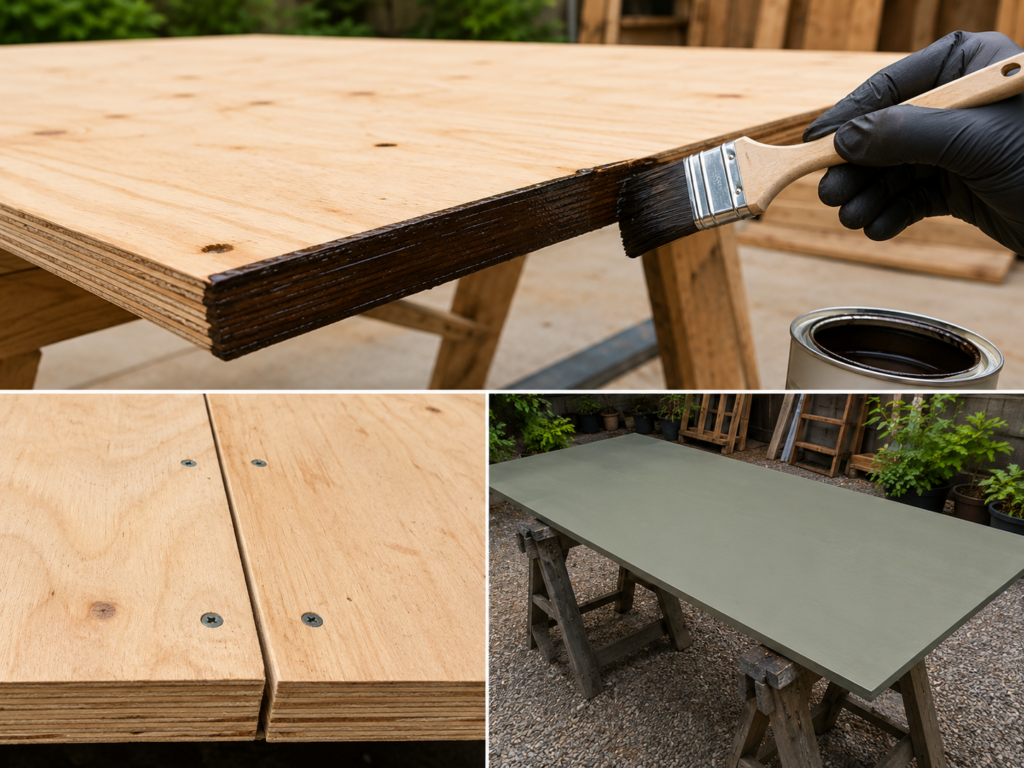
Seal the Edges
Raw plywood edges are particularly vulnerable to moisture absorption.
Seal all field-cut edges with a coating compatible with the panel and final finish. Depending on the project, this may include exterior primer, epoxy, solid-color stain, or a dedicated edge-sealing compound.
Maintain Panel Gaps
Plywood can expand as moisture levels change.
Many structural installations require approximately a 1/8-inch gap between panel edges, but the correct gap should be confirmed using the panel manufacturer’s instructions and project specifications.
Insufficient spacing can contribute to panel buckling.
Apply an Exterior Coating
Protect exposed face veneers from moisture and ultraviolet degradation with a compatible exterior coating system.
A typical painted system may include:
Surface preparation
Exterior-grade primer
Two compatible finish coats
Sealing around exposed edges and penetrations
Follow the coating manufacturer’s instructions for preparation, drying time, and recoating.
Install Fasteners Correctly
Use exterior-rated fasteners compatible with the plywood and any preservative treatment.
Fastener heads should generally be driven flush unless the manufacturer specifies otherwise. Driving a fastener too deeply can damage the face veneer and create a depression where water collects.
Provide Ground Clearance and Drainage
Keep untreated plywood away from soil, standing water, and damp masonry.
The necessary clearance depends on the building design, siding system, flashing, local code, and manufacturer instructions. Avoid relying on one universal clearance measurement for every project.
Exterior plywood lasts longer when water can drain and the panel can dry. Avoid flat unprotected surfaces, upward-facing raw edges, trapped water behind trim, and direct soil contact.
Cost Analysis and Long-Term Value
Exposure 1 panels generally cost less because they may contain lower-grade veneers. However, using them in exposed applications can introduce replacement costs that exceed the original savings.
Consider a hypothetical outdoor project requiring four standard 4-by-8-foot sheets.
Hypothetical Option 1: Exposure 1 Sheathing
Example sheet price: $32 Initial material cost: $128
In this hypothetical scenario, premature deterioration forces the owner to replace the Exposure 1 panels.
The additional materials, finish, fasteners, disposal, and labor would eliminate the original $132 savings. The exact service life cannot be predicted because it depends on exposure, climate, drainage, construction details, and maintenance.
Example sheet price: $65 Initial material cost: $260
When properly selected, detailed, coated, and maintained, the Exterior-classified panel is better suited to long-term weather exposure.
The bond classification alone cannot guarantee a specific service life, but it gives the panel a construction standard appropriate for more severe moisture exposure.
Buying Checklist
Before purchasing plywood for an outdoor project, complete this five-point check.
Check the Stamp
Locate the official ink stamp and verify that it explicitly states Exterior when your project requires long-term weather exposure.
Inspect the Edges
Look along the factory-cut edges. Avoid panels showing severe delamination, crushed corners, large visible gaps, or overlapping interior veneers.
Verify the Thickness
Confirm that the stamped performance category matches your structural plans.
A panel described as nominal 1/2-inch plywood may have an actual performance category of 15/32 inch.
Examine Surface Defects
For visible exterior surfaces such as furniture or soffits, select a face grade appropriate for the desired finish.
Inspect the face for open knots, rough patches, splits, handling damage, and excessive surface checking.
Verify the preservative system, retention level, intended application, fastener requirements, and whether the panel is approved for ground contact.
Do not rely on color alone. Green, brown, or natural coloring does not prove that a panel is pressure-treated or approved for a specific application.
Frequently Asked Questions
Can paint or sealer make Exposure 1 plywood suitable for outdoor use?
A coating can slow moisture absorption, but it does not change the panel’s bond classification.
Exposure 1 plywood should not replace an Exterior-classified panel where long-term weather exposure is expected or where project specifications require Exterior plywood.
Paint may extend service life in a sheltered, noncritical project, but performance depends on edge sealing, drainage, fastener penetrations, maintenance, and the severity of exposure.
Why does Exposure 1 allow larger internal defects than Exterior plywood?
Exposure 1 panels are engineered under the assumption that they will eventually be protected from weather by roofing, siding, flooring, or another barrier.
Because they are not intended to handle continuous moisture cycling, the standards permit lower-grade veneers and larger defects than those allowed in Exterior-classified panels.
This enables mills to use more of the available wood while still producing structural panels suitable for protected applications.
Does Exterior plywood resist mold, mildew, and insects?
No.
The Exterior bond classification concerns the glue bond and panel construction. It does not establish resistance to ultraviolet exposure, mold, fungal decay, termites, or other insects.
Exterior plywood can still check, swell, weather, and decay when poorly detailed, continuously damp, or left unfinished.
Preservative-treated plywood may be required where fungal decay or insect exposure is expected.
Related Posts:
Exterior Plywood Lifespan: How Long Each Type Lasts Outdoors by Admin August 21, 2026 DIY Exterior plywood has no single outdoor lifespan. Covered sheathing that remains dry can remain serviceable for the life of the surrounding assembly, while permanently exposed…
Best Paint for Exterior Plywood: What Actually Lasts Outdoors by Admin August 27, 2026 DIY The best paint for exterior plywood is a high-quality 100% acrylic latex exterior paint applied over an exterior-rated primer. Just as important, every exposed plywood edge…
Dealing with Wet and Warped Plywood: What You Can Do by Admin March 21, 2025 Repairs Dealing with Wet and Warped Plywood: A Practical Guide We have prepared a reference guide for you—an easy checklist for your convenience. Wet_and_Warped_Plywood_Checklist_ThePlywoodDownload If you’ve…