This post contains Amazon affiliate links. If you buy through them, we may earn a small commission at no extra cost to you.
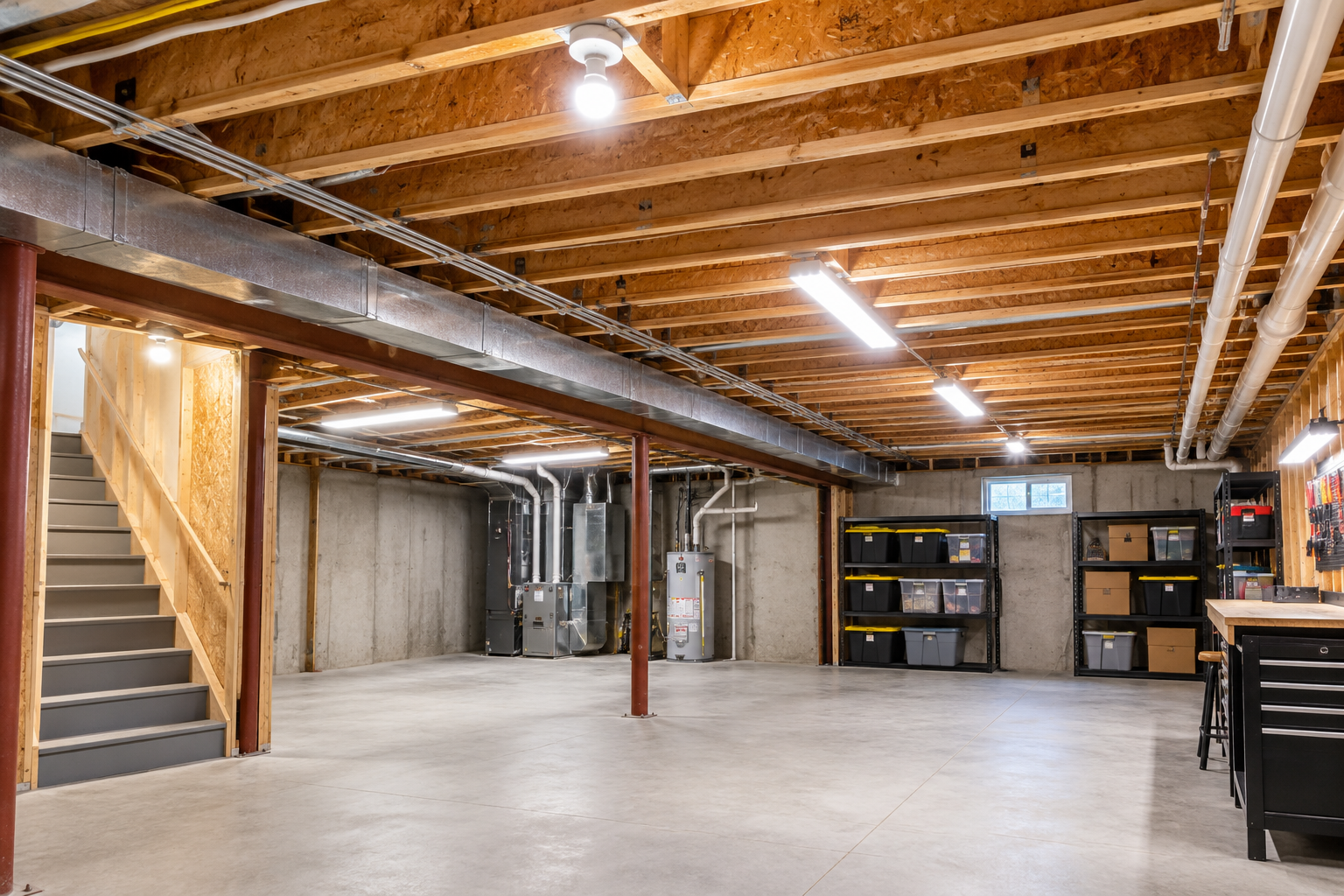
For most unfinished basements with open joists, the cheapest permanent light is a porcelain keyless lampholder on an electrical box with an LED bulb. For a workbench or laundry area, a hardwired LED strip or wraparound fixture is worth the step up. This guide compares six budget options side by side, shows how many lumens your basement needs with a worked example, and covers the wiring rules for exposed joists that trip up most DIY installs.
Quick answer
Cheapest permanent option: porcelain keyless lampholder + LED bulb, mounted on a box fastened to a joist.
Best value for work areas: hardwired 4 ft LED strip or wraparound fixtures.
Cheapest to install, but limited: plug-in linkable LED shop lights. They’re only code-friendly when the fixture is listed and hangs directly under its own receptacle with the cord fully visible.
Skip for now: canless wafer lights. They’re built to clip into a finished ceiling, not to hang on bare joists.
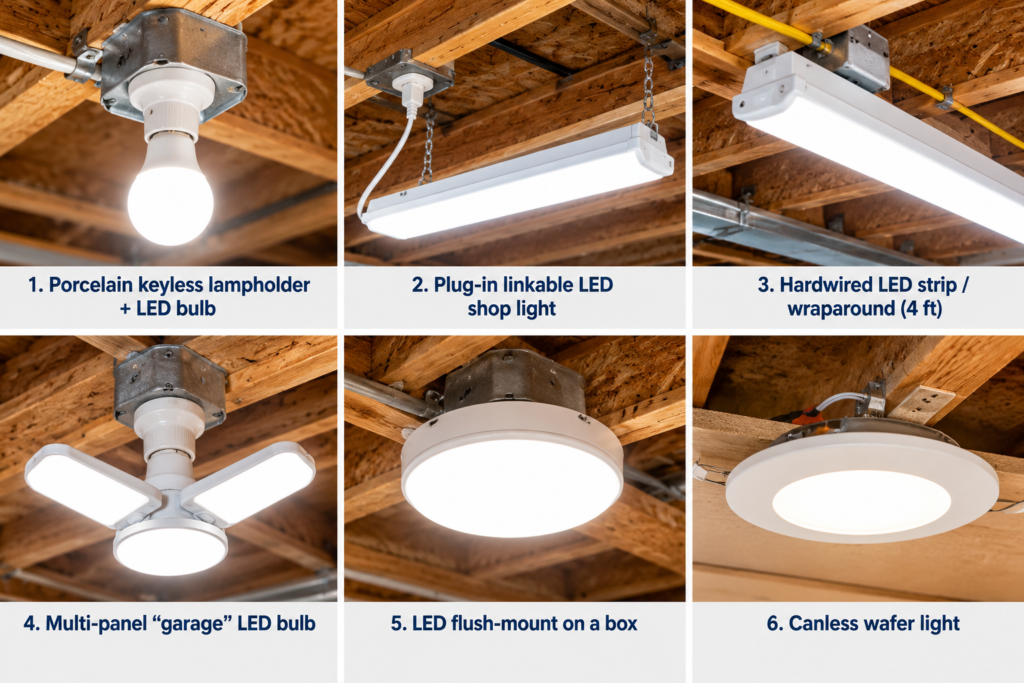
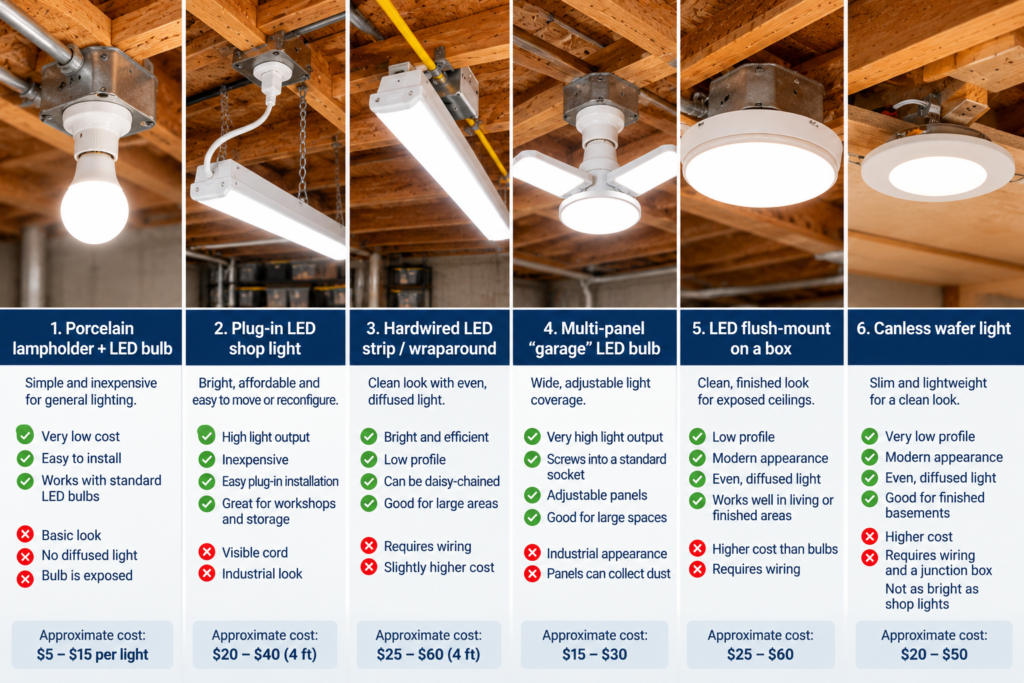
Exposed Joist Basement Lighting Options Compared
Option
Relative cost per light
Light spread
How it installs
Best for
The catch
Porcelain keyless lampholder + LED bulb
$ (lowest)
All directions, moderate
Hardwired to a box on a joist
Storage, stairs, mechanical area
One bare bulb = glare and shadows
Plug-in linkable LED shop light
$–$$
Wide, bright
Plugs into a receptacle
Workbench under its own outlet
Cord rules (see below)
Hardwired LED strip / wraparound (4 ft)
$$
Wide, even
Hardwired to a box
Laundry, workshop, long runs
More boxes and wiring
Multi-panel “garage” LED bulb
$–$$
Very wide
Screws into an existing socket
Quick upgrade of old lampholders
Bulky; check fit and weight on your socket
LED flush-mount on a box
$$
Moderate, softer
Hardwired to a box
Half-finished rec or exercise area
You pay for looks, not output
Canless wafer light
–$
Downward cone
Clips into a ceiling surface
Only after you add a ceiling
Not designed for bare joists
Prices change often, so the table uses relative tiers. Check local and online pricing before you buy.
How Many Lumens an Unfinished Basement Needs
Light levels are measured in foot-candles, and one foot-candle equals one lumen per square foot. These are approximate planning ranges for common basement uses. They’re starting points, not code minimums:
Workshop or workbench area: roughly 20–75 foot-candles
Laundry area: roughly 20–100 foot-candles
Exercise or recreation area: about 30 foot-candles
General storage: about 20 foot-candles is a reasonable starting point
The math: square feet × target foot-candles = lumens needed.
That number is the light that needs to land on the floor and work surfaces. It isn’t the total of the lumen ratings printed on the fixture boxes. Some of every fixture’s output is lost to joists, subfloor and walls, so the rated lumens you buy need to be higher. How much higher depends on the fixtures and their spacing. Bare wood and dark ceilings lose more.
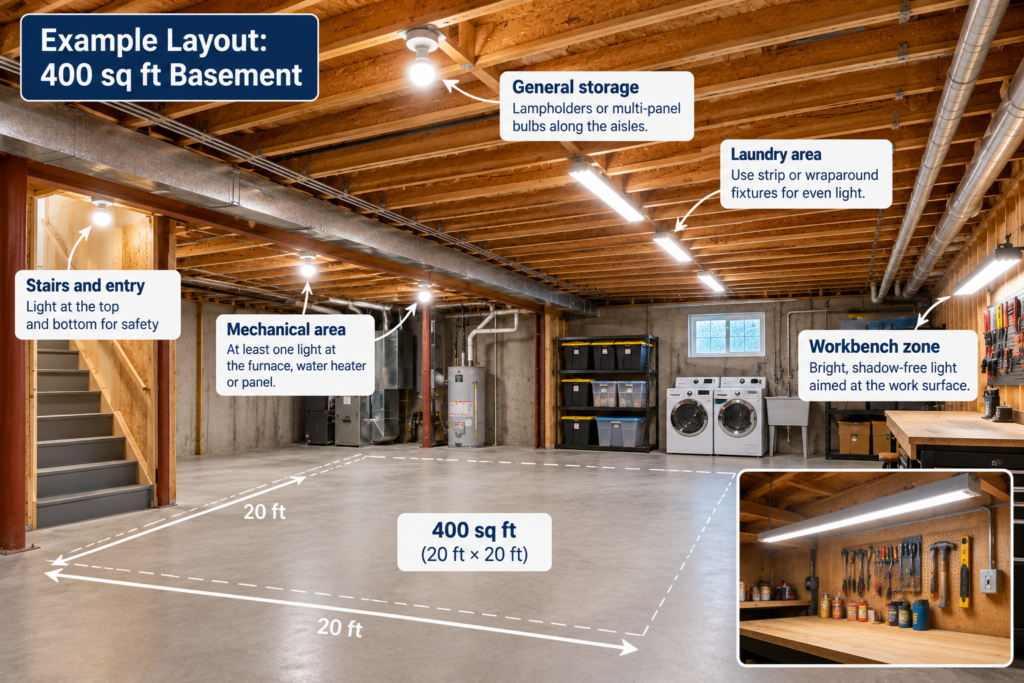
Example: Lighting a 400 sq ft Storage Basement
Target: 400 sq ft × 20 foot-candles = about 8,000 lumens on the floor.
On paper: with LED bulbs rated 1,600 lumens, 8,000 ÷ 1,600 = 5 lampholders.
In practice: some light never reaches the floor, so plan a few extra boxes along the aisles. That way you can add a bulb wherever it’s still dim instead of rewiring.
Workbench zone: a 40 sq ft bench at 50 foot-candles needs about 2,000 more lumens aimed at the bench. Check the rated lumens on the box and use enough 4 ft strips to cover it with margin.
Lighting by Zone, Not by Room
Exposed joists cut a basement into channels, and a single center fixture leaves dark bays on either side of every joist. Light each zone for its task instead:
Stairs and entry: safety first. See the code rules below.
Mechanical area: at least one light at the furnace, water heater or panel.
Laundry and workbench: strip or wraparound fixtures for even, shadow-free light.
Storage aisles: lampholders or multi-panel bulbs run along the aisle.
Wiring Rules for Lights on Exposed Joists
These are the rules most likely to come up at inspection. Towns adopt different editions of the NEC and IRC and add their own amendments, so confirm what applies where you live.
A switched light is required in most basements. NEC 210.70(A)(3) says basements used for storage or containing equipment that needs servicing need at least one lighting outlet with a switch or wall switch. The control has to be at the usual point of entry, and the light has to be at or near the equipment.
Stairs need their own light. The International Residential Code requires an artificial light source for interior stairways. For stairs with six or more risers, it also requires a switch at each floor level, unless the lights stay on continuously or turn on automatically. This is section R303.7 in the 2021 IRC and section R325.6 in the 2024 IRC. Check with your building department for the edition and amendments your town uses.
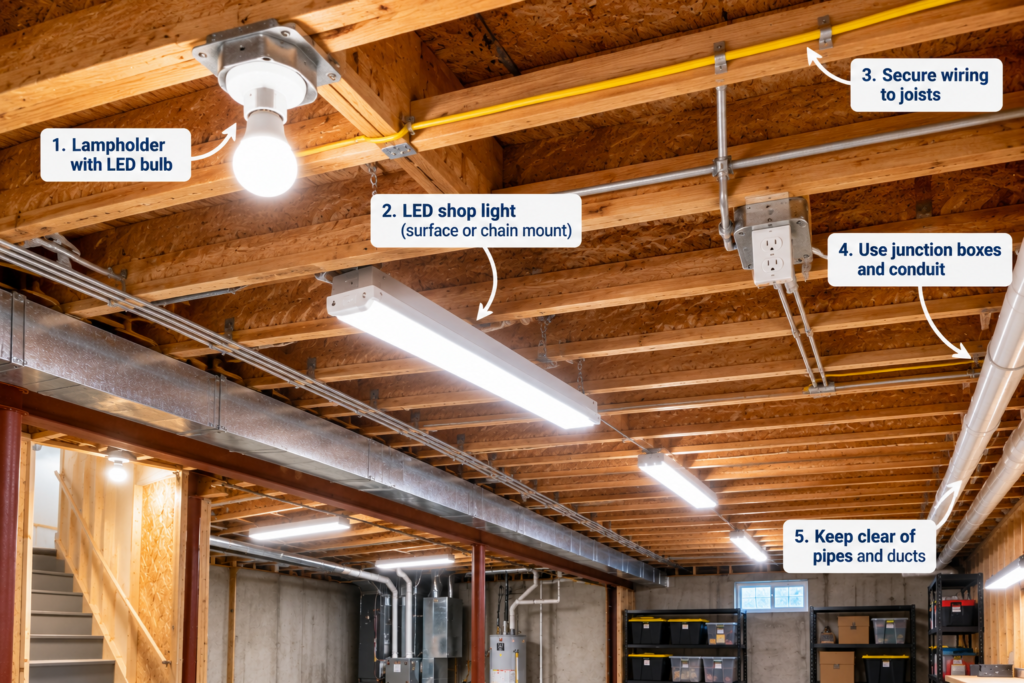
Don’t staple small cable to the bottom of the joists. NEC 334.15(C) allows only large cables (two 6 AWG or three 8 AWG conductors) to be fastened directly to the lower edges of joists when crossing them in an unfinished basement. Ordinary lighting cable has to run through bored holes or along running boards.
Drill holes in the right place. NEC 300.4(A)(1) wants the edge of a bored hole at least 1¼ in. from the nearest edge of the framing, or a steel plate to protect the cable. For sawn lumber joists, IRC R502.8.1 limits hole diameter to one-third of the joist depth and keeps holes at least 2 in. from the top and bottom edges and from other holes. I-joists and other engineered members fall under IRC R502.8.2: drill only where the manufacturer allows. If you’re finishing more of the basement later, our basement subfloor plywood guide covers what happens below these joists.
Plug-in shop lights have real limits. NEC 400.12 says flexible cords can’t replace permanent wiring, run through holes in ceilings, be attached to building surfaces, or be hidden inside ceilings. NEC 410.62(C) does allow some cord-connected LED fixtures, but only when the fixture is listed and installed according to its instructions, hangs directly below its receptacle, and has a cord that’s visible along its whole length and isn’t under strain. Not every plug-in shop light qualifies, so check the listing and instructions before you hang one.
Budget Picks for Exposed Joist Basements
Porcelain keyless lampholder (box mount): the cheapest permanent fixture. Most are rated 660 W and fit a standard outlet box. Use a medium-base (E26) LED bulb, and check the bulb’s size and any fixture-use limits on its package. Check price on Amazon
LED A19 bulbs, 1,500+ lumens (100 W equivalent): pair these with lampholders for more output from the same box. Check price on Amazon
Hardwired 4 ft LED wraparound or strip fixture: even light for laundry and workbench zones. Check price on Amazon
Linkable plug-in LED shop light: only for spots with a receptacle directly above the fixture, and only if the fixture’s listing and instructions allow it. Check price on Amazon
Multi-panel LED garage bulb: a fast upgrade for existing sockets. Measure the clearance between joists before you order. Check price on Amazon
Ceiling box rated for your fixture: use a box rated for the fixture’s weight, fastened securely to a joist or to a bar hanger between joists. Check price on Amazon
Mistakes That Cost Money or Fail Inspection
⚠️ Warning: stapling plug-in shop light cords to the joists. It’s a quick way to light a basement, and NEC 400.12 prohibits it. It can fail inspection and get flagged when you sell the house.
❌ Mistake: stapling lighting cable across the bottom of joists. It breaks NEC 334.15(C). It also leaves the cable where hangers, ladders and shelving can damage it, and you’ll have to pull it and re-run it later.
💸 Cost difference: one fixture per bay vs. fixtures along the aisle. Lighting every joist bay takes many more boxes, fixtures and feet of cable than lighting only the walkways and work zones you use. Light the zones first, then fill gaps.
😬 Regret: buying wafer lights for bare joists. Canless wafers are designed to clip into a finished ceiling. Without one, you’re building backer boards just to hold them, and you lose the main reason to buy them.
❌ Mistake: drilling I-joists like sawn lumber. IRC R502.8.2 defers to the manufacturer for engineered joists. A hole in the wrong place can need an engineer’s fix.
Mistake: forgetting the stair switch. If the stair has six or more risers, the IRC calls for a switch at each floor level unless the lights come on automatically, so plan that wiring from day one.
When These Budget Options Are the Wrong Choice
If you’re finishing the ceiling within a year, put the money toward the final layout (recessed or wafer lights) instead of fixtures you’ll tear out. Our step-by-step guide to finishing basement walls covers the order of work.
If you’re not comfortable adding circuits, a licensed electrician is the safer call. Many towns also require a permit for new basement wiring.
For a full home workshop, a single lampholder per zone won’t reach the higher end of the workshop range. Budget for strips over each bench.
FAQ
What is the cheapest way to light a basement with exposed joists? A porcelain keyless lampholder on a joist-mounted box with an LED bulb is the lowest-cost permanent fixture. It’s hardwired, needs no cords, and you can raise the output just by changing the bulb.
Can I use plug-in LED shop lights in an unfinished basement? Sometimes. NEC 410.62(C) allows a listed cord-connected LED fixture that hangs directly below its receptacle, with the cord visible along its whole length and not under strain. Running cords through joists or stapling them to framing breaks NEC 400.12.
How many lumens do I need for a basement? Multiply the square footage by your target foot-candles. For general storage, about 20 foot-candles is a common starting point, so a 400 sq ft basement needs about 8,000 lumens reaching the floor. Buy fixtures with more total rated output than that, because joists and walls absorb some of the light.
Do I need a light switch at the bottom of the basement stairs? If the stairway has six or more risers, the IRC calls for a wall switch at each floor level unless the lights run continuously or turn on automatically (2021 IRC R303.7; 2024 IRC R325.6). Check your local amendments.
Can I mount wafer lights directly to exposed joists? They’re designed to clip into a ceiling surface. On bare joists, you’d need backer material for each light, which usually makes them the most expensive option here.
Bottom Line
For exposed joists on a budget, use porcelain lampholders with bright LED bulbs for general light, then add hardwired LED strips over laundry and work areas. Run cable through properly placed bored holes, put a switch at the entry, and keep plug-in shop lights to listed fixtures hanging directly under a receptacle.
Related Posts:
Best Budget Track Saw for Plywood: 5 Picks Compared by Admin October 13, 2026 DIY Affiliate disclosure: ThePlywood.com is reader-supported. As an Amazon Associate, we earn from qualifying purchases at no extra cost to you. Links to other retailers are…
Best Basement Wall Systems: 7 Options Compared by Admin August 27, 2026 DIY The best basement wall systems do more than cover bare concrete. A properly designed wall assembly must control moisture, reduce condensation, insulate the foundation, provide…