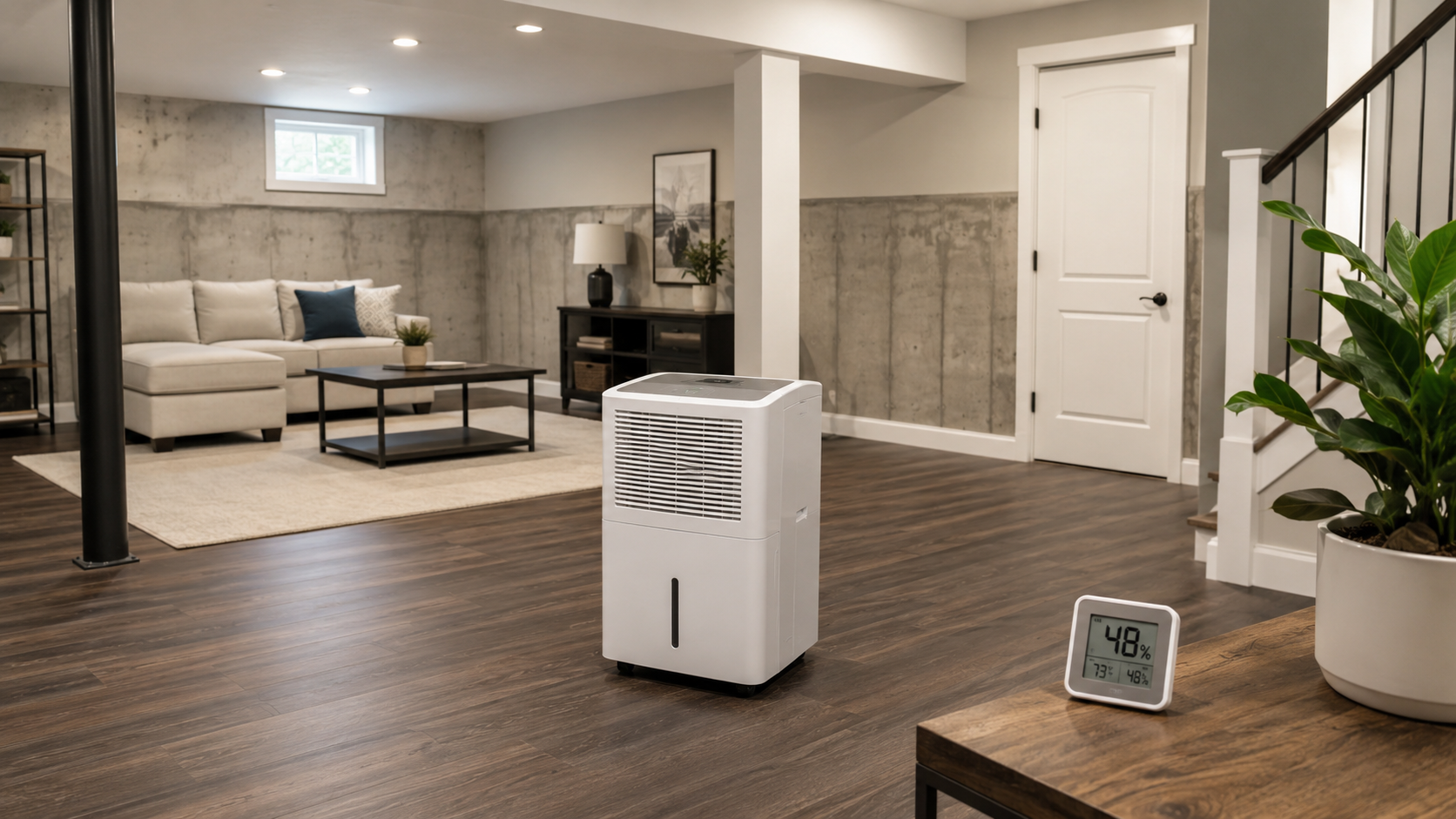
Buying a basement dehumidifier looks simple until you realize the square footage number on the box was measured under conditions that look nothing like a basement. That single misunderstanding is why so many people spend a summer listening to an undersized unit run 24 hours a day while a $12 hygrometer stubbornly reads 62% — comfortably inside mold territory. The EPA recommends keeping indoor relative humidity between 30% and 50%; sustained readings above 60% create conditions where mold and dust mites thrive.
This guide compares five current models, explains the sizing mistake that catches most buyers, and covers the one drainage question you need to answer before spending a dollar.
This article contains affiliate links. If you purchase through one of these links, theplywood.com may earn a commission at no additional cost to you.
Quick Comparison: Best Basement Dehumidifiers in 2026
Dehumidifier prices swing meaningfully between spring and peak summer demand — check current listings before buying.
What Is the Best Dehumidifier for a Basement?
The best dehumidifier for most basements in 2026 is the Midea Cube 50-Pint (MAD50S1QWT). In independent head-to-head testing of more than 50 units by Dehumidifier Buyers Guide, the Cube lowered room humidity from 90% down to 40% RH faster than any other dehumidifier tested. Its nested bucket design also holds roughly three times the water of a conventional tank.
That’s the short answer. But “best” hinges on one question most buyers never ask themselves before checkout: do you have a floor drain? If you don’t — and you don’t want to carry a bucket upstairs every day of summer — a pump-equipped unit like the Midea Cube MAD50PS1QWT or GE’s 50-pint pump model becomes the smarter buy even at a higher price. More on that below.
❌ The #1 Mistake: Trusting the Square Footage on the Box
Manufacturers advertise coverage numbers — “up to 4,500 sq. ft.!” or even “up to 7,000 sq. ft.!” — based on favorable test conditions: warm air, moderate dampness, open floor plans. A basement is none of those things. Basements run cooler (which slows compressor dehumidifiers down), are often partitioned into rooms that block airflow, and receive a continuous moisture supply through the concrete itself.
Concrete is porous. Ground moisture migrates through foundation walls and slabs by capillary action and vapor diffusion, which means a basement dehumidifier isn’t drying a room once — it’s working against an ongoing supply. If you haven’t confirmed how much moisture is actually coming through your walls and floor, a taped-plastic-sheet test is a cheap way to find out before you buy anything.
The sizing takeaway that testing sites and Consumer Reports converge on: buy more capacity than the coverage chart suggests. Consumer Reports’ testers specifically advise choosing a larger-capacity model than you technically need — it dries the space faster and spares you constant tank-emptying. A right-sized unit reaches its target and cycles off; an undersized one runs around the clock and may never get there.
How much capacity depends on both the size of the space and how damp it is — ENERGY STAR’s sizing guidance uses both factors, not square footage alone. For most damp basements in the 800–2,500 sq ft range, a 50-pint (DOE-rated) unit is the sensible default. A genuinely wet basement, or one much larger, may need more than that — or a fix at the source first (see the warning section below). A small basement that’s only mildly damp can get away with a 20–22 pint unit.
Why a “50-pint” today equals the old “70-pint”
If you’re replacing a unit from before 2020 and the numbers look like a downgrade, they aren’t. The U.S. Department of Energy changed its test standard in 2019 to rate capacity at 65°F instead of 80°F — conditions much closer to an actual basement. Under the new test, yesterday’s “70-pint” units became today’s “50-pint” units. Same machine class, more honest number.
One buying note that follows from this: not every brand states its capacity under the same conditions. Midea’s Cube models carry current DOE-standard ratings, while hOmeLabs describes its 50-pint figure at 80°F and 60% RH — warmer, wetter conditions than the DOE test uses. That doesn’t make the hOmeLabs a bad unit; it means the headline numbers aren’t measured on the same yardstick, so compare with that in mind.
💸 The Cost Difference Nobody Calculates: Pump vs. No Pump
Here’s the math that catches people after the box is already open.
A 50-pint dehumidifier in a damp basement can fill its bucket in under a day. When the bucket’s full, the unit shuts off — and humidity climbs right back up while you’re at work. Your three options:
Empty the bucket manually. Free, but it’s a daily chore from May through September. Skip two days on vacation and the basement spends the weekend back above 60%.
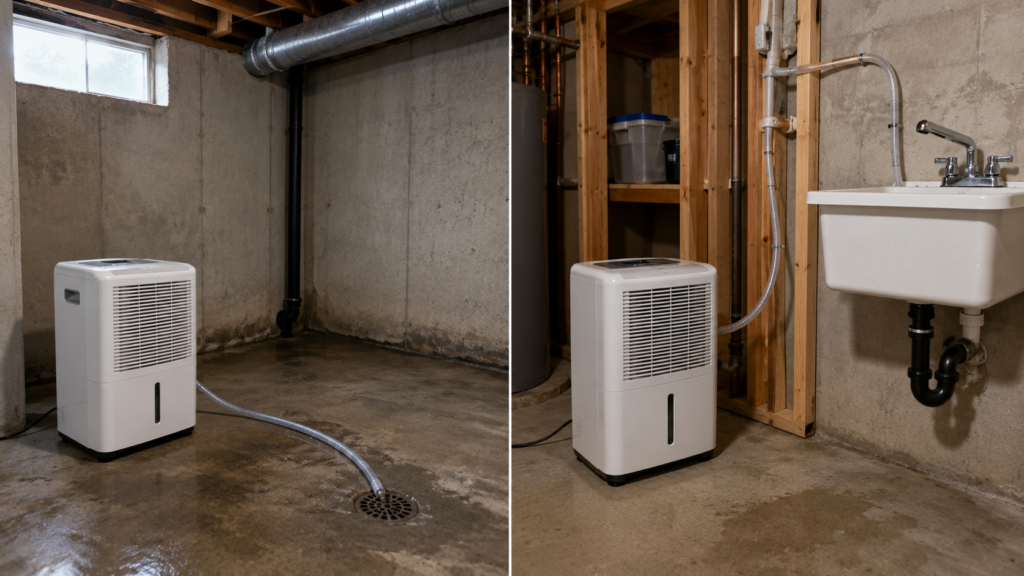
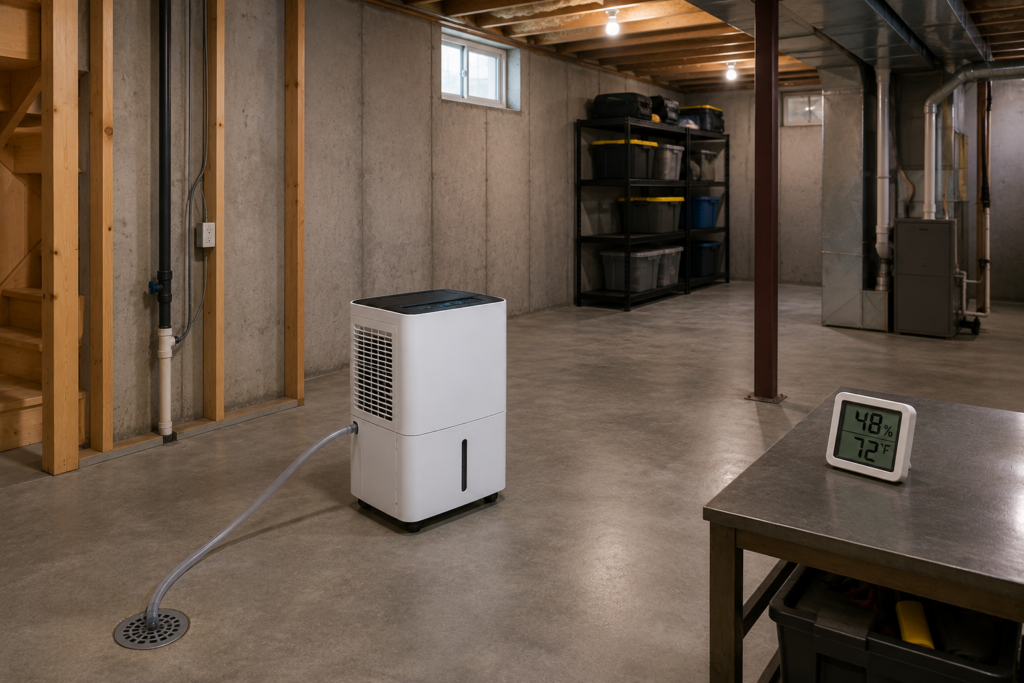
Gravity drain to a floor drain. Nearly free, works perfectly — if your basement has a floor drain sitting lower than the unit’s drain port. Many finished basements don’t.
Built-in pump. The Midea Cube MAD50PS1QWT and the GE 50-pint pump model can both push condensate uphill through an included 16-foot line — into a utility sink, out a basement window, across the room to a standpipe.
Pump versions typically sell for more than their non-pump siblings — the gap varies with seasonal pricing, so compare both listings. What happens without one is predictable: buyers grab the cheaper unit, discover their drain situation doesn’t work, and either return it or resign themselves to bucket duty for the life of the machine. If your basement has no floor drain, the pump premium buys you the difference between an appliance you manage daily and one you forget exists.
What makes it different: The Cube’s nesting design is genuinely clever — the unit lifts up and its housing doubles as an oversized water bucket, a removable 4.2-gallon tank roughly 3x the capacity of a conventional unit’s. If you are emptying manually, that’s every two or three days instead of daily. It’s the top-ranked unit at Dehumidifier Buyers Guide, whose testing found it pulled a room from 90% to 40% RH faster than anything else they’ve run, and it appears in RTINGS’ current tested lineup as well. A drain hose for gravity draining is included, the filter is washable, and Wi-Fi app control is genuinely useful for monitoring a basement you don’t visit daily. Energy Star certified.
What to know: No pump on this version, and the cube shape takes more floor footprint than a tower-style unit. In an unfinished utility corner, irrelevant. In a finished rec room, measure first.
Midea Cube 50-Pint with Pump (MAD50PS1QWT) — Best for Basements Without a Floor Drain
What makes it different: Same machine, same nested bucket, plus a built-in condensate pump with a 16-foot drain tube included that lifts water vertically or horizontally to a sink, window, or remote drain. It’s listed among RTINGS’ currently tested basement units. If bucket duty or gravity drainage isn’t realistic in your layout, this is the version to buy — the pump turns the dehumidifier into a set-and-forget appliance.
What to know: A pump is one more mechanical part that can eventually wear out, and pump models cost more up front. For most no-floor-drain basements, that trade is worth making on day one rather than after a summer of stairs.
GE 50-Pint with Built-in Pump — For Wet, Demanding Basements
What makes it different:RTINGS recommends GE’s 50-pint pump unit (tested as the APYR50LC) for demanding basement use, and the design carries a spec sheet built around exactly that job: a built-in pump with included 16-foot hose that lifts water to a sink or drain, three drainage options (bucket, gravity hose, or pump), auto-defrost for cooler rooms, and GE’s Smart Dry mode that adjusts fan speed automatically to the room’s humidity. Note that GE has transitioned this model line — the APYR50LC that earned the RTINGS recommendation is no longer being manufactured, and GE’s current equivalent (sold as the ADHE50PWF) offers the same 50-pint capacity, pump, and Smart Dry feature set with an updated refrigerant. Confirm the model number on the listing you buy.
What to know: GE skipped the smart features on this line — no Wi-Fi or app control — so if remote monitoring matters, the Midea pump Cube is the better fit. If you just want a workhorse that moves a lot of water out of a wet basement without your involvement, this is it.
hOmeLabs 50-Pint Wi-Fi (HME031003N) — Large Coverage on a Budget
What makes it different: Current-generation hOmeLabs unit with Wi-Fi app control, a 1.6-gallon tank, and turbo airflow up to 218 CFM. hOmeLabs rates it at 50 pints per day at 80°F and 60% RH — note that’s a warmer, wetter test condition than the current DOE standard the Midea ratings use, so the headline numbers aren’t measured on the same yardstick. Its listing claims coverage up to 7,000 sq ft; treat that with the skepticism the sizing section above earned. It’s frequently priced below the competition, which is the honest reason to pick it.
What to know: This model includes a built-in pump for draining into an elevated sink or other suitable outlet. That makes it more versatile than a gravity-drain-only budget model. However, its advertised 50-pint capacity is measured at 80°F and 60% RH rather than under the current DOE conditions used for the Midea ratings, so the capacities are not directly comparable. Long-term reliability reports are mixed, so register the warranty and maintain the filter as directed.
What makes it different: The same nested-bucket engineering as the flagship, scaled down for spaces under roughly 800 sq ft that are damp but not wet. Its 20-pint rating is under the current DOE standard — equivalent to about 30 pints under the pre-2020 test — and the removable 3.2-gallon tank is roughly triple the size of most units in its class. Drain hose included, app-connected, Energy Star certified, and meaningfully cheaper.
What to know: Do not buy this for a large or genuinely damp basement to save money — an undersized unit running 24/7 without reaching its setpoint is the most common regret purchase in this category, and it can cost more in electricity than a properly sized unit that cycles off.
The most useful numbers in this category don’t come from manufacturer spec sheets — they come from labs running identical conditions across competing units.
Dehumidifier Buyers Guide runs two standardized pull-down tests on every unit: how fast it drops a room from 90% to 40% RH, and from 80% to 50% RH. Across more than 50 tested units, the Midea Cube 50-pint completed the harder 90-to-40 test faster than any other dehumidifier they’ve measured — which is the core reason it holds their top recommendation. RTINGS buys and tests units at retail (20 dehumidifiers in their current lineup) and ranks basement performance on moisture-removal speed. Consumer Reports adds the reliability dimension: their brand data draws on survey feedback from nearly 12,000 members covering more than 13,600 dehumidifiers purchased since 2014.
The pattern across all three sources is consistent: modern 50-pint compressor units from the major brands all remove moisture competently, and the meaningful differences are speed, drainage options, noise, and long-term reliability — not raw capacity. That’s why the buying decision above centers on your drain situation and room use rather than chasing spec-sheet numbers.
⚠️ Warning: A Dehumidifier Can’t Fix a Water Problem
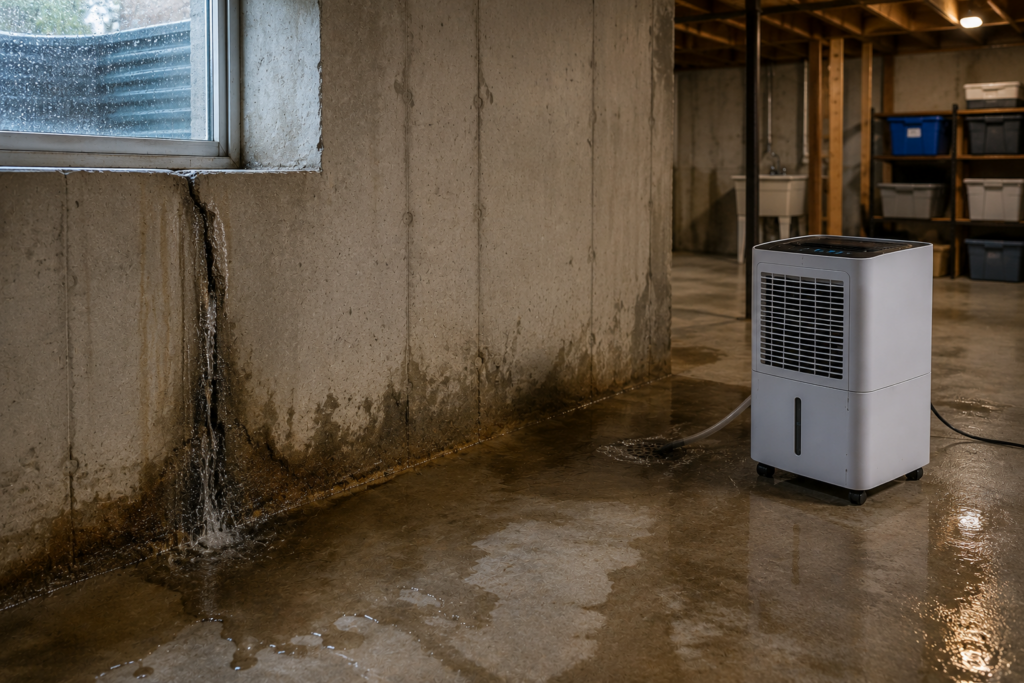
This is the caveat every honest recommendation list needs and most skip. A dehumidifier manages airborne moisture. It cannot compensate for bulk water entry — a crack that seeps after rain, a downspout dumping against the foundation, hydrostatic pressure pushing water through the slab. Consumer Reports’ testing lead makes the same point: a dehumidifier can only remove so much moisture, and areas that constantly let water in need the leak addressed directly.
If your dehumidifier runs nonstop and humidity still won’t hold below 55%, you don’t have a dehumidifier problem — you have a water intrusion problem, and running a $300 appliance against it around the clock is an expensive way to lose. Fix the source first: grading, gutters, downspout extensions, crack sealing, and a proper moisture barrier where the wall assembly calls for one. The dehumidifier is the maintenance tool that comes after those fundamentals.
😬 The Regret Purchase: Desiccant Buckets and Mini Units
Every spring, people try to solve a basement humidity problem with $15 moisture-absorber buckets or a $50 mini “dehumidifier” the size of a coffee maker, because the real thing feels expensive. It doesn’t work at basement scale. Disposable desiccant products pull ounces of water from the air over weeks; a damp basement releases pints per day. Peltier-style mini units are built for a closet, not a thousand square feet of concrete. The money isn’t saved — it’s spent twice, because the compressor unit still gets bought in August, at peak-season pricing.
Desiccants do have a legitimate role in sealed micro-spaces — safes, cabinets, storage totes — where a compressor unit physically can’t help. As a basement solution, they’re the purchase people quietly regret by July.
What Size Dehumidifier Do I Need for My Basement?
For a damp basement between roughly 800 and 2,500 square feet, a 50-pint (DOE-rated) dehumidifier is the sensible default. Sizing depends on both room size and dampness level — ENERGY STAR guidance uses both — so a small but mildly damp basement can use a 20–22 pint unit, while a very wet or larger space may need more capacity or a moisture fix at the source. When between sizes, size up: a larger unit reaches its target and cycles off, while an undersized one runs constantly.
What Humidity Should a Basement Be Kept At?
Keep basement relative humidity between 30% and 50%, per EPA guidance. Below 50%, mold growth, dust mites, and musty odors are effectively suppressed. Set the dehumidifier’s humidistat to 45–50% for most basements; pushing far lower burns electricity without meaningful added protection.
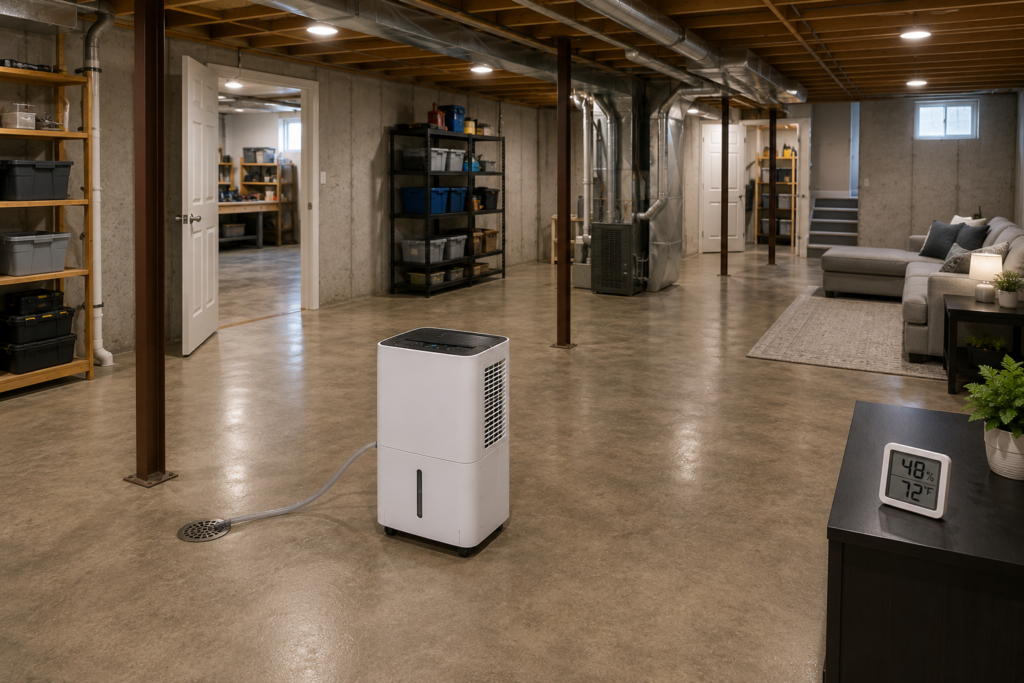
Don’t guess at your number — a basic digital hygrometer costs about the same as lunch and tells you whether the machine is doing its job. Place it across the room from the dehumidifier, not next to it, or you’ll be reading the unit’s dry exhaust instead of the room. This matters double if you store lumber or sheet goods downstairs: wood acclimates to ambient humidity, and a basement swinging between 50% and 70% RH will move your material.
Where Should You Place a Dehumidifier in a Basement?
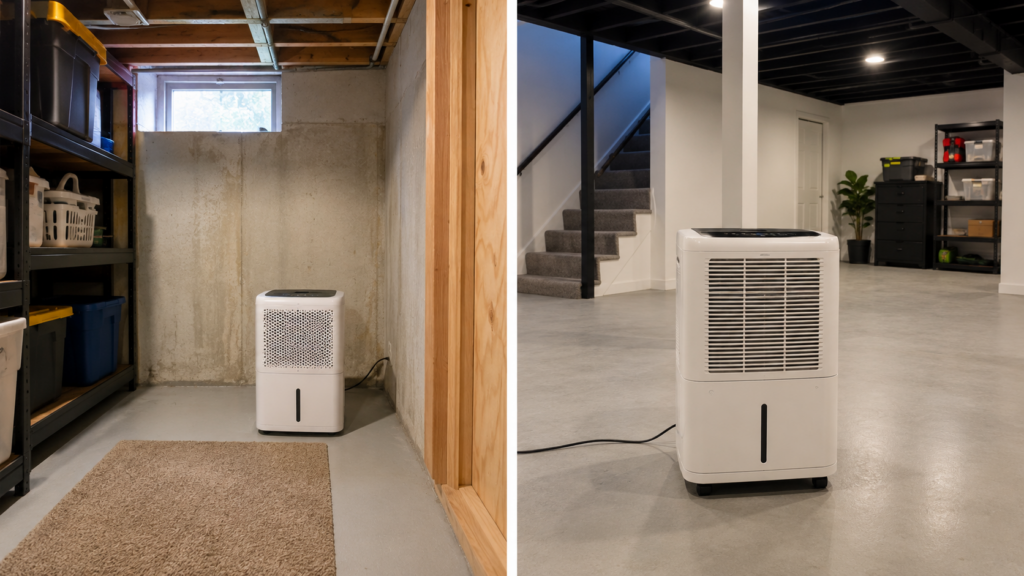
Place the dehumidifier near the center of the basement with at least 12 inches of clearance on all sides, away from walls and furniture that block airflow. If draining continuously by gravity, position it close to — and higher than — the floor drain. In partitioned basements, put it in the largest or dampest room and leave interior doors open.
Two placement mistakes worth avoiding: shoving the unit into the dampest corner (corners choke airflow — the dampest room is right, the corner of it is wrong), and parking it directly against a wall you’re worried about. It dries air, not surfaces; give it room to circulate.
Cold Basement? Read This Before Buying
Compressor dehumidifiers lose efficiency as temperature drops, and below roughly 65°F the coils can begin to frost. Every unit in the table above has auto-defrost, which handles typical cool basements — the unit pauses, melts the frost, resumes. But if your basement sits below about 50°F for long stretches, a compressor unit will spend more time defrosting than dehumidifying. The saving grace: cold air holds far less moisture in the first place, so genuinely cold basements are usually winter-dry and mainly need dehumidification in the warm months — exactly when compressor units work best. Insulating the space raises those temperatures and improves dehumidifier performance at the same time.
Frequently Asked Questions
How much does it cost to run a basement dehumidifier?
A modern Energy Star 50-pint dehumidifier draws roughly 500–700 watts while running. At typical U.S. electricity rates, running 8–12 hours daily works out to roughly $15–$30 per month during humid season. An undersized unit running 24/7 can cost more than a properly sized unit that cycles off.
No. A correctly sized dehumidifier should reach its humidity setpoint and cycle off. If your unit runs continuously and never reaches 50% RH, it is either undersized for the space and moisture load, or the basement has an active water intrusion problem that needs to be fixed at the source.
Can one dehumidifier handle a whole basement?
Usually, yes — one 50-pint unit handles most basements up to roughly 2,500 square feet if interior doors stay open for airflow. Heavily partitioned basements, unusually wet conditions, or much larger spaces may call for a second unit or a whole-house/ducted dehumidifier instead.
How long do basement dehumidifiers last?
Expect roughly 5–10 years from a quality compressor dehumidifier, with wide variation by brand. Consumer Reports tracks brand reliability through owner surveys covering thousands of units. Lifespan improves with monthly filter cleaning, clear side vents, and letting auto-defrost cycles finish in cool weather. Register the manufacturer warranty at purchase.
Do dehumidifiers help with musty basement smell?
Yes — musty odor comes from mold and mildew activity, which requires sustained elevated humidity. Holding the basement at 45–50% RH typically eliminates the smell within one to three weeks. If odor persists at low humidity, existing mold growth on surfaces needs to be cleaned or removed.
Related Posts:
Best Basement Wall Systems: 7 Options Compared by Admin August 27, 2026 DIY The best basement wall systems do more than cover bare concrete. A properly designed wall assembly must control moisture, reduce condensation, insulate the foundation, provide…
Scroll Saw Guide: Uses, Costs, Mistakes & Best Models by Admin June 10, 2026 DIY Whether you want to cut detailed fretwork, craft custom children's puzzles, or step up your DIY woodworking game, a scroll saw is an indispensable workshop…