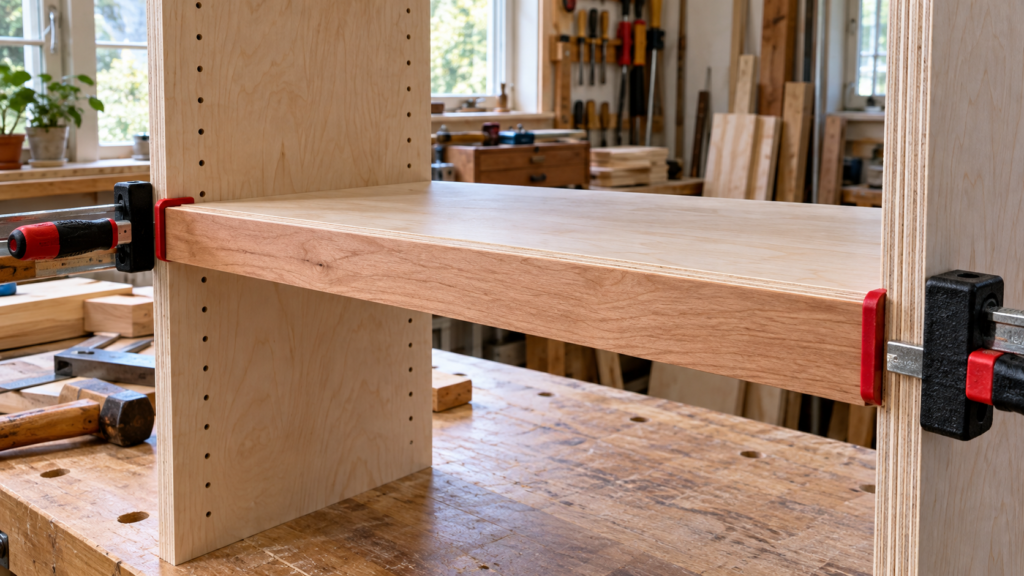
The best plywood for built-in bookshelves depends on the finish. For painted built-ins, use 3/4″ birch or maple hardwood plywood with a B-grade face or better. For stained built-ins, use 3/4″ A-grade plywood in the species you want to show, such as oak, maple, cherry or walnut. If your shelves have long spans or heavy loads, or you want the plywood edges to show, step up to 3/4″ (18mm) Baltic birch.
Quick answer
Painted built-ins: 3/4″ birch or maple plywood, veneer or combination core, B face or better
Stained built-ins: 3/4″ A-1 or A-2 plywood in your chosen species
Long spans, heavy loads, exposed edges: 3/4″ (18mm) Baltic birch, BB/BB grade, with added support on long shelves
Back panel: 1/4″ plywood with a face that matches. Anchor the cabinet itself into the wall studs through a solid mounting rail. Don’t rely on the back panel to hold it.
Skip: construction sheathing (CDX), particleboard and melamine for the shelves themselves
Best Plywood for Built-In Bookshelves: Comparison Chart
Finish / use
Best plywood
Grade to ask for
Why it works
Watch out for
Painted (most built-ins)
Birch or maple hardwood plywood
B-2 or better
Smooth, tight grain that paints cleanly
The thin face veneer is easy to sand through
Stained or clear finish
Oak, maple, cherry or walnut hardwood plywood
A-1 or A-2
Even, matched face veneer
Birch and maple can blotch without conditioner
Long or heavily loaded shelves
Baltic birch
BB/BB
All-birch plies, stiff, holds screws well
Can still sag over long spans. Metric thickness, often 5′ x 5′ sheets.
Super-smooth painted panels
MDO (medium density overlay)
Paint grade
Paper overlay leaves a flat paint surface
Edges need filling before paint
Back panel
Hardwood plywood to match
1/4″
Locks the case square
Not a mounting surface. Anchor the case through a rail into studs.
The grade letters come from the hardwood plywood standard, ANSI/HPVA HP-1. Face grades run from AA (best) down to E, and back grades run from 1 to 4. A sheet labeled “B-2” has a B face and a #2 back. This is a different system from the A–D grades on construction plywood. For a full breakdown of the letters, see our birch plywood guide.
Why Built-Ins Need Hardwood Plywood, Not Construction Plywood
Built-in bookshelves are furniture you look at every day, so the face matters as much as the strength. Construction plywood like CDX is made for sheathing. It has rough faces, open knots and patches, and its fir grain often shows through paint even after priming.
Hardwood plywood has a thin, sanded face veneer made for finishing. Under paint, birch and maple look flat and smooth. Under stain, oak, cherry and walnut look close to solid lumber.
Warning: Grain raise and patches on construction plywood rarely disappear under extra coats of paint. If you can see them on the bare sheet, expect to see them on the finished built-in.
Best Thickness for Built-In Bookshelves
Use 3/4″ plywood for every part that carries weight: the sides, top, bottom, fixed shelves and adjustable shelves. Half-inch shelves may sag under heavy books, particularly over longer spans, and a shelf that has bowed under load often stays bowed. For more detail on thickness by shelf type, see our plywood thickness guide.
Span rule of thumb: keep 3/4″ plywood shelves to about 30″ between supports for a full load of books. How much a shelf actually sags depends on its span, load, plywood construction and support. That’s why we use the same 30″ limit in our step-by-step bookshelf build. If you need longer shelves:
Glue a 3/4″ x 1-1/2″ hardwood strip to the front edge. It stiffens the shelf noticeably and covers the raw plies.
Make the long shelves fixed (dadoed or screwed in) rather than adjustable.
Add a center divider to split the span.
Check your exact span, depth and load in a free shelf-sag calculator such as the Sagulator before you cut.
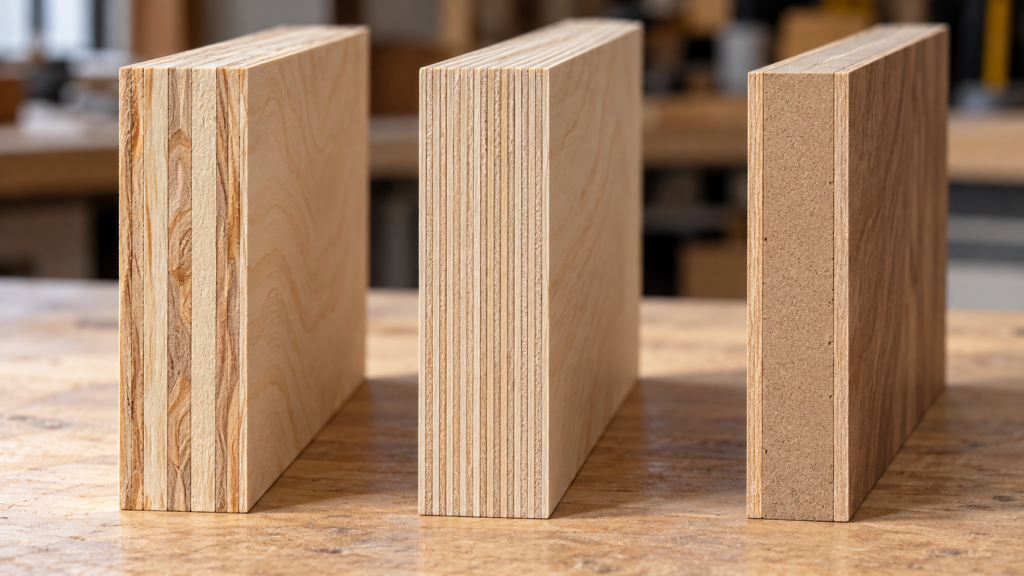
Veneer Core vs. MDF Core vs. Combination Core
The core is the inside of the sheet, and it affects how a shelf handles weight and screws.
Veneer core
Every layer is wood veneer. It’s generally the lightest of the three, holds screws well, and makes stiff shelves. The downside is that the face may be less perfectly flat, and there can be small gaps in the inner plies.
MDF core
The face veneer sits on a fiberboard core. It gives the flattest face, so it works well for painted sides and fixed panels. It’s usually heavier, holds screws less well at the edges, and is generally less stiff than veneer core for long shelves.
Combination core
The inner plies are veneer, with thin MDF layers just under the faces. It’s flatter than veneer core and generally lighter and stiffer than MDF core. For built-ins, it’s a good all-around pick when you can get it.
Pick: use veneer core or combination core for the shelves. MDF core is fine for painted case sides that don’t carry a span.
Painted vs. Stained: Which Plywood to Buy
For painted built-ins
Birch and maple are the standard choices. Maple is a little harder and resists dents better. Birch is usually easier to find. Either way, a B face is plenty under paint, and paying for an A face that you’re going to cover makes little sense.
Quick test: run your palm across the sheet at the store. If you can feel ridges or patches, they’re likely to show through paint.
For stained or clear-finished built-ins
Buy an A face in the species you want to see. Plain-sliced faces look more like solid boards. Rotary-cut faces, common on birch, can show a wide, wavy grain that looks busy under stain.
Birch and maple tend to soak up stain unevenly and blotch. Use a pre-stain conditioner or a gel stain, and test on a scrap from the same sheet first.
When Baltic Birch Is Worth It
Baltic birch is all-birch plywood, with no softwood filler plies. A 3/4″ (18mm) sheet usually has 13 plies. That generally makes it stiffer than domestic birch plywood, better at holding screws, and good-looking enough on the edges to leave exposed for a modern look.
It’s usually worth the extra cost for long shelves, heavy loads such as records or art books, and designs where the plywood edges show. Even Baltic birch can sag over long spans under heavy books. Use a hardwood front edge, additional supports, or a center divider when necessary.
For a standard painted built-in with face frames, domestic birch or maple plywood generally does the job for less money. Baltic birch usually costs more per square foot, so check local pricing before you decide. We compare the two in more detail in our birch plywood guide.
Two things to plan for with Baltic birch:
It’s made to metric thickness (18mm is about 0.71″), so size your dadoes to the actual sheet.
It’s often sold in 5′ x 5′ sheets, which changes your cut list compared with 4′ x 8′ sheets.
Anchoring Built-Ins to the Wall
A 1/4″ back panel keeps the case square, but it isn’t what holds the cabinet to the wall, and a thicker back doesn’t make the anchoring safe on its own. Fasten the case into the wall studs through a solid mounting rail (a hanging strip across the top back of the cabinet), using screws sized for the cabinet and the load it will carry. Tall built-ins full of books are heavy, so check your anchoring against the hardware maker’s instructions and your local code.
Check the Formaldehyde Label
Built-ins live in bedrooms, offices and living rooms, so look at the panel label. Hardwood plywood sold in the U.S. must be certified to the EPA’s formaldehyde standard under TSCA Title VI, and compliant panels carry a label saying so. If you want to go further, ask for NAF (no added formaldehyde) or ULEF (ultra-low-emitting formaldehyde) panels.
Supplies That Make Plywood Built-Ins Look Custom
Plywood sheets are usually cheaper and easier to buy at a lumber yard or home center. These smaller items are worth having on hand:
Using construction plywood for visible parts. The grain and patches can show through paint, and fixing it may mean reskinning or rebuilding the case.
Using 1/2″ plywood for shelves. They may sag under heavy books, particularly over longer spans, and a shelf that has bowed may not flatten again.
Staining birch without conditioner. You can end up with blotchy, uneven color that’s hard to sand out without going through the thin face veneer.
Cutting dadoes with a full 3/4″ bit. Many 3/4″ sheets are a little thinner, so the joints can come out loose and the case can rack.
Leaving plywood edges raw. The layered edge can show through paint and make a built-in look like shop furniture. Use edge banding, a hardwood strip or a face frame.
Counting on the back panel to hold the cabinet up. The back keeps the case square. It’s the mounting rail and the screws into the studs that hold it to the wall.
FAQ
What is the best plywood for built-in bookshelves?
For painted built-ins, 3/4″ birch or maple hardwood plywood with a B face or better. For stained built-ins, 3/4″ A-grade plywood in the species you want to show. For long or heavily loaded shelves, 3/4″ Baltic birch, with a hardwood front edge or extra support on long spans.
What thickness plywood should I use for built-in bookshelves?
Use 3/4″ for the sides, top, bottom and shelves, and 1/4″ for the back. Keep 3/4″ shelves to about 30″ between supports for a full load of books, or stiffen longer shelves with a hardwood front edge, a center divider or extra supports.
Is Baltic birch worth it for built-ins?
It’s worth it for long spans, heavy loads and designs with exposed plywood edges, though it can still sag over long spans under heavy books. For standard painted built-ins with a face frame, domestic birch or maple plywood usually does the job for less.
Can I use MDF instead of plywood for built-in bookshelves?
MDF paints well and works for fixed panels, but it’s generally less stiff than plywood, so long MDF shelves are more likely to sag under books. Plywood shelves are the safer choice.
Is maple or birch plywood better for painted built-ins?
Both paint well. Maple is slightly harder and more dent-resistant, and birch is usually easier to find. Choose whichever your supplier stocks in a clean B grade or better.
Bottom Line
For most built-in bookshelves, 3/4″ birch or maple hardwood plywood is the right buy for paint, and A-grade plywood in your chosen species is the right buy for stain. Spend more on Baltic birch only where the spans are long, the loads are heavy or the edges will show, and add support on long shelves whatever plywood you use. For a related project, see our guide to plywood shelves.
Plywood vs Hardboard: Which One Is Right for Your Project? by Amy Reed September 8, 2025 More About Whether you're building a cabinet, designing wall panels, or installing subflooring, choosing the right type of wood product is essential. Two popular options, plywood and…