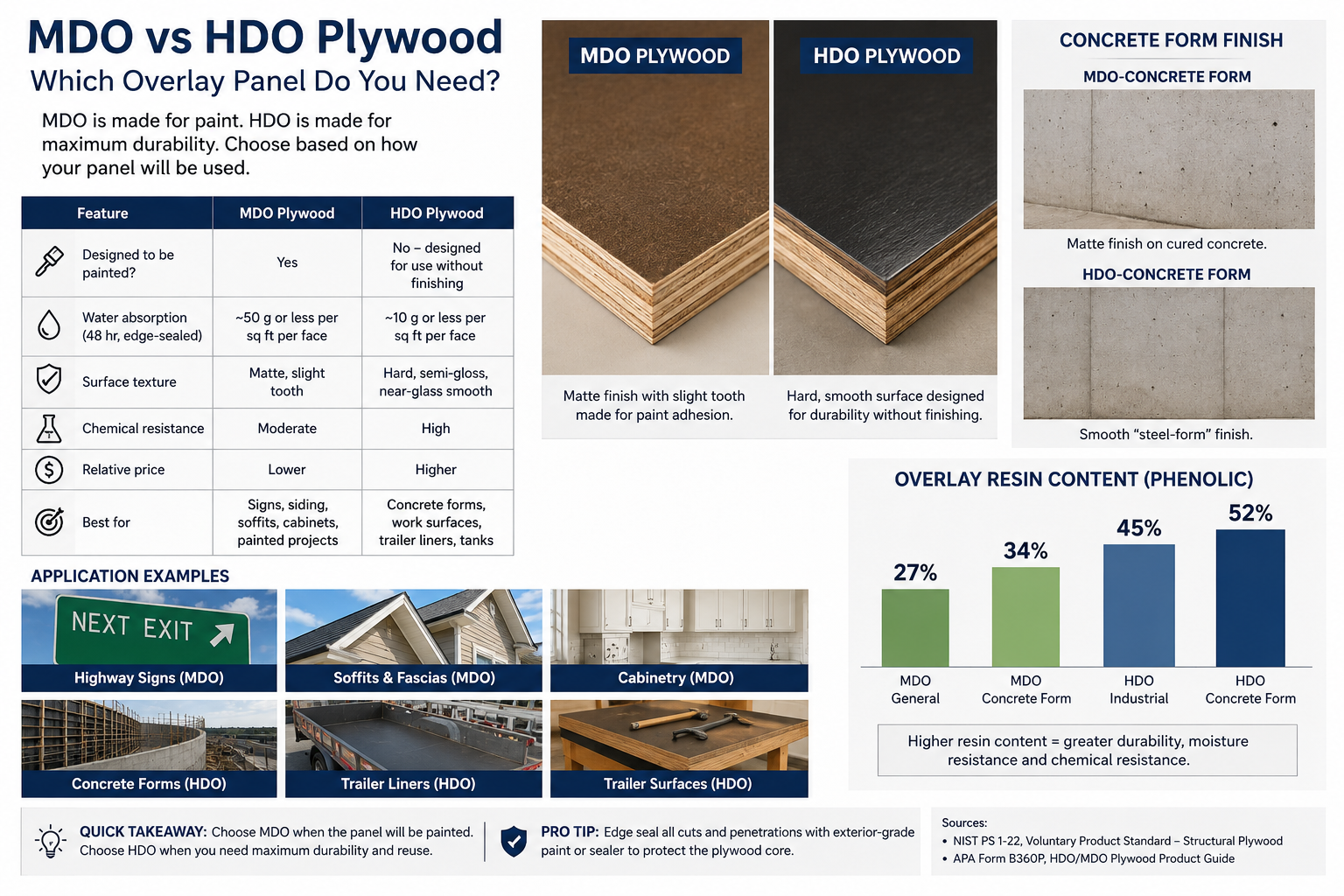
MDO plywood is the overlay panel to choose when you need a paintable surface. HDO plywood is the heavier-duty choice when you need maximum abrasion, moisture and chemical resistance — often without any additional finish.
MDO-General uses a minimum 27% phenolic-resin overlay, while HDO-Industrial starts at 45%. Concrete-form grades increase those minimums to 34% for MDO and 52% for HDO.
In practical terms: if the panel is primarily being painted, start with MDO. If it will be repeatedly scraped, exposed to concrete, subjected to industrial wear or used where maximum overlay durability matters, start with HDO.
MDO vs HDO Plywood: Quick Comparison Table
Feature
MDO Plywood
HDO Plywood
Full name
Medium Density Overlay
High Density Overlay
Minimum phenolic resin content
27% (General) / 34% (Concrete Form)
45% (Industrial) / 52% (Concrete Form)
Minimum overlay weight
58 lb per 1,000 sq ft
60 lb per 1,000 sq ft
Minimum overlay thickness
0.012 in after pressing
0.012 in before pressing
Veneer grades
Commonly B-B or B-C
A-A, B-B or B-C depending on grade and application
Inner plies
Generally C grade
Generally C grade; C-Plugged specified for HDO-Industrial sign applications
Surface texture
Slight tooth, matte, may faintly show grain
Hard, semi-gloss, near-glass smooth
Designed to be painted?
Yes — that is the panel’s purpose
No — designed for use without further finishing, though it can be painted after surface prep
Bond classification
Exterior
Exterior
Water absorption (48 hr, edge-sealed)
Approx. 50 g or less per sq ft per face
Approx. 10 g or less per sq ft per face
Vapor permeance (unfinished)
0.3 perm (3/8″, one side)
0.1 perm (1/2″–5/8″, both sides)
Concrete forming
MDO-Concrete Form only; matte concrete finish
Highest reuse of the overlaid panels; “steel-form” concrete finish
Chemical resistance
Moderate
High
Relative price
Lower
Higher
Best for
Signs, siding, soffits, painted cabinetry, jigs
Concrete forms, work surfaces, trailer liners, tanks, reflective signage
Technical sources: NIST — Voluntary Product Standard PS 1-22, Structural Plywood; APA – The Engineered Wood Association — HDO/MDO Plywood Product Guide, Form B360P.
Pricing note: MDO and especially HDO availability varies considerably by region. Get a current lumberyard quote before budgeting a project.
What Is MDO Plywood?
MDO plywood is Exterior-type plywood with a resin-impregnated cellulose-fiber overlay bonded to one or both working faces under heat and pressure, engineered to hold paint.
A structural point that gets misstated often: the overlay sits on the outside faces. It is not layered between the inner veneers.
PS 1-22 defines two MDO grades, and they are not interchangeable:
MDO-General — overlay containing not less than 27% phenolic resin, at least 0.012 in thick after pressing, weighing at least 58 lb per 1,000 sq ft. The facing must be suitable for painting. This is the “sign board” panel.
MDO-Concrete Form — overlay containing not less than 34% phenolic resin, plus a chemically reactive release agent. Leaves a matte finish on cured concrete.
General-use MDO is not suitable for concrete forming. APA states that directly. If a supplier offers “MDO” for a pour without specifying Concrete Form, confirm the grade before you buy.
Typical uses: highway and commercial signage, soffits and fascias, color accent panels, garage doors, structural siding, and indoors for cabinets, built-ins and shelving. Industry uses it for factory work surfaces, storage bins and freezer liners. If you are weighing MDO against more common exterior options, our exterior plywood guide covers where sanded panels like ACX top out and overlays take over.
What Is HDO Plywood?
HDO plywood is Exterior-type plywood with a denser, higher-resin overlay designed to be used without any additional finish.
PS 1 requirements are specific: minimum overlay thickness of 0.012 in before pressing, and overlay weight of not less than 60 lb per 1,000 sq ft of panel surface in the ready-to-use condition. The overlay may be specified on the face only or on both face and back.
Two grades:
HDO-Concrete Form — not less than 52% phenolic resin. Produces a smooth “steel-form” finish on concrete.
HDO-Industrial — not less than 45% phenolic resin. Highway signs, tanks, work surfaces, pallet decks, trailer and railcar liners, freezer lockers.
HDO typically ships in a natural opaque color reading as a soft wood tone. Black, brown and olive drab are also produced, though generally as mill orders rather than retail stock.
HDO concrete-form plywood is designed for substantially greater reuse than standard forming panels. APA references approximately 20–50 pours for HDO Plyform under typical applications, with specialist form systems sometimes achieving as many as 200 pours. Actual reuse depends heavily on panel grade, release-agent use, stripping practices, concrete mix, edge protection and jobsite handling. Because HDO-Concrete Form has such low permeability, panels can also be stacked on level supports immediately after stripping without separating them to dry.
The Common MDO vs HDO Mistake: Using MDO Where the Surface Will Take Abuse
MDO is optimized as a paintable overlay. HDO is the better choice when the exposed face will repeatedly encounter abrasion, scraping, chemicals or demanding industrial use.
That distinction matters for work surfaces, reusable concrete forms, trailer liners and similar applications. Once an MDO overlay is damaged deeply enough to expose the plywood beneath it, the panel loses much of the moisture protection the intact overlay provided — and any paint film on that surface loses the substrate it was bonded to.
A useful rule:
Choose MDO when paintability is the priority. Choose HDO when surface durability is the priority.
MDO vs HDO Cost: Compare Cost Per Pour, Not Cost Per Sheet
HDO normally costs more per sheet than MDO, but concrete-form economics depend on how many pours you actually get from each panel.
Cost per pour = panel purchase price ÷ usable pours
For example, a $100 panel that survives 10 pours costs $10 per pour. A $140 panel that survives 35 pours costs $4 per pour.
That is why HDO can become the less expensive panel on repetitive formwork even when its purchase price is considerably higher.
For one-time forms or low-reuse jobs, however, paying for HDO’s additional durability may provide no economic benefit. A single footing, an oddball radius wall you will never build again, or a decorative pour are all cases where MDO-Concrete Form — or even standard plyform — makes better financial sense.
The same logic applies outside formwork. On a painted sign or soffit that will never be abraded, HDO’s abrasion resistance is a feature you are paying for and will never use.
Why Edge Sealing Matters
Edges and penetrations are the weak points of an overlaid plywood panel.
The overlay is a barrier, and a barrier only works when it is continuous. The moment a sheet is ripped, raw end-grain veneer is exposed, and that edge will absorb moisture while the overlaid face beside it sheds it. That differential is what produces localized swelling, edge checking and paint failures that creep inward from the perimeter.
APA’s guidance is direct: panels intended for exterior exposure should be edge-sealed as soon as possible — though APA also states plainly that edge sealing is not permanent and does not necessarily make edges moisture-proof. It minimizes sudden changes in moisture content caused by weather cycles. Use one or two heavy coats of a top-quality exterior primer formulated for wood, applied while the panels are still stacked. Factory edges need the same treatment as fresh cuts.
Fasteners create the same vulnerability. APA warns that overdriven fasteners provide a path for moisture to penetrate the overlay, and recommends filling overdriven or countersunk holes with caulk or exterior wood filler — paintable caulk if the face is being painted.
Are MDO and HDO Waterproof?
No. Both carry an Exterior bond classification and both resist moisture well at the face, but neither panel is waterproof.
Exterior bond describes the glue line, not the wood. It means the adhesive will not fail under repeated wetting and drying. It says nothing about resistance to fungal decay, which comes from preservative treatment — a separate process. Both MDO and HDO can be pressure-treated with preservatives or fire-retardant chemicals when required, but they are not treated by default.
MDO-General must be finished outdoors. APA’s guidance is that it should always be face-primed and top-coated with a compatible solid-color stain or house paint when exposed to weather or wet, humid conditions. Pre-primed MDO is still a primer, not a finish. Indoors and out of the weather, unfinished MDO performs fine.
HDO is the exception, since it is designed to be used without further coating. If you do want to paint it or apply reflective film, the dense resin face has almost no tooth and must be conditioned first.
The APA trademark appears only on panels manufactured by APA member mills, but APA is not the only possible certification agency. A panel represented as conforming to PS 1-22 should carry the mark of an accredited certification agency along with the PS 1-22 designation and required grade information. If a panel is simply marketed as “MDO” or “HDO” without recognized certification or a PS 1-22 marking, do not assume it meets the requirements described here. For more on what stamps guarantee, see our guides to structural vs. non-structural plywood and plywood grades.
APA’s 48-Hour Water Absorption Data
The difference between MDO and HDO becomes especially clear in APA’s water-absorption data. When edge-sealed panels are soaked in room-temperature water for 48 hours, APA reports average absorption of approximately:
HDO: 10 grams or less per square foot per panel face
MDO: 50 grams or less per square foot per panel face
That is roughly a five-to-one difference under the stated test conditions. It does not mean HDO is waterproof — cut edges, drilled holes and damaged overlay all still expose wood to moisture. The data demonstrates how much more resistant the higher-resin HDO surface is to moisture penetration.
The vapor-permeance figures point the same direction. Unfinished Exterior-type plywood at 3/8 inch runs about 0.8 perm. MDO overlaid on one side at the same thickness drops to approximately 0.3 perm, while HDO overlaid on both sides at 1/2 and 5/8 inch is approximately 0.1 perm. Under current building-code terminology, 0.3 perm falls within Class II vapor-retarder territory, while 0.1 perm is at the Class I threshold. These values show how strongly the overlays restrict vapor diffusion, but whether a panel should function as a vapor retarder in a wall assembly depends on the complete assembly and climate.
Both are used by highway departments nationwide, but they split by finish method.
MDO-General is the better base for painted signs. The overlay’s tooth is engineered for it. Prime and topcoat before applying reflective backgrounds and legends.
HDO-Industrial is the better substrate for reflective films. The dense, smooth face is what vinyl and reflective sheeting want. Clean the surface before applying material.
Rounding the panel corners and sealing the edges extends the life of a reflectorized sign. And because sign life is usually governed by the message material rather than the panel, an MDO or HDO sign can often be stripped and refinished with no apparent degradation of the overlaid base.
HDO-Concrete Form is one of the highest-performance plywood options for exceptionally smooth concrete surfaces and maximum panel reuse — APA specifically describes it as its best concrete-form option on both counts. It performs well under the alkaline exposure concrete brings, and scraping is minimized; wiping the surface is usually all that is required, with a light release agent before each use.
MDO-Concrete Form is a legitimate choice when architects specify a matte concrete finish, or when reuse count is low. It significantly outperforms non-overlaid form panels while costing less than HDO. Most manufacturers recommend chemically reactive release agents, which resist bonding of the concrete to the overlay — generic form oil is not the same product.
Siding, Soffits and Fascias
MDO, essentially without argument. It is produced specifically for structural siding and painted exterior applications, and it is available with texture-embossed and grooved surfaces.
Cabinets, Jigs and Shop Fixtures
MDO for anything getting sprayed — paint-grade cabinet boxes, doors, built-ins and shelving. The surface needs far less filling than standard plywood sheets.
HDO is well suited to router tables, assembly benches and jigs. Its smooth face lets workpieces slide easily and offers substantially better resistance to abrasion, clamps and everyday shop wear than ordinary plywood surfaces.
Marine Applications
Both HDO-Industrial and MDO-General are used for bulkheads, marina decks, transoms, cabin construction and hatch covers. Specially constructed Marine grades are also available with MDO or HDO faces, combining the tighter veneer and core-gap requirements of Marine-grade plywood with the durability of an overlaid surface. If core construction matters to your application, verify the core spec rather than the overlay — the same principle applies when people ask whether plywood works for a deck.
MDO vs HDO vs Film-Faced and Marine Plywood
Overlaid panels do not exist in isolation, and the panels they compete with solve different problems.
High surface durability and repeated concrete-form reuse; industrial wear surfaces
Film-faced plywood
Concrete forming where phenolic film products are locally available
Marine plywood
Core quality and void control, rather than overlay durability
Film-faced phenolic plywood is widely used for concrete formwork internationally and can compete directly with HDO on price and reuse. If your supplier stocks it, price it against HDO-Concrete Form on a cost-per-pour basis rather than assuming HDO is the default.
Marine plywood is the one most often confused with overlaid plywood, but the specifications address different parts of the panel. Marine grading places much tighter requirements on veneer quality and core gaps — APA permits a maximum core gap of 1/8 inch — while MDO and HDO specifications primarily govern the overlaid working surface. For context on the neighbouring categories, see our roundup of 28 plywood types and the guide to the best plywood for outdoor projects. Note that standard interior MDF, despite the similar acronym, is not an exterior substitute for MDO, although specialized exterior-rated MDF products are available.
Working With MDO and HDO
Both machine like plywood, with a few adjustments.
Cutting. Use a power saw with little or no set and as much lead as possible. Adjust the blade to extend through the panel at least 1/2 inch. Cutting teeth should enter the face of MDO — face up on a table saw, face down with a circular saw. Backing the panel with scrap and feeding it slowly helps avoid chipping. A sharp carbide-tipped finish blade is the practical choice for repeated cutting, because resin-rich overlay surfaces are harder on cutting edges than ordinary plywood.
Drilling. Use a high-speed drill, back the panel with scrap if the exit face matters, and drill at least 1/4 inch in from the edge.
Fastening. Spiral or ring-shank nails provide the best holding power. Predrill and countersink screws carefully, use washers for a better bearing surface, and avoid overdriving fasteners.
Gluing. HDO-Industrial develops strong joints if the overlay is lightly sanded and cleaned first, then bonded with a resorcinol or phenolic-type glue for exterior work.
Storage. Cool, dry, out of the sun, and away from the high-humidity conditions common on job sites. Panels must be dry when finish is applied.
Finishing MDO and HDO
MDO-General is an ideal base for paint. APA notes that the best finish durability comes from a top-quality acrylic latex system of primer plus topcoat, and advises avoiding hard, brittle finishes and clear finishes. Oil-based finishes should be allowed to erode before repainting, since thick oil films become brittle and fail within themselves.
HDO requires surface conditioning before any coating or reflective film. Lightly scuff-sanding with fine grit and removing all dust is the simplest method; APA also describes solvent cleaning with a nylon abrasive pad as an alternative, following the panel and solvent manufacturers’ instructions.
Use only paint products formulated for wood, and pair primer and topcoat from the same manufacturer to ensure adhesion between coats.
Tools and Supplies for Working With MDO and HDO
Links go to Amazon; ThePlywood.com earns a small commission at no extra cost to you.
Carbide-tipped finish saw blade— Resin-rich overlays are harder on cutting edges than ordinary plywood, and a chipped MDO face cannot be sanded out.
Acrylic latex exterior paint system— APA identifies acrylic latex primer-and-topcoat systems as delivering the best finish durability on overlaid panels.
Concrete form release agent — Chemically reactive types for MDO-Concrete Form; confirm compatibility with the panel manufacturer.
Ring-shank or spiral nails— Best holding power in overlaid panels, and less likely to back out and break the overlay seal.
Nylon abrasive pads — For conditioning an HDO face before painting or applying reflective film.
How to Choose in 30 Seconds
Choose MDO if: you are painting it · it is a sign · it is siding, soffit or fascia · it is a paint-grade cabinet · it is a one-time or low-reuse concrete form (specify MDO-Concrete Form) · you want a matte concrete finish.
Choose HDO if: you want no finishing at all · it is a reusable concrete form · it is a work surface, bench or jig · it is a trailer or railcar liner · it will see chemicals · it is a substrate for reflective film · it will be abraded.
Choose neither if: the panel will be hidden behind siding or drywall. You would be paying for a surface nobody sees. Standard exterior plywood is the correct answer there.
Frequently Asked Questions
Is HDO plywood waterproof? No. HDO has an Exterior bond classification and a highly water-resistant overlay — APA reports approximately 10 grams of absorption or less per square foot per face over a 48-hour soak — but the panel is not waterproof. Cut edges, drilled holes and damaged overlay all expose wood to moisture. Seal all edges and avoid overdriving fasteners.
Can you paint HDO plywood? Yes, but the surface must be conditioned first. The dense resin face has almost no tooth. Scuff-sanding with fine grit and removing all dust is the simplest method; APA also describes solvent cleaning with a nylon abrasive pad as an alternative. HDO is designed to be used without any finish, so painting it is a choice rather than a requirement.
Does MDO plywood need to be painted? Outdoors, yes. APA’s guidance is that MDO-General should always be face-primed and top-coated with a compatible solid-color stain or house paint when exposed to weather or wet, humid conditions. Indoors and away from moisture, unfinished MDO performs fine. Pre-primed MDO still requires topcoats.
What is the resin content difference between MDO and HDO? Under PS 1-22, MDO-General uses a minimum 27% phenolic resin overlay and MDO-Concrete Form a minimum of 34%. HDO-Industrial requires a minimum of 45% and HDO-Concrete Form a minimum of 52%. Higher resin content is what produces HDO’s harder, more abrasion- and chemical-resistant surface.
Can MDO be used for concrete forms? Only MDO-Concrete Form. General-use MDO is not suitable for forming — APA states this directly. MDO-Concrete Form leaves a matte finish on the cured concrete and significantly outperforms non-overlaid form panels, but it will not match HDO’s reuse count.
How many times can you reuse HDO concrete forms? APA references approximately 20–50 pours for HDO Plyform in typical applications, with specialist patent-form systems sometimes reaching as many as 200. Actual reuse depends on panel grade, release-agent use, stripping practice, concrete mix, edge protection and jobsite handling.
Which is better for signs, MDO or HDO? It depends on the graphic. MDO-General is the superior base for painted signs because the overlay is engineered to accept paint. HDO-Industrial is the superior substrate for reflective films because of its dense, smooth face. Both are widely specified by highway departments.
The Bottom Line
MDO and HDO are not competing products. They are two answers to two different questions.
Ask what is going to touch the panel. If it is a paintbrush, choose MDO and put the savings into a quality acrylic latex system. If it is wet concrete, a forklift, a chemical or a pallet corner, choose HDO and consider whether you need to finish it at all.
Then seal the edges. That single step does more to determine service life than the choice between the two panels.
Plywood H-Clips: What They Are & Why You Need Them by Admin March 13, 2025 Installing Softwood plywood is commonly used for walls, roofs, and floors in home construction. In all these areas, the plywood must bridge gaps between support beams.…