The cheapest basement wall is a masonry coating rolled straight onto the concrete. The cheapest wall that looks like a real room is usually painted plywood or plain drywall. Which one wins depends on one question: will there be foam insulation behind it? This page ranks eight low-cost wall ideas by relative cost. It covers the moisture and fire rules each one depends on, and the finishing details that keep a budget wall from looking cheap.
Quick answer
Cheapest overall: masonry paint or a waterproofing coating on bare concrete. It adds no insulation, so it suits storage, laundry and utility space.
Cheapest “real room” over foam insulation: usually 1/2-inch drywall if you can tape and finish it yourself. 23/32-inch (3/4-inch nominal) plywood is the other single-layer option; whether it costs less depends on local panel prices and finishing labor.
Cheapest hang-anything wall: painted plywood or pegboard on furring strips, in a shop or storage room.
Before any of it: if the wall leaks, nothing on this list will last.
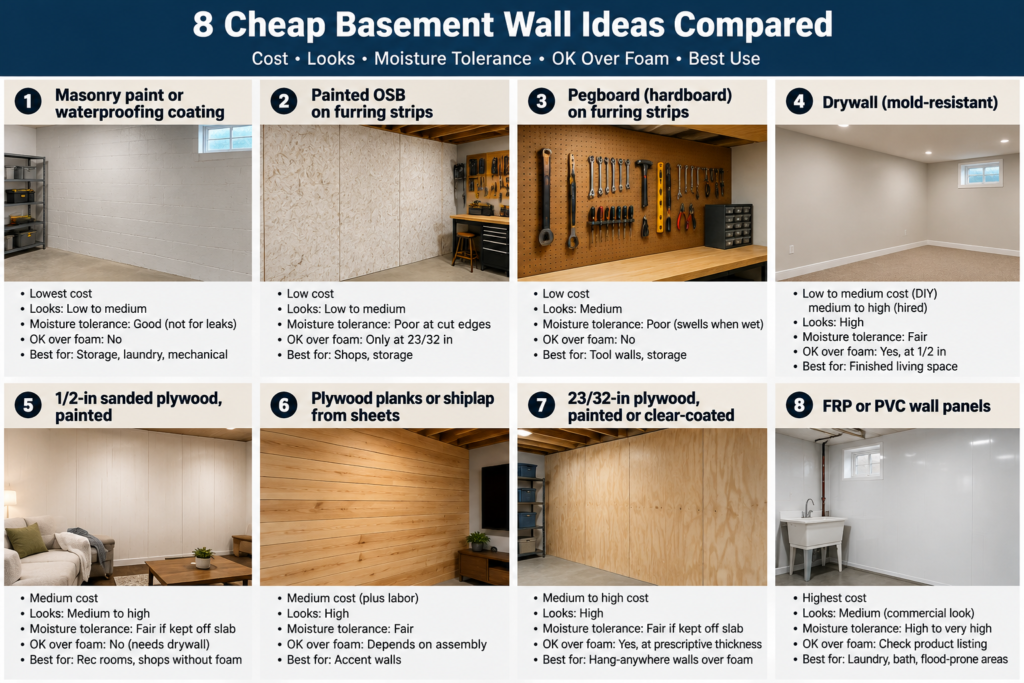
Cheap Basement Wall Ideas Compared (Cost Chart)
The cost tiers compare materials plus DIY installation per square foot of wall, ranked against each other. They are not prices. Panel and drywall pricing moves quickly, so check your local yard before you commit.
Wall idea
Relative cost
Looks finished?
Moisture tolerance
OK directly over foam?
Best for
Masonry paint or waterproofing coating on concrete
Lowest
Low to medium
Tolerates minor dampness; not a fix for leaks
No foam involved
Storage, laundry, mechanical rooms
Painted OSB on furring strips
Low
Low to medium (texture shows)
Poor at cut edges if wetted
Only at 23/32 in
Shops, storage
Pegboard (hardboard) on furring strips
Low
Medium
Poor, since hardboard swells when wet
No
Tool walls, storage
Drywall (mold-resistant), taped and painted
Low to medium if DIY; medium to high if you hire finishing
High
Fair; paperless facings handle damp better
Yes, at 1/2 in
Most finished living space
1/2-in sanded plywood, painted
Medium
Medium to high
Fair if kept off the slab
No, it needs drywall behind it
Rec rooms, shops without foam
Plywood planks or shiplap ripped from sheets
Medium, plus extra labor
High
Fair
Depends on what is behind it
Accent walls
23/32-in plywood, painted or clear-coated
Medium to high
High
Fair if kept off the slab
Yes, at prescriptive thickness
Hang-anywhere walls over foam
FRP or PVC wall panels
Highest
Medium (FRP looks commercial)
High to very high
Check the product listing
Laundry, bath, flood-prone areas
The “over foam” column is the one most budget guides skip. It is explained in the fire section below, and it changes the cost ranking.
Start With the Wall, Not the Finish
A cheap finish fails for the same reason an expensive one does: water. Before you price anything, find out what the concrete is doing. Our basement moisture test guide covers five tests you can run in a weekend.
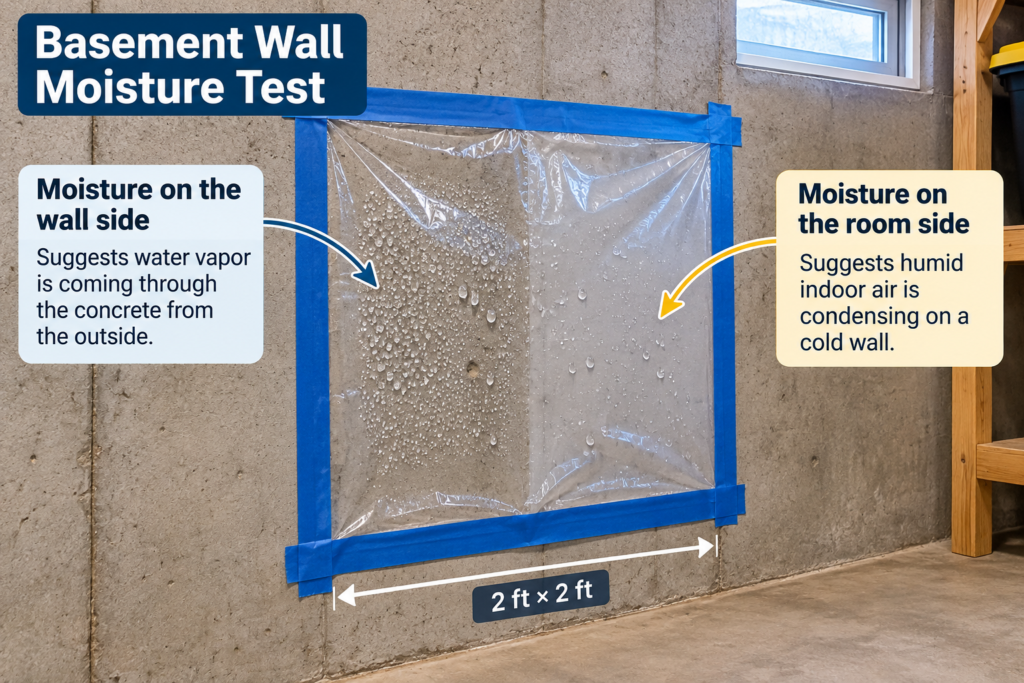
🧪 Real test you can run tonight (a first screen, not a diagnosis): tape a 2 × 2 ft square of clear plastic sheeting tight to the bare wall on all four edges and leave it 24 to 48 hours. Moisture on the wall side of the plastic suggests water vapor is coming through the concrete. Moisture on the room side suggests humid indoor air is condensing on a cold wall. A dry result doesn’t clear the wall, though. The outcome changes with season, rainfall, wall temperature and indoor humidity, and the test can’t tell you how much moisture is moving or where it comes from. Repeat it in a different season, look for staining and efflorescence too, and get a professional assessment if results are mixed or you see any liquid water.
If you see active seepage, puddling at the floor-wall joint, or efflorescence that keeps coming back, fix the drainage first.
The Moisture Rules Behind Every Option
Three rules decide what goes behind a cheap finish.
Coatings are not drainage. A masonry waterproofing coating can reduce dampness on a wall’s inside face. It does not reliably stop water moving through concrete under pressure, and it is not a substitute for grading, gutters, footing drains, a sump system or exterior waterproofing. If water is getting in, those fixes come first. The coating is a finish, not the fix.
No plastic sheeting on the inside of basement walls by default. The IRC requires an interior vapor retarder on frame walls in colder climate zones, but Section R702.7 lists basement walls and the below-grade portion of any wall as exceptions. Building Science Corporation’s vapor control guidance, published through the U.S. Department of Energy, recommends avoiding Class I vapor retarders such as polyethylene in below-grade spaces because the moisture drive in those walls runs inward. Poly behind a finish traps that moisture against your framing.
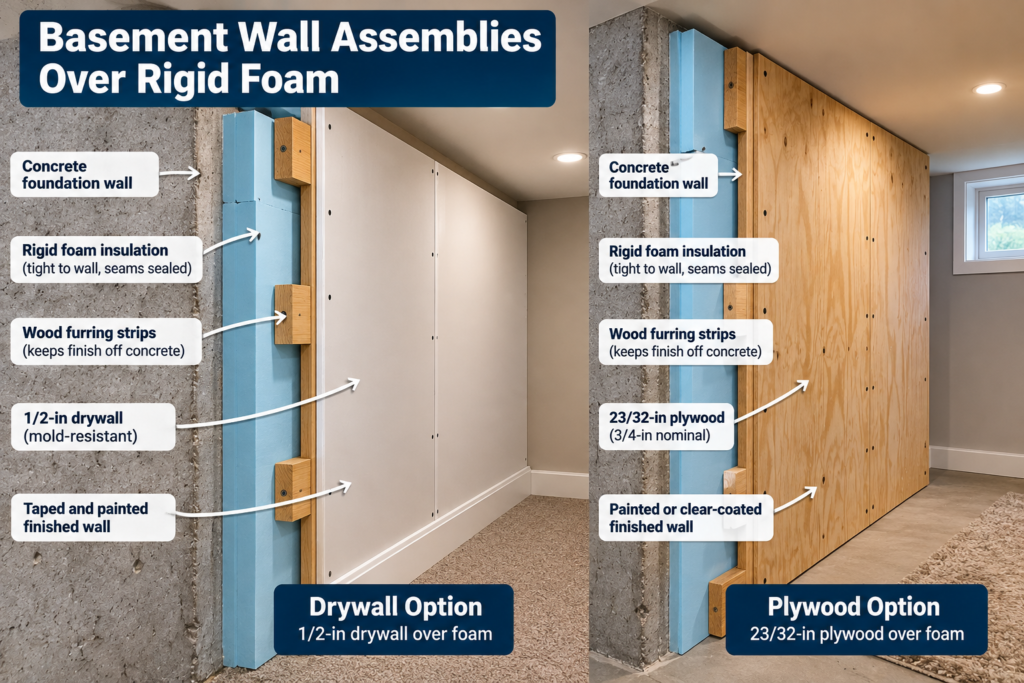
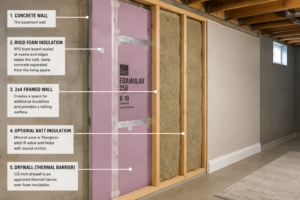
Foam against the concrete, wood off the concrete. For heated living space, the usual assembly is continuous rigid foam tight to the foundation with sealed seams, then furring strips or a stud wall, then the finish. Our basement wall systems comparison walks through all seven assemblies. For a storage room you don’t plan to heat, you can skip the foam and fasten furring strips or panels to a dry wall.
The Fire Rule That Changes the Cost Ranking
⚠️ Warning: thin panels over foam usually aren’t allowed on their own. Under IRC R316.4, foam plastic insulation generally has to be separated from the room by an approved thermal barrier. The prescriptive options are 1/2-inch gypsum wallboard or a 23/32-inch wood structural panel. North Carolina’s Office of the State Fire Marshal quotes this wording in a published code interpretation.
Meeting the thickness alone doesn’t make a wall compliant. Compliance also depends on the specific foam product and its evaluation report, how the barrier is fastened and installed, and the code edition and amendments your jurisdiction has adopted. Some foam products are approved with other coverings; others carry extra conditions. Read the foam manufacturer’s installation instructions and confirm the assembly with your building department before you buy panels.
In practice:
1/2-inch plywood, pegboard, FRP or PVC panels screwed straight over foam usually aren’t compliant in a finished room. They typically need 1/2-inch drywall behind them, which adds a second layer of cost.
1/2-inch drywall alone is a prescriptive thermal barrier in one layer, which is why it often ends up the cheapest finished option once foam is involved.
23/32-inch plywood or OSB is the other prescriptive single-layer option and gives you a hang-anywhere wall.
Plywood is fine as a wall finish by itself. IRC R302.9.1 caps wall finishes at a flame spread index of 200. HUD’s manufactured-housing standard (24 CFR 3280.203) classes 1/4-inch and thicker plywood in the 76 to 200 range. Check the ASTM E84 rating on pegboard, FRP and PVC products before you buy.
💸 Cost difference: one thick layer vs two thin ones. This is illustrative math, not current prices. A 400 sq ft run of wall takes about 13 sheets at 32 sq ft each. Over foam you can choose between:
Assembly over foam
Sheets to buy
Labor
A: 1/2-in drywall + 1/2-in plywood
13 drywall + 13 plywood
Hang two layers
B: 23/32-in plywood only
13 plywood
Hang one heavier layer, then prime and paint
C: 1/2-in drywall only
13 drywall
Hang, tape, mud, sand, prime and paint
Price all three with your own numbers. Take the per-sheet gap between 23/32 and 1/2-inch plywood at your yard and multiply by 13. If that is smaller than 13 sheets of drywall plus the labor of hanging them, B beats A. Comparing B with C comes down to plywood price versus the cost of taping and finishing drywall. If you do that work yourself, C usually wins. If you pay for it, B can come out ahead.
8 Cheap Basement Wall Ideas, Ranked
1. Masonry Paint or Waterproofing Coating
This is the lowest-cost way to make bare concrete look intentional, and it doesn’t take any floor space. It also leaves cracks and stains visible, so you’ll see a new problem early. It adds no insulation, and a cold, painted wall in a humid basement can still sweat in summer. A coating can cut down minor dampness on the surface. It won’t hold back water under pressure or replace drainage and waterproofing. For when a coating is the right tool and when it isn’t, see Drylok vs vapor barrier.
Skip it when: the wall is actively leaking, or the room will be a heated bedroom or office.
2. Painted OSB on Furring Strips
OSB is generally one of the cheapest sheet goods per square foot. Painted, it gives a rugged look that suits workshops. Its edges absorb water faster than plywood’s, so keep it off the slab and seal the cut edges before you hang it.
Skip it when: you want a smooth, painted living-room wall. The strand texture shows through paint.
3. Pegboard on Furring Strips
Pegboard turns a storage wall into a tool wall at low cost. Furring strips hold it off the wall so hooks have room to seat. Standard hardboard pegboard swells if it gets wet, so use it only where the wall has tested dry.
Skip it when: the basement runs humid most of the year, or foam is behind it without drywall.
4. Drywall, Taped and Painted
Drywall is cheap per sheet, and 1/2-inch board is a prescriptive thermal barrier over foam. The cost climbs if you hire the taping and sanding, since that is most of the labor. Mold-resistant or paperless board is the safer pick near a foundation. For moisture-heavy rooms, compare it against panels in our basement wall panels vs drywall breakdown.
Skip it when: the basement has a real flood history. Paper-faced drywall is hard to dry out once soaked.
5. 1/2-Inch Sanded Plywood, Painted
This works in an unheated shop or rec room without foam. It costs more than OSB, but the sanded face takes paint cleanly and holds screws anywhere. Our guide to the best plywood for basement walls compares grades. In short, an A-face exterior-glue panel such as ACX is the usual pick for a painted wall. Exterior glue is about the bond surviving moisture during construction. It doesn’t make the panel rot-resistant.
Skip it when: it would go straight over foam in a living space (see the fire rule above).
6. Plywood Planks or Shiplap Ripped From Sheets
Ripping 4 × 8 sheets into 6- or 8-inch strips gives a plank look for less than solid boards. A shiplap-style gap hides imperfect walls better than a flat panel does. The trade-off is more cuts and more fasteners. Our shiplap guide covers spacing and layout.
Skip it when: you’re short on time. The ripping and finishing take far longer than hanging full sheets.
7. 23/32-Inch Plywood Over Foam
This is one of two prescriptive single-layer finishes over foam, and it gives you a wall you can screw into anywhere. Whether it costs less than drywall depends on your local panel prices and on whether you’d pay someone to tape and finish drywall. Run the numbers in the cost table above before deciding. The sheets are heavy, so plan on a helper or a panel lift.
Skip it when: you plan to tape and mud drywall yourself and don’t need hang-anywhere walls. Drywall will usually cost less.
8. FRP or PVC Panels
These cost the most on this list, but they hold up in laundry rooms and areas that may see water again. FRP (fiberglass-reinforced plastic) needs a solid backer like drywall or plywood behind it. Interlocking PVC panels can sometimes go on furring strips, depending on the product’s listing.
Skip it when: the goal is a cozy family room. Both read as utility finishes.
Decision Chart: Which Cheap Wall Fits Your Basement
Your situation
Pick
Why
Wall leaks or shows active seepage
Fix drainage and waterproofing first
No finish or coating replaces it
Storage or mechanical room, not heated
Masonry coating, OSB or pegboard
Lowest cost, nothing to trap moisture
Heated room, you can tape and mud
Foam + 1/2-in drywall
Usually the cheapest prescriptive single layer
Heated room, you want to hang things anywhere
Foam + 23/32-in plywood
Single layer; compare its cost against drywall first
Plan your seams. Run plywood or OSB vertically and cover the joints with thin battens for a board-and-batten look. Trying to hide plywood seams with filler usually shows through the paint.
Prime for the substrate. Plywood and OSB can bleed tannins and show grain through latex. A stain-blocking primer stops that. Our painting plywood guide covers primer choice.
Hold panels off the slab. Leave about 1/2 inch at the bottom and cover the gap with baseboard. This keeps panel edges out of any water on the floor and gives the wall a clean bottom line.
Trim every opening. Casing around windows and a simple cap where panels meet the ceiling make a cheap wall look planned.
Use a washable sheen. Eggshell or satin wipes clean, and flat paint shows scuffs on rough panels.
Light the walls. Fixtures placed 2 to 3 feet off the wall wash light down the surface, which makes even OSB look intentional.
Common Mistakes That Make Cheap Walls Expensive
❌ Mistake: treating a coating as waterproofing. Painting over a wall that takes on water under pressure hides the problem for a while. Then the coating blisters and the water keeps coming.
❌ Mistake: poly behind the finish. Plastic sheeting on the inside of a basement wall traps inward-moving moisture against framing. The usual result is mold you can’t see until you open the wall.
❌ Mistake: wood touching the slab. Plywood or furring that sits on concrete wicks moisture from the bottom edge. Hold it off the floor or use pressure-treated bottom plates where your code requires them.
❌ Mistake: thin panels straight over foam. It looks done and passes your own inspection, but it often fails the real one. That can mean adding drywall later.
😬 Regret: covering the shutoffs. A tidy wall feels great until a valve drips. Mark valves, cleanouts and junction boxes before you close in, and leave access panels at each one.
Picks for a Low-Cost Basement Wall
Disclosure: As an Amazon Associate, theplywood.com earns from qualifying purchases.
Tracks basement humidity so you know if you need a dehumidifier
FAQ
What is the cheapest way to cover basement walls? Masonry paint or a waterproofing coating applied directly to clean, dry concrete. It costs the least and leaves the foundation visible for inspection, but it adds no insulation and does not replace drainage or waterproofing.
Can you put plywood directly on concrete basement walls? It isn’t a good idea. Wood pressed against concrete takes on moisture. Fasten furring strips or build a stud wall first, keep the bottom edge off the slab, and in heated rooms put rigid foam between the wall and the wood.
Do basement walls need a vapor barrier? Not usually. IRC R702.7 exempts basement walls and below-grade walls from the interior vapor retarder requirement. Building science guidance recommends against interior polyethylene in below-grade walls because it can trap moisture. Check your local code, since some jurisdictions amend this.
Is drywall cheaper than plywood for basement walls? Per sheet, drywall is generally cheaper, and over foam 1/2-inch drywall is a prescriptive thermal barrier in one layer. Plywood can come out ahead if you’d otherwise pay someone to tape and finish the drywall, so compare local panel prices against finishing labor.
What is the cheapest basement wall that still looks finished? For an unheated room, painted plywood on furring strips with battens over the seams. For a heated room over foam, taped and painted 1/2-inch drywall is usually cheapest if you finish it yourself.
Bottom Line
Paint is the cheapest basement wall, and plywood or drywall is the cheapest finished room. Once foam goes behind the finish, 1/2-inch drywall is usually the lowest-cost option if you can finish it yourself, while 23/32-inch plywood can compete when finishing labor is paid. Either way, confirm the wall is dry and the assembly meets local code before you spend anything on the finish.
Related Posts:
How to Make Plywood Look Nice: 6 DIY Finishes by Admin March 31, 2025 Finish Most people think of plywood as just cheap, utility-grade wood. For years, I thought the same—until I started working on weekend furniture builds in my…