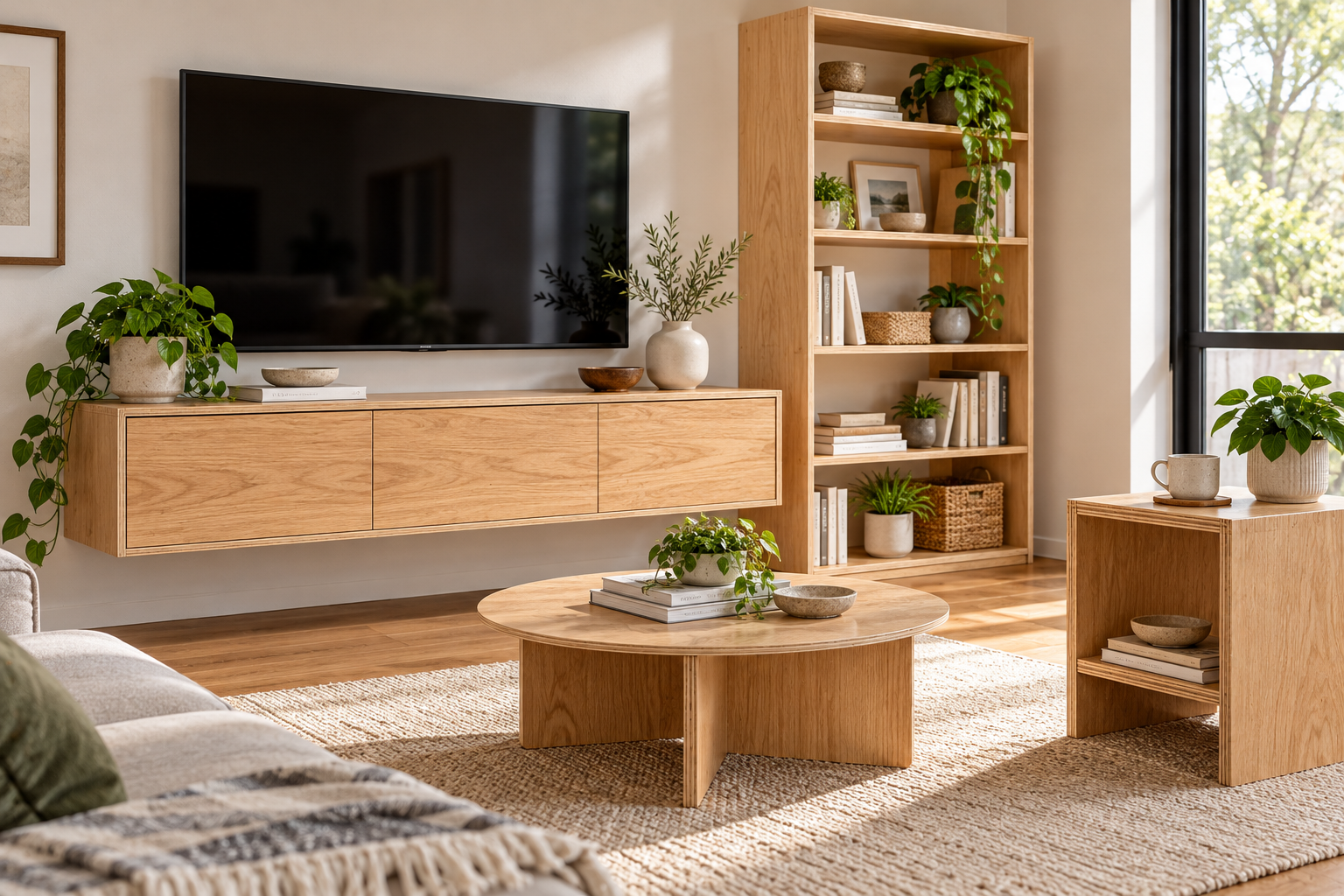
DIY plywood furniture looks expensive when you get three things right: a hardwood-veneer face where people look, edges that are either cleanly banded or deliberately shown off, and a clear finish that keeps the wood its natural color.
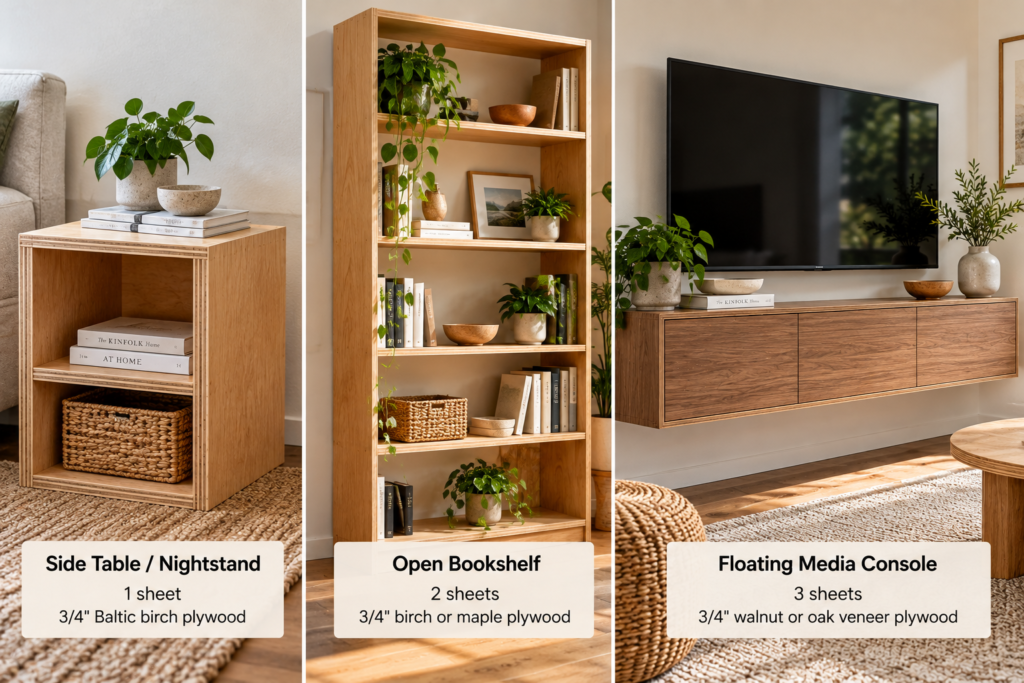
The best projects to start with are a Baltic birch side table, an open bookshelf, and a floating media console, because each one shows plenty of face and needs only one or two sheets. Below you’ll find a project chart with plywood picks and sheet counts, which grades to buy, how to finish edges and faces, ready-made pieces worth buying instead, and the mistakes that make plywood look cheap.
Pick a project that fits in one or two sheets. Use A- or B-face hardwood plywood (birch, maple, oak or walnut veneer) for anything visible, or Baltic birch if you want the layered edge to show. Band raw edges or sand them smooth and leave them exposed on purpose, then finish with a water-based clear coat to keep light woods light.
DIY Plywood Furniture Project Chart
Sheet counts are estimates for the size listed, using standard 4×8 sheets unless noted. Confirm against your final cut list. Larger builds need more.
Project (size)
Best plywood
Sheets (estimate)
Difficulty
What makes it look expensive
Watch out for
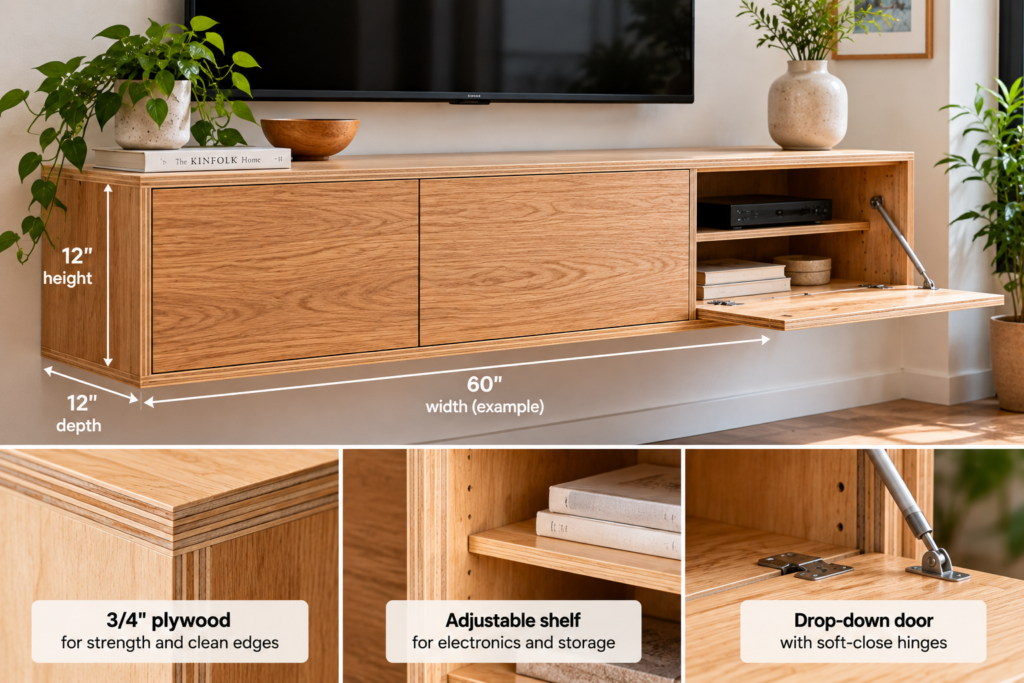
Floating media console (60″ W x 16″ H x 15″ D)
3/4″ walnut or white oak veneer
2 x 3/4″ + 1 x 1/4″ back
Moderate
Continuous grain across the doors, flush edges, hidden wall cleat
Must anchor into studs
Open bookshelf (36″ W x 72″ H x 12″ D)
3/4″ birch or maple veneer, 4×8
2 x 3/4″ + 1 x 1/4″ back
Easy–moderate
Banded edges, recessed back, thick-looking front edges
Shelf sag on long spans
Side table / nightstand (20″ x 20″ x 24″ H)
3/4″ Baltic birch, 5×5
1
Easy
Exposed, evenly layered edges sanded smooth
Patches on lower grades
Wall shelves (set of three, 36″ long)
3/4″ Baltic birch or oak veneer
1
Easy
Hidden brackets, doubled front edge
Bracket must match the load
Writing desk (48″ x 24″)
3/4″ oak or walnut veneer, top doubled at the front edge
1
Moderate
A top that reads 1-1/2″ thick from the front
Veneer chipping on cut edges
Queen platform bed
3/4″ veneer ply for visible sides, cheaper sanded ply for the hidden deck
3–4
Moderate–hard
Clean side panels, recessed base that makes it “float”
Weight, center support
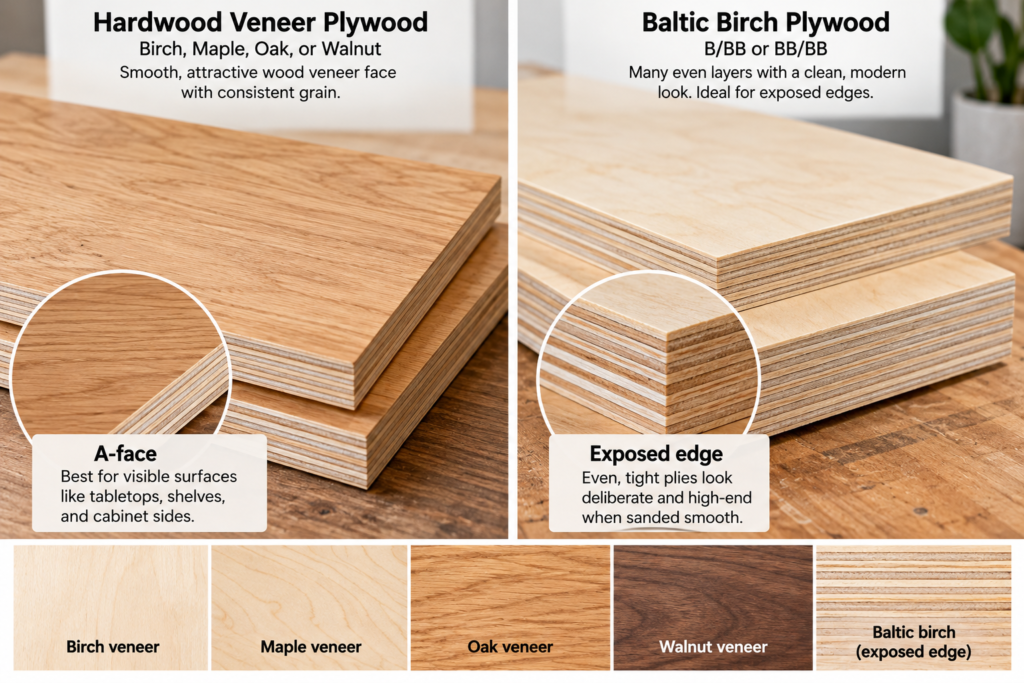
The two plywood types in the chart behave differently. Hardwood veneer plywood is sold in 4×8 sheets, so it handles tall parts like 72″ bookshelf sides. Forest Plywood lists Baltic birch’s common format as 5×5 feet, which is ideal for small pieces but can’t produce a part longer than 60 inches. Our Luan vs Baltic birch comparison covers the trade-offs in more detail.
How to Pick the Right Plywood Grade for Furniture
The face grade decides whether a piece looks custom or looks like plywood. Under ANSI/HPVA HP-1, hardwood plywood carries a letter for the face (A is the best) and a number for the back (1 is the best). As WOODWEB’s summary of the grades explains, a 1 or 2 back is meant to be seen, while a 3 or 4 back is for hidden surfaces like drawer bottoms and cabinet interiors.
Where the panel goes
Grade to buy
Why
Both sides visible (open shelves, room dividers)
A1 or A2
Both faces are finish quality
One side visible (cabinet sides, desk tops)
A3 or B3
Clean face, back can show stain or splices
Hidden (drawer bottoms, bed deck)
B4 or C4, or sanded softwood ply
No reason to pay for a face nobody sees
Exposed-edge look
Baltic birch B/BB or BB/BB
Many even layers; BB faces have a few small patches
Forest Plywood describes BB/BB Baltic birch as having on average 3 to 6 small, color-matched patches per face, while B/BB keeps one face clear. If both sides of a side table will show, the patches will show too. Our furniture-grade plywood guide explains what that label really means at the store, and our cabinet-grade plywood buying guide covers the sheets most stores stock. For which thickness suits each part of a build, see our furniture plywood thickness chart.
💸 Cost difference: put your best sheet where the eye lands. On a platform bed, only the side panels and headboard are seen. If you buy one A-face sheet for those parts and two sanded sheets for the hidden deck, your savings are twice the price gap between the two grades. Check local pricing, but the gap between a hardwood-veneer sheet and a sanded utility sheet is usually large.
How to Make Plywood Edges Look High-End
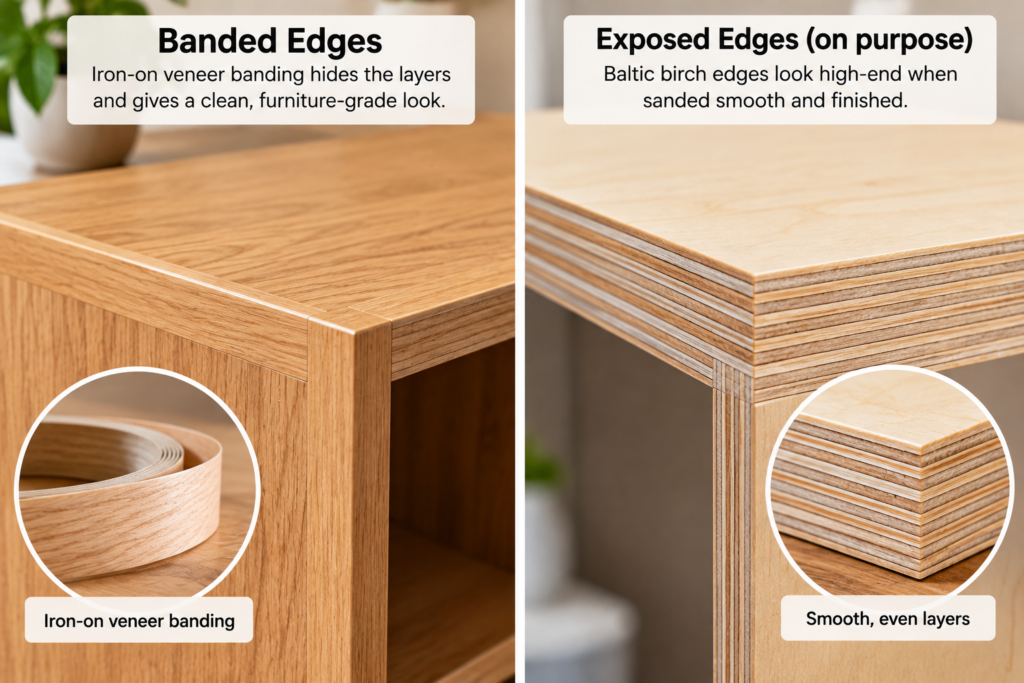
There are two good options. A half-sanded edge in between is the one that looks cheap.
Band the edges
Iron-on veneer banding hides the layers completely. Family Handyman’s method: sand the edge smooth with 120-grit first, empty the water from the iron and set it to the cotton setting, then move it about 2 inches per second so the glue melts without scorching. Press the hot banding down with a wood block, trim the overhang with an edge-banding trimmer, and ease the corner lightly with 150-grit. For 3/4″ plywood, they recommend 13/16″ or 7/8″ banding so there’s a little extra to trim off.
Show the layers on purpose
Baltic birch edges look deliberate because the plies are even and tight. Sand the edges up to the same grit as the face and finish them with the rest of the piece. This works with Baltic birch. It does not work with construction plywood, whose edges can show voids and uneven plies.
Fake a thicker top
Glue a 1-1/2″ strip under the front edge of a desk or table top and band across both layers. From standing height, a 3/4″ top then reads as a solid 1-1/2″ slab.
⚠️ Warning: banding is thin. Iron-on banding covers an edge. It doesn’t armor it. On a desk front or bench edge that gets bumped daily, a glued-on hardwood strip holds up better than banding.
Which Finish Makes Plywood Look Expensive
Keep light woods light
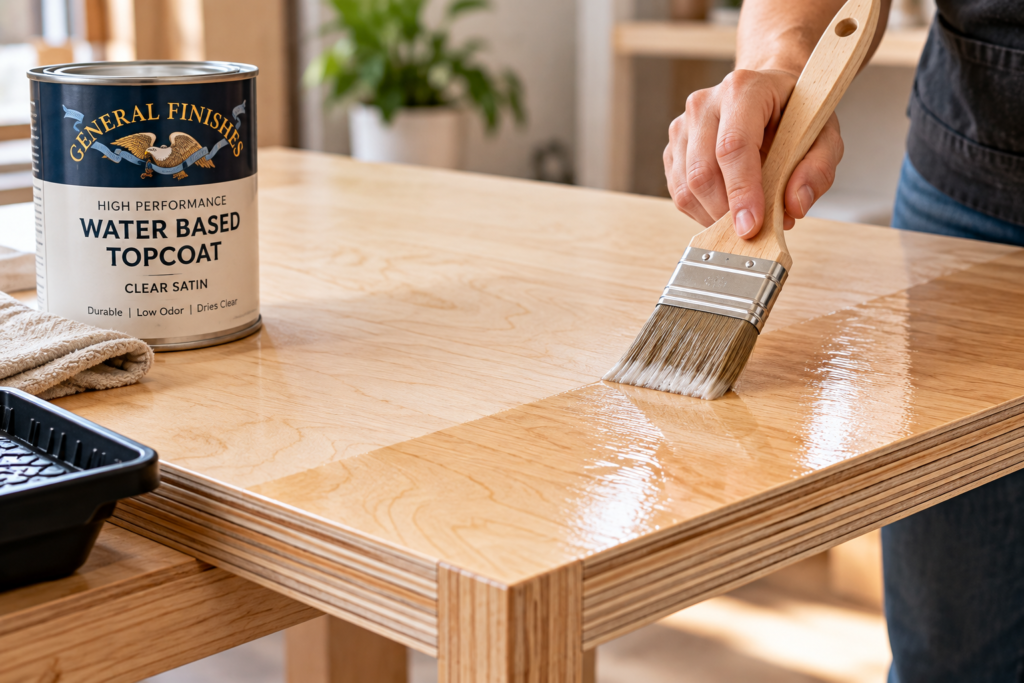
Birch and maple look most expensive when they stay pale. General Finishes says its water-based topcoats generally dry clear, with the exception of its oil-modified Enduro-Var, which ambers. Oil-based finishes add a warm, yellow tone that suits walnut and oak but can make birch look dated.
If you stain, condition first
Birch and maple can stain unevenly. Minwax says its Pre-Stain Wood Conditioner is especially necessary on pine, alder, birch and maple, and that stain must go on within 2 hours of conditioning. On walnut or white oak veneer, a clear finish alone usually looks richer than any stain. See our guide to finishing plywood for coat-by-coat steps.
🧪 Test before you commit: Finish a 12-inch offcut from the same sheet with your exact sequence of sanding, conditioner, stain and topcoat. Let it dry overnight and look at it in the room where the furniture will live. The veneer on your sheet, not the photo on the can, decides the color.
Rather Buy Than Build? Plywood Furniture Worth a Look
Not every piece is worth a weekend in the garage. These are the types of ready-made plywood furniture that hold their value, and what to check before you order. On Amazon, “wood” in a listing often means particleboard or MDF. Look for plywood or Baltic birch explicitly identified as the core material. A real wood veneer alone does not mean the furniture is constructed from plywood.
Baltic Birch Side Table or Nightstand: A good choice because a small piece with exposed, evenly layered edges is the hardest look to fake with particleboard. If the edges in the photos show clean, even stripes, it’s real multi-ply. Check that the listing names Baltic birch and shows the edge up close.
Molded Plywood Lounge Chair: A good choice because curved, molded plywood is the one thing a home shop can’t build without a press and forms. It’s the piece most worth buying rather than making. Check the weight limit, the veneer species, and whether the shell is real plywood or plastic with a wood-look surface.
Plywood Bookshelf or Ladder Shelf: A good choice when you need shelves sooner than you could build them, or you don’t own a saw for full sheets. Check the shelf thickness and the weight rating per shelf. Thin shelves on a long span will sag under books.
Plywood Media Console or Sideboard: A good choice because a console is a large surface people look at every day, and a factory sprayed finish is hard to match at home. Check that the listing names plywood as the material for the whole case, not just the doors. Some use plywood fronts on a particleboard box.
Floating Plywood Wall Shelves: A good choice for a quick upgrade with no tools beyond a drill. Check the included mounting hardware and the weight rating, and plan to anchor into studs for anything heavier than decor.
💸 Cost difference: Buying generally costs more than building when you already own the tools, and less when you’d need to buy a saw, an edge trimmer and clamps for a single project. Price out your tool list before deciding.
When Plywood Furniture Is the Wrong Choice
Edges that take constant wear. Dining table edges, chair arms and stair-like steps wear through banding. Use solid wood strips there.
Long, heavily loaded shelves. Plywood shelves can sag under books. The Woodbin Sagulator targets 0.02 inches of sag per foot or less and notes that wood shelves sag about 50% more over time. As a starting point, check any shelf longer than about 30 inches before you build it.
Outdoor furniture. Most hardwood plywood sold for furniture is made for indoor use. Check the panel’s bond type before taking it outside, and remember that a waterproof glue line doesn’t make the wood itself rot resistant.
Pieces with lots of curved, exposed edges. Banding struggles on tight curves, and exposed layers on a curve need an even-ply panel like Baltic birch.
Common Mistakes That Make Plywood Look Cheap
❌ Using construction plywood for visible parts. Sanded or sheathing grades can have voids and patches on the face and gaps in the edge. Result: a piece that reads as “garage shelf” no matter how it’s finished. Our plywood grades guideshows which letters to avoid for visible parts.
❌ Cutting with a dull or coarse blade. Hardwood plywood face veneers are thin. Result: chipped edges along every cut that banding can’t fully hide. Use a fine-tooth blade and put the good face where your saw won’t tear it.
❌ Sanding through the veneer. Result: a light patch of core showing through the face, which can’t be repaired invisibly. Stop at 180–220 grit and sand by hand near the edges.
😬 Regret: oil-based poly on birch. Result: a pale piece that slowly turns yellow. Test on an offcut first.
❌ Designing a tall piece around 5×5 Baltic birch. Result: sides that come out too short, or a visible joint in a long part.
❌ Skipping wall anchors on consoles and bookshelves. Result: a tall or wall-hung piece that can tip or pull away from the wall. Anchor into studs.
FAQ
What is the best plywood for DIY furniture that looks expensive? For visible faces, A-grade hardwood veneer plywood (walnut, white oak, birch or maple). For an exposed-edge look, Baltic birch with a B or BB face.
Does Baltic birch come in 4×8 sheets? Its common format is 5×5 feet, and some suppliers also stock larger sizes. A 5×5 sheet can’t produce a part longer than 60 inches.
How do I hide plywood edges? Use iron-on veneer banding slightly wider than the panel, then trim it flush. For edges that get bumped often, glue on a solid hardwood strip instead.
Should I stain birch plywood? You can, but use a pre-stain conditioner first. Minwax names birch and maple as woods that especially need it. Many builders leave birch unstained and use a clear water-based finish.
How long can a 3/4″ plywood shelf be? It depends on the load, depth and species. The Woodbin Sagulator calculates sag for your exact shelf and targets 0.02 inches per foot or less. Check long shelves before cutting.
How can I tell if store-bought furniture is real plywood? Look for plywood or Baltic birch named as the core material in the listing’s materials section. A real wood veneer alone doesn’t prove it, because veneer is often applied over MDF or particleboard. A photo of an exposed edge helps: plywood shows thin, even layers, while particleboard looks like compressed chips.
Bottom Line
The DIY plywood furniture that looks most expensive uses a quality face only where it shows, edges that are either banded or deliberately exposed, and a finish that keeps the wood’s natural color. Start with a smaller project such as a Baltic birch side table, test your finish on an offcut, and buy the pieces a home shop can’t make well, like molded plywood chairs.
How to Make Plywood Look Nice: 6 DIY Finishes by Admin March 31, 2025 Finish Most people think of plywood as just cheap, utility-grade wood. For years, I thought the same—until I started working on weekend furniture builds in my…