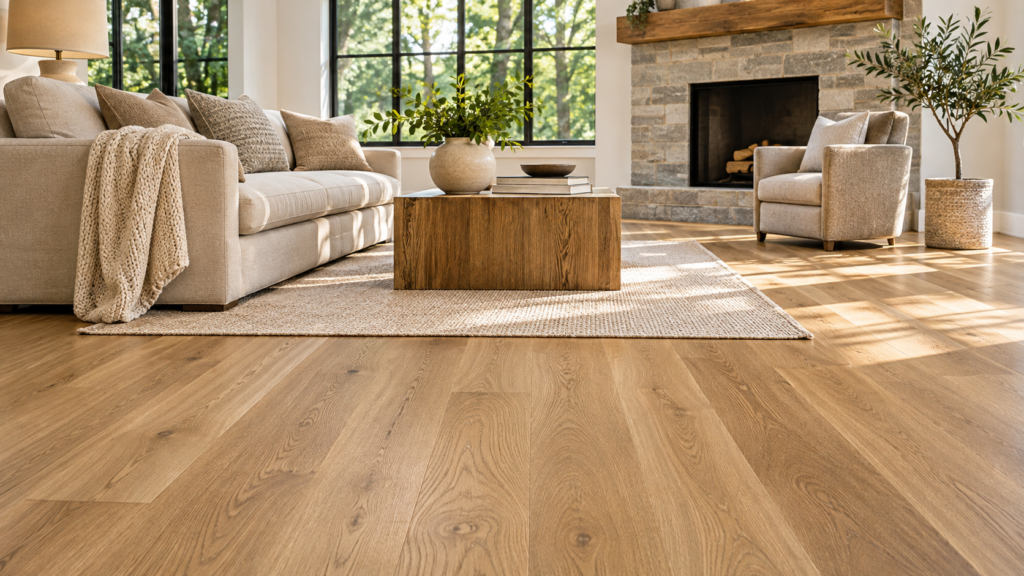
For most homes, the best white oak flooring buy is plain-sawn, Select or #1 Common grade. It gives you the classic oak look, it’s a little harder than red oak, and it costs the least of the white oak options. Pay more for rift and quartersawn if you’re putting in wide planks. Choose engineered white oak over solid for basements and concrete slabs.
Disclosure: This post contains Amazon affiliate links. If you buy through them, we may earn a small commission at no extra cost to you.
Quick answer
Hardness: about 1,360 lbf on the Janka scale, compared with about 1,290 for northern red oak
Best grade for most homes: Select (cleaner look) or #1 Common (more knots, usually cheaper)
Best cut for wide planks: rift and quartersawn
Radiant heat: use flooring the manufacturer specifically approves for radiant heat
Basement or slab: engineered, not solid
Biggest risk: tannins. White oak can turn gray, green or black when it meets water-based stains, iron or ammonia
White Oak Flooring at a Glance
White oak
Red oak
Janka hardness (NWFA figures)
~1,360 lbf
~1,290 lbf
Color
Tan to brown, slight gray/green cast
Pinkish to reddish tan
Pores
Plugged with tyloses
Open
Water resistance
Better (not waterproof)
Lower
Takes gray and modern stains
Well, but tannin reactions are a risk
Red undertone shows through
Iron/ammonia reaction
Strong
Present, weaker
Hardness numbers vary by source. Some references list white oak at 1,350 and red oak at 1,220. Either way the gap is small. A dog’s nails or a dropped pan will dent both, so don’t pay extra for white oak because of hardness alone.
Which White Oak Flooring Cut to Buy
How the log was sawn changes both the look of the floor and how much the boards move with the seasons.
Cut
Look
Width movement
Relative cost
Best for
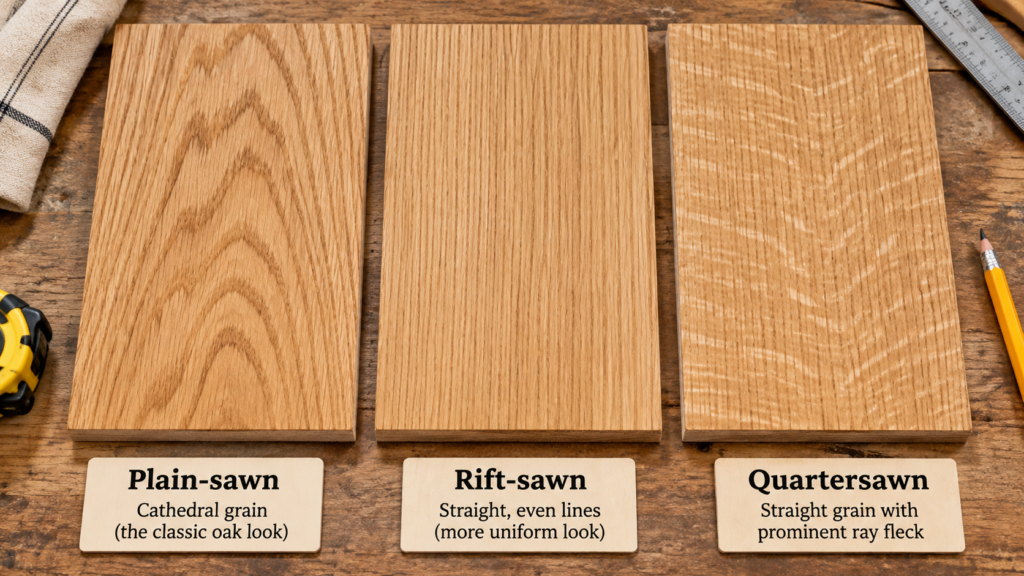
Plain-sawn (flat-sawn)
Cathedral grain, the “classic oak” look
Most
Lowest
Most rooms, strip and standard plank widths
Rift-sawn
Straight, even lines
Low
Higher
Modern, uniform floors
Quartersawn
Straight grain plus ray fleck
Lowest
Highest
Wide planks, Craftsman style
Rift & quartered (R&Q)
Mix of both
Low
Higher
Wide planks where you want straight grain
Why the cut matters: white oak has approximately 10.5% tangential shrinkage and 5.6% radial shrinkage when measured from green to oven-dry conditions. These figures illustrate why quartersawn flooring is generally more dimensionally stable than plain-sawn flooring. On a 2¼-inch strip floor the difference is hard to see. On wide planks it can decide whether the seams stay tight through winter.
Regret to avoid: buying wide plain-sawn solid planks for a house with big seasonal humidity swings. Wider boards move more because movement grows with width. If you want wide planks, look at rift and quartered or engineered.
Radiant heat: for radiant heating systems, choose flooring specifically approved by the manufacturer for radiant heat installation, regardless of the cut or construction.
White Oak Flooring Grades Explained
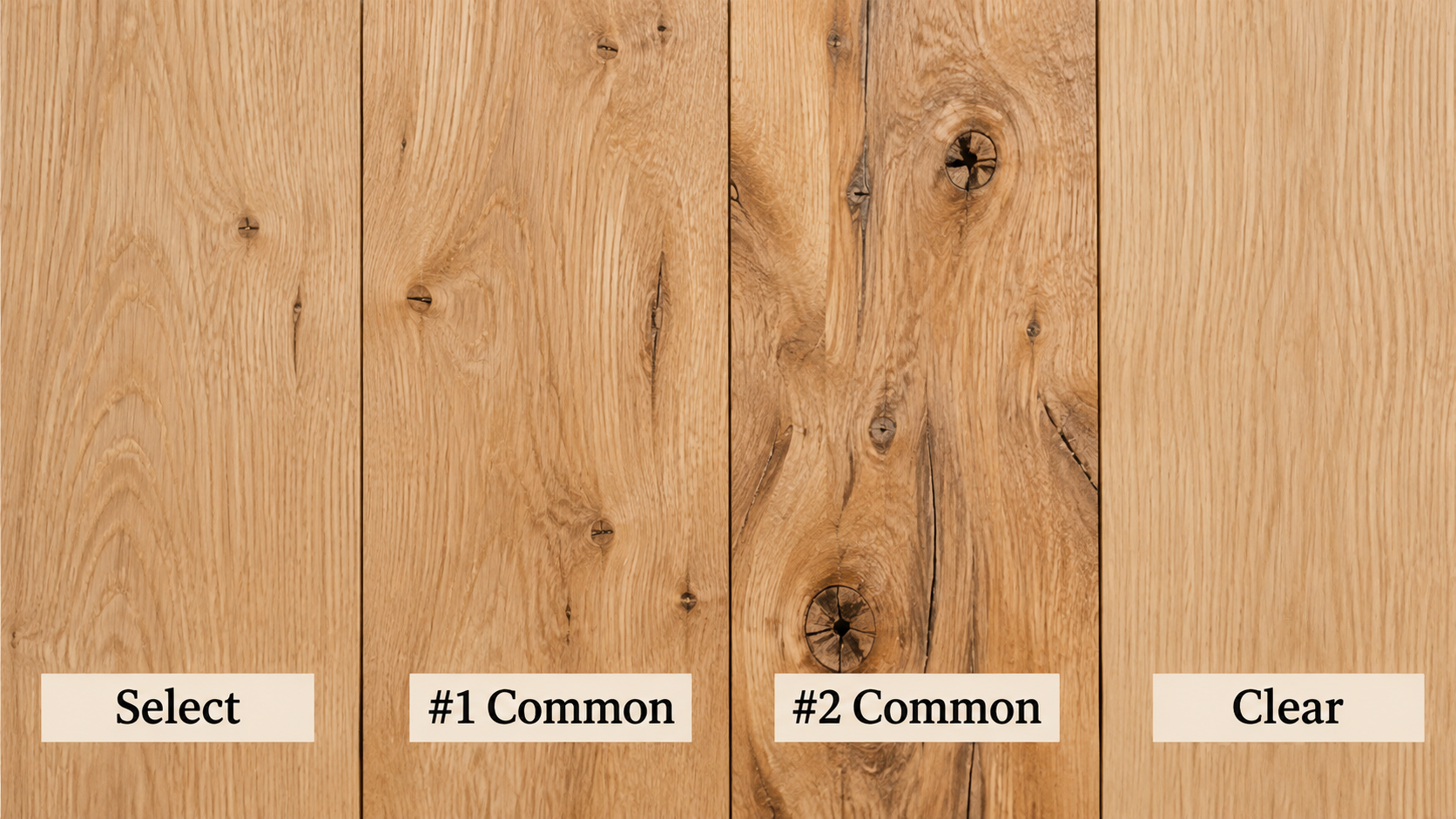
NWFA flooring grades primarily describe appearance rather than structural strength. Higher grades generally offer fewer visible knots, less color variation and longer average board lengths. All grades must meet their applicable manufacturing standards.
Grade (unfinished, NWFA/NOFMA)
What you’ll see
Minimum average board length, 3–5″ plank
Clear
Very uniform, almost no knots or mineral streaks
36″
Select
Small knots, some color variation, some sapwood
32″
#1 Common
Medium knots, prominent color variation
28″
#2 Common
Open knots, worm holes, strong color swings (rustic)
24″
Factory-finished flooring uses different names. Prime is roughly Clear/Select, Standard is roughly #1 Common, and Tavern is roughly #2 Common. “Character grade” isn’t an NWFA grade; each mill uses it for its own mix of Select, #1 and #2.
Wide-plank catch: NWFA board-length standards don’t cover flooring wider than 5 inches. On wide planks, ask the seller for the actual average length. Short average lengths mean more end joints and a busier-looking floor.
Cost tip: #1 Common is usually cheaper than Select. On a whole house, the price gap per square foot multiplied by the floor area is often large enough to pay for upgrading the cut instead. Check local pricing for both.
Solid vs. Engineered White Oak Flooring
Solid white oak is ¾ inch of wood all the way through. You can sand and refinish it many times, and it’s the standard choice over a wood subfloor above grade.
Engineered white oak is a real oak wear layer bonded to a plywood or similar core. The cross-layered core moves less with humidity. That’s why engineered is the usual pick for:
Basements and other below-grade rooms (solid hardwood generally isn’t recommended below grade)
Glue-down installs over concrete
Wide planks in homes with big seasonal humidity swings
How many times an engineered floor can be refinished depends on how thick the wear layer is. Check that spec before you buy. For more on lower-level floors, see our basement flooring options.
Why White Oak Handles Water Better Than Red Oak
The pores in white oak heartwood are plugged with growths called tyloses. They’re the reason white oak is the traditional wood for barrels that hold liquid. Red oak’s pores are open, so water moves into the wood more easily.
Warning: better is not waterproof. Tyloses slow water down, but a leaking dishwasher or a pet accident left overnight will still stain, cup or swell a white oak floor. Wipe spills promptly in kitchens and entryways.
Quick test: is it really white oak? Look at a clean-cut end of a board with a magnifier. White oak pores look filled. Red oak pores look like open pinholes. Some lumber sold as “white oak” is actually a mix of related species (bur, swamp white, chinkapin), and for flooring that’s normal.
The Tannin Problem: Gray, Green and Black Stains
White oak is high in tannins. Tannins react with three things you’ll likely meet during install and finishing:
Iron. Wet oak touching steel (fasteners, steel wool, metal shavings from a saw) can turn blue-black or gray. The reaction is the same one used to make old iron-gall ink.
Water-based finishes and stains. Water can draw tannins to the surface (“tannin pull”), which leaves blotchy brown, gray or greenish marks. Gray stains and pale “pastel” stains under water-based finish are the riskiest combination.
Ammonia. Ammonia darkens oak. That’s how fumed white oak furniture was colored, and it’s why some ammonia-based cleaners and sealers can unexpectedly darken a floor.
Before you stain the whole floor: sand an offcut or a closet corner the same way you’ll sand the floor, then apply the exact stain and finish you plan to use. Let it fully cure before you judge the color. If you want a gray look, read our guide to grey stain for wood first, and see the vinegar and steel wool stain on pine vs. oak test to see how strongly oak reacts to iron.
Moisture Rules Before Installing White Oak Flooring
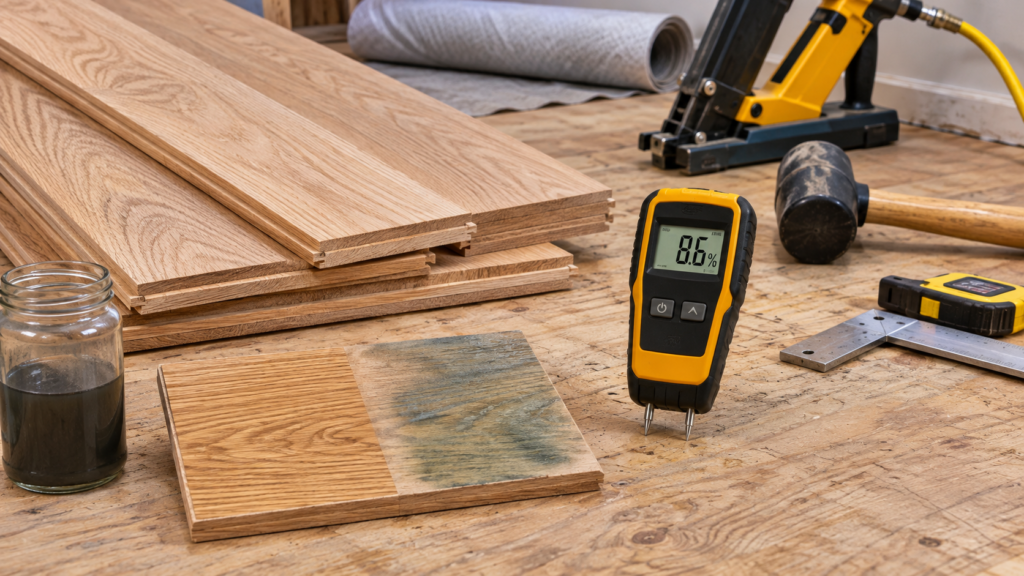
Most cupping, gapping and buckling problems start with moisture, not the wood species. For solid hardwood flooring over a wood subfloor, NWFA guidelines set limits on the moisture-content difference between the flooring and the subfloor:
Solid strip flooring (under 3″ wide): no more than 4 percentage points apart
Solid plank flooring (3″ and wider): no more than 2 percentage points apart
For example, if the subfloor reads 11% and your 5-inch solid planks read 8%, that’s a 3-point gap. It’s fine for strip flooring but too wide for plank, so keep acclimating or dry out the subfloor. NWFA also calls for about 20 readings per 1,000 square feet of wood subfloor, averaged.
Engineered flooring: follow the manufacturer’s installation requirements for moisture testing and acceptable readings. They vary by product and decide whether the warranty holds.
A pin-type moisture meter for the subfloor and flooring readings. The General Tools MMD4E is a common budget choice. Make sure whatever you buy has a wood setting. Our moisture meter guide compares types.
A pinless moisture meter for checking prefinished boards without leaving pin holes, such as the Wagner Orion 910.
Synthetic abrasive pads instead of steel wool on bare oak, such as Scotch-Brite non-woven pads. Steel wool fragments plus moisture can leave black specks in oak.
A pH-neutral hardwood floor cleaner such as Bona Hardwood Floor Cleaner for daily cleaning instead of ammonia-based products.
Felt furniture pads (felt pads). Hardness won’t save a floor from a dragged chair.
5 White Oak Flooring Mistakes (and What They Cost You)
Skipping the stain test. Water-based gray stain on white oak can come out blotchy or greenish. The fix is a full re-sand, which means paying for the whole finishing job twice.
Using steel wool or iron fasteners on bare, damp oak. You get black-gray stains that can go deep into the wood and are hard to sand out.
Installing before checking moisture. Flooring that’s too wet shrinks and gaps. Flooring that’s too dry swells and cups. Neither is covered when acclimation wasn’t done.
Buying wide plain-sawn solid planks for a humid-swing house. Wide boards move more, and seasonal gaps follow. Rift and quartersawn or engineered planks typically cost more upfront but reduce the risk of excessive seasonal movement and gaps.
Paying for Clear grade when you wanted “character.” NWFA flooring grades primarily describe appearance rather than structural strength. Higher grades generally offer fewer visible knots, less color variation and longer average board lengths. All grades must meet their applicable manufacturing standards. If you like knots, #1 Common looks the part and usually costs less.
Where White Oak Flooring Is Not the Best Choice
Full bathrooms and laundry rooms with standing water. Even white oak swells. Tile or a rated waterproof floor is safer. See our basement flooring options for moisture-tolerant choices.
Heavy-dent homes on a budget. If dent resistance is the top priority, species higher on the Janka scale (hard maple, hickory) dent less. The extra ~70 lbf white oak has over red oak won’t make much difference.
Pale “white-washed” looks with water-based products, done DIY with no test boards. That’s the combination most likely to go wrong.
FAQ
Is white oak flooring harder than red oak? Slightly. NWFA lists white oak at about 1,360 lbf and northern red oak at about 1,290 lbf on the Janka scale. In everyday use the difference is small, and both will dent under heavy, point-loaded impacts.
Is white oak flooring waterproof? No. Tyloses make white oak more water resistant than red oak, but standing water can still stain, swell or cup the boards. Wipe spills quickly.
Why did my white oak floor turn green or gray after finishing? The wood’s tannins reacted with the stain or finish, usually a water-based product or a gray or pastel stain. Water can pull tannins to the surface. Testing on scrap pieces before finishing the whole floor is the best way to prevent it.
What grade of white oak flooring should I buy? Select if you want a clean, even look. #1 Common if you like knots and color variation and want to save money. NWFA flooring grades primarily describe appearance rather than structural strength. Higher grades generally offer fewer visible knots, less color variation and longer average board lengths. All grades must meet their applicable manufacturing standards.
Can white oak flooring go in a basement? Engineered white oak can, when the manufacturer approves it for below-grade use. Solid hardwood generally isn’t recommended below grade.
Is rift and quartersawn white oak worth the extra cost? For wide planks, often yes, because those cuts move less in width. For standard-width floors in a stable house, plain-sawn performs well and costs less. Over radiant heat, choose flooring specifically approved by the manufacturer for radiant heat installation, regardless of the cut or construction.
Bottom Line
Plain-sawn Select or #1 Common white oak is the right floor for most above-grade rooms. Upgrade to rift and quartered for wide planks, use only manufacturer-approved flooring over radiant heat, and switch to engineered for basements and slabs. Whatever you buy, check moisture before you install and test the stain on scrap boards. Those two steps prevent most white oak flooring problems.
ApplePly Plywood Review: Pros, Cons & Where to Buy It by Admin March 31, 2025 Hardwood When I first started woodworking, plywood was just the budget-friendly go-to for garage shelves or workshop benches. But as I began taking on more serious…