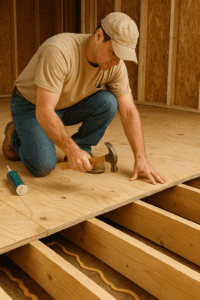
Plywood needs at least 3 plies. Under the U.S. structural plywood standard (PS 1-22), sheets 3/8″ and thinner can be 3-ply. A 3/4″ sheet must have at least 4 or 5 plies, depending on the grade, while marine plywood thicker than 3/8″ requires at least 5 plies. For cabinets, shelves and furniture, look for 3/4″ sheets with 7 or more plies, or 18mm Baltic birch, which usually has 13. For subfloors and roofs, pick by the span rating on the stamp. Ply count matters less there.
Quick answer
Minimum for any plywood: 3 plies
1/2″ standard C-D sheathing (CDX): 3 plies minimum
3/4″ standard C-D sheathing (CDX): 4 plies (3 layers) minimum
The one rule people get wrong: an even number of plies is fine. A 4-ply sheet is built as 3 layers and is fully allowed under PS 1.
Plywood Plies Chart: PS 1 Minimums by Thickness
These are the minimum ply counts in PS 1-22, Table 4. Thickness means the panel’s performance category, so a “3/4” sheet usually measures 23/32″. Structural I panels have different requirements and aren’t shown here.
Thickness
Standard C-D Sheathing (CDX)
Underlayment, C-C Plugged
Exterior Sanded Grades (A-C, B-C, A-B)
Marine
1/4″
3
3
3
3
3/8″
3
3
3
3
1/2″
3
3
4 (3 layers)
5
5/8″
3
4 (3 layers)
5
5
3/4″
4 (3 layers)
4 (3 layers)
5
5
7/8″
5
5
5
7
1″ and up
5
5
6 (5 layers)
7
These are minimums. Mills can and often do add more plies, so a 3/4″ sanded sheet with 7 plies is common.
Plies vs. Layers: Why a 4-Ply Sheet Is Legal
PS 1 counts two things:
Ply: one sheet of veneer.
Layer: one ply, or two or more plies glued together with the grain running the same way.
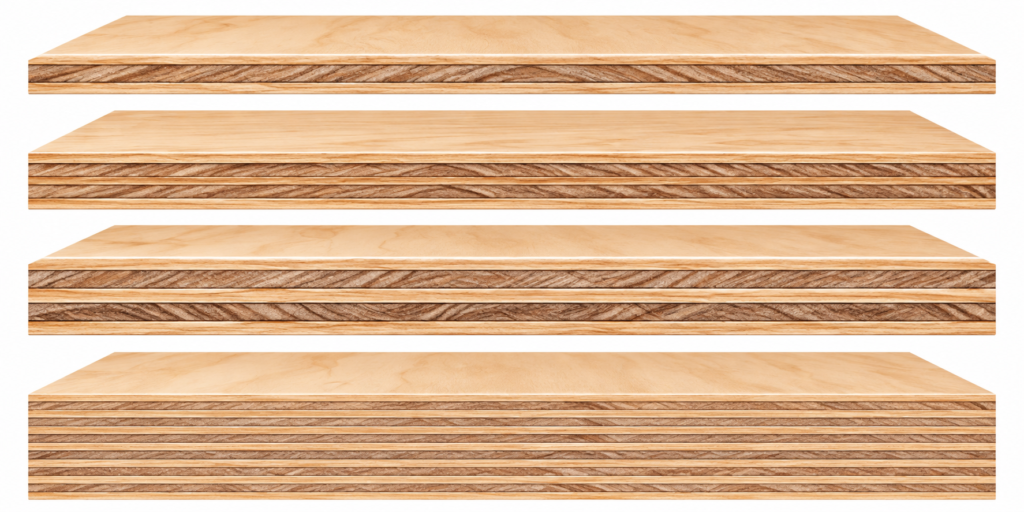
A 4-ply, 3-layer panel has two center plies glued grain-parallel, so they act as one thick middle layer. The panel is still balanced: one grain direction on the outside, the opposite in the middle, then back again. That’s why the old shop rule that “plywood always has an odd number of plies” isn’t quite right. The odd number that matters is the layer count.
Warning: If you count 4 plies on a 3/4″ CDX edge and think you got a defective sheet, you didn’t. That build is listed in the standard.
How Many Plies Baltic Birch Has
Baltic birch isn’t made to PS 1 and follows its own construction, using thin birch veneers all the way through. Wolstenholme’s Baltic birch spec sheet lists:
Thickness
Typical plies
3mm (1/8″)
3
6mm (1/4″)
5
9mm (3/8″)
7
12mm (1/2″)
9
15mm (5/8″)
11
18mm (3/4″)
13
24mm (1″)
17
These counts come from a supplier’s spec sheet, not a standard, so check the listing or count the edge. Our Baltic birch vs. birch plywood comparison covers the other differences.
How Many Plies You Need by Project
Project
What to look for
Why
Subfloor, roof and wall sheathing
Span rating and grade stamp first
Code and stiffness are set by the span rating. A 3-ply or 4-ply sheet that carries the right rating meets the standard.
Cabinet boxes and shelves
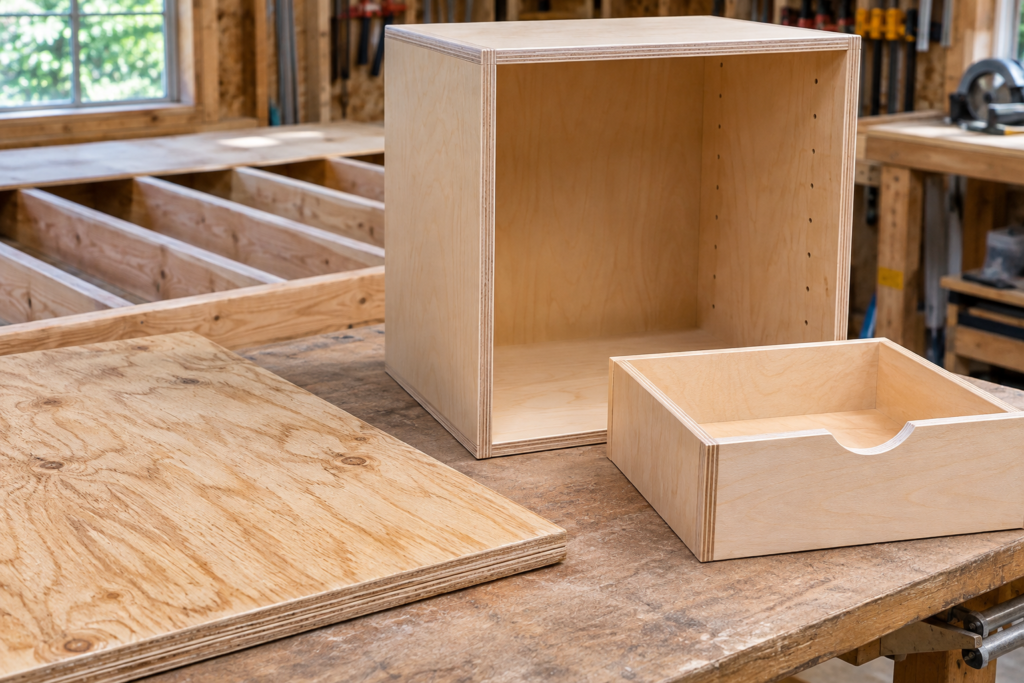
3/4″ with 7+ plies of good veneer, or 18mm Baltic birch
Thin, well-made veneers with few core voids help the sheet stay flat and hold screws in the edges
Drawer boxes
12mm (1/2″) Baltic birch, about 9 plies
Clean exposed edges and solid joints
Jigs, sleds and shop fixtures
18mm Baltic birch
Stays flat and machines cleanly
Paint-grade utility shelving
5-ply 3/4″ exterior sanded is usually enough
Extra plies cost more and add little here
Outdoor projects
Exterior bond classification first
Ply count says nothing about how the glue handles water
Cross-laminating veneers is what makes plywood resist warping, splitting and shrinkage. More numerous, thinner veneers can improve dimensional stability, edge quality and screw-holding performance when the plywood is manufactured with high-quality veneers and minimal core voids. A high ply count made from poor veneer, with gaps in the core, doesn’t deliver those gains.
The limitation: ply count alone doesn’t measure strength. For structural panels, PS 1 sets a span rating either by meeting a construction table or by passing performance tests. A rated 4-ply sheet can outperform an unrated 7-ply import, so when you buy structural plywood, start with the grade stamp. Our plywood thickness vs. strength guideexplains how span, thickness and ply count trade off.
Test It Yourself: Count the Plies in 30 Seconds
Look at a clean, square-cut edge. Sand a rough edge lightly so the glue lines show.
Count the dark glue lines and add 1. That’s your ply count.
Look for one center ply that’s thicker than the others. That’s usually two parallel plies, so you have an even-ply, 3-layer sheet.
Check the edge for gaps or open spots in the inner plies. That tells you more about quality than the count does.
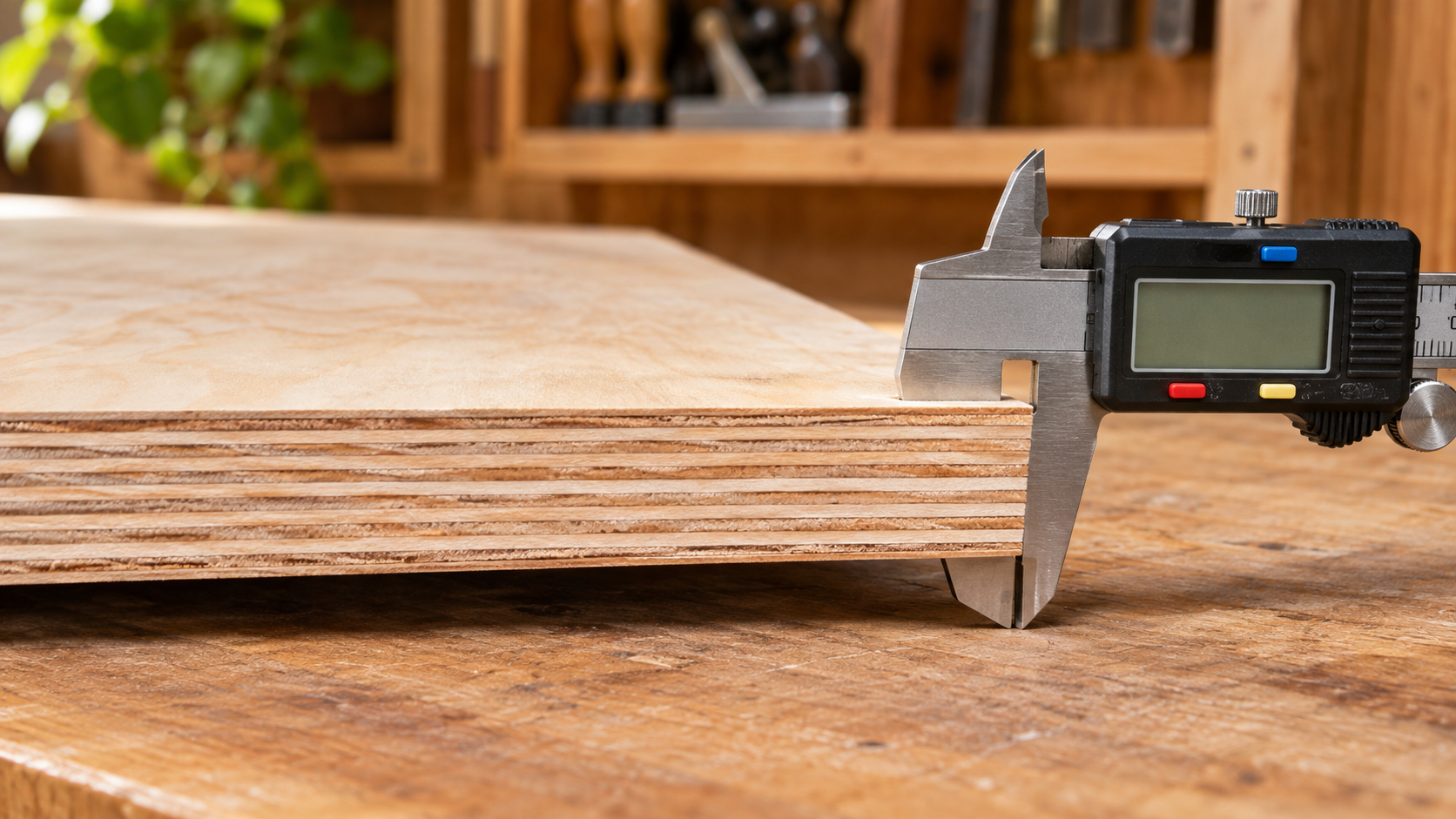
Measure the thickness with a caliper. A “3/4” sheet may be 23/32″ or 18mm, and that matters for dadoes.
Test tip: If a “3/4 birch plywood” sheet shows 5 to 7 thick plies with a softwood core, it’s birch-faced plywood, not Baltic birch, whatever the bin tag says.
Our Picks
18mm Baltic birch plywood: the standard choice for cabinet boxes, jigs and furniture where edges show. Typically 13 plies.
1. Rejecting a legal 4-ply sheet. People assume even ply counts are defective and pay more for a “5-ply” sheet they didn’t need. Consequence: wasted money and a trip back to the store, when the 4-ply, 3-layer sheet met the standard all along.
2. Picking subfloor by ply count instead of span rating. A sheet with lots of plies but the wrong span rating for your joist spacing can still bounce. Consequence: a springy floor, cracked tile, or a failed inspection.
3. Thinking more plies means it can go outdoors. Ply count and bond classification are separate. An interior-glue sheet with 13 plies is still an interior sheet. Consequence:delamination once it gets wet.
4. Buying “birch plywood” and expecting Baltic birch. Birch-faced domestic plywood often has fewer, thicker plies and a softwood core. Consequence: voids in exposed edges and screws that split or strip near the edge.
5. Cutting dadoes for 3/4″ when the sheet is 18mm or 23/32″. The ply count is right, but the thickness isn’t what the label says. Consequence: loose joints and visible gaps.
6. Paying for 13-ply where 5-ply works. For paint-grade shop shelves or hidden parts, high-ply sheets add cost without a real gain. Cost difference: on a project that takes several sheets, the price gap per sheet adds up quickly. Check local pricing for both before you decide.
Plywood Plies FAQ
How many plies does 3/4″ plywood have? Under PS 1-22, 3/4″ standard C-D sheathing (CDX) needs at least 4 plies (3 layers). Exterior sanded grades and marine need at least 5. Many 3/4″ sanded sheets have 7. Baltic birch at 18mm usually has 13.
How many plies does 1/2″ plywood have? 1/2″ CDX and underlayment can be 3-ply. Exterior sanded grades need at least 4 plies (3 layers), and marine needs at least 5. 12mm Baltic birch is typically 9-ply.
Is 4-ply plywood bad? No. A 4-ply sheet is built as 3 layers, with the two center plies glued grain-parallel. PS 1 lists 4-ply, 3-layer builds for several grades and thicknesses, including 3/4″ CDX.
Are more plies always stronger? No. More numerous, thinner veneers can improve dimensional stability, edge quality and screw-holding when the veneers are good and the core has few voids. Structural capacity, though, is set by the span rating, grade and thickness. Buy structural panels by the stamp, not the ply count.
How many plies does Baltic birch have? Supplier specs typically list 3mm at 3 plies, 6mm at 5, 9mm at 7, 12mm at 9, 15mm at 11, 18mm at 13 and 24mm at 17. Check the listing or count the edge, since counts can vary by mill.
Is 3-ply plywood OK for subfloor? It can be, if the sheet carries a span rating that matches your joist spacing. PS 1 allows 3-ply, 3-layer builds for some span-rated 1/2″ and 5/8″ panels. Thin underlayment is a different product from structural subfloor, so check the stamp.
Bottom Line
Plywood needs at least 3 plies. A 3/4″ sheet must have at least 4 or 5 plies, depending on the grade, while marine plywood thicker than 3/8″ requires at least 5 plies. For cabinets and furniture, thin, well-made veneers with few core voids, such as 18mm Baltic birch, give the most stable panels and cleanest edges. For floors and roofs, buy by span rating and let the standard handle the ply count. For the full grading system, see our plywood grades explained guide.
Plywood Thickness Guide: Don’t Guess—Use This Chart by Admin March 9, 2026 More About Selecting the correct plywood thickness is one of the most important decisions in woodworking and construction. The thickness of the sheet determines how strong the…