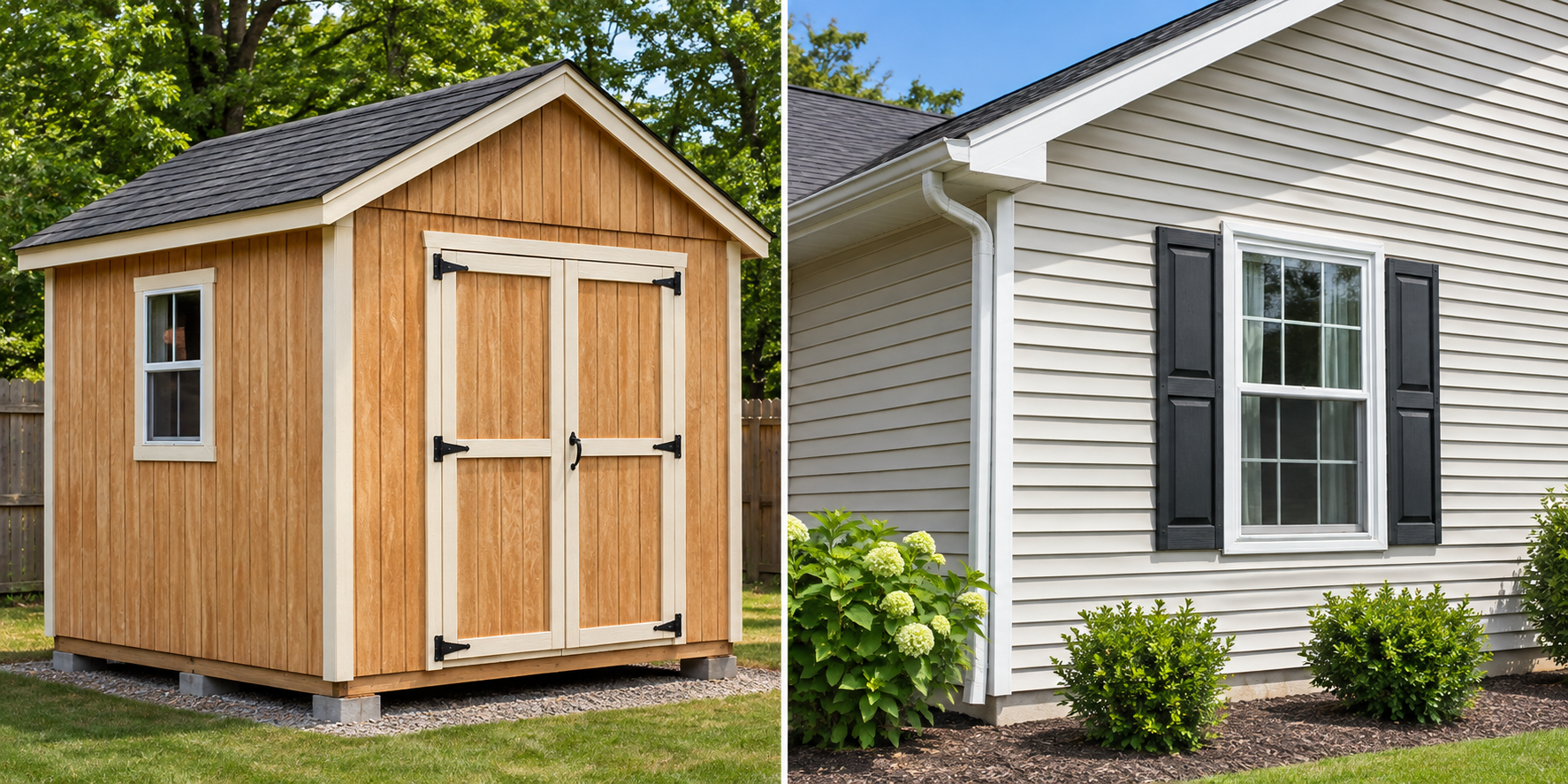
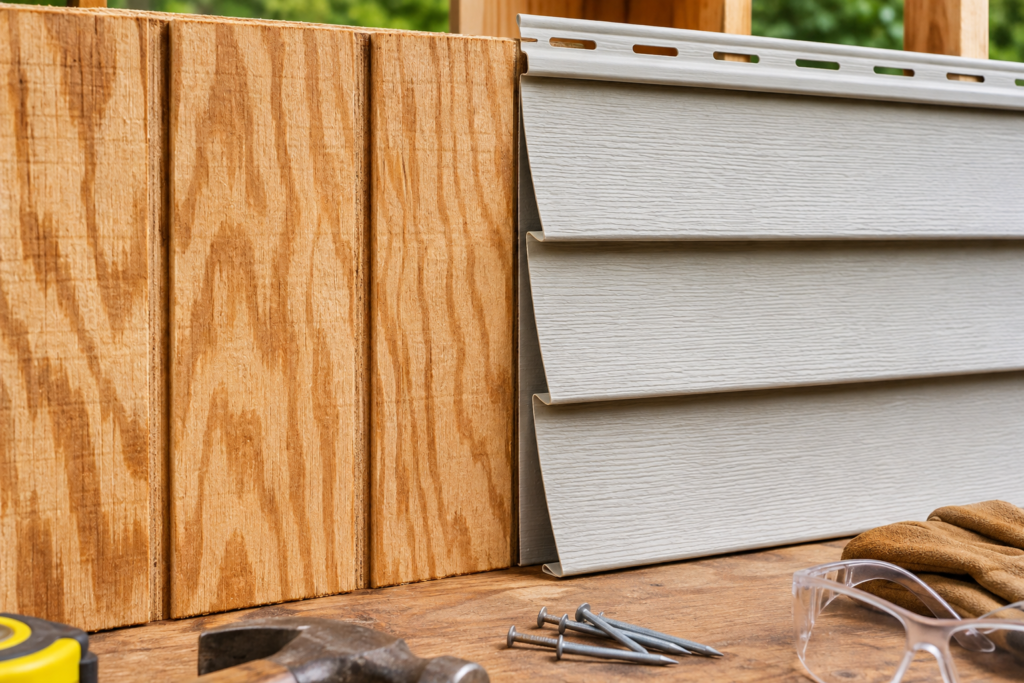
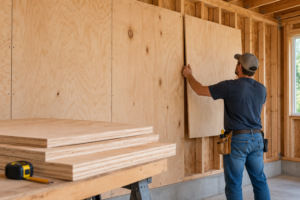
Vinyl siding is the better choice for a house you never want to paint again. It doesn’t rot, it doesn’t need a finish, and it hangs over the backing your walls already have. T1-11 is the better choice for sheds and outbuildings, where rated panels can do the job of both sheathing and siding if they meet an approved bracing method. It’s also an option where sunlight reflected from windows could warp PVC. Below you’ll find a side-by-side chart, a decision table, the install details that change the answer, and the mistakes that cost people a re-side.
Quick Answer
House, low upkeep, sheathing already in place: vinyl siding (look for ASTM D3679 certification).
Shed, barn, budget outbuilding, wood look you can paint or stain: plywood T1-11 with an APA 303 stamp.
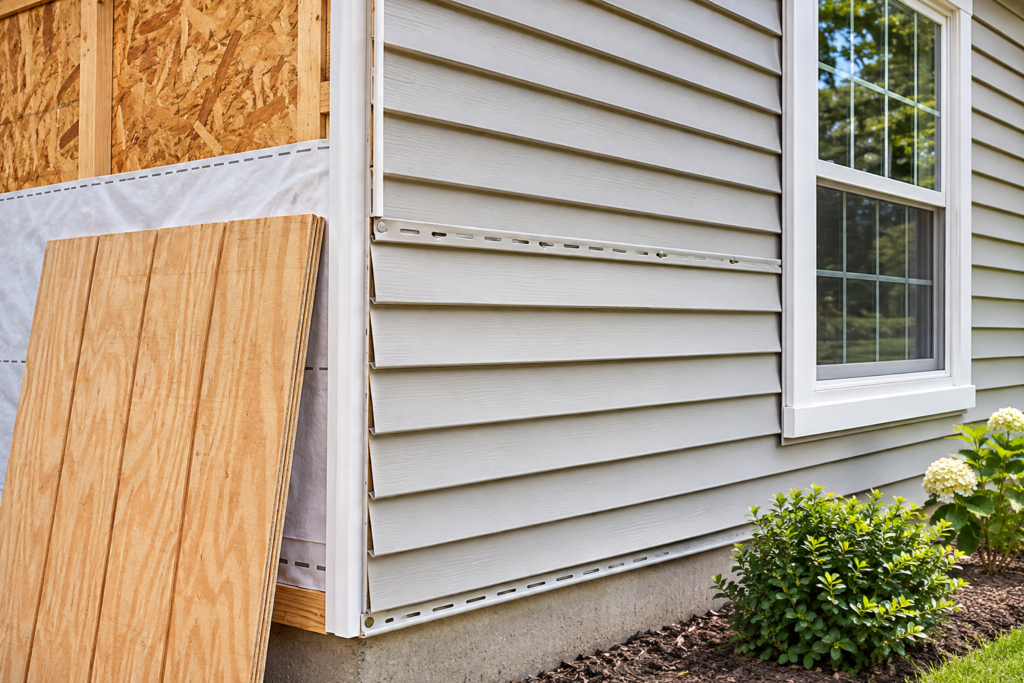
The deciding factor most people miss: vinyl isn’t a sheathing or bracing panel. It hangs loosely over a backing approved by the manufacturer and your local code, and the wall still needs bracing from somewhere. On a bare-stud shed, that usually means paying for backing and bracing on top of the vinyl.
T1-11 vs Vinyl Siding Comparison Chart
Factor
Plywood T1-11 (APA 303 Rated Siding)
Vinyl Siding (ASTM D3679)
Material
Grooved exterior plywood
Rigid PVC
Thickness
11/32″, 15/32″, 19/32″ (manufacturer data)
0.035″ minimum average under ASTM D3679
What goes behind it
Rated panels can go directly on studs
An approved backing per the manufacturer’s instructions and local code. VSI calls for a smooth, flat surface, and wind ratings depend on the backing
Can act as wall bracing
Only when the panel and nailing meet an approved bracing method and local code
No. Bracing has to come from the wall assembly
Water-resistive barrier
Where your code and wall assembly require it
VSI’s installation manual calls for one
Fastening
Nailed tight per the panel’s schedule
Hung loose: nails centered in the slots with about 1/32″ left under the head
Movement
Small seasonal swelling and shrinking
Can move 1/2″ or more over a 12’6″ panel with temperature changes
Heat
Combustible wood. Doesn’t soften like PVC, but needs clearance from heat sources
VSI says normal grades can begin to soften at 160–165°F
Rot and insects
Wood can decay if water gets in
The panel doesn’t rot. The wall behind it still can
Finish
Paint or stain, renewed over time
No paint needed. Color is through the panel
Impact
Dents and gouges. Resistance varies with panel thickness
Can crack on impact. Results vary with formulation, thickness and temperature
Sources: ASTM D3679; Vinyl Siding Institute (VSI) installation manual and quick tips; APA Rated Siding guidance; NAHB report on reflected sunlight damage.
The Decision Chart: Which Siding Fits Your Project
Your situation
Use
Why
Re-siding a house that already has sheathing and a WRB
Vinyl
The backing is already there, and you’ll never repaint
Shed on bare studs, panels can meet an approved bracing method
T1-11
One layer can do both sheathing and siding
Neighbor’s low-E windows face the wall
A non-PVC siding such as T1-11, or shade the window
Reflected sunlight can soften vinyl. It has occasionally discolored wood too
Grill, smoker or fire pit near the wall
Neither without adequate clearance
Move the heat source or use an appropriately rated wall assembly
You won’t paint on a schedule
Vinyl
T1-11 fails at neglected paint first, especially the bottom edges
You want a stained wood look or to change colors later
T1-11
Vinyl’s color is set when you buy it
Workshop or barn where things bump the walls
Compare the specific products
Impact resistance depends on T1-11 thickness and on vinyl formulation, thickness and temperature
What Changes the Answer
Backing and bracing: where the real cost difference hides
💸 Cost difference: Comparing the price of one sheet against a box of vinyl misses most of the cost. Compare the whole wall:
T1-11 wall: T1-11 panels (rated and nailed to meet an approved bracing method) + water-resistive barrier where your code and wall assembly require it + Z-flashing at horizontal joints + edge sealing, primer and paint
Vinyl wall: backing and wall bracing approved by the vinyl manufacturer and your local code + water-resistive barrier + vinyl panels + starter strip, J-channel and corner posts + corrosion-resistant fasteners
On a house that already has sheathing, the vinyl list shrinks to panels, trim and a WRB, and vinyl gets competitive. On a 10×12 shed with 8′ walls, that’s 352 sq ft of gross wall. If the studs are bare, vinyl usually means adding an approved backing and bracing for all of it before any siding goes up. Price both full lists at your local yard. Prices change too fast to print here.
Vinyl has to move, so install it loose
VSI’s instructions say to center fasteners in the nail slots, drive them so about 1/32″ (the thickness of a dime) is left under the head, and get at least 1-1/4″ of penetration into nailable material. Leave a 1/4″ gap at corner posts and channels, and 3/8″ when installing below 40°F. A vinyl wall nailed tight like T1-11 buckles the first hot afternoon.
T1-11 has to stay dry, so seal it
Plywood takes on water fastest through its edges and ends. Georgia-Pacific’s Plytanium instructions call for coating panel edges, and APA’s finishing guide names an all-acrylic latex primer and topcoat as the best protection for wood siding. Read the span rating on the back stamp before you frame: 16 oc panels go directly on studs at 16″ centers, and 24 oc panels on 24″ centers. The span rating sets stud spacing. It doesn’t establish wall bracing. Our T1-11 siding install guide covers nailing and thickness. Our exterior plywood guide explains why the waterproof glue in exterior plywood doesn’t make the wood itself rot-resistant.
Heat is vinyl’s real weakness
⚠️ Warning: VSI says normal grades of vinyl siding can begin to soften at 160–165°F. An NAHB report notes that sunlight reflected from double-paned low-E windows has been measured above 200°F. The usual result is warped, rippled panels across from a neighbor’s or your own windows. T1-11 doesn’t soften like PVC, but it’s combustible, and the same NAHB report mentions occasional discoloration and charring of wood from reflected sunlight. Neither siding belongs near a grill, smoker or fire pit without the clearance the manufacturer and your local code call for.
Clearance
Clearance to grade, hard surfaces, roofing and heat sources is set by each siding manufacturer’s instructions and your local code. Check both for the exact product you buy instead of relying on a rule of thumb.
Picks: Tools That Make Either Job Go Right
As an Amazon Associate, theplywood.com earns from qualifying purchases.
Vinyl siding saw blade: VSI recommends a vinyl blade, or a fine-tooth blade installed in reverse, for clean cuts.
Nail hole slot punch: extends a slot when a stud doesn’t line up, so the nail stays centered.
Snap lock punch: locks the cut top course under the soffit trim.
Siding zip tool: unlocks panels for repairs without breaking them.
Galvanized roofing nails: corrosion-resistant fasteners for vinyl. Size them for 1-1/4″ penetration.
❌ Mistake 1: Nailing vinyl tight. Tight nails stop the panel from moving, so it ripples or buckles when it warms up. Fixing it means pulling and rehanging courses.
❌ Mistake 2: Hanging vinyl without an approved backing. VSI calls for a smooth, flat surface, and the IRC ties vinyl’s wind ratings to what’s behind it. The wrong backing gives you wavy walls and panels that can blow off in a storm.
❌ Mistake 3: Skipping expansion gaps at corners and channels. Leave no room for movement and the panels pull out of the trim in winter or bow out in summer. Leave 1/4″ in normal weather and 3/8″ below 40°F.
❌ Mistake 4: Putting vinyl across from low-E windows. The warped panels have to be replaced, and if the reflection isn’t blocked, the new panels can warp again.
❌ Mistake 5: Leaving T1-11 edges unsealed. Water soaks into the end grain, the plies swell, and the bottom of the wall rots first. Fixing it means cutting out and patching panels.
❌ Mistake 6: Treating a T1-11 span rating as proof of bracing. A 16 oc stamp sets stud spacing, not shear strength. If the panels and nailing don’t match an approved bracing method, expect an inspection problem or sheathing added later.
When Not to Use Each One
⚠️ Skip vinyl if: the walls have no approved backing and you aren’t adding one, a low-E window points reflected sun at the wall, or you want a stained wood finish. If the wall takes frequent hard impacts, check the specific product’s impact rating before you choose.
⚠️ Skip T1-11 if: you won’t keep it painted, the wall takes heavy weather with no roof overhang, or you’re re-siding a house whose sheathing is already in good shape, where T1-11’s main advantage goes away.
⚠️ Skip both near a grill, smoker or fire pit unless you have the clearance the manufacturer and your local code require. Move the heat source or use an appropriately rated wall assembly.
Frequently Asked Questions
Is vinyl siding better than T1-11 for a house? For upkeep, usually. Vinyl never needs paint, and the panel itself doesn’t rot. T1-11 can last on a house, but only with regular paint and edge sealing. For heat and impact, the answer depends on the products. Vinyl can soften from reflected sunlight. Impact resistance varies with T1-11 thickness and with vinyl formulation, thickness and temperature.
Can you put vinyl siding over T1-11? Often, if the T1-11 is sound and flat and the vinyl manufacturer and local code accept it as a backing. VSI calls for a smooth, flat surface, and fasteners need 1-1/4″ of penetration into nailable material. Rotted or delaminated T1-11 has to be repaired or replaced first.
Is T1-11 cheaper than vinyl siding? On a shed with bare studs, usually yes overall, because rated T1-11 can serve as the sheathing and bracing while vinyl can’t. On a house that already has sheathing, the gap narrows. Price both full wall lists locally rather than comparing panel prices.
Does vinyl siding need sheathing? It needs a backing approved by the vinyl manufacturer and your local code, and the wall needs bracing from the assembly behind it. VSI calls for a surface that’s smooth and flat. The IRC ties vinyl’s wind ratings to the backing, and vinyl over foam sheathing needs a wind rating for that setup.
Why does vinyl siding melt? VSI says normal grades can start to soften at 160–165°F. Sunlight reflected from double-paned low-E windows has been measured above 200°F. Grills or fire pits too close to the wall can also damage it, and wood siding isn’t safe near those either without proper clearance.
Can you put vinyl siding on a shed? Yes, over an approved backing with bracing in the wall assembly, using the same nailing and gap rules as a house. On a small shed, that extra backing is often what makes T1-11 the cheaper choice.
Bottom Line
Use vinyl on a house with sound sheathing where you never want to paint again, as long as no low-E window is aimed at the wall. Use T1-11 on sheds and outbuildings where the panels can meet an approved bracing method. Whichever you choose, keep heat sources at the clearance the manufacturer and your code require. For a tougher low-upkeep option for houses, compare T1-11 vs fiber cement siding. For outbuilding framing and panels, see our best plywood for sheds guide.
Related Posts:
T1-11 vs Fiber Cement Siding: Which One to Use by Admin November 16, 2026 DIY Fiber cement siding is the better choice for a house wall you want to paint and mostly leave alone. It doesn’t burn, insects don’t eat…
Best Plywood for Built-In Bookshelves: Which One to Use by Admin October 30, 2026 DIY The best plywood for built-in bookshelves depends on the finish. For painted built-ins, use 3/4" birch or maple hardwood plywood with a B-grade face or better.…