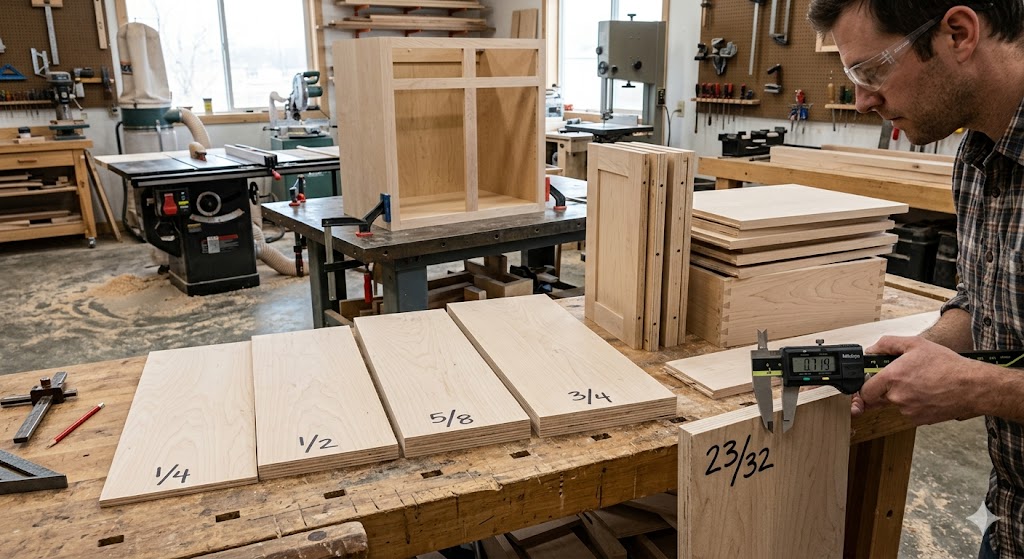
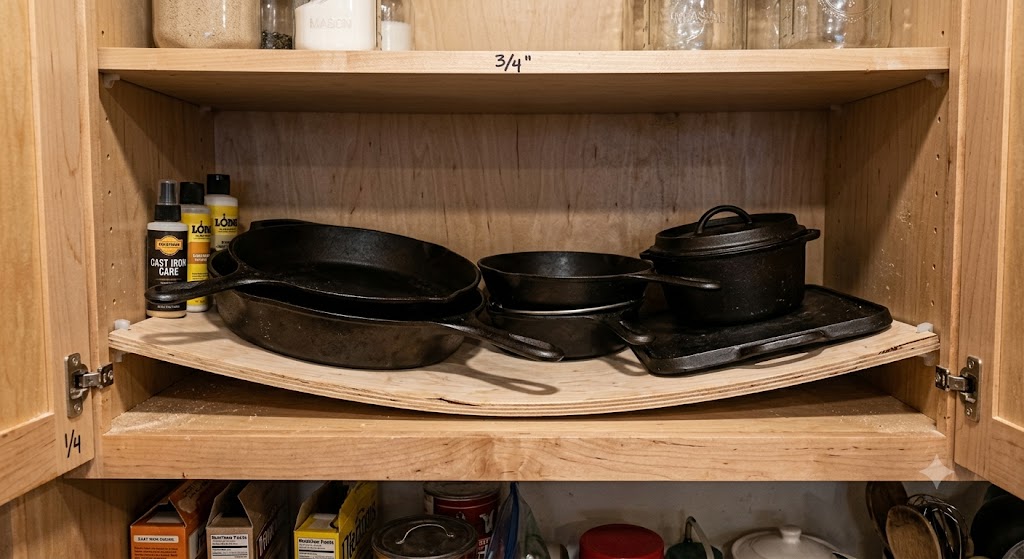
When I tackled my first major kitchen remodel, I thought I’d save a few bucks by picking up whatever standard plywood sheets looked decent at the home center. Big mistake. 💸 Within six months, my beautifully painted cabinet bottoms began to sag under the weight of my cast-iron skillets.
Choosing the wrong plywood thickness is the single biggest source of regret for DIY cabinet builders. Go too thin, and your shelves will bow. Go too thick, and you are wasting money, adding unnecessary weight, and making your installation a nightmare.
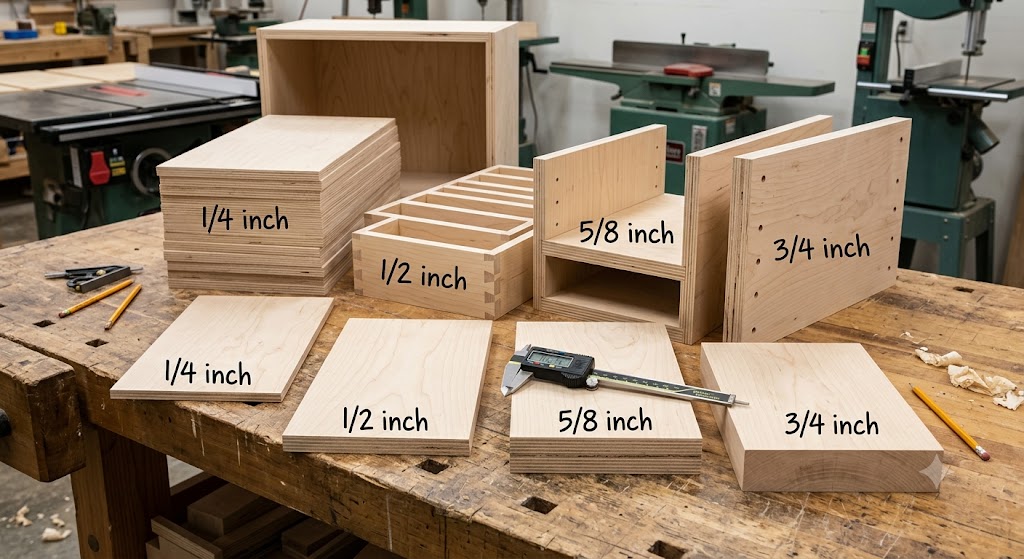
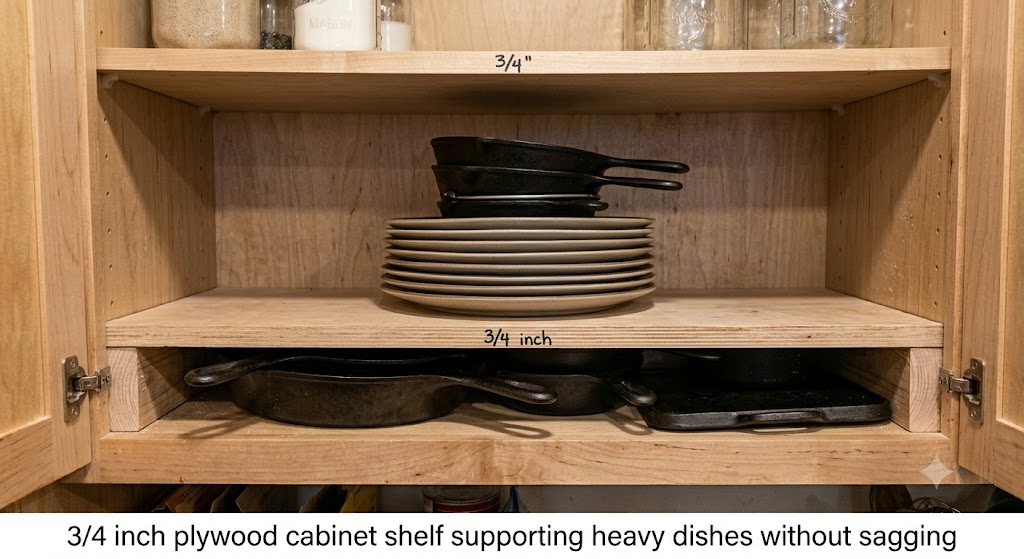
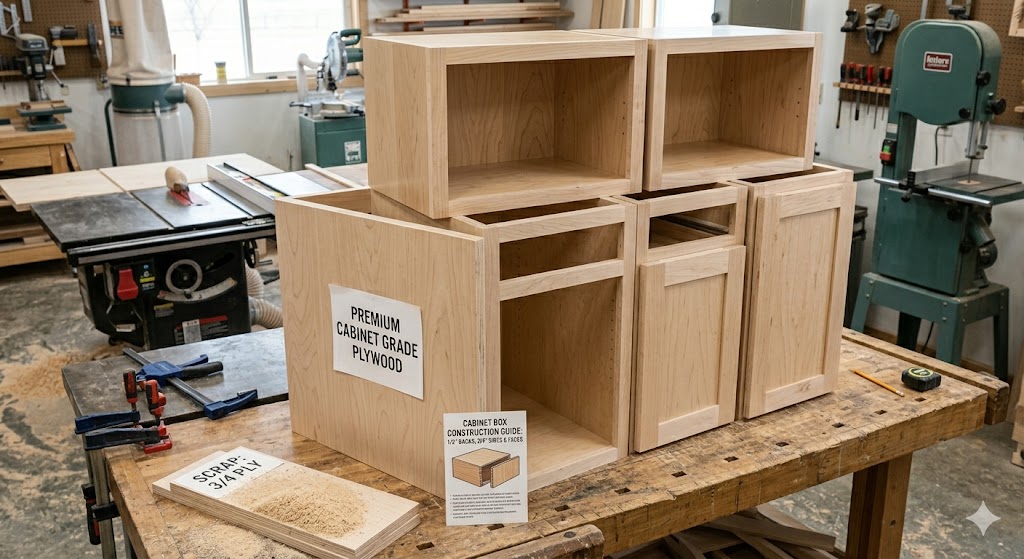
What is the best plywood thickness for cabinets? The best plywood thickness for cabinets is 3/4-inch plywood for cabinet sides, tops, bottoms, and shelves. Cabinet backs are commonly 1/2-inch, while drawer boxes are usually built from 1/2-inch or 5/8-inch plywood.
Before we dive into the nitty-gritty, here is a quick-reference breakdown based on years of shop experience and real-world testing.
📊 Quick Comparison: Plywood Thickness by Cabinet Component
Cabinet Part
Recommended Thickness
Alternative Option
Why It Matters
Cabinet Sides / Carcass
3/4″ (19mm)
5/8″ (16mm)
Provides structural integrity and holds pocket screws tightly.
Shelves
3/4″ (19mm)
1/2″ (12mm) with support
Crucial to prevent bowing under heavy dishes or pantry items.
Cabinet Backs
1/2″ (12mm)
1/4″ (6mm) with hanging strips
1/2″ allows you to screw directly through the back into wall studs.
Drawer Boxes
5/8″ (16mm)
1/2″ (12mm)
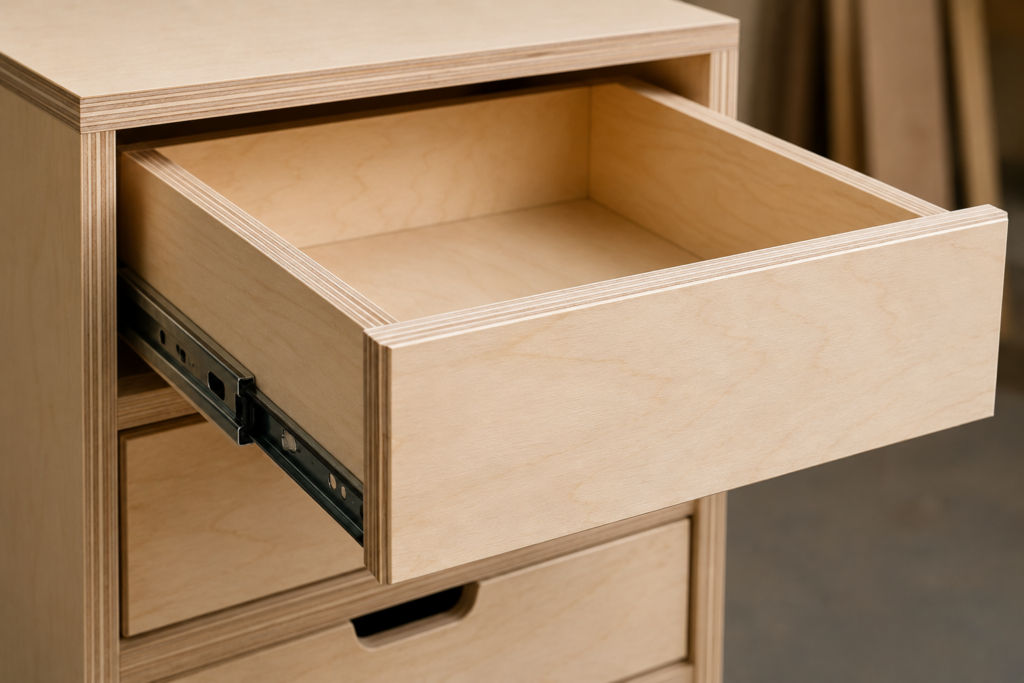
5/8″ is ideal for undermount drawer slides; 1/2″ works for lighter loads.
Drawer Bottoms
1/4″ (6mm)
1/2″ (12mm) for wide drawers
Slides easily into grooves; upgrade to 1/2″ for wide pots-and-pans drawers.
Toe Kicks & Trim
1/4″ (6mm)
3/4″ (19mm) rip cuts
Thinner plywood easily skins over the rough framing lumber underneath.
📋 Cabinet Thickness Cheat Sheet by Cabinet Type
Different environments demand different load capacities. While a light-duty display cabinet can occasionally squeeze by with thinner materials, hard-working storage units require maximum structural integrity.
Cabinet Type
Recommended Thickness
Kitchen Base Cabinets
3/4″
Wall Cabinets
3/4″
Pantry Cabinets
3/4″
Garage Cabinets
3/4″
Bathroom Vanities
3/4″
Shop Cabinets
3/4″
Drawer Boxes
1/2″–5/8″
Cabinet Backs
1/2″
Why Heavy-Duty Applications Benefit from Thicker Material
Pantry Cabinets: Pantries are notorious for concentrated weight. Stacking dozens of dense canned goods, bags of flour, and small appliances on a shelf creates immense localized pressure. A 3/4-inch thickness prevents the permanent downward deflection (creeping) that occurs when shelves are left under heavy loads for years.
Kitchen Base Cabinets: These units don’t just hold your pots and pans—they must also bear the permanent dead load of heavy stone countertops such as quartz, granite, or concrete. Using 3/4-inch plywood for the sidewalls ensures that vertical compression forces are safely transferred down to the floor without the risk of the carcass racking or buckling.
Garage & Shop Cabinets: Garage storage routinely holds heavy mechanical tools, fluid bottles, and hardware. Beyond weight, garage environments experience significant seasonal shifts in humidity. Thicker 3/4-inch panels offer the structural mass needed to resist twisting and warping when moisture levels change.
⚠️ Warning: The “Nominal vs. Actual” Plywood Trap
Here is a quick warning before you head to the lumberyard: Plywood is almost never the thickness it claims to be.
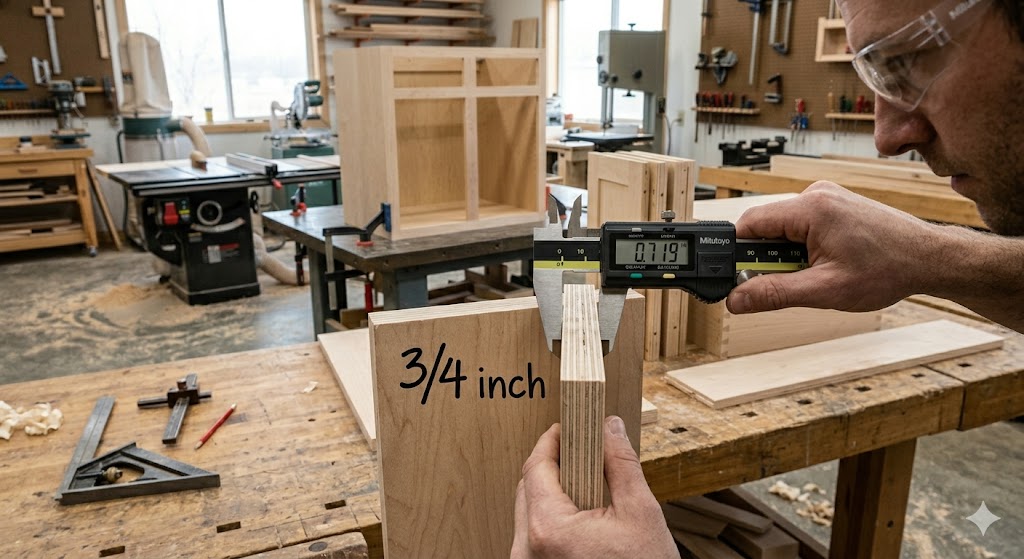
A sheet labeled 3/4″ is actually nominal. If you run a digital caliper over it, you’ll find it’s usually closer to 23/32″ or 18mm.
🧪 The Real Test: If you cut your dadoes and grooves to an exact 3/4″ on your table saw, your joints will be sloppy and weak. Always use a dedicated plywood router bit set or test your cuts on a scrap piece of your actual sheet before assembling the cabinet box.
If you’re planning a full kitchen layout or upgrading utility areas, check out our comprehensive guide to cabinet dimensions for standard kitchen layouts to ensure your carcass sizing matches standard appliance openings perfectly.
The Breakdown: Why Each Part Needs a Specific Thickness
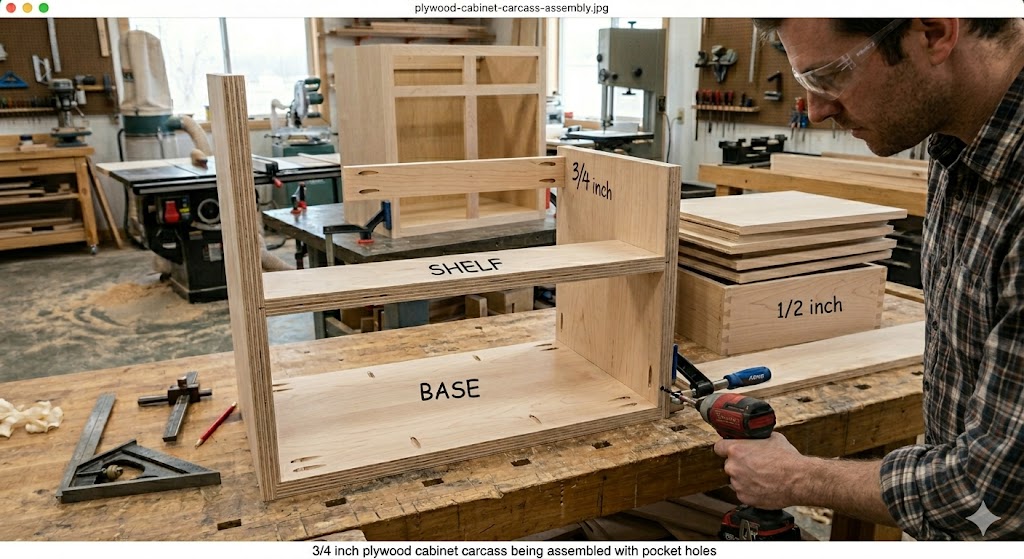
1. Cabinet Sides, Tops, and Bottoms (The Carcass): 3/4″ Plywood
The carcass is the backbone of your cabinet. It has to support heavy countertops (like granite or quartz), withstand the tension of door hinges, and stay perfectly square.
Why 3/4″ wins: It gives you plenty of meat for pocket holes, dados, or biscuits. Trying to screw into the edge of 1/2″ plywood is an exercise in frustration and split plies.
The Cost Difference: While a sheet of 3/4″ ACX or hardwood plywood costs more upfront than a sheet of 1/2″, the additional rigidity helps prevent sagging, racking, and joint failure over time.
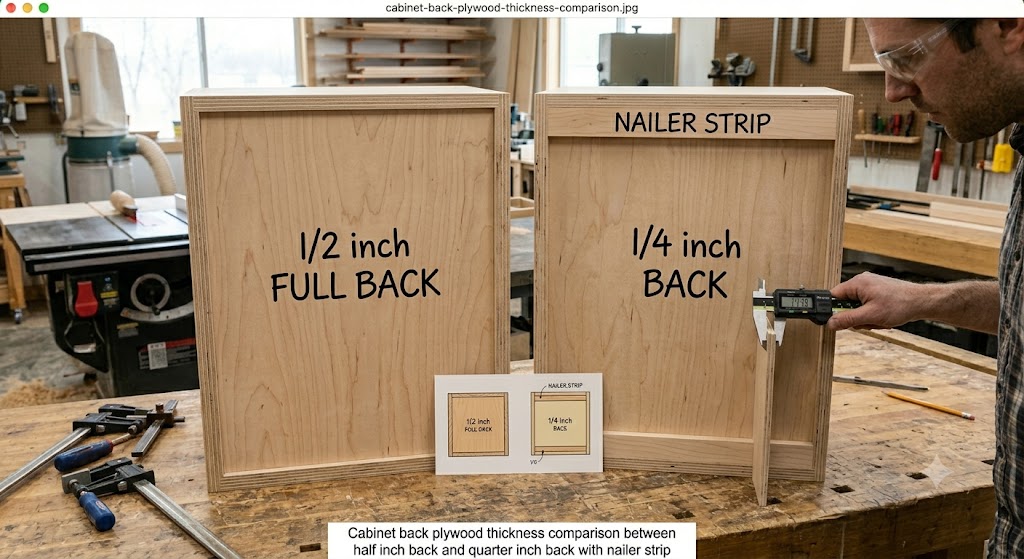
2. Cabinet Backs: 1/2″ vs. 1/4″
This is where opinions diverge among woodworkers.
The 1/4″ Method: Commercial cabinets often use 1/4″ backs to save money. However, they require a 3/4″ thick “hanging rail” (or nailer strip) at the top and bottom so the cabinet can actually be screwed into the wall studs.
The 1/2″ Method (My Choice): I prefer using 1/2″ plywood for the entire back panel. It instantly squares up the cabinet box, eliminates the need for individual nailer strips, and allows you to drive an installation screw anywhere through the back into a stud.
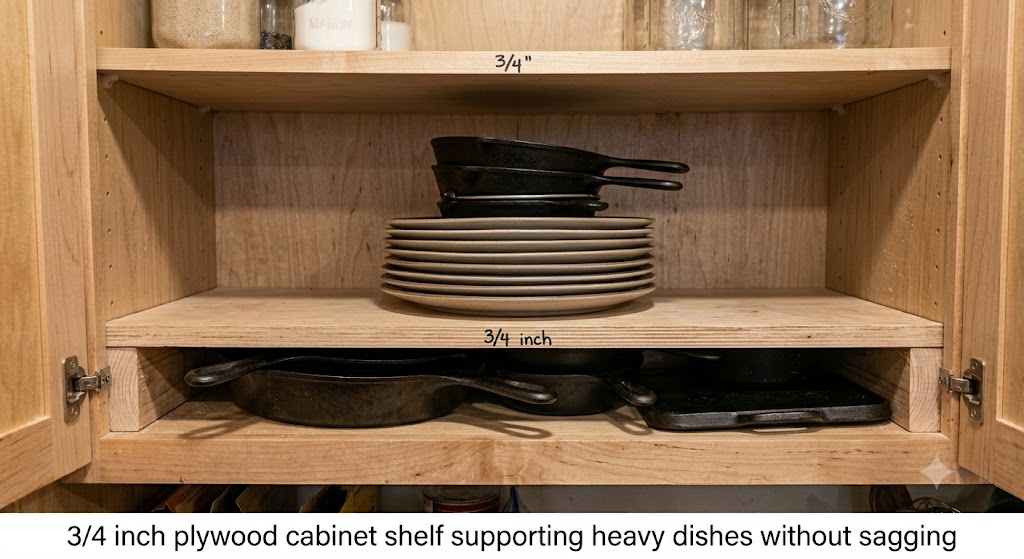
3. Shelves: Always Default to 3/4″
Never use 1/2″ plywood for a shelf spanning more than 24 inches without a solid wood face frame or support cleat. Over time, gravity always wins. For spans wider than 30 inches, consider a hardwood edge band or support cleat to further reduce sagging. If you are building adjustable shelves, 3/4″ Baltic birch or maple plywood ensures your shelves stay flat, even when loaded with heavy ceramic plates.
🪵 Best Plywood Type for Cabinets
Choosing the right thickness is only half the battle; the core and veneer type dictate how well your cabinets will hold up over time.
Baltic Birch: widely considered one of the best plywood options for cabinet construction. Unlike standard plywood, Baltic Birch features void-free inner plies constructed from multiple uniform birch plies. It offers unmatched screw-holding power and crisp, exposed edges that look great when finished.
Maple Plywood: Boasts a dense hardwood veneer over a stable core. It is the premier choice for custom, high-end kitchen interiors because its light, uniform color looks exceptionally clean under a clear coat.
Birch Plywood: A more budget-friendly alternative to Baltic Birch, standard domestic or imported birch plywood offers a smooth surface that takes paint or stain beautifully.
MDF-Core Plywood: This option features a wood veneer layered over a medium-density fiberboard core. It is incredibly flat and completely lacks natural grain defects, making it highly prized for large, modern slab-style cabinet doors that must never warp.
When evaluating the best material for cabinets, the choice often comes down to MDF (Medium-Density Fiberboard) vs. plywood. Both are staples in modern cabinet shops, but they handle weight, hardware, and finishes in completely different ways.
Weight Differences: MDF is substantially heavier than standard hardwood plywood. A full 4×8 sheet of 3/4-inch MDF weighs around 90 pounds, whereas an equivalent sheet of maple plywood weighs closer to 60–70 pounds. This added weight makes MDF significantly tougher to handle for solo DIYers and places significant strain on wall cabinet mounting points.
Screw Holding: Plywood wins comfortably here. The alternating, cross-laminated layers of wood grain lock fasteners tightly into place. MDF is comprised of compressed wood fibers and glue; if you over-tighten a screw or apply lateral stress to a hinge, the core can strip out or crumble far more easily than plywood.
Moisture Resistance: Standard MDF behaves like a sponge when exposed to direct water, swelling and permanently losing its structural integrity. Plywood will handle occasional moisture drops much better without immediate thickness deformation, making it the safer option for bathroom vanities and kitchen sink bases.
Painted Finishes: If you are chasing a dead-flat, glass-smooth finish on a painted cabinet door, MDF is superior. It lacks any natural grain pattern, meaning you don’t have to worry about grain telegraphing or wood pores showing through your paint coat.
Cost Comparison: MDF is cheaper than premium cabinet-grade plywood, often saving you $20 to $40 per sheet. For this reason, many hybrid builds use plywood for the cabinet boxes and MDF for the painted door fronts.
🤔 Is 5/8-Inch Plywood Good for Cabinets?
You will frequently spot 5/8-inch plywood at commercial suppliers, which leaves many builders wondering if it is an acceptable middle ground between 1/2-inch and 3/4-inch stock.
The short answer is yes: 5/8-inch plywood is completely acceptable for cabinet carcasses. In fact, it is common in high-volume commercial shops seeking to reduce shipping weight and material costs for large-scale multi-family housing projects.
However, 5/8-inch material is not ideal for large, wide shelves. If your shelf span exceeds 28 inches, 5/8-inch plywood will sag noticeably under normal household storage loads unless reinforced with a solid wood face strip. Furthermore, 5/8-inch panels are much less forgiving for DIY joinery. The thinner edge reduces your target zone when drilling pocket holes, meaning a minor alignment error can easily cause your pocket screw to blow out through the face of your finished cabinet panel.
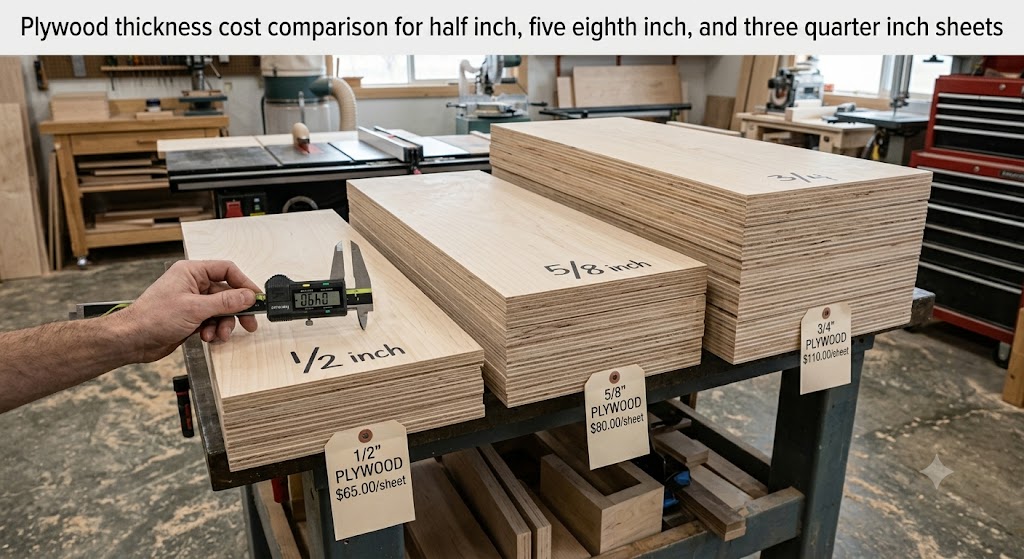
Plywood pricing scales sharply with thickness because more plies require more raw veneer and glue. To put this into perspective, let’s look at the rough cost tiers for a premium material like maple hardwood plywood:
1/2″ Maple Plywood: ~$65 – $75 per sheet
5/8″ Maple Plywood: ~$80 – $90 per sheet
3/4″ Maple Plywood: ~$95 – $115+ per sheet
When scaling these numbers for a complete kitchen remodel that requires 8 to 10 sheets of material, switching to thinner sheets can save you a couple of hundred dollars upfront. However, this is a clear case of cost versus performance. Saving $200 on material thickness is a poor trade-off if it results in racking boxes, doors falling out of alignment because the hinge screws are stripped, or shelves bowing within the first year. For structural safety, spend the extra money on 3/4-inch stock for your main boxes.
🏗️ What Thickness Do Professional Cabinet Shops Use?
If you step inside a high-end custom cabinet shop, you will find that material choices are heavily dictated by whether they construct framed or frameless (European-style) cabinetry.
Frameless Cabinet Shops: These shops rely almost exclusively on 3/4-inch plywood for the entire cabinet box. Because frameless cabinets lack a structural hardwood face frame on the front, the plywood panels themselves must provide 1/4-inch of resistance against twisting, racking, and bowing.
Face-Frame Cabinet Shops: Because a solid 3/4-inch hardwood frame is glued and pocket-screwed to the front of the box, some traditional shops will drop their side panels down to 1/2-inch to save weight. The face frame squares and reinforces the front, while the 1/2-inch sides enclose the box.
CNC Cabinet Shops: Automated production shops utilize precision CNC routers to nest-cut entire sheets at once. These operations overwhelmingly prefer 3/4-inch pre-finished maple or Baltic birch plywood. The 3/4-inch thickness provides the deep edge profile required to machine blind dados, dowel constructions, and confirm clean, repeatable joinery configurations without panel break-outs.
🛠️ Essential Tools for Cabinet Building & Finishing
To achieve a professional, high-end look without the premium custom shop price tag, having the right gear makes all the difference:
If you are looking to save on material costs, consider a hybrid material strategy. Use premium hardwood plywood only for the visible end panels, face frames, and doors. For the inner divider partitions or cabinet bottoms that are hidden by drawers and toe kicks, opt for lower-grade, budget-friendly shop plywood instead.
If you want a truly unique, rustic-modern vibe for your cabinet doors, you can even explore charring techniques. Check out our guide on treating and sealing Shou Sugi Ban panels to learn how to properly apply this beautiful finish for interior use.
🛑 Common Cabinet Thickness Mistakes
Even seasoned DIYers can fall into predictable traps when purchasing and cutting materials. Keep an eye out for these frequent slip-ups before you begin your build:
Using 1/2″ plywood for long shelves: It can be tempting to buy a single thickness for an entire project, but for wide spans, 1/2″ plywood will result in unsightly bowing under standard household loads. Stick to 3/4″ unless your shelves are exceptionally narrow.
Using 1/4″ backs without nailer strips: If you opt for thin 1/4″ material to close up the back of your cabinets, you cannot screw directly through it to hang the unit. Forgetting to install a solid wood or 3/4″ plywood hanging rail at the top and bottom means your cabinet will pull away from the wall.
Assuming 3/4″ plywood is actually 3/4″: Relying on nominal numbers instead of measuring the actual thickness with calipers will throw off your entire cut list. Your interlocking joints will end up either too loose to hold glue or too tight to slide together.
Buying MDF-core for garage cabinets exposed to moisture: While MDF-core plywood stays perfectly flat in climate-controlled spaces, it behaves like a sponge in humid or damp environments. For workshop or garage storage where seasonal dampness is a factor, stick to a stable, veneer-core exterior or marine-grade plywood instead.
For most cabinet projects, 3/4-inch plywood remains the safest and most versatile choice. While thinner materials can save money upfront, the long-term cost of sagging shelves, weak joinery, and eventual cabinet failure usually outweighs those initial savings.
❓ FAQ
Is 1/2-inch plywood strong enough for cabinets?
While 1/2-inch plywood is strong enough for cabinet backs or small, lightly loaded drawer boxes, it is generally not robust enough for cabinet sides, tops, or bottoms. Using 1/2-inch plywood for structural parts often results in split edges during pocket-hole joinery and in structural sagging over time.
How much weight can a 3/4-inch plywood shelf hold?
A properly supported 3/4-inch plywood shelf can easily support approximately 50–100 pounds or more over a typical cabinet span. The exact capacity depends on shelf width, depth, plywood quality, and whether a face frame or support cleat is used.
What plywood do professional cabinet makers use?
Professional cabinet makers typically use 3/4-inch Baltic Birch, Maple, or Birch cabinet-grade plywood for structural carcasses and shelves. For painted modern slab doors, many pros favor MDF-core plywood due to its flawless flatness and resistance to warping.
Yes, MDF is widely used for cabinet door panels and painted components because it offers an ultra-smooth finish without any wood grain telegraphing. However, plywood is preferred for the main structural boxes because it is lighter, holds mechanical fasteners more securely, and offers superior water resistance.
What is the best plywood thickness for kitchen cabinets?
The best all-around thickness for kitchen cabinet carcasses and shelves is 3/4-inch plywood. Cabinet backs can be stepped down to 1/2-inch, while drawer boxes perform best when constructed from 5/8-inch or 1/2-inch plywood panels.
Marine Grade Plywood: Avoid This Costly Mistake by Admin April 7, 2026 DIY Marine grade plywood is a high-performance plywood made with waterproof phenolic glue, no internal voids, and multiple thin veneer layers. It is designed for high-moisture…