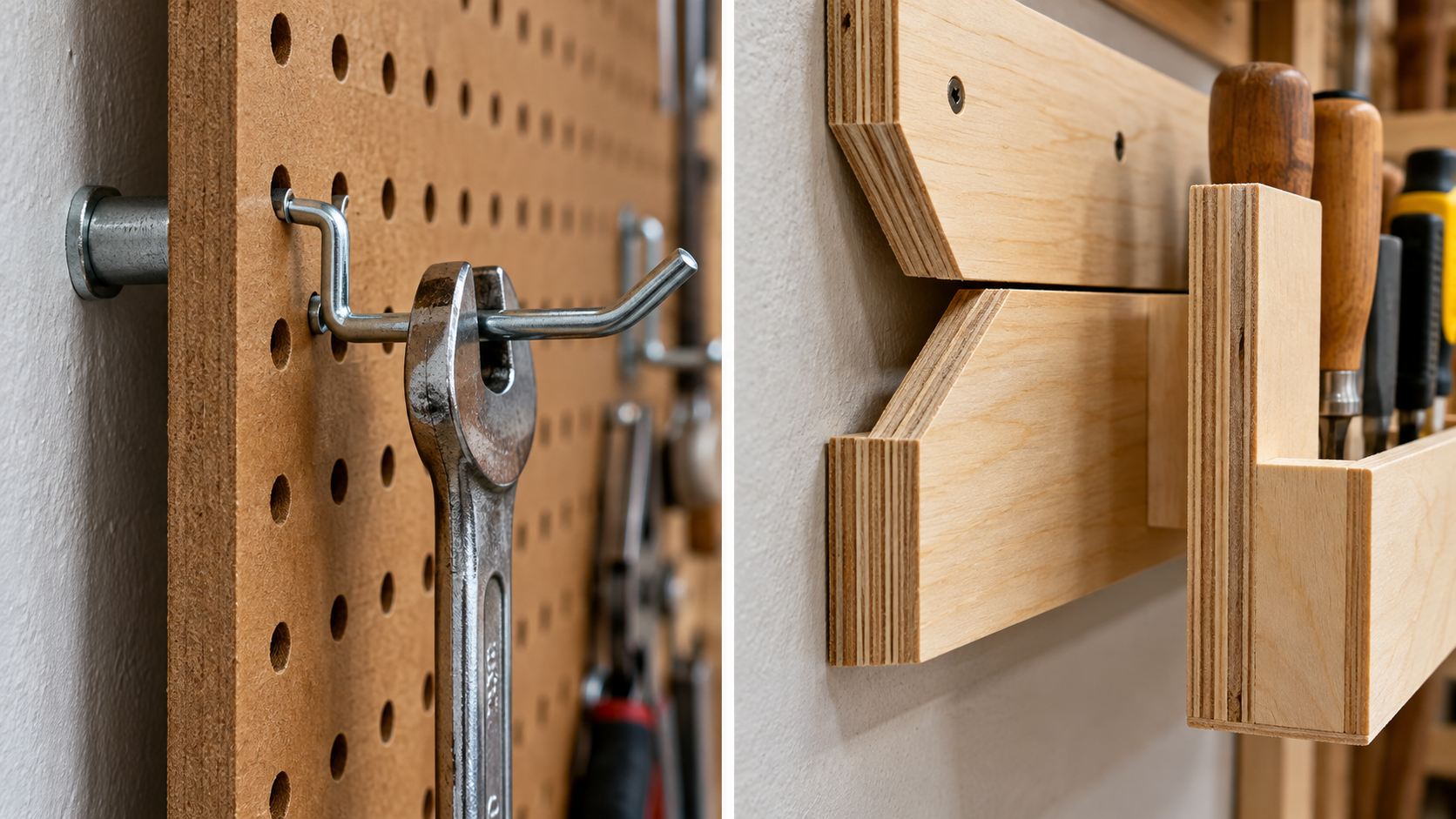
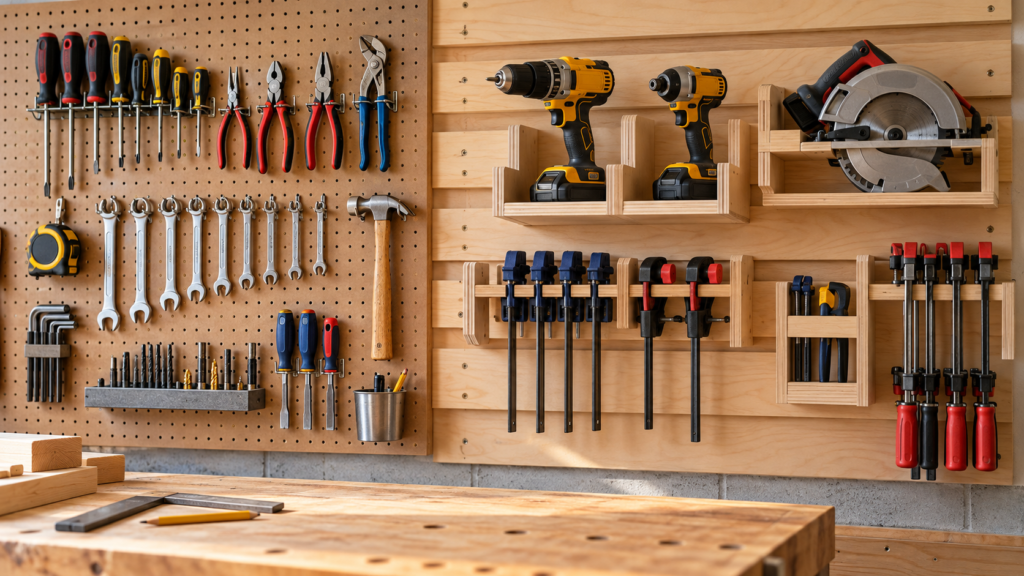
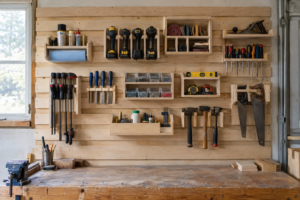
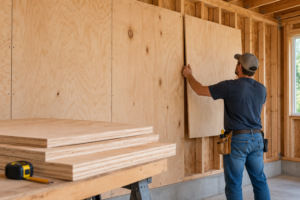
For heavy power tools, or a wall you’ll keep rearranging for years, build a French cleat wall. For light hand tools on a small budget, when you want it up in an afternoon, use pegboard.
The real difference is how each one fails. Pegboard hooks work loose and pop out when you grab a tool. A French cleat holder only comes down if you lift it straight up. And for many shops, the best answer is both: a pegboard panel hung on French cleats.
Quick Answer
Choose pegboard if you’re hanging light hand tools (wrenches, screwdrivers, tape measures, pliers), want the fastest and cheapest setup, and don’t own a table saw or circular saw.
Choose a French cleat wall if you’re hanging drills, saws, sanders, clamps, or anything heavy, or you want holders you can move without tools.
Choose both if you have a mix: cleats for the heavy tools and a pegboard panel on a cleat for small items.
French Cleat vs Pegboard: Side-by-Side Chart
Pegboard
French Cleat Wall
Best for
Light hand tools, small parts, crafts
Power tools, clamps, cabinets, heavy bins
What holds the load
Thin wire hooks in hardboard holes
Beveled plywood strips screwed into studs
Weak point
Hooks shift or pull out; holes wear oval
Screws and wall attachment, not the cleat
Rearranging
Fast, but hooks come loose
Fast, and holders stay put
Material cost
Generally lower (hardboard sheet + hooks)
Generally higher (3/4-inch plywood + screws)
Build time
An afternoon
A weekend or more, including holders
Tools needed
Drill, stud finder, level
Table saw or circular saw, drill, stud finder, level
Holders
Store-bought hooks and bins
Mostly you build them yourself
Damp garages
Hardboard can swell
Plywood handles it better if sealed
Warning: Pegboard hook ratings printed on the package are per hook, under ideal conditions. A 1/8-inch hook in a worn 1/4-inch hole won’t come close to that number.
How Pegboard Works (and Where It Falls Short)
Pegboard is perforated hardboard with holes on 1-inch centers. There are two common types, and they don’t take the same hooks:
Small-hole pegboard: usually 1/8-inch-thick hardboard with 3/16-inch holes. It takes only 1/8-inch hooks.
Large-hole pegboard: usually 1/4-inch-thick hardboard with 1/4-inch holes. It takes both 1/8-inch and 1/4-inch hooks. This is the type to use in a garage or shop.
Although 1/4-inch pegboard can accept smaller hooks, use hooks specifically designed for your board to minimize movement and accidental dislodging.
Pegboard also has to stand off the wall. Hooks need about 1/2 to 3/4 inch of space behind the board to go in and seat properly, so you mount it on furring strips or spacers. If you screw it flat against the wall, hooks won’t fit.
Where pegboard falls short:
Hooks lift out when you pull a tool off, unless you use locking hooks or add hook locks or clips.
Thin hardboard flexes between supports when loaded.
Hooks rub the holes over time and wear them oval, and loose holes hold even worse.
Hardboard can swell and soften in a damp garage or basement.
How a French Cleat Wall Works
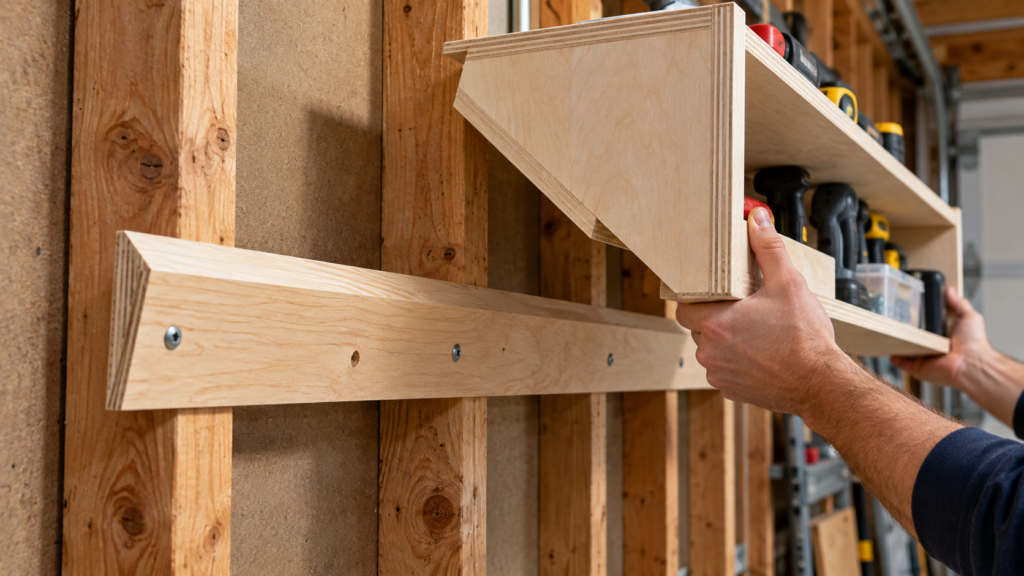
A French cleat is a strip of plywood ripped at 45 degrees. The wall strip is screwed into the studs with the beveled edge pointing up and away from the wall. The matching cleat on the back of each holder points downward, so the two pieces lock together when you set the holder on the wall strip. You can slide the holder sideways or lift it off, but a tug outward won’t pull it loose.
Our step-by-step French cleat wall guide covers strip sizes, spacing, and the build itself. For this decision, two points matter most:
The wall attachment sets the limit. How much a cleat can hold depends on the screws, how many studs it hits, and the wall itself, more than on the plywood strip. Use structural or construction screws into studs. Drywall screws snap under sideways load and aren’t made for this.
Warning: Never assume a French cleat wall can support a particular weight without checking the plywood, fasteners, stud attachment, and holder construction. There is no universal load rating for a French cleat.
Screws in a cleat are loaded sideways. Pull-out numbers for screws don’t tell the whole story here. See plywood screw holding strength for why face screws grip better than edge screws, and drill pilot holes so the cleat strips don’t split.
Where French cleats fall short:
You build most holders yourself, and that’s where most of the time goes.
Cutting accurate bevels takes a table saw, or a circular saw with a good guide.
A loaded cleat wall needs studs. Hanging it on drywall alone isn’t an option for heavy tools.
It uses more wall depth than pegboard, because holders stick out farther.
Cost Difference: Pegboard vs French Cleat
Prices change too fast to list, so check your local store. The relative picture holds, though:
Pegboard: one hardboard sheet, furring strips, screws, and a hook kit. A 4×8 hardboard sheet generally costs less than a sheet of 3/4-inch plywood.
French cleat wall: 3/4-inch plywood for the wall strips, plus more plywood for holders, and construction screws. One sheet of 3/4-inch plywood rips into many cleat strips, but the holders add up.
The math that matters: say pegboard saves you the price of one plywood sheet. If you’re hanging $1,000 of cordless tools, that saving is small next to one drill falling off a hook onto concrete. For light hand tools, the cheaper option makes sense. For heavy, expensive tools, the stronger hold is worth paying for.
Regret check: The most common complaint is building pegboard first, then rebuilding with cleats once the power tools pile up. If you already own several cordless tools, start with cleats.
Which One to Use: Picks by Situation
Mostly hand tools, small shop, tight budget → Pegboard. Use large-hole, 1/4-inch hardboard, locking hooks made for your board, and furring strips into studs.
Power tools and chargers → French cleat wall. Drills, drivers, and batteries are heavy and you grab them often. For a dedicated charging station, see organizing your cordless tools.
Clamps → French cleat wall. A rack of bar clamps gets heavy fast. Cleat-mounted clamp racks handle the weight and move as your collection grows. See the best clamps for plywood if you’re still building that collection.
Mixed shop → Both. Mount a framed pegboard panel on a French cleat. Small tools go on the pegboard, heavy tools go on cleat holders next to it, and the whole panel moves when you rearrange.
No table saw or circular saw → Pegboard, or buy pre-made cleat strips and holders.
Damp garage or basement → French cleat wall with sealed plywood. Hardboard pegboard isn’t the best choice where moisture is high.
This section contains affiliate links. As an Amazon Associate, we earn from qualifying purchases at no extra cost to you.
Top pick for pegboard: Triton DuraHook 36-Piece Hook Assortment (model 76936) This kit fixes pegboard’s biggest problem: hooks lifting out when you grab a tool. Each DuraHook uses a double-locking design, with a locking screw installed from the front of the board, so the hook stays put. The same hooks fit 1/8-inch or 1/4-inch pegboard; you just swap in the matching lock screws from the pack. Hooks can also mount vertically or horizontally. Limitation: Triton lists these for hardboard pegboard, not steel pegboard. If you’re using a metal panel, buy hooks made for that panel. Check the price on Amazon
Also useful:
Pegboard spacers or mounting kit, for the clearance hooks need behind the board. Check the price on Amazon
Circular saw rip guide, for cutting straight 45-degree cleats without a table saw. Check the price on Amazon
Common Mistakes
1. Buying 1/8-inch hooks for 1/4-inch-hole pegboard. Thin hooks wobble in large holes and fall out. Match the hook size to the hole size, or use locking hooks.
2. Mounting pegboard flat against the wall. Hooks can’t go in without clearance behind the board. You’ll end up taking it down and adding furring strips.
3. Putting power tools on pegboard. Hooks pull out and holes wear oval, and a drill on concrete can mean a cracked housing or a ruined battery.
4. Screwing cleats into drywall only. Anchors aren’t a substitute for studs under a loaded cleat wall. The wall attachment is the weak point, so hit the studs.
5. Using drywall screws for cleats. They’re brittle and made for holding drywall, not sideways loads. Use construction or structural screws.
6. Skipping the bottom spacer on cleat holders. Without a spacer at the bottom, holders tilt into the wall and hang crooked. The French cleat guide explains how to add one.
When Not to Use Either
Very heavy items like full cabinets of hardware, a lumber rack, or anything near your body weight. These need a design based on fastener ratings and your wall structure, not a typical tool wall.
Masonry walls need concrete screws or masonry anchors rated for the load. Wood screws won’t work.
Rentals with no-holes rules. Both systems screw into studs. A freestanding rack or rolling cart is the safer choice.
FAQ
Is a French cleat stronger than pegboard? In most shop setups, yes. A cleat strip screwed into several studs spreads the load across the wall, while pegboard relies on thin wire hooks in hardboard holes. But there’s no universal load rating for a French cleat. What it can hold depends on the plywood, fasteners, stud attachment, and how each holder is built.
Can you put pegboard on a French cleat? Yes. Frame a pegboard panel, attach a cleat strip to the back, and hang it on the cleat wall. Small tools go on the pegboard, and the whole panel moves when you rearrange.
Is pegboard cheaper than a French cleat wall? Generally yes. A hardboard pegboard sheet and a hook kit usually cost less than 3/4-inch plywood plus the material for holders. Check local pricing, because both change often.
What size pegboard is best for a garage? Large-hole pegboard: 1/4-inch-thick hardboard with 1/4-inch holes. It’s more rigid than 1/8-inch board. It accepts both hook sizes, but 1/8-inch hooks can sit loosely in the larger holes, so use 1/4-inch or locking hooks made for your board.
Do you need studs for a French cleat wall? For a loaded tool wall, yes. Screw the wall strips into studs with construction screws. Anchors in drywall alone aren’t suitable for heavy tools.
How do you stop pegboard hooks from falling out? Use hooks sized to the holes, add hook locks or clips (or use locking hooks), and replace the board once holes wear oval.
Bottom Line
Pegboard is the quick, low-cost choice for light hand tools. A French cleat wall takes more work up front, but it’s the better long-term choice for power tools, clamps, and anything heavy you grab every day. If your shop has both, hang a pegboard panel on the cleats and get the benefits of each.
How to Build a French Cleat Wall: Complete DIY Guide by Admin September 15, 2026 Installing A French cleat wall is one of the simplest ways to organize tools without locking yourself into a permanent layout. Instead of attaching every shelf, rack and…