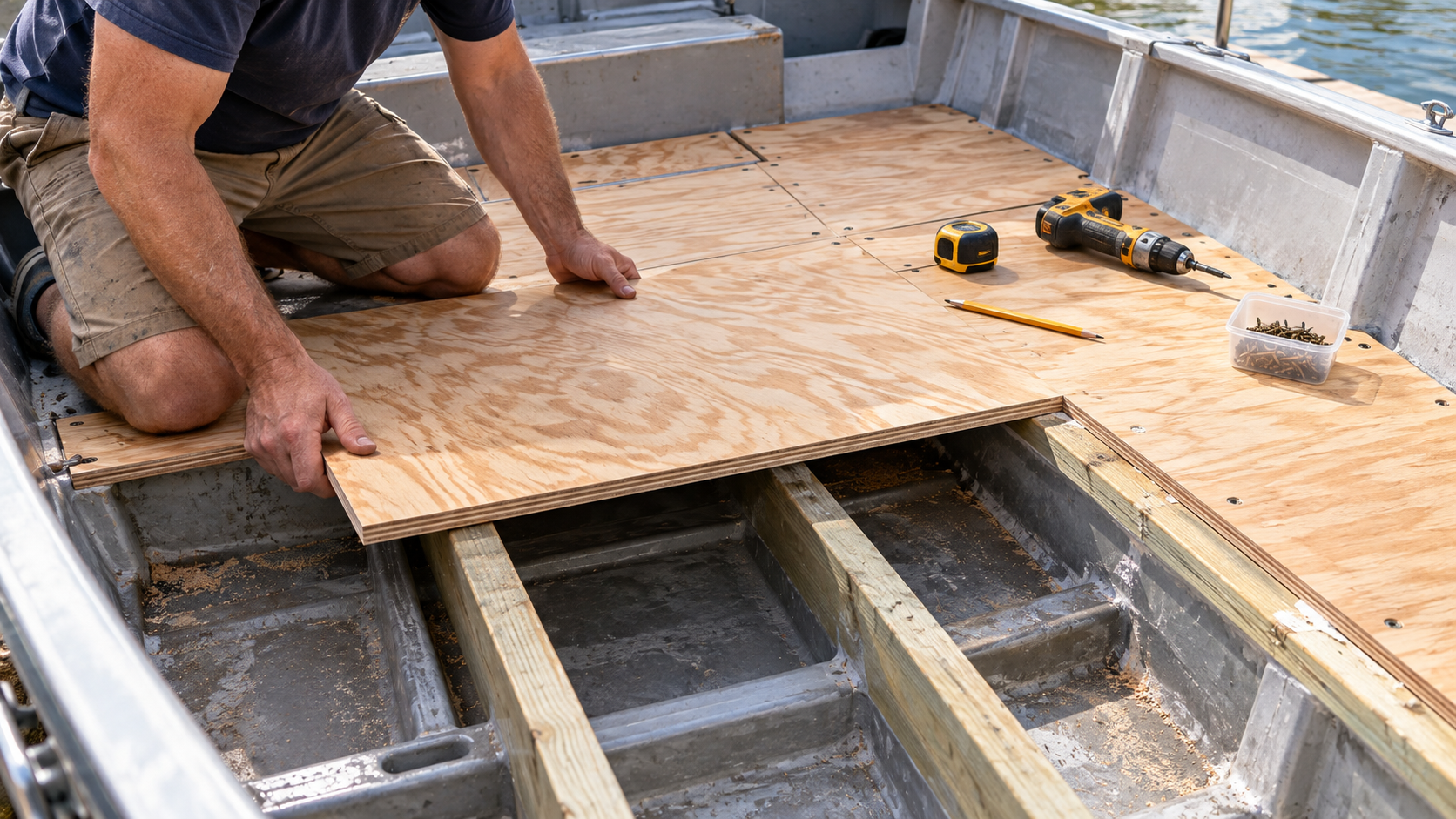
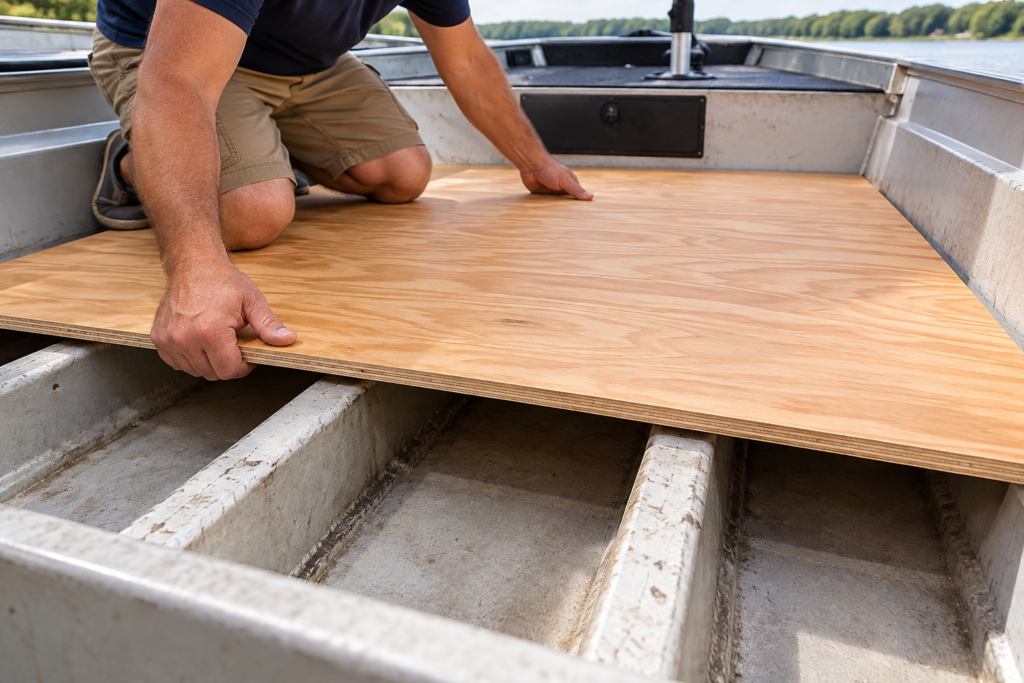
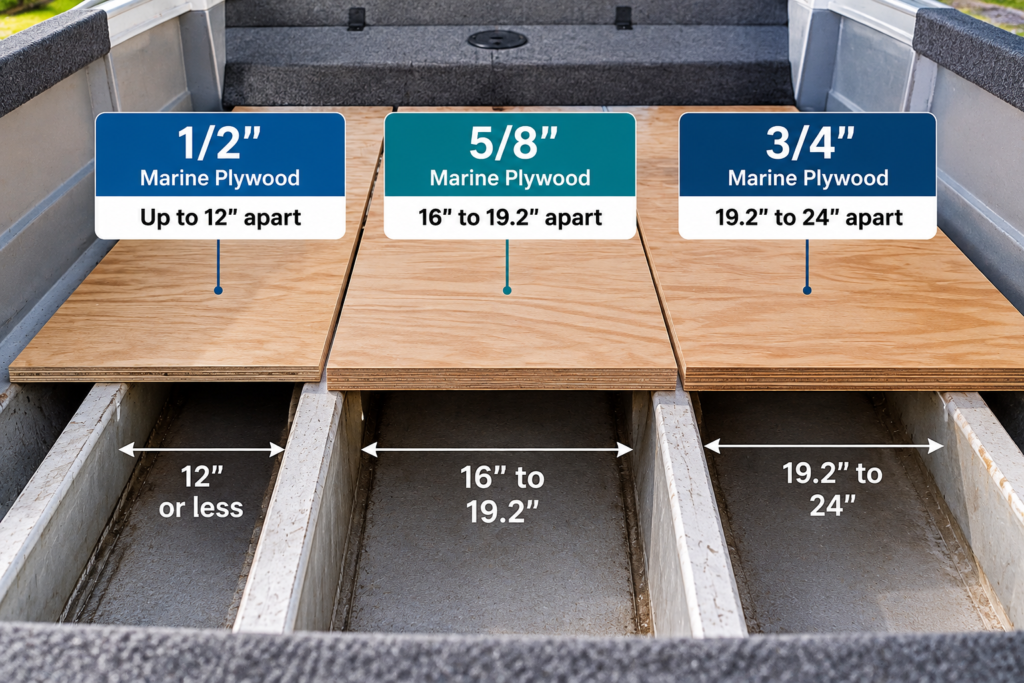
For most marine plywood boat floors, 5/8″ works over supports spaced 16 to 19.2 inches apart, and 3/4″ works over supports up to 24 inches apart. Thicker plywood does not save a floor that sits on rotten stringers or wide gaps. Fix the supports first. This guide covers the thickness chart, which grade to buy, how to seal the panels, and how to install the floor on both fiberglass and aluminum boats.
Measure the distance between stringers or cross supports, center to center. Up to 12 inches: 1/2″ marine plywood. 16 to 19.2 inches: 5/8″. Between 19.2 and 24 inches: 3/4″. Over 24 inches: add a cross support rather than buying thicker plywood. Coat every face and edge in epoxy before installing, and treat every screw hole as a place where water can get in. If your boat’s manufacturer lists a floor thickness, use theirs.
Marine Plywood Thickness Chart for Boat Floors
APA’s Sturd-I-Floor span tables, published in the Engineered Wood Construction Guide (Form E30W), are a useful comparison for how panel thickness relates to support spacing. However, those tables apply to building-floor products, not marine plywood or boat structures. The recommendations below are general starting points, not certified marine span ratings. The thickness you actually need depends on how the panel is built, what loads it carries, any fiberglass on it, how it’s supported, and the boat manufacturer’s specifications.
Support spacing (center to center)
APA building-floor reference (not a marine rating)
Suggested marine plywood
Typical ply count
Notes
12″ or less
Not listed (table starts at 16″)
1/2″
5-ply
Small jon boats and tight-stringer hulls
16″
19/32″
5/8″
6–7 ply
Common runabout layout
19.2″
19/32″
5/8″
6–7 ply
Go to 3/4″ if people stand at the edges to cast
24″
23/32″
3/4″
7-ply
Standard pontoon and center-console range
32″
7/8″
Add a cross support
—
Standard marine panels top out at 3/4″
48″
1-3/32″
Add cross supports
—
Do not span this with plywood alone
APA’s 20 oc designation corresponds to 19.2-inch maximum support spacing, not a full 20 inches.
Ply counts come from Aetna Plywood’s marine-grade data sheet, which lists 1/2″ as 5-ply and 3/4″ as 7-ply. APA lists standard marine thicknesses as 1/4, 3/8, 1/2, 5/8 and 3/4 inch. That is why the chart switches to “add a support” past 24 inches instead of naming a thicker panel. For how each thickness is used in other builds, see our plywood thickness guide.
How to Read the Chart for Your Boat
Measure supports, not the old floor
Measure from the center of one stringer or cross brace to the center of the next. Don’t copy the thickness of the old floor. A factory floor may have been sized for a support layout that has since rotted, sagged or been cut away during repairs.
Spacing between chart rows
If your spacing falls between two rows, use the thicker panel. Stringers 20 or 22 inches apart call for 3/4″, not 5/8″.
Point loads change the answer
APA’s building tables assume weight spread evenly across the floor. A boat floor rarely gets that. Seat pedestals, a trolling battery, a cooler someone stands on, and the spot where you step aboard from the dock all put concentrated weight on one area. If any of these sit between supports, go one thickness up in that area, or add blocking under them.
Weight is a real trade-off
Each step up in thickness adds weight across the whole floor. On a small aluminum or fiberglass boat, that weight sits high in the hull and affects how the boat sits in the water. Our plywood weight chart shows the per-sheet difference. Check the boat’s capacity plate before adding a heavier floor.
Which Marine Plywood Grade to Use for Boat Floors
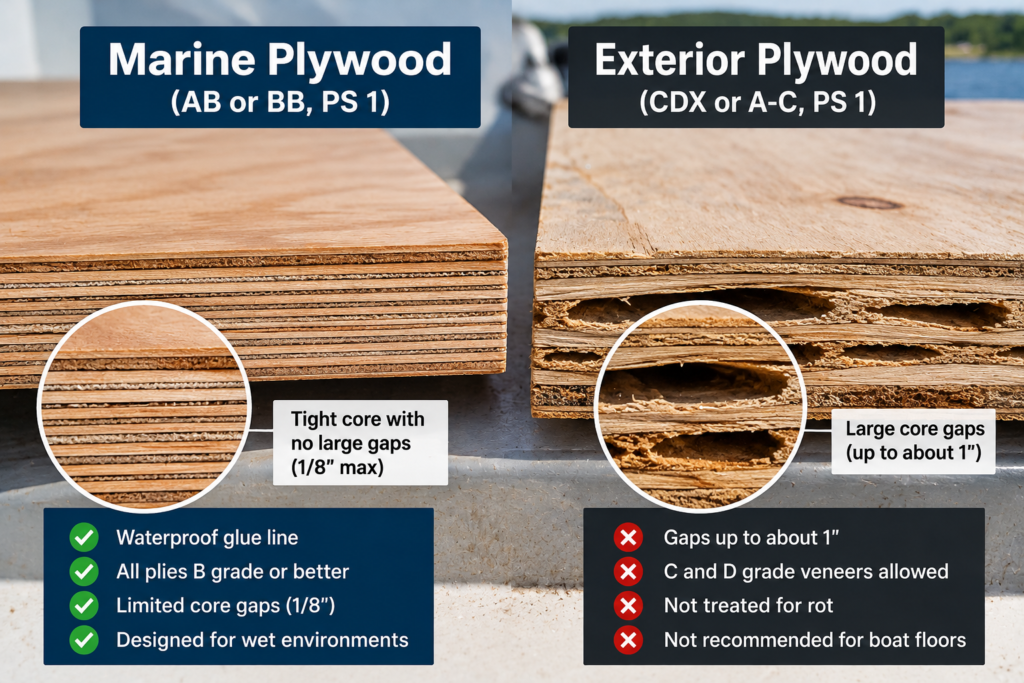
Bond classification and rot resistance are separate things, and both matter here. Marine plywood uses a fully waterproof glue line. Under PS 1, it is not treated with any preservative, so the wood can still rot if water gets in and stays.
Panel
Standard
Inner plies
Core gaps
Rot resistance
Use on a boat floor?
AB Marine
PS 1 (APA)
Douglas fir or western larch, B grade or better
Limited to 1/8″
Not treated; depends on sealing
Good general-purpose option
BB Marine
PS 1 (APA)
Same as AB, B face
Limited to 1/8″
Not treated; depends on sealing
Yes. Fine under carpet or vinyl
BS 1088
British Standard
Tropical hardwood veneers, WBP glue
Gaps in faces not permitted
Species chosen for some fungal resistance
Yes; weight depends on the panel’s species and class
Exterior A-C
PS 1
C-grade veneers allowed
Up to about 1″
Not treated
Only if fully encased, and the core gaps are a risk
Pressure-treated
AWPA treatment
Varies
Varies
Treated
Generally avoid under epoxy or fiberglass (see mistakes below)
CDX
PS 1 (Exposure 1)
C/D veneers
Up to about 1″
Not treated
No
Under PS 1, marine-grade panels are made entirely of Douglas fir or western larch, every ply is B grade or better, and core gaps are limited to 1/8 inch. That is a small gap, not zero. Marine plywood is not void-free. It has fewer and smaller hidden gaps than exterior grades, and that is the reason to pay for it on a floor. Water that reaches a 1″ core gap in exterior plywood has a hidden channel to travel through. A 1/8″ limit gives water far less room to spread.
BS 1088 has two classes: standard and lightweight. Ask which class you’re buying, because the weight and species can vary between panels that carry the same marking.
APA trademarks apply only to panels from APA member mills. A panel labeled “marine” without a grade stamp or a BS 1088 marking is just a label. Our plywood grades guide explains how to read the face and back letters. For a direct comparison of when marine is worth it and when exterior will do, see exterior plywood vs marine plywood.
💸 Cost difference: Marine plywood generally costs well above exterior grades. Check local pricing. As an example, a 16-foot boat floor might need four sheets. If marine costs twice as much per sheet as exterior, the extra cost on the job is four times the price gap per sheet. That is usually less than the cost of tearing out one rotted floor. Our marine plywood cost guide covers what changes the price.
How to Seal Marine Plywood for a Boat Floor
Waterproof glue keeps the plies from separating. It does not keep water out of the wood. The seal does that.
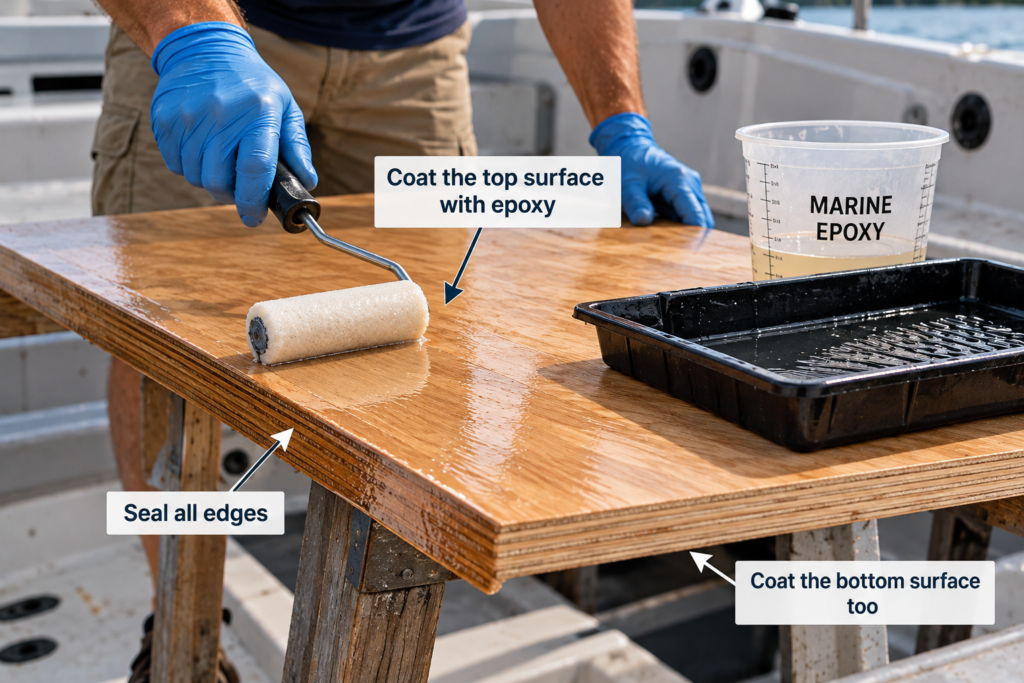
Epoxy coating
WEST SYSTEM’s barrier-coating instructions call for at least two coats of epoxy for moisture protection, and three if you plan to sand. Protection keeps improving with more coats, up to about six coats (roughly 20 mils). WEST also advises against thinning their epoxy with solvents. Apply all coats in one day if you can, so you don’t need to sand between coats.
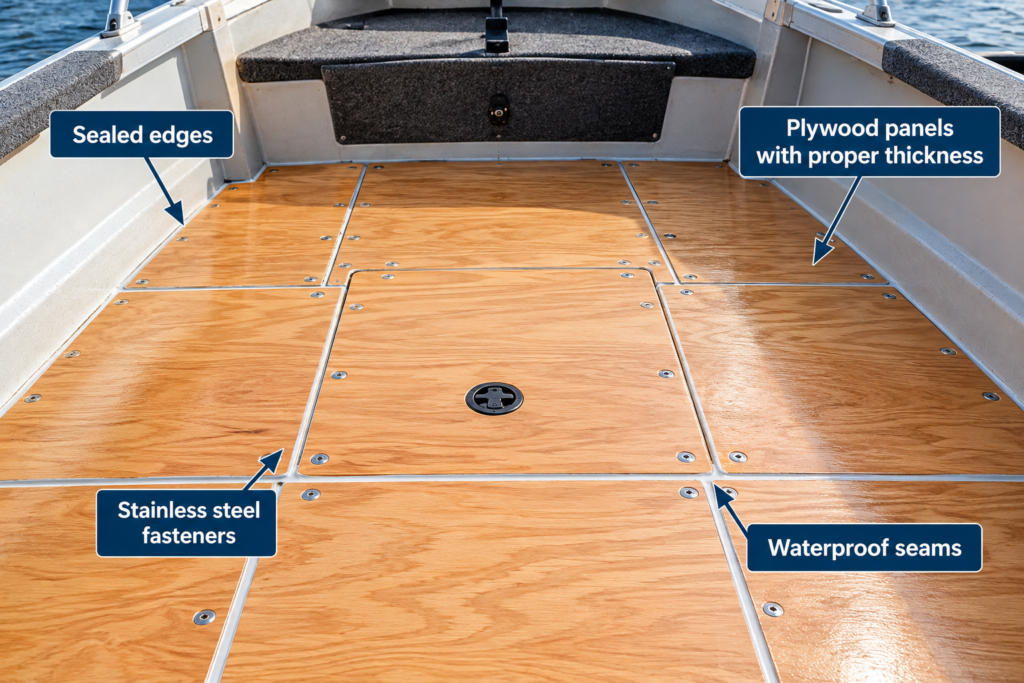
Coat every surface before installation: top, bottom and every cut edge. Edges soak up water fastest because they expose end grain on every ply. Give the edges an extra coat.
Fiberglass cloth on top
For a floor people walk on, lay fiberglass cloth over the epoxy on the top face. The cloth resists scuffs and impacts that would crack bare epoxy. If you use epoxy resin, use woven cloth rather than chopped strand mat. Mat is designed for polyester resin.
Epoxy breaks down in sunlight. Finish the top with marine paint, varnish, a nonskid coating, or a covering like marine vinyl or carpet. An open boat left uncovered needs this layer.
⚠️ Warning: let the panel settle first. WEST notes that porous material should reach a stable temperature before coating. Otherwise, air in the wood expands and bubbles out through the wet epoxy. Coat in the shade on a steady or cooling day, not while the panel is warming in the morning sun.
How to Install a Marine Plywood Boat Floor
Fix the supports first. Probe stringers and transom with an awl. Soft wood under a new floor will fail and take the new floor with it. Our guide to stopping wood rot for good covers how to judge how far rot has spread.
Make a template. Use the old floor, or cardboard, and test-fit before cutting good plywood.
Cut, then seal. Do all cutting, hatch openings and dry-fitting first. Epoxy-coat every face and edge after the final cut, not before.
Bed the panel. On a fiberglass boat, spread thickened epoxy along the tops of the stringers so the floor bears on solid support everywhere, not just at the screws.
Seal every fastener hole. Practical Sailor recommends drilling an oversized hole, filling it with slow-cure epoxy, then redrilling to fastener size once it cures. This leaves the screw in epoxy instead of bare wood. Use stainless fasteners.
Tape the edges. On a fiberglass boat, fill the joint between the floor and hull with a thickened-epoxy fillet, then lay fiberglass tape over it.
Important for aluminum boats: The epoxy bedding and fiberglass taping in Steps 4 and 6 describe fiberglass boat construction. Aluminum boats commonly use deck panels mechanically fastened to aluminum framing. Follow the boat manufacturer’s fastening and support recommendations rather than bonding or fiberglass-taping the floor to the aluminum hull. Sealing the plywood itself (Step 3) still applies.
Finish the top. Add fiberglass cloth if you’re using it, then the UV-resistant topcoat or covering.
🧪 Test before you commit: If you’re unsure whether a coating will bond to the panel you bought, coat a scrap, let it cure fully, and try to pry the coating off with a putty knife. If it peels cleanly from the wood, it didn’t bond, and the whole floor would fail the same way.
Foam Epoxy Roller Covers: Thin foam rollers make even coats and can be cut into tipping brushes.
When Marine Plywood Is the Wrong Choice
When you want a floor that can never rot. Every wood floor depends on its seal staying intact. If your boat stays wet, sits uncovered, or gets hard use, a composite or foam-core floor may outlast plywood.
When the supports are wider than 24 inches. Marine plywood doesn’t come thick enough to bridge wide gaps. Add framing.
When you can’t seal it properly. Marine plywood installed without sealing will rot. A carefully encased exterior panel can outlast a carelessly sealed marine panel, though the core gaps remain a risk.
On boats where weight matters most. Small aluminum boats and boats near their capacity limit may be better off with a lighter floor material.
Common Mistakes
❌ Using pressure-treated plywood under epoxy or fiberglass. WEST SYSTEM’s plywood guidance warns that treated plywood is often warped, that some panels separate during treatment, and that water-repellent additives can prevent glue and paint from bonding. Result: a coating that peels off the floor. Our comparison of marine plywood vs pressure-treated covers where treated wood does make sense.
❌ Leaving cut edges or screw holes unsealed. Water enters through the end grain and soaks along the plies. Result: rot that starts at the edges and spreads under a top surface that still looks fine.
❌ Sizing the floor to the old one instead of the support spacing. Result: a floor that flexes between supports, cracks its fiberglass, and lets water in.
❌ Coating a warming panel in direct sun. Result: pinholes from air escaping the wood, each one a path for water.
😬 Regret: installing over soft stringers. A new floor on rotten supports sags within a season, and you pay to tear it out again.
❌ Calling it waterproof. Marine plywood has a waterproof glue line. The wood itself is not waterproof. Result: owners skip sealing and the floor rots.
FAQ
What thickness marine plywood do I need for a boat floor? Start from support spacing: 1/2″ up to about 12 inches, 5/8″ at 16 to 19.2 inches, and 3/4″ up to 24 inches. These are general starting points, not marine span ratings. If your boat’s manufacturer specifies a thickness, use theirs.
Is marine plywood void-free? No. PS 1 allows core gaps up to 1/8 inch in marine-grade panels. That is much smaller than the gaps allowed in exterior grades, but it is not zero.
Do I have to seal marine plywood on a boat? Yes. Under PS 1, marine plywood is not treated with any preservative. Its glue is waterproof, but the wood can still rot if water gets in. Seal every face and edge with epoxy.
How many coats of epoxy go on a plywood boat floor? WEST SYSTEM calls for at least two coats, three if you plan to sand. Protection improves with more coats, up to about six.
Can I epoxy and fiberglass a plywood floor into an aluminum boat? Generally no. Aluminum boats usually use floors mechanically fastened to aluminum framing. Seal the plywood, then follow the manufacturer’s fastening method rather than bonding or taping the floor to the hull.
Can I use pressure-treated plywood for a boat floor? It is generally not recommended under epoxy or fiberglass. WEST SYSTEM warns that treated panels are often warped and that water-repellent additives can prevent coatings from bonding.
Bottom Line
Choose your thickness based on support spacing: 5/8″ marine plywood for 16 to 19.2-inch spacing and 3/4″ up to 24 inches, with extra framing past that, and defer to the boat manufacturer’s specs where they exist. Buy PS 1 marine grade or BS 1088 panels, seal every face, edge and screw hole with epoxy, and use the fastening method that matches your hull: bonded and taped for fiberglass, mechanically fastened for aluminum.
Related Posts:
DIY Jon Boat: How to Build a Plywood Fishing Boat by Admin January 5, 2026 DIY A jon boat is one of the few boats that actually makes sense to build at home. It’s simple by design—flat bottom. Straight sides. Mostly…