Understanding the cost of marine plywood is critical before starting a boat, dock, or outdoor construction project. Many builders are shocked when marine-grade plywood costs two to three times more than standard exterior plywood, but the price difference comes from strict manufacturing standards, waterproof adhesives, and void-free construction.
If you are standing in a lumber yard or browsing online, staring at a sheet of plywood that costs significantly more than standard exterior sheeting, you are probably asking yourself: Is marine-grade plywood actually worth it? Choosing the wrong material is a shortcut to structural failure. This comprehensive guide breaks down the real expenses, grading rules, hidden project fees, and critical traps to help you avoid expensive mistakes.
Marine Plywood Cost by Thickness and Wood Species
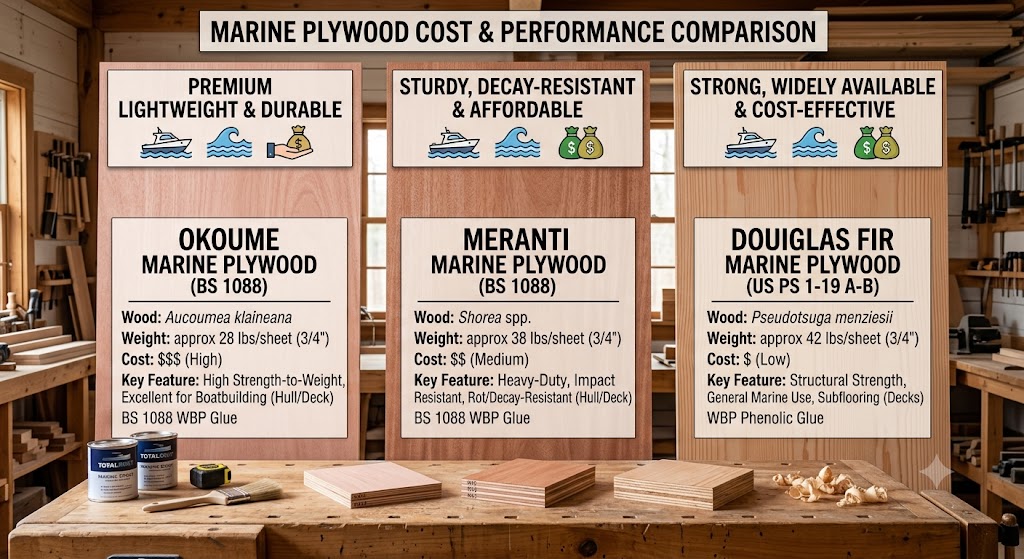
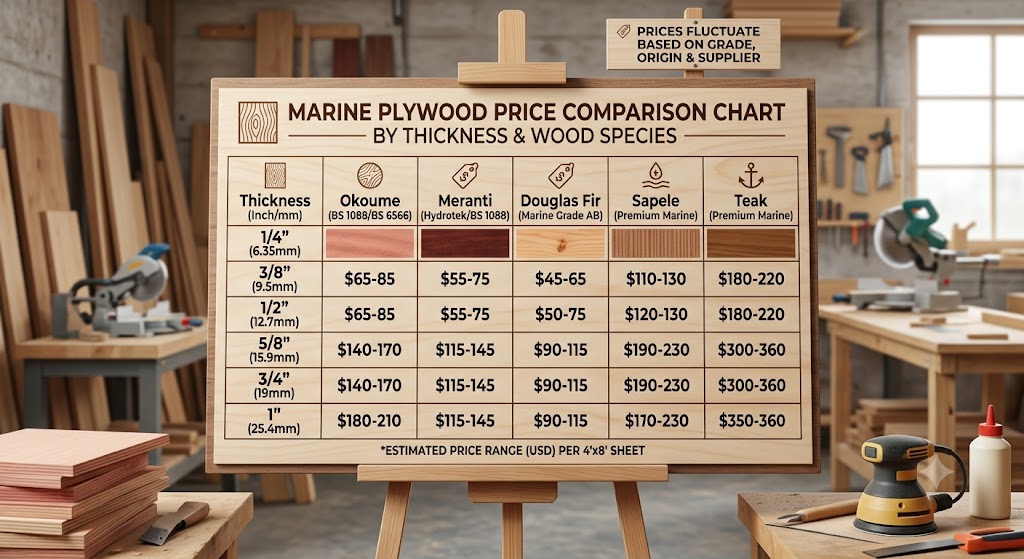
The cost of marine plywood is primarily determined by its thickness and the core wood species used. Premium imported hardwoods like Okoume or Meranti offer flawless plies with higher water resistance than domestic softwoods like Douglas Fir.
The baseline costs for standard $4 \times $8-foot sheets across the major marine-grade options are shown below.
Thickness
Douglas Fir (AB Marine)
Meranti (BS 1088)
Okoume (BS 1088)
1/4″ (6mm)
$55 – $75 / sheet
$100 – $115 / sheet
$110 – $130 / sheet
3/8″ (9mm)
$75 – $95 / sheet
$150 – $170 / sheet
$165 – $185 / sheet
1/2″ (12mm)
$95 – $120 / sheet
$190 – $210 / sheet
$210 – $240 / sheet
3/4″ (19mm)
$135 – $180 / sheet
$290 – $320 / sheet
$310 – $360 / sheet
❌ The Mistake: Why “Waterproof” Doesn’t Mean What You Think
The single biggest mistake builders make when purchasing sheet goods is assuming that marine plywood is treated with chemicals to prevent wood rot. It is not.
Marine-grade plywood is completely untreated structural wood. Its water resistance comes entirely from two things:
The Glue: It uses 100% waterproof structural pheno-resorcinol or epoxy adhesives that will not delaminate (separate) even when boiled.
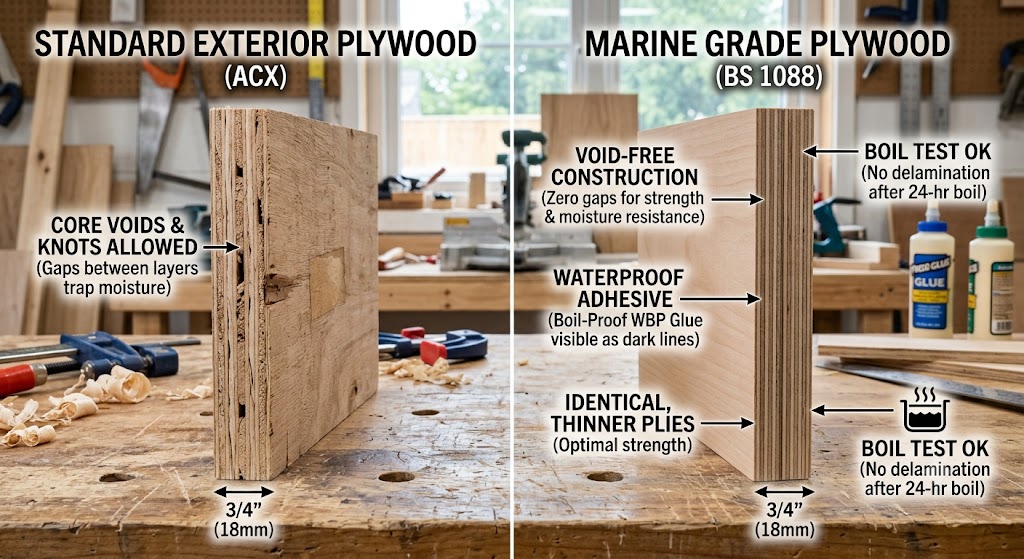
The Core Quality: Standard plywood can have hidden voids (gaps) within the inner layers. If moisture finds its way into those voids, it traps water, rots the wood from the inside out, and weakens the panel. Marine plywood prohibits these voids.
⚠️ Warning: If you leave raw marine plywood exposed to water without a proper seal, it will absorb moisture, swell, and eventually rot just like any other piece of wood. The premium price pays for a void-free structure and boil-proof glue, not an immunity to rot.
For a comprehensive breakdown of alternative materials with chemically treated protection, check out our guide to exterior plywood.
Marine Plywood Cost vs Exterior Plywood
Why pay $150 for a sheet of 3/4″ AB Marine Fir when a sheet of standard 3/4″ CDX exterior plywood at a big box retailer costs roughly $45 to $60? The extreme cost difference stems from intensive manufacturing regulations:
Feature
Exterior Plywood (CDX)
Marine Plywood
Core Voids
Allowed
Not Allowed
Face Quality
Knots and patches
Sanded A/B faces
Adhesive
Exterior waterproof
Boil-proof waterproof
Typical Uses
Roofing, siding
Boats, docks, marine projects
Cost
Low
High
Zero Void Tolerance: Operators manually check inner plies to ensure there are no overlapping knots or hollow spaces.
High Ply Count: Marine panels use thinner, higher-quality plies to build thickness. A typical 3/4″ marine sheet contains 7 to 11 plies, whereas standard exterior sheathing might only use 5. More plies mean higher dimensional stability and less warping.
Premium Face Veneers: The exterior faces are sanded flat and clear of open knots, graded as A or B.
🧪 Real Test: The 24-Hour Boil Check
To prove why marine-grade commands a higher premium, performance can be verified using a simple industrial test. Take a scrap block of standard exterior plywood and a scrap block of BS 1088 Marine Plywood, and drop them both into a pot of boiling water.
Standard Exterior: Within 2 to 4 hours, the steam and intense heat break down standard exterior glues. The plies curl, warp, and separate.
Marine Grade: Quality marine plywood is manufactured using boil-proof waterproof adhesives and is designed to withstand prolonged boil testing without delamination.
If your project involves a marine environment where the wood is submersed or constantly saturated, this adhesive integrity prevents catastrophic hull or floor delamination. To compare how different plywood grades stack up under environmental duress, view our comprehensive index.
😬 Regret: The True Cost of Cheap Substrates
Cutting corners on material selection often leads to major repair costs later.
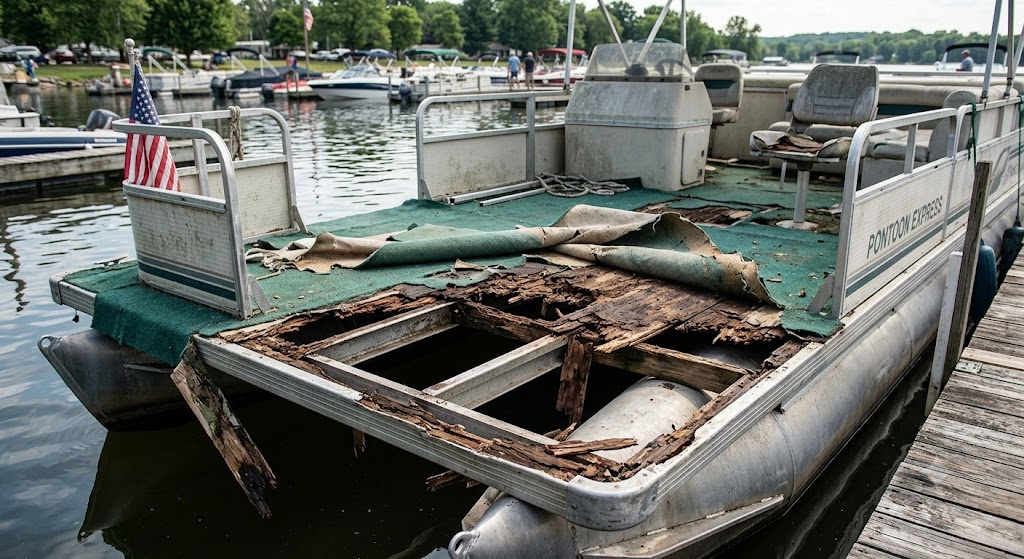
Consider this real-world example: A builder opts to save $300 by using cheap exterior plywood for a pontoon boat decking project instead of specialized, pressure-treated plywood designed for marine environments.
Two seasons later, foot traffic compromises the cheap vinyl flooring overlay. Rainwater seeps through, hitting the internal core voids of the non-marine sheet. The unvented pockets trap the moisture, turning the subfloor spongy and weak.
To fix the issue, the owner has to strip the entire boat console, pull up the ruined vinyl, discard the rotted wood, buy the correct marine panels anyway, and pay for new flooring. A $300 savings quickly escalates into a $2,500 structural rebuild.
Essential Supplies for Marine Construction
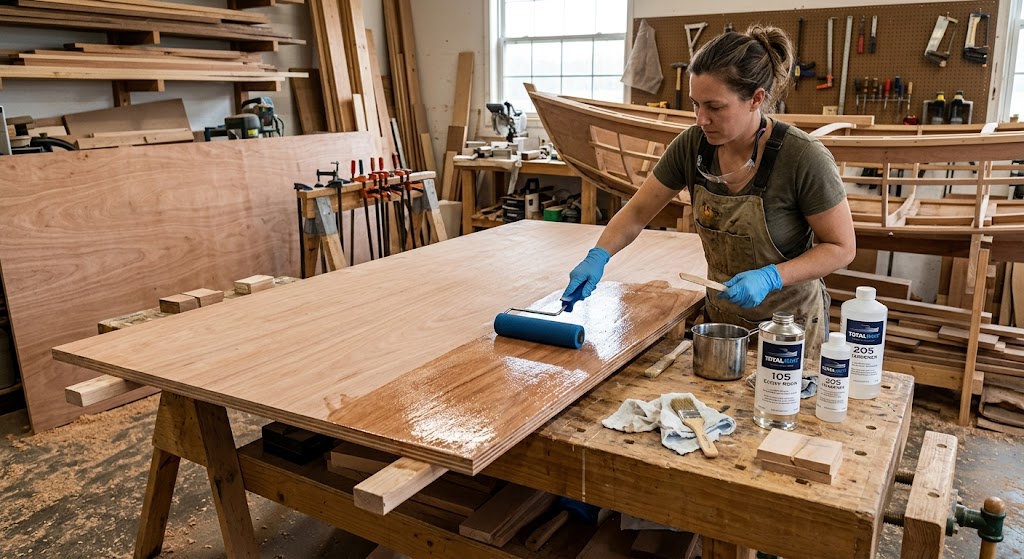
To properly handle, seal, and mount marine plywood so it lasts for decades, you will need high-grade epoxy coatings, sealants, and corrosion-resistant fasteners.
TotalBoat Marine Penetrating Epoxy: A thin, clear resin designed to soak deep into the raw face veneers of marine plywood to seal it against moisture.
TotalBoat 5:1 Epoxy Kits: Perfect for laminating multiple sheets together, creating structural fillets, or wetting out fiberglass cloth over hull panels.
3M Marine Adhesive Sealant 5200: The industry standard for high-strength, polyurethane underwater through-hull adhesion and bedding joints.
Eagle One Marine Grade Waterproof Sealant: Excellent for sealing above-water deck seams, trim joints, and exposed fastener heads.
Stainless Steel Wood Screws (316 Grade): Regular steel or zinc screws corrode instantly in saltwater environments, staining the wood and failing structurally. Always use marine-grade stainless fasteners.
Understanding Marine Plywood Grading Standards
When reviewing quotes from local commercial lumber suppliers, you will run into specific industry certifications. Understanding these terms ensures you don’t overpay for an improper grade.
US Product Standard PS 1-19 (Douglas Fir Marine)
Domestic marine plywood is usually built using Douglas Fir or Western Larch. It must follow strict rules: no core voids larger than 1/8 inch, and faces must be grade A or B.
AA Marine: Flawless sanded A-grade faces on both sides. Best for varnished or clear finishes.
AB Marine: One flawless A-face, with a slightly lower B-grade back face (minor tight knots or neat patches allowed). This is the most common choice for boat floors and decking.
British Standard BS 1088 (Okoume & Meranti)
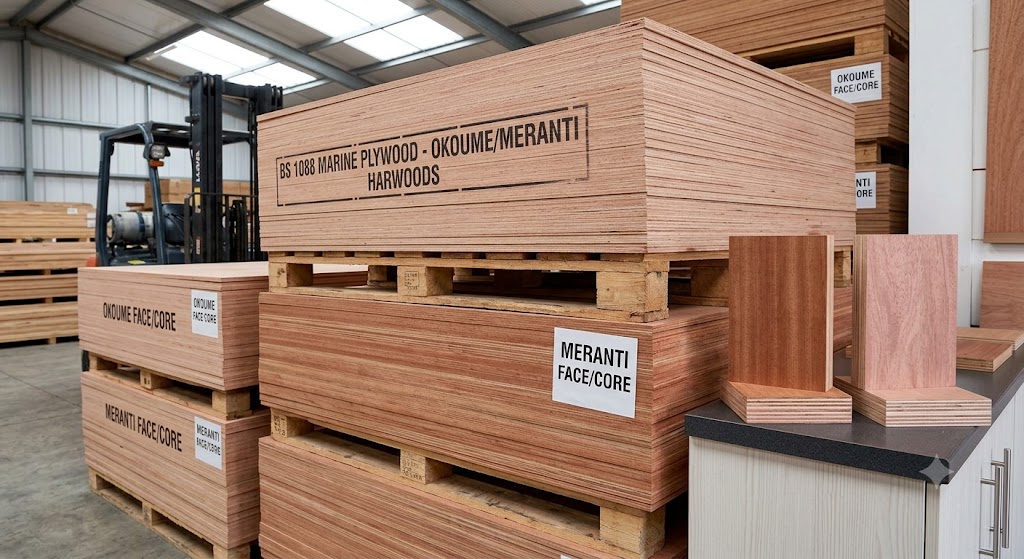
This is the international benchmark for high-end boat building. BS 1088 panels require identical face and back veneers, zero internal voids, and highly stable tropical hardwood cores.
Okoume: Lightweight, tight-grained, and exceptionally flexible. It is easy to curve around tight hull radiuses but has low natural rot resistance, meaning it must be fully encapsulated in fiberglass and epoxy resin.
Meranti: Slightly heavier and stiffer than Okoume, with excellent natural resistance to fungal decay. It is highly favored for heavy-duty floor transformations and structural stringers.
For a detailed look at structural sizing guidelines for heavy load applications, read our overview on plywood thickness.
Hidden Marine Plywood Costs Most Buyers Forget
The raw sheet price is only one part of the equation. Budgeting for a marine build requires accounting for several additional factors.
Freight & Heavy Delivery Fees: Because big-box retailers rarely stock genuine BS 1088 hardwood panels, ordering from a specialty lumber supplier means dealing with freight shipping costs. Shipping 3 to 4 heavy sheets on a pallet can easily add $150 to $300 in residential delivery fees.
Epoxy Encapsulation Supplies: To ensure your investment doesn’t rot, you must account for epoxy protection. Coating a single $4 \times 8$ sheet on both sides and along the edges requires roughly 1/3 gallon of mixed epoxy resin, which adds $30 to $50 in material cost per sheet.
Premium Fasteners: Using cheap fasteners with premium marine panels creates weak points. True marine-grade 316 stainless steel or silicon bronze screws cost significantly more than standard construction fasteners.
Marine Plywood Cost Calculator (Quick Estimate)
To help scope your project budget, use the table below for a quick estimate of the required sheets and baseline material costs for common applications.
Project
Typical Sheets Needed
Estimated Material Cost
Small Jon Boat Repair
1–2 Sheets
$100–$400
Pontoon Deck Replacement
4–8 Sheets
$600–$2,500
Small Sailboat Build
10–20 Sheets
$2,000–$6,000
Outdoor Marine Cabinetry
2–4 Sheets
$200–$1,200
Where to Buy Marine Plywood
Marine plywood is available through specialty lumber yards, marine supply stores, and select building material distributors. While some home improvement stores carry marine-grade Douglas Fir plywood, BS 1088 Okoume, and Meranti panels are usually sourced through specialty suppliers. Always verify certification paperwork before purchasing, as some imported panels are marketed as marine plywood but do not meet the true BS 1088 requirements.
Is Marine Plywood Worth the Cost?
For projects exposed to occasional rain and that can dry completely between wetting cycles, premium exterior plywood may provide adequate performance at a lower cost.
For boats, pontoon decks, docks, transoms, and continuously wet environments, marine plywood is usually worth the additional investment because the void-free core and waterproof adhesive significantly reduce the risk of structural failure.
Frequently Asked Questions About Marine Plywood Cost
Why is marine plywood so expensive?
Marine plywood costs more because it uses waterproof adhesives, higher-quality veneers, additional plies, and strict void-free construction standards.
Can I use exterior plywood instead of marine plywood?
For projects that stay dry, exterior plywood may work. For boats, docks, pontoon decks, and constantly wet environments, marine plywood is the safer choice.
Does marine plywood need to be sealed?
Yes. Marine plywood is not rot-proof. It should be sealed with epoxy, paint, fiberglass, or another moisture barrier.
Douglas Fir marine plywood is typically the lowest-cost option, with prices often 30% to 50% lower than BS 1088 Okoume or Meranti.
Final Project Recommendations
Before purchasing your material, use this quick checklist to find the best balance between cost and performance:
For Structural Boat Hulls: Spend the money on BS 1088 Okoume or Meranti. Structural integrity and the absence of core voids are necessary for safety on the water.
For Pontoon & Skiff Decks: Choose 3/4″ AB Marine Douglas Fir or specialized CCA pressure-treated marine panels. They provide high stiffness at a lower cost per sheet than imported hardwoods.
For Outdoor Cabinets & Signs: Standard MDO (Medium Density Overlay) or a high-quality exterior ACX panel can often do the trick at a fraction of the cost, provided the edges are well sealed.
Investing in genuine marine plywood protects your hard work and ensures your project withstands the elements without requiring early, expensive structural repairs.