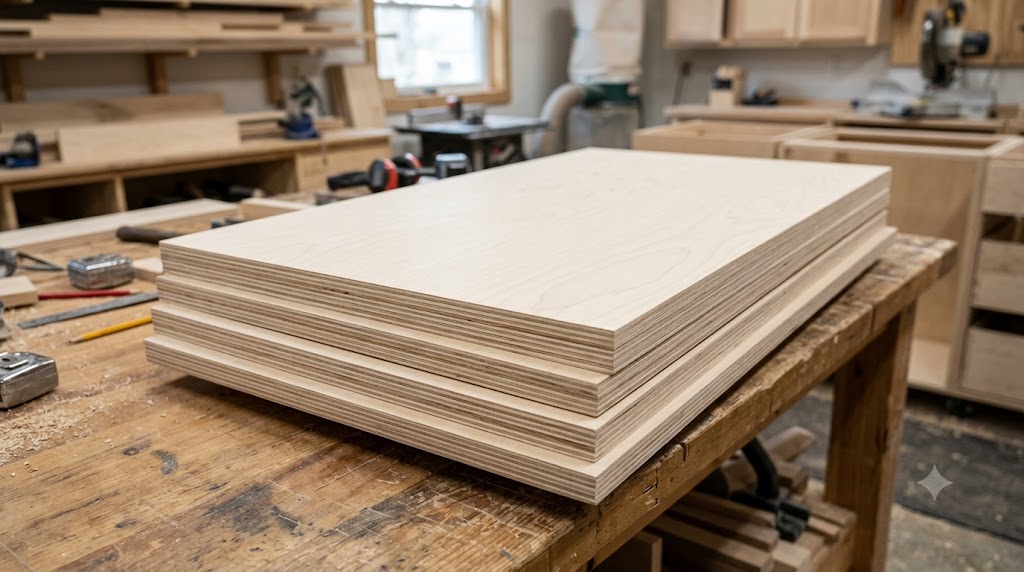
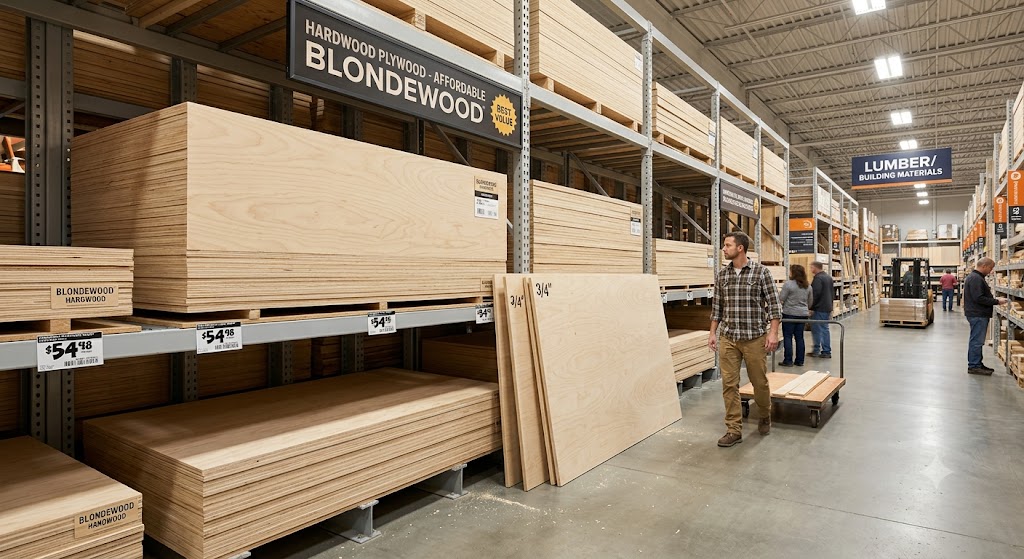
Walk into any big-box home improvement center looking for budget-friendly cabinet material, and you’re bound to encounter a stack of exceptionally clean, bright sheets labeled Blondewood Plywood. It looks beautiful on the rack. Blondewood plywood has become one of the most popular budget sheet goods at home centers because it looks clean, cuts easily, and costs significantly less than maple or Baltic birch.
But if you are about to load up your cart for a major shop project, hit the brakes for just a second.
“Blondewood” is a marketing term, not a tree species. There is no such thing as a Blondewood tree. Instead, it is a commercial catch-all label used for imported, light-colored hardwood plywood, often manufactured from sustainable plantation hardwoods (such as poplar or radiata pine hybrids) or various overseas white woods.
While it looks like a million bucks on the shelf, working with it requires a specific set of rules. Below is a raw, field-tested breakdown of what Blondewood sheet goods actually are, where they shine, and why treating them exactly like high-end Baltic birch can lead to a massive workshop regret.
📌 Quick Verdict
✅ Great for: Painted cabinets, budget shop projects, storage bins, and lightweight utility shelving.
❌ Avoid for: Heirloom-quality furniture, heavy structural loads, or designs with exposed raw plywood edges.
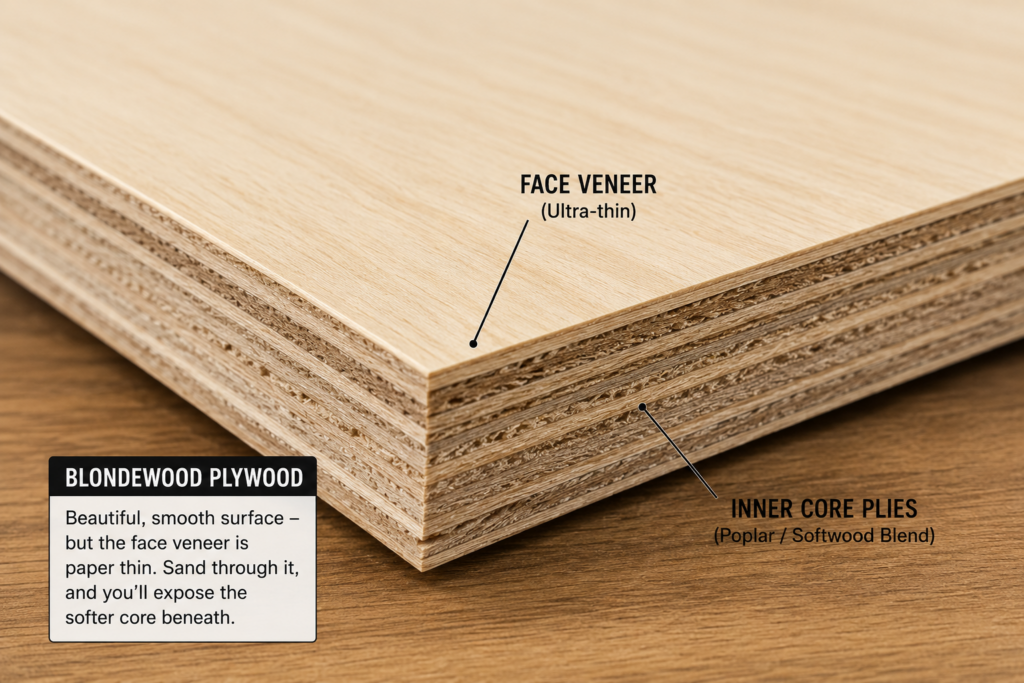
⚠️ The Catch: It features an ultra-thin face veneer that burns through easily if oversanded, and the inner core can contain hidden structural voids.
Blondewood vs. The Competition: At-a-Glance
Before diving into the sawdust, let’s see how commercial Blondewood stacks up against traditional workshop staples. This quick-reference comparison highlights the structural and financial trade-offs.
Plywood Type
Average Plies (3/4″ Sheet)
Core Quality & Voids
Surface Stability
Weight & Density
Price Bracket
Blondewood Plywood
Typically 4 to 7 layers
High risk of hidden voids; prone to slight edge splitting
Thin veneer; requires light sanding only
Lightweight, easy to handle
💸 Budget-Friendly
Baltic Birch (BB/BB)
13 layers (all birch)
Virtually zero voids; completely solid edges
Thick, highly durable veneer
Heavy and incredibly dense
💰 Premium Investment
Domestic Maple / Birch
5 to 7 layers
Minimal voids; stable engineered core
Excellent grain matching; stable
Moderate to heavy weight
🏷️ Mid-to-High Range
MDF (Medium Density Fiberboard)
Solid uniform composite
Zero internal voids; edges require sealing
Flawless paint surface; zero grain
Extremely heavy; sags over long spans
💸 Low Cost
What Is Blondewood Plywood?
To understand how this material behaves under real-world workshop conditions, we have to look past the marketing. After working with multiple brands of Blondewood plywood, the consensus is clear: it is a built-to-a-price utility sheet.
Because the face veneer on commercial Blondewood is exceptionally thin, it is highly prone to micro-chipping along the cut line if you don’t use a zero-clearance insert or a high-tooth-count finishing blade on your table saw.
Furthermore, because the inner layers are made of lighter, softer woods than the face, overtightening joinery screws can easily strip the internal threads or cause the inner plies to separate slightly. Set your impact driver or drill clutch to a lower setting when assembling this material.
❌ The Critical Mistake Most Woodworkers Make
The absolute biggest mistake you can make with Blondewood is treating it like solid hardwood or high-density Baltic birch during the sanding phase.
Because the factory sands these sheets to a beautiful, glass-like sheen before shipping, the outer blonde veneer is often paper-thin. If you attack a glued joint with an aggressive 80-grit disk on a random orbital sander, you will burn right through the finish layer in a matter of seconds, exposing the darker, rougher utility core wood underneath.
Once you burn through that veneer, no amount of stain or clear coat will hide the blemish. Treat the surface gently. Only use 180-grit or 220-grit sandpaper for a light scuffing before applying your finish.
Blondewood Plywood Pros and Cons
Every sheet good involves a trade-off between price, aesthetics, and structural integrity.
Pros
Surface Polish: Comes pre-sanded to a very smooth finish, making it an excellent canvas for primers.
Affordability: Drastically reduces the total cost of large-scale builds compared to domestic hardwood panels.
Weight: Easier on your back when loading and cutting full 4×8 sheets solo.
Cons
Core Inconsistency: Contains interior gaps that can cause edge blowout during routing.
Edge Finishing Required: The exposed plies are rarely attractive enough to leave bare.
Moisture Sensitivity: Fewer internal layers mean it is more susceptible to cupping in high-humidity areas than multi-ply alternatives.
Blondewood Plywood vs Baltic Birch
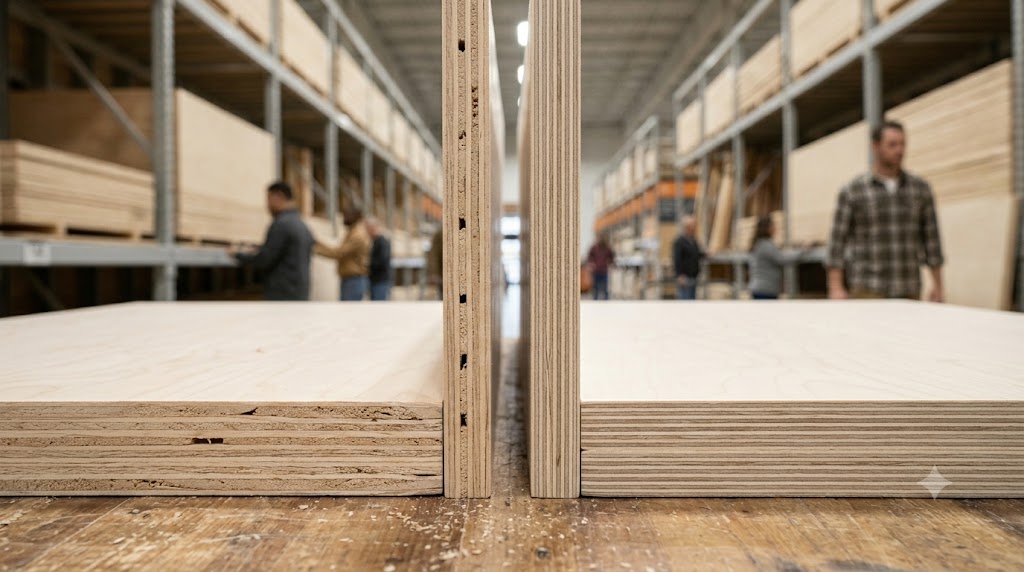
Baltic birch uses a massive stack of uniform, void-free birch plies throughout the board’s thickness. This creates an incredibly dense, heavy panel with an edge that looks beautiful when left exposed. Blondewood relies on fewer, thicker inner layers made of softer plantation timbers. While it mimics the bright look of birch on the surface, it lacks the raw density, stability, and clean edge profile of true Baltic birch.
Is Blondewood Plywood Good for Cabinets?
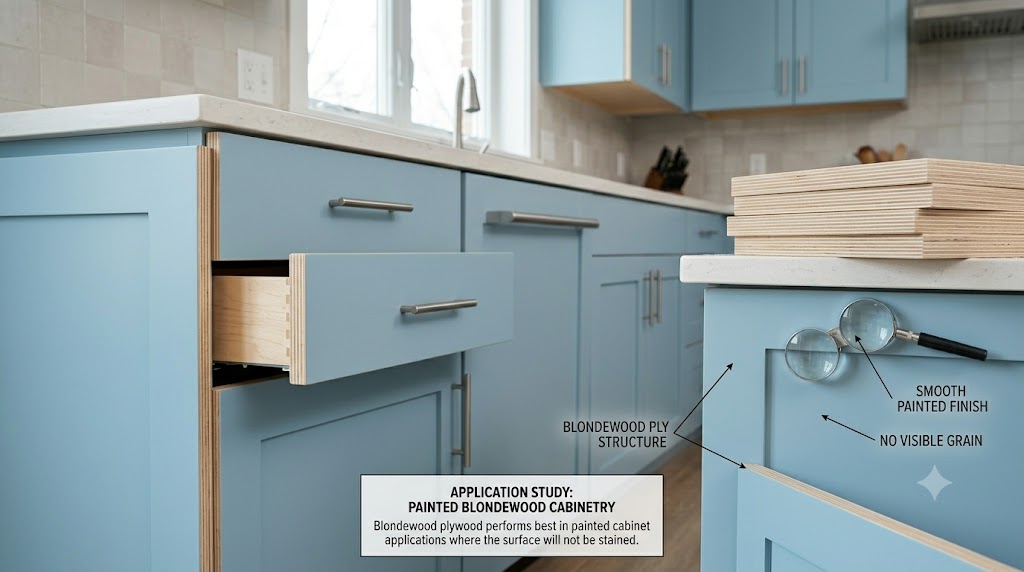
The short answer is yes—but context matters. Blondewood plywood cabinets are highly successful when you plan to paint the final project. Since the surface is completely smooth and uniform with minimal grain texture, it takes primer and latex paint beautifully without demanding endless coats of grain filler.
However, if you are building frameless cabinets with exposed edges or staining the wood a dark color, you may struggle with grain variation between different sheets. For high-end stained work, it pays to understand the specific differences in a dedicated breakdown of birch plywood vs. maple plywood.
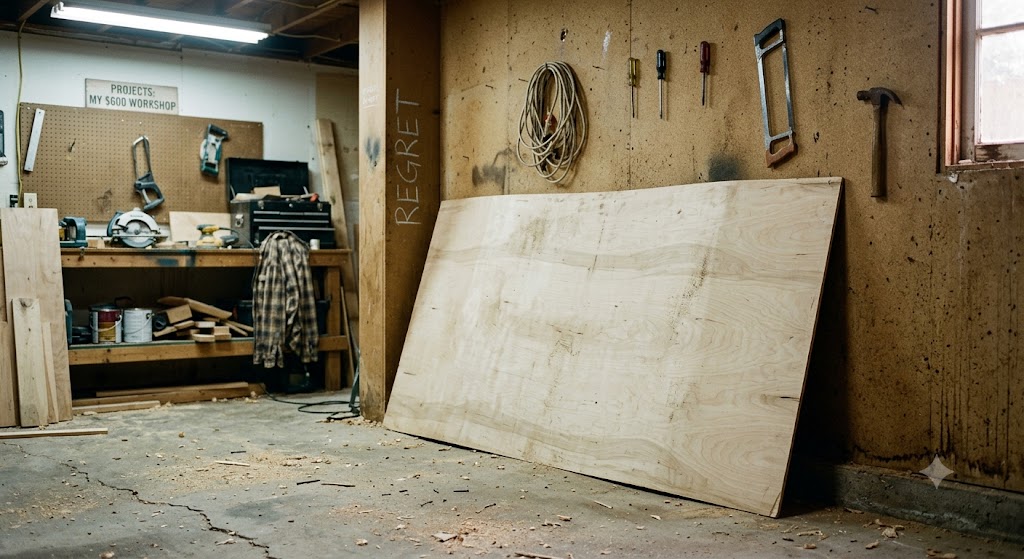
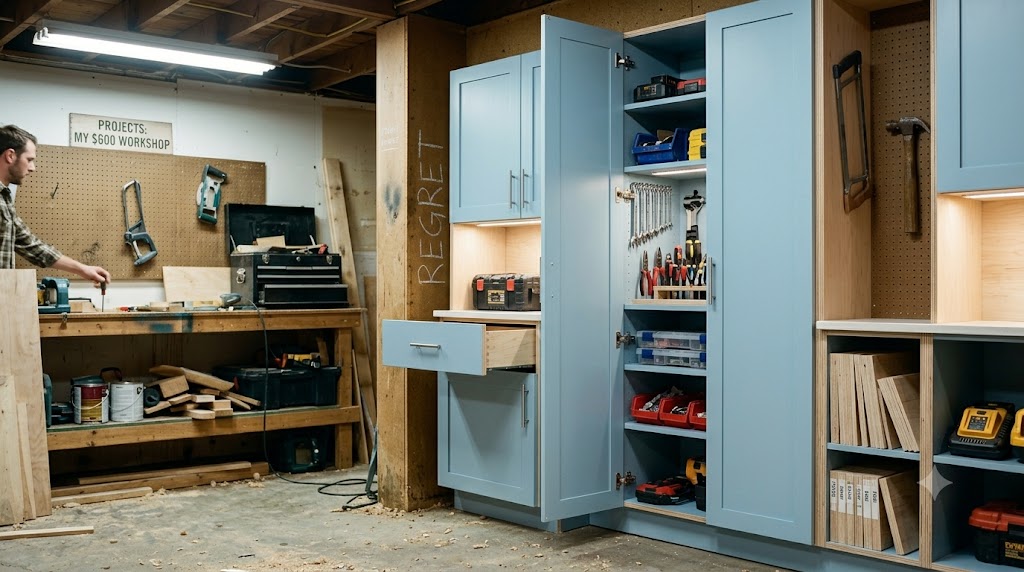
A couple of seasons back, I was tasked with building a massive wall of custom garage storage cabinets. Trying to maximize my margins, I opted for eight sheets of budget blondewood rather than my usual choice of maple plywood. The sheets looked pristine on the cart, and I felt like a financial genius at checkout.
The regret hit during assembly. As I began ripping long 8-foot lengths for the side carcasses, internal tension in the panels caused several pieces to immediately bow and banana on the table saw. Furthermore, when edge-routing a clean rabbit joint, the router bit hit an empty air void inside the core, blowing out a massive chunk of the side panel.
I ended up wasting an entire sheet due to warping and spent hours filling edge voids with wood putty. If you need absolute dimensional flatness for long, frameless cabinet runs, spend the extra money on premium cabinet-grade plywood. Save the blondewood for smaller, face-framed projects where minor warping can be pulled flat by mechanical fasteners.
Best Uses for Blondewood Plywood
Painted garage cabinets
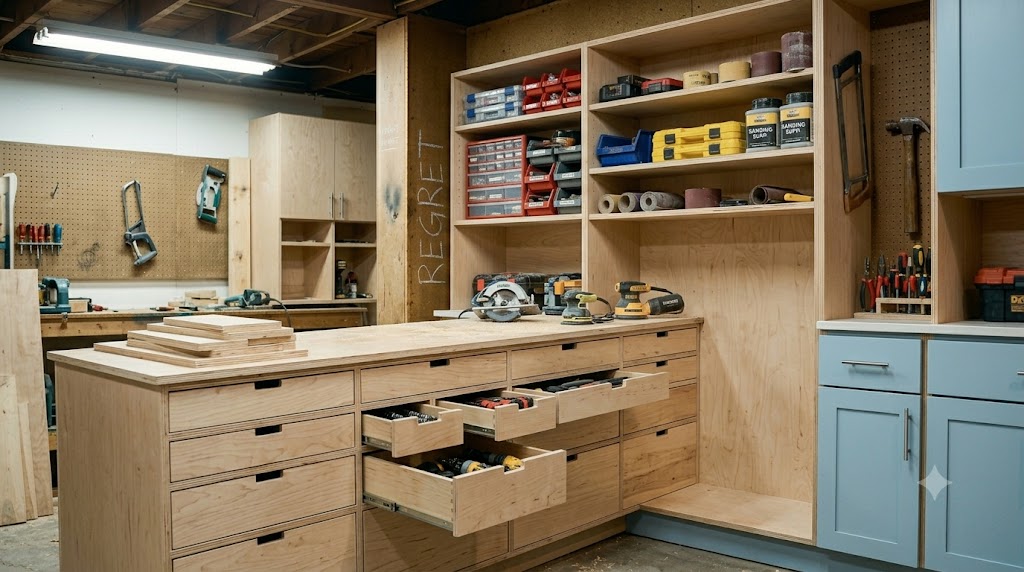
Workshop storage cabinets
Utility shelving
Closet organizers
Shop jigs and fixtures
Workbenches
Drawer boxes with edge banding
Painted built-ins
Avoid using it for exposed-edge furniture, heirloom projects, or applications where maximum panel flatness is critical.
Who Should Buy Blondewood Plywood?
Painted workshop cabinets built from budget sheet goods
Buy Blondewood if:
You’re building garage cabinets, workshop storage, or utility shelving.
You’re planning to paint the finished project rather than stain it.
You’re on a strict budget and need to keep material costs down.
You need lightweight sheet goods that are easy to maneuver on your own.
Skip Blondewood if:
You’re building heirloom furniture or high-end custom commissions.
You need perfectly flat, frameless cabinet panels that won’t bow.
You want exposed plywood edges as a design feature.
You’re expecting performance characteristics comparable to Baltic birch.
🛒 Upgrading Your Shop Setup (Monetization & Tools)
To get clean, professional results from budget-friendly sheet goods, you need the right tools to compensate for their thin veneers and softer cores. Here are the exact items I rely on to get flawless results out of commercial plywood:
For Flawless Cuts: To prevent the face veneer from splintering, swap your standard construction blade for a premium finishing blade. The Freud Diablo 10-Inch 90-Tooth Ultimate Flawless Finish Saw Blade is an absolute lifesaver for clean, chip-free cuts on delicate plywood sheets.
For Bulletproof Joinery: Don’t risk stripping out the softer inner cores of imported plywood. Use a dedicated pocket-hole system, such as the Kreg Pocket Hole Jig 320. It allows you to dial in precise depth settings so your screws seat securely without splitting the plies.
For Flawless Edge Finishing: Since the raw edges of blondewood reveal its utility layers, seal them immediately with Real Wood Birch Edge Banding (3/4-inch x 50 feet). Simply iron it onto the raw edges, trim the excess, and your budget sheet instantly looks like premium furniture-grade plywood.
Smart Designing & Resource Planning
When mapping out your project cut list, keep in mind that nominal sheet measurements don’t always match exact dimensions. It is incredibly common for imported 3/4-inch metric sheets to actually measure closer to 18mm (roughly 23/32 of an inch). To avoid loose, sloppy joinery slots, verify your exact material thickness using a reliable plywood thickness guide before setting up your dado stacks or router bits.
❓ Frequently Asked Questions
Is Blondewood plywood waterproof? No. Blondewood plywood is manufactured with interior-grade resins and is intended strictly for dry, interior use. It should always be protected from prolonged exposure to moisture and high-humidity environments to prevent delamination.
Is Blondewood plywood good for cabinets? Yes. It works exceptionally well for painted cabinets, utility shop storage, and garage built-ins where raw material cost is a primary consideration and structural perfection isn’t mandatory.
Is Blondewood plywood the same as Baltic birch? No. Baltic birch contains significantly more plies per sheet, features virtually zero internal core voids, and offers far greater structural stability and edge beauty than budget blondewood panels.
Can Blondewood plywood be stained? Yes, but the results vary dramatically. Because veneer thickness and grain consistency across species vary widely between manufacturing batches, blotching is common. Pre-stain wood conditioner is highly recommended.
Final Verdict: Is It Worth It?
Blondewood plywood is an excellent addition to the modern workshop, provided you respect its limitations. Do not buy it expecting the structural density or heavy veneer thickness of premium architectural panels. Treat it gently with the sander, use sharp, high-tooth blades, back up your joinery carefully, and enjoy the significant cost savings on your next interior build.
Related Posts:
ApplePly Plywood Review: Pros, Cons & Where to Buy It by Admin March 31, 2025 Hardwood When I first started woodworking, plywood was just the budget-friendly go-to for garage shelves or workshop benches. But as I began taking on more serious…
OSB Board: Pros, Cons and Best Uses by Admin August 25, 2026 DIY OSB is everywhere in modern construction and barely gets a second thought — until something goes wrong with it. It sheathes the walls and roofs…