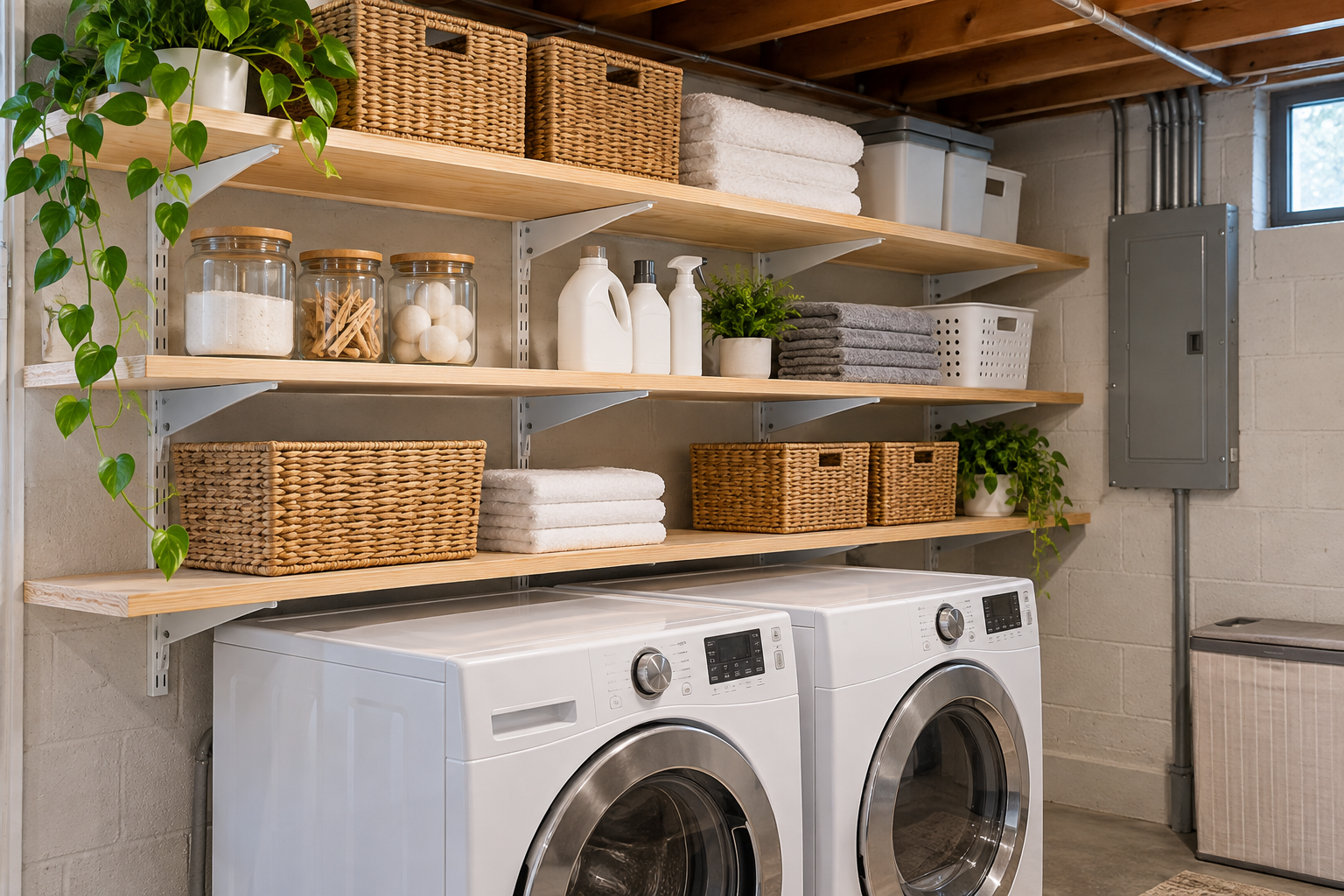
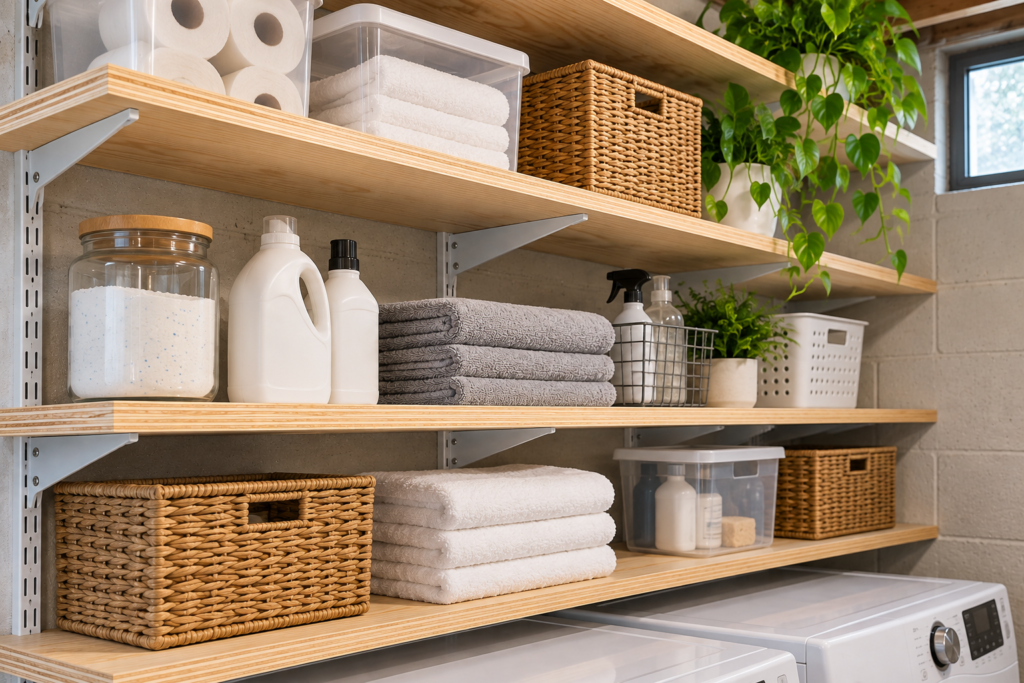
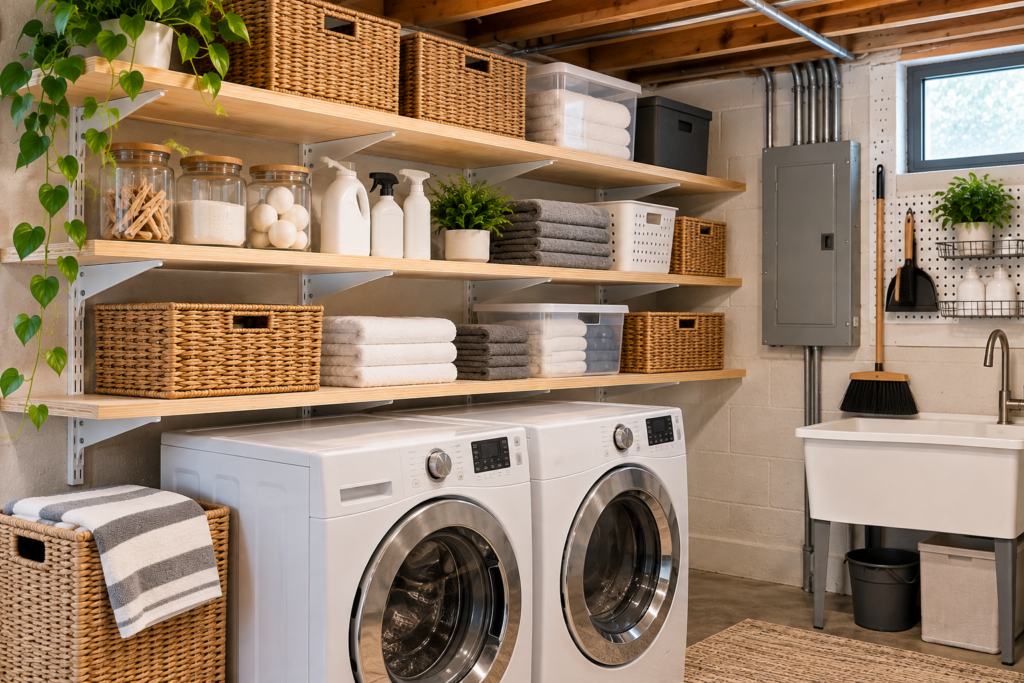
The best budget basement laundry room shelves are 23/32-inch (3/4-inch nominal) exterior-glue plywood on steel brackets, with a bracket screwed into every wall stud. On a wall framed 16 inches on center, the most common stud layout in the IRC’s wall framing tables, that setup keeps sag low even with full detergent jugs on the shelf. Below you’ll find the sag chart, a one-sheet cut plan, the moisture and clearance rules for a basement laundry, and the mistakes that turn a weekend project into a redo.
Quick answer
Shelf: 23/32-inch ACX or BCX plywood, ripped to just under 12 inches deep.
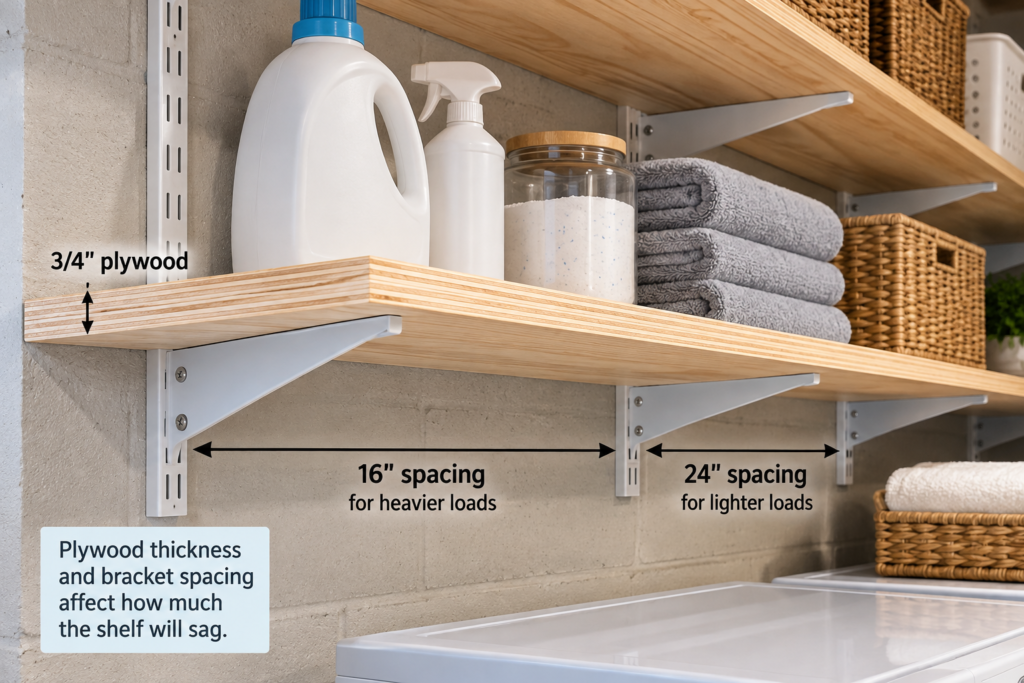
Support: a bracket into every stud, usually 16 inches apart. In theory, skipping every other stud gives about 16 times the sag.
Finish: seal both faces and every cut edge. The edges soak up spills fastest.
First: keep basement humidity below 60%, the EPA’s upper limit for mold prevention, and keep shelves out of the electrical panel’s clear zone.
Skip plywood if the floor floods or the room stays above 60% humidity most of the year. Wire or plastic shelving is the safer choice there.
Plywood Shelf Sag Chart for Basement Laundry Room Shelves
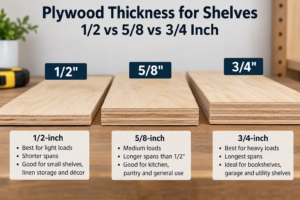
These numbers are theoretical comparisons, not certified load capacities. They show how much one setup sags relative to another. They don’t tell you how many pounds a shelf can safely hold. They come from the standard beam deflection formula: sag rises with the fourth power of the span between supports and falls with the cube of the shelf’s thickness. A 23/32-inch shelf on brackets 16 inches apart is the baseline of 1.0.
Shelf thickness (PS 1 stamp)
Brackets 16 in. apart (every stud)
Brackets 24 in. apart
Brackets 32 in. apart (every other stud)
Laundry use
23/32 in. (3/4 nominal)
1.0
5.1
16
Best pick: full jugs, bins, cleaning supplies
19/32 in. (5/8 nominal)
1.8
9.0
28
Lighter items, 16-in. spacing only
15/32 in. (1/2 nominal)
3.6
18
58
Towels and empty baskets, 16-in. spacing only
23/32 in. + 1×3 rail on edge under the front
Lower than 1.0
Lower than 5.1
Requires a separate load and deflection assessment
Long runs or heavy rows
Real shelves won’t match the chart exactly. Actual performance depends on:
bracket spacing
plywood grade
species
thickness
how the shelf is attached
how much weight it carries and where that weight sits
The chart also assumes every panel has the same stiffness. In practice, stiffness varies with grade, species, ply count and panel construction, so two 23/32-inch sheets with different stamps won’t necessarily sag the same amount. Treat any value above about 5 as a warning sign, not a precise limit.
How to Read the Chart
Bracket spacing matters more than thickness. In theory, moving from every stud to every other stud multiplies sag by 16. Going from 1/2-inch to 3/4-inch plywood cuts it to just over a quarter. Spend on brackets before you spend on a thicker panel.
Go by the stamp, not the label. PS 1-22 identifies panels by Performance Category, so a sheet sold as 3/4 inch is stamped 23/32. That actual thickness is what the chart uses. Our plywood thickness guide explains how nominal and actual sizes differ.
Rip along the 8-foot length. APA’s load-span tables (Technical Note Q225) are built around the panel’s strength axis, which runs the long way on a standard 4×8 sheet. Shelves cut along the 8-foot length keep that stiffness. Shelves cut across the sheet lose much of it.
Allow for time. Wood creeps under constant load, as the USDA Forest Products Laboratory’s Wood Handbookexplains. A shelf that looks flat on day one can sag more over the following months, so leave a margin.
What a Laundry Shelf Actually Holds
The USGS puts a gallon of water at about 8.34 pounds. Liquid detergent is mostly water, so assume it weighs at least as much.
Item
Approximate weight
1 gallon of liquid detergent or fabric softener
8.3 lb or more
150 oz jug (about 1.17 gal)
About 10 lb, plus the jug
Four of those jugs on a 4-ft stretch of shelf
40 lb or more, concentrated where you set them
That last row is why the 15/32-inch row is limited to towels and empty baskets.
Budget Basement Laundry Room Shelves: The One-Sheet Cut Plan
Rip one 4×8 sheet lengthwise with three cuts and you get four shelves about 96 inches long. Each one comes out just under 12 inches deep: 48 inches minus three 1/8-inch saw kerfs leaves 47-5/8 inches, and dividing that by four gives about 11-29/32 inches. That’s 32 linear feet of shelving from one sheet, deep enough for most detergent jugs.
💸 Cost difference: brackets vs. sag. This is a comparison of how many parts you need, not of prices.
An 8-foot shelf crosses six or seven studs at 16-inch spacing, so it needs six or seven brackets.
Using every other stud cuts that to three or four brackets.
Saving those three brackets per shelf gives about 16 times the sag on the same plywood.
To compare with pre-cut shelf boards, divide the sheet price by 32 to get your cost per linear foot, then divide the board price by its length. Check both at your local store before you buy.
Budget shelving option
What you’ll need to buy
Relative cost
Moisture tolerance
Holds full jugs?
23/32-in. plywood on steel brackets, sealed
One 4×8 sheet, one bracket per stud, structural screws (or masonry screws for concrete), sandpaper, primer and paint or clear coat for all faces and edges, optional 1×3 front rails
Low to medium
Fair once all faces and edges are sealed
Yes, at 16-in. spacing
Wire shelving on wall standards
Shelves, wall standards, brackets, screws or anchors, end caps
Low to medium
High
Yes, within the maker’s rating
Freestanding plastic shelving
The unit, plus an anti-tip wall strap
Low
High
Light to medium loads
Melamine particleboard shelves
Boards, edge banding for cut ends, brackets, screws
Low
Poor: cut edges swell when wet
Short spans only
Which Plywood to Buy for Laundry Shelves
ACX: It has a smooth A face that takes paint well and an exterior bond. This is the default pick. See our ACX plywood guide.
BCX: It costs less and has small patches on the face that disappear under paint. It’s a good budget pick.
Hardwood “cabinet” plywood (birch, maple): It looks the best clear-coated. Most of it is bonded for interior use under ANSI/HPVA HP-1, which is fine in a dry room but a risk right next to a washer that might leak. Its stiffness can also differ from softwood sheathing-grade panels of the same thickness.
One distinction matters here. An exterior bond means the glue lines hold when the panel gets wet. It does not make the wood rot-resistant. A shelf that stays damp can still grow mold or decay, whatever the stamp says.
Moisture, Clearance and Code Checks Before You Drill
⚠️ Warning: the electrical panel zone. Basement laundries often share a wall with the main panel. NFPA 70 (the NEC), Section 110.26, sets two separate requirements.
Working space. This is the area in front of the panel. It’s at least 30 inches wide (or the width of the equipment, if that’s wider) and typically 3 feet deep for residential panels. It must stay clear from the floor to 6-1/2 feet or the top of the equipment, whichever is higher, and it can’t be used for storage. Any shelf below or in front of the panel sticks out into this space, so that’s what rules out shelving there.
Dedicated equipment space. This covers only the panel’s own width and depth. It runs from the floor to 6 feet above the panel or to the structural ceiling, and it’s reserved for the electrical installation. For a typical panel that sticks out only a few inches, it mainly matters for anything mounted directly above the panel.
In practice: put shelves beside the 30-inch clear zone, not inside it. Mount nothing in the panel’s footprint above it, and make sure the panel door can open at least 90 degrees. Your jurisdiction may have adopted a different NEC edition or local amendments, so check with your inspector if you’re unsure.
Dryer exhaust: Keep shelves and bins clear of the duct, and don’t crush or reroute it to fit a shelf. Follow the dryer’s installation manual and IRC M1502.
Valves and cleanouts: Leave the washer shutoff valves, floor drain and any cleanouts reachable without moving anything.
Humidity: The EPA recommends keeping indoor humidity below 60%, ideally 30% to 50%. A hygrometer on the shelf tells you whether the room needs a dehumidifier before the plywood shows it.
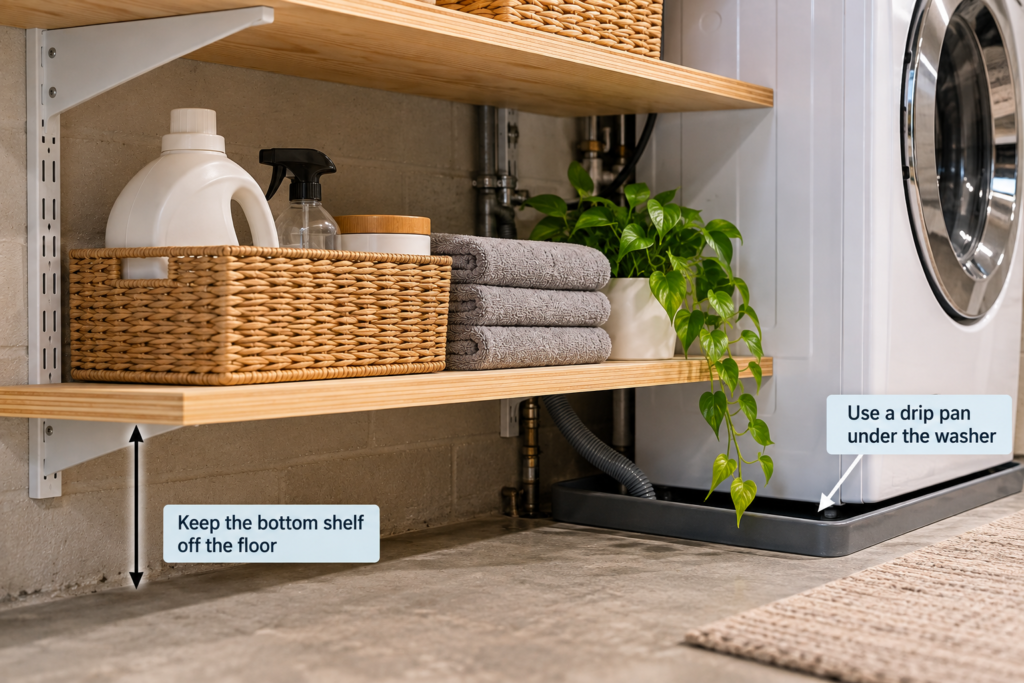
Leaks are a separate problem. Keeping humidity below 60% helps prevent mold on surfaces. It does nothing to protect plywood from a washer leak, a burst supply hose or standing water. Keep the lowest shelf well off the floor, keep the space under the washer and nearby shelves clear so you can spot a leak early, and consider a washer drain pan where the floor can hold water.
Concrete walls: Fasten brackets with masonry screws or anchors rated for the load. Don’t put the back edge of the plywood tight against bare concrete. If the wall is still unfinished, our cheap basement wall ideas compare the low-cost finishes, and the basement wall finishing guide covers the full assembly.
How to Build Basement Laundry Room Shelves (7 Steps)
Check the room first. Run the checks in our basement moisture test guide. Shelves won’t survive a wall that leaks.
Plan the heights. Over a top-loader, leave the lid clearance listed in the washer’s manual. Over front-loaders, keep the lowest shelf high enough that you can reach it without leaning over the open door.
Rip and sand. Make three lengthwise rips, sand the faces to 150 grit and ease the front edges.
Seal everything. Coat both faces and all four edges. Use water-based polyurethane for a clear finish, or a stain-blocking primer plus paint. Our painting plywood guide covers primer choice.
Add a front rail if the run is long or heavy. Glue and screw a 1×3 on edge under the front of the shelf. It stiffens the shelf far more than going up a plywood thickness does.
Mount the brackets. Snap a level line, then drive the screws the bracket maker specifies into each stud. Stay within the bracket’s rated load.
Load-test before you fill the shelves.
🧪 Real tests you can run:
Sag test. Set your heaviest planned row of full jugs on one shelf. Lay a straightedge across the front edge and measure the gap at the middle. Measure again after 48 hours. If the gap has grown, add a bracket or a front rail before you load the rest.
Finish test. Put a drop of water on a sealed cut edge. If it soaks in within a minute, that edge needs another coat.
For more storage in the same room, a washer and dryer pedestal raises the machines and adds basket space underneath.
Affiliate disclosure: ThePlywood.com is reader-supported. As an Amazon Associate, we earn from qualifying purchases at no extra cost to you.
Common Mistakes With Basement Laundry Room Shelves
❌ Mistake: brackets in drywall anchors only. A shelf of full jugs pulls anchors out of drywall over time. Screw into studs or fasten into concrete.
❌ Mistake: 1/2-inch plywood on every other stud. That combination scores 58 on the chart, compared with 1.0 for the recommended setup. Expect it to bow visibly under detergent.
❌ Mistake: sealing only the top face. Cut edges and the underside absorb spills and humid air. The panel swells and the finish lifts at the front edge first.
⚠️ Warning: shelves in front of or above the electrical panel. A shelf that sticks out into the working space or sits in the panel’s footprint above it blocks access and can fail inspection. Mount shelves beside the clear zone instead.
😬 Regret: covering the shutoff valves. A shelf that looks neat is no help when a hose bursts and the valve is behind three bins. Keep the valves clear.
❌ Mistake: plastic sheeting behind the shelves. IRC R702.7 exempts basement walls from the interior vapor retarder requirement. A Class I vapor retarder such as polyethylene on the room side of a below-grade wall can trap moisture against the wall.
When Plywood Shelves Are the Wrong Call
The floor has flooded or the sump runs often. Plywood that gets wet repeatedly will stain and swell. Use wire or plastic shelving.
Humidity stays above 60% and you won’t run a dehumidifier. Even sealed plywood will struggle.
You rent. Freestanding units leave no holes and move with you.
You need more than 8 feet of shelf with no studs to fasten into. A freestanding frame or a French cleat wallhandles that better than brackets.
FAQ
What thickness of plywood is best for laundry room shelves? Use 23/32-inch (3/4-inch nominal) plywood. In theory it’s about 3.6 times stiffer than 15/32-inch plywood of the same type at the same span, which matters once full detergent jugs go on it.
How far apart should shelf brackets be in a laundry room? Put one in every stud, usually 16 inches apart. Sag rises with the fourth power of the span, so 32-inch spacing gives about 16 times the sag in theory. APA publishes structural load-span data for panels in its Technical Note Q225.
Is plywood OK in a damp basement laundry room? Yes, as long as it’s sealed on every face and edge and the room stays below 60% humidity, the EPA’s upper limit in its mold and moisture guidance. The EPA also notes that materials dried within 24 to 48 hours of a spill usually won’t grow mold. Low humidity won’t protect plywood from leaks or standing water, though, so keep the lowest shelf off the floor.
Can I put shelves above the washer and dryer? Yes. Leave the lid or door clearance listed in the manual and keep the dryer duct clear. Stay out of the electrical panel’s working space and out of its footprint above the panel.
What’s the cheapest way to finish plywood laundry shelves? Put two coats of water-based polyurethane on every face and edge. If you’d rather paint, a stain-blocking primer plus one coat of satin paint wipes clean almost as well.
Bottom Line
The best budget basement laundry room shelves are 23/32-inch exterior-glue plywood ripped from one sheet into four shelves, sealed on every edge, with a bracket into every stud. Spend the savings on brackets, not on a thicker panel. Keep the electrical panel’s clear zone, the dryer duct and the shutoff valves clear.
Floating Shelves: Stylish Storage & Easy DIY Guide by Admin September 8, 2025 DIY I still remember the first time I put up floating shelves. It wasn’t some big renovation—just a Saturday project in my living room. Instead of…