Exterior plywood vs marine plywood: APA/PS 1-22 marine plywood carries an Exterior-rated waterproof structural bond but has much tighter limits on veneer defects, knotholes and core gaps than ordinary exterior plywood. BS 1088:2018 uses a separate marine-plywood specification. Neither type should automatically be assumed to be preservative-treated.
Exterior Plywood vs Marine Plywood at a Glance
Exterior Plywood
APA / PS 1-22 Marine Plywood
What it is
A category of panels carrying an Exterior bond classification
A specific panel grade defined by PS 1-22
Bond
Exterior-rated waterproof adhesive
Exterior bond classification; fully waterproof structural adhesive
Face/back grades
Vary by panel grade; C-grade veneers are permitted in many exterior-rated panels
A-A, A-B, B-B, MDO or HDO only
Inner plies
May be C or D grade
B grade or better
Knotholes
Permitted in C and D veneers
Not permitted in any ply
Core gaps
Common; can be large
1/8 inch maximum
Species
Many species permitted
Douglas-fir or western larch only
Preservative treatment
None unless pressure-treated
None
Decay resistance
Not guaranteed by Exterior bond classification
Not preservative-treated; no species-durability requirement
BS 1088:2018 uses a different specification system; see the BS 1088 section below.
What Is Exterior Plywood?
Exterior plywood is plywood carrying an Exterior bond classification, meaning the panel is manufactured with adhesives and construction rated for long-term exposure to weather or moisture.
Exterior is a statement about the glue line, not about the wood. Untreated veneers still absorb water, swell, check and eventually decay.
Exterior vs Exposure 1. These are two different bond classifications and the distinction causes most outdoor plywood failures:
Classification
Rated for
Typical panel
Exterior
Long-term exposure to weather or moisture
ACX, BCX, marine, APA 303 siding
Exposure 1
Moisture during construction; protected applications
⚠️ Warning: “ACX” and “CDX” are trade shorthand, not certifications. Read the panel stamp for the words EXTERIOR or EXPOSURE 1. The APA trademark applies only to panels produced by APA member mills.
What Is Marine Plywood?
When tied to a recognized specification, marine plywood is a defined product — not simply a claim that plywood is suitable around water. Two important specifications are APA/PS 1-22 and BS 1088:2018.
APA / PS 1-22 marine (North American)
Under Voluntary Product Standard PS 1-22, Structural Plywood — the current standard, effective October 2023, superseding PS 1-19 — a marine panel must meet every requirement for Exterior plywood, plus:
Requirement
Specification
Species
Douglas-fir or western larch only
Knotholes
Not permitted in any ply
Face/back grades
A-A, A-B or B-B, or MDO/HDO overlay
Inner plies
Grade B or better
Maximum core gap
1/8 inch
Crossband gaps, edge and end splits
Limited by both dimension and number
Repairs in A faces
Maximum of 9 per 4×8 panel
Preservative
None
APA states directly that marine-grade plywood is not treated with chemicals to enhance decay resistance, and that if decay is a concern the panel should be pressure-preservative treated to an appropriate standard.
BS 1088:2018 marine (British Standard)
BS 1088:2018 is the current British Standard for marine plywood, superseding BS 1088-1:2003 and BS 1088-2:2003. It specifies requirements for two classes:
Class
Intended for
Standard
General marine craft, marine and waterway applications
Lightweight
Applications where weight is critical, held to the same durability intent
The standard addresses two things in particular: resistance to bio-deterioration and resistance to loss of bond strength over time. Veneer species are selected on density and resistance to bio-deterioration. Bonding quality is established by test rather than by trade label.
Two practical consequences:
BS 1088 does not make provision for every property relevant to a given end use. A panel can conform and still be the wrong choice for a specific application.
“WBP” (weather and boil proof) remains common trade shorthand, but it is legacy terminology rather than the current basis of conformity. Glue-line terminology across standards is covered in our WBP plywood explainer.
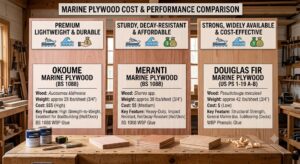
BS 1088-certified marine plywood is commonly available in species such as okoume, meranti and sapele. Okoume is the lightweight choice for stitch-and-glue craft; meranti is heavier, stiffer and holds fasteners better.
Exterior vs Marine Plywood: 5 Key Differences
The five differences below compare ordinary exterior-rated plywood with APA/PS 1-22 marine plywood. BS 1088 uses a different specification system.
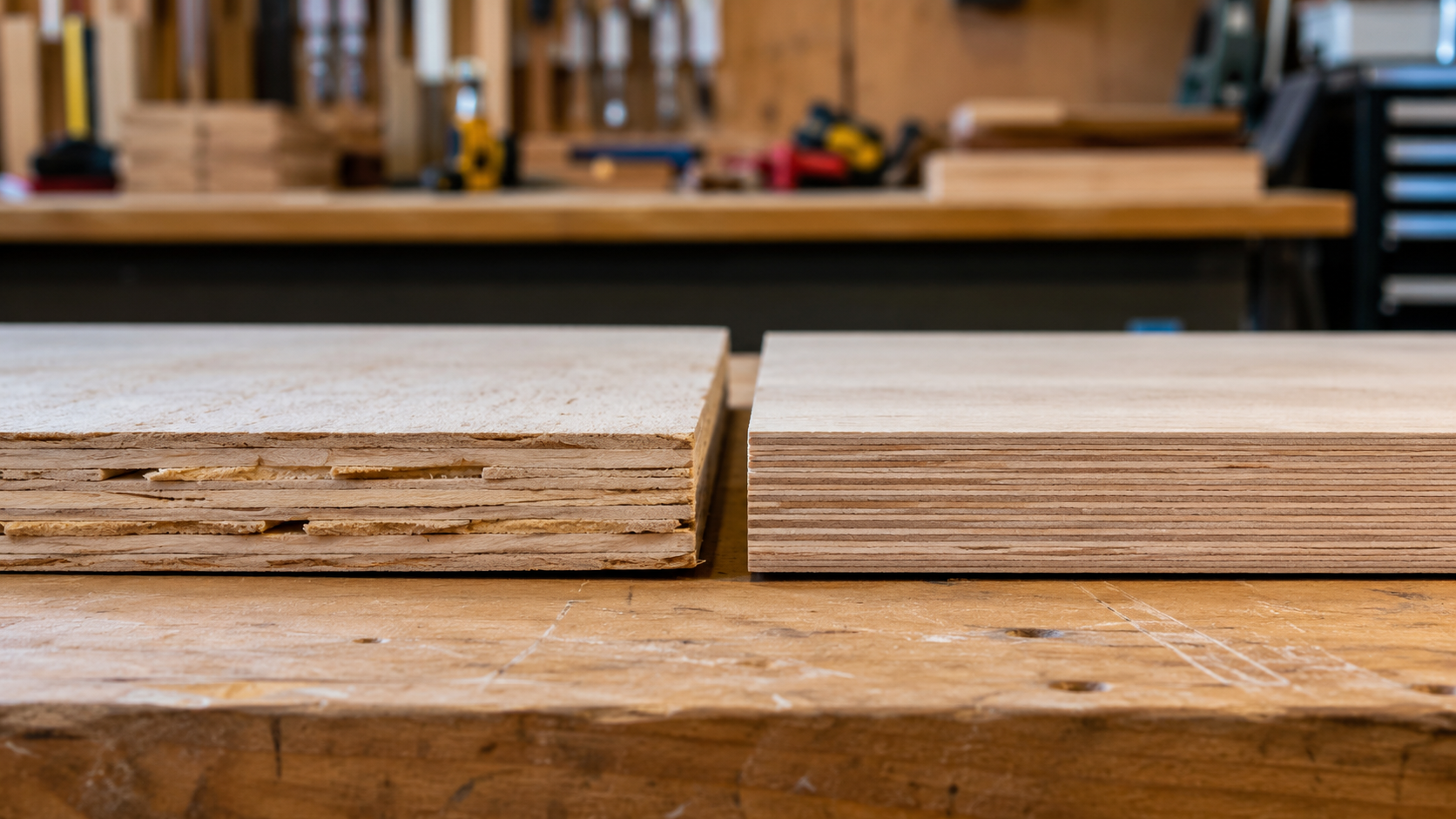
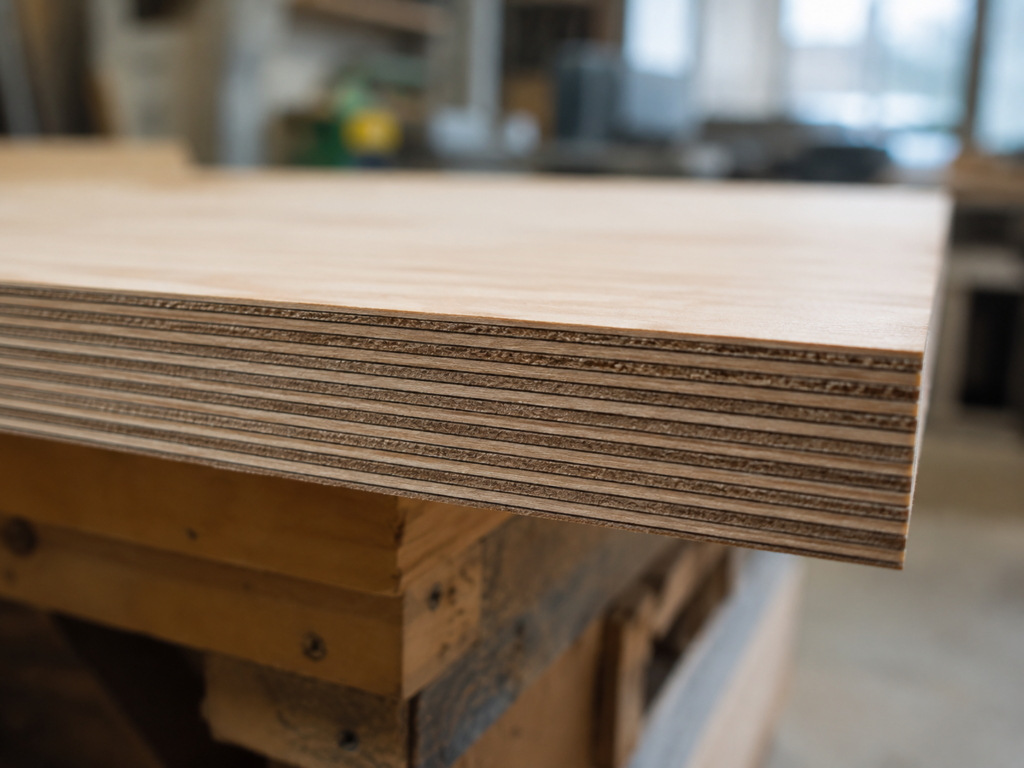
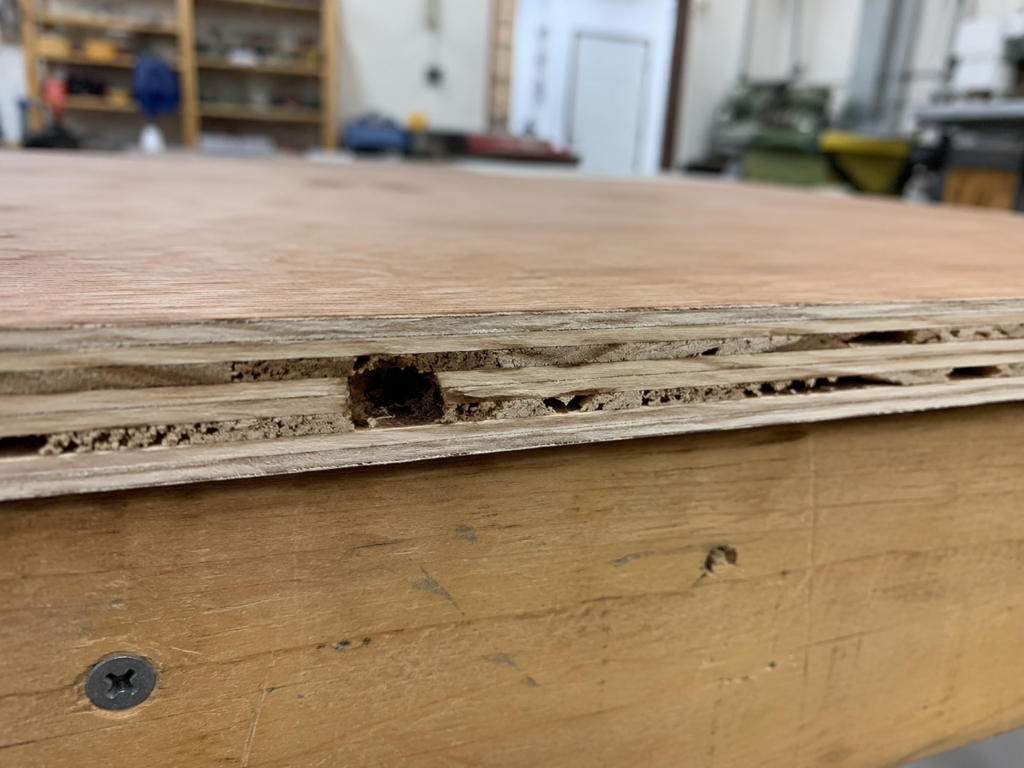
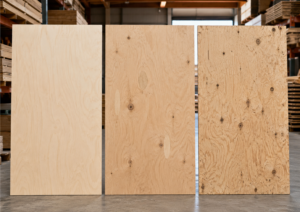
1. Core gaps. Exterior panels using C and D veneers commonly contain sizeable internal gaps. APA marine caps core gaps at 1/8 inch, so water passing a finish has far less room to collect.
2. Knotholes. C veneer permits knotholes up to roughly 1-1/2 inches; D veneer up to roughly 2-1/2 inches. Marine permits none in any ply.
3. Veneer quality throughout the panel. Marine plywood controls defects throughout the panel, including the inner veneers, rather than only providing an attractive surface face.
4. Face and back quality. Exterior-rated plywood is available in a wider range of face/back grades. APA marine plywood is restricted to A-A, A-B, B-B, MDO or HDO configurations.
5. Fastener holding. Fewer voids means a fastener is less likely to land in a gap — one reason marine plywood is commonly specified for transoms and mounting points.
Which Is More Water Resistant?
Marine plywood is more water resistant in construction, not in material.
Both can use moisture-resistant structural bonds designed to withstand repeated wetting better than interior-bond plywood. The wood itself, however, can still absorb moisture, swell and decay.
The difference is internal geometry: an exterior panel with open core gaps can hold water inside the panel where it cannot evaporate, while a marine panel’s limited core gaps give trapped water less room to collect.
BSI notes a failure mode worth understanding here: rapid water ingress at a panel edge can cause differential swelling in the core and localized rupture of the wood fibres, which presents as apparent delamination even where the bond itself has not failed. This is why edge sealing matters more than grade selection in most exposed applications.
Neither panel is waterproof wood. Both require a finish system in exposed service. What happens to a saturated panel, and how to dry one, is covered in can plywood get wet.
Which Is More Rot Resistant?
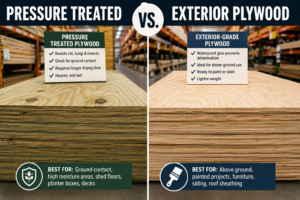
Neither is preservative-treated. For ground contact or sustained wetting, use pressure-treated plywood.
Bond classification and decay resistance are separate properties produced by separate processes:
Property
Comes from
Resistance to glue-line failure
Bond classification (Exterior / Exposure 1)
Resistance to fungal decay and insects
Preservative treatment (AWPA use category), or natural durability of the species
Pressure-treated plywood is the only category discussed here that is preservative-treated for decay resistance. Use categories: UC3A and UC3B for above-ground exterior, UC4A or higher for ordinary ground contact, UC5 categories for saltwater and brackish exposure. Our pressure-treated vs exterior plywood comparison covers the trade in detail.
The one nuance: BS 1088:2018 selects veneer species on density and resistance to bio-deterioration, so certified panels carry some natural durability from the timber itself. That is species durability, not preservative treatment, and it does not substitute for treatment in ground contact. APA marine panels carry no such species-durability requirement — APA states directly that marine plywood is not treated to resist decay.
❌ Common mistake: Buying marine plywood for a planter, garden bed or ground-contact structure on the assumption that it resists rot. Neither APA marine nor exterior-rated plywood is preservative-treated. Pressure-treated plywood is generally the more appropriate and often less expensive choice for those applications. Panels already showing decay are covered in our guide to rotten plywood.
Exterior vs Marine Plywood Cost
Panel (3/4″, 4×8)
Typical retail range
CDX
$35–$60
BCX
$45–$70
ACX
$60–$95
Pressure-treated
$55–$95
AB marine Douglas-fir
$85–$140
BS 1088 certified okoume or meranti
$140–$200+
Marine plywood usually costs substantially more than ACX, with the premium varying widely by species, certification, thickness and supplier. Prices move with species, thickness and market week — current ranges are tracked in our plywood price guide.
💸 When the premium pays for itself: Marine plywood is worth its cost where a hidden void is a structural or safety failure, or where the panel cannot be inspected again after installation — hulls, transoms, soles, permanent bulkheads. It is not worth its cost on sheds, planters, fence panels, mailbox posts or garden boxes. On those, the same money is better spent on the correct panel plus a proper edge-sealing system.
For ordinary exterior projects that do not require marine-grade construction, careful panel selection and finishing can substantially improve service life. It does not turn exterior plywood into marine plywood or eliminate hidden core defects.
Buy the best available face — ACX or BCX rather than CDX. Fewer voids from the start.
Inspect all four edges of every sheet before purchase. Reject panels with visible core gaps.
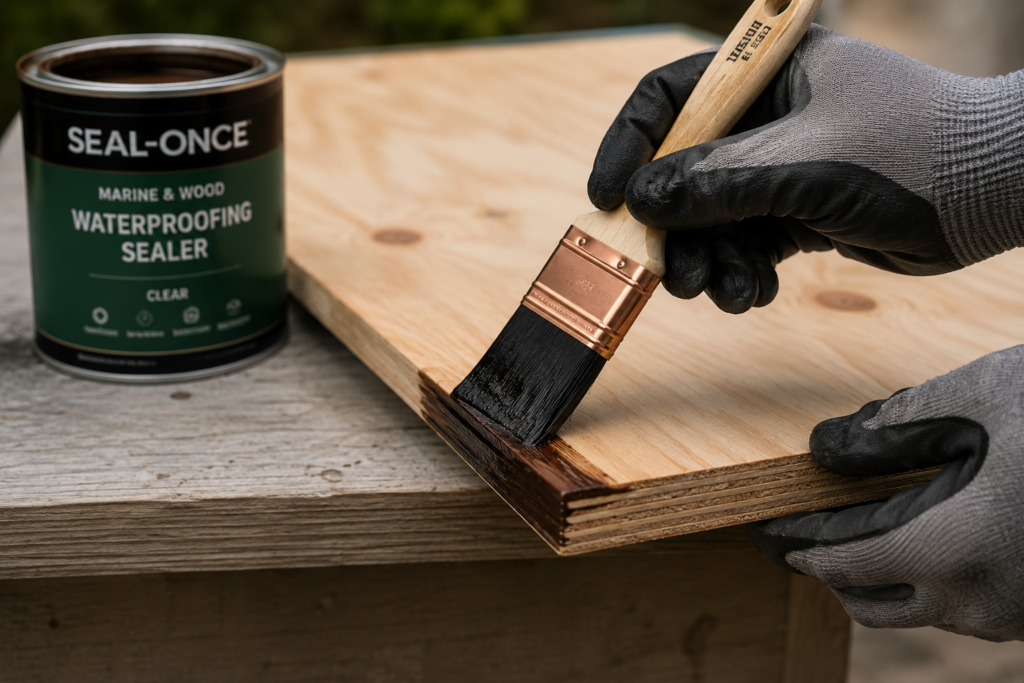
Seal exposed and field-cut edges using the coating system appropriate for the project, before assembly while all four edges are still reachable. Penetrating epoxy is one option for demanding exposure; painted siding can use a compatible primer or edge sealer, and stained siding a suitable water-repellent treatment. End grain is the primary water entry path.
Prime and topcoat both faces. Unbalanced finishing causes cupping.
Reseal every field cut made during installation.
Keep the bottom edge above grade and leave an expansion gap between panels. APA recommends 1/8 inch spacing, but manufacturer installation instructions take precedence where they differ.
Documented failure pattern: A frequent cause of early failure in exposed panels is finishing the visible faces thoroughly while leaving the bottom edge unsealed. Moisture wicks up through unsealed end grain and the lower portion of the panel can soften while the painted face above still appears sound. APA recommends sealing all siding edges before installation and resealing any edge cut in the field.
Quick Answers
Is marine plywood waterproof? No. Marine plywood uses a waterproof structural bond, but the wood itself can still absorb moisture and decay.
Is marine plywood pressure treated? No. Marine grade describes panel construction and veneer quality. Preservative treatment is a separate process and a separate property.
Does marine plywood have fewer voids? Yes. APA marine plywood limits core gaps to 1/8 inch and permits no knotholes in any ply.
Is exterior plywood the same as Exposure 1? No. Exterior is rated for long-term weather exposure. Exposure 1 is rated for construction-stage moisture and protected applications.
Is marine plywood stronger than exterior plywood? Not automatically. Marine plywood has tighter limits on veneer defects and core gaps, but structural capacity still depends on species, thickness, construction and panel rating.
Can exterior plywood be used on a boat? For structural components such as hulls and transoms, follow the boat plans or designer’s material specification. Marine plywood is commonly specified because its tighter limits on core gaps and veneer defects reduce hidden-defect risk.
Do I need marine plywood for a bathroom? No. Exterior or Exposure 1 panels are appropriate for humid interiors.
What is the cheapest plywood suitable for outdoor use? CDX is the cheapest panel with a waterproof bond, but it is designed to be covered. For permanently exposed painted work, BCX is generally the lowest-cost smooth-faced option.
Why is okoume marine plywood expensive? Quality BS 1088 okoume combines low weight with tightly controlled marine-plywood manufacturing requirements. Certification, veneer quality and import costs can add substantially to its price.