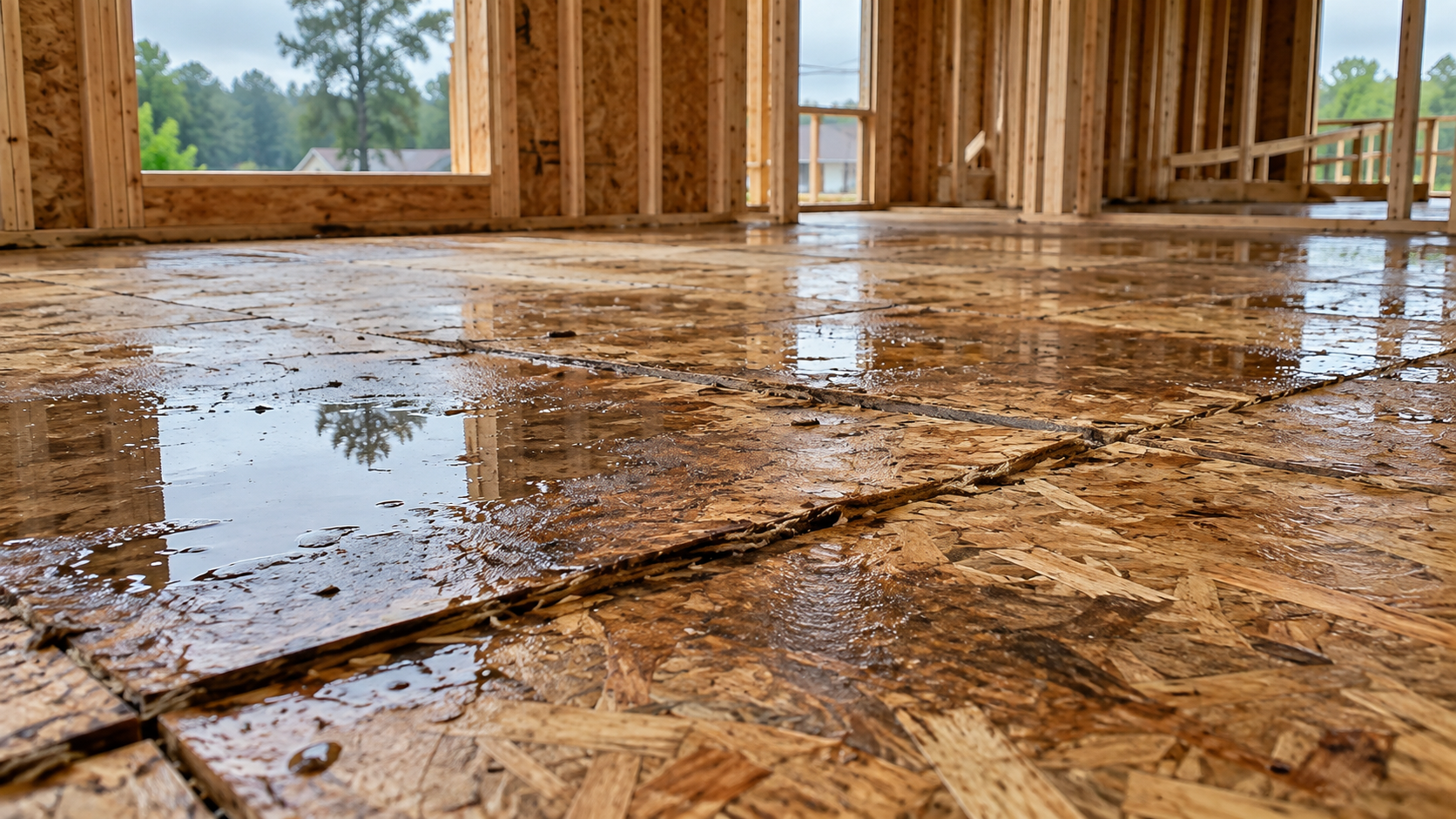
Yes, OSB can get wet. A standard Exposure 1 panel is built to handle normal construction delays without losing its structural strength. The catch is that OSB edges often swell, and that swelling may not fully go away after the panel dries. That leftover swelling, not the wetting itself, usually decides whether you sand, seal or replace.
This page covers why OSB swells, how to tell repairable damage from a panel that has to come out, how dry is dry enough, and the mistakes that turn a rain delay into a tear-out.
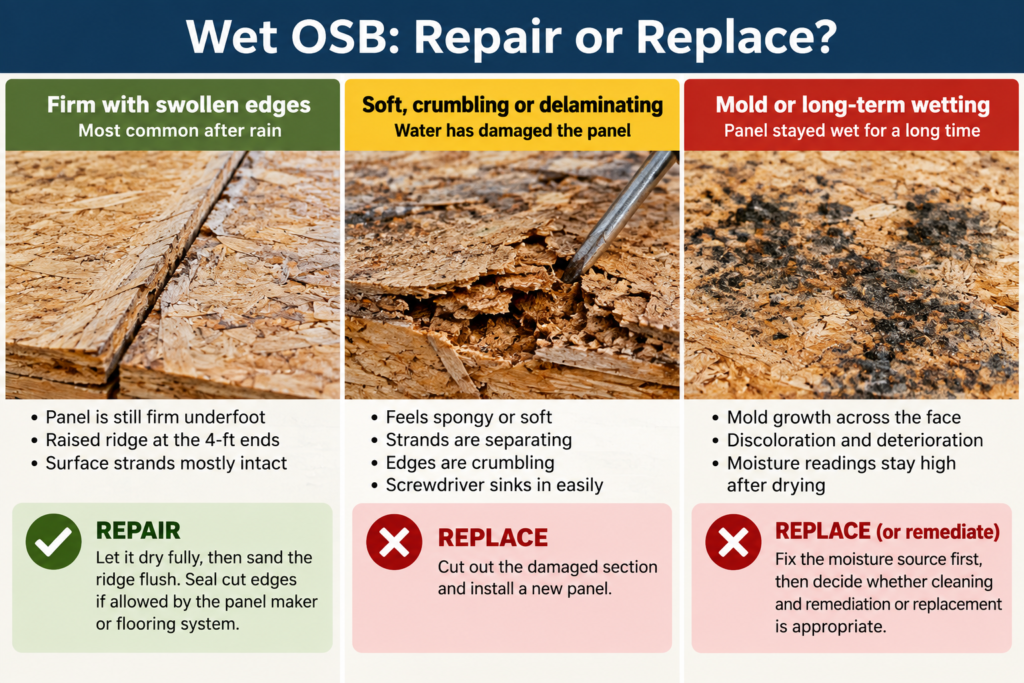
Short rain exposure (days): Usually fine structurally. Let it dry fully, then check the edges.
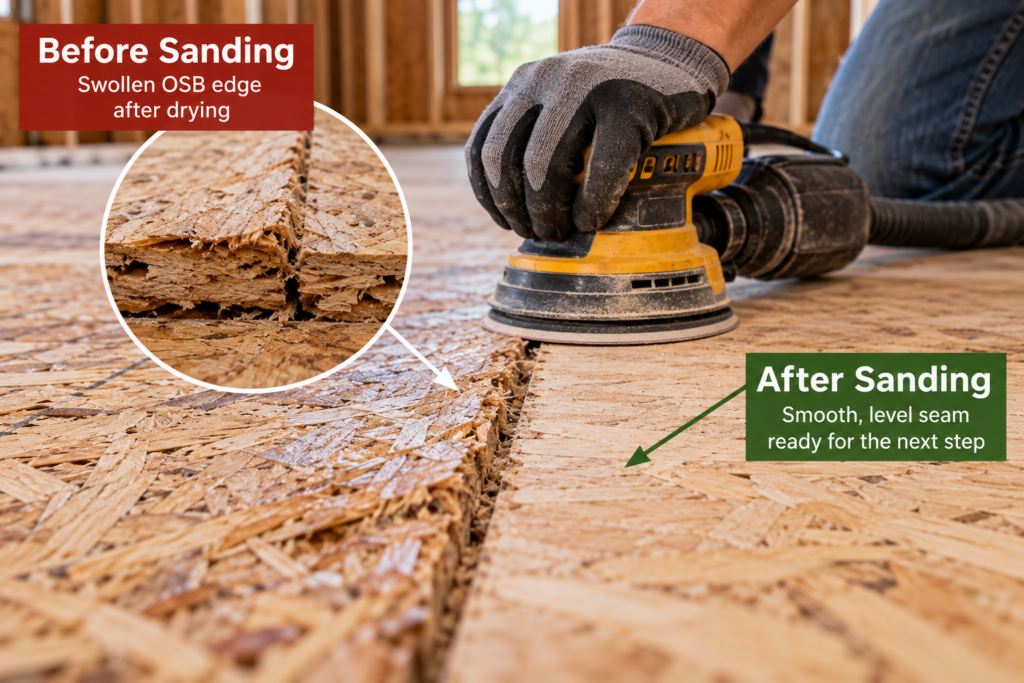
Swollen edges, panel firm: Repairable. Dry it, then sand the ridges flush if it’s a subfloor.
Soft, crumbling or delaminating through the panel: Replace that section.
Extensive mold, or wet for weeks from a hidden leak: Fix the source first, then decide between cleaning and replacement based on what a probe and a moisture meter show.
Wet OSB Repair or Replace Chart
What you see after the panel dries
What it usually means
Do this
Raised ridge along the 4-ft panel ends, face is firm
Edge thickness swell, the most common result
Sand flush once fully dry (subfloor). Seal exposed cut edges only if the panel maker or flooring system allows it.
Light surface flaking, panel firm underfoot
Face strands lifted by water
Sweep, and sand lightly if a finished floor is going over it
Ridges showing through thin roof shingles (“ghost lines”)
Deck edges swelled before or under roofing
Often cosmetic. Replace panels if the ridges are severe or the deck was roofed while wet.
Panel feels spongy, or a screwdriver sinks in easily
Decay has started
Cut out and replace
Strands separating through the thickness, edges crumbling
Bond and strand structure breaking down
Replace
Fasteners loose or pulling through
Holding power lost around the nails
Replace, or re-fasten into sound material if the damage is very local
Extensive mold growth, especially with long wetting or a deteriorating panel
Panel stayed wet a long time
Fix the moisture source, then decide whether cleaning and remediation or replacement fits
Moisture readings stay high days after the source is fixed
Hidden water source or trapped moisture
Find the source before you touch the panel
Why OSB Swells When It Gets Wet
OSB is made by pressing resin-coated wood strands together under heat and pressure, which squeezes them tight. Water lets some of that squeeze go. InterNACHI’s comparison of OSB and plywood says this release of pressing stress is why OSB swells more than plywood.
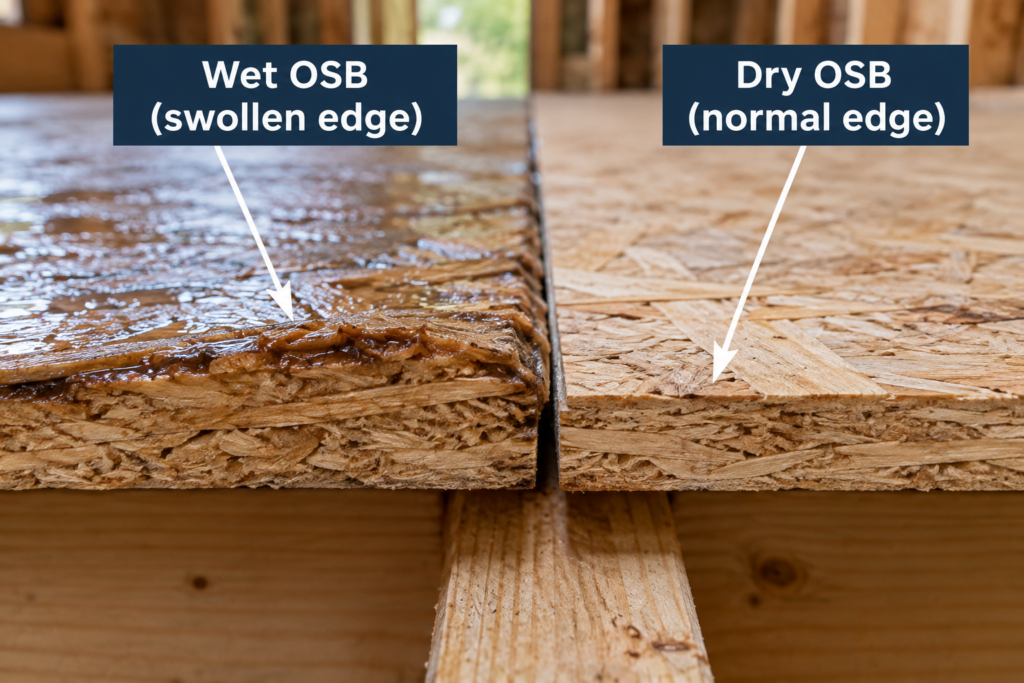
The edges take the worst of it, because that’s where strands are cut open and water gets in fastest. Weyerhaeuser’s technical support notes that thickness swell shows up most at the 4-ft panel ends. Adjacent panels can swell into each other and leave a ridge along the joint.
This is the real difference from plywood. The University of Massachusetts Building and Construction Technology program points out that plywood soaks up water faster than OSB, but plywood isn’t prone to edge swelling and it dries out sooner. OSB takes on water more slowly and holds it longer.
⚠️ Warning: “Exposure 1” describes the glue bond, not rot resistance. The stamp means the panel can handle temporary weather during construction. It does not mean the panel resists decay if it stays wet. Keep those two ideas separate when you read a grade stamp.
What a Real Rain Test Showed
🧪 Real test: Researchers writing in the Forest Products Journal (Vol. 63, No. 5/6) left OSB and Douglas-fir plywood subfloor panels out through a Pacific Northwest winter, with the panel edges sealed. After about 31 mm (roughly 1.2 inches) of rain over the first 25 days, both had climbed to nearly 40% moisture content. By day 92 the OSB had reached 46%, while the plywood had dropped back to 33%. The authors concluded that even short construction delays can noticeably affect panel properties.
The takeaway isn’t that OSB can’t get rained on. It’s that time matters. A weekend of rain on a new roof deck or subfloor is a normal job-site event. A deck left uncovered for a month is a different situation.
How Long Can OSB Stay Wet?
No standard publishes a safe number of days. The honest answer depends on the panel, the climate and whether it can dry between storms. Here is how the main sources frame it.
Panel type
What the maker or standard says
Practical read
Standard Exposure 1 OSB
West Fraser says Exposure 1 panels withstand normal construction delays without affecting structural properties
Brief, intermittent construction exposure is generally expected for Exposure 1 panels, but cover the OSB as soon as practical.
Enhanced sheathing (example: GP DryGuard)
Georgia-Pacific warrants no sanding needed for up to 200 days
The extra cost buys edge-swell protection during long builds
Enhanced subfloor (example: GP DryMax)
Georgia-Pacific guarantees no sanding for up to 500 days
Worth it if the floor will sit open for a season
Any OSB left out in the weather permanently
Exposure 1 isn’t rated for this
Use a product rated for exterior exposure, or cover it
💸 Cost difference: Enhanced OSB panels generally cost more per sheet than standard Exposure 1 OSB, so check local pricing. Compare that extra cost against the labor of sanding a whole floor’s seams, or tearing out a room of subfloor. On a long build in a wet season, the upgrade often costs less than the fix.
How to Dry Wet OSB
Stop the water first. Get the roof covered or the leak fixed. Drying a panel that’s still taking on water wastes time.
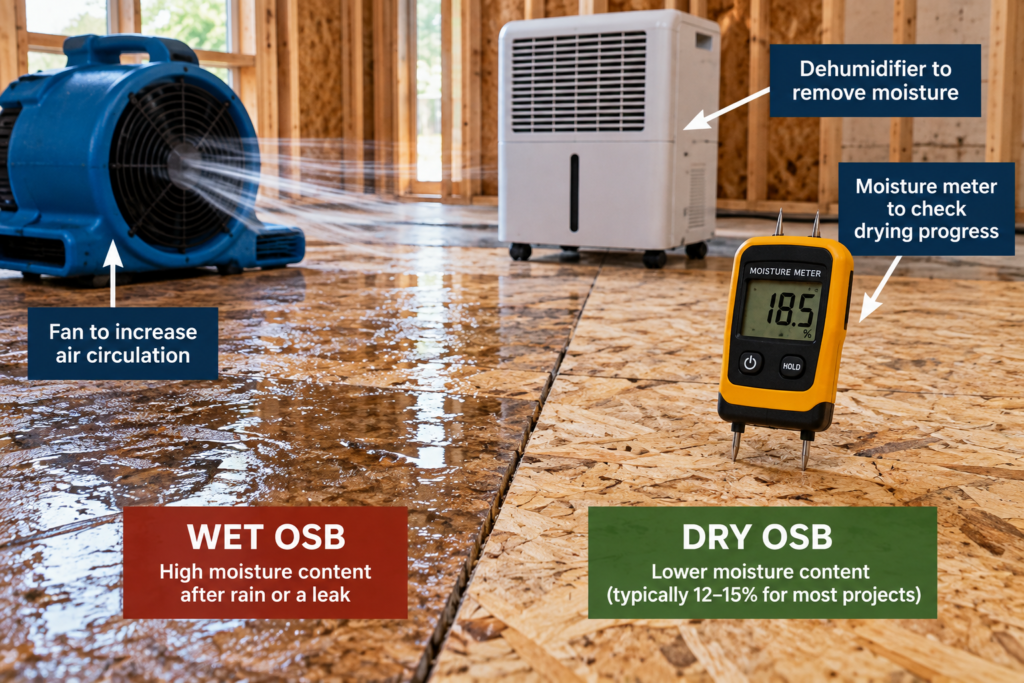
Let air reach both sides where you can. Close up the building, then run the HVAC, fans and a dehumidifier. Weyerhaeuser notes that indoor drying works best once the roof and windows are in and the HVAC is running.
Measure, don’t guess. Pin moisture meters are calibrated for solid wood, so readings on OSB are useful for comparison rather than exact. West Fraser suggests averaging several readings across the wet area and comparing them with a piece of OSB you know is dry, such as a sheet from the store.
Don’t trap it. West Fraser says roof sheathing has to dry completely, which can take a few days, before roofing goes on. Roofing over wet panels traps moisture and invites edge swell and buckling.
Re-check the edges once it’s dry. Weyerhaeuser notes that swelling often shrinks or disappears as the panel dries. Whatever swelling is left after full drying is what you’re actually fixing.
How dry is dry enough under a wood floor? Hardwood flooring instructions that follow NWFA guidelines commonly require a wood subfloor at or below 12% moisture content, and within 4 percentage points of the flooring. Some manufacturers tighten that to 2 points for planks wider than 3 inches. Your flooring manufacturer’s instructions take priority.
Sanding raised seams flush is common field practice. Weyerhaeuser cites the APA Subfloor Preparation Guide (V440) on this. Timing is the key.
Wait. West Fraser says not to sand until the house is fully dried in, drywall and paint are done, and the HVAC is running. Sanding early opens up the surface and can lead to more swelling.
Sand only the ridge. Bring the high edge down to the surrounding surface. You’re leveling a joint, not resurfacing the panel.
Check flatness. Many wood flooring instructions call for the subfloor to be flat within 3/16 inch over 10 feet. Run a straightedge across the seams after sanding.
Seal edges only where allowed. If the panel manufacturer or flooring system permits it, seal exposed cut edges with a compatible edge sealer. Some flooring adhesive systems don’t want a coating on the subfloor, so check the installation instructions first. Our OSB sealer guide compares product types.
Add underlayment if the floor needs it. APA’s builder tips say underlayment should go only on a dry subfloor, with its joints offset at least 2 inches from the subfloor joints.
Roof and wall sheathing
Don’t sand roof decking to fix ridges, because that thins a structural layer. If the deck dried fully before roofing and the ridges are mild, the usual result is cosmetic lines showing through thin shingles. If the deck was roofed while wet, or the ridging is severe, replacing the affected panels is the clean fix.
😬 Regret: The most common regret on this topic is putting hardwood or tile over a subfloor that “felt dry” without taking a meter reading. The floor goes down fine, then cups, gaps or cracks grout months later. Then the finished floor has to come up to fix a subfloor that could have been checked in five minutes.
When to Replace Wet OSB
Replace the section if any of these is true after the panel has dried:
A screwdriver or awl pushes into it easily, which is a sign of decay.
Strands are separating through the thickness, not just flaking on top.
Fasteners won’t hold.
Swelling is still severe after full drying, and sanding it flat would remove a meaningful share of the panel’s thickness.
It’s in a wet room (bathroom, kitchen, laundry) and the water came from a slow leak you only just found.
If you find extensive mold, especially after prolonged wetting or alongside a deteriorating panel, fix the moisture source first. Then decide whether cleaning and remediation or replacement fits the extent of the damage.
How to replace a section:
Find and fix the water source first.
Cut the damaged OSB back to the centers of the nearest joists or rafters, so the new panel’s edges land on framing. Add blocking wherever an edge falls between supports.
Check the framing underneath, because wet subfloor often means wet joists. Probe them for softness, and see our rotten plywood repair guide for how to judge and treat rot.
Match the thickness and span rating of the panel you removed. Use tongue-and-groove panels for floors.
Leave about a 1/8-inch gap at panel ends and edges, the spacing West Fraser specifies for its 4-ft edges, so the new panel has room to move.
If the panel manufacturer or flooring system permits it, seal exposed cut edges with a compatible edge sealer before the panel goes in.
If you’re weighing a different material for the replacement, our OSB alternatives guide covers the options.
When This Advice Doesn’t Apply
Panels that aren’t OSB. Many older mobile homes and some cabinets use particleboard, which can break down badly when wet. The sanding advice above doesn’t apply to it.
Floodwater or sewage. Contaminated water is a health problem before it’s a panel problem. Affected material is generally removed rather than dried and sanded.
Structural doubt. If joists, rafters or a whole roof deck are involved, or the floor is visibly sagging, get a contractor or structural engineer to look at it before you repair panels.
Enhanced panels with warranties. If you used a warranted product, read its terms before sanding or replacing anything. Some warranties set their own conditions.
Tools and Products for Drying and Repairing Wet OSB
These cover the steps above. Each link is a search, so you can compare current models.
Pin-type moisture meter: The most practical way to check how the drying is going. Compare several readings with known-dry OSB.
Random orbital or belt sander: For sanding dried subfloor ridges flush. A belt sander removes ridges faster but takes more control.
Edge sealer / exterior primer: For sealing exposed cut edges where the panel maker or flooring system allows it. Check compatibility with your flooring adhesive first.
Oscillating multi-tool: For cutting out damaged subfloor next to walls, where a circular saw can’t reach.
Common Mistakes With Wet OSB
❌ Mistake 1: Sanding seams while the panel is still wet. You remove material that might have shrunk back on its own, and you open the surface to more swelling.
❌ Mistake 2: Roofing over a wet deck. Moisture gets trapped under the underlayment, which invites edge swell and buckling that shows through the shingles.
❌ Mistake 3: Butting panels tight. Without the 1/8-inch gap, wet panels push against each other and buckle.
❌ Mistake 4: Ignoring raw cut edges. Factory edges often come with some edge sealing, but your cuts don’t, and raw cut edges take on water fastest. Keep them dry, and seal them where the panel maker or flooring system allows.
❌ Mistake 5: Trusting your hand instead of a meter. The face can feel dry while the core is still wet. The flooring will find out later.
❌ Mistake 6: Treating “Exposure 1” as “waterproof.” It’s rated for temporary weather during construction, not for permanent exposure, and it says nothing about rot resistance.
FAQ
Does OSB go back to normal after it gets wet? Partly. Weyerhaeuser notes that edge swelling often shrinks or disappears as OSB dries. Some swelling can remain, which is why subfloor seams sometimes need sanding after the building is dried in.
Does rain ruin OSB? Normal construction rain usually doesn’t. West Fraser says Exposure 1 panels handle normal delays without losing structural properties. Problems such as edge ridges, flaking and eventually decay come from long or repeated wetting.
How long does wet OSB take to dry? It depends on how wet it got, the temperature, the humidity and the airflow. West Fraser says a rained-on roof deck can take a few days. A soaked subfloor in a closed-up house without HVAC can take much longer. Track it with moisture readings rather than a set number of days.
Can you put flooring over OSB that got wet? Yes, once it’s dry and flat. Hardwood instructions that follow NWFA guidelines commonly require the subfloor at or below 12% moisture content and within 4 points of the flooring. Sand any remaining ridges flush first.
Is OSB waterproof if it’s painted? No. Paint or sealer slows water down, especially at the edges, but OSB isn’t waterproof. Keep it covered and away from standing water.
Should I use plywood instead of OSB in wet areas? Plywood dries faster and resists edge swelling better, so many builders prefer it for bathrooms, kitchens and shed floors. Enhanced moisture-resistant OSB subfloor panels are another option. Our OSB pros and cons guide compares them.
Bottom Line
OSB can get wet, and short construction rain usually won’t hurt its strength. The real risk is edge swelling that stays after the panel dries. Dry it fully, check it with a meter, sand subfloor ridges only after the building is dried in, and replace any section that’s soft, crumbling or rotted.
Related Posts:
Dealing with Wet and Warped Plywood: What You Can Do by Admin March 21, 2025 Repairs Dealing with Wet and Warped Plywood: A Practical Guide We have prepared a reference guide for you—an easy checklist for your convenience. Wet_and_Warped_Plywood_Checklist_ThePlywoodDownload If you’ve…
Patch or Replace a Rotted Plywood Subfloor? by Admin September 24, 2026 DIY Woodworking Whether to patch or replace rotted plywood subfloor comes down to how far the decay has spread and what's underneath it. Small areas of rot…