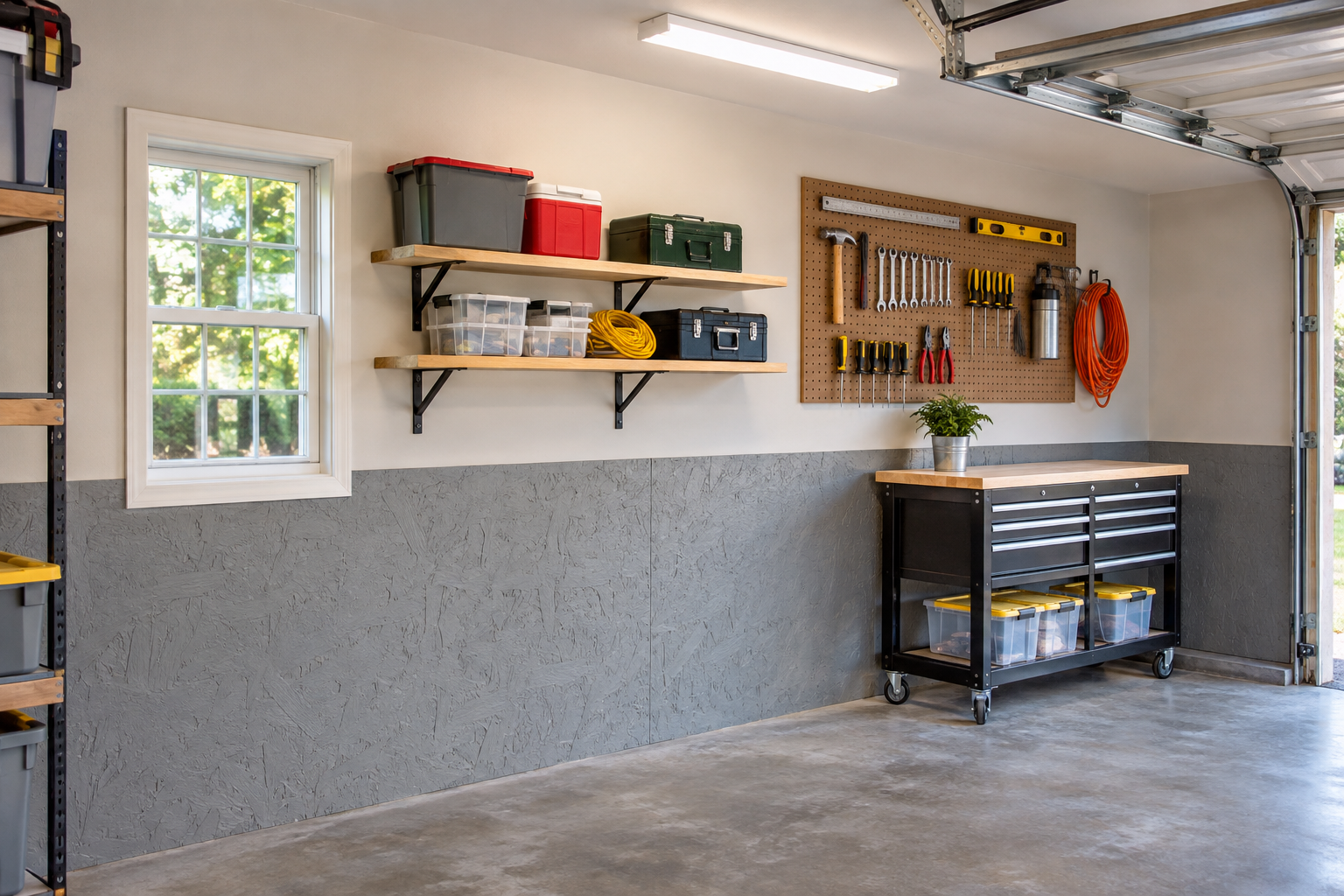
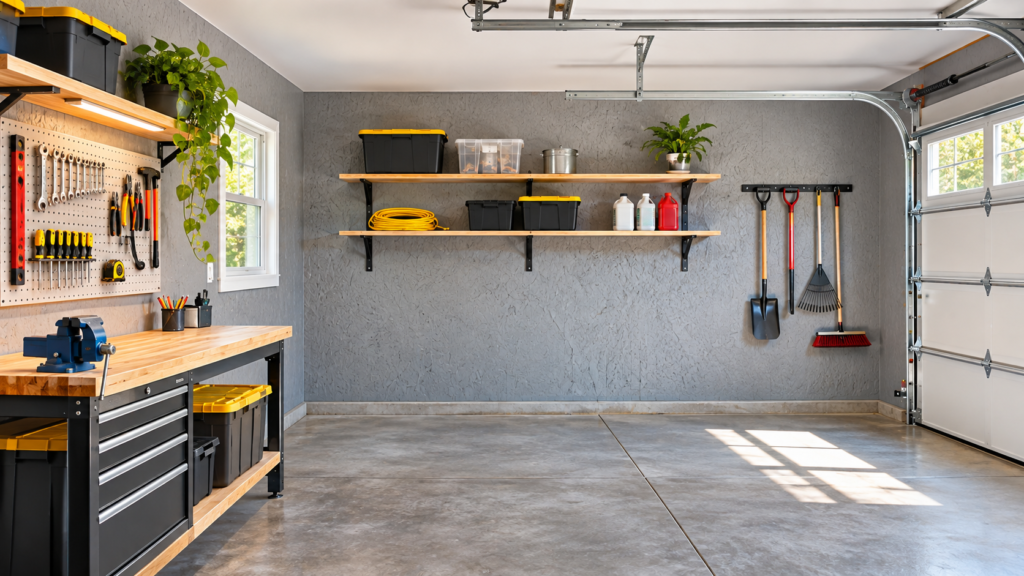
The cheapest way to cover garage walls is 7/16-inch OSB or 1/2-inch drywall. In November 2026, Home Depot listed both at about $11–$17 per 4×8 sheet, roughly 34–53 cents per square foot. Drywall needs taping. OSB needs only primer and paint, and it holds screws across its surface for light-duty storage. One rule changes the choice: in an attached garage, the IRC requires at least 1/2-inch gypsum board on the wall shared with the house, so OSB alone doesn’t count there. Below are nine options with current prices, a full-garage cost example, and the mistakes that turn a cheap wall into an expensive one.
Lowest cost on open studs: 1/2-inch drywall (about $12–$16 a sheet) or 7/16-inch OSB (about $11–$17 a sheet).
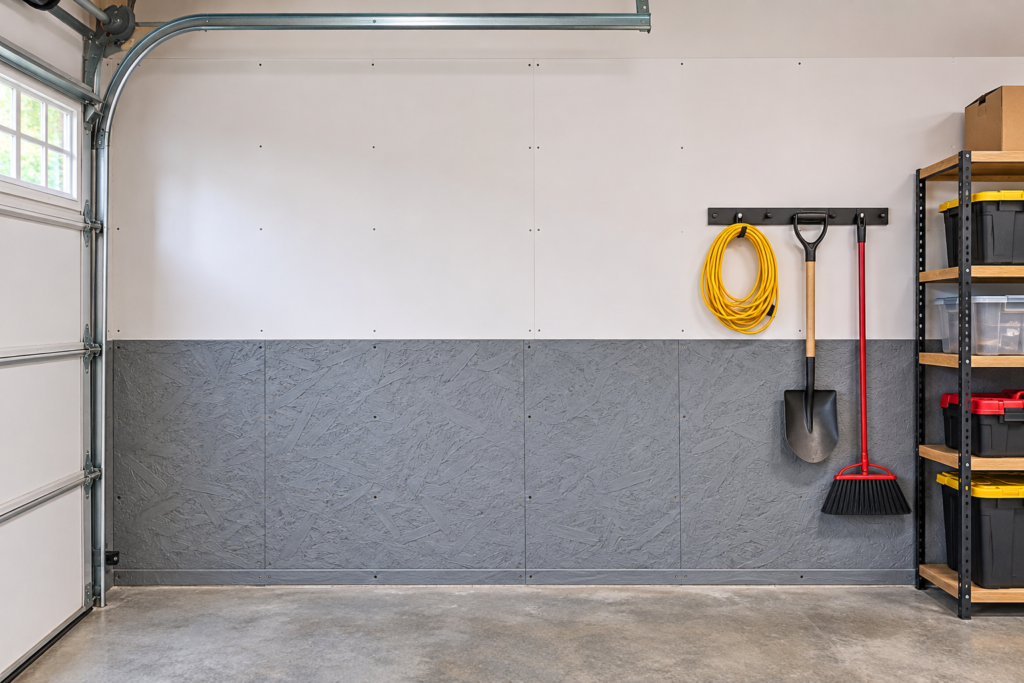
Best value for a workshop: OSB on the lower 4 feet and drywall above. It costs about the same as all-drywall and takes the bumps where they happen.
Heavy storage: OSB and plywood hold screws for light-duty items. Anchor heavy shelving, cabinets and equipment directly into wall studs.
Wall shared with the house: at least 1/2-inch gypsum board on the garage side (IRC Table R302.6).
Cheap Garage Wall Covering Prices Compared
Prices are Home Depot online listings checked in November 2026. They vary by store and region and change often, so confirm locally before you buy.
Wall covering
Typical price
Approx. cost per sq ft
Finishing work
Hanging without hitting studs
Dent resistance
Moisture tolerance
OK as house-to-garage separation?
1. Paint over existing drywall or block
Primer and paint only
Lowest
Low
No; use studs or anchors
Same as wall
Same as wall
Yes, if existing 1/2″ gypsum is intact
2. 1/2″ drywall, Level 2 finish
$12.48–$16.37 per 4×8 sheet
$0.39–$0.51 + tape and mud
Tape, mud, paint
No; use studs
Low
Low
Yes
↳ Mold-resistant version of 1/2″ drywall
$19.78–$25.98 per sheet
$0.62–$0.81
Tape, mud, paint
No; use studs
Low
Better than standard
Yes
3. 7/16″ OSB, primed and painted
$10.98–$16.90 per 4×8 sheet
$0.34–$0.53
Prime and paint
Light-duty only; heavy items into studs
High
Fair if painted; edges swell when wet
No, not on its own
4. 1/2″ sanded plywood (12 mm)
$45.55–$53.73 per 4×8 sheet
$1.42–$1.68
Prime and paint, or clear coat
Light-duty only; heavy items into studs
High
Fair to good if finished
No, not on its own
5. Hybrid: OSB lower 4 ft, drywall above
Mix of the two above
About $0.36–$0.52
Partial taping
Lower half, light-duty only
High where it matters
Better at the floor line
Yes, if gypsum runs full height on that wall
6. Hardboard pegboard on furring strips
$23.98 per 4×8 sheet (3/16″)
About $0.75 + furring
Furring + paint
Hooks only
Low to medium
Poor
No
7. Ribbed steel panels (29-gauge, 3×8 ft)
$31.76–$36.50 per panel
$1.32–$1.52 before side laps
Horizontal nailers needed
No
High (dents show)
Good
No
8. FRP panels (.090″, 4×8) over a backer
$42.98–$47.98 per sheet
$1.34–$1.50 + backer + adhesive
Adhesive + trim
No
Medium
Very good
Only if the backer is 1/2″ gypsum
9. PVC garage panels (Trusscore)
$299 per 8-pack (85.31 sq ft)
$3.50–$3.93
Low
Varies by system
Medium
Very good
Check the product’s listing
How to read it: OSB and drywall are so close in price that the sheet price won’t decide between them. Labor and hanging will. Drywall needs taping, while OSB takes light-duty screws anywhere on the wall. If the wall is shared with the house, start with drywall and build from there.
The Rule That Changes the Cheapest Option: Attached Garages
The IRC requires the garage to be separated from the house by not less than 1/2-inch gypsum board or equivalent, applied on the garage side (Table R302.6). Two related rules from the same table:
Living space above the garage: the garage ceiling needs at least 5/8-inch Type X gypsum board. Walls and posts supporting that floor need at least 1/2-inch gypsum.
Detached garage less than 3 feet from the house: walls facing the house within that distance need 1/2-inch gypsum on the inside.
So “cheapest” depends on which wall you’re covering. On the shared wall, drywall is the minimum. Plywood or OSB can go over it, but not in place of it. Some areas amend these rules, so confirm with your building department before you cover a separation wall.
⚠️ Warning: Swapping the builder’s drywall on the house-side wall for OSB to “make it stronger” can remove the fire separation the code requires. Put the panel over the drywall instead.
What Changes the Answer
Open studs or block
On open studs, every option above applies. On concrete block or poured concrete, wood panels need furring strips, and they belong only on a wall that stays dry. A block wall that wicks ground moisture will feed mold behind any panel. On a dry block wall, primer and masonry paint are often the cheapest finish that holds up.
Insulation behind the wall
If you insulate with foam board, the foam usually needs a thermal barrier between it and the room. The IRC names 1/2-inch gypsum board or a 23/32-inch wood structural panel as the prescriptive options (R316.4 in the 2021 IRC; newer editions renumber this section, so check the edition your area adopted). That rules out 7/16-inch OSB over foam under the prescriptive path, while 23/32-inch plywood or OSB qualifies. If you use kraft-faced fiberglass, read the bag: manufacturers generally say the facing must not be left exposed.
What you’ll hang
Drywall can’t hold a screw on its own, so anything you hang on it goes into studs or anchors. OSB and plywood hold screws across their surface for light-duty storage like hooks, small bins and hand tools. Anchor heavy shelving, cabinets and equipment directly into wall studs, whatever the covering. A French cleat rail screwed into studs spreads heavy loads well. Our French cleat weight capacity guide covers how much a cleat wall can carry.
Labor vs. material cost
At current prices, drywall and OSB cost about the same per sheet, so labor is where they differ. The Gypsum Association’s GA-214 standard says a Level 2 finish (tape bedded in compound, one coat over the fasteners) may be used in garages and similar areas where appearance isn’t the main concern. That cuts drywall labor down, but it doesn’t remove it. OSB skips taping altogether.
9 Cheap Garage Wall Covering Ideas, Ranked by Value
1. Paint what you already have
If the builder left drywall or block, primer and a light-colored paint are the cheapest upgrade by far. Paint won’t make the wall any tougher.
2. Drywall with a Level 2 finish (about $12–$16 a sheet)
This is the lowest-cost new covering for open studs and the default on any wall shared with the house. Its weakness is impact: bikes, car doors and shop carts dent it. Use it from about 4 feet up, and as the base layer on separation walls. Mold-resistant board runs about $20–$26 a sheet and is worth a look near the floor in a damp garage.
3. Painted 7/16-inch OSB (about $11–$17 a sheet)
This is the workhorse for workshops. It takes bumps well, needs no taping, and holds screws across its surface for light-duty storage. Anchor heavy shelving, cabinets and equipment directly into wall studs. Raw OSB soaks up paint, so prime it first. Our guide on how to paint OSB covers choosing a primer and sealing the edges. Here, panel thickness is a covering choice, not a structural span rating. Our OSB thickness guide explains where the structural ratings apply.
4. 1/2-inch sanded plywood (about $46–$54 a sheet)
It’s smoother and cleaner-looking than OSB, and it takes a clear finish if you want the wood to show. It costs roughly three times as much per sheet. Like OSB, it handles light-duty hanging, and heavy items still go into studs. Choose it when the look matters as much as toughness.
5. The hybrid wall: wood below, drywall above
This is the best fit for most garages that do double duty. Run 4-foot-high OSB along the bottom, where bumpers, mowers and carts hit, and drywall above. At current prices it costs about the same as all-drywall. On the shared house wall, hang the gypsum full height first and put the OSB over it.
Pegboard works for light hand tools, but it isn’t a wall surface on its own. Hooks need space behind the board, so mount it on furring strips screwed into studs. For heavier tools, see how it compares with a cleat wall in French cleat vs. pegboard.
7. Metal wall panels (about $32–$37 per 3×8 panel)
Ribbed or corrugated steel panels are tough, washable and quick to put up. Vertical panels need horizontal nailers or blocking, because the fasteners have to land in wood, not air. Side laps reduce each panel’s coverage, so buy a few extras. Cut edges are sharp, and you can’t hang things just anywhere.
8. FRP panels (about $43–$48 a sheet, plus a backer)
Fiberglass-reinforced plastic wipes clean and handles moisture well, which makes it a good choice behind a utility sink or in a wash bay. Standard FRP sheets are glued to a solid backer and aren’t made to span studs on their own. Pre-laminated FRP-on-plywood products are the exception. Fire ratings vary by product: many standard panels are Class C under ASTM E84, and Class A versions exist.
9. PVC garage panels (about $3.50 per sq ft)
This is the one option here that isn’t cheap. PVC systems shrug off moisture and look finished, but they cost several times as much as OSB or drywall. Choose them when moisture or appearance justifies the price, not when the goal is a low budget.
Decision Chart: Which Cheap Wall Fits Your Garage
Your situation
Pick
Why
Attached garage, wall shared with the house
1/2″ drywall (plus optional OSB over it)
Code minimum first, then toughness
Workshop with light tools and bins
OSB, full height (non-separation walls)
Light-duty screws hold anywhere; resists bumps
Heavy shelving or cabinets planned
Any covering, with units anchored into studs
The studs carry heavy loads, not the covering
Parking plus storage, tight budget
Hybrid: 4 ft OSB + drywall above
Toughness at bumper height, same cost as drywall
Block or concrete wall that stays dry
Primer + masonry paint
Cheapest finish; no cavity for mold
Block wall that gets damp
Fix the water first, then paint
Panels over a wet wall hide rot and mold
Foam board insulation going in
1/2″ drywall or 23/32″ panel over it
Meets the prescriptive thermal-barrier options
Wash area or utility sink
FRP over a gypsum or plywood backer
Wipes clean, handles splashing
What It Costs to Cover a Two-Car Garage
This is a worked example using the November 2026 prices above, not a measured project. Plug in your own dimensions and local prices.
Take a 24 x 24 ft garage with 8-ft walls, one 16 x 7 ft overhead door and one 3 x 6.8 ft entry door:
Gross wall area: 4 walls x 24 ft x 8 ft = 768 sq ft
Minus the overhead door (112 sq ft) and the entry door (about 20 sq ft) = about 636 sq ft
636 ÷ 32 sq ft per 4×8 sheet = about 20 sheets, plus about 10% for waste = about 22 sheets (about 700 sq ft)
Covering
Quantity
Estimated material cost
7/16″ OSB
22 sheets
$242–$372 + primer and paint
1/2″ drywall
22 sheets
$275–$360 + tape, compound and paint
Hybrid (11 OSB + 11 drywall)
22 sheets
$258–$366 + finishing supplies
Pegboard on furring
22 sheets
About $528 + furring strips
1/2″ sanded plywood
22 sheets
$1,002–$1,182 + finish
FRP over a backer
22 sheets + 22 backer sheets
$946–$1,056 for FRP alone, plus backer and adhesive
Ribbed steel (3×8)
About 30 panels
$953–$1,095+ (side laps add more)
PVC panels
9 boxes
About $2,691
If one 24-ft wall is shared with the house (about 172 sq ft after the entry door), that wall alone takes about 6 sheets of drywall. The other walls can be OSB, plywood or the hybrid.
💸 Cost difference: At these prices, all-OSB and all-drywall come within about $35 of each other for the whole garage. The real gap is the tape, joint compound and evenings of finishing that drywall needs, compared with one coat of primer on OSB. Plywood adds about $750–$800 over OSB for the same garage. That buys a smoother face, not more holding power for heavy items.
Common Mistakes That Make a Cheap Wall Expensive
Replacing the house-side drywall with OSB. The wall may no longer meet IRC Table R302.6, and an inspector or insurer can make you redo it. Add wood over the gypsum instead.
Hanging heavy cabinets or shelving on the panel alone. OSB and plywood hold screws for light-duty storage. Heavy units fastened only to the sheathing can pull loose over time, so anchor them directly into wall studs. Our guide to installing garage wall cabinets covers mounting.
Paneling over a damp block wall. The panel hides the moisture while mold or rot grows behind it. Test the wall first, and don’t seal damp wood, because the sealer traps the moisture inside.
Leaving OSB unpainted at the floor line. Snowmelt and car drips puddle along the base, and unsealed OSB edges swell. Keep panels off the slab and seal the bottom edge. Our guide on whether OSB can get wet shows what swelling looks like and when a panel has to come out.
Leaving foam board exposed, or covering it with thin OSB. Either one misses the prescriptive thermal-barrier rule. Use 1/2-inch gypsum or a 23/32-inch panel.
Gluing FRP straight to the studs. Standard sheets bow and crack without a solid backer. Budget for the backer layer, which roughly doubles the sheet count.
Picks for a Low-Cost Garage Wall
As an Amazon Associate, theplywood.com earns from qualifying purchases.
Full-coverage adhesive keeps FRP flat on its backer
FAQ
What is the cheapest way to cover garage walls?
On open studs, 1/2-inch drywall (about $12–$16 a sheet) or 7/16-inch OSB (about $11–$17 a sheet) is the cheapest, based on November 2026 Home Depot listings. Drywall needs taping and OSB doesn’t. On a wall shared with an attached house, drywall is the minimum.
How much does it cost to cover garage walls with OSB?
A typical 24 x 24 ft two-car garage takes about 22 sheets. At $11–$17 a sheet, that’s roughly $242–$372 in OSB before primer and paint.
Can I use OSB for garage walls?
Yes, on walls that aren’t the house separation and that stay dry. Prime and paint it, and seal the bottom edge. OSB holds screws for light-duty storage, but heavy items should be anchored into studs. On the shared wall, OSB can go over 1/2-inch gypsum but can’t replace it.
The IRC requires at least 1/2-inch gypsum board or equivalent on the garage side of any wall separating the garage from the house. Garage ceilings below living space need 5/8-inch Type X. Your local code may amend these rules.
Is plywood or drywall better for garage walls?
Drywall is cheaper and meets the separation rule. Plywood is tougher and holds screws for light-duty storage, but it costs about three times as much per sheet. Either way, heavy shelving and cabinets go into the studs.
For most garages, the best cheap wall is drywall wherever code requires it and painted OSB wherever the wall takes bumps. At about $11–$17 a sheet, the two cost nearly the same. Put 1/2-inch gypsum on the shared house wall first, use OSB or the hybrid on the other walls, and anchor anything heavy into the studs.
Related Posts:
Cheap Basement Ceiling Ideas That Don’t Look Cheap by Admin October 23, 2026 DIY The cheapest basement ceiling that still looks finished is usually painting the exposed joists, ducts and pipes one solid color. It costs the least, loses…
Cheap Basement Wall Ideas That Actually Look Finished by Admin October 11, 2026 DIY The cheapest basement wall is a masonry coating rolled straight onto the concrete. The cheapest wall that looks like a real room is usually painted…
Cheap DIY Garage Storage Shelves: 2x4 Plan and Cut List by Admin November 2, 2026 DIY This post contains affiliate links. As an Amazon Associate, theplywood.com earns from qualifying purchases. A freestanding 2x4 frame with plywood decks is often the lowest-cost…