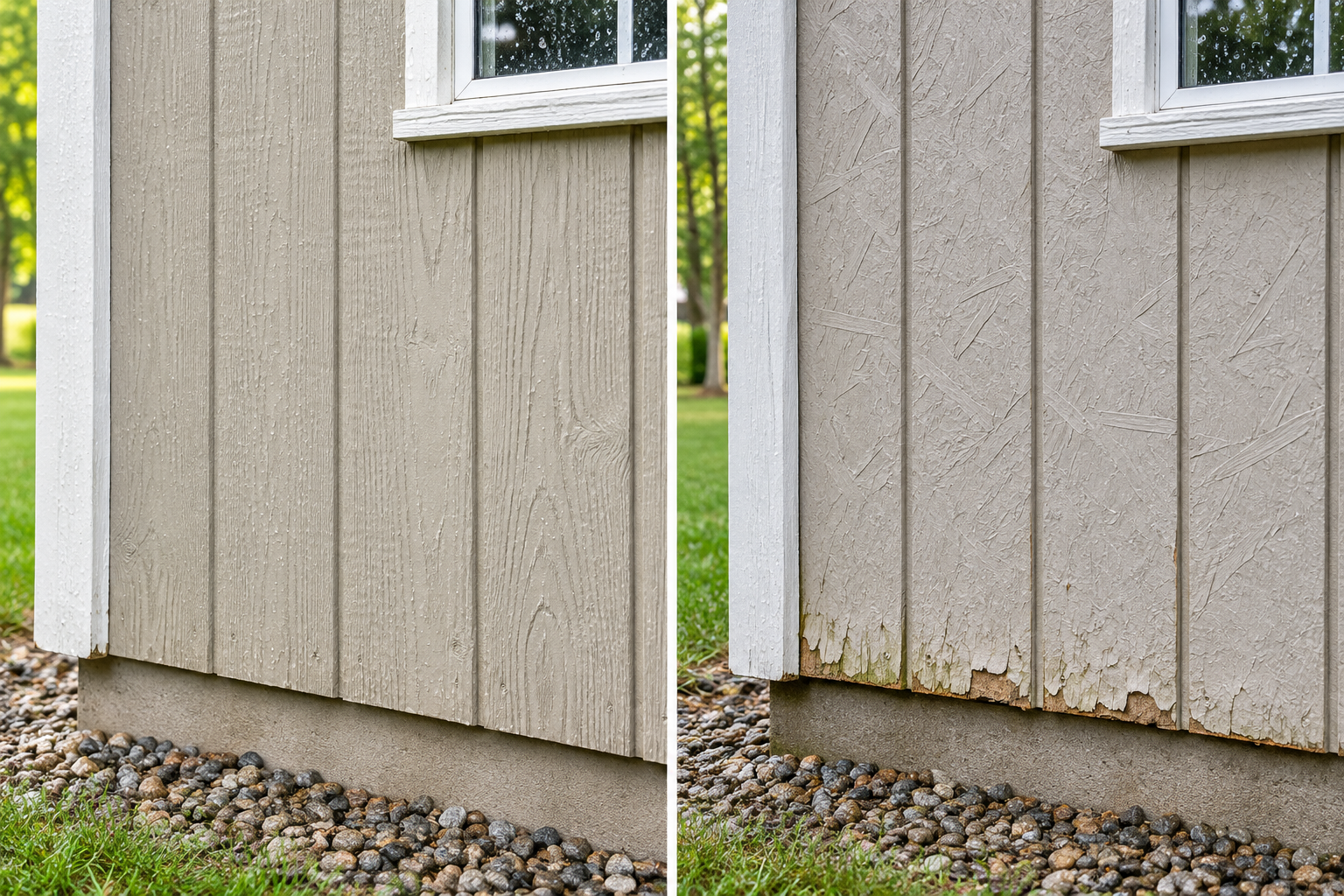
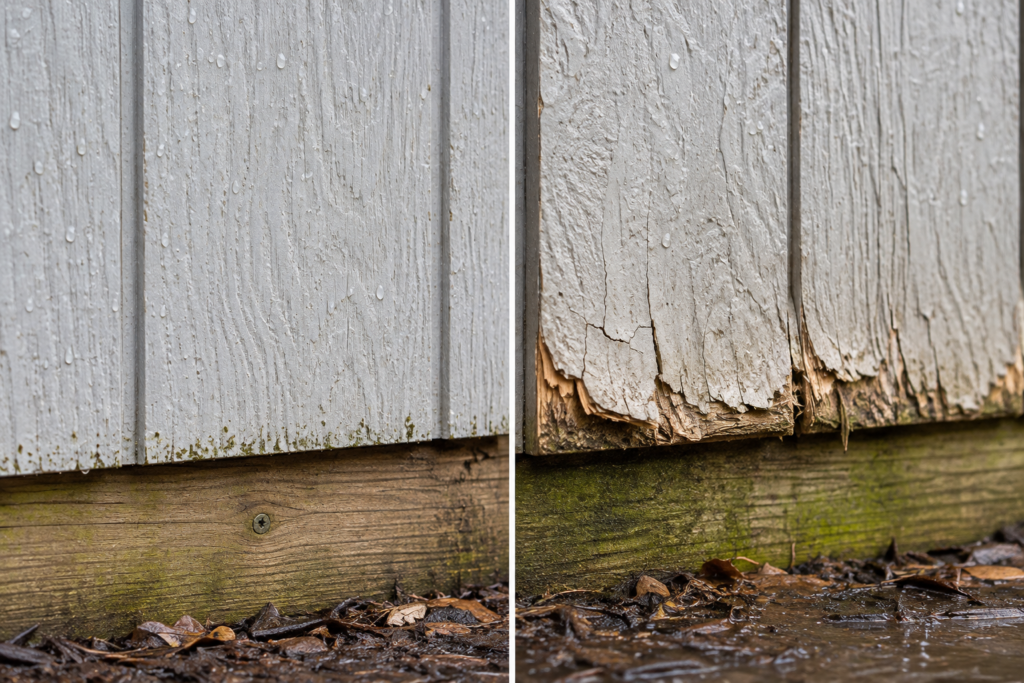
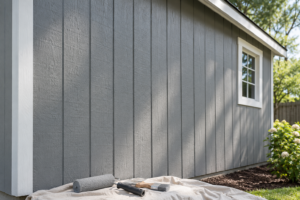
Plywood T1-11 holds up better than standard OSB grooved siding on most walls that get wet. The main reason is the edges. When OSB gets soaked, the edges swell and mostly stay swollen. Plywood swells less and largely goes back to its original thickness as it dries. The exception is treated engineered strand siding such as LP SmartSide. It is made in a different way from plain OSB, and it can be a reasonable choice in humid areas with termites.
Best for a house or a shed you want to keep for decades: Plywood T1-11 (APA 303 Rated Siding). Treated engineered strand siding is another option.
Fine for a dry, covered, or short-term building: Standard OSB grooved siding, as long as every edge is sealed and the siding is kept above grade per the maker’s instructions.
What actually ruins any of them: Unsealed cut edges, siding too close to the ground, and paint that isn’t kept up.
The test that matters: Look at the bottom edge after one wet season. If OSB edges have puffed up, they won’t go back down.
T1-11 Plywood vs OSB Comparison Chart
Plywood T1-11
Standard OSB grooved siding
Treated strand siding (e.g., LP SmartSide)
Edge swelling when wet
Swells less and mostly recovers as it dries
Swells more, especially at cut edges, and most of the swelling stays
Factory edges are sealed. Field cuts must be primed and painted
Wetting and drying
Takes on water faster and dries faster
Takes on water more slowly but dries more slowly
Waxes and resins slow water uptake
Rot and termite resistance
None unless pressure-treated
None in standard panels
Zinc borate treatment throughout (manufacturer claim)
Face problems
Face checks (small grain cracks) can crack paint
No grain checks, but swollen strands can show through paint
Resin overlay helps resist splitting
Paint holding
Good with acrylic latex, though checking can shorten paint life
Good when the surface stays dry
Factory-primed for paint
Typical cost
Usually middle
Usually lowest
Often highest. Check local pricing
Best fit
Houses, sheds, garages
Dry climates, covered walls, short-term buildings
Humid or termite-prone areas, sheds sold with a warranty
Cost difference callout: OSB grooved siding usually costs a few dollars less per sheet than plywood T1-11. Prices change too fast to quote here, so do the math for your own job. A 10×12 shed with 8-foot walls takes about 12 sheets of siding before doors and windows. Multiply the per-sheet difference at your local yard by 12, then compare that to the cost of replacing even one swollen bottom panel. For most people the savings are small next to the cost of a redo.
What T1-11 Actually Is
T1-11 is a grooved plywood siding product defined by APA as Texture 1-11, a type of APA 303 Rated Siding. Similar-looking grooved siding is also manufactured using OSB or treated engineered wood strands. Although these products can have a similar appearance, their construction, moisture performance, and installation requirements differ.
Genuine T1-11 has deep vertical grooves, usually 4 or 8 inches on center, cut into an exterior plywood panel made of thin wood veneers glued in cross-layers. OSB grooved siding, often sold or searched as “OSB T1-11”, is made from compressed wood strands with resin binders, sometimes with a textured overlay on the face.
Once painted, the two look nearly the same. Once water gets in, they behave differently.
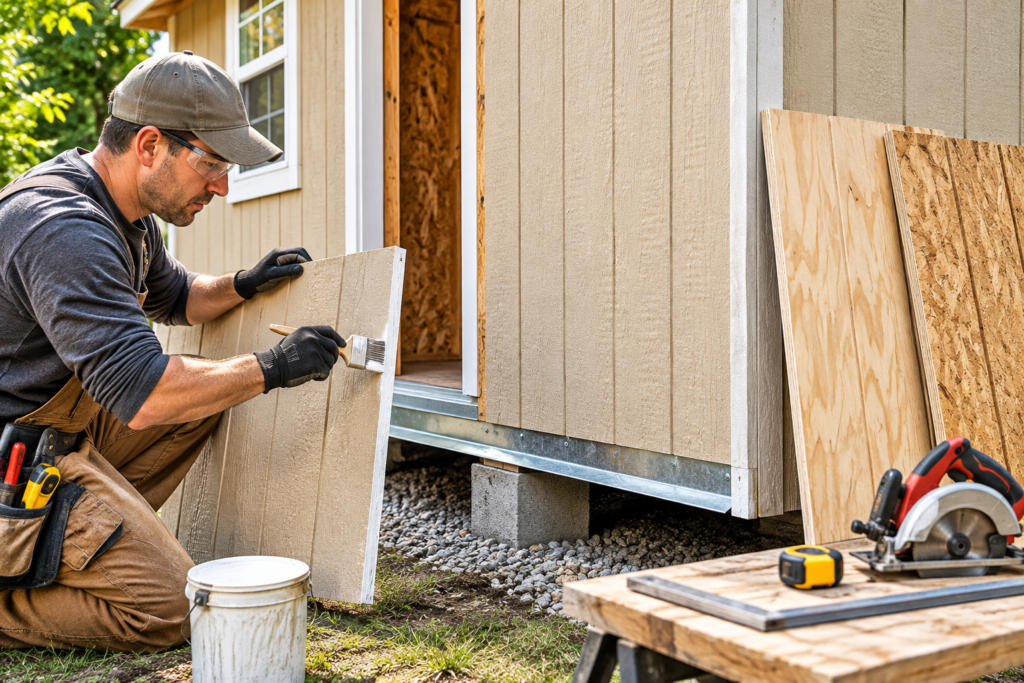
If you’re building a shed and want the install steps, our guide to installing T1-11 siding on your own covers panel order, flashing, and nailing.
Why Plywood T1-11 Holds Up Better When It Gets Wet
Edge swelling is the deciding difference
All wood panels swell when wet. The question is whether they come back.
In APA testing reported by the National Roofing Contractors Association, 7/16-inch OSB swelled in thickness about 3.5 times as much as 1/2-inch plywood when taken from oven-dry to a vacuum soak (32.9% vs 9.4%). Those were structural sheathing panels, not finished siding. These laboratory results illustrate differences between panel materials. They do not directly predict the lifespan of finished siding installed outdoors.
Georgia-Pacific, which makes both panel types, explains the difference. Plywood swells evenly and returns to its original thickness as it dries. OSB stays swollen to some degree, because the compression from the factory press is released when the strands absorb water.
On a wall, that means:
A plywood bottom edge that gets soaked and dries out usually looks about the same.
An OSB bottom edge that gets soaked again and again can puff up, crack the paint, and soak up more water the next time.
Warning: The bottom 12 inches of the wall and the cut edges around doors and windows are where OSB grooved siding fails first. That’s where rain splashes back and water sits.
Plywood soaks up water faster but dries faster
This is the part most comparisons get wrong. In side-by-side testing described by the Journal of Light Construction, plywood got saturated faster than OSB, but it also dried out much faster. OSB took longer to soak through and longer to dry.
On siding, slow drying is the bigger problem. A wall that stays damp for days after every storm gives rot fungi the time they need.
Outdoor exposure testing points the same way
In an above-ground outdoor exposure study near Corvallis, Oregon, published in the Forest Products Journal, plywood panels grew about 5% thicker after 25 days of rain exposure, while OSB grew about 15%. The panels that swelled also lost bending strength.
Where OSB Siding Still Makes Sense
OSB siding isn’t junk. Plywood and OSB meet the same APA performance standards for structural use. OSB also has real advantages:
No knots or core voids. OSB is dense and consistent throughout, with no soft spots from overlapping knot holes.
Lower price in most markets.
Good performance when kept dry. Under a deep roof overhang, in a dry climate, or with excellent edge sealing, standard OSB siding can last a long time.
When OSB grooved siding is a reasonable choice:
Dry climates with little wind-driven rain
Walls protected by deep overhangs or a porch
Temporary or low-value buildings
Projects where you’ll repaint on schedule
Treated Strand Siding Is a Different Product
Don’t lump LP SmartSide and similar treated engineered wood siding together with plain OSB grooved siding from a big-box rack.
According to LP, its SmartGuard process treats every strand with resins, water-resistant waxes, and zinc borate, then bonds on a resin-saturated overlay. LP says the zinc borate helps the siding resist fungal decay and termites. LP backs its siding with a 5/50-year limited warranty: 5 years of 100% labor and replacement, then a prorated 50-year warranty on the substrate.
Read the fine print before you count on it:
The warranty applies only when LP’s installation instructions are followed.
LP’s instructions vary by product and application, so follow the instructions for the exact product you buy. LP’s panel siding instructions call for at least 6 inches of clearance from finished grade in the U.S. (8 inches in Canada), at least 1 inch from roofing and from hard surfaces such as patios and walks, and a 1/8-inch gap at panel joints, with no staples.
LP states that its panel siding warranty does not cover water penetration.
LP technical bulletins say zinc borate does not protect against surface mold or mildew, or against woodpeckers.
Regret callout: Some of OSB siding’s bad reputation is earned. Louisiana-Pacific’s older Inner-Seal OSB siding was the subject of a large class-action settlement in the mid-1990s over siding rotting on homes in damp climates. Today’s treated strand products are made differently, but that history is why many contractors still distrust anything that looks like OSB.
Don’t Confuse “Exterior” With Rot-Proof
Plywood T1-11 is stamped Exterior. That label describes the glue bond: the layers are meant to stay together through repeated wetting. It does not mean the wood resists rot or insects.
Untreated plywood T1-11 can still rot if water keeps getting in. Rot resistance comes from pressure treatment or a factory preservative, not from the glue. For more on how bond ratings and treatment differ, see our exterior plywood guide and our comparison of pressure-treated vs exterior plywood.
The same steps protect plywood and OSB siding. They just matter more on OSB.
Seal every edge before you hang the panel. APA’s finishing guide for Rated Siding calls for sealing panel edges before installation. Do the bottom edge twice.
Use an acrylic latex system. APA says the best protection for wood siding is an all-acrylic latex house paint over a primer. Solid-color stain also protects well.
Keep it off the ground. Keep siding above finished grade according to the manufacturer’s instructions and applicable building codes. LP SmartSide generally requires at least 6 inches of ground clearance. Additional clearances apply near roofs, patios, and other horizontal surfaces.
Flash the horizontal joints. Put Z-flashing at every horizontal seam so water drains out instead of running behind the panel.
Leave the expansion gap. Panels move with moisture, and butting them tight leads to buckling.
Check the span rating on the stamp. APA Rated Siding is marked 16 oc or 24 oc. That’s the maximum stud spacing for nailing straight to studs.
Hot-dipped galvanized siding nails: for corrosion resistance. Check your siding instructions for size and spacing. Shop galvanized siding nails on Amazon
Common T1-11 Siding Mistakes (and What They Cost You)
1. Leaving cut edges bare. A bare cut edge on OSB takes on water and swells. On plywood, it lets water into the layers. Result: the panels around doors and windows fail years before the rest of the wall.
2. Running siding down to the dirt or the slab. Splash-back keeps the bottom edge wet. Result: swollen or rotted bottom panels, which are the hardest to replace without pulling trim.
3. Skipping Z-flashing at horizontal joints. Water runs down the face and gets behind the upper panel. Result: hidden rot behind siding that looks fine from outside.
4. Using a clear sealer or semi-transparent stain on OSB or overlaid siding. APA’s finishing table marks semi-transparent stain as not recommended on overlaid grades, and some makers allow only latex. Result: poor UV and water protection, and a voided warranty.
5. Treating “Exterior” as rot-proof. The stamp describes the glue, not decay resistance. Result: untreated panels rot in damp spots even though the layers never come apart.
6. Letting the paint go. Paint failure on grooved siding starts in the grooves and at the bottom edge. Result: by the time you see peeling, water may already be getting in.
When None of These Is the Right Pick
Plywood T1-11 and OSB grooved siding are both wood products that need paint. Look at something else if:
The wall faces heavy wind-driven rain and has no overhang
You won’t repaint on schedule
Wildfire code in your area limits what siding you can use (check local requirements)
You need very low upkeep. Fiber cement or vinyl may suit you better.
Is plywood T1-11 better than OSB siding? For walls that get wet, usually yes. Plywood swells less and largely recovers when it dries, while OSB edges tend to stay swollen. Standard OSB siding can still work on dry or well-protected walls.
Is “OSB T1-11” real T1-11? Not by APA’s definition. APA defines Texture 1-11 as a plywood siding product within APA 303 Rated Siding. Grooved OSB siding is a different product that looks similar and is often sold under the same name.
How can I tell if my siding is plywood or OSB? Look at a cut edge or the back of the panel. Plywood shows thin layers of veneer. OSB shows compressed flakes or strands. The grade stamp on the back usually names the product type too.
Does OSB siding rot faster than plywood T1-11? Standard OSB siding tends to fail sooner where water sits, because swollen edges stay open and dry more slowly. Neither is rot-resistant unless it’s treated. Treated strand siding such as LP SmartSide includes a zinc borate preservative.
Is LP SmartSide just OSB? It’s made from wood strands like OSB, but LP treats it with resins, waxes, and zinc borate and adds a resin overlay. It carries a 5/50-year limited warranty when installed according to LP’s instructions. That makes it a different product from untreated OSB siding.
How far off the ground should T1-11 siding be? Follow the siding manufacturer’s instructions and your local building code. LP SmartSide generally requires at least 6 inches above finished grade in the U.S., plus separate clearances near roofs, patios, and walks. Requirements vary by product and region.
The Bottom Line
If the wall will get wet, plywood T1-11 holds up better than standard OSB grooved siding, mainly because its edges recover after soaking and OSB edges don’t. If you’re in a humid or termite-prone area and willing to pay more, treated strand siding installed to the maker’s rules is another option worth considering. Whichever you pick, sealed edges, proper clearances, flashing, and paint decide how long it lasts more than the core does.
Affiliate disclosure: theplywood.com is a participant in the Amazon Services LLC Associates Program. When you buy through links on this page, we may earn a commission at no extra cost to you.
Related Posts:
OSB vs Plywood for Subfloor: Which Is Better? by Admin September 29, 2026 DIY When comparing OSB vs plywood for subfloor use, start here: at the same APA span rating, plywood and OSB are designed to perform the same…