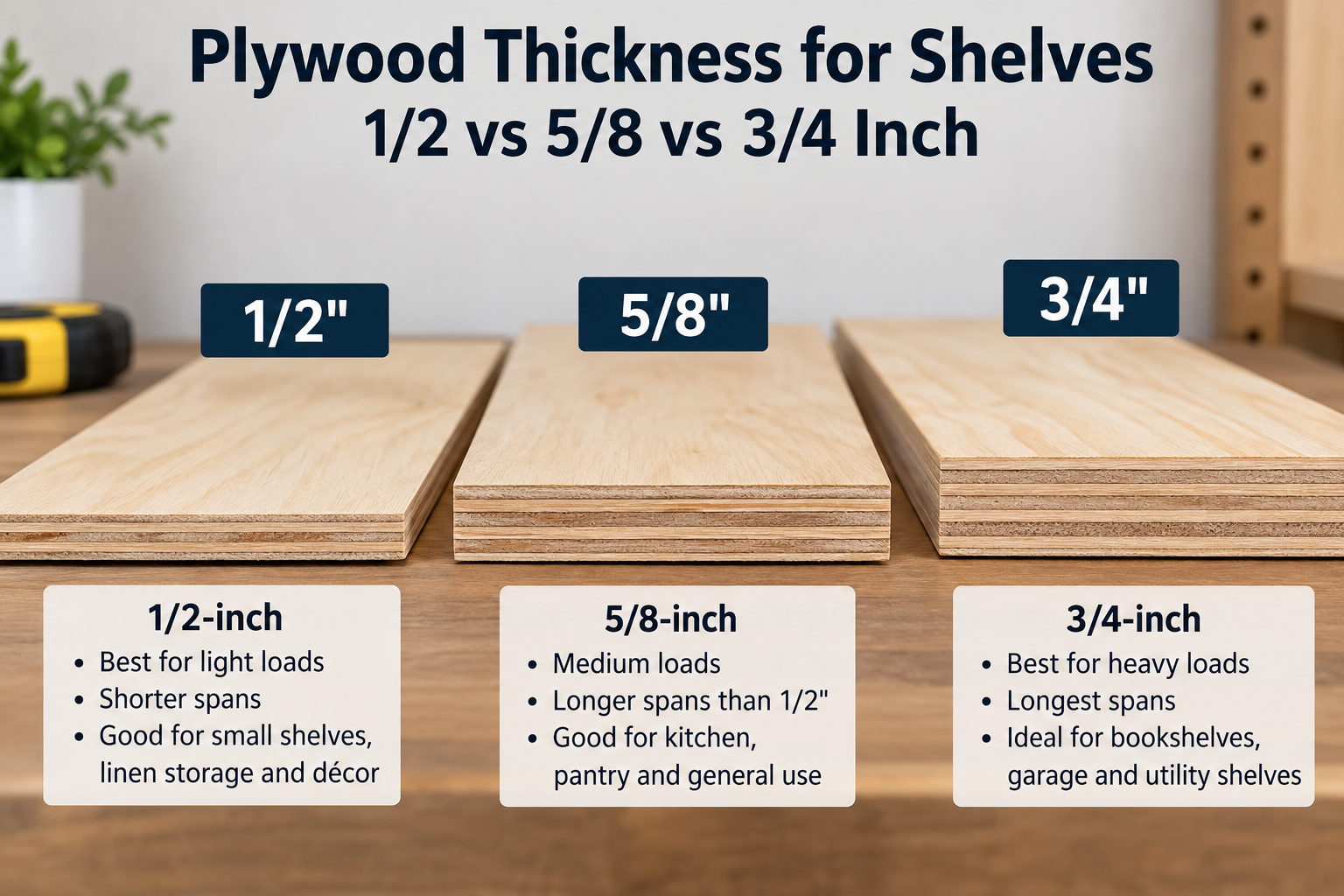
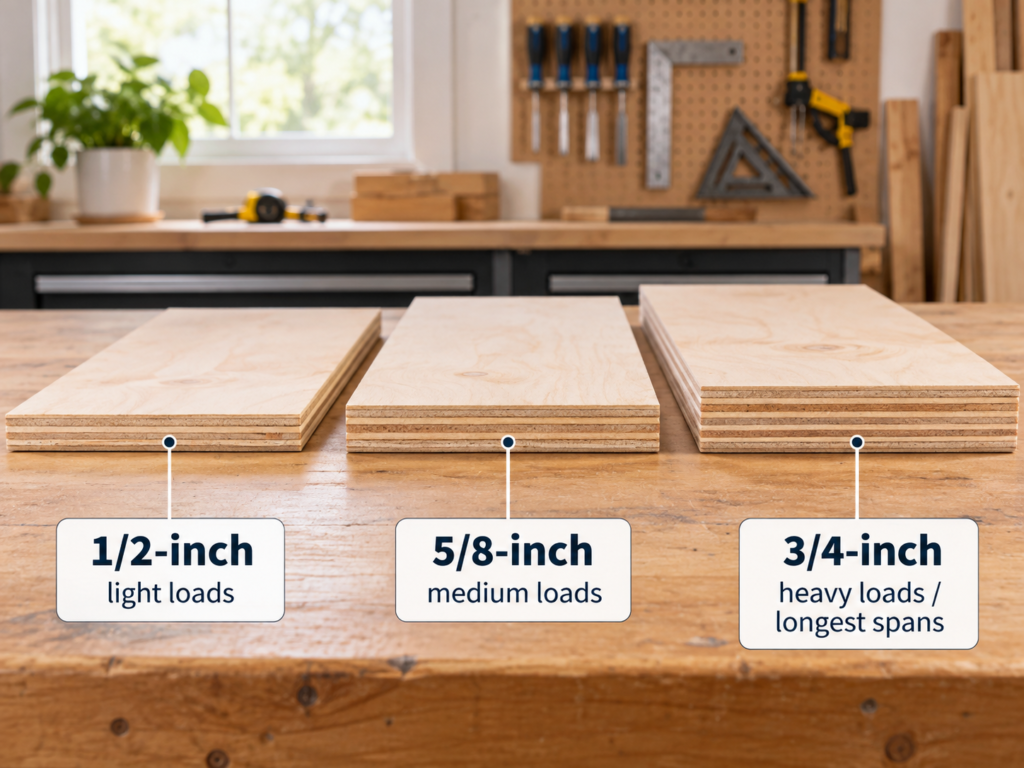
Choosing the right plywood thickness for shelves depends on the span, expected load, and grain direction.
For most shelves, use 3/4-inch plywood and keep the span (the gap between supports) at 30 inches or less. Use 5/8-inch for medium loads up to about 26 inches. Save 1/2-inch for light loads on short spans. For heavy books, even 3/4-inch needs a stiffening strip or a shorter span once you go past about 24 inches. The direction of the face grain matters almost as much as thickness. Get it wrong and a shelf can lose most of its stiffness.
The common advice, “just use 3/4,” is right more often than not. It still doesn’t tell you how far a shelf can span, what happens under a full load of books, or when 1/2-inch is perfectly fine. This guide answers those questions with APA’s published stiffness values, not guesswork.
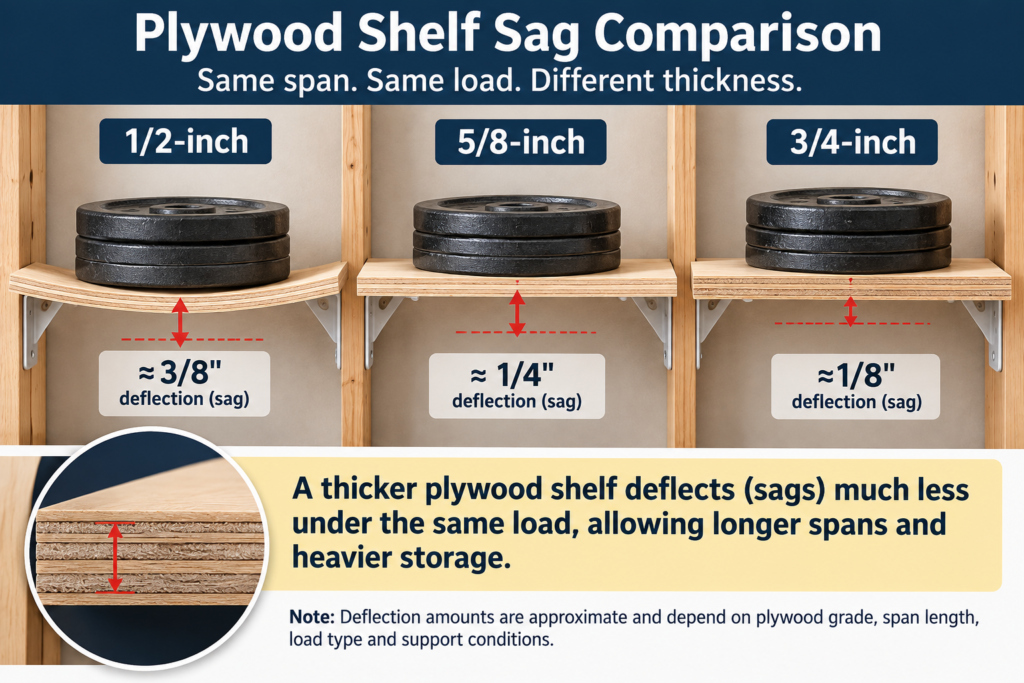
How Much Stiffer Is 3/4 Than 1/2?
Sag depends on a panel’s bending stiffness, which engineers write as EI. APA – The Engineered Wood Association publishes minimum design stiffness values for sanded plywood (the smooth-faced grades used for shelving and cabinets) in its Panel Design Specification, PDS-2020, Table 10.
Thickness
Stiffness, grain running along the shelf (lbf-in²/ft)
5/8″ is about 1.6 times stiffer than 1/2″. That is a real step up, not a small one.
3/4″ is about 2.5 times stiffer than 1/2″ and about 1.5 times stiffer than 5/8″.
Stiffness rises much faster than thickness. Adding 50% more thickness (1/2″ to 3/4″) gives roughly 150% more stiffness.
For a deeper look at how thickness relates to load in floors, roofs and benches, see our guide to plywood thickness vs strength.
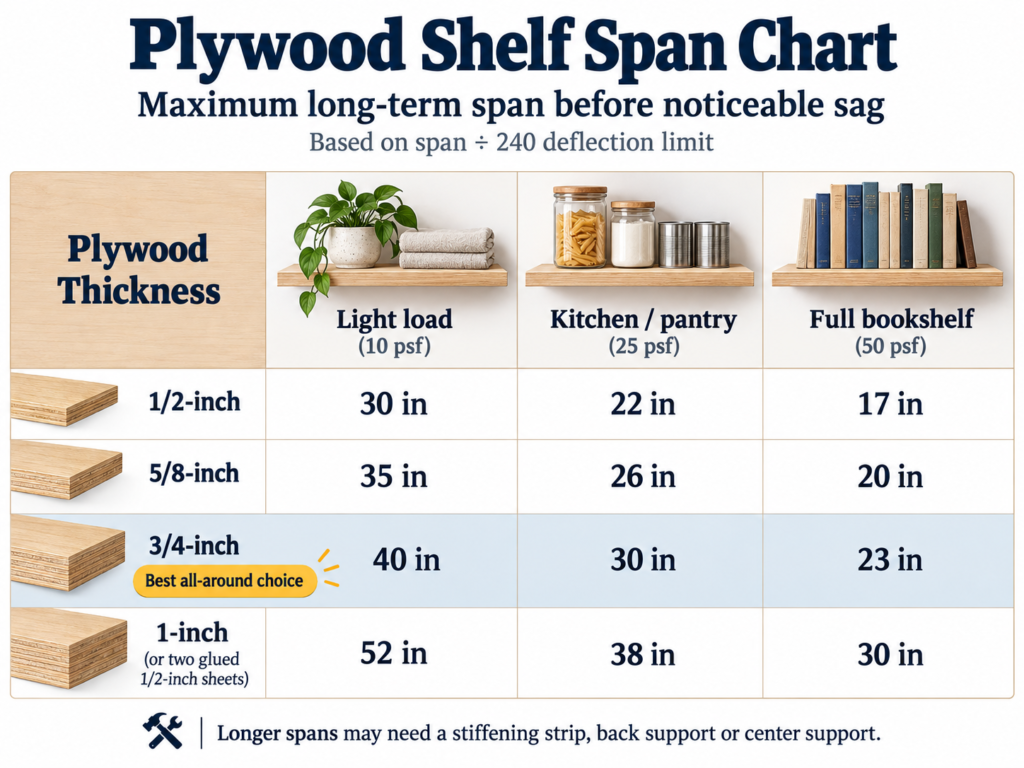
Plywood Shelf Span Chart: 1/2 vs 5/8 vs 3/4
This is the chart to use before you cut. It shows the longest span that keeps sag within span ÷ 240. That is the limit the Composite Panel Association uses in its shelving design bulletin. On a 36-inch shelf, it allows 0.15 inch of sag.
Maximum span, long-term (includes sag that builds up over time):
Thickness
Light load (10 psf): linens, décor
Kitchen / pantry (25 psf)
Full bookshelf (50 psf)
1/2″
30″
22″
17″
5/8″
35″
26″
20″
3/4″
40″
30″
23″
1″ (or two glued 1/2″ sheets)
52″
38″
30″
Maximum span, day one (before long-term sag):
Thickness
10 psf
25 psf
50 psf
1/2″
37″
27″
22″
5/8″
44″
32″
26″
3/4″
51″
37″
30″
How the chart was built
Stiffness: APA PDS-2020 Table 10 minimums for sanded Group 1 plywood, with the face grain running along the length of the shelf.
Support: The shelf rests on pins or cleats at each end and isn’t fastened, which is how an adjustable shelf works. Span means the clear distance between supports.
Loads: The Composite Panel Association notes that kitchen cabinet shelves can reach 25 to 30 pounds per square foot (psf) and bookshelves can easily reach 50 psf. The 10 psf light-load column is an example value for comparison.
Long-term sag: Wood-based shelves keep sagging slowly under a load that never comes off. This is called creep. The Composite Panel Association notes that long-term shelf sag is often estimated at about twice the initial sag for design purposes, and the long-term table uses that approach to stay conservative. APA also publishes creep adjustment factors for plywood under sustained high loading, including a 0.50 factor when a permanent load stresses the panel to half or more of its design strength.
These are safe-side planning numbers, not breaking points. On every row, sag became the limit long before bending strength did. Cabinet-grade panels usually beat APA’s minimums, but you can’t confirm that from the store shelf, so plan with the conservative numbers.
For floor and roof span ratings, which are a different use with different rules, see our plywood span chart.
Why Span Matters More Than You Think
A longer shelf has two problems at once. The span is longer, and it also holds more weight. For an evenly loaded shelf, sag grows with the fourth power of the span.
Going from a 30″ span to a 36″ span (20% longer) roughly doubles the sag (1.2⁴ ≈ 2.07).
Going from 24″ to 36″ (50% longer) multiplies sag by about 5.
That’s why a shelf that looks fine at 30 inches can bow visibly at 36 inches with the same plywood and the same books. Moving a support in by a few inches often does more than moving up a thickness.
1/2-Inch Plywood Shelves: Where They Work
1/2-inch plywood is a reasonable choice when:
The span is 22 inches or less for kitchen-weight loads, or about 30 inches for light items.
The shelf sits in a closet or utility space where a little visible sag doesn’t matter.
The shelf is supported along its back edge, like a shelf screwed into a dado or onto a cleat on the cabinet back.
It’s the wrong choice for bookshelves over about 17 inches, for garage shelves holding paint or tools, and for any adjustable shelf in a wide bay. At a 36-inch span under 30 psf, APA’s stiffness values predict about 0.39 inch of initial sag for 1/2″ plywood, which is clearly visible. 3/4″ plywood under the same load sags about 0.15 inch.
5/8-Inch Plywood: The Overlooked Middle Option
Most shelf guides skip 5/8-inch, but it fills a real gap. It’s about 60% stiffer than 1/2-inch, so it handles pantry and kitchen loads on spans up to about 26 inches. It’s also lighter and usually cheaper than 3/4-inch. Check local pricing, because the gap between thicknesses varies by region and grade.
The catch is availability. Sanded 5/8″ cabinet-grade plywood is harder to find than 1/2″ or 3/4″ at many home centers. 5/8″ is also a common thickness for sheathing grades like CDX, and those have rough faces and are a poor fit for visible shelving.
3/4-Inch Plywood: The Default for a Reason
3/4-inch is the standard shelf thickness because it covers the widest range of real-world bays without extra work:
Kitchen and pantry shelves: up to about 30″ long-term.
Light storage and display: up to about 40″.
Bookshelves: about 23″ long-term without help. With a hardwood stiffening strip or back-edge support, a typical 30″ bookcase bay is fine (see the stiffening section below).
If you build cabinets or bookcases with 3/4″ sides, 3/4″ shelves also keep your joinery and shelf-pin layout simple. Our basic cabinet construction guide covers that layout.
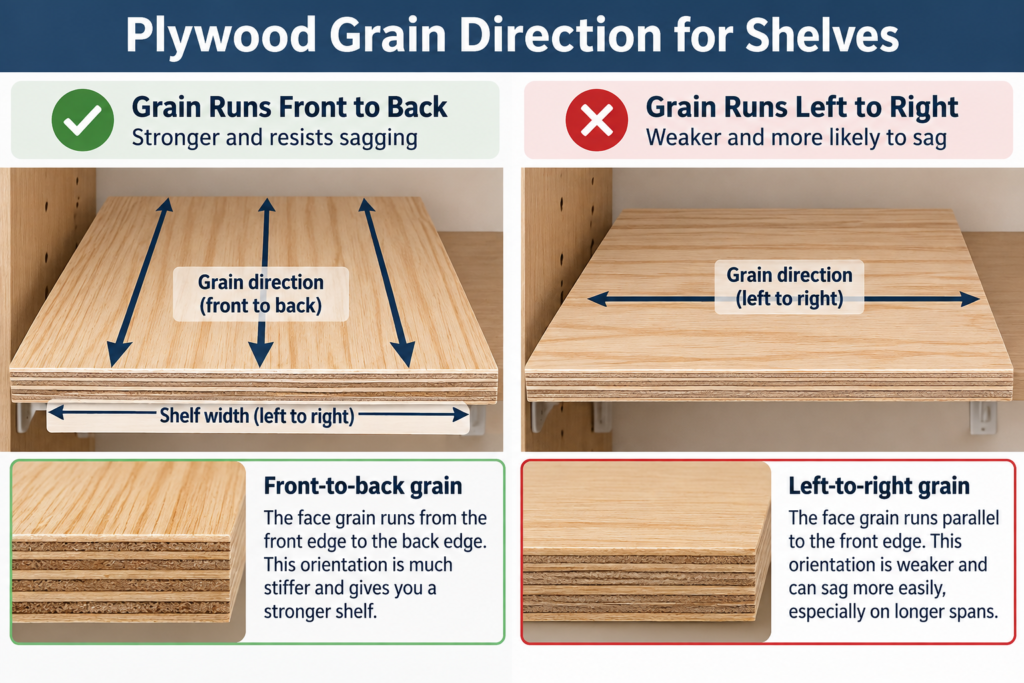
The Grain-Direction Mistake That Cuts Stiffness by Up to 9x
This is the most common reason a “thick enough” shelf sags.
Plywood is much stiffer along its face grain than across it. APA’s own numbers show the difference:
1/2″ plywood: 140,000 with the grain along the shelf vs 15,500 across it, about 9 times stiffer in the right direction.
3/4″ plywood: 355,000 vs 115,000, about 3 times stiffer.
The rule: cut shelves so the face grain runs the long way, from support to support. On a standard 4×8 sheet, the face grain runs along the 8-foot length, so rip your shelves along the length of the sheet. If you cross-cut short, deep shelves from the 4-foot direction to save material, you lose most of the stiffness without seeing any difference.
At a 36-inch span under 30 psf, a 3/4″ shelf with the grain running front to back sags about 0.48 inch, roughly three times more than the same shelf cut correctly.
1. Creep. Wood under a load that never comes off slowly deforms further. That’s why the long-term chart above plans for twice the initial sag. A bookshelf is the worst case, because the books never leave.
2. Moisture. APA reduces plywood stiffness by 15% (a factor of 0.85) when the panel’s moisture content in service is 16% or higher. Garages, basements and unheated sheds are where this shows up. If your shelves live there, build toward the shorter spans in the chart.
A note on glue ratings: a panel’s bond classification (Exposure 1 vs Exterior) describes how well the glue holds up to moisture. APA states it does not change strength or stiffness. It also says nothing about decay resistance, which is a separate question. Choosing an Exterior-rated panel won’t make a garage shelf sag less.
Weigh Your Load Before You Pick a Thickness
The chart is only as good as your load estimate. The CPA’s suggestion is the simplest method: weigh what will go on the shelf with a bathroom scale.
Weigh the items, or weigh yourself holding a box of them and subtract your own weight.
Measure the shelf area in square feet: span (ft) × depth (ft). A 36″ × 12″ shelf is 3 sq ft.
Divide the weight by the area. 90 lb of books on that shelf = 30 psf.
Find that load in the chart.
Watch for concentrated loads. A stack of paint cans or a heavy appliance in the middle of the span stresses a shelf much more than the same weight spread out. The CPA recommends designing around the heaviest single item, not an average.
Cheaper Than Going Thicker: How to Stiffen a Plywood Shelf
If the chart says you need more stiffness, these options usually beat buying thicker plywood.
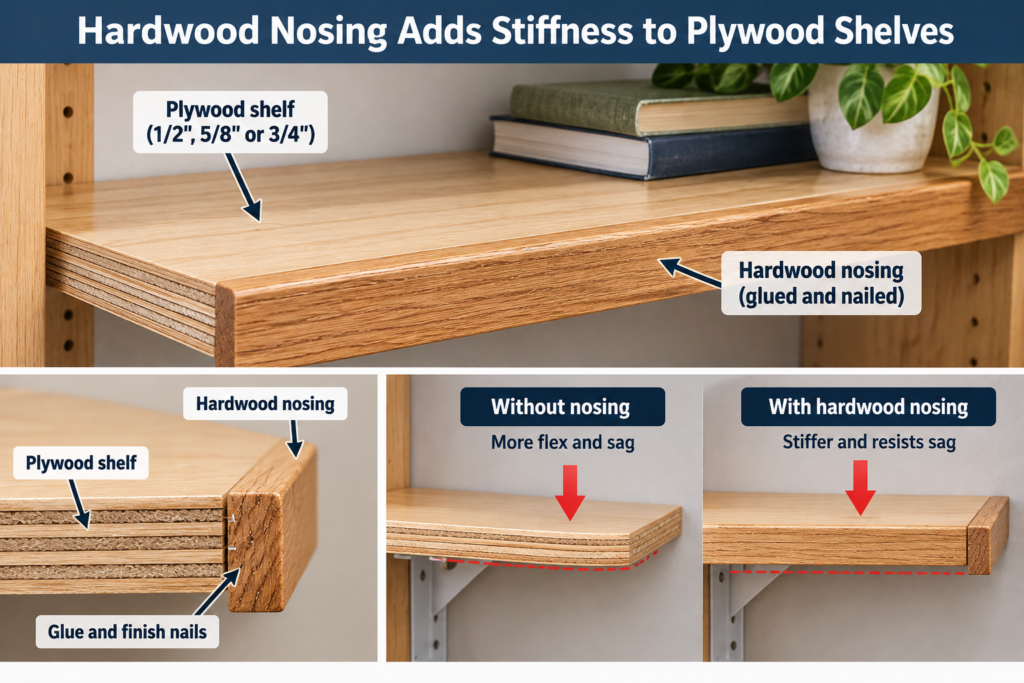
Add a hardwood nosing on edge
A solid-wood strip glued to the front edge acts like a small beam. Its stiffness grows with the cube of its height, so a strip turned on edge matters far more than a flush strip.
A 3/4″ × 1-1/2″ red oak strip set on edge has a bending stiffness, on paper, in the same range as the full 12-inch-deep 3/4″ plywood panel. That can roughly double the shelf’s stiffness. (Northern red oak’s average modulus of elasticity is about 1.82 million psi at 12% moisture content, per the USDA Wood Handbook.)
A 3/4″ × 3/4″ flush edge strip adds only a fraction of that, about 14% on the same math. It mostly improves looks.
Use a full glue line. A nosing that is only nailed on can’t share the load properly. If you only need to cover the plies, see our guide to plastic edging.
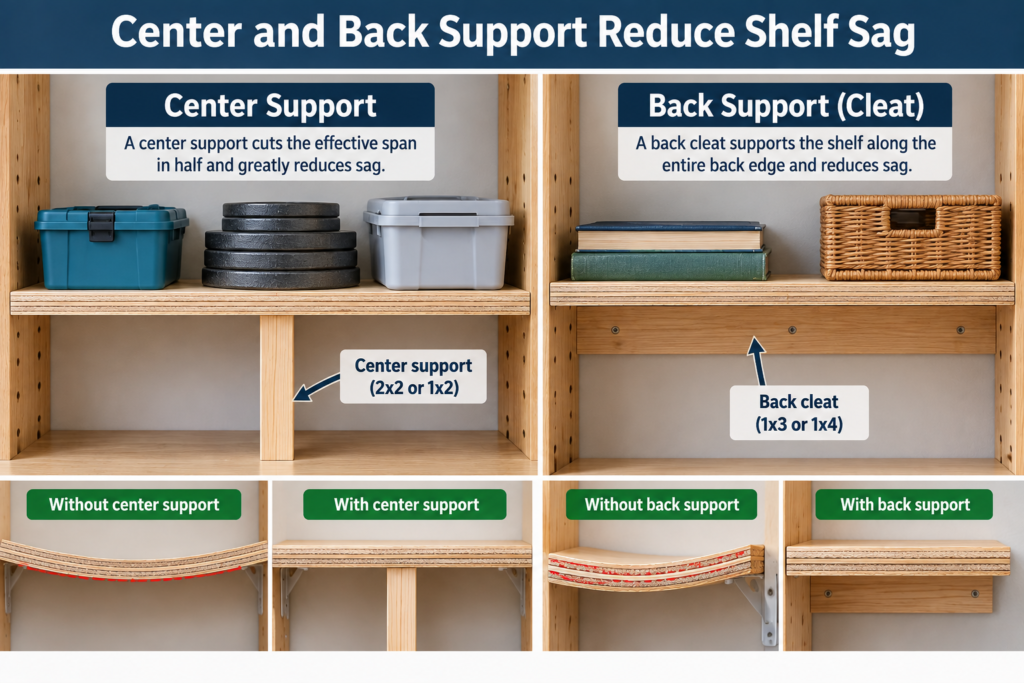
Support the back edge
A shelf screwed into a dado, or onto a cleat along the cabinet back, can’t sag along that edge. The CPA bulletin, written for particleboard and MDF shelves, lets designers double the allowable span for shelves 12 inches deep or less with continuous back-edge support. The same principle helps plywood, though the CPA doesn’t publish plywood-specific figures.
Add a center support
Halving the span cuts sag dramatically because of the fourth-power rule above. A single vertical divider or bracket at mid-span usually fixes a sagging shelf for less than replacing it. A French cleat wall makes it easy to add supports where you need them in a garage or shop.
Laminate two sheets
Two layers of 1/2″ plywood glued face to face, with a full glue line, act close to a single 1-inch panel. APA rates 1″ sanded plywood at more than twice the stiffness of 3/4″. This works well for long, heavy-duty garage shelves. Treat the 1″ row in the chart as the best case, because glue coverage determines how much you actually get.
Actual thickness. PS 1 allows sanded plywood to vary by plus or minus 1/64 inch from its designated thickness. APA notes that the decimal thickness printed on panels is usually at or near the low end of that range. A digital caliper is the quickest way to check what you actually bought.
Species group. APA’s values above are for Group 1 faces (the stiffest group, which includes Douglas-fir, birch and southern pine). For sanded panels marked Group 2, 3 or 4, APA multiplies stiffness by 0.83, 0.67 or 0.56. A Group 4 sheet of 3/4″ plywood is only slightly stiffer than a Group 1 sheet of 5/8″.
Hardwood cabinet plywood. Birch, maple and oak-veneer cabinet panels are usually made to ANSI/HPVA HP-1, not PS 1. APA’s design values don’t formally apply to them. Use the numbers in this guide as a baseline, and if a shelf really matters, test a sample under its real load before building the whole unit. For help choosing a panel, see our guides to cabinet-grade plywood and furniture-grade plywood, and our full plywood thickness guide for furniture.
Plywood Shelf Thickness by Project
Project
Typical load
Recommended thickness
Max long-term span
Linen / closet shelf
Light (≈10 psf)
1/2″
30″
Kitchen or pantry shelf
25–30 psf (CPA)
3/4″ (5/8″ on short bays)
30″ (26″ for 5/8″)
Bookshelf
Up to 50 psf (CPA)
3/4″ + nosing, or 1″
23″ plain 3/4″; longer with nosing
Garage / shop shelf
Heavy, concentrated
3/4″ with center support, or laminated 1″
Design around heaviest item
Display / décor shelf
Light
1/2″ or 5/8″
30–35″
FAQ: Plywood Thickness for Shelves by Project
Is 1/2-inch plywood strong enough for shelves? Yes, for light loads on short spans. Based on APA stiffness values, 1/2″ plywood stays within span ÷ 240 over the long term up to about 30 inches for light items and about 22 inches for kitchen-weight loads. It’s a poor choice for bookshelves past roughly 17 inches.
How far can 3/4-inch plywood span without sagging? For kitchen and pantry loads, plan on about 30 inches long-term. For full bookshelves, about 23 inches without stiffening. A glued hardwood nosing or back-edge support lets a typical 30″ bookcase bay work.
Is 5/8-inch plywood worth it for shelves? Often, yes. It’s about 60% stiffer than 1/2″ and handles pantry loads up to about 26 inches. The main drawback is that sanded cabinet-grade 5/8″ can be harder to find locally.
Does grain direction matter on plywood shelves? A great deal. APA’s values show 1/2″ plywood is about 9 times stiffer with the face grain running along the shelf than across it, and 3/4″ is about 3 times stiffer. Always rip shelves along the length of the sheet.
Why is my plywood shelf sagging more over time? Wood creeps under a load that never comes off, and stiffness drops when moisture content reaches 16% or more. Shorten the span, add a center support or nosing, or move the heaviest items next to the supports.
Are two layers of 1/2-inch plywood stronger than one 3/4-inch sheet? When fully glued, yes. Together they behave close to a 1-inch panel, which APA rates at more than twice the stiffness of 3/4″.
Bottom Line
Start with 3/4-inch plywood, keep the grain running the long way, and check your span against the chart. Light loads on short spans are fine on 1/2-inch. 5/8-inch is a smart middle option for pantry shelves. Heavy bookshelves need either a shorter span or a glued hardwood nosing, even at 3/4″. When a shelf sags, shortening the span almost always fixes it more cheaply than buying thicker plywood. For most projects, the best plywood thickness for shelves is 3/4 inch, but shorter spans and lighter loads can make 1/2- or 5/8-inch plywood practical.
Related Posts:
Floating Shelves: Stylish Storage & Easy DIY Guide by Admin September 8, 2025 DIY I still remember the first time I put up floating shelves. It wasn’t some big renovation—just a Saturday project in my living room. Instead of…
Plywood Load Capacity: 1/2 vs 3/4 Inch by Admin October 4, 2026 DIY As floor or roof sheathing over framing, standard 1/2-inch plywood (15/32 Performance Category, 32/16 span rating) is listed for about 180 pounds per square foot…