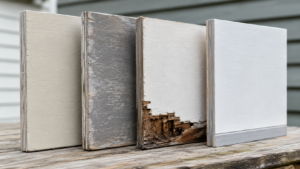
Ask ten contractors how long T1-11 siding lasts and you’ll get answers ranging from “a lifetime” to “I’ve pulled panels that were rotting in a few years.” That spread is the whole point: the T1-11 siding lifespan isn’t set by the panel itself so much as by how it’s finished, where the bottom edge sits, and whether the finish gets renewed before the wood starts taking on water.
Here’s a realistic answer, then everything that moves the number up or down.
How Long Does T1-11 Siding Last?
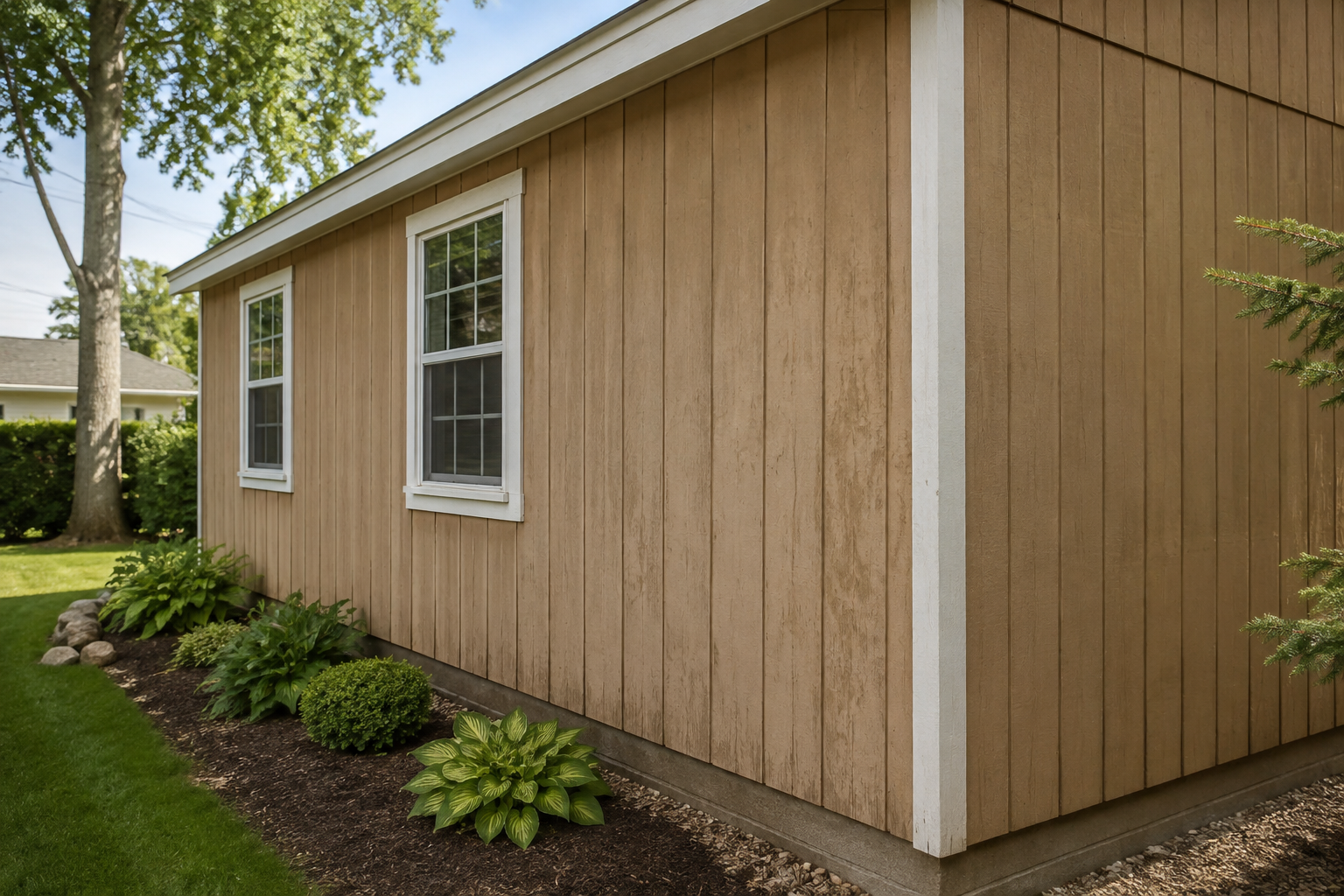
Properly installed and maintained T1-11 siding can often last 20 to 30 years or longer. Its actual service life varies substantially with panel type, climate, ground clearance, flashing, edge protection, and maintenance. Panels subjected to persistent moisture can deteriorate much sooner.
In other words, there’s no single number — there’s a range, and where you land in it is mostly within your control.
How Conditions and Maintenance Affect T1-11 Lifespan
The two biggest variables are the conditions the siding lives in and how well it’s maintained. Rather than assign a hard number of years to each scenario, it’s more honest to think in terms of direction:
Persistent moisture or failed finish: premature deterioration
Normal exposure with regular maintenance: longer service life
Proper flashing, clearance, edge protection, and maintenance: best chance of reaching the upper lifespan range
The factors behind that direction are what actually matter, so let’s look at what drives them.
What Actually Determines How Long T1-11 Lasts
A handful of factors move the needle, roughly in order of impact:
The finish. This is the single biggest lever, and the one you fully control. Bare or thinly-coated T1-11 absorbs water at the surface and through the grooves. A proper finish — primer and topcoats applied as the manufacturer directs — is what stands between the wood and the weather.
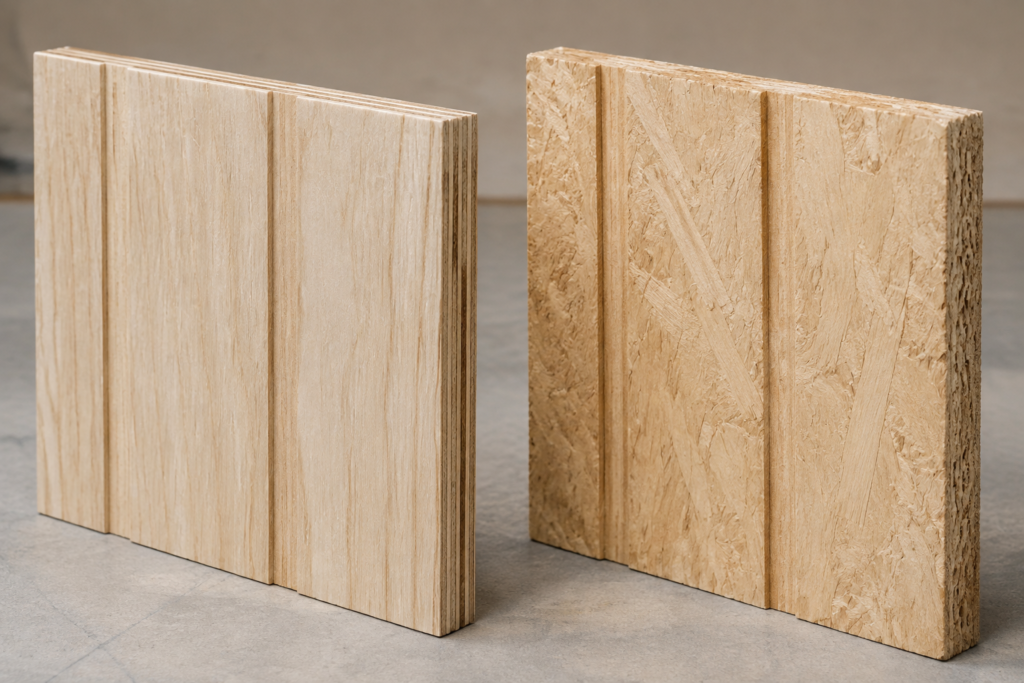
The substrate — plywood vs. OSB. Plywood generally shows less edge swelling after moisture exposure than commodity OSB. However, performance depends on the specific siding product, treatment, installation, finish, and moisture exposure. Engineered OSB siding products can also differ significantly from generic OSB panels. Compare the product specifications and warranty rather than judging solely by the substrate name.
Ground clearance and edge sealing. The bottom edge is where most T1-11 tends to fail first — more on that in the next section.
Climate. Constant humidity, heavy rain, and freeze-thaw cycles all shorten the clock. The same panel that reaches 30 years in a dry climate may need replacing sooner in a wet one.
One expert distinction is worth understanding, because it trips up a lot of homeowners: a bond classification stamp like “Exposure 1” describes the glue line, not the wood’s ability to resist rot. According to APA – The Engineered Wood Association, Exposure 1 panels use a moisture-resistant exterior-type adhesive but are intended only for temporary construction exposure or similarly limited moisture conditions; Exterior-rated panels are intended for repeated wetting and long-term weather exposure. Critically, APA notes that bond classification does not relate to the panel’s resistance to biological factors such as fungal decay or insects. Neither classification makes untreated wood immune to rot — the face veneers on most T1-11 are ordinary softwoods that will decay if kept wet. Bond durability and decay resistance are two separate things. (Where you see an APA grade stamp such as 303 Siding, note that the APA trademark applies to panels from APA member mills.)
The Mistake That Shortens T1-11 Lifespan
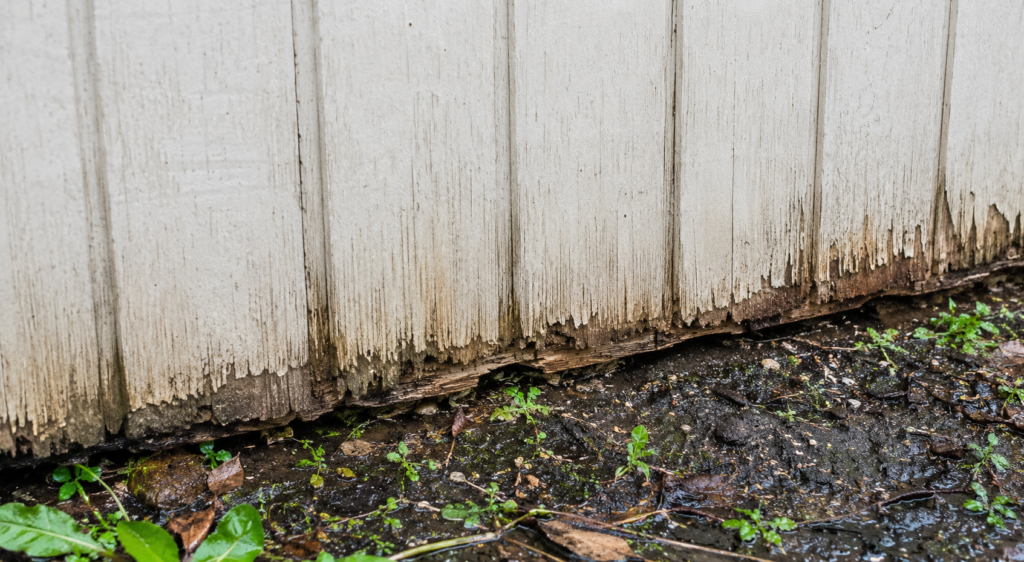
If there’s one install error that ages T1-11 before its time, it’s this: the bottom edge is set too close to the ground and the cut edges are never sealed.
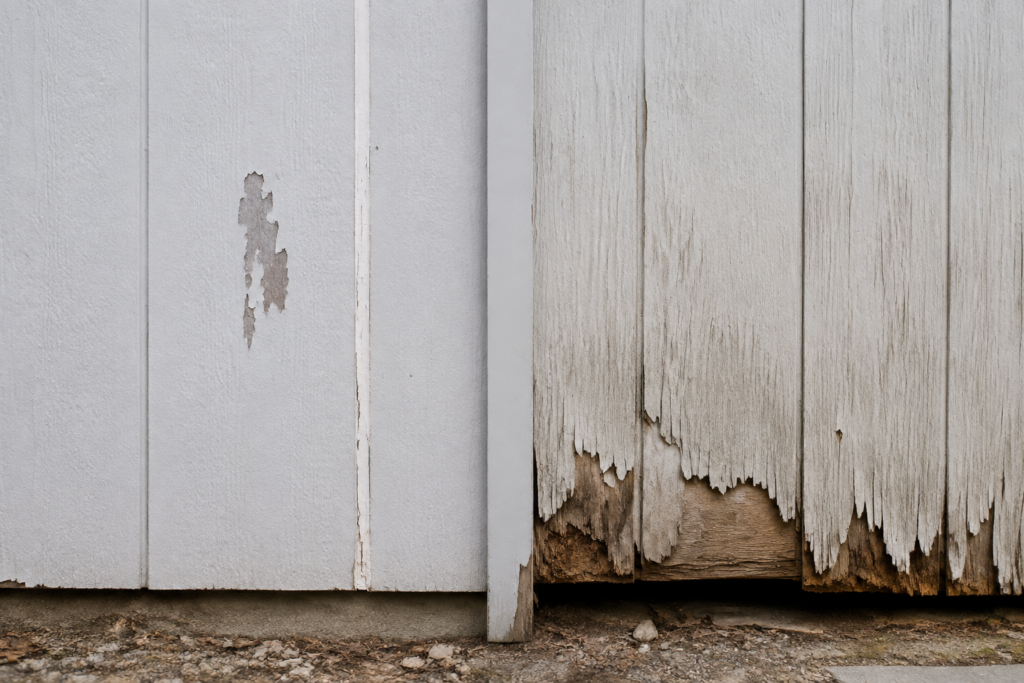
Rain hits the soil, splashes back up, and keeps the bottom few inches of the panel damp. Field-cut edges are raw end grain — the thirstiest part of any wood panel — so they wick that moisture up into the core. On plywood you can get swelling and delamination creeping up from the bottom; on OSB you can get edge swelling and softening. Either way, deterioration tends to climb the wall from below while the top of the panel still looks fine.
There’s a code reason this matters. The 2021 IRC generally requires preservative-treated or naturally durable wood where exterior wood siding is less than 6 inches above exposed earth, or less than 2 inches above concrete or similar horizontal surfaces exposed to the weather. In practice, that means untreated T1-11 should be held back from the ground by those margins. Check the code adopted in your jurisdiction and the panel manufacturer’s installation instructions, since editions and local amendments vary. (See 2021 IRC Section R317.1 for the exact language.)
For the full step-by-step on getting panels up correctly the first time, see our guide on how to install T1-11 siding.
Plywood vs. OSB: Weighing the Cost Difference
OSB T1-11 is usually the cheaper sheet at the register, and that saving is what talks a lot of people into it. It’s worth thinking past the day of purchase.
The upfront cost is only part of the picture. If a cheaper panel is more prone to moisture damage in your climate and it fails earlier, you can end up paying for materials, labor, and teardown a second time — while a more moisture-tolerant panel might still have years left. That doesn’t mean OSB always fails early or that plywood is always the right call; it means the decision should weigh the product’s specifications, warranty, and suitability for your exposure, not just the shelf price.
The homeowners who tend to regret T1-11 are usually the ones who bought the cheapest panel and skipped the finish — not the ones who bought a suitable panel and protected it properly.
Warning Signs Your T1-11 May Be Failing
Some damage is cosmetic and fixable. Some means the wood is done. Watch for:
Delamination — on plywood, the veneer layers lifting or peeling apart, often starting at the bottom edge or in the grooves.
Swollen, soft, or spongy edges — a common OSB failure; press it and it gives.
Paint that won’t hold — a fresh coat peeling within a season often means moisture is pushing out from behind.
Dark staining and soft spots near the bottom edge or around windows.
Visible fungal growth or a musty smell at the wall.
Nails backing out or a loss of fastener hold.
The tell that separates “repair” from “replace”: if the wood is soft or spongy to the touch, the affected siding material is likely deteriorated, and paint won’t reverse that.
How to Extend Your T1-11 Siding’s Lifespan
Most of this is within a homeowner’s control, and each step buys you time.
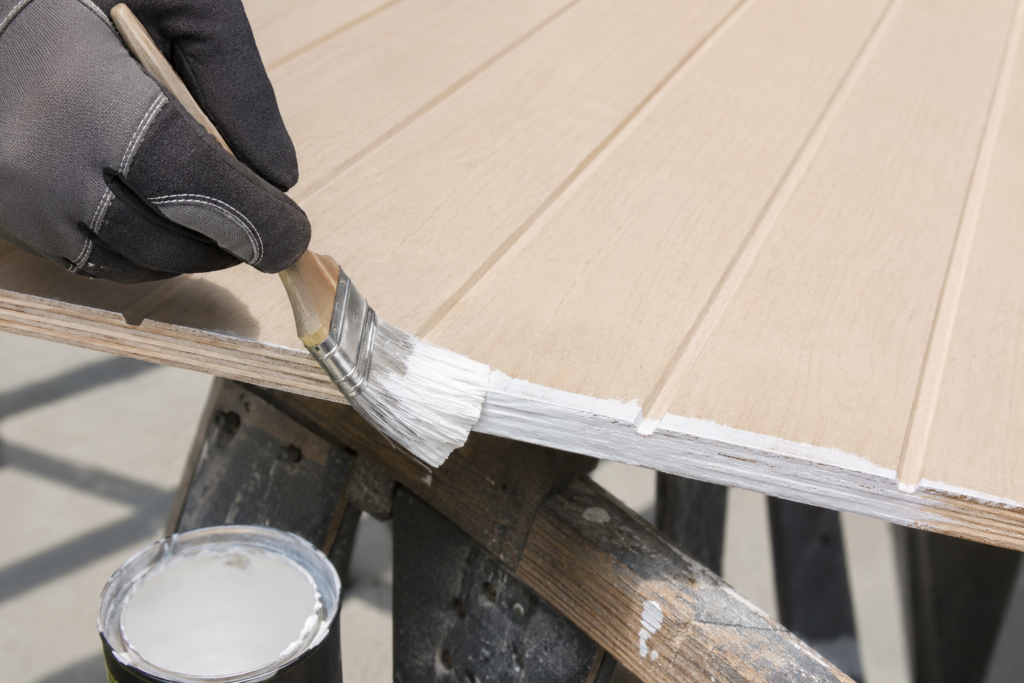
Seal or coat field-cut edges before installation. Raw end grain is where water gets in — the bottom edge especially. Follow the panel manufacturer’s instructions for edge treatment; some specify a primer or paint, others a wood preservative or edge sealer.
Prime and finish per the manufacturer’s instructions. Prime and finish the panel according to the panel and coating manufacturers’ instructions, and seal or coat all field-cut edges as required before installation. A quality exterior stain-blocking primer is usually the foundation the topcoat bonds to; skipping it is a common reason paint peels early.
Apply the number of coats specified by the panel and coating manufacturers, using an approved exterior paint or stain. This layer does the actual protecting. A durable 100% acrylic exterior paint or solid-color exterior stain applied as directed outlasts a single thin coat.
Keep the bottom edge back from grade. Maintain the clearances above (generally 6 inches from earth, 2 inches from paved surfaces) to reduce the splashback that damages panels from below.
Flash and seal vulnerable areas correctly. Install flashing around windows, doors, penetrations, horizontal transitions, and roof intersections according to the siding manufacturer’s instructions. Apply manufacturer-approved exterior sealant only where specified; do not caulk required drainage gaps or joints that the manufacturer says to leave open.
Renew the finish before it fails. Inspect the finish annually and reapply it before it cracks, peels, fades, or otherwise fails. Depending on the coating (paint or stain), exposure, climate, and manufacturer’s instructions, that may be needed roughly every 5 to 10 years. Manufacturers generally advise recoating before the existing finish gives out, rather than on a fixed calendar.
Use a proper water-resistive barrier where required. Behind siding, a water-resistive barrier (such as housewrap or felt) is installed per code and the manufacturer’s instructions to provide a drainage plane. Some rated structural siding is designed to attach directly to framing under specific conditions — confirm the correct assembly against your locally adopted code and the manufacturer’s details.
Inspect once a year. Pay particular attention to the bottom edge, penetrations, and areas around windows, where moisture damage commonly appears. Catching a problem early keeps it small.
The right finish products aren’t where you cut corners — a good primer and topcoat are what carry T1-11 to the top of its lifespan range.
An Example: Why Two Identical Panels Can Age Differently
Consider a hypothetical garage sided all at once — same panels, same day, same paint. Years later, the gable-end panels up high, in the sun and away from splashback, might still be sound and just want a repaint. Meanwhile a panel down by a downspout, in a spot that stays wet after every rain and sits too close to grade, could be delaminating at the bottom and soft to the thumb. Same material, same crew, very different outcomes — because one lived in a dry, well-drained spot and the other lived in a splash zone.
That’s the lesson in miniature: T1-11 tends to fail where water is allowed to sit. Control the water and you control much of the lifespan.
Repair or Replace: How to Decide
Repair when the damage is localized and the surrounding panel is still firm. Catch failed finish, caulk, or flashing before the wood softens and it may be a maintenance repair — reseal, re-caulk, prime, and refinish.
Replace when the material is soft or spongy, delaminating across an area, or showing rot around fasteners and openings. Soft or spongy material generally indicates deterioration that requires removal and replacement; no finish brings it back. Individual panels can sometimes be replaced without removing the entire wall, although trim, flashing, overlapping materials, and concealed damage can make replacement more involved.
Frequently Asked Questions
Does T1-11 siding have to be painted? T1-11 must be properly finished and maintained, but that does not always mean paint. Depending on the specific product, the manufacturer may permit exterior paint or an approved stain, while some siding is sold prefinished. Follow the panel manufacturer’s finishing instructions. Whatever the finish, bare or neglected T1-11 absorbs water and can fail early — the finish is the biggest single factor in how long the siding lasts.
How often should you renew the finish on T1-11 siding? There’s no universal interval. Inspect the finish annually and reapply it before it cracks, peels, fades, or otherwise fails. Depending on the coating, exposure, and climate, that may work out to roughly every 5 to 10 years — sooner in harsh conditions. Follow the coating manufacturer’s guidance.
Is plywood or OSB T1-11 better? Plywood generally shows less edge swelling after moisture exposure than commodity OSB, but performance depends on the specific product, treatment, finish, and exposure. Compare product specifications and warranties rather than judging by substrate name alone.
How far off the ground should T1-11 siding be? The 2021 IRC generally requires preservative-treated or naturally durable wood where exterior wood siding is less than 6 inches above exposed earth, or less than 2 inches above concrete and similar surfaces — so untreated T1-11 is typically held back by those margins. Confirm the code adopted in your jurisdiction and the manufacturer’s instructions.
Can you install new siding over existing T1-11? Possibly, but the existing T1-11 must be dry, sound, flat, and properly attached. Window, door, flashing, drainage-plane, and fastener details must also be redesigned for the added layer. Follow the new siding manufacturer’s instructions and have concealed moisture damage ruled out first.
Does T1-11 add structural strength to the wall? Rated plywood siding can serve double duty as sheathing and provide bracing when it’s the correct grade and fastened to code — one reason T1-11 stayed popular for sheds and outbuildings. Confirm the panel’s grade stamp and your local code before relying on it structurally.
The Bottom Line on T1-11 Siding Lifespan
T1-11 siding can often last 20 to 30 years or more, but its real service life comes down to keeping water out. Choose a panel suited to your exposure, seal the edges, hold the bottom back from grade, and renew the finish before it fails, and you’ll push toward the upper end of the range. Skip those, and the same siding can deteriorate much sooner. The panel isn’t the whole story — the maintenance is.
Related Posts:
Exterior Plywood Lifespan: How Long Each Type Lasts Outdoors by Admin August 21, 2026 DIY Exterior plywood has no single outdoor lifespan. Covered sheathing that remains dry can remain serviceable for the life of the surrounding assembly, while permanently exposed…
Exterior Plywood Guide: Grades, Types, Uses and Lifespan by Admin July 21, 2026 DIY Exterior plywood is plywood carrying an Exterior bond classification, meaning the panel is manufactured for long-term exposure to weather or moisture. It uses moisture-resistant exterior…