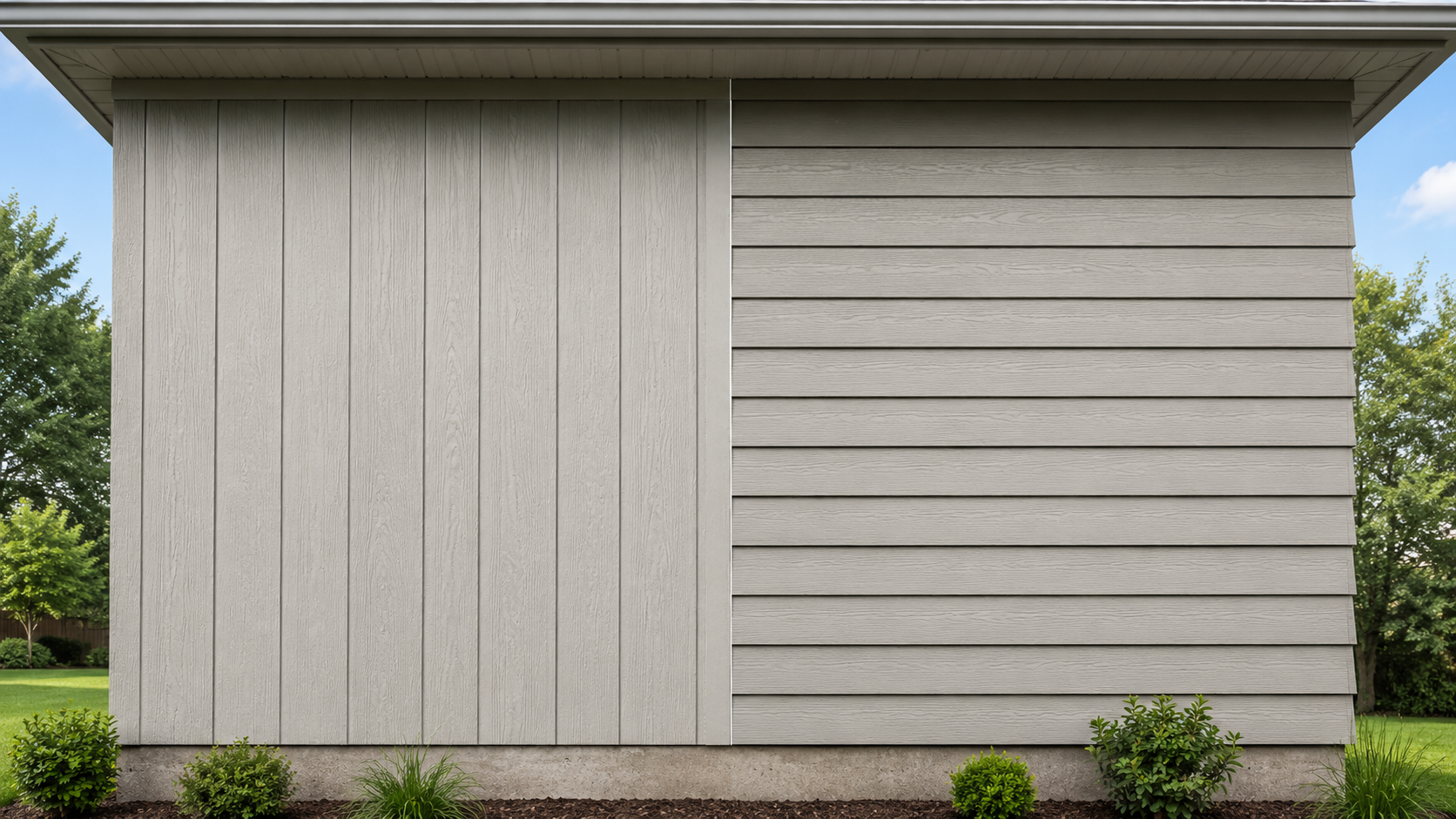
Two panels that can look similar on the truck — but they’re built differently, cost differently, and fail differently.
If you’re choosing between T1-11 and LP SmartSide, you’re weighing the cheapest wood siding on the shelf against an engineered product built to resist the weather that wears the cheap stuff down. And here’s the part most buyers miss: they punish different mistakes.
Here’s the honest breakdown, including the one installation error that hurts both.
Quick Answer: T1-11 vs LP SmartSide
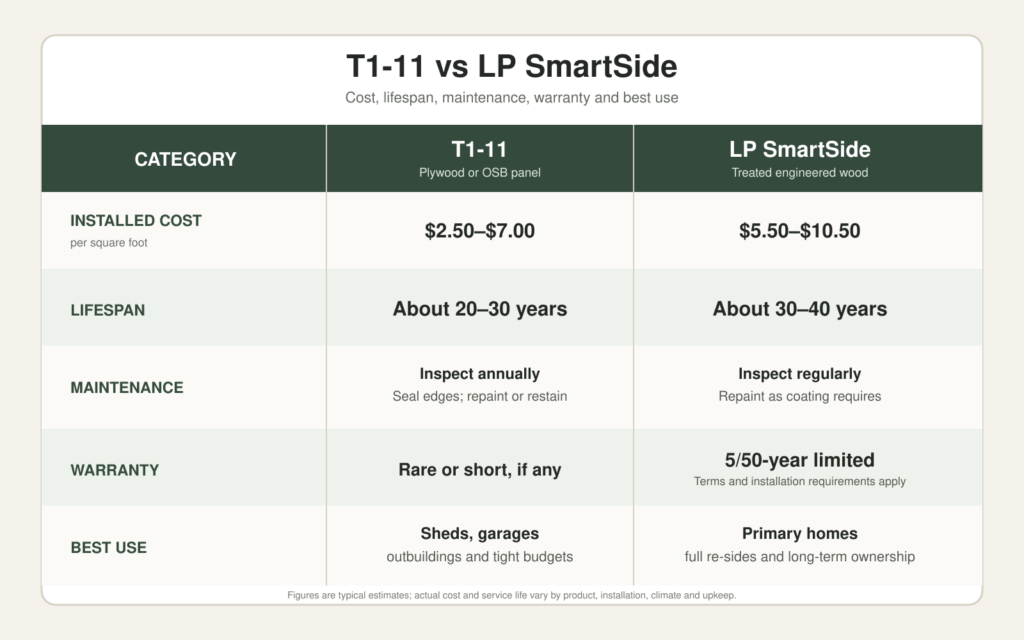
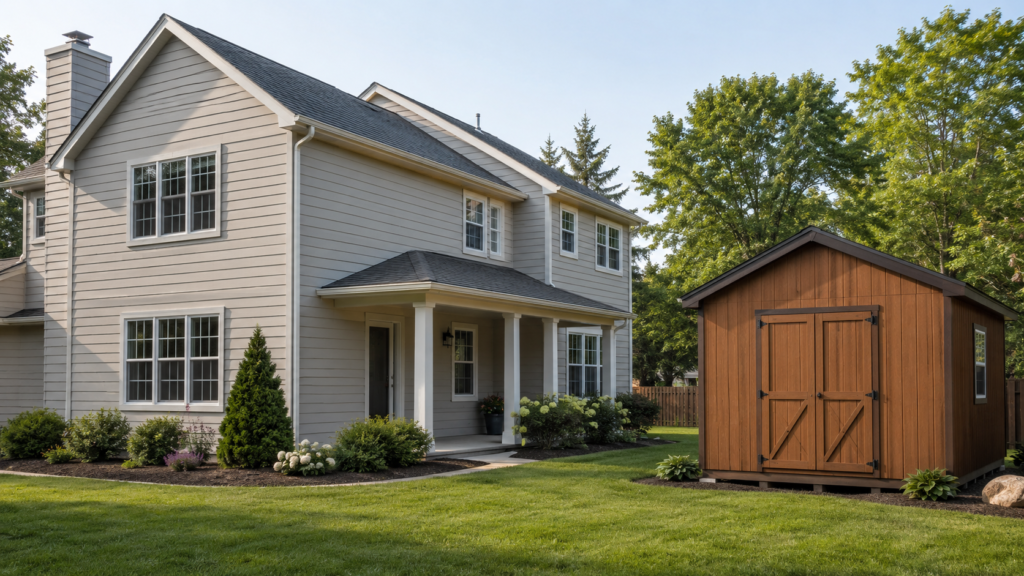
T1-11 is a low-cost grooved plywood or OSB panel siding, best for sheds, garages, and budget wall sections — it typically runs $2.50–$7.00 per square foot installed and depends heavily on sealing and repainting to last. LP SmartSide is engineered wood siding treated with zinc borate for rot and termite resistance, backed by a 5/50-year limited warranty, and typically costs $5.50–$10.50 per square foot installed. Choose T1-11 for outbuildings and tight budgets; choose LP SmartSide for a house you plan to keep.
Bottom line: T1-11 wins on up-front price. LP SmartSide wins on built-in durability and warranty. On a house you’re keeping long-term, the cheaper panel can cost more over its life once maintenance is factored in.
What Is T1-11 Siding?
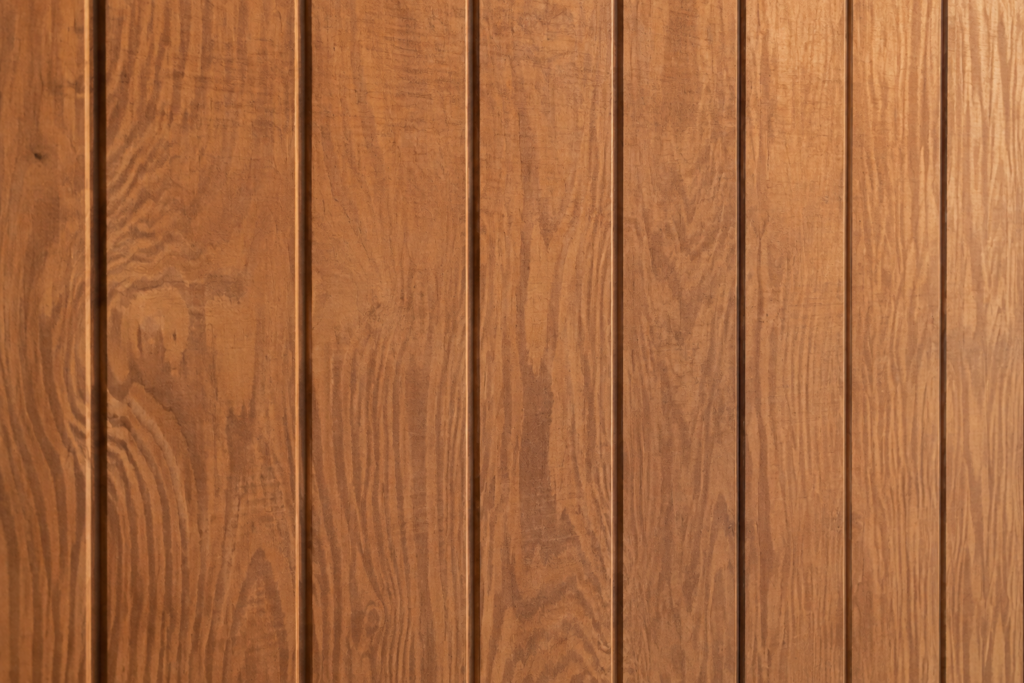
Strictly speaking, “T1-11” refers to APA’s Texture 1-11 — a specific all-veneer plywood siding panel with vertical grooves. Over the decades the name became a catch-all: grooved OSB panels are widely sold and marketed as “T1-11” too, but they aren’t the original APA plywood product, and the APA draws that distinction on its Rated Siding page. So when a supplier says “T1-11,” they may mean genuine plywood siding or an OSB look-alike — and the two don’t perform the same.
T1-11 comes in 4×8 or 4×10 sheets with vertical grooves spaced 4 inches or 8 inches on center (8-inch is the classic look; 4-inch reads more like traditional plank siding from the curb). Because genuine APA Rated Siding is a structural panel, it can often be nailed directly to studs with no separate sheathing layer — part of why it’s stayed cheap for 50 years. Our exterior plywood guide covers how those grades and edge-sealing rules actually work.
One thing to keep straight: a panel’s glue bond (Exposure 1 vs. Exterior) is what keeps the plies from delaminating. That’s a separate question from decay resistance, which on T1-11 comes almost entirely from paint, stain, and sealing. T1-11 is not rot-proof on its own.
Plywood T1-11 vs OSB T1-11
Plywood T1-11 — cross-laminated veneers, holds paint well, better moisture resistance, costs more. The version to choose if it’s staying up a while.
OSB T1-11 — compressed wood strands, cheaper, but its edges swell when water reaches a groove or a cut edge and are slow to recover. In wet climates it can disappoint sooner. (More on that behavior in our OSB pros and cons guide.)
If a supplier just says “T1-11,” ask which one you’re getting.
What Is LP SmartSide?
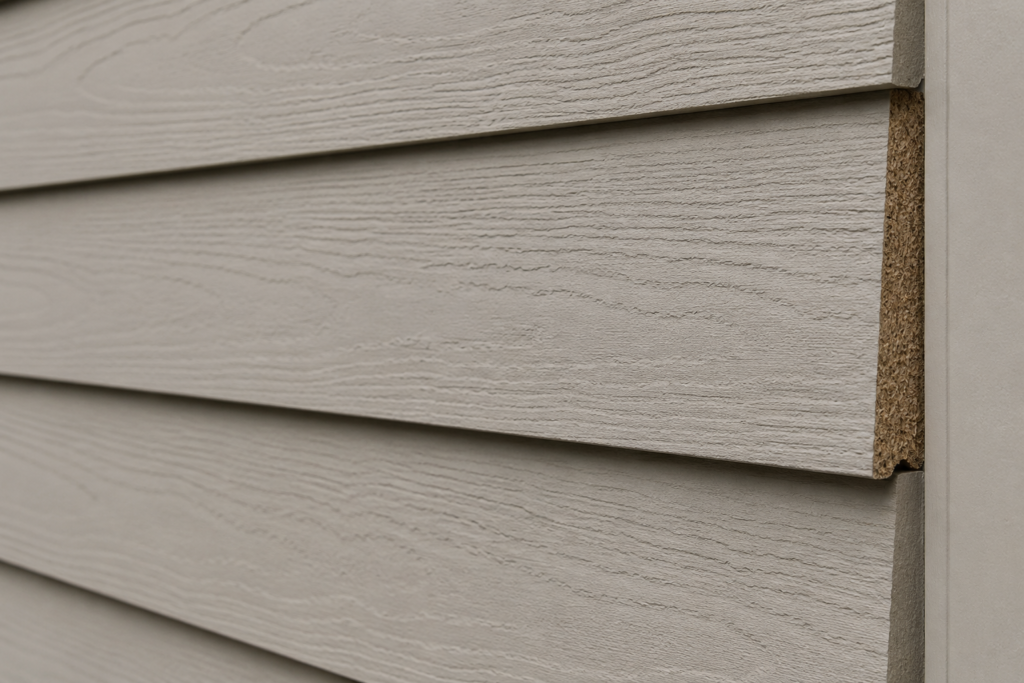
LP SmartSide is engineered wood siding made by Louisiana-Pacific (LP Building Solutions) from aspen wood strands treated through the whole panel with LP’s SmartGuard process: zinc borate for termite and fungal-decay resistance, waxes for moisture resistance, resins for strength, plus a resin-saturated overlay bonded on top.
The specs that matter for this comparison:
5/50-year limited warranty — five years of 100% labor-and-material replacement, followed by prorated material coverage through year 50, plus qualifying hail coverage up to 1.75 inches in diameter. LP explains the terms in its 5/50 warranty breakdown.
Core treatment — the zinc borate is worked into the panel, not just the surface, which is the real point of difference from untreated T1-11.
Product range — comes as panel (the direct T1-11 competitor), lap, trim, soffit, and fascia, plus the pre-finished ExpertFinish line, which carries an additional finish warranty and skips job-site painting.
That core treatment is why LP SmartSide holds up better against the failure T1-11 — with no built-in treatment — is more exposed to: rot starting at a wet edge.
T1-11 vs LP SmartSide: Side-by-Side
Material
T1-11: Plywood (genuine T1-11) or an OSB look-alike
LP SmartSide: Treated engineered wood strands
Rot and termite resistance
T1-11: From coating only — none built in
LP SmartSide: Zinc borate, treated to the core
Installed cost
T1-11: about $2.50–$7.00 per square foot
LP SmartSide: about $5.50–$10.50 per square foot
Warranty
T1-11: rare or short, if any
LP SmartSide: 5/50-year limited
Lifespan (with proper install and upkeep)
T1-11: roughly 20–30 years
LP SmartSide: roughly 30–40 years
Maintenance
T1-11: inspect annually; repaint or restain when the coating deteriorates
LP SmartSide: inspect regularly; repaint as required by coating condition and manufacturer guidance
Weak point
T1-11: grooves, cut edges, and the bottom edge
LP SmartSide: cut edges if left unsealed
Best for
T1-11: sheds, garages, outbuildings
LP SmartSide: full house re-side, long-term homes
The Mistake That Ruins Both Panels
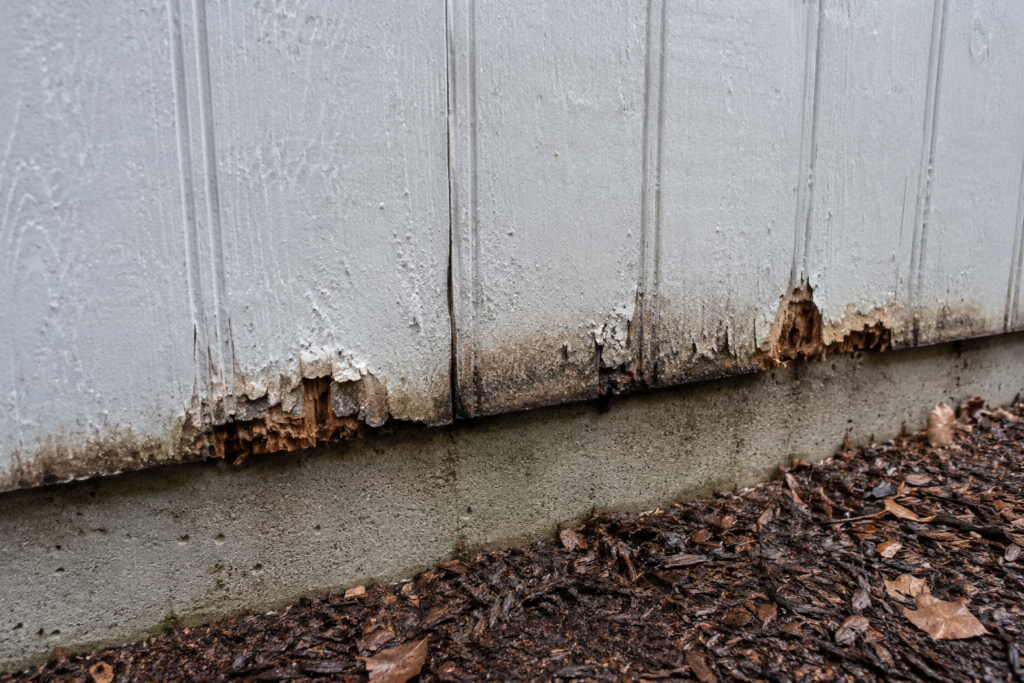
The failure that shows up most often in siding-repair reports has nothing to do with the brand: leaving the bottom edge and cut edges unsealed.
Both products are wood. Water rarely attacks a well-painted face — it wicks up into the raw, unsealed bottom edge by capillary action and works into the panel from below, where you don’t see it until the paint bubbles. On T1-11, the grooves make it worse, funneling water to end grain.
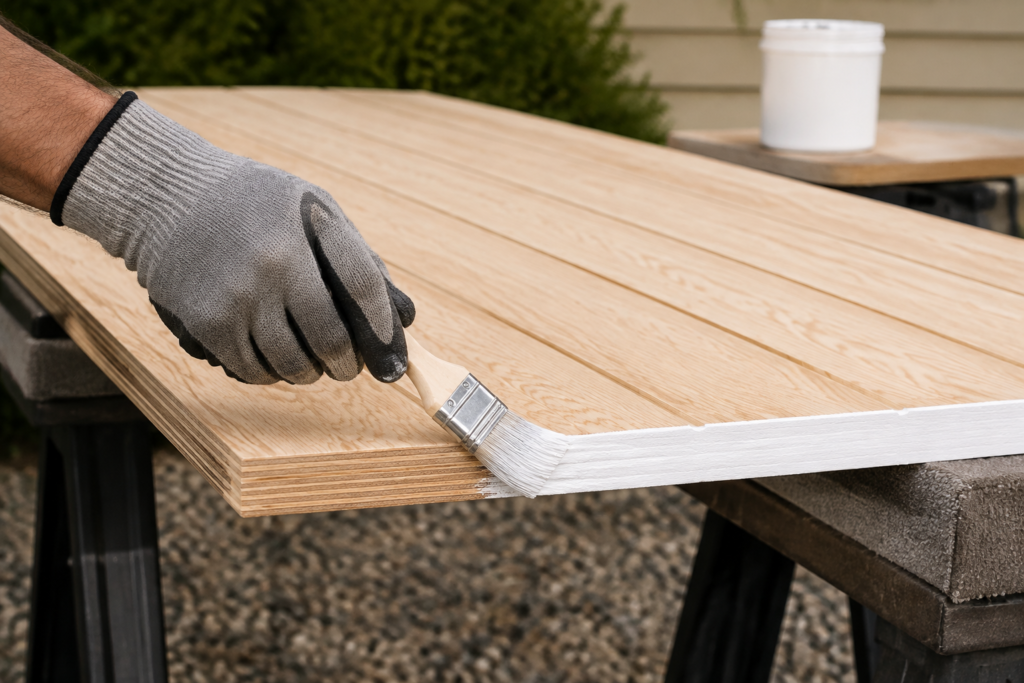
The fix is cheap and straightforward: keep the bottom edge above grade. LP requires at least 6 inches of clearance above finished grade in the United States and 8 inches in Canada or where local codes require it, according to its siding installation guidance. Also maintain the required clearance above roofs and decks, seal exposed cut edges according to the manufacturer’s instructions, and install proper Z-flashing at horizontal joints. (Here’s how that rot gets started and spreads.)
Warning: OSB is the least forgiving of this mistake. Once water reaches the strands at a cut edge, the swelling can be permanent — you often can’t sand or dry it back to flat.
An Informal Edge-Exposure Demonstration
This is an informal demonstration, not a standardized durability test. It should not replace manufacturer specifications, warranty documentation, or approved installation instructions.
If you want to see for yourself why edges matter, stand an offcut of your panel in a shallow tray of water, cut edge down, and check it a day or two later. Unsealed OSB edges tend to swell and puff at the strands where water reaches them. Plywood and treated engineered panels behave differently, and actual results vary by product, coating, and how the edge was cut. Either way, this only shows the short-term behavior of a bare, unsealed edge sitting in standing water — conditions a properly installed wall is designed to avoid.
This demonstration can help illustrate why exposed panel edges require proper sealing, but it cannot predict the installed lifespan of either product.
The Cost Difference (2026 Numbers)
This is where most people stop reading and grab T1-11. Run the full math first.
T1-11 installed: roughly $2.50–$7.00 per square foot, with whole-project averages commonly around $8,500 and a broader range of about $4,000–$14,000, according to 2026 cost data from Angi and HomeAdvisor. The sheet is cheap; sealing, flashing, and repeated repainting are part of the true cost.
LP SmartSide installed: commonly cited at $5.50–$10.50 per square foot, though some 2026 data puts the national range closer to $4.50–$9.00 per square foot. It generally lands between budget vinyl and premium fiber cement.
LP SmartSide typically costs considerably more up front, although the actual difference depends on the product, labor rates, wall preparation, finishing, and location. Over the long run, though:
T1-11 that’s kept dry and repainted on schedule can reach the 20–30 year range.
Neglect the coating or let the base wick water, and it can fail short of that — especially OSB.
LP SmartSide’s core treatment and warranty reduce the odds of surprise repair bills.
The catch with T1-11 is that its lower price assumes you keep up the sealing and repainting. If that maintenance slips, some of the savings erode. (For how coatings and edge-sealing drive plywood longevity, see our exterior plywood guide.)
The Regret Test: Who Ends Up Wishing They’d Chosen Differently?
Two ways people end up unhappy, and they run in opposite directions:
Mismatch on T1-11 — siding an actual house with it to save money, then running into the ongoing repaint reality, or finding soft, water-damaged panels at the base after moisture got in. More likely with OSB in a wet or coastal climate.
Mismatch on LP SmartSide — paying house-siding prices to clad a shed or detached garage where cheaper T1-11 would have been fine, or (you or your installer) skipping edge-sealing and giving up the durability you paid for.
The pattern: T1-11 disappointment usually comes from over-reaching (using it where it can’t easily survive), and LP SmartSide disappointment from over-spending (using it where you didn’t need to). Match the panel to the job and both largely disappear.
Which Should You Choose?
Choose T1-11 if:
You’re siding a shed, garage, workshop, or outbuilding.
Budget is the hard constraint and it isn’t your primary home.
You’ll commit to sealing edges and repainting on schedule.
You’re in a drier climate with lower moisture pressure.
Get plywood, not OSB, if it’ll see real weather.
Choose LP SmartSide if:
It’s your actual house and you plan to stay.
You want stronger resistance to fungal decay, termites, and moisture-related damage than untreated wood siding provides.
You want a manufacturer warranty standing behind the product.
You’re in a wet, humid, or hail-prone region.
You’d rather repaint less often — or skip job-site painting with ExpertFinish.
Resale matters; engineered wood tends to show better than aging T1-11.
Affiliate disclosure: ThePlywood.com is a participant in the Amazon Associates Program. As an Amazon Associate, ThePlywood.com earns from qualifying purchases. This article contains affiliate links; if you purchase through them, we may earn a commission at no additional cost to you.
Tools & Materials You’ll Need for Either Panel
Whichever panel you choose, the outcome rides on the boring supporting cast — the primer, sealant, and flashing that decide whether water ever reaches the wood:
Exterior wood primer — seal every cut edge before the panel goes up. This is the step that saves the panel. → Shop exterior wood primer
Paintable exterior sealant / caulk — for joints, seams, and trim transitions. → Shop exterior sealant
Z-flashing / drip cap — the non-negotiable at horizontal panel joints. → Shop Z-flashing
Galvanized or stainless siding nails — so fasteners don’t rust-streak the wall. → Shop siding nails
Moisture meter — check panels before install and diagnose soft spots later. → Shop a moisture meter
Properly sealed edges and dry panels significantly reduce the risk of premature moisture damage.
Frequently Asked Questions
Is LP SmartSide better than T1-11? For a home you plan to keep, many homeowners find it worth the extra cost — its treated core resists rot and termites and it carries a 5/50-year warranty. For a shed or budget project, T1-11 can be the smarter spend.
How long does T1-11 siding last? Commonly cited at 20–30 years with regular sealing and repainting. It can be less in wet climates or if maintenance is neglected, especially with OSB.
Is LP SmartSide just fancy T1-11? No. Both are wood panels, but LP SmartSide is treated to the core with zinc borate and sealed with a resin overlay, giving it rot and termite resistance T1-11 doesn’t have out of the box.
Which is cheaper, T1-11 or LP SmartSide? T1-11 is cheaper up front — roughly $2.50–$7.00 per square foot installed versus $5.50–$10.50 for LP SmartSide. Over the long run, T1-11’s repaint-and-repair costs can narrow that gap.
Can you use T1-11 on a whole house? It’s doable, and people do it — but it demands strict edge-sealing and regular repainting to hold up, which is why many homeowners step up to engineered wood for a primary residence.
Does LP SmartSide rot? It’s highly resistant, not immune. Left with unsealed cut edges or installed too close to grade, any wood-based siding can take on water. Seal the cuts and keep it off the ground.
Final Verdict
T1-11 is the right answer for sheds, garages, and tight budgets — buy the plywood version, seal every edge, and stay on top of paint. LP SmartSide is the right answer for the house you actually live in — you pay more once and get built-in rot resistance plus a real warranty.
Moisture damage frequently begins at exposed edges, improperly flashed joints, and areas installed too close to grade. Correct installation and continued coating maintenance are essential for both products, although untreated T1-11 is generally less forgiving of prolonged moisture exposure.