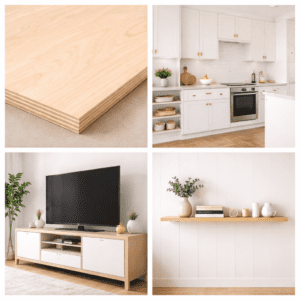
If you are weighing your options for lightweight interior builds or looking for an alternative to heavy hardwoods, Aspen Plywood might have crossed your radar. Aspen plywood has developed a loyal following among RV builders, sauna manufacturers, and woodworkers who prioritize weight savings. However, its softness means it is not the right choice for every project.
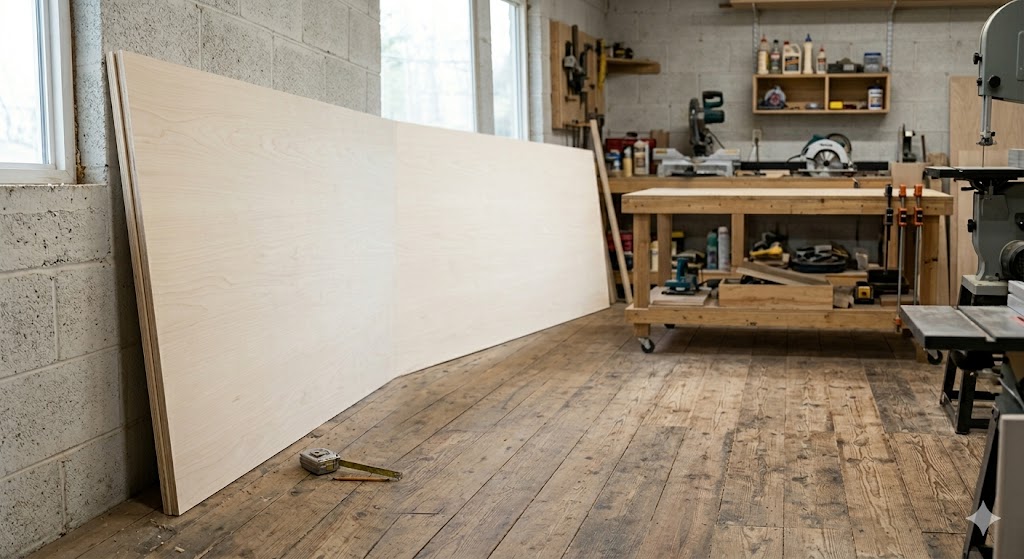
Aspen plywood is a lightweight hardwood plywood known for its pale appearance, smooth texture, and excellent weight savings. It is commonly used in camper vans, RV interiors, sauna construction, and painted cabinetry, but its softness makes it less suitable for flooring, workbenches, and high-impact cabinetry.
Aspen Plywood At A Glance
Before diving into real-world performance, let’s see how Aspen stacks up against the reigning champions of the plywood world: Baltic Birch and standard Pine/Fir structural sheets. If you are unfamiliar with how different types of plywood affect project durability, read up on the various types of plywood before making a final selection.
Feature
Aspen Plywood
Baltic Birch Plywood
Standard Pine/Fir (CDX)
Average Density
~25–27 lbs/cu ft (Ultra-Lightweight)
~42–45 lbs/cu ft (Heavy/Dense)
~32–36 lbs/cu ft (Medium)
Janka Hardness
420 lbf (Soft)
1,260 lbf (Very Hard)
~380–540 lbf (Soft to Medium)
Best Used For
Saunas, lightweight camper vans, drawer sides
Fine furniture, shop jigs, heavy cabinets
Subfloors, framing, rough structural work
Paintability
High (Uniform texture, no grain bleed)
Excellent (Smooth, uniform surface)
Poor (Heavy grain raising, sap knots)
Relative Cost
$$ Economical alternative
$$$$ Premium pricing
$ Cheap commodity sheet
⚖️ Weight Comparison: 4×8 Sheet Breakdown
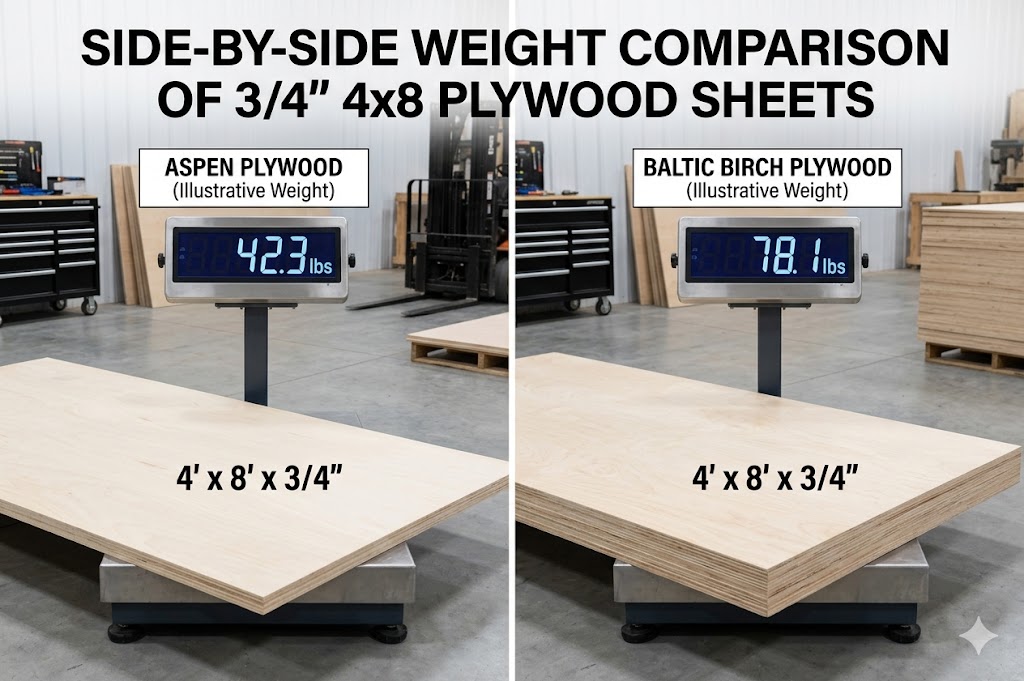
Because weight savings is one of the primary reasons woodworkers choose Aspen plywood over denser alternatives, keeping an accurate target in mind helps you stay within payload limits. Check out our universal plywood weight chart to map out your total project load.
Plywood Type
1/2-inch Sheet Weight
3/4-inch Sheet Weight
Aspen Plywood
~32–35 lbs
~48–52 lbs (Easiest to handle alone)
Standard Pine/Fir
~40–45 lbs
~60–68 lbs
Baltic Birch
~50–55 lbs
~75–82 lbs (Heavy structural density)
💵 Real-World Cost Comparison Table
While prices fluctuate depending on regional lumberyard stock, this matrix reflects the typical baseline retail cost differences you will encounter when purchasing full 4ft×8ft project sheets:
Material Thickness
Sanded Aspen Plywood
Premium Baltic Birch
1/2-inch Sheet
~$50 – $60
~$75 – $90
3/4-inch Sheet
~$65 – $75
~$110 – $140
⚔️ Direct Head-to-Head: Aspen Plywood vs Baltic Birch
When analyzing Aspen plywood vs Baltic Birch, your choice ultimately comes down to a direct trade-off between dead weight and mechanical density:
Feature
Aspen Plywood
Baltic Birch
Weight
Considerably Lighter
Significantly Heavier
Screw Holding
Fair (Requires care)
Excellent (High density)
Hardness
Soft (Easily scratched)
Very Hard (Impact resistant)
Paint Finish
Excellent (Smooth, no bleed)
Excellent (Uniform surface)
Durability
Moderate (Interior only)
Excellent (Highly rigid)
Cost
Lower Baseline
Higher Premium
🪵 Material Showdowns: Aspen vs. Poplar vs. Maple
To truly understand where Aspen fits in the workshop hierarchy, it helps to compare it to Poplar and Maple—two other light-toned hardwood plywoods frequently chosen for interior cabinetry.
Aspen Plywood vs. Poplar Plywood
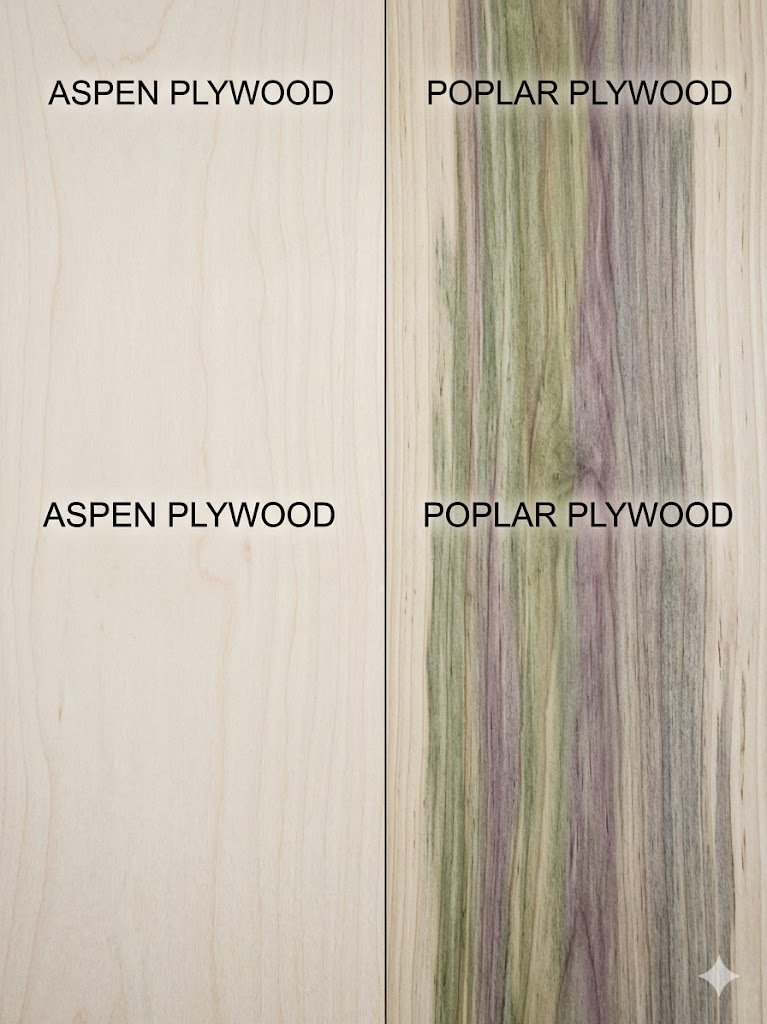
Poplar and Aspen are botanical cousins, both belonging to the Salicaceae family, and they share very similar density properties. However, there is a major visual difference. Poplar plywood often displays dramatic color variations, ranging from pale cream to streaks of olive green and deep purple. Aspen, by contrast, is much more visually consistent, offering a cleaner, uniformly white-to-cream face veneer. If you plan to clear-coat your project rather than paint it, Aspen provides a more uniform canvas, while Poplar is slightly harder (Janka rating of ~540 lbf vs. Aspen’s 420 lbf) and holds screws a bit more securely.
Aspen Plywood vs. Maple Plywood
Maple is a premium, dense hardwood, and the performance gap between Maple and Aspen plywood is massive. Maple plywood features a Janka hardness rating of 1,450 lbf, making it exceptionally scratch- and dent-resistant. While Maple is the ultimate choice for heirloom furniture and residential kitchen cabinets, it comes with a major weight penalty, at around 70-75 lbs per 3/4-inch sheet. Choose Aspen for weight-sensitive applications where surfaces are protected from daily abuse; choose Maple when durability cannot be compromised.
🏭 How Aspen Plywood is Manufactured
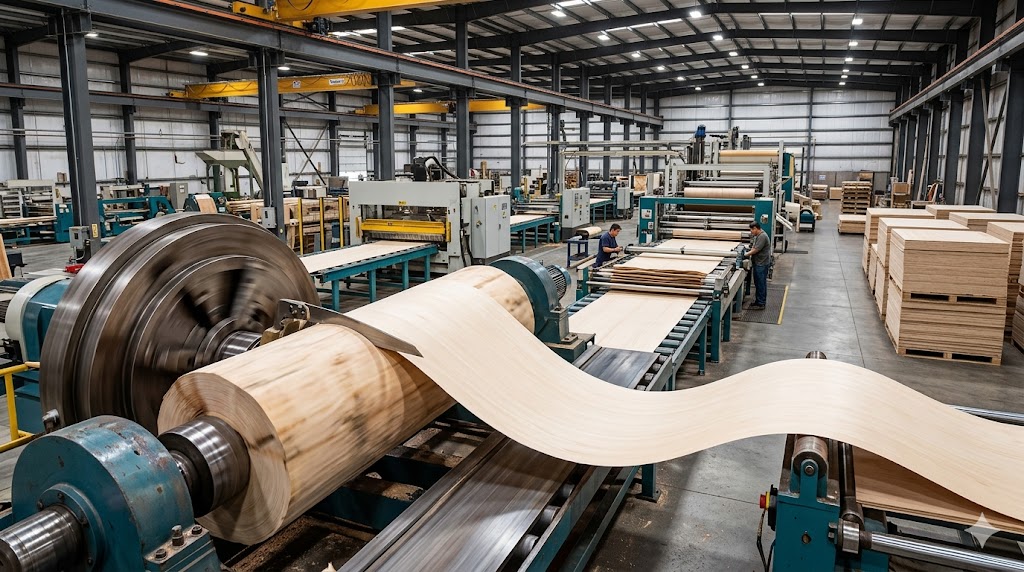
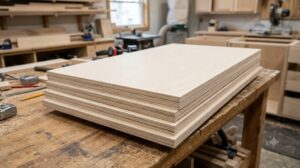
Understanding how Aspen sheets are constructed explains their unique physical properties. The process begins in managed northern forests, where fast-growing Aspen logs are harvested and transported to the mill.
Peeling: The logs are conditioned in hot-water tunnels to soften the wood fibers before being placed on a high-speed rotary lathe, which peels them into continuous, thin ribbons of veneer.
Drying & Grading: These wood ribbons are clipped to size, run through industrial dryers to bring moisture content down to roughly 5%, and sorted by visual grade. The cleanest, knot-free pieces are reserved for the face and back veneers.
Layering (Veneer Core): Unlike MDF (Medium-Density Fiberboard) or particleboard cores, high-quality Aspen plywood uses a veneer core construction. The inner plies are stacked with their grain directions alternating at 90-degree angles (cross-banded). This alternating cross-ply architecture provides the final sheet with structural stability and prevents bowing.
Pressing: Industrial exterior- or interior-grade adhesives are applied between each layer. The assembled stack is then placed under immense pressure and heat in a multi-opening hydraulic press to cure the glue bonds.
Finishing: Finally, the sheets are trimmed to exact 4 ft × 8 ft dimensions and fed through wide-belt sanders to create a smooth, paint-ready surface.
🧪 Shop Notes: Working with Aspen Plywood
While Aspen looks remarkably clean right off the rack, it behaves very differently under tools than traditional dense hardwoods.
⚠️ The Sanding Warning: Watch the Fuzz
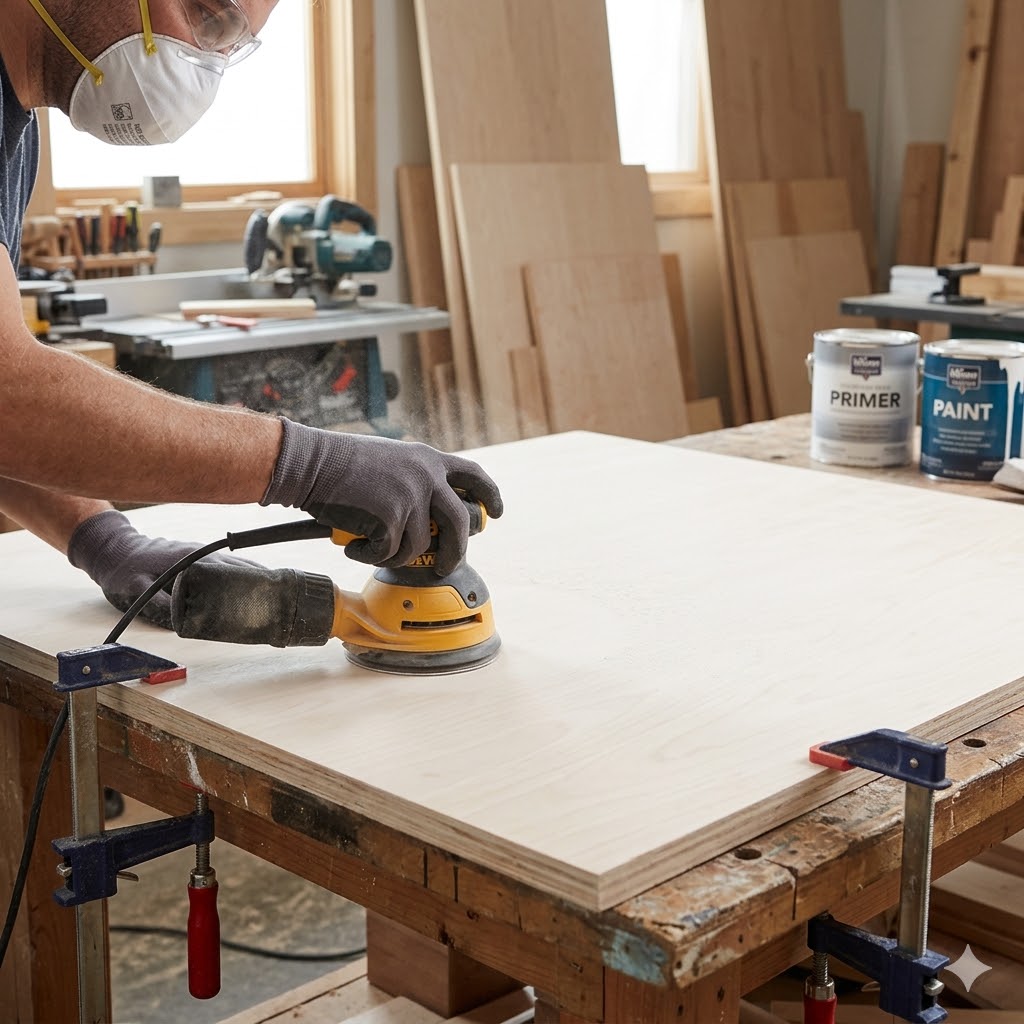
Here is something to keep in mind before finishing: Aspen has a notoriously “woolly” or “fuzzy” grain structure. If you hit it with standard coarse sandpaper on a random-orbit sander, the soft fibers tend to tear, creating micro-fuzz rather than a slick surface.
To achieve a pristine finish, apply a dedicated sanding sealer to lock the grain flat before making your final light pass with fine sandpaper. Skipping this step often causes paint coats to absorb unevenly, leading to a rough, patchy texture.
The Fastener Vulnerability
Because Aspen sits relatively low on the Janka hardness scale (420 lbf), its screw-holding capacity is inherently limited compared to dense options like birch. Compared with Baltic Birch, Aspen is generally more prone to screw stripping when fasteners are over-tightened. If you are assembling a project out of Aspen, it is a critical mistake to rely on mechanical fasteners alone—always pair your joints with high-quality wood glue.
⚠️ Common Mistakes When Working with Aspen Plywood
Working with lightweight, soft hardwoods requires a few shifts in standard shop technique. Avoid these common blunders to ensure your project turns out beautifully:
Using Dull Crosscut Blades: Because Aspen fibers are soft and flexible, dull saw blades won’t cleanly sever them. Instead, they will push and tear the fibers, resulting in severe veneer tear-out on the back side of your cuts. Always use sharp, high-tooth-count carbide blades.
Over-Tightening Pocket Screws: Driving pocket screws into Aspen with an impact driver set to high torque will instantly strip out the pocket. Set your drill clutch low, or use a manual screwdriver for the final snug turn.
Skipping Pre-Stain Conditioner: If you choose to stain Aspen rather than paint it, applying stain directly to the raw wood will cause severe blotching. The varying density across the face veneer causes uneven stain absorption, making a pre-stain sealer mandatory for a uniform appearance.
😬 The Cabinet Maker’s Dilemma: Denting & Regret
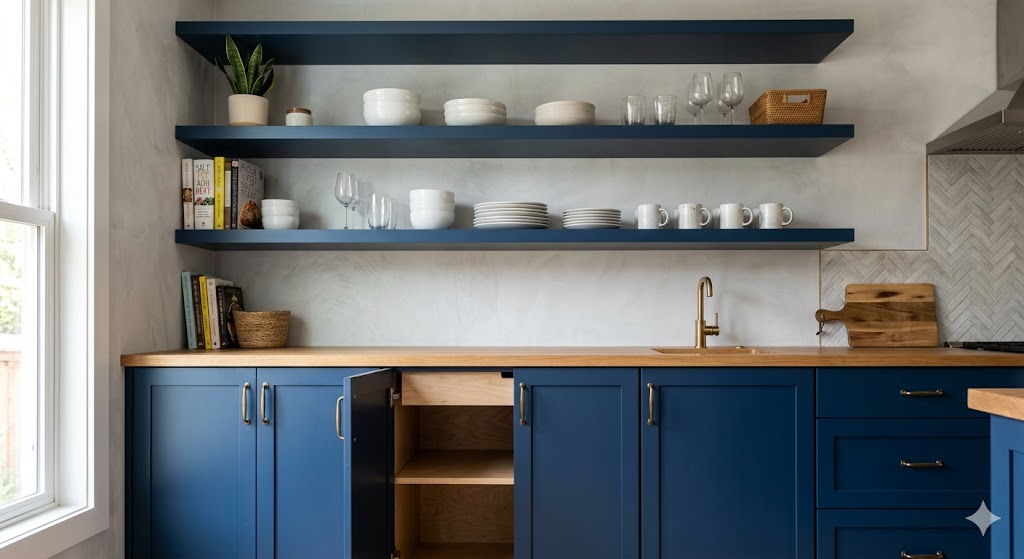
One cabinetmaker reported premature denting in heavily loaded Aspen cabinet boxes compared to Baltic Birch. Because kitchen cabinets are subject to daily impacts from heavy cookware, the softer Aspen cores can easily compress under localized pressure over time. If you want a panel that withstands decades of slamming doors, explore our definitive guide to the best plywood for cabinets.
🔍 Best Uses for Aspen Plywood
Where should you actually deploy this material? This table breaks down where it thrives and where it fails:
Stays cool to the touch; no resin or sap outgassing.
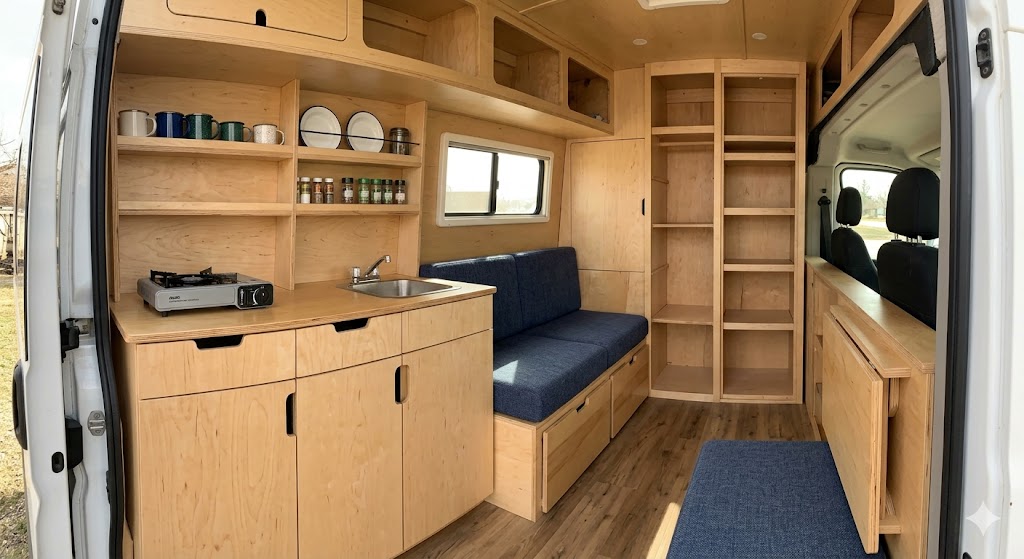
Camper Vans
✅ Excellent
Aspen plywood for camper vans reduces overall vehicle weight, which improves payload capacity and efficiency.
RV Cabinets
✅ Good
Using Aspen plywood for RVs keeps overhead storage frameworks light.
Children’s Furniture
✅ Good
Tends to produce fewer harsh splinters than coarse woods.
Kitchen Cabinets
❌ Not Recommended
Prone to daily impact dents from pots and pans.
Workbenches
❌ Not Recommended
Too soft for heavy mechanical clamping or pounding.
Flooring
❌ Not Recommended
Lacks the necessary structural hardness for foot traffic.
Outdoor Projects
❌ Not Recommended
Lacks natural weather or decay resistance.
💸 Cost Difference & Smart Alternatives
Where Aspen shines is in your budget. On average, a sheet of high-grade Aspen plywood will run you about 30% to 40% less than true Baltic Birch. It is an amazing budget-friendly option if you use it where its weaknesses don’t matter.
If you are looking for premium alternatives or complementary layout materials, check out our deep-dive breakdowns:
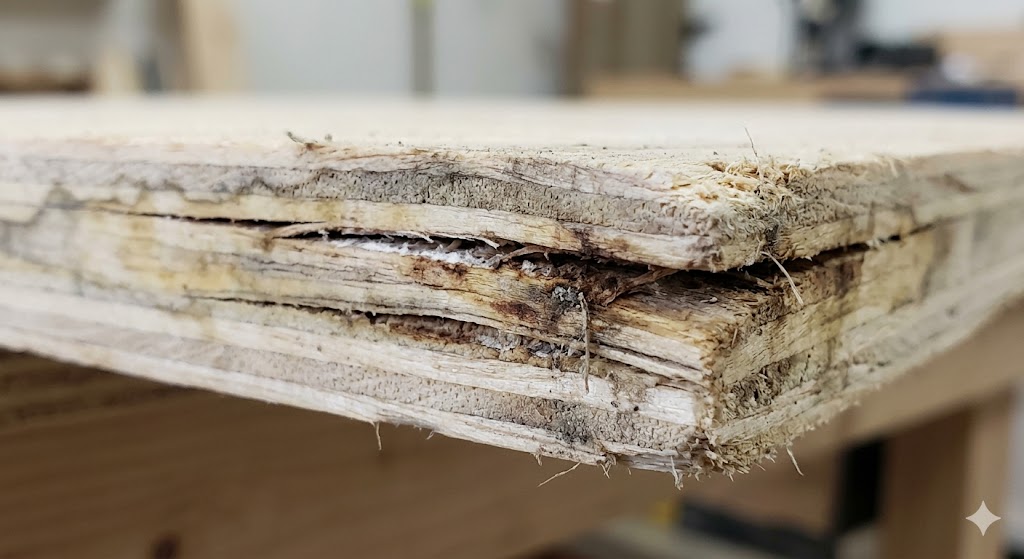
No. Is Aspen plywood waterproof? Absolutely not. Like most interior hardwood plywood products, it can absorb moisture and swell when exposed to prolonged water contact. Repeated wetting and drying cycles may eventually weaken glue bonds and lead to veneer separation.
If your project requires complete weather resistance or will be exposed directly to rain and ground moisture, skip Aspen entirely. Exterior-grade or specialized marine-grade options are far better choices for wet environments.
📋 Common Aspen Plywood Thicknesses
Choosing the correct core profile ensures your assembly resists sagging under load. For a full breakdown of sizing tolerances, refer to our comprehensive plywood thickness guide.
Thickness
Typical Uses
1/4-inch
Drawer bottoms, cabinet backs, lightweight panels
1/2-inch
Aspen plywood for saunas, custom benches, and shelving frames
Aspen plywood for saunas, custom benches, shelving frames
📋 Buying Guide: How to Choose Aspen Plywood
Choose Aspen plywood if:
Total assembly weight matters significantly more than raw surface durability.
You plan to apply a solid coat of paint to the finished project.
You are building mobile structures such as RVs, trailers, and camper vans.
You specifically need a smooth, consistently pale appearance with minimal grain contrast.
Choose Baltic Birch instead if:
You need maximum screw-holding power for heavy mechanical joints.
The project will see heavy daily use, scratches, or high impact.
You are building permanent kitchen or utility room cabinets.
Long-term wear resistance and structural rigidity are your top priorities.
❓ Frequently Asked Questions
Is Aspen plywood stronger than pine plywood?
Aspen plywood is generally lighter than pine plywood but offers similar or slightly lower overall structural strength, depending on the specific core ply construction and grade.
Can Aspen plywood be stained?
Yes. Aspen accepts stain cleanly, although many woodworkers prefer paint. Because its subtle grain pattern provides limited visual contrast, stains can sometimes look washed out without a pre-stain wood conditioner.
Is Aspen plywood good for cabinets?
Aspen plywood can work well for lightweight cabinet backings or RV cabinets, but Baltic Birch or maple plywood remains the standard choice for heavily used residential kitchen cabinets.
Does Aspen plywood warp easily?
When stored flat in a climate-controlled room and kept dry, Aspen plywood remains remarkably stable. However, as with any wood product, improper vertical storage or prolonged exposure to standing moisture will cause warping.
Extremely lightweight and easy to manipulate alone
Softer than Baltic Birch or Maple panels
Uniform, pale surface that takes paint beautifully
Lower screw-holding capacity if over-tightened
Highly cost-effective compared to premium hardwoods
Poor moisture resistance; susceptible to rot if wet
Splinter-resistant face veneer texture
Not ideal for heavy-duty structural flooring or worktops
Perfect for saunas and camper van cabinetry weight specs
Can dent under heavy, localized impacts
🛠️ Final Verdict: Is Aspen Plywood Worth It?
Aspen plywood is not a replacement for Baltic Birch, maple plywood, or other premium hardwood panels. Instead, it fills a unique niche where low weight matters more than maximum durability. For RVs, camper vans, saunas, painted furniture, and lightweight storage projects, Aspen can be an excellent value. For workbenches, kitchen base cabinets, flooring, and high-impact shop projects, a denser plywood is usually the better long-term investment.
🛒 Gear Up For Your Next Build
To get the absolute best finish out of an ultra-light hardwood like Aspen, you need the right setup. Here are the specific shop tools commonly used to handle the fuzzy grain and soft core:
Sanding Sealer: To knock down that infamous woolly grain before you paint, apply a coat of Minwax Water-Based Sanding Sealer to flatten the fibers.
Ultra-Sharp Blades: Do not use dull saw blades on Aspen. Pick up a dedicated DIABLO 60-Tooth Fine Finish Saw Blade to eliminate tear-out along your cut lines.
Parallel Clamps: Because Aspen glues beautifully but requires immediate, even pressure, a set of BESSEY Parallel Bar Clamps will keep your panels perfectly flat as they dry.
What Is Sande Plywood? Uses, Pros, Cons, and Buying Guide by Admin March 28, 2026 Hardwood Sande plywood fills a very specific role: it gives you a smooth, paint-ready surface with solid strength—without paying hardwood prices. Once you understand where it…
Blondewood Plywood Review: Pros, Cons & Best Uses by Admin June 22, 2026 Softwood Walk into any big-box home improvement center looking for budget-friendly cabinet material, and you’re bound to encounter a stack of exceptionally clean, bright sheets labeled…