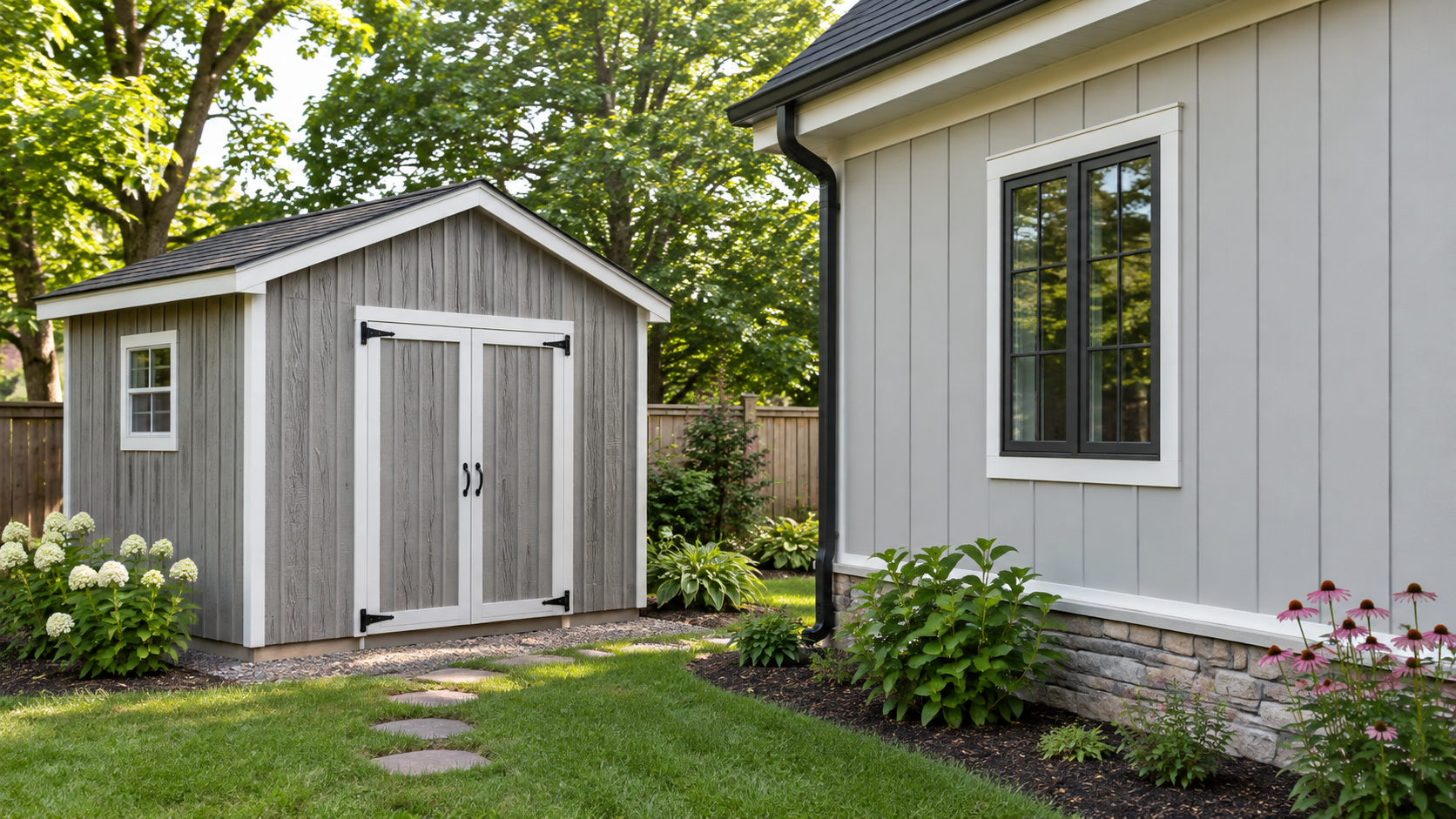
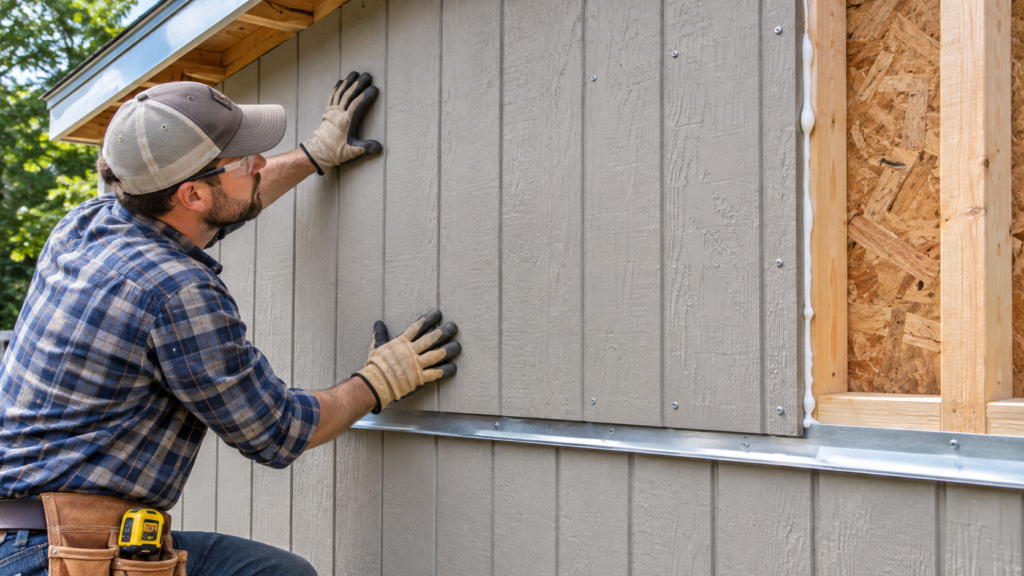
Fiber cement siding is the better choice for a house wall you want to paint and mostly leave alone. It doesn’t burn, insects don’t eat it, and James Hardie backs its vertical panel with a 30-year non-prorated warranty. T1-11 is the better choice for sheds, barns and other outbuildings, because in many builds one sheet can do the job of both sheathing and siding, as long as the panel and nailing meet an approved bracing method. Below you’ll find a side-by-side chart, a quick decision guide, the install details that change the answer, and the mistakes that cost people a full re-side.
Shed, garage, budget build, DIY solo: plywood T1-11 with an APA 303 stamp.
The deciding factor most people miss: rated T1-11 can serve as wall bracing, but only when the panel and nailing match an approved bracing method or engineered design. Fiber cement goes over studs that are already braced, so you usually pay for sheathing or other bracing on top of the siding.
T1-11 vs Fiber Cement Comparison Chart
Factor
Plywood T1-11 (APA 303 Rated Siding)
Fiber Cement Panel (HardiePanel Vertical)
Common thickness
11/32″, 15/32″, 19/32″ (manufacturer data)
5/16″ (James Hardie spec sheet)
Weight
Lighter; check the panel’s data sheet
2.40 lbs per sq ft (about 77 lbs per 4×8 sheet)
Max stud spacing
Set by the span rating on the back stamp (16 oc or 24 oc)
24″ o.c. over braced studs
Acts as sheathing / wall bracing
Only when the panel, thickness and nailing meet an approved bracing method (IRC R602.10 or an engineered design) and local code. The span rating alone doesn’t prove bracing
Not used as bracing in standard installs. HardiePanel goes over braced studs
Fire
Combustible wood
Noncombustible per ASTM E136, flame spread index 0
Rot and insects
Wood can decay if water gets in. The “Exterior” stamp is about the glue, not rot resistance
The cement board doesn’t decay like wood. The framing behind it still can
Finish options
Paint or stain (match the finish to the siding grade)
Paint only. James Hardie says do not use stain
Factory finish
Raw or primed
Primed, or ColorPlus factory paint (15-year finish warranty)
Warranty
Varies by mill and product line
30-year non-prorated limited (product)
Cutting
Standard circular saw
Fiber cement blade or shears, with silica dust control
Solo DIY friendly
Yes
Hard. Weight and handling make it a two-person job
Sources: James Hardie HardiePanel spec sheet and installation instructions; ICC-ES ESR-2290; APA Rated Siding guidance; Georgia-Pacific Plytanium siding data.
The Decision Chart: Which Siding Fits Your Project
Your situation
Use
Why
Shed or outbuilding, studs 16″ o.c., panels can meet an approved bracing method
T1-11
One layer can do both sheathing and siding
House in a wildfire-prone area
Fiber cement
It’s noncombustible and on the CAL FIRE WUI building materials list
You want a semitransparent or solid stain look
T1-11
Hardie products shouldn’t be stained
You won’t repaint on schedule
Fiber cement
Wood siding fails at bad paint first, especially along the bottom edges
You’re working alone with no helper
T1-11
A 77 lb fiber cement sheet is hard to hold, level and nail by yourself
Re-siding a house that already has sheathing
Fiber cement
The sheathing is already there, so T1-11’s main advantage goes away
Low-slope ground or splashback against the wall
Neither, until you fix clearance
Both fail early if the bottom edge sits in water
What Changes the Answer
Span rating and stud spacing
For T1-11, read the back stamp before you frame. APA says panels with a 16 oc span rating go directly on studs spaced 16″ on center, and panels rated 24 oc can go on 24″ centers. Over structural sheathing, the number tells you how far apart the vertical rows of nails can be instead. The span rating tells you the stud spacing for the siding. It doesn’t tell you whether the wall is braced. Bracing depends on the panel, its thickness, the nail type and spacing, and the bracing method your building department accepts. Our plywood grade stamp guide walks through each line on the stamp, and our T1-11 siding install guide covers thickness choices and nailing.
HardiePanel’s installation instructions allow studs up to 24″ o.c., but the studs must already be braced. Every vertical joint has to land on a stud, and there must be framing behind every horizontal and vertical edge.
Sheathing: where the real cost difference hides
💸 Cost difference: Comparing the price of one sheet against the other misses most of the cost. A fair comparison is the whole wall:
T1-11 wall: T1-11 panels (rated and nailed to meet an approved bracing method) + water-resistive barrier where your code and wall assembly require it + Z-flashing at horizontal joints + edge sealing, primer and paint
Fiber cement wall: sheathing or other approved bracing + water-resistive barrier + fiber cement panels + trim + fiber cement blade or shears + paint (unless you buy ColorPlus)
Under the current IRC, house walls need a water-resistive barrier behind the siding. Some local codes and older code editions exempt detached accessory buildings, but many don’t, so check with your building department before you leave it out of a shed.
On a 10×12 shed with 8′ walls, that’s 352 sq ft of gross wall before you subtract openings. Price both full lists at your local yard for that area. On a shed, the extra layers usually make up most of the difference, not the siding sheet itself. On a house that already has sheathing and a WRB, the gap gets much smaller. Prices change too fast to print here, so check local pricing.
Moisture and the bottom edge
Plywood takes on water fastest through its edges and ends, so manufacturers tell you to seal them. Georgia-Pacific’s Plytanium instructions call for coating panel edges. APA’s finishing guide names an all-acrylic latex primer and topcoat as the best protection for wood siding. Our exterior plywood painting guide covers primer and topcoat picks. Our exterior plywood guide explains why the waterproof glue in exterior plywood doesn’t make the wood itself rot-resistant.
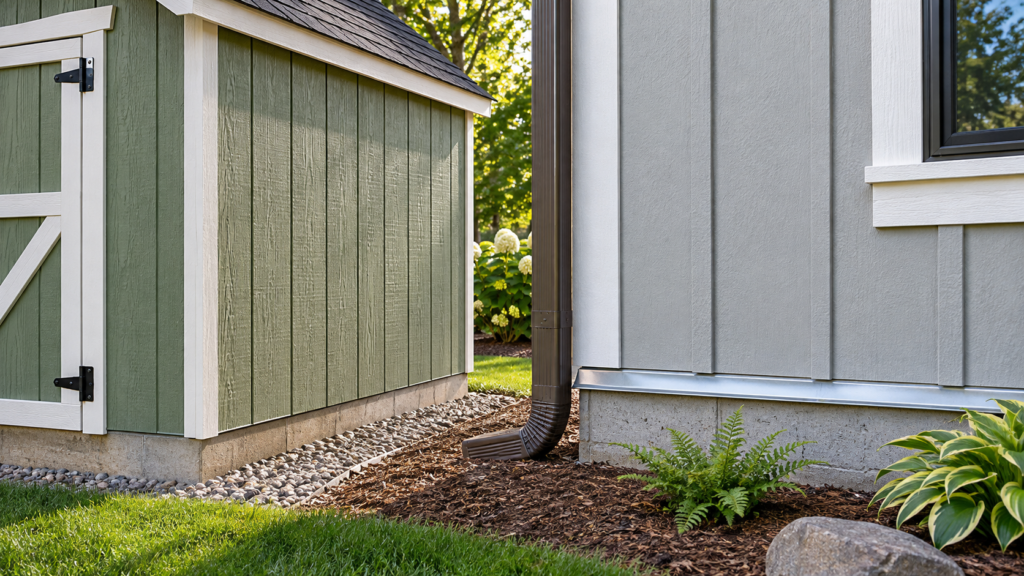
Clearance to grade, hard surfaces and roofing is set by each siding manufacturer’s instructions and your local code, so check both for the exact product you buy. As one example, Roseburg’s plywood siding instructions call for at least 6″ between the bottom edge and finished grade or horizontal surfaces. James Hardie publishes its own clearance and flashing details in the HardiePanel installation instructions. Follow the numbers for your product, not a general rule of thumb.
Climate zone (fiber cement only)
James Hardie makes its products for specific climate zones (HZ5 and HZ10). Its instructions warn that installing HZ10 products outside an HZ10 area voids the warranty. Check your zone on Hardie’s site before you order.
Picks: Tools and Materials That Make Either Job Go Right
As an Amazon Associate, theplywood.com earns from qualifying purchases.
Fiber cement shears: cut with little dust, which matters for silica exposure.
❌ Mistake 1: Leaving T1-11 bottom edges unsealed. Water soaks into the end grain, the plies swell and separate, and the bottom foot of the wall rots first. Fixing it means cutting out and patching panels. Painting the edges before you hang them costs far less.
❌ Mistake 2: Putting fiber cement on unbraced shed framing. Fiber cement goes over braced studs. Skip the sheathing or bracing and the wall can rack, and fixing it means pulling the siding off.
❌ Mistake 3: Treating a span rating as proof of wall bracing. A 16 oc or 24 oc stamp tells you stud spacing for the siding. It doesn’t make the wall braced. If the panel and nailing don’t match an approved bracing method, the wall can fail inspection or need sheathing added later.
❌ Mistake 4: Buying OSB T1-11 when you wanted plywood. Both are sold as “T1-11.” If plywood is what you’re paying for, check the back stamp for APA 303 plywood siding.
❌ Mistake 5: Staining fiber cement. James Hardie’s instructions say not to use stain. Stain that peels or blotches has to be stripped and the wall repainted.
❌ Mistake 6: Running siding down to the dirt. Skipping the clearance your siding manufacturer and local code require lets splashback keep the bottom edge wet. Wood siding rots, and the framing behind fiber cement can too.
When Not to Use Each One
⚠️ Skip T1-11 if: the wall takes heavy weather with no roof overhang and you won’t keep it painted, you’re in a wildfire zone that requires noncombustible cladding, or you’re selling a house where buyers will see “T1-11” as cheap siding.
⚠️ Skip fiber cement if: you’re building alone with no helper or lift, your walls have no sheathing or bracing and you aren’t adding any, you want a stain finish, or you can’t control cutting dust.
⚠️ Dust warning: Dry-cutting fiber cement with a grinder in an enclosed space is a real silica health risk. OSHA’s silica rule lists controls for cutting fiber cement board. Use shears, or a saw with dust collection, outdoors.
Frequently Asked Questions
Is fiber cement better than T1-11 for a house? Usually, if you care most about low upkeep and fire performance. Fiber cement is noncombustible per ASTM E136, and HardiePanel carries a 30-year product warranty. T1-11 can last on a house too, but only with regular paint and edge maintenance.
Can you put fiber cement siding over T1-11? James Hardie’s instructions call for a proper substrate, fasteners that reach the framing, and a water-resistive barrier. Whether you can cover existing siding depends on its condition and Hardie’s current requirements. Check Hardie’s technical documents or call their tech line before you plan it.
Is T1-11 cheaper than fiber cement? The siding itself usually is, and on a shed the gap gets bigger when rated T1-11 can also serve as the bracing. Prices change often, so price the full wall for each one locally rather than comparing per-sheet prices.
Does T1-11 count as sheathing? It can, but not automatically. APA-rated siding can go directly on studs when the span rating matches your stud spacing. To count as wall bracing, it also needs the right panel, thickness and nailing under an approved bracing method or engineered design, plus local code approval. Fiber cement panel siding isn’t used as bracing in standard installs.
Can I stain fiber cement to look like wood? No. James Hardie says not to use stain on its products. If you want a stained wood look, plywood siding is the material that takes stain.
Which is easier to install alone? T1-11, by a wide margin. A HardiePanel sheet weighs about 77 lbs (2.40 lbs per sq ft × 32 sq ft), and cutting it safely takes silica dust controls.
Bottom Line
Use fiber cement on a house you want to paint and largely forget, especially where fire is a concern. Use T1-11 on sheds and outbuildings where the panels can meet an approved bracing method, because one layer doing the work of sheathing and siding saves the most money and labor there. For either material, the bottom edge, clearance and water-resistive details decide how long the wall lasts more than the siding does. For framing and panel choices on outbuildings, see our best plywood for sheds guide.
Best Plywood for Built-In Bookshelves: Which One to Use by Admin October 30, 2026 DIY The best plywood for built-in bookshelves depends on the finish. For painted built-ins, use 3/4" birch or maple hardwood plywood with a B-grade face or better.…
French Cleat Wall vs Pegboard: Which One to Use by Admin October 30, 2026 DIY For heavy power tools, or a wall you’ll keep rearranging for years, build a French cleat wall. For light hand tools on a small budget,…