Affiliate disclosure: ThePlywood.com is reader-supported. As an Amazon Associate, we earn from qualifying purchases at no extra cost to you.
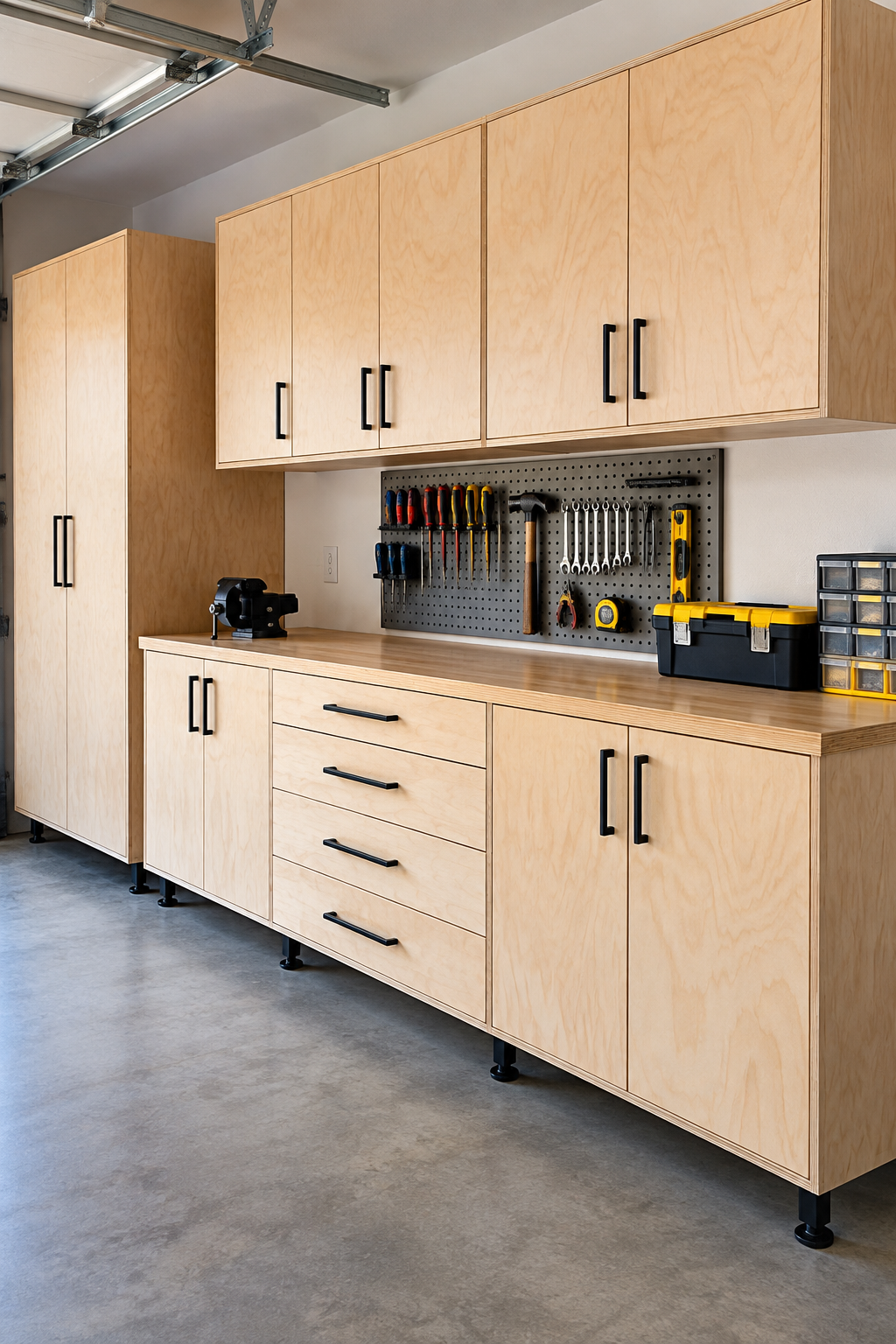
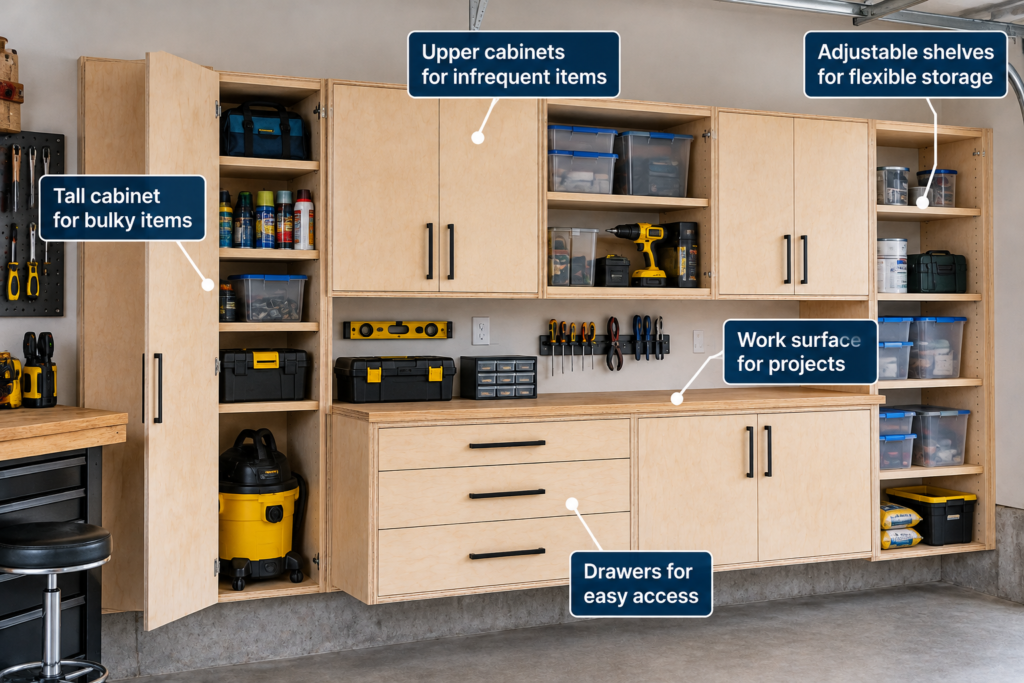
For most garage cabinets, the best plywood is 3/4-inch (23/32) panel with an exterior-rated glue bond: ACX if you plan to paint, or hardwood plywood with a Type I bond if you want a clear finish. If your garage is heated, cooled and stays dry, standard 3/4-inch birch cabinet-grade plywood works fine. Below you’ll find a chart by cabinet part, a chart by garage type, how much a garage’s humidity moves plywood, product picks, and the cases where plywood is the wrong choice.
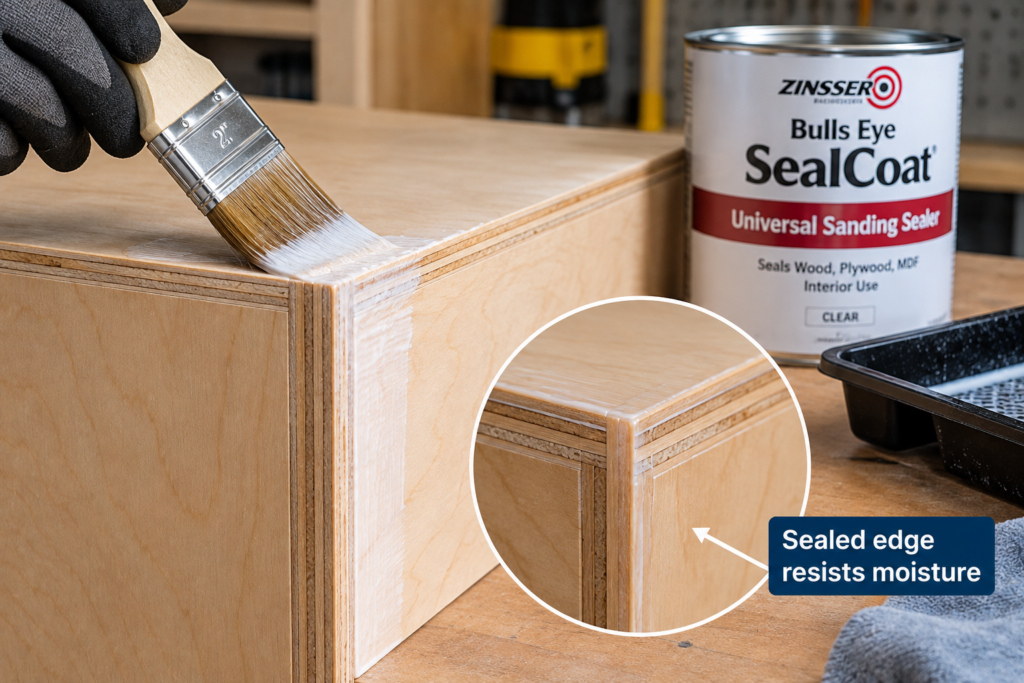
Unheated or humid garage: 3/4″ ACX (painted) or 3/4″ hardwood plywood with a Type I bond, sealed on all faces and edges.
Heated and dry garage: 3/4″ birch cabinet-grade plywood is fine.
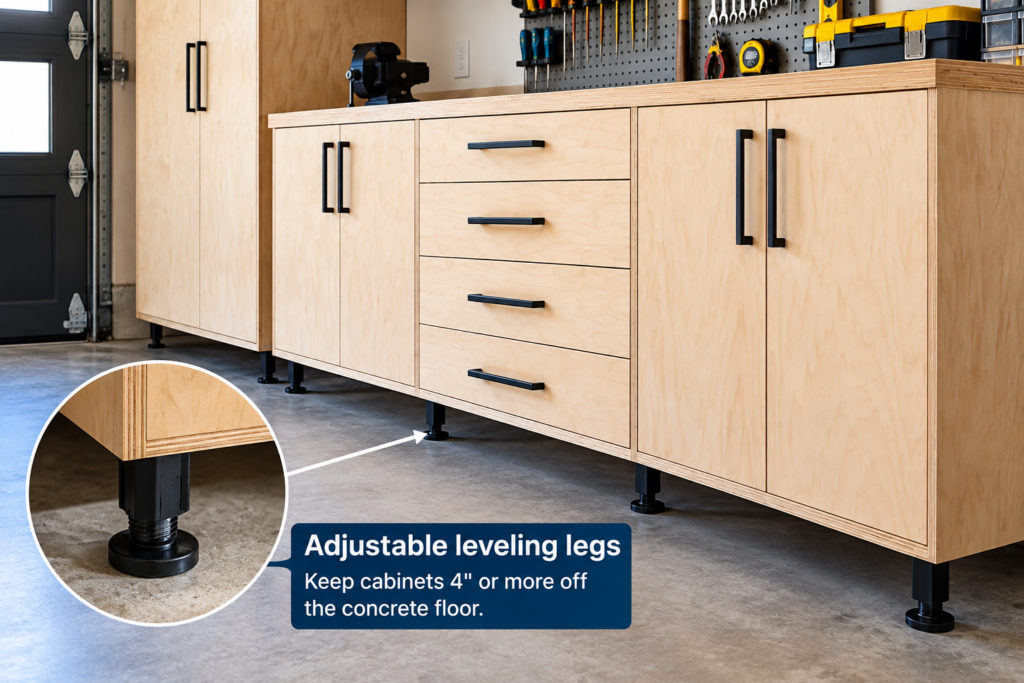
Never set the box on the slab. Use leveling legs or a separate base.
Garage Cabinet Plywood Chart by Part
Cabinet part
Thickness
Best panel
Why
Box sides, top, bottom
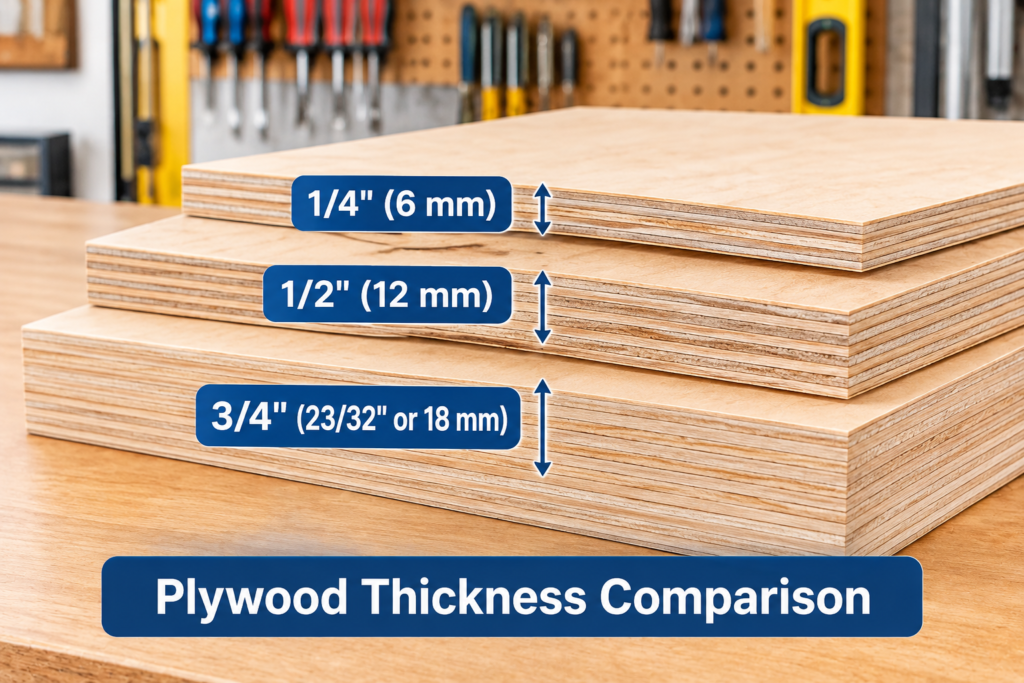
3/4″ (23/32″ or 18 mm)
ACX or Type I hardwood plywood
Holds screws and hinges, resists racking
Shelves
3/4″
Same as box
Thinner shelves sag sooner under tools and paint cans
Back panel with separate mounting rail
1/4″
Birch or ACX
Keeps the cabinet square; secure the structural rail to studs
Back panel with direct wall mounting
1/2″ or thicker
Birch or ACX
Use properly sized fasteners, washers or mounting rails, and verified stud connections
Drawer sides
1/2″ (12 mm)
Baltic birch
Solid plies hold fasteners well at the edges
Drawer bottoms
1/4″ (6 mm)
Baltic birch
Stiff enough for most drawer widths
Doors
3/4″
ACX (painted) or hardwood plywood
Matches the box and holds hinge screws
Base or toe kick touching concrete
Not plywood
Leveling legs or a pressure-treated sleeper
Slabs wick moisture into anything sitting on them
The thickness column follows common cabinet practice. It is not a code requirement. For shelf spans, check our plywood shelf thickness guide before you cut.
Which Plywood for Your Garage Type
Your garage
Best choice
Finish
Heated and cooled, stays dry year-round
3/4″ birch cabinet-grade plywood (Type II bond is fine)
Clear coat or paint
Unheated, with humid summers or cars bringing in snow
3/4″ ACX or Type I hardwood plywood
Prime and paint all faces and edges
Floor gets hosed down, or the garage has flooded before
Plywood boxes on legs 4″ or more off the floor, or metal base cabinets
Seal every edge, including the underside
Garage doubles as a shop with dust and impacts
3/4″ ACX for boxes, Baltic birch for drawers
Durable paint over the ACX
Why Garages Are Hard on Cabinet Plywood
A garage isn’t living space. The humidity follows the weather, and plywood follows the humidity. The USDA Wood Handbook’s equilibrium moisture content table shows how far wood moves with the air around it:
Garage condition
Wood moisture content the panel settles at
70°F, 40% relative humidity (typical house)
7.7%
50°F, 60% relative humidity
11.2%
80°F, 80% relative humidity (humid summer)
15.7%
30°F, 80% relative humidity (damp winter)
16.5%
These figures represent approximate equilibrium moisture content for wood under sustained conditions. Actual plywood moisture content depends on panel construction, finishes, exposure time, and changing garage conditions.
For comparison, building guidance puts recommended indoor humidity at 30% to 50%, which keeps wood between 6% and 9% moisture. A cabinet built indoors at 7% and moved into a humid garage can end up with close to double the moisture content over a humid season. That swelling and shrinking is what sticks doors, opens joints and loosens glue lines over the years.
What the glue labels mean
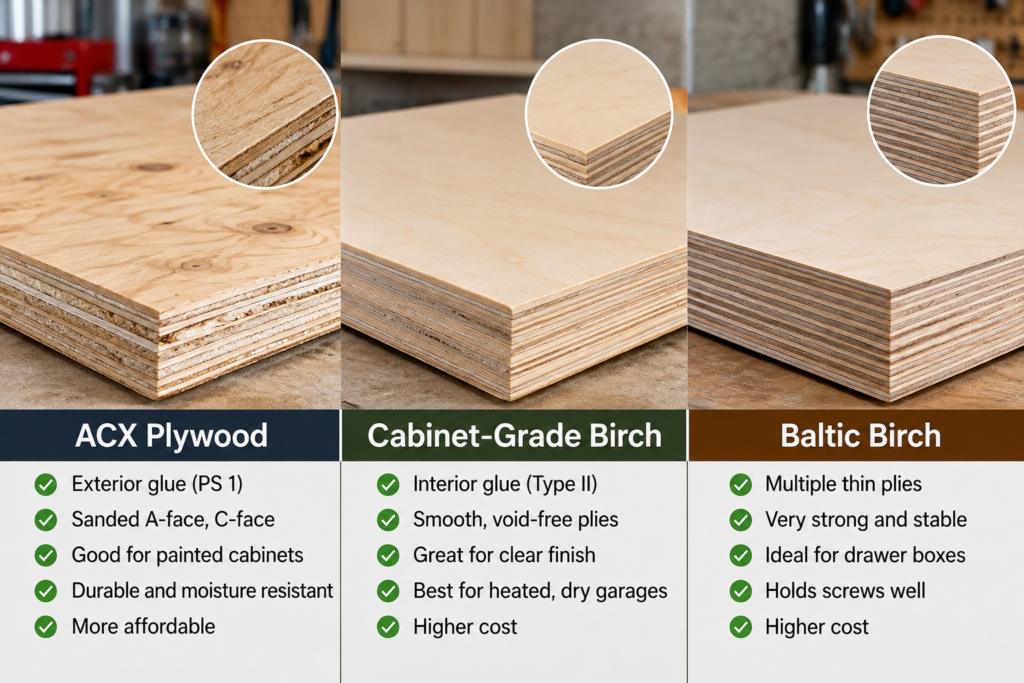
Hardwood plywood is graded under ANSI/HPVA HP-1. The standard lists Technical and Type I as exterior, fully waterproof bonds, and Type II as an interior, water-resistant bond. ACX is construction plywood graded under PS 1. The “X” stands for its Exterior bond classification, and the “A” for a sanded face that paints well. See our ACX plywood guide for the full grade breakdown.
⚠️ Warning: “Exterior” and “Type I” describe the glue, not rot resistance. An exterior-bond panel won’t delaminate when it gets wet, but the wood itself can still mold or decay if it stays damp. Paint, airflow and getting it off the slab protect against rot. The glue rating doesn’t.
The Main Options Compared
Panel
Glue bond
Strengths
Weak spots in a garage
Birch cabinet-grade plywood
Usually HP-1 Type II (interior)
Smooth face, good for clear finishes
The interior bond is meant for dry rooms
ACX
PS 1 Exterior
Exterior glue, paints well, sold at most yards
Softwood face shows grain under thin paint; not a fine-furniture look
Baltic birch
Varies by mill, so check the label
All-birch plies with no filler plies; 3/4″ is 18 mm with 13 plies
Sold in 5×5 sheets; some is sold as interior-grade for dry rooms only
Melamine particleboard
Not plywood
No finishing needed; wipes clean
Cut edges swell if left unsealed; suppliers don’t recommend it for high humidity or direct water contact
Baltic birch is a good example of why you read the label. One retailer lists its Baltic birch as made with exterior glue, while another sells B/BB stock as interior plywood. Check the bond on the sheet you buy, not the product name.
💸 Cost difference: Baltic birch usually comes in 5×5 sheets (25 sq ft) while ACX and cabinet-grade plywood come in 4×8 (32 sq ft). Compare the price per square foot, not per sheet. A 5×5 sheet that costs less than a 4×8 can still be the more expensive panel. Check local pricing; it moves often.
🧪 Real test: Before you buy, put a cheap digital hygrometer in your garage for one week in the season you’re in, and write down the high reading. If it regularly passes about 60%, build with exterior-bond plywood and seal every edge. If it stays near your house’s humidity, birch cabinet-grade plywood will do.
Picks: Tools and Supplies for Garage Cabinets
Digital hygrometer: run the one-week humidity test above before choosing a panel.
Iron-on birch edge banding: covers exposed plywood edges for a finished appearance. Seal or finish the edges appropriately to protect against moisture.
Stain-blocking primer: seals the panel and stops knots and patches in ACX from bleeding through paint.
Storing gasoline or other flammables in quantity. Use a listed flammable-storage cabinet. A DIY plywood box isn’t one.
Floors that flood or get hosed down. Even exterior-bond plywood will mold if it sits in water. Use metal base cabinets, or hang everything on the wall.
Very heavy tool storage, like stacked tool chests or engine parts. Plywood shelves sag over time under constant heavy loads. Use steel shelving or design shorter spans.
Cabinets right next to a fuel-burning water heater or furnace. Check clearance requirements in the appliance manual before building nearby.
Common Garage Cabinet Mistakes
❌ Mistake 1: Setting the box directly on the slab. The bottom edge wicks moisture from the concrete, swells and can start to rot, often out of sight behind the toe kick.
❌ Mistake 2: Painting only the faces you can see. Unsealed backs, undersides and cut edges take on moisture, and the panel moves unevenly. That shows up as warped doors and gaps at the joints.
❌ Mistake 3: Using melamine particleboard for base cabinets. One wet spot at a cut edge swells the core, and that damage doesn’t go back down.
❌ Mistake 4: Buying “cabinet grade” and assuming it’s moisture-proof. Most cabinet-grade birch carries an interior Type II bond. That’s fine in a dry garage and a risk in a humid one.
❌ Mistake 5: Treating the back panel as the mounting system. Thickness alone doesn’t make a cabinet safe to hang. Without a mounting rail or properly sized fasteners and washers driven into verified studs, a loaded cabinet can pull off the wall.
😬 Regret: Picture a full wall of melamine cabinets in an unheated garage. Snowmelt from the car runs under the base cabinets every winter. By the second spring, the bottom edges have swollen and the edge banding is peeling off. The fix is new base cabinets, and a hygrometer and a set of leveling legs would have prevented it.
FAQ
What is the best plywood for garage cabinets? For most garages, 3/4″ plywood with an exterior bond: ACX if you’re painting, or Type I hardwood plywood for a clear finish. In a heated, dry garage, 3/4″ birch cabinet-grade plywood works.
Is ACX plywood good for garage cabinets? Yes. ACX has an exterior glue bond and a sanded A face that paints well. Prime and paint every face and edge, and keep it off the slab.
What thickness plywood do I need for garage cabinets? Use 3/4″ for the box, shelves and doors, 1/2″ for drawer sides, and 1/4″ for drawer bottoms. For the back, use 1/4″ when a separate mounting rail is screwed to the studs, or 1/2″ or thicker when you mount through the back. Either way, the cabinet’s safety depends on properly sized fasteners and solid stud connections, not on panel thickness alone.
Can I use melamine for garage cabinets? In a dry, heated garage, melamine is fine for wall cabinets. Avoid it for base cabinets in an unheated or humid garage, because water at a cut edge swells the particleboard core.
Is Baltic birch good for garage cabinets? It’s an excellent choice for drawers, and for boxes too if the glue bond suits your garage. Check the label, because some Baltic birch is sold as interior-grade.
Build garage cabinets from 3/4″ plywood with an exterior glue bond: ACX if you’ll paint, or Type I hardwood plywood for a clear finish. Seal every face and edge, and keep the boxes off the slab. If your garage is heated and stays dry, birch cabinet-grade plywood is fine. For more on choosing cabinet panels, see our cabinet-grade plywood guide.
Related Posts:
Best Plywood for Outdoor Cabinets: Grade, Thickness & Finish by Admin September 28, 2026 DIY For most painted outdoor cabinets, Exterior-rated MDO (Medium Density Overlay) plywood is the best overall choice. A-C or B-C Exterior plywood is the budget alternative.…