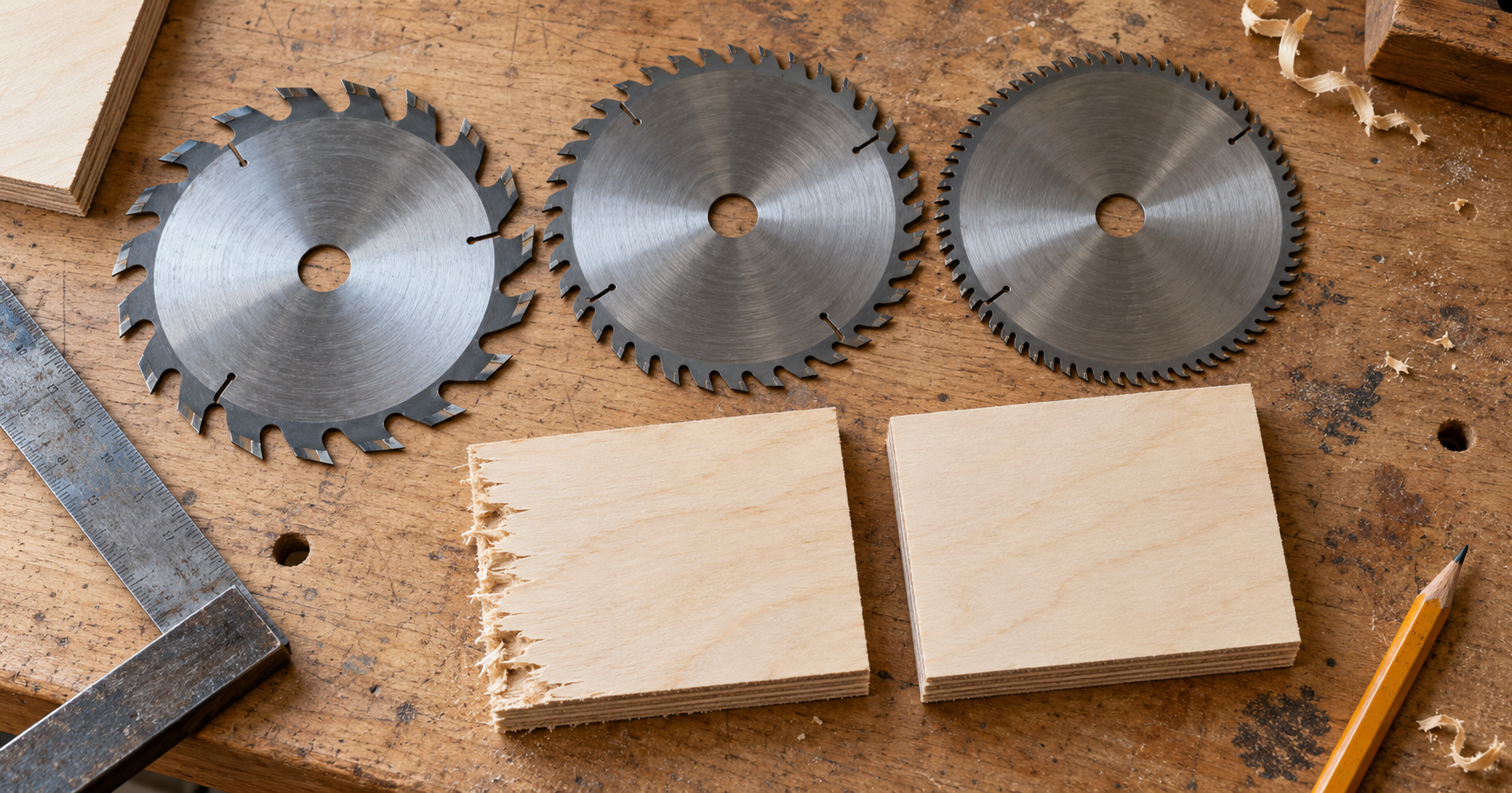
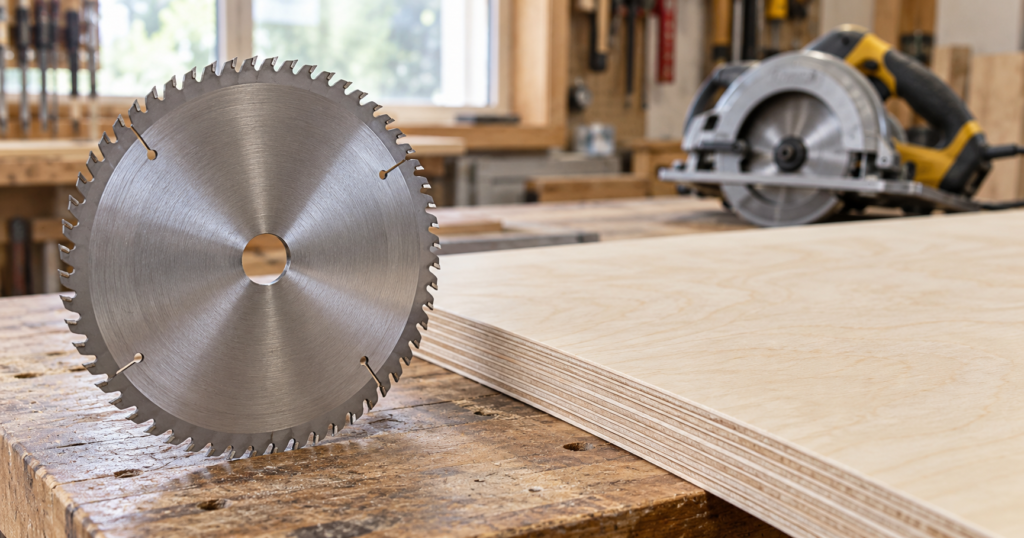
Quick answer: The best circular saw blade for plywood is a 60-tooth, thin-kerf, Alternate Top Bevel (ATB) blade. The high tooth count takes smaller bites, the ATB grind slices the veneer instead of chopping it, and the thin kerf keeps the cut clean without bogging down your saw. Our top pick for most people is the Diablo D0760A (7-1/4″, 60T Ultra Finish).
Most people don’t wreck a sheet of plywood because they’re bad at cutting. They wreck it because they left the same 24-tooth framing blade on the saw that came with it — the one built to rip through 2x4s fast, not to slice cleanly through a $70 sheet of birch ply.
That single mistake is the difference between an edge you can install as-is and one you’re sanding for twenty minutes, or hiding under trim, or throwing in the offcut pile. Blade choice is one of the biggest factors affecting cut quality, although proper support, blade depth, and feed speed also matter. Below is exactly what to look for, the models actually worth buying, and a two-cut test you can run this afternoon to prove it to yourself.
The mistake almost everyone makes with plywood
The blade that ships on a new circular saw is a general-purpose or framing blade — usually 18 to 24 teeth. It’s designed to remove material quickly in construction lumber. Point it at the thin face veneer of a plywood panel and each tooth acts like a tiny chisel: it punches through the wood fibers instead of shearing them. The veneer lifts and splinters before the tooth ever finishes the cut.
That splintering is called tearout. You can fight it with a scoring pass, painter’s tape, and a slow feed, and all of that helps a little. But if the wrong blade is on the saw, you’re fixing the symptom instead of the cause. The blade is doing the actual cutting — get that right and most of the other tricks become optional. Technique still helps, and our full guide to cutting plywood without splintering walks through the scoring, taping, and support steps — but this article is about picking the tool that makes clean cuts possible in the first place.
What actually makes a blade good for plywood
Four specs decide whether a blade cuts plywood cleanly. Ignore the marketing on the box and look at these.
Tooth count: aim for 40 to 60 (or higher for finish work)
Tooth count is the single biggest lever. For clean cuts in plywood, use a blade with 40 to 60 teeth. More teeth means each one removes a smaller bite, the blade stays in contact with the fibers longer, and the surface comes out smoother.
24 teeth or fewer — ripping and framing. Fast, rough, tears plywood badly. Leave it for lumber.
40 teeth — the practical sweet spot for construction-grade plywood and general project work. Clean enough for most jobs, still cuts at a reasonable pace.
60 teeth — the finish choice for cabinet-grade, veneered, and hardwood plywood where the edge shows.
120 to 140 teeth — very fine blades for thin plywood, paneling, and delicate veneers. Smooth edges, but they cut slowly and can overheat if you push them.
Tooth grind: ATB
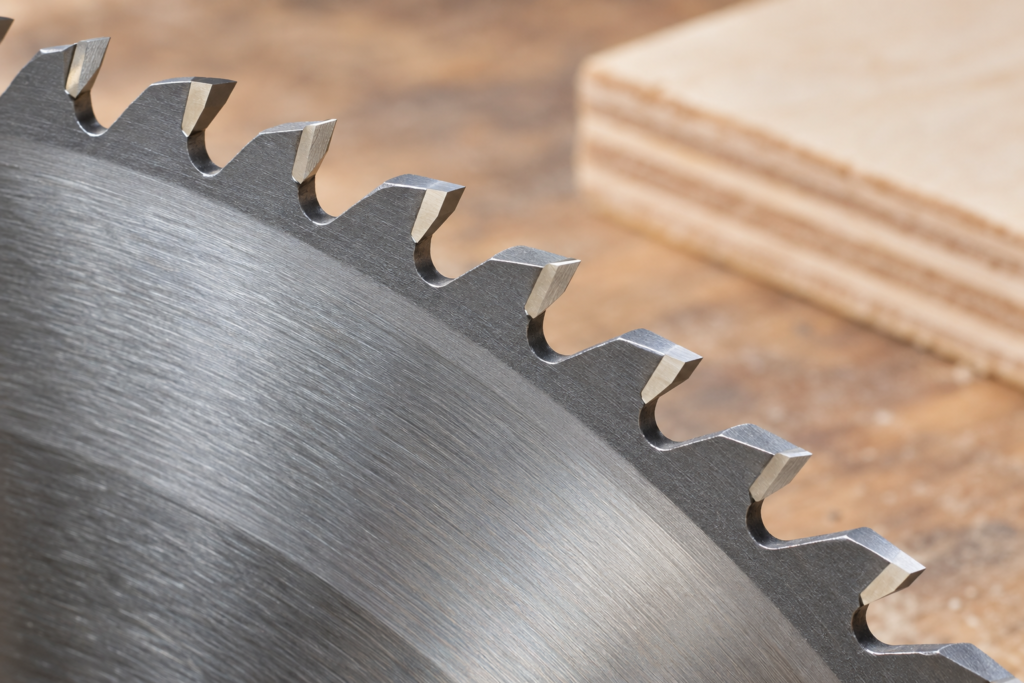
ATB stands for Alternate Top Bevel — the teeth are ground at an angle, alternating left and right, so they slice through the veneer like a knife instead of chopping like a chisel. This is the grind you want for plywood. Some premium plywood and melamine blades use Hi-ATB, a steeper bevel for even less tearout; it’s a nice bonus if you find it, but a good standard ATB blade handles most plywood cleanly. Avoid flat-top (FTG) and triple-chip (TCG) grinds for plywood — TCG is built for laminate and non-ferrous metal and won’t leave as clean a wood edge.
Kerf: go thin
Kerf is the width of the slot the blade cuts. A thin-kerf blade (roughly 0.059″ to 0.070″) removes less material, needs less power, and puts less strain on a cordless saw — which means less deflection and a cleaner line. For handheld circular saws, thin kerf is almost always the right call.
Hook angle: lower feeds smoother
Hook angle is the tilt of the teeth relative to the blade’s center. A lower hook angle slows the “grab” of each tooth, which reduces tearout and gives you more control on a sheet good. High-hook blades feed aggressively — great for ripping lumber, less so for finish cuts in plywood.
Put it together and the ideal plywood blade reads like this: 7-1/4″, 60-tooth, ATB grind, thin kerf. That’s the exact spec on the finish blade below.
The two-cut test that proves blade choice matters
You don’t have to take this on faith. Here’s a test you can run in five minutes with one offcut of plywood, and it makes the difference impossible to miss.
What you need: a scrap piece of veneered plywood (birch or oak faced is ideal — the grain shows tearout clearly), your 24-tooth framing blade, and a 60-tooth ATB finish blade.
With the 24-tooth blade, crosscut the scrap.
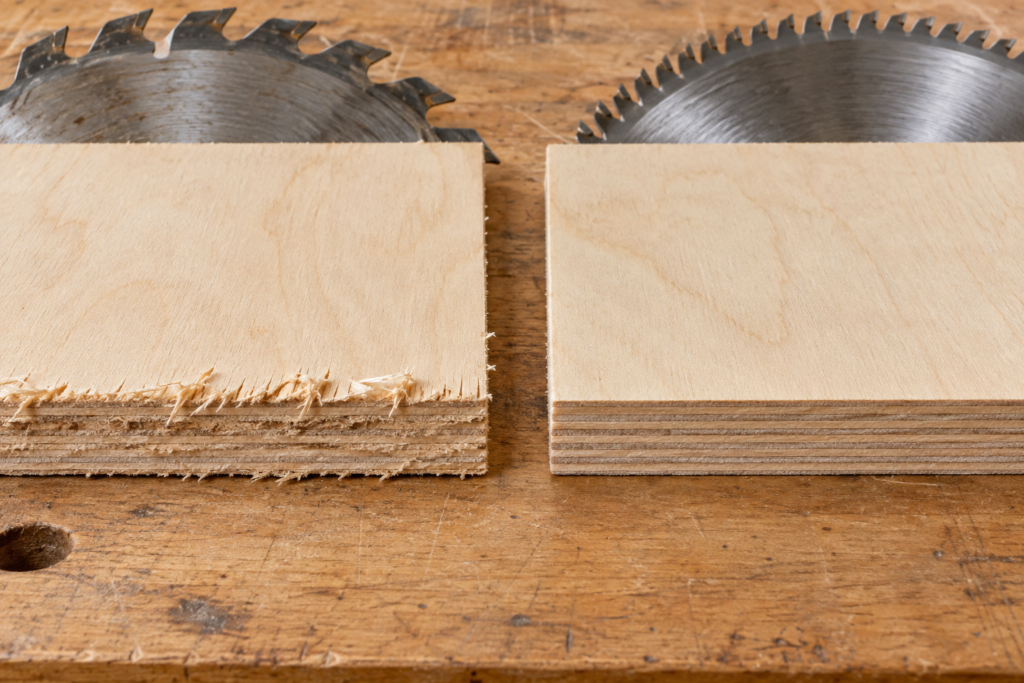
Look at the top face along the cut line — the side that pointed up at the saw. You’ll see lifted, feathered fibers. That’s tearout on the exit face.
Swap in the 60-tooth ATB blade and make an identical cut in the same piece, same speed.
Compare the two top edges side by side.
The 60-tooth cut will be visibly cleaner — often clean enough to skip sanding entirely, where the 24-tooth edge needs work before it’s usable. Same saw, same wood, same feed speed. The only thing that changed was the blade. That gap is the whole argument for buying the right one.
(Bonus finding from the test: notice which face tore out. On a conventional handheld circular saw the teeth enter the plywood from below and exit through the top surface, so the top is where splintering is usually worse. That’s why you cut with the good face down — more on that below.)
Disclosure: This article contains affiliate links. As an Amazon Associate, theplywood.com earns from qualifying purchases at no additional cost to you.
Best Circular Saw Blade for Plywood: Our Top Picks
These are 7-1/4″ blades to fit a standard handheld circular saw — the most common size by far. All models below are current and widely available.
Best overall: Diablo D0760A (60-tooth Ultra Finish)
If you buy one blade for plywood, buy this one. The Diablo D0760A 60-tooth Ultra Finish blade is a 60-tooth ATB blade with a thin 0.059″ kerf and a 10° hook angle, built for clean, chip-free crosscuts in veneered plywood, melamine, and delicate molding. The non-stick coating keeps resin from gumming the teeth on longer cuts, and the thin kerf means it doesn’t fight a cordless saw. For most people cutting cabinet-grade or project plywood, this leaves an edge clean enough to install with little or no sanding.
Watch for: at 60 teeth it cuts a touch slower than a 40-tooth blade and can scorch if you dawdle mid-cut. Keep a steady feed and don’t stop in the middle of a pass.
If your saw does double duty — some plywood, some general cutting — the Diablo D0740A 40-tooth ATB finish blade— that’s the smarter single-blade choice. Forty teeth is the sweet spot: clean enough for construction-grade and most project plywood, fast enough that you’re not babying every cut. It’s the blade to leave on the saw when you don’t want to keep swapping.
Best alternative brand: DeWalt DWA171460 (60-tooth)
If you’re in the DeWalt ecosystem or just prefer the brand, the DeWalt DWA171460 60-tooth finish blade covers the same ground as the Diablo 60T — tungsten carbide teeth, ATB grind, thin kerf, clean crosscuts in plywood and hardwood. Performance is close enough that brand preference and price on the day can decide it.
Budget pick for thin plywood and paneling: Craftsman CMAS2725140
If you mostly cut thin plywood, underlayment, and paneling and want the smoothest edge for the least money, the Craftsman CMAS2725140 140-tooth blade is a reasonable budget option. It’s a 140-tooth carbon-steel blade — not a premium carbide finish blade — so the high tooth count gives a smooth cut on thin material, but expect a slower cut, faster dulling, and less durability than the carbide picks above. For occasional cuts in thin panels it does the job; for cabinet-grade hardwood plywood you’ll be happier with the carbide 60-tooth blades.
The cost difference: why a $30 blade saves you money
Here’s the math people skip. A quality 60-tooth finish blade runs roughly two to three times the price of the bargain-bin blade next to it. That gap feels like a lot at the register and like nothing the first time you ruin a sheet of hardwood plywood.
A single sheet of cabinet-grade birch or oak plywood costs meaningfully more than the blade upgrade. Tear out the veneer on one bad cut and you’ve thrown away more than the price of the good blade — plus the drive back to the store and the wait to redo the project. The blade is the cheapest insurance in the whole job.
There’s a slower cost too: sanding. A rough 24-tooth edge means real time with a sander before the piece is usable, on every cut. A clean 60-tooth edge often needs none. Across a project with a dozen cuts, that’s the difference between an afternoon and a weekend. Cheap blades aren’t cheap — they just move the cost somewhere you don’t see at checkout.
Common mistakes and a warning before you cut
A good blade fixes most tearout, but a few habits will sabotage even the best one.
Cutting with the good face up on a circular saw. On a conventional handheld circular saw, the teeth enter the plywood from below and exit through the top surface, where splintering is usually worse. Position the best face down. With a table saw, position the best face up. Major saw makers give the same guidance — Bosch, for one, recommends the good face down for circular-saw cuts.
Leaving the framing blade on “just for this one cut.” That one cut is usually the expensive sheet. Swap the blade.
Forcing the feed. Pushing a fine-tooth blade too fast overloads the teeth and burns the edge. Let the blade set the pace.
No support under the cut line. An unsupported panel flexes, pinches the blade, and tears.
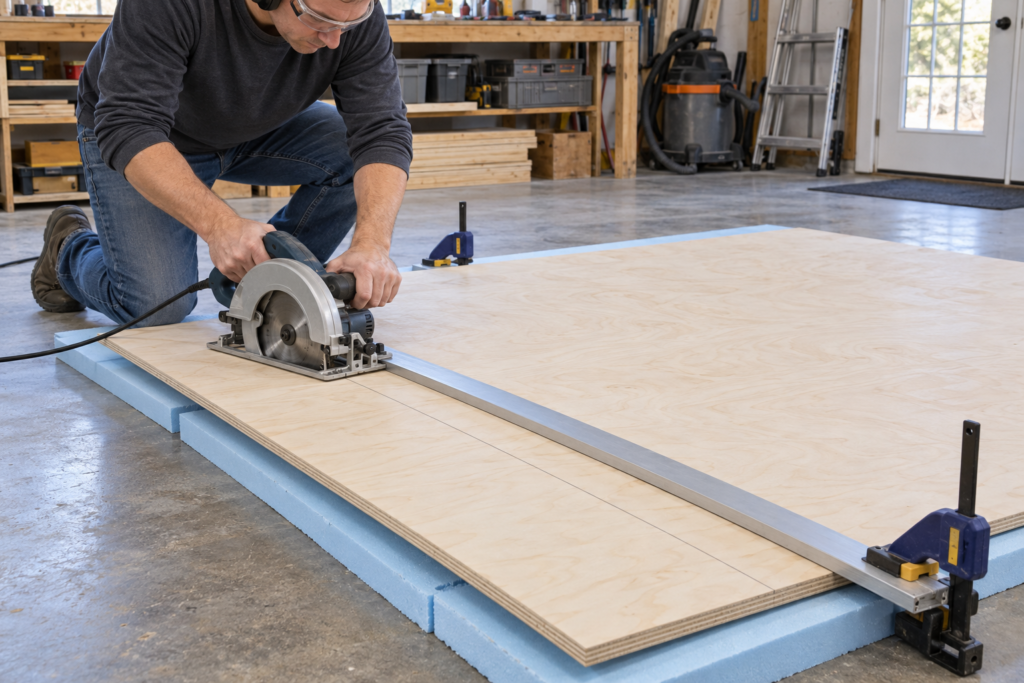
A safety warning that matters more than any of the above: a fine blade with a lot of teeth generates more heat and can bind if the panel pinches the kerf mid-cut, and a bind can cause the saw to kick back toward you. Support the sheet on a stable work surface or rigid foam insulation, set the blade only slightly deeper than the plywood, and arrange the supports so the kerf cannot close around the blade. Keep both hands on the saw, and never reach under a sheet while it’s cutting. Clean cuts aren’t worth a kickback.
If the panel is headed outdoors or into a bathroom, seal and finish the exposed edges after cutting so the core doesn’t wick moisture.
Circular saw vs. the alternatives for cutting plywood
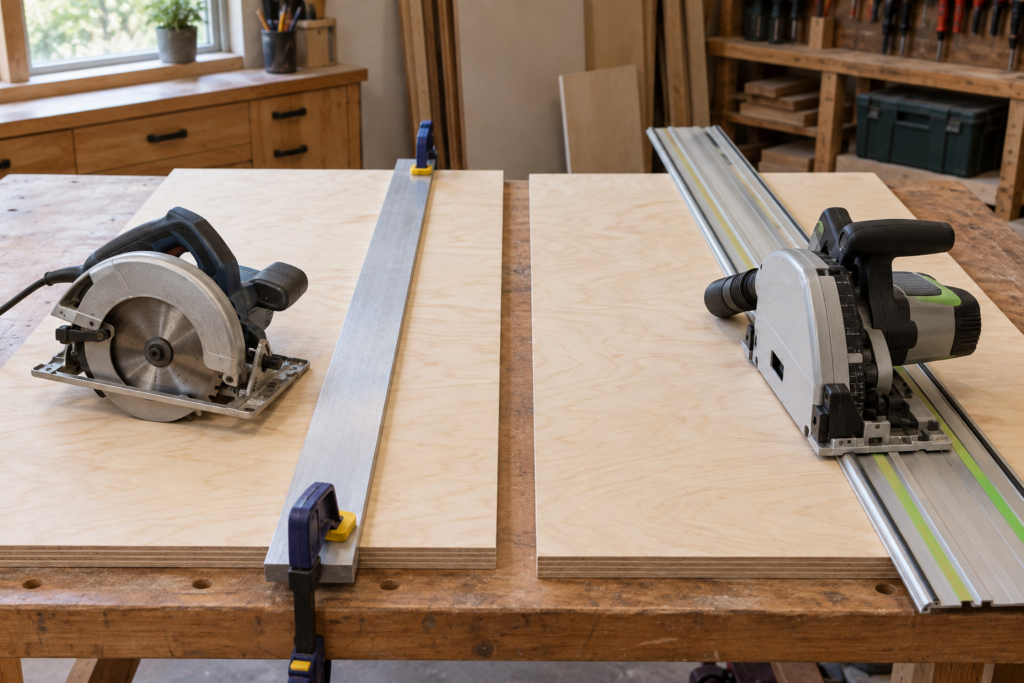
A circular saw with the right blade and a straightedge guide will cut plywood cleanly enough for almost any straight cut — it’s the most accessible tool most people already own. A track saw does the same job with a built-in guide rail and near-zero tearout, at a higher price. A table saw gives you the cleanest, most repeatable rip cuts but is harder to manage with full 4×8 sheets solo. For curves and cutouts, a circular saw isn’t the tool at all — reach for a jigsaw with a down-cut blade instead.
For most DIYers and even a lot of pros, the honest answer is that a 60-tooth blade on the circular saw you already have closes most of the gap for a fraction of the money. The real question before upgrading to a track saw or table saw is whether you cut enough sheets to justify it — for occasional projects, the blade is the better spend. It also helps to know your panel: finish-grade and hardwood plywood (our guide to plywood grades explains the differences) tears out more visibly than rough sheathing, and MDF likes an even higher tooth count than plywood — it has no grain to tear, but it dulls blades faster.
Frequently asked questions
How many teeth should a circular saw blade have for plywood? For clean cuts in plywood, use a blade with 40 to 60 teeth. Forty teeth is the practical sweet spot for general and construction-grade plywood; step up to 60 teeth for cabinet-grade, veneered, or hardwood plywood where the edge will show.
What kind of blade cuts plywood without splintering? An Alternate Top Bevel (ATB) blade with a high tooth count and a thin kerf cuts plywood with the least splintering. The angled teeth slice the veneer instead of chopping it, and more teeth mean smaller, cleaner bites.
Should I cut plywood good side up or down with a circular saw? Cut with the good side facing down when using a circular saw. On a conventional handheld circular saw the teeth enter from below and exit through the top, so tearout is worst on the top surface. On a table saw it’s the opposite — good side up.
Can I use a 24-tooth blade on plywood? You can, but you shouldn’t for anything that shows. A 24-tooth blade is built for ripping lumber and will tear out plywood veneer badly. Keep it for framing and put a 40- or 60-tooth ATB blade on for sheet goods.
Is a thin-kerf blade better for plywood? Yes, in most cases. A thin-kerf blade removes less material, needs less power, and puts less strain on cordless saws, which helps keep the cut clean and the line accurate. It’s the right default for handheld circular saws.
Do I need a special blade for melamine or veneered plywood? For melamine and veneered plywood, a fine ATB blade with 60 or more teeth gives the chip-free edge you need. Keep the feed steady so the teeth don’t scorch the surface.
Sandblasting Wood: How to Clean & Restore by Admin May 17, 2025 Finish There’s something satisfying about bringing old wood back to life. Whether it's barn siding, an antique door, or a weathered cedar plank, wood has a…
How to Clean Old Unfinished Wood Floors by Admin May 20, 2025 More About Cleaning old unfinished wood floors can feel intimidating—after all, they’re raw, porous, and prone to staining or warping. But the good news is: with the…