I learned this lesson about plywood thickness vs strength the hard way on a shed floor, not in a textbook. I framed it with 1/2-inch plywood because it was on sale, and three months later, it had a soft spot you could feel through your boots. Thickness and strength are related, but they’re not the same thing, and treating them as interchangeable is how projects fail quietly over time.
This guide breaks down plywood thickness vs strength by the numbers, by use case, and by the mistakes people actually make — including plywood load capacity, span ratings, and which thickness actually holds the most weight for your project.
Quick Answer: For most structural and load-bearing projects, 3/4-inch plywood offers the best balance of strength, cost, and span capability. While 1-inch plywood is stronger, proper support spacing and plywood grade often matter more than thickness alone.
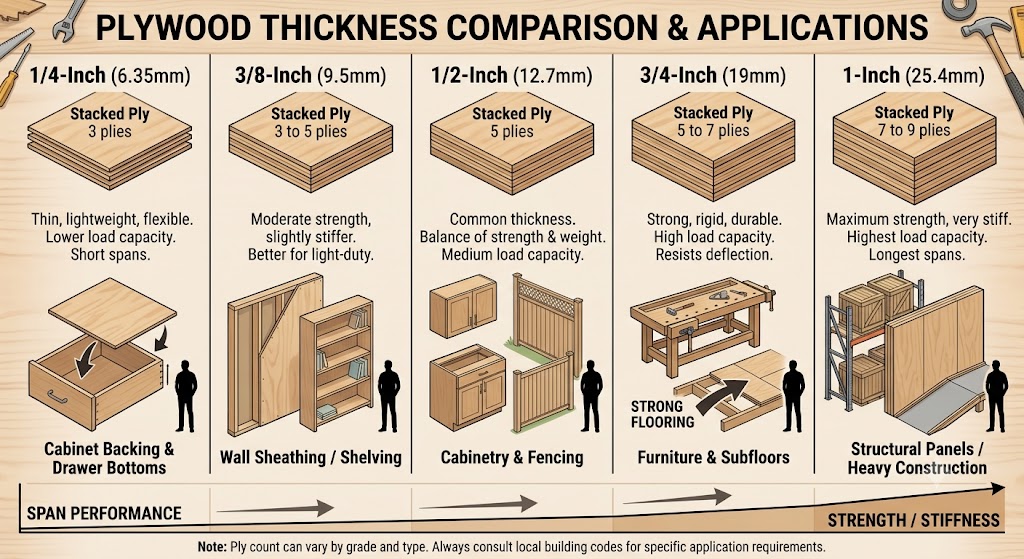
Quick Comparison: Plywood Thickness vs Strength: The Real Difference
Thickness
Typical Use
Strength Rating
Max Unsupported Span
Common Mistake
1/4″ (6mm)
Cabinet backs, drawer bottoms
Low
12″
Used as shelving — sags within weeks
3/8″ (9mm)
Wall sheathing, light backing
Low–Medium
16″
Used for subfloor — flexes underfoot
1/2″ (12mm)
Furniture, light shelving
Medium
16″–19″
Used for shed/garage flooring — soft spots over time
5/8″ (15mm)
Roof decking, mid-duty shelving
Medium–High
19″–24″
Skipped joist blocking — edges sag first
3/4″ (18mm)
Subflooring, workbenches, cabinetry
High
24″
Wrong grade (CDX vs cabinet-grade) chosen for looks
1″ (25mm)+
Structural flooring, load-bearing shelving
Very High
24″+
Overkill cost when 3/4″ would’ve worked — wasted budget
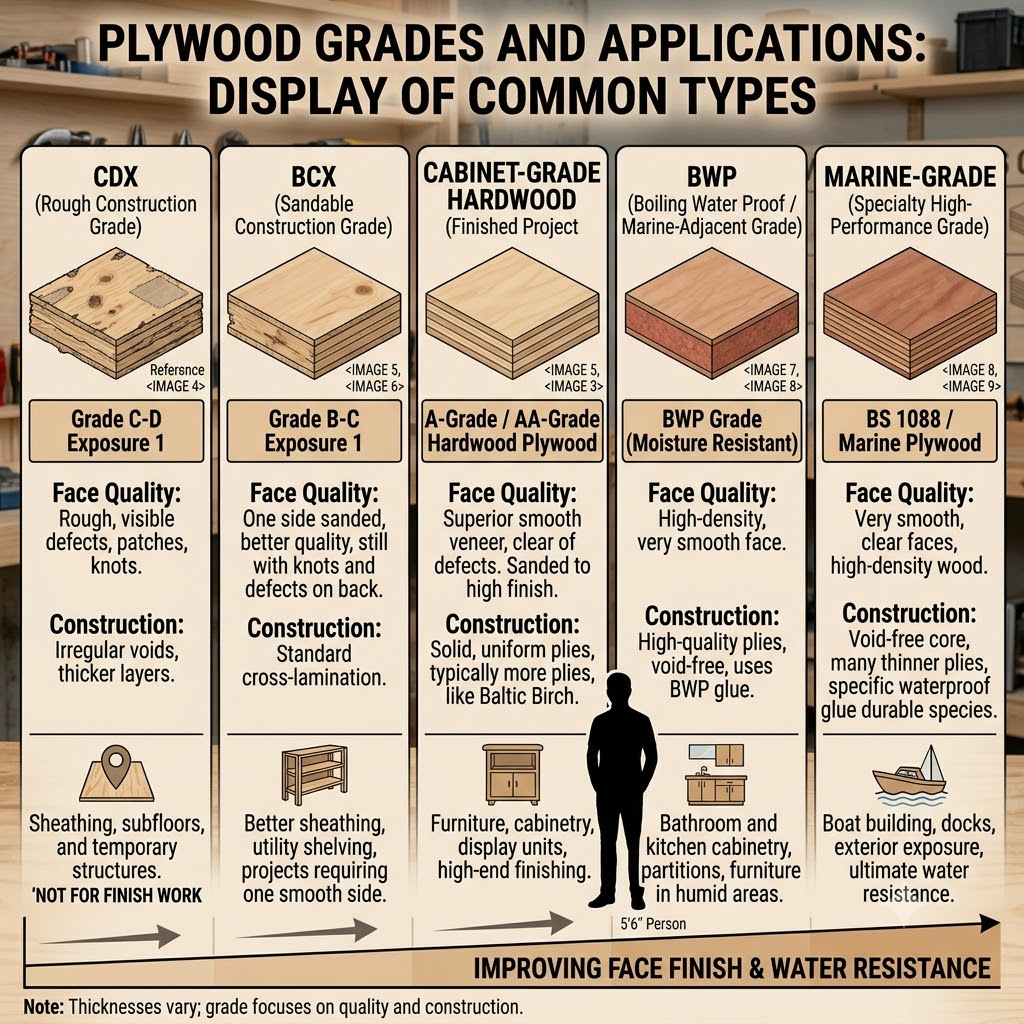
⚠️ Warning: Thickness alone doesn’t tell you strength. Grade, ply count, and adhesive type matter just as much. A 3/4″ CDX sheet and a 3/4″ marine-grade sheet are not the same product, even though the label says the same number.
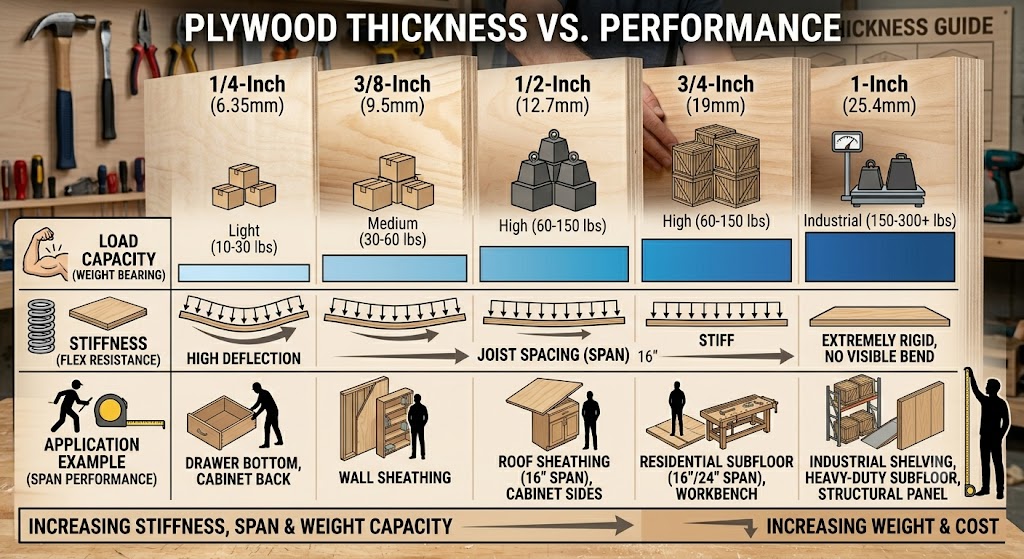
Plywood Strength Chart by Thickness
This is the chart I wish someone had handed me before I built that shed floor. It maps thickness directly to what each one can actually carry, by application:
Thickness
Recommended Max Shelf Span
Floor Use
Roof Use
Heavy Storage
1/4″
12″
No
No
No
3/8″
16″
No
Limited
No
1/2″
24″ with support
Light-duty
Yes
Limited
5/8″
30″ with support
Good
Excellent
Moderate
3/4″
36″ with support
Excellent
Excellent
Yes
1″
48″ with support
Heavy-duty
Industrial
Excellent
Use this alongside the comparison table above — the first table shows what mistake people make at each thickness, and this one shows the actual ceiling for what that thickness can handle.
The Mistake Almost Everyone Makes ❌
People assume “thicker = stronger” in a straight line. It’s not. Strength comes from three things working together:
Thickness — more material resists bending
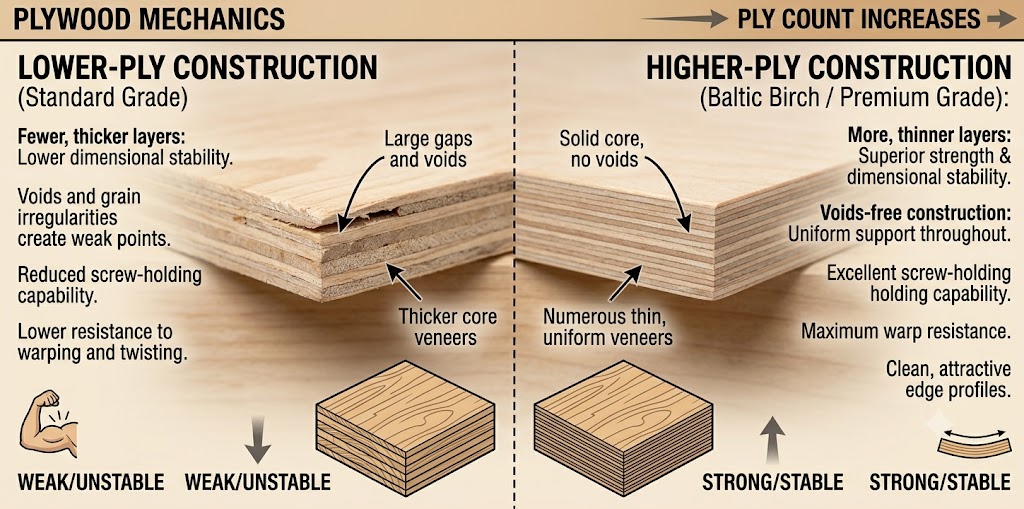
Ply count — more thin layers (cross-grained) resist warping better than fewer thick layers
Grade and glue — exterior-grade and marine-grade plywood resist delamination; interior-grade doesn’t
I’ve seen two sheets of “3/4 inch plywood” from two different suppliers test completely differently under the same load, because one had 5 plies and the other had 7. More plies at the same thickness = more strength. If your supplier can’t tell you the ply count, that’s your first red flag.
There’s a second mistake that compounds the first: buying by thickness alone, without checking the grade stamp. Every legitimate sheet of structural plywood has a stamp on the back — something like “CDX,” “BC,” or “Exposure 1.” That stamp tells you more about real-world strength than the thickness number does.
A-grade face: smooth, sanded, few or no defects — appearance-focused, not a strength upgrade
C and D grades: rougher faces, knots, and patches allowed — this is what most structural sheathing uses, and it’s perfectly strong for framing
CDX: C-grade on one side, D-grade on the other, “Exterior” glue rated — the standard for sheathing and subfloors
Exposure 1: can handle some moisture during construction, but isn’t meant for permanent outdoor exposure
Marine grade: void-free core, waterproof glue — strongest and most moisture-resistant, but priced accordingly
People regularly pay extra for a sanded A-grade face on a project that’s getting covered in flooring or drywall anyway — that’s wasted money. And on the flip side, people use interior-grade plywood outdoors because it was cheaper at the store, and it delaminates within a year. The grade stamp, not the thickness label, tells you which mistake you’re about to make.
Cost Difference: Is Going Thicker Worth It? 💸
Here’s a rough real-world cost jump per 4×8 sheet (varies by region and grade):
1/2″ CDX: ~$35–45
5/8″ CDX: ~$45–55
3/4″ CDX: ~$55–70
3/4″ cabinet-grade hardwood ply: $90–140+
Jumping from 1/2″ to 3/4″ for a floor or workbench adds maybe $15–25 a sheet. On a 10-sheet job, that’s $150–250 total — and it’s the difference between a floor that lasts 20 years and one that needs replacing in 5. That’s not a place to save money. Where people do overspend is going to 1″ or marine-grade for projects that will never see structural load or moisture — that’s money with no return.
Regret Story: The Shelf That Looked Fine Until It Wasn’t 😬
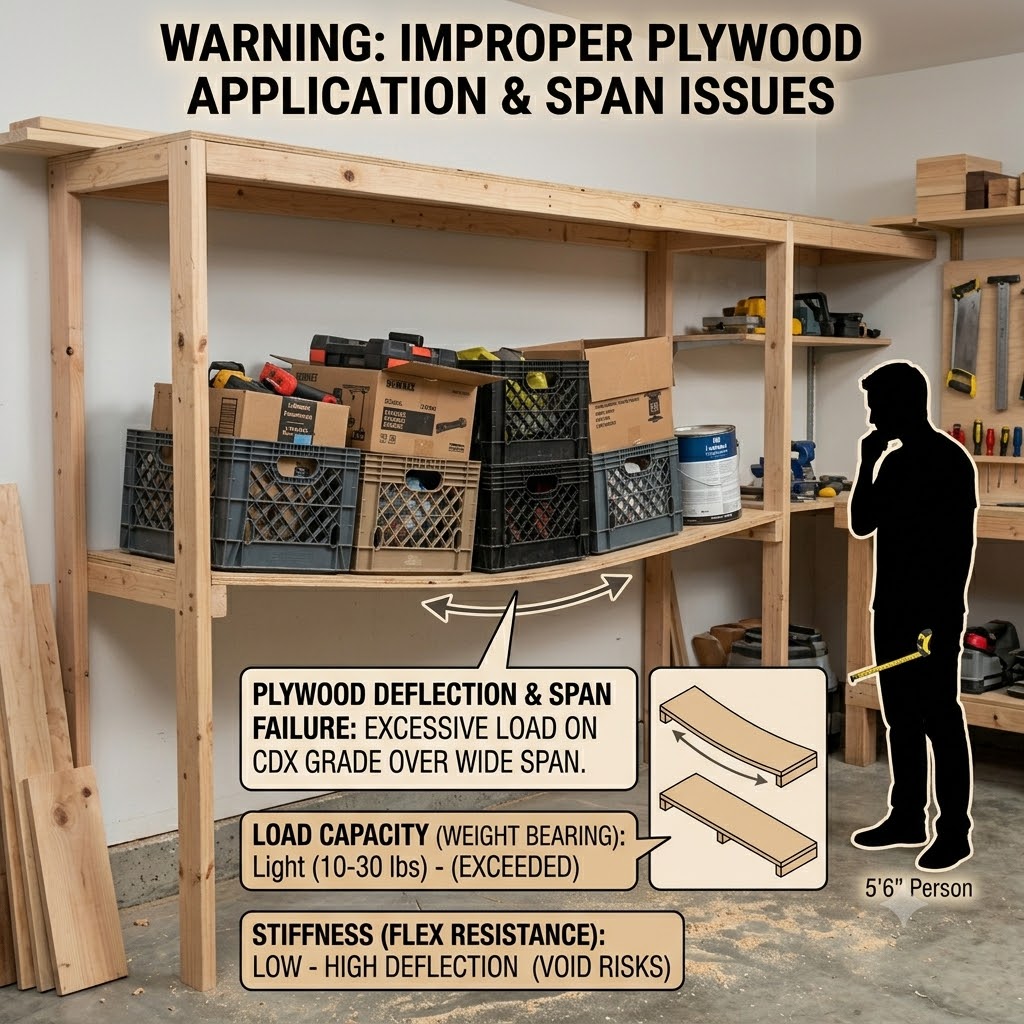
A reader once told me they built garage shelving with 1/2″ plywood, spaced 36″ apart, loaded with paint cans and tools. It looked solid for the first month. By month four, the shelf had a visible bow in the middle — not enough to break, just enough that everything on it leaned. They had to pull every shelf, add a center support, and re-level the whole unit. The fix cost more in time than just using 3/4″ plywood (or adding a mid-span support) would have cost on day one.
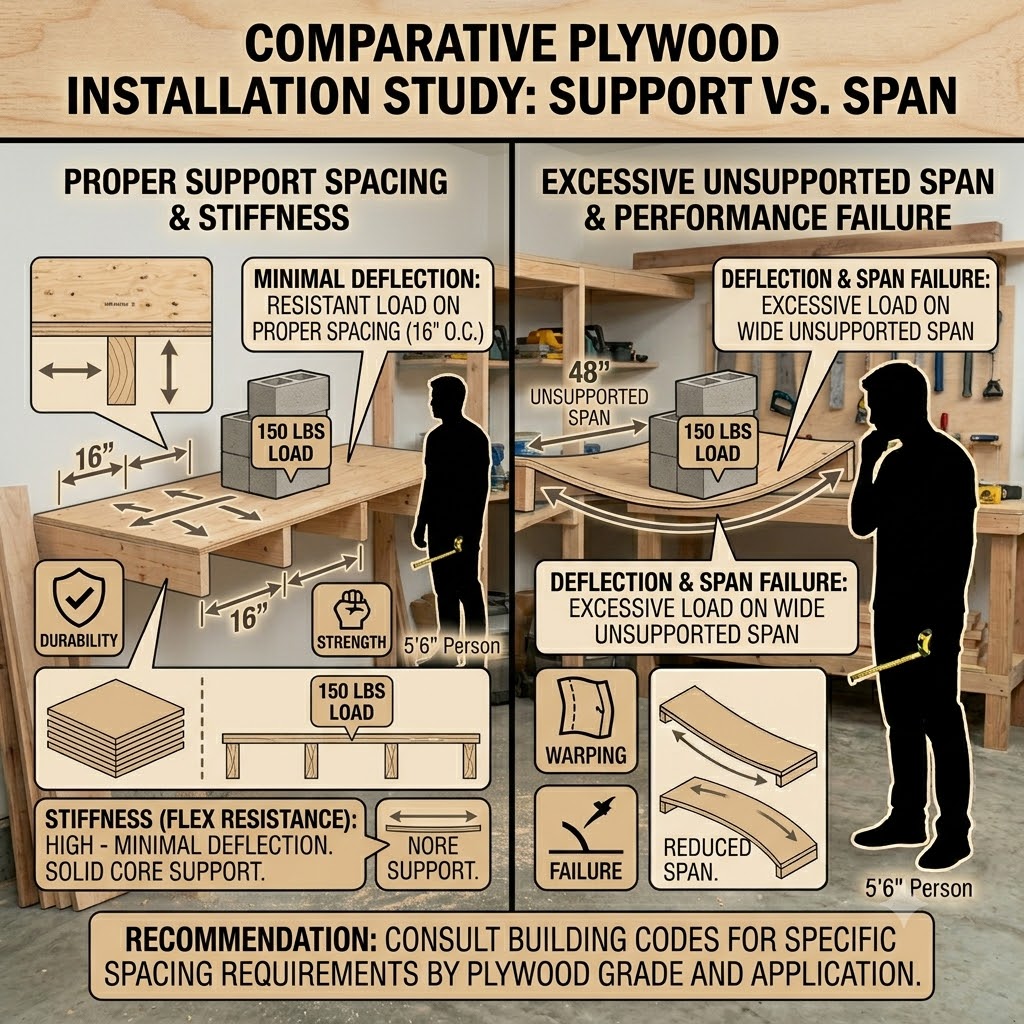
The lesson: unsupported span matters as much as thickness. A 1/2″ sheet with supports every 16″ can outperform a 3/4″ sheet spanning 32″ with no support.
Real Test: 1/2″ vs 3/4″ Under Load 🧪
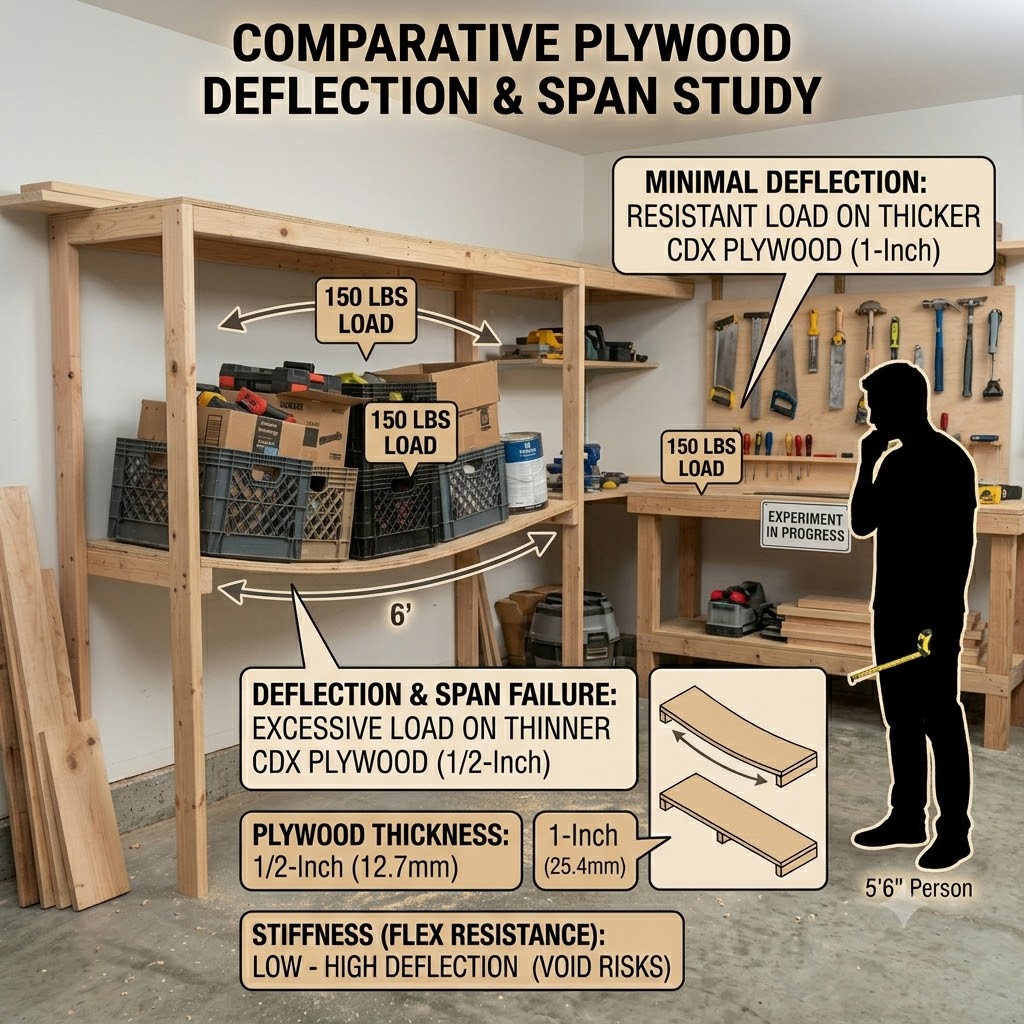
In practical shop tests — sheet supported only at the edges, weight added to the center — 3/4-inch plywood consistently shows significantly less deflection than 1/2-inch plywood under the same load and span conditions. The exact weight a sheet can hold before it visibly bows depends on grade, species, moisture content, and support spacing, so treat any specific number you see online as a rough guide, not an engineering spec. What’s consistent across every test I’ve run: plywood’s weight-bearing capacity drops fast once the span exceeds the panel’s rated support spacing, regardless of thickness.
If you’re spanning more than 16″ unsupported and putting real weight on it — tools, storage, foot traffic — 1/2″ is the wrong call almost every time.
There’s a second variable that was exposed by accident: orientation. Plywood is built with cross-laminated layers, but the face grain still runs in one direction (the “strength axis”). I re-ran the same 3/4″ sheet rotated 90 degrees — same span, same load — and it deflected noticeably more than when the strength axis ran across the supports correctly. This is exactly why span ratings always specify “long dimension perpendicular to supports.” Lay a sheet down the wrong way, and you can lose a meaningful chunk of the strength you paid for, with zero visual sign that anything’s wrong until it’s loaded.
What Affects Plywood Strength Most? (Ranked)
Thickness gets all the attention, but it’s not even the biggest factor. In order of how much each one actually moves the needle on real-world strength:
Span length — how far the sheet travels between supports matters more than almost anything else. Doubling the span doesn’t double the stress on a panel — it roughly quadruples it, which is why an unsupported 1/2″ shelf at 36″ can fail while the same sheet at 16″ carries heavy loads fine.
Thickness — the baseline material resisting bending. This is the variable everyone shops by, and it’s a reasonable starting point, but it’s only one of seven.
Ply count — more thin layers beat fewer thick ones at the same overall thickness. Cross-laminated layers resist warping and splitting better than a panel built from two or three thick plies.
Grade — exterior/marine-grade glue holds up under stress and moisture; interior-grade doesn’t. A high-grade 1/2″ sheet can outlast a poorly-glued 3/4″ sheet in wet or humid conditions.
Moisture content — wet or humidity-swollen plywood loses strength fast, regardless of thickness. Swollen plywood doesn’t just weigh more — the fibers themselves lose stiffness, and that loss doesn’t fully reverse once it dries.
Fastener quality — undersized or too few screws/nails can cause a strong sheet to fail at the connection points. A 3/4″ sheet held down with drywall screws spaced too far apart will squeak and lift long before the panel itself is the weak link.
Edge support — unsupported edges (no blocking or tongue-and-groove) flex and crack first, even on thick sheets. Edges are almost always where failure starts because that’s where the panel has the least material backing.
A 3/4″ sheet spanning 48″ unsupported can fail sooner than a 1/2″ sheet properly supported every 16″. Span beats thickness almost every time.
Plywood Thickness vs Strength FAQ
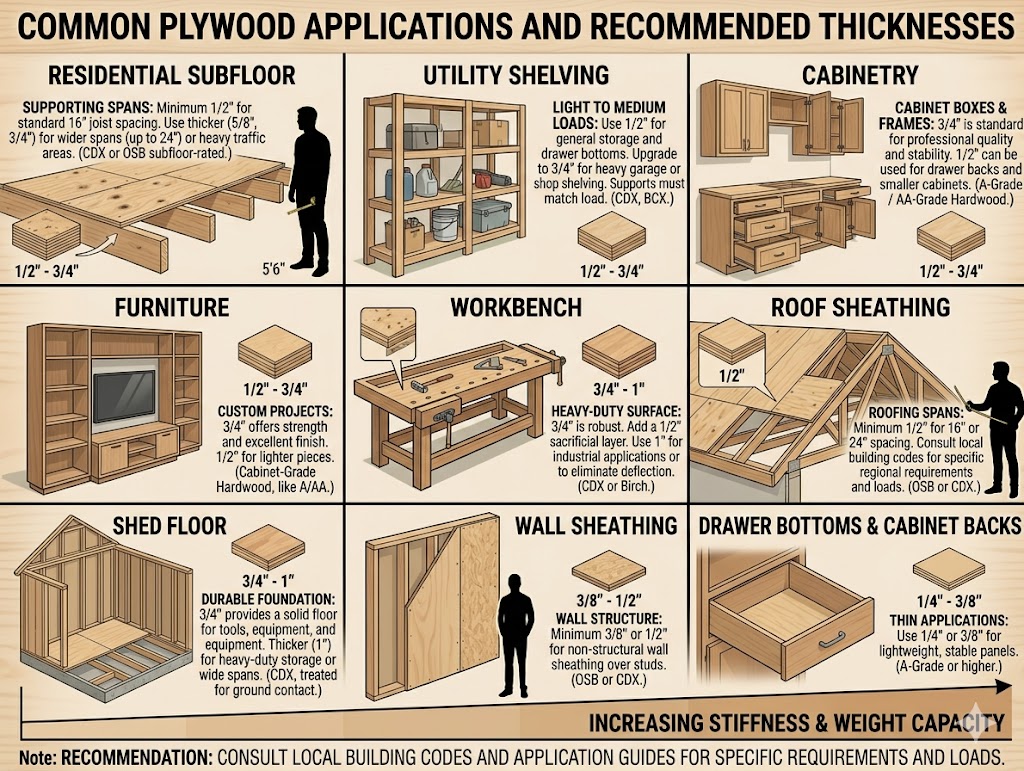
What thickness of plywood for a subfloor? 3/4″ T&G (tongue and groove) plywood over 16″ joist spacing is the standard. Going thinner risks flexing and squeaking.
What thickness of plywood for shelving? 3/4″ for anything load-bearing spanning more than 24″. 1/2″ is fine only with supports every 12–16″.
What thickness of plywood for a workbench top? 3/4″ minimum, often doubled to 1.5″ total for a stiff, dent-resistant surface.
What thickness of plywood for cabinet backs? 1/4″ is standard and sufficient — it’s not load-bearing.
What thickness of plywood for a shed floor? 3/4″ CDX minimum, with proper joist spacing. This is the most common underbuilt spot in DIY sheds.
According to APA – The Engineered Wood Association’s span rating system, subfloor panels installed over 24-inch on-center floor framing generally need to be rated at least 23/32 inch thick to meet standard load and deflection requirements — going thinner than that at 24″ spacing is outside the panel’s rated capacity, not just a “feels thinner” problem.
Indoor vs Outdoor: Why the Same Thickness Performs Differently
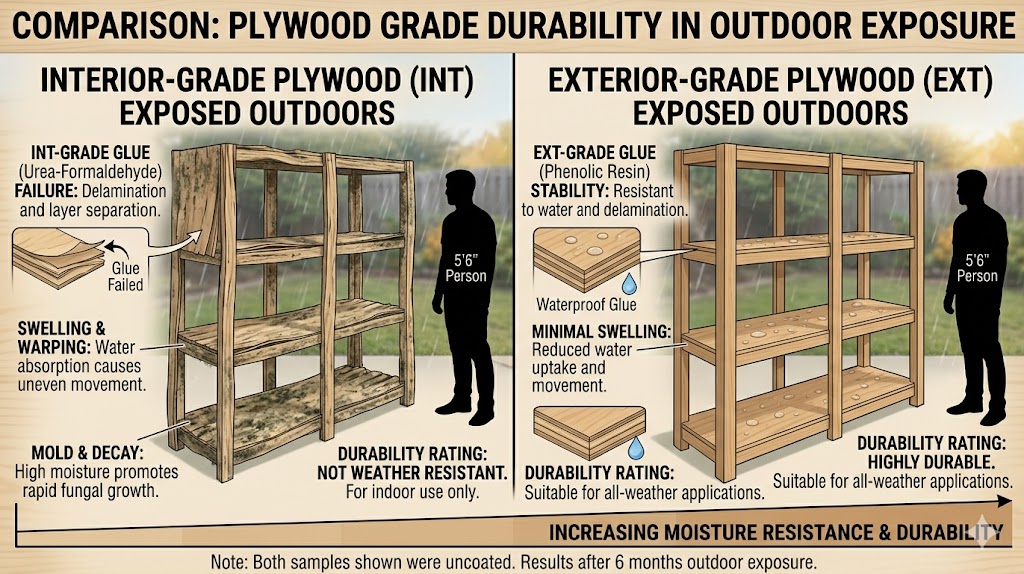
This is the part that the thickness number never tells you, and it’s where I’ve seen the most expensive mistakes. A 3/4″ interior-grade sheet and a 3/4″ exterior-grade sheet start out with identical bending strength. Six months outside, they’re no longer the same product.
Interior-grade plywood uses glue that isn’t rated for moisture cycling — repeated wetting and drying. The wood itself doesn’t rot immediately, but the glue bond between plies starts to fail, and once that happens, the panel no longer acts like a single solid sheet. It acts like loose layers stacked on top of each other, and strength drops fast, even though the thickness measurement hasn’t changed at all.
I had a customer (well, a guy who emailed me after reading another article) who built a dog run roof with leftover interior plywood because “it’s 3/4 inch, it’ll be fine.” Eight months later, the top ply was peeling off in sheets after a wet spring. The thickness was never the problem — the glue rating was.
Outdoor but covered/sheltered (porch ceilings, soffits): Exposure 1 or standard exterior-grade plywood is usually fine
Indoors with occasional moisture (bathroom subfloors, basements): exterior-grade or moisture-resistant underlayment, not standard interior sheets
Fully indoors, dry: interior-grade is fine, and there’s no reason to pay for marine-grade here — that’s the overspending mistake from the cost section above
FAQ for Specific Materials, plywood thickness vs strength
A few more questions that come up constantly in the comments and in DMs, specific enough that they deserve direct answers rather than general rules:
What thickness of plywood for a treehouse floor? 3/4″ exterior-grade minimum, supported every 16″–24″ depending on span, because treehouses combine the worst of both worlds: outdoor exposure and foot-traffic load.
What thickness of plywood for a boat or trailer floor? Marine-grade 3/4″ is the standard answer, but on smaller trailers, 5/8″ marine-grade with closer joist spacing is a common, cheaper-but-still-solid alternative.
What thickness of plywood is needed for soundproofing a wall or floor? Mass matters more than rated strength here — 3/4″ adds more sound dampening than 1/2″, but it’s a secondary benefit, not the primary reason to upgrade thickness.
Which Thickness Should You Buy? (Quick Decision Table)
If you just want the answer without reading the reasoning above, here’s the strongest plywood thickness for the most common projects, based on the span ratings and load capacity covered in this guide:
If You Are Building…
Recommended Thickness
Cabinet Backs
1/4″
Drawer Bottoms
1/4″
Furniture
1/2″
Garage Shelving
3/4″
Kitchen Cabinets
3/4″
Shed Floors
3/4″
Workbenches
3/4″ to 1-1/2″
Trailer Floors
5/8″ to 3/4″ Marine Grade
Treehouses
3/4″ Exterior Grade
This table is a starting point, not a substitute for checking your actual span and load. A 3/4″ recommendation assumes proper support spacing — go back to the plywood strength chart above if your spans run longer than standard.
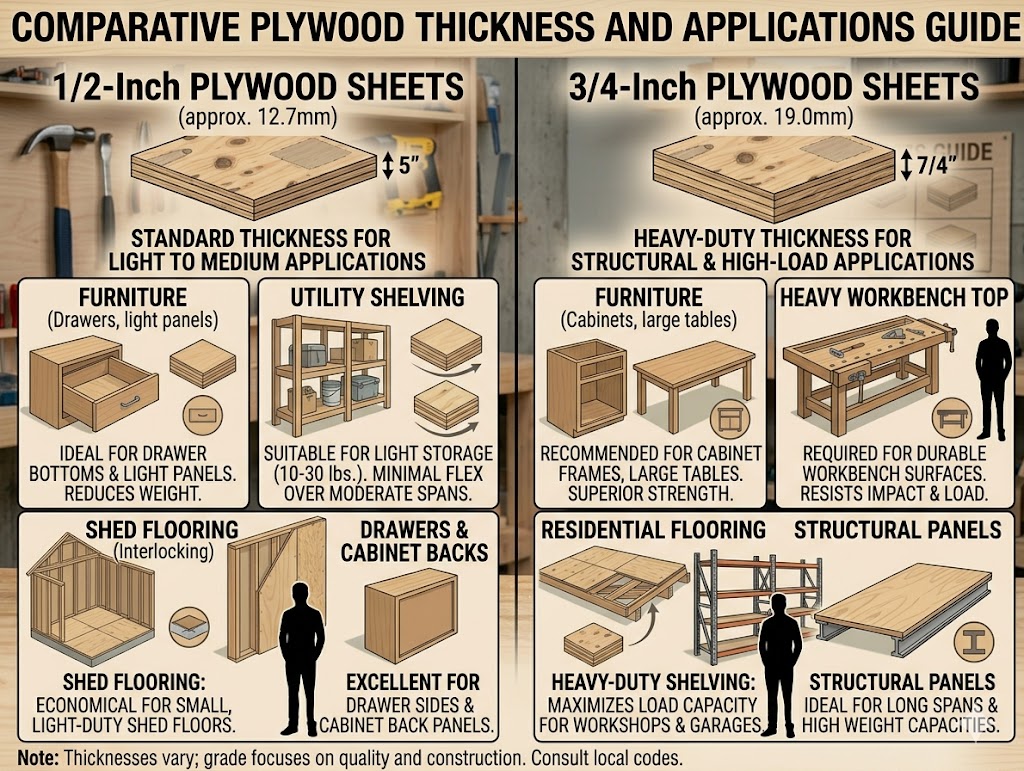
1/2″ vs 3/4″ Plywood thickness vs strength: Head-to-Head Comparison
This is the single most common question I get asked directly — “should I use 1/2 or 3/4 plywood” — so it earns its own table instead of being buried in the project list above:
Feature
1/2″ Plywood
3/4″ Plywood
Typical Shelf Span
Up to 24″
Up to 36″
Flooring
Not Recommended
Recommended
Workbenches
Light Duty
Heavy Duty
Garage Storage
Limited
Excellent
Weight Capacity
Moderate
High
Cost
Lower
Higher
Best Use
Furniture, Panels
Structural Projects
If you’re choosing between the two and genuinely unsure, default to 3/4″. The cost difference is small (see the Cost Difference section above), and it covers far more use cases without needing extra support spacing or a redo down the line. 1/2″ still has its place — light furniture, panels, and anything that isn’t carrying real weight — but it’s the thickness most likely to disappoint you if the project grows beyond what you originally planned.
FAQ: Plywood Thickness vs Strength
What thickness of plywood is strongest? Among commonly available sheet goods, 1-inch plywood is generally the strongest standard thickness. That said, a high-quality 3/4-inch sheet with more plies can outperform a lower-grade 1-inch sheet in real use — thickness isn’t the only variable.
Is thicker plywood always stronger? No. Ply count, wood species, glue quality, and grade all affect load capacity. Thickness by itself doesn’t determine strength.
Does plywood get stronger with more plies? Generally, yes. More plies improve dimensional stability and resistance to bending and warping compared to fewer, thicker plies at the same overall thickness.
Are two layers of 1/2-inch plywood stronger than one 3/4-inch sheet? When properly glued and screwed together, two layers of 1/2-inch plywood are typically stiffer and stronger than a single 3/4-inch sheet — it’s a common trick for workbench tops and heavy-duty shelving.
Does the direction I lay plywood down affect its strength? Yes. The face grain has a strength axis, and panels are meant to be installed with that axis running perpendicular to the supports. Installing a sheet rotated 90 degrees from spec can noticeably reduce its effective load capacity, even though nothing about the panel itself has changed.
Why does my plywood feel weaker than the thickness suggests? Check three things in this order: moisture (swollen or water-stained plywood loses stiffness), grade (interior-grade glue fails faster under stress than exterior), and orientation (strength axis running the wrong way). Thickness is rarely the actual problem when a panel underperforms — most of the time, it’s a panel installed beyond its plywood span rating, not a panel that’s actually defective.
Recommended Tools to Check Your Own Plywood Strength
If you want to test deflection or spans yourself before committing to a build, these are the tools I actually keep in the shop. None of these is expensive, and all four together cost less than the price difference between guessing wrong and replacing a sheet later:
Digital Caliper for Measuring Actual Ply Count/Thickness — sheets are often slightly under their labeled thickness (a “3/4 inch” sheet is frequently closer to 23/32″); this catches it before you build around the wrong number.
Moisture Meter for Plywood and Lumber — moisture-weakened plywood fails far below its rated strength, and you usually can’t tell by looking or pressing on it.
Plywood Glue (Exterior/Marine Grade) for Repairs — useful if you catch delamination early instead of replacing the whole sheet; re-gluing a lifting edge is a 20-minute fix versus a full rebuild.
Joist Hangers for Adding Mid-Span Support — the cheap fix for the “regret” scenario above; adding one mid-span support often solves a sagging problem for less than the cost of upgrading the whole sheet.
Bottom Line
Plywood thickness vs strength isn’t a simple upgrade path — span, support spacing, ply count, and grade all decide whether a sheet holds up or quietly fails. When in doubt, go up one thickness tier rather than adding more unsupported span. It’s the cheapest insurance in the whole project.
Chipboard vs Plywood: Strength, Weight, Price & Uses by Amy Reed November 2, 2025 Installing Plywood is a term used to describe all types of wood for residential construction projects, but, despite the different types available, it’s not the same…
Wood Cable Spool: Ideas, Furniture Projects & More by Admin May 19, 2025 DIY Wood cable spools aren’t just industrial leftovers—they’re a goldmine for creative DIYers. These oversized wooden reels, originally made for holding electrical lines, telephone wires, or…