Choosing the best plywood thickness for shed floors is one of the most important decisions you’ll make when building a shed. Building or upgrading a backyard shed represents a major investment of time and money, yet one of the most common structural failures happens directly under your feet. Choosing an inadequate subfloor material or the wrong thickness can lead to sagging spots, bouncy walking surfaces, and wood failure over time.
Whether you are storing a heavy zero-turn lawnmower, stacking heavy oak firewood, or setting up a personal backyard workshop, getting your floor thickness right is critical to the longevity of your build.
🛑 Quick Answer
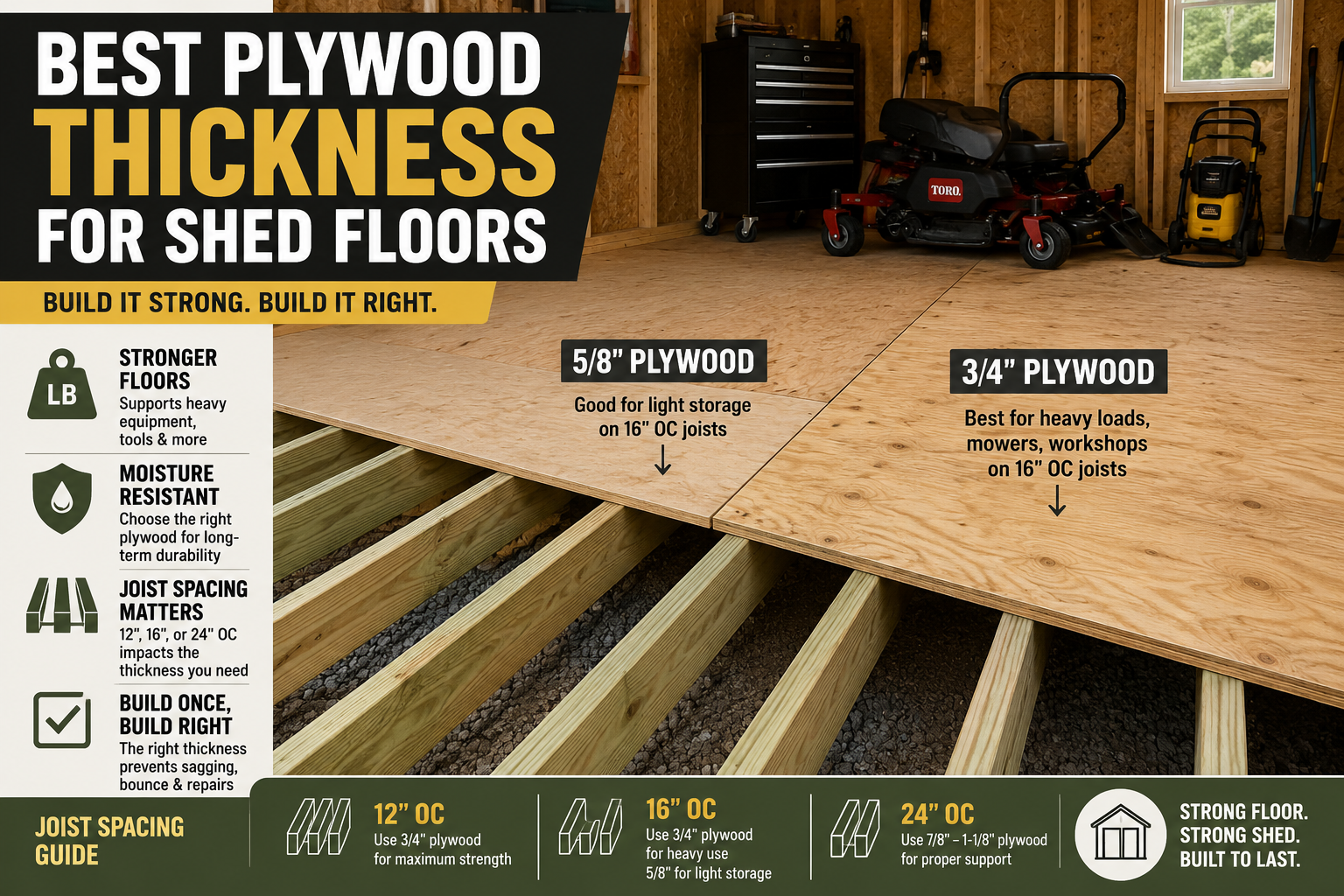
Most shed floors should use 3/4-inch CDX plywood over 16-inch-on-center (OC) joists. For light storage, 5/8-inch plywood is acceptable. For heavy workshops, ATVs, and riding mowers, use 3/4-inch plywood, preferably tongue-and-groove (T&G). Never use 1/2-inch plywood or thin standard OSB for standard joist framing.
Quick Recommendation Chart
If you need a quick baseline recommendation for your project, match your intended shed usage to the required thickness below:
Light Storage: 5/8-inch standard plywood (plastic bins, garden hoses, rakes)
Riding Mowers & Tool Chests: 3/4-inch standard CDX plywood
Workshops or Home Gyms: 3/4-inch Tongue & Groove (T&G) plywood
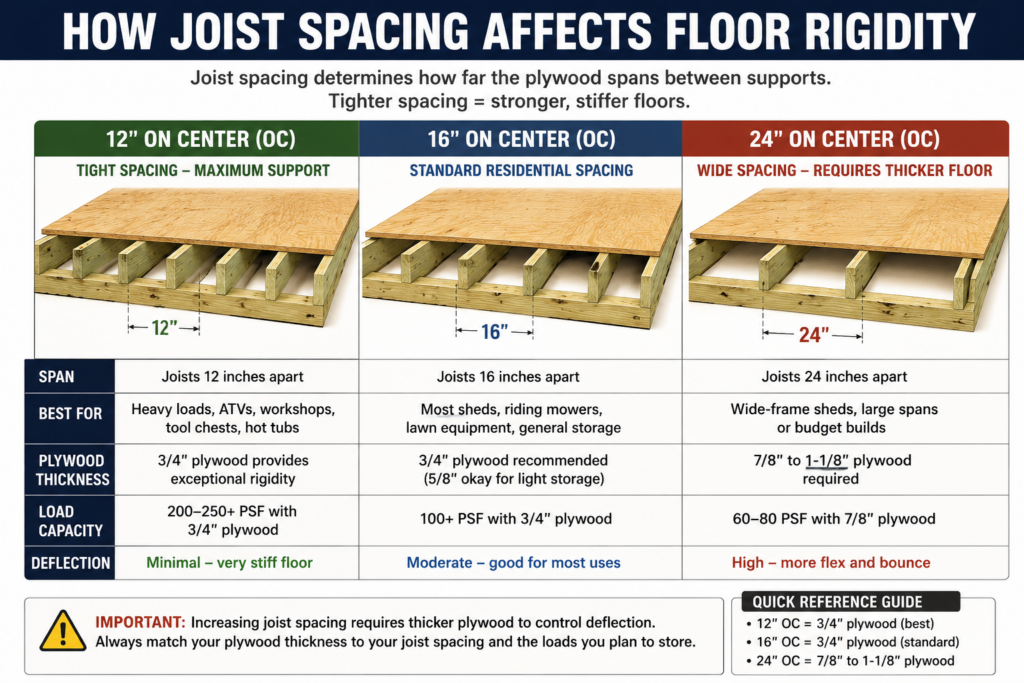
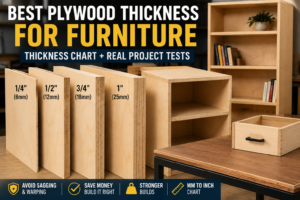
To help you get the exact layout right for your build, use this comprehensive overview mapping expected weight loads and joist configurations to the appropriate panel options.
💡 Recommended Choice for Most Homeowners: For the absolute best balance of structural strength, moisture protection, and value, use 3/4-inch pressure-treated CDX plywood over 16-inch on-center joists. This combination easily handles heavy equipment while standing up to high humidity.
⚠️ Warning: Never use 1/2-inch plywood or thin standard OSB panels for a shed floor if your joists are spaced 16 inches or 24 inches apart. It lacks the structural cross-stiffness required for moving point loads. A single heavy rolling wheel or a concentrated step can flex the wood fibers past their threshold, leading to permanent sagging, soft spots, and floor bounce.
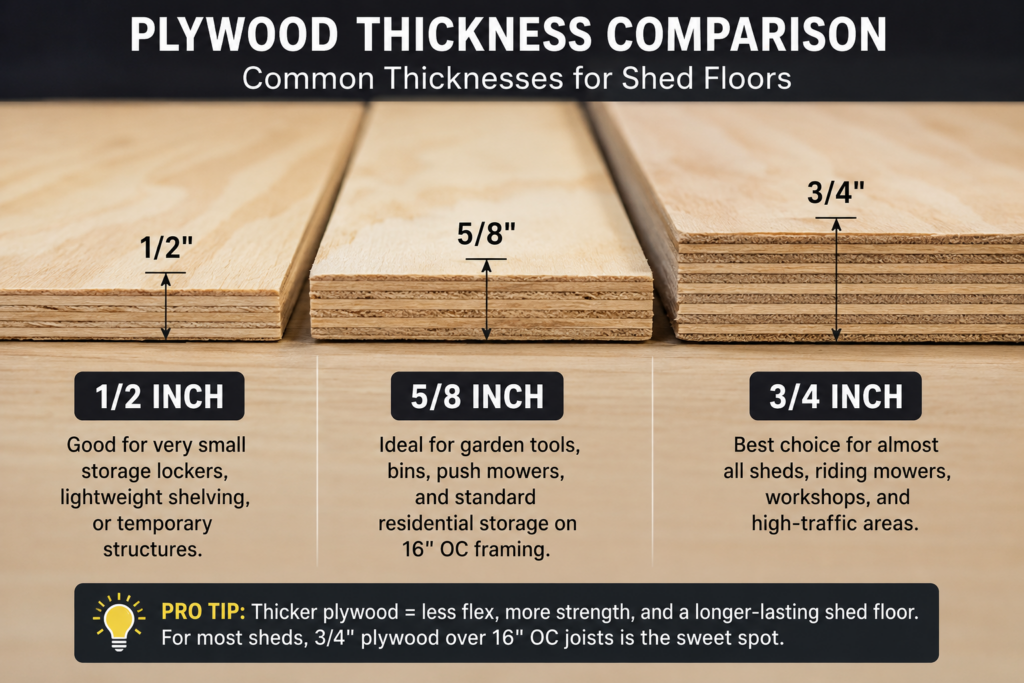
Plywood Thickness for Shed Floors: 1/2 vs. 5/8 vs. 3/4 Inch
When walking through the lumber aisle, the choices can look nearly identical on the rack. However, the performance differences between these common thicknesses are massive when spanning open joists.
Thickness
Good For
Avoid If
1/2 inch
Very small storage lockers, lightweight shelving, or temporary structures.
Riding mowers, heavy lawn equipment, or standard 16″ OC joist spacing.
5/8 inch
Garden tools, bins, push mowers, and standard residential storage on 16″ OC framing.
Heavy workshops, machine tool storage, or wide 24″ OC framing.
3/4 inch
Almost all residential and heavy-duty sheds, riding mowers, workshops, and high-traffic areas.
When budget is the absolute only priority (carries a slightly higher panel cost).
7/8 inch+
Commercial heavy equipment storage or wide 24″ OC joist framing.
Overkill for the vast majority of standard backyard homeowners.
What Does Upgrading from 5/8″ to 3/4″ Cost?
Homeowners often make subfloor thickness decisions entirely based on their upfront budget. However, the cost gap between an adequate floor and a bulletproof floor is remarkably small over the structure’s lifetime.
Per-Sheet Cost Difference: Standard 5/8-inch CDX plywood typically runs between $30 and $35 per 4×8 sheet, while a robust 3/4-inch CDX sheet costs roughly $38 to $45. Upgrading to a premium 3/4-inch Tongue & Groove (T&G) panel or a pressure-treated alternative usually adds an extra $10 to $15 per sheet.
Total Build Impact: For a standard 10×12 shed—which requires roughly 4 standard 4×8 panels—the direct material cost difference to upgrade from a standard 5/8-inch floor to a premium 3/4-inch subfloor is only about $20 to $60.
Given that replacing a buckled or soft floor down the road requires jacking up walls and emptying the structure, spending the extra $40 upfront provides an exceptional return on investment.
Why Floor Thickness and Deflection Matter
A shed floor handles structural loads differently than an indoor residential room does. It must support high-intensity, concentrated weight points while handling moisture vapor rising from the bare earth below.
When choosing sheet goods, thickness directly determines the panel’s deflection (how much a panel bends under weight between structural supports). If a subfloor flexes too far, the underlying wood layers repeatedly stretch, stress, and eventually separate.
In real-world building scenarios, thin 1/2-inch panels installed across 16-inch on-center (O.C.) spacing flex significantly under average adult footsteps, causing a noticeable “trampoline” feel. Upgrading to a 5/8-inch panel reduces this flex significantly, making it stable enough for light foot traffic and storage. Moving up to a robust 3/4-inch panel minimizes deflection and distributes weight evenly across the surrounding framing lumber.
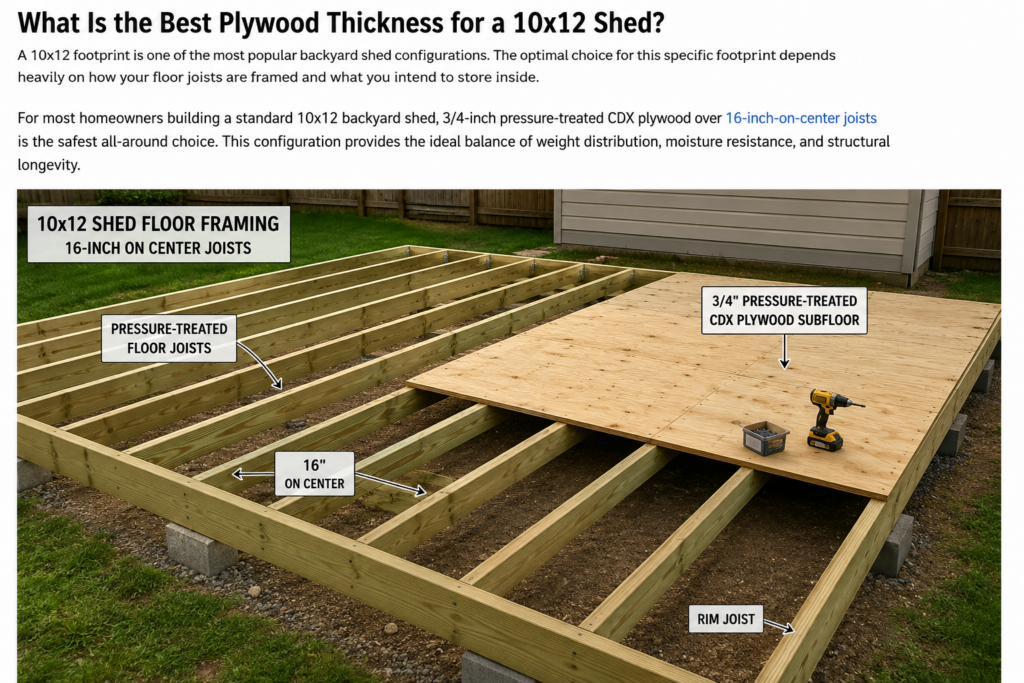
What Is the Best Plywood Thickness for a 10×12 Shed?
A 10×12 footprint is one of the most popular backyard shed configurations. The optimal choice for this specific footprint depends heavily on how your floor joists are framed and what you intend to store inside.
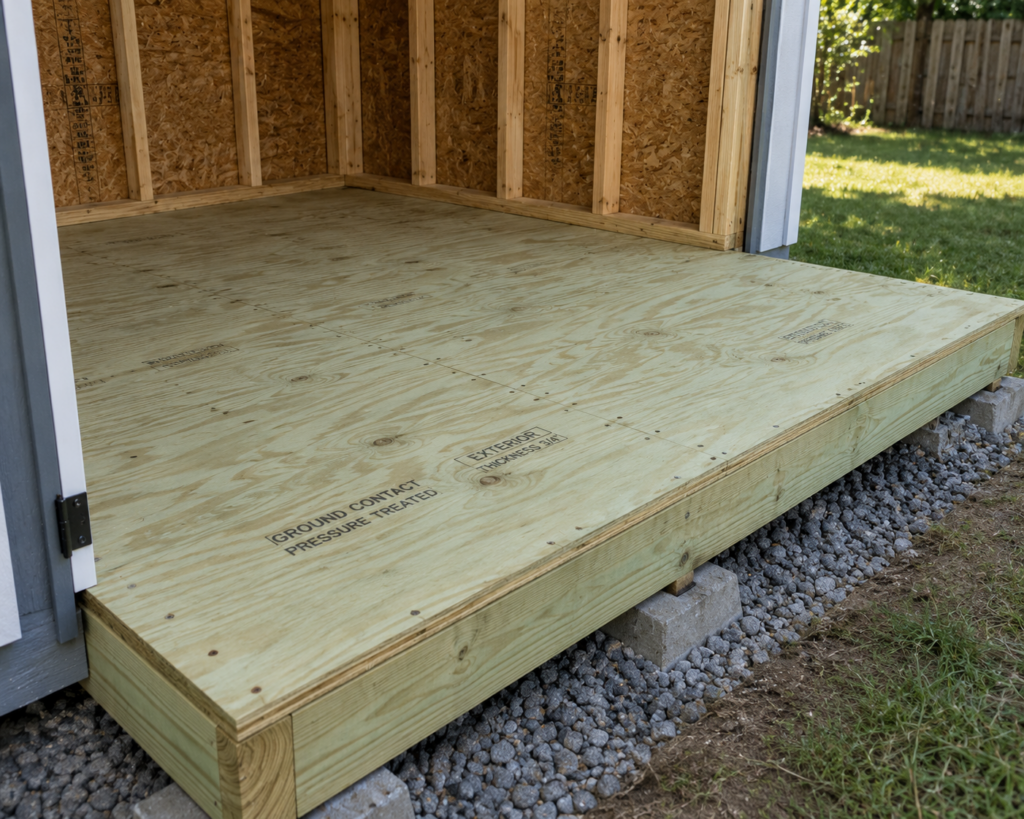
For most homeowners building a standard 10×12 backyard shed, 3/4-inch pressure-treated CDX plywood over 16-inch-on-center joists is the safest all-around choice. This configuration provides the ideal balance of weight distribution, moisture resistance, and structural longevity.
16″ On-Center Joists (Standard Build)
For a standard 10×12 frame with joists spaced 16 inches apart, 3/4-inch plywood is the safest overall choice. It ensures total structural stability, preventing low spots or long-term structural warping.
Light Storage Exemption
If you are strictly using your 10×12 layout to store plastic bins, garden hoses, rakes, and light seasonal items, 5/8-inch plywood is an acceptable alternative. It saves a bit on material costs while still providing a safe foundation for light point loads.
Riding Mowers, ATVs, or Heavy Workshops
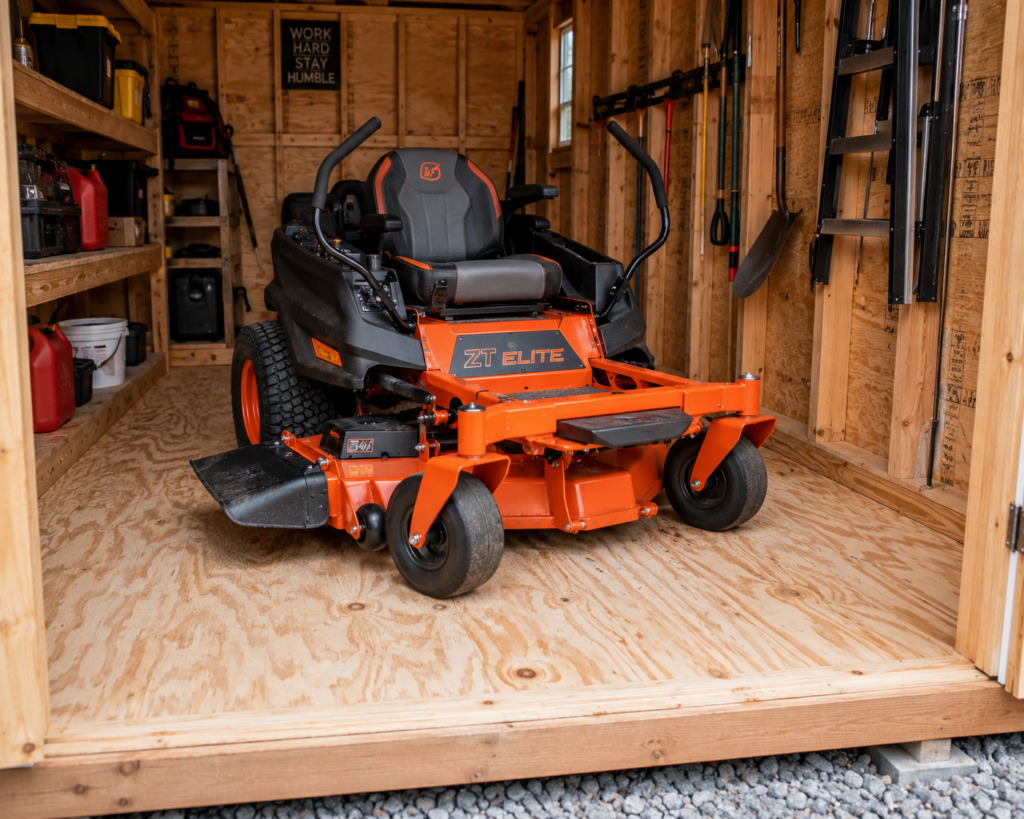
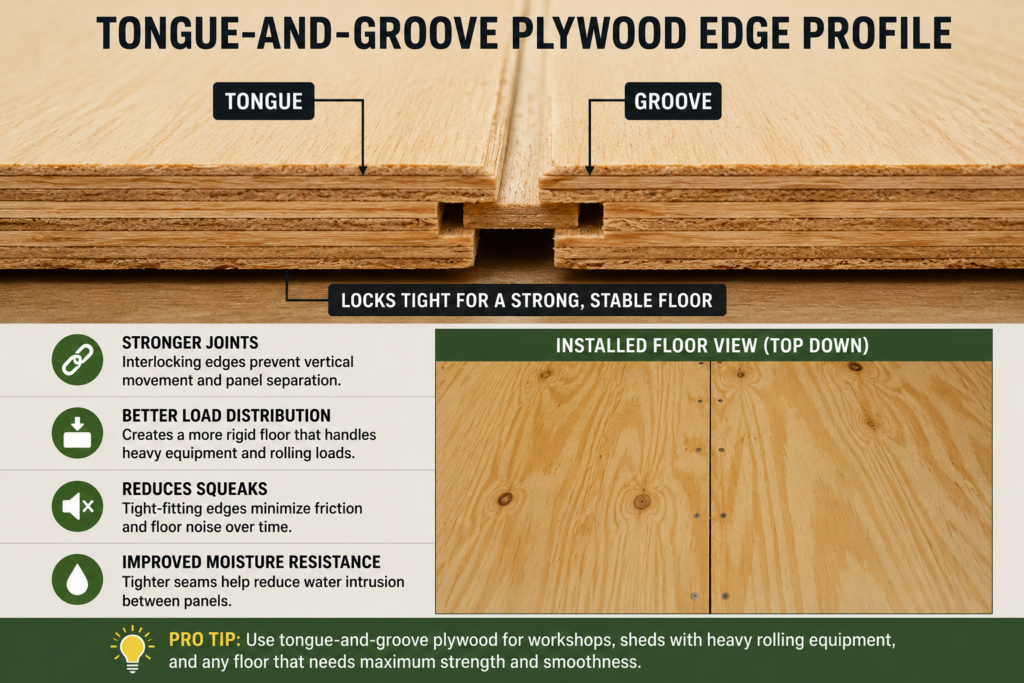
If your 10×12 space is storing a zero-turn riding mower or an ATV, 3/4-inch standard CDX plywood on 16-inch OC joists works perfectly fine for most typical setups. However, if you are building an active workshop with heavy rolling toolboxes, 3/4-inch tongue-and-groove (T&G) plywood is highly preferred. The interlocking edges prevent heavy rolling wheels from forcing an individual panel edge down, maintaining a smooth, level seam under heavy rolling stress.
How Much Weight Can a Shed Floor Hold?
A shed floor’s total load-bearing capacity relies entirely on the interplay between panel thickness and structural joist spacing. When properly constructed with standard 16-inch on-center framing, the uniform live load limit varies dramatically across thicknesses.
5/8″ Plywood Capacity
A standard 5/8-inch CDX plywood panel spanning 16-inch OC joists comfortably supports a uniform live load of approximately 50-60 pounds per square foot (PSF). This makes it highly efficient for standard backyard storage, including plastic bins, push lawnmowers, holiday decorations, and basic yard tools. However, it lacks the structural stiffness to handle high-density point loads.
3/4″ Plywood Capacity
Upgrading to a robust 3/4-inch plywood panel bumps the load capacity up to 100+ PSF when paired with 16-inch OC framing. If you drop the joist spacing to a tight 12 inches on-center, a 3/4-inch floor easily exceeds a capacity of 200-250 PSF.
Real-World Weight Matching
Before buying lumber, map out your maximum structural point loads:
Riding Mowers & ATVs: A commercial zero-turn mower or full-sized ATV can easily weigh between 700 and 1,200 pounds. Because that weight is concentrated entirely on four small tire contact patches, a minimum of 3/4-inch plywood over 16-inch OC joists is required. For heavy utility ATVs, tightening joists to 12-inch OC prevents localized indentation over time.
Tool Chests: A fully loaded rolling mechanic’s cabinet can exert upwards of 500 pounds on four tiny steel casters. Standard 5/8-inch or OSB panels will dip or punch through under this pressure; use 3/4-inch tongue-and-groove or double-layer sheets.
Firewood: Green oak or maple firewood weighs roughly 4,000 to 4,800 pounds per cord. Stacking wood along a shed wall creates immense, continuous dead weight. If you plan to store firewood, a 3/4-inch floor over 12-inch OC joists is non-negotiable.
Home Gyms: Power racks, iron weight plates, and heavy dumbbells generate intense structural drop forces. A 3/4-inch subfloor topped with 3/4-inch recycled rubber stall mats is the industry-standard baseline for shielding the framing from structural failure.
Material Grades & Panel Classifications
The performance of your floor isn’t just about thickness; it depends completely on the material grade you select. For an in-depth look at how various sheets stand up to outdoor conditions, review our guide on Pressure Treated vs Exterior Plywood.
CDX Pressure-Treated Plywood (Best Overall): This offers the ultimate defense. It couples the structural strength of plywood with deep chemical preservation against moisture rot and bugs.
Standard CDX Plywood (Best Value): It refers to a C-D veneer grade with an Exposure 1 rating. The ‘C’ and ‘D’ denote rough visual faces with visible knots and factory patches, while the ‘X’ indicates that the interior plies are bonded with exterior-grade moisture-resistant glue. It is highly reliable if your floor remains dry or is well-sealed.
Tongue-and-Groove Subfloor (Preferred for Rolling Loads): T&G panels feature a machined ridge along one side and a matching slot along the opposite edge. This design mechanically locks adjacent sheets together, preventing edge seams from sagging independently over time.
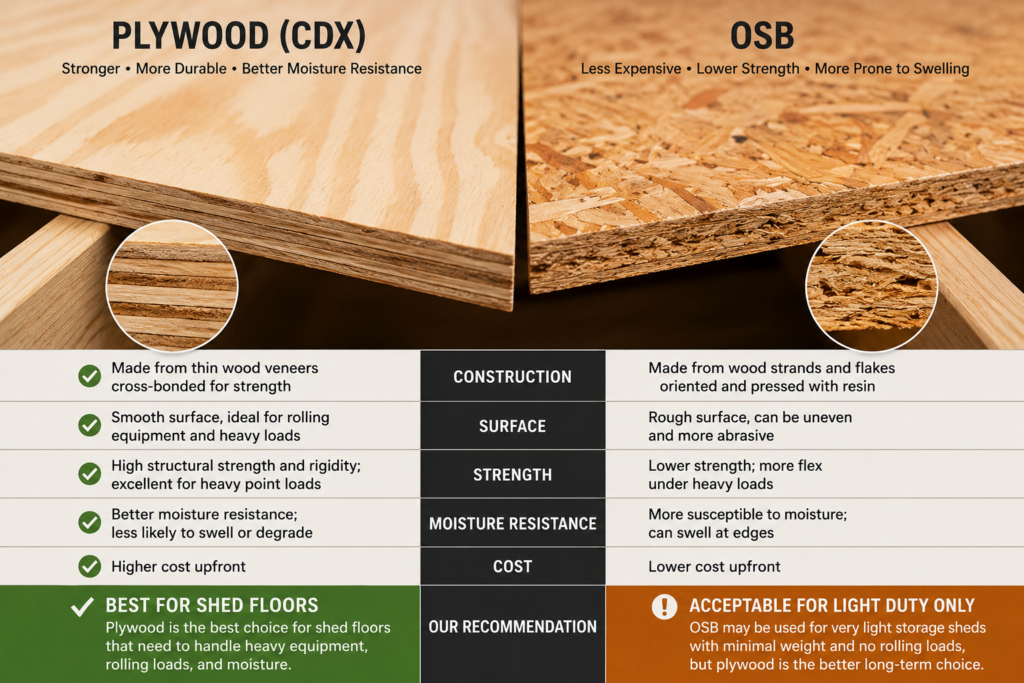
Standard OSB Panels (Budget option): Made by compressing wood strands together with adhesive resins under high pressure. While budget-friendly, it must be noted that if it gets exposed to constant humidity or leaks, the edges can swell significantly.
Marine Grade Plywood (Premium): Constructed using premium, knot-free plies of wood bound together with water-immersion-rated resins. It is virtually immune to delamination but is generally unnecessary and cost-prohibitive for 95% of standard backyard shed projects.
Core Materials Selection Chart
Choosing the wrong panel classification can cause long-term durability issues. Review the primary properties of common subfloor options below:
Material Classification
Primary Benefit
Moisture Resistance Level
Price Category
Standard OSB Panels
Extremely budget-friendly
Low (Edges swell when wet)
Budget
CDX Exposure 1 Plywood
High cross-grain stiffness
Moderate (Handles wet boots)
Mid-Range
Pressure-Treated Plywood
Immune to rot and insects
High (Handles damp air)
Premium
Tongue & Groove Subfloor
Locks sheet seams flat
Moderate to High
Premium
Plywood vs. OSB for Shed Floors
The choice between traditional CDX plywood and Oriented Strand Board (OSB) is one of the most heavily debated topics in shed building. While they serve similar structural purposes in residential housing, the harsh environment beneath a backyard shed exposes the critical weaknesses of both options. To weigh all the pros and cons of these materials, see our comprehensive OSB vs Plywood Guide.
Strength
Plywood is constructed using thin, alternating cross-laminated wood veneers glued together under intense heat and pressure. This cross-graining gives plywood exceptional stiffness along both axes and superior nail-holding power at the panel edges. OSB is engineered by compressing thousands of 3- to 4-inch wood strands with waterproof resins. While OSB is highly uniform and lacks the structural inner knots or voids occasionally found in plywood, it exhibits less shear stiffness and flexes slightly more under concentrated rolling point loads.
Moisture Resistance
Moisture performance is where these two materials diverge completely. If standard OSB gets wet or sits in high-humidity conditions, its exposed edges absorb water like a sponge. This causes irreversible edge-swelling, delamination, and severe structural softening. Plywood handles moisture far more elegantly; while it will expand when exposed to high humidity, it dries out evenly, retains its structural integrity, and returns almost entirely to its original dimensions without permanent swelling.
OSB typically costs roughly 20% to 35% less than equivalent plywood sheets, making it highly attractive for budget builds. However, the lifespan math shifts over time. An OSB floor exposed to persistent ambient humidity at the perimeter can fail within 5 to 7 years. A high-quality CDX plywood floor, if kept well-ventilated, easily lasts 20 to 30 years.
The Bottom Line: For most shed floors, plywood remains the better long-term choice. The minor upfront cost savings of OSB are rarely worth the risk of a soft, swollen floor deck down the road.
Deep Dive: When is Pressure-Treated Plywood Required?
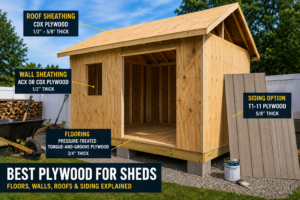
Because backyard sheds sit close to the ground, ambient humidity and vapor easily accumulate beneath the floor frame. Knowing when to opt for pressure-treated plywood saves your subfloor from early failure. Check out our detailed breakdown of sheet styles in the Best Plywood for Sheds directory.
When it is Mandatory
If your shed floor frame sits directly on gravel beds, concrete pads, or bare earth with an unskirted, open framing underside, you should use pressure-treated sheets. The constant ground moisture can significantly shorten the lifespan of standard plywood.
When Standard Plywood is Acceptable
You can safely utilize standard premium CDX or subfloor panels if your shed sits on a raised foundation with excellent perimeter air drainage, or if you plan to prime and paint the interior subfloor with heavy-duty protective deck paints.
Fastener Requirements
⚠️ Warning: Pressure-treating chemicals are highly corrosive to standard steel. When fastening treated plywood to your framing, you must use hot-dip galvanized screws, stainless steel, or specialized exterior-coated fasteners to prevent the screws from rusting out and snapping over time.
Should You Use Tongue-and-Groove Plywood?
Standard plywood panels have square cut edges on all four sides. Tongue-and-Groove (T&G) plywood, on the other hand, features a precision-machined protruding ridge (“tongue”) along one long edge and a perfectly matched recessed slot (“groove”) along the opposite edge.
Plaintext
Standard Square Edge:   [_______] [_______]  <-- Seam can deflect independently
Tongue-and-Groove:      [_______]=[_______]  <-- Interlocked seam transfers load
What T&G Does
When you install T&G panels, the sheets lock together mechanically across their entire length. This interlocking joint transfers weight loads seamlessly across adjacent sheets. On a square-edge plywood floor, if a heavy wheel rolls over a seam, only the single panel directly under the wheel bends down, creating an uneven lip and stressing the fasteners. T&G forces both panels to deflect downward as a single cohesive unit.
When it Matters
You should absolutely pay the premium for 3/4-inch Tongue-and-Groove plywood if your shed will house:
Heavy rolling toolboxes or engine hoists.
Large riding lawn tractors or heavy commercial equipment.
Active workshops where floor seams must remain perfectly flush to prevent trip hazards.
When Standard Plywood is Enough
Standard square-edge CDX plywood is perfectly adequate if you are building a simple storage shed for lawn chairs, bicycles, and push mowers, or if you plan to install solid 2×4 blocking underneath every single raw sheet seam to mechanically support the edges from below.
How Joist Spacing Affects Floor Rigidity
The floor joist spacing you select dictates exactly how thick your plywood deck needs to be. For a granular look at span ratings and capacities across different dimensions, consult our Plywood Thickness Guide.
12″ OC (On-Center) Spacing
This is the heavy-duty framing standard. Tighter 12-inch spacing drastically minimizes the open span between joists, effectively eliminating panel deflection. When paired with 3/4-inch plywood, a 12-inch OC configuration transforms your shed floor into an unyielding platform capable of supporting heavy commercial machinery, heavy motorcycles, or thousands of pounds of stacked lumber.
16″ OC Spacing
The gold standard for the vast majority of standard backyard sheds. It offers the ideal compromise between framing material costs and structural rigidity. At 16 inches OC, a 3/4-inch plywood sheet provides an incredibly solid, bounce-free feel underfoot, while a 5/8-inch panel offers an acceptable baseline for lightweight household storage.
24″ OC Spacing
Commonly found in pre-fabricated budget utility sheds or ultra-cheap DIY kits. Spanning 24 inches of open air leaves standard 1/2-inch or even 5/8-inch plywood highly prone to severe sagging and floor bounce. If your frame is set to 24 inches OC, you must upgrade your subfloor to heavy-duty 7/8-inch or 1-1/8-inch premium subfloor panels to prevent the floor from feeling like a trampoline under your feet.
Common Shed Floor Thickness Mistakes
Using 1/2-inch plywood on 16-inch OC joists: This results in permanent sagging, soft spots, and floor bounce under standard lawn equipment loads.
Using interior plywood outdoors: The constant ground moisture can significantly shorten the lifespan of standard interior plywood, leading to rapid delamination.
Skipping expansion gaps: Plywood expands and contracts with humidity; leaving no gaps (approx. 1/8-inch between sheets) causes the edges to buckle.
Using untreated fasteners with PT plywood: The chemicals in pressure-treated wood will quickly corrode standard nails and screws, leading to structural failures.
Building on poor drainage: Even the thickest premium plywood will fail prematurely if the framing sits in a perpetual puddle of water.
Can You Upgrade an Existing Shed Floor?
If your current shed floor is experiencing noticeable bounce, soft spots, or minor structural sag, you do not always have to completely tear down the structure to fix it. Depending on the condition of the underlying framing joists, you can implement a few targeted structural upgrades to restore the deck.
Adding a Second Plywood Layer
If your original floor is structurally sound but thin (such as 1/2-inch or worn 5/8-inch panels) and exhibits excessive floor bounce, you can stiffen the floor by overlaying a second layer of plywood. Clean the original deck thoroughly, apply a heavy bead of premium polyurethane construction adhesive across the entire floor, and lay 1/2-inch or 5/8-inch CDX plywood directly on top.
💡 Pro-Tip: Stagger the seams of the new upper layer by at least 16 to 24 inches relative to the original bottom layer seams, and fasten them with exterior screws driven straight into the underlying joists.
Replacing Damaged Sheets
If a specific area of the floor has rotted out due to a localized roof leak or spilled chemicals, you can patch it. Use a circular saw set to the exact depth of the plywood, then cut out the rotted section, ensuring your cuts stop precisely halfway across the center of a solid floor joist. This leaves an exposed ledge of framing lumber to support the edges of your new patch piece.
Reinforcing Joists from Below
If you have crawlspace access underneath the shed, you can eliminate excessive bounce by installing solid wood blocking (2×4 or 2×6 pieces cut to fit tightly, perpendicular to the joists) along the centerline of the floor span. This mechanically locks the framing together and completely halts structural twisting.
Shed Type Floor Specification Reference
Review the quick reference comparison below to match your exact build type with its optimal subfloor requirements:
😬 The Floor Sag Regret: Saving money by choosing thin 1/2-inch OSB over a robust 3/4-inch CDX plywood panel might cut down your initial material costs. However, replacing a buckled, rotted, or sagging shed floor down the road is incredibly difficult. You have to completely empty the structure, unscrew the bottom wall plates, jack up the wall headers, and rebuild the base deck from scratch—costing significantly more in tools and materials than doing it right the first time.
Frequently Asked Questions (FAQ)
Is OSB acceptable for a shed floor?
Standard OSB is acceptable only if the shed is built strictly for budget storage, sits on a highly elevated foundation with exceptional air circulation, and will never be exposed to interior water spills or intense rolling point loads. If the edges are exposed to chronic ground moisture or water leaks, OSB will permanently swell and compromise the floor structure much faster than CDX plywood.
Can I use 5/8-inch plywood on 24-inch centers?
No, 5/8-inch plywood is too thin for 24-inch on-center joist spacing. Spanning two feet of open space between supports will cause the floor to heavily sag and bounce under standard foot traffic or moving lawn equipment. For 24-inch framing, you must use premium subfloor panels with a thickness of 7/8-inch to 1-1/8-inch.
Do I need pressure-treated plywood?
Pressure-treated plywood is mandatory if your shed’s subfloor frame sits directly on ground beds (such as gravel or soil) or concrete pads where damp air gets trapped with limited airflow. If your shed foundation is highly elevated and has good perimeter drainage, standard CDX plywood with an Exposure 1 rating is perfectly adequate.
What is the cheapest acceptable shed floor?
The cheapest acceptable option for a standard 16-inch on-center frame is 5/8-inch CDX Exposure 1 plywood. It provides the baseline structural stiffness necessary for light residential storage (push mowers, tools, bins) without the added cost of premium T&G edge profiling or chemical pressure treatments. Avoid going any thinner than 5/8-inch.
Final Thoughts on the Best Plywood Thickness for Shed Floors
For most backyard sheds, the best plywood thickness for shed floors is 3/4-inch pressure-treated CDX plywood installed over 16-inch-on-center joists. While 5/8-inch plywood may work for light storage, heavier loads such as riding mowers, workshops, and firewood storage benefit from the additional strength and durability of 3/4-inch panels.
Related Posts:
How to Build a Lean-To Shed (Step-by-Step DIY Guide) by Admin June 17, 2025 DIY If you’ve ever run out of space for your lawn tools, garden gear, or even firewood, you’re not alone. Many homeowners eventually find themselves needing…