Affiliate disclosure: ThePlywood.com is reader-supported. As an Amazon Associate, we earn from qualifying purchases at no extra cost to you.
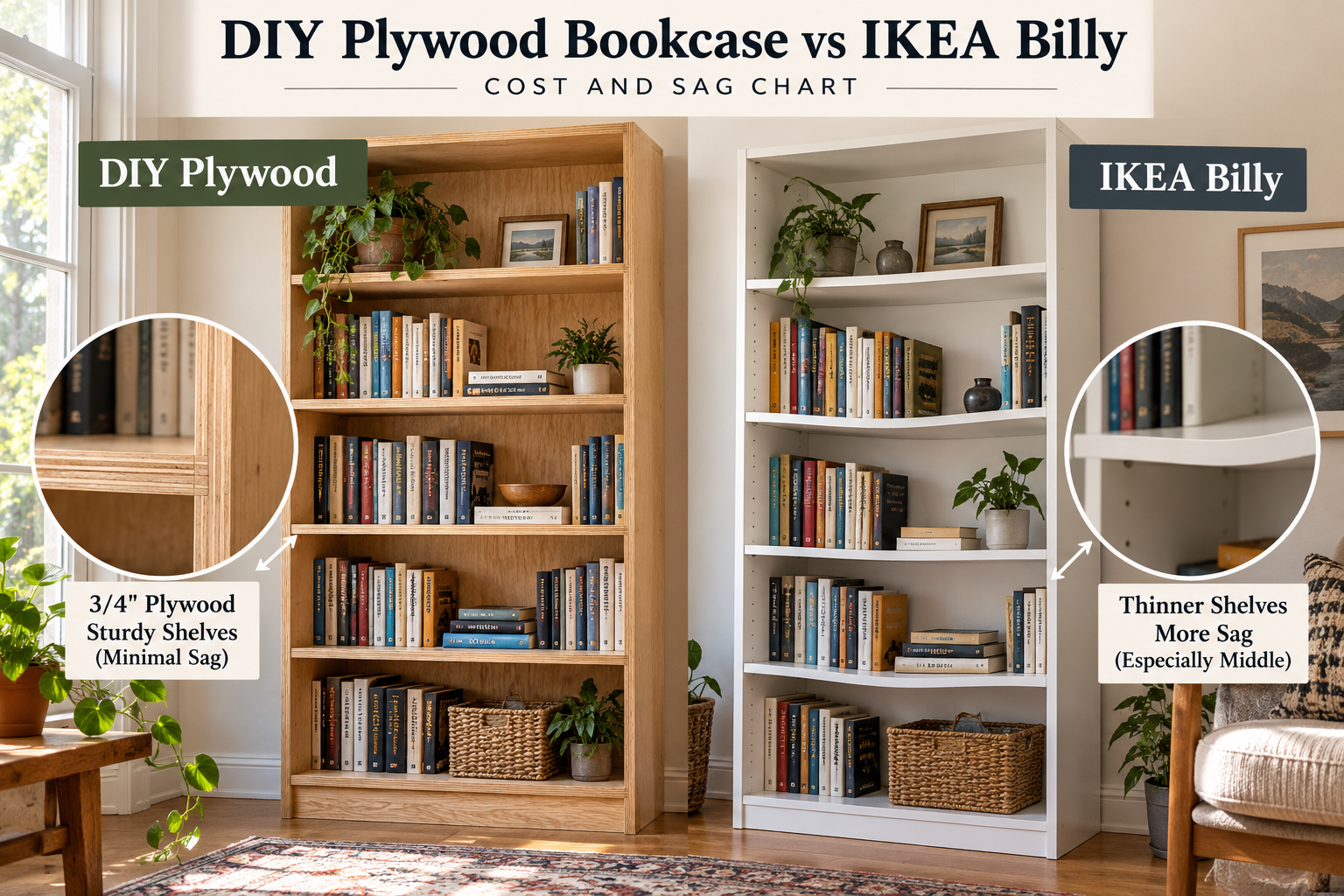
At IKEA’s rated load of 66 lb per shelf, a 3/4-inch plywood shelf is predicted to sag about one-fifth to one-third as much as a 3/4-inch particleboard shelf of the same size. On cost, the IKEA BILLY 31½” × 11″ × 79½” was listed at $79 online at IKEA US when we checked on October 20, 2026. A plywood build only beats that if your local sheet price is below the break-even figures worked out below. This page covers the sag chart and its assumptions, a cut list for an 11-inch-deep case, the cost math, and when buying the Billy is the smarter call.
Quick answer Buy the Billy for paperbacks, décor, or light items, or if you move often. Build in 3/4-inch plywood if the shelves will be fully loaded with hardcovers, records, or binders, or if you want spans longer than 30 inches. IKEA rates the Billy at 66 lb per shelf. Plywood’s advantage is stiffness: it sags less under the same load. The figures below are calculated, not measured on a real shelf.
Plywood Bookcase vs IKEA Billy: The Sag Chart
Rated-load comparison: 26.4 lb per foot spread evenly across the shelf, which equals IKEA’s 66 lb maximum on a 30-inch shelf.
Shelf (10½” deep)
Span
Load
Predicted sag
L/400 limit
Passes?
3/4″ particleboard
30″
66 lb (26.4 lb/ft)
0.18″
0.075″
No
3/4″ plywood, E = 1.8M psi
30″
66 lb
0.04″
0.075″
Yes
3/4″ plywood, E = 1.2M psi
30″
66 lb
0.06″
0.075″
Yes
3/4″ particleboard
36″
79 lb (26.4 lb/ft)
0.37″
0.09″
No
3/4″ plywood, E = 1.8M psi
36″
79 lb
0.08″
0.09″
Yes, barely
3/4″ plywood, E = 1.2M psi
36″
79 lb
0.12″
0.09″
No
The 36-inch rows keep the same 26.4 lb per foot, which totals 79 lb. That is above the Billy’s rating, but a Billy is only 31½ inches wide, so these rows apply to a wider DIY case.
⚠️ Above-rated-load comparison, for interest only: the next table uses 35 lb per linear foot, the load engineer Harris Hyman measured for a shelf of dense textbooks. On a 30-inch shelf, that is 87.5 lb, which is above IKEA’s 66 lb rating. Do not load a Billy shelf this heavily. These rows only show how the two materials respond as the load increases.
Shelf (10½” deep)
Span
Load
Predicted sag
3/4″ particleboard
30″
87.5 lb (35 lb/ft)
0.24″
3/4″ plywood, E = 1.8M psi
30″
87.5 lb
0.05″
3/4″ plywood, E = 1.2M psi
30″
87.5 lb
0.08″
How These Numbers Were Calculated
🧪 These are calculations, not a physical test. We did not load a Billy shelf. The assumptions are:
Formula: d = 5wL⁴ ÷ (384 × E × I), the standard deflection formula for a simply supported beam under an evenly spread load. This is the same formula Hyman uses in his Journal of Light Construction article Down With Sagging Shelves (April 1995).
Supports: the shelf rests on pins at each end and is free to rotate, as adjustable shelves are. A shelf held in dadoes at both ends would sag less.
Load: spread evenly across the full span. A single heavy stack in the middle sags a shelf more than the same weight spread out.
Shelf size: 10½ inches deep. Plywood is taken at 23/32 inch actual thickness and particleboard at 3/4 inch. IKEA’s product page does not list the Billy’s shelf thickness, so the particleboard rows are a stand-in; measure your own shelf. If it measures 5/8 inch, the same formula predicts 0.31 inch of sag at the rated load on a 30-inch span.
Stiffness (E): 350,000 psi for particleboard and 1,800,000 psi for plywood, the values Hyman uses. Actual plywood stiffness depends on species, layup, and face-grain direction, so we added a lower 1,200,000 psi row as a cautious case. Some “3/4-inch” sheets measure as thin as 0.703 inch, which adds roughly 7% more sag.
Sag limit: 1/400 of the span, the limit Hyman uses for shelves where sag should not be visible.
Not included: long-term sag. Shelves under constant load can keep sagging slowly over time, and the formula predicts only the initial sag. As a real-world check, Hyman measured 0.29 inch of sag on his own loaded 26-inch particleboard shelves, where his formula had predicted about 0.40 inch. The formula gives a reasonable estimate, not an exact one.
What a Billy Actually Is
IKEA US lists the white BILLY at 31½” wide × 11″ deep × 79½” tall. It has five shelves (one stationary and four adjustable) and a maximum load of 66 lb per shelf. The sides are particleboard with paper foil and plastic edging. The back is fiberboard with paint and paper foil. IKEA states that the bookcase must be securely anchored to prevent tipping. Mounting brackets are included, but wall screws and plugs are sold separately.
The 66 lb figure is IKEA’s maximum load rating. What you will notice first is sag: the rated-load chart predicts that a 3/4-inch particleboard shelf exceeds the visible-sag limit well within that rating.
Cut List: An 11-Inch-Deep Plywood Bookcase
This cut list builds a case matching the Billy’s outside dimensions: 31½” wide × 11″ deep × 79½” tall. It has seven horizontal pieces: top, bottom, one fixed shelf, and four adjustable shelves.
How the back attaches: cut a rabbet along the back inside edge of each side, 3/8 inch into the side’s thickness and 1/4 inch in from the back edge. The 1/4-inch back sits in these rabbets. The top, bottom, and fixed shelf are 10¾ inches deep, so the back laps over their rear edges and is glued and nailed to them. The front edges sit flush with the front of the sides, so the overall depth stays at 11 inches.
Part
Qty
Size (W × L)
Notes
Sides
2
11″ × 79½”
3/4″ hardwood plywood; back rabbet as described above
Top and bottom
2
10¾” × 30-1/16″
Fit between the sides
Fixed shelf
1
10¾” × 30-1/16″
Glued and screwed, mid-height
Adjustable shelves
4
10½” × 29-15/16″
1/16″ clearance each end; 1/4″ behind for the back
Toe kick
1
3″ × 30-1/16″
Cut from the offcut strip
Back
1
30-13/16″ × 79½”
1/4″ plywood, set in the side rabbets
Edge banding
~31 ft
13/16″
Iron-on wood veneer; buy a 50 ft roll
Inside width: 31½ inches minus two side panels at 23/32 inch leaves about 30-1/16 inches. Sheet thickness varies, so measure the actual inside width after assembling the sides, then cut the horizontal pieces to fit.
Sheet yield: rip one 4×8 sheet of 3/4-inch plywood into four 11-inch strips. The leftover strip, about 3½ inches wide, becomes the toe kick. Two strips give the sides. The other two strips each yield three pieces about 30 inches long, for six horizontal pieces; rip four of these down to 10½ inches for the adjustable shelves. The seventh horizontal piece comes from a 2×4 part sheet, or from a second full sheet if your store doesn’t sell part sheets. You also need one 4×8 sheet of 1/4-inch plywood for the back.
We don’t list a plywood sheet price because it varies too much by store, region, and grade. Use this break-even test instead. A DIY case is cheaper than the Billy only if:
“Your 3/4-inch plywood” means either one full sheet plus a 2×4 part sheet, or two full sheets if your store doesn’t sell part sheets. The table shows the most you can pay per full 3/4-inch sheet and still beat the Billy.
Your 1/4″ sheet + supplies total
vs $79: full + part sheet (best case)
vs $79: two full sheets
vs $65: full + part sheet (best case)
vs $65: two full sheets
$20
$47.20
$29.50
$36.00
$22.50
$30
$39.20
$24.50
$28.00
$17.50
$40
$31.20
$19.50
$20.00
$12.50
The best-case columns assume the part sheet costs a quarter of a full sheet. Part sheets often cost more per square foot than that, so your real limit sits between the two columns. This table is arithmetic only; plug in your local prices. If your 3/4-inch sheet costs more than your limit, the Billy is cheaper on materials alone, before you count tools or time.
Saw, drill, clamps, router or table saw for the rabbet
Screwdriver
Build time (estimate)
One weekend, plus finish drying
About 1–2 hours
Wall anchoring
Needed
Needed; wall screws and plugs sold separately
Which One Should You Pick?
Your situation
Pick
Why
Paperbacks, décor, kids’ books
Billy
Light loads keep sag small
Shelves fully loaded near 66 lb
Plywood
Particleboard fails the L/400 sag limit at rated load in the chart
Spans over 30″
Plywood, plus a divider or front strip
Sag grows with the 4th power of span
Moving every year or two
Billy
Designed to be taken apart
Damp basement or garage
Plywood
Particleboard is a poor choice where it may get wet
Need it this weekend, no saw
Billy
No cutting required
Built-in look, custom height
Plywood
You set every dimension
⚠️ When not to build in plywood: if you rent, expect to move soon, and only shelve light items, a DIY case costs more and weighs more for little benefit. It is also unnecessary for shelves of 24 inches or shorter that hold paperbacks.
How to Stiffen Either Option
Shorten the span. Sag grows with the 4th power of the span, so cutting a span from 36 to 30 inches reduces predicted sag by more than half.
Add a front strip under the shelf. Hyman reports that a 1″ × 3/4″ hardwood strip can extend the allowable span by roughly 50–75%, but only when it is properly attached. He used glue plus #6 screws about every 6 inches so the strip and shelf act as one piece; a strip that is only nailed or tacked on adds little stiffness.
On an adjustable shelf, set the strip back from the shelf ends so it clears the shelf pins, and allow for the vertical space it takes up.
On Billy particleboard, drill pilot holes and rely on the glue, because screws hold poorly in particleboard.
Fasten the back edge, on fixed shelves only. Gluing or screwing a fixed shelf to the back panel adds stiffness. You can’t do this to an adjustable shelf without making it permanent. If an adjustable shelf sags, add a front strip or a center divider, or make that shelf fixed.
Add a center divider. A vertical divider halves the span, which is usually the most effective fix for long shelves.
Flip sagged Billy shelves. Turning a shelf over periodically slows the permanent bow. It does not make the shelf stiffer.
❌ Skipping the wall anchor. IKEA requires anchoring for the Billy, and a 79½-inch plywood case loaded with books is heavier still. An unanchored tall case can tip, especially if a child climbs it.
❌ Loading past the rated limit. Putting more than 66 lb on a Billy shelf goes past IKEA’s published rating. Expect more sag than the chart shows.
❌ Using 1/2-inch plywood for shelves. Stiffness depends on thickness cubed, so a 1/2-inch shelf sags badly under books on a 30-inch span.
❌ Leaving out the back, or attaching it only at the edges. The back keeps the case square. Glue and nail it into the rabbets and to the top, bottom, and fixed shelf. Without it, the case can rack sideways and lean over time.
❌ Painting raw plywood edges without filling them. The end grain soaks up paint and the plies show through. Band the edges, or fill and sand them first. Our painting plywood guide covers primer choice.
😬 Regret to avoid: filling a Billy with vinyl records or art books right up to the rated load. That stays within IKEA’s 66 lb rating, but if your shelves are 3/4-inch particleboard, the chart predicts visible sag at that load. Choose plywood from the start.
FAQ
Is a plywood bookcase stronger than an IKEA Billy? Under the same load, a 3/4-inch plywood shelf is stiffer. Calculated at IKEA’s 66 lb rated load on a 30-inch span, it sags about one-fifth to one-third as much as a 3/4-inch particleboard shelf. The exact ratio depends on the plywood’s stiffness.
How much weight can a Billy shelf hold? IKEA US rates the 31½-inch Billy at 66 lb per shelf.
Is it cheaper to build a bookcase than buy a Billy? It depends on your local sheet price. Against the $79 online price (October 20, 2026), with $30 of back panel and supplies, a full 3/4-inch sheet has to cost under about $39 if you can buy a 2×4 part sheet, or under about $25 if you need two full sheets.
What plywood thickness should I use for bookshelves? Use 3/4-inch plywood for shelves up to about 30 inches long. For longer spans, add a properly attached front strip, a divider, or a second layer.
Can I make a Billy shelf stiffer? Yes. Add a glued hardwood strip under the front edge (keeping it clear of the shelf pins), add a center support, or replace the shelf with 3/4-inch plywood cut to the same size.
Bottom Line
For shelves loaded near 66 lb, or spans longer than 30 inches, build in 3/4-inch plywood; the calculated sag is one-fifth to one-third that of particleboard. For light loads, short spans, or frequent moves, the $79 Billy usually wins on price and effort. Either way, anchor it to the wall.
Basement Laundry Room Shelves: DIY Plywood Sag Chart by Admin October 15, 2026 DIY The best budget basement laundry room shelves are 23/32-inch (3/4-inch nominal) exterior-glue plywood on steel brackets, with a bracket screwed into every wall stud. On…