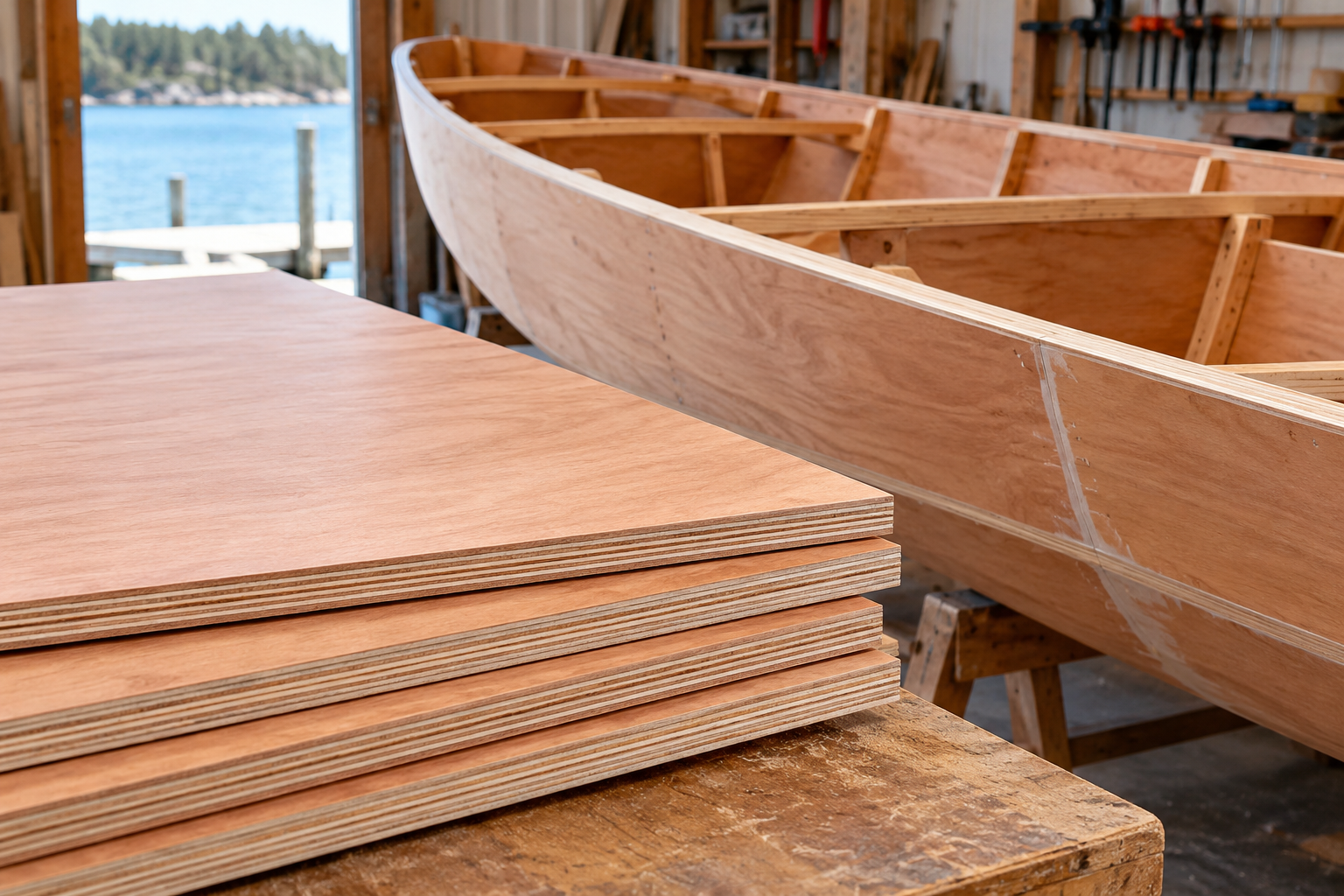
The best marine plywood for a boat is the panel your boat plans specify, at the thickness they specify. In North America that usually means APA marine grade (Douglas-fir or western larch, B-grade or better veneers throughout, core gaps no wider than 1/8 inch). For lightweight stitch-and-glue boats it usually means BS 1088 okoume. APA states that marine plywood is not preservative-treated. BS 1088 sets minimum natural-durability requirements for the veneer species, and some BS 1088 panels may also be treated during manufacture. Either way, the wood still absorbs water, so every boat panel needs a sealing system.
Marine Plywood for Boats at a Glance
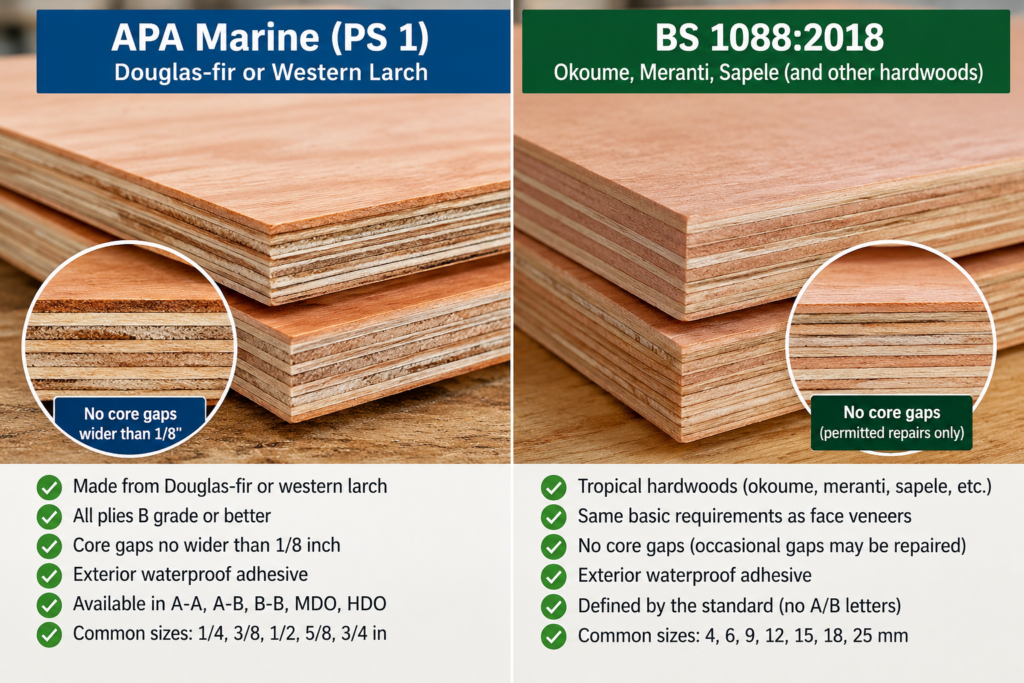
APA Marine (PS 1)
BS 1088:2018
Where it’s from
North American standard
British Standard, made worldwide
Species
Douglas-fir or western larch only
Tropical hardwoods selected for density and resistance to rot and insects (okoume, meranti, sapele are common)
Inner plies
B grade or better
Same basic requirements as face veneers, with limited exceptions
Core gaps
1/8 inch maximum
Not permitted; occasional gaps may be repaired with bonded veneer inserts
Face grades
A-A, A-B, B-B, MDO, HDO
Defined by the standard rather than A/B letters
Sizes
1/4, 3/8, 1/2, 5/8, 3/4 in; 4×8, some up to 5×12
Metric (4, 6, 9, 12, 15, 18, 25 mm are common)
Preservative treatment
None (APA states this directly)
Species must meet natural-durability requirements; some panels may also be treated during manufacture
Typical boat use
Workboats, skiffs, transoms, soles, plans drawn in imperial
Kayaks, canoes, stitch-and-glue boats, plans drawn in metric
What Makes Plywood “Marine” for Boat Building
“Marine” is only meaningful when it’s tied to a standard. For boats, two standards matter.
APA marine grade (PS 1)
Under Voluntary Product Standard PS 1, Structural Plywood, APA marine-grade plywood is made entirely of Douglas-fir or western larch. Every ply is B grade or better: B veneer may have knots but no knotholes, and A veneer has neither. The largest core gap permitted is 1/8 inch. The bond is Exterior, and the adhesive is a fully waterproof structural adhesive.
APA lists hulls and other marine uses involving bending as the reason this premium grade exists. It is equally direct about the limit: marine-grade plywood is not treated with any chemicals to enhance its resistance to decay.
APA’s trademark appears only on panels from APA member mills. A sheet sold as “AB marine fir” without an APA or other agency stamp hasn’t been verified to this standard by anyone.
BS 1088:2018
BS 1088:2018 replaced BS 1088-1:2003 and BS 1088-2:2003. It defines two classes of marine plywood, standard and lightweight, intended mainly for building boats and other marine and waterway uses.
According to BSI, the standard deals mainly with two things: the plywood’s resistance to rot and insects, and how well its glue bond holds up over time. Veneer species are chosen only on density and resistance to rot and insects.
BS 1088 specifies minimum requirements for the natural biological durability of the veneer species. Some panels may also receive preservative treatment during manufacture. If treated plywood is offered, check the manufacturer’s documentation for the treatment and confirm that it is suitable for your boat. Ask specifically whether it is compatible with the epoxy and glues your plans call for.
BSI also states that BS 1088 doesn’t cover every property that might matter for a specific use. A BS 1088 stamp tells you about species durability and bond quality. It doesn’t tell you the panel is right for your boat. Your plans still decide that.
⚠️ Warning: A “BS 1088” stamp is a manufacturer’s claim unless it’s backed by a third-party certification body. Boat-plan suppliers and importers have reported panels stamped BS 1088 with core gaps and face veneers that don’t meet the standard. Buy from a marine plywood specialist who can name the mill and the certifying body, and inspect every edge before you pay (the test below shows how).
Best Marine Plywood Grades for Boats
Every APA marine grade meets the same requirements for inner plies and core gaps. Where the grades differ most is the faces: what they look like and how they take a finish. That makes face grade mainly a finishing decision. Whether a panel is structurally right for a part still depends on its thickness, species and construction, and on what your plans call for. Treat the grade as one part of matching the plans, not as a replacement for them.
Grade
Faces
Best boat use
A-A
Both faces A (no knots)
Panels finished bright (clear-coated) on both sides, such as cabin bulkheads seen from both sides
A-B
One A face, one B face
The most common choice. Put the A face where it’s seen or varnished and the B face inside or under glass
B-B
Both faces B (knots allowed, no knotholes)
Panels that will be painted, glassed or hidden: soles, internal frames, transom cores
MDO
Medium-density resin-paper overlay
Painted surfaces where a smooth, paint-ready face matters more than wood grain
HDO
High-density resin overlay
Hard-wearing surfaces; a harder face that is less paintable
MDO and HDO also change the surface itself, not just how it looks. If your plans call for bare wood under epoxy and glass, check with the designer before switching to an overlay panel. More on overlays is in our MDO and HDO guide.
💸 Cost difference: If the panel is going under fiberglass and paint, and your plans don’t call for a particular face grade, an A face may be money spent on a surface nobody will see. B-B and A-B marine panels meet the same requirements for inner plies and core gaps. Check local pricing on both. On a boat that takes a dozen sheets, small per-sheet differences add up.
Best Marine Plywood Species for Boats
Species drives three things on a boat: weight, how easily the panel bends, and how the surface behaves under a finish.
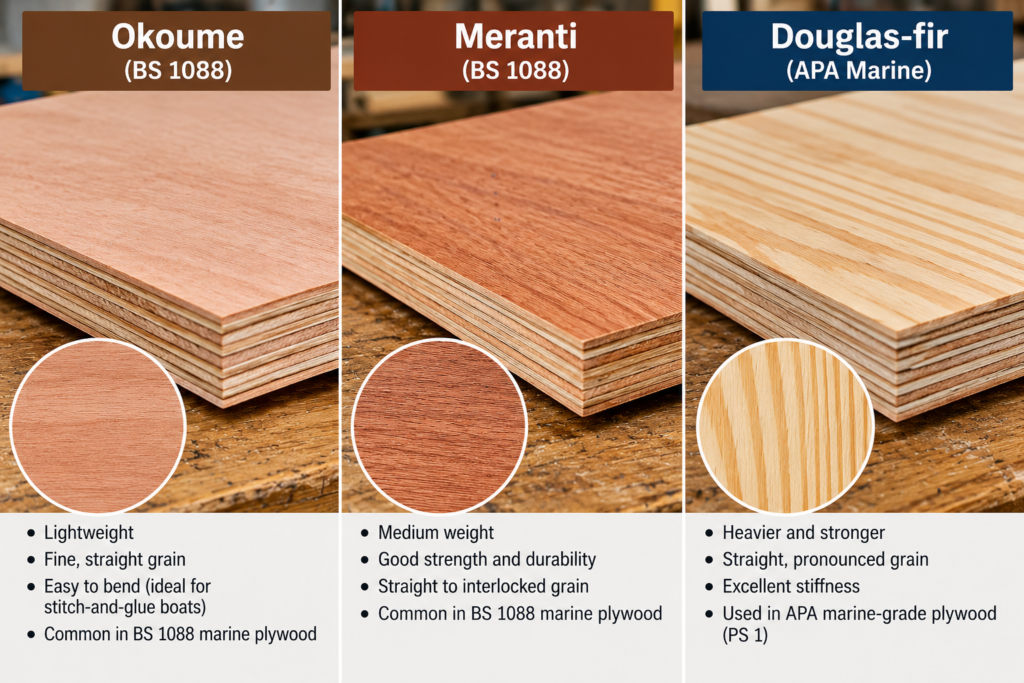
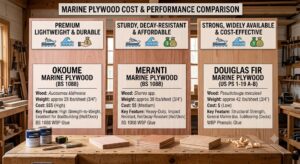
Okoume
Okoume is the default for kayaks, canoes and most stitch-and-glue plans because it is light and bends easily. That low weight is the main reason designers specify it. The trade-off is that okoume has little natural decay resistance. Builders typically fully encapsulate it in epoxy, inside and out, rather than relying on the wood.
Meranti
Meranti is denser and heavier than okoume and is also widely sold to BS 1088. Builders choose it for larger boats, where weight matters less per sheet and the extra density helps with stiffness and dent resistance. It is harder to bend to tight curves. If your plans were drawn around okoume, switching to meranti adds weight in every sheet. Ask the designer before you substitute.
Douglas-fir
Douglas-fir is one of only two species allowed in APA marine grade, so it’s the North American marine panel. It’s widely available and has a long boat-building history. The well-known drawback is face checking: hairline splits along the grain of the face veneer, especially as the panel goes through wet-dry cycles or is bent across the grain. Common boat-building practice is to sheathe fir hull surfaces in lightweight fiberglass cloth set in epoxy, because epoxy and paint alone may not stop checking.
Sapele and other mahogany-type species
Sapele and similar species, such as African mahogany, show up in BS 1088 panels when the plywood will be varnished and seen. They are generally heavier and pricier than okoume and are chosen mostly for looks, such as transoms, brightwork panels and cabin interiors. Teak and holly plywood is a decorative cabin-sole surface, not a structural hull panel.
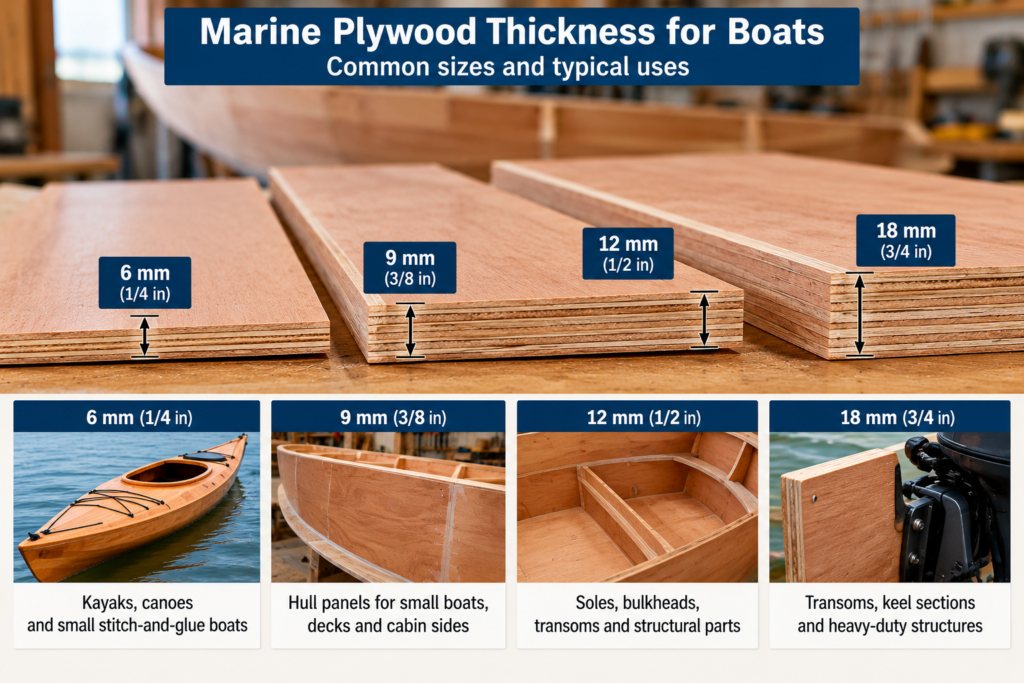
Use the thickness on your boat plans. Thickness is a structural design decision, not something to look up in a generic chart.
A designer picks each panel’s thickness alongside the framing, the fiberglass schedule, the panel’s curve and the boat’s total weight. Change one and you’ve changed the others. That’s why this section won’t give you a “1/2 inch for transoms” rule. Any such chart would override the one document that knows your boat.
What you can control is making sure the sheet you buy actually matches the plans.
Metric and imperial are not interchangeable
Plans call for
Common “substitute”
Actual difference
1/4 in (6.35 mm)
6 mm
About 0.35 mm thinner
3/8 in (9.53 mm)
9 mm
About 0.5 mm thinner
Those gaps look tiny, but stiffness does not scale evenly with thickness. Under basic beam theory, a panel’s bending stiffness rises with the cube of its thickness. Going from 6 mm to 9 mm of the same material makes the panel about 3.4 times stiffer, not 1.5 times. Small substitutions in either direction change how the panel behaves.
BS 1088 sets permitted tolerances for panel thickness, and APA panels have tolerances under PS 1 too, so a sheet’s actual thickness can differ from its nominal size. Measure several points around the edge with calipers before you cut. This matters most when joints, slots or kit parts are machined to a nominal dimension.
Thicker isn’t automatically safer
😬 Regret: Upsizing every panel “to be safe” is one of the most common ways builders ruin a stitch-and-glue boat. A thicker panel may not bend to the hull shape the plans assume. It adds weight that changes how and where the boat floats, and it can crack or spring off the frames when you try to pull it into shape. If you think a panel is too thin, ask the designer. Don’t just buy the next size up.
Ply count matters for bending
APA marine fir is usually made with fewer, thicker plies than BS 1088 okoume of similar thickness. One APA mill’s published spec lists 1/4 inch as 3-ply, 1/2 inch as 5-ply and 3/4 inch as 7-ply. Fewer, thicker plies generally make a stiffer panel that resists tight bends. That’s one reason stitch-and-glue kayak plans favor thin, multi-ply okoume. Our plywood bending guide covers the techniques. General span and load guidance for non-boat projects is in our plywood thickness guide, but don’t use it in place of your boat plans.
Marine Plywood Cost: Is BS 1088 Worth the Extra Money?
Marine plywood prices depend on species, thickness, certification, import costs and supplier, and they change often. Prices vary enough that a blanket “this standard costs more than that one” comparison can mislead you. Get current quotes from two or three marine plywood suppliers for the exact panels your plans call for.
The useful question is what the difference costs across the whole boat, not per sheet. As an example with made-up numbers: if your plans call for 12 sheets and the panel you’re considering costs $40 more per sheet in your area, the upgrade adds $480 to the build. Weigh that against the epoxy, glass, hardware and hours the boat will take.
When BS 1088 is usually worth it:
Your plans specify it. The design’s weight and bending assumptions depend on it.
The boat is a lightweight kayak, canoe or stitch-and-glue design where every sheet’s weight matters.
Panels will be varnished, so face quality shows.
When APA marine fir is usually the better choice:
Your plans were drawn for it, often in imperial thicknesses.
The boat is a painted or glassed skiff or workboat where weight is less critical.
You can get APA-stamped panels locally and inspect them before you buy.
💸 What a premium does and doesn’t buy: Paying more for certified marine plywood buys verified species, veneer quality and glue bond. It doesn’t buy rot-proofing or remove the need to seal every surface and edge. Paying for certified panels and then skipping edge sealing wastes the extra money.
❌ Mistake: Treating marine plywood as rot-proof. APA states that marine plywood is not preservative-treated. BS 1088 sets natural-durability requirements for the veneer species, and any preservative treatment is a manufacturer option you have to confirm. Neither standard makes a wet, unsealed panel safe from decay. On a boat, the sealing system has to do that work. See rotten plywood for what failure looks like.
❌ Mistake: Leaving cut edges and fastener holes raw. Water gets into plywood mainly through end grain and holes. BSI specifically notes that fast water entry at a panel edge can make the core swell unevenly and rupture the wood fibers locally. It looks like delamination even when the glue bond hasn’t failed. Seal every cut edge and drilled hole before assembly.
❌ Mistake: Using pressure-treated construction plywood as a hull material. Pressure-treated panels sold for building construction are made for decay resistance in houses and decks, not for boat building. Treatment can affect how glues and epoxy bond, and hardware compatibility needs checking. Our pressure-treated plywood guide covers where it does belong.
❌ Mistake: Joining panels a different way than the plans show. Plywood boats join panels in several ways: glued scarf joints, butt joints backed with a butt block, or butt joints reinforced with fiberglass on both sides. Each is used successfully in boats designed for it. Problems start when a builder swaps one method for another, or leaves out the backing block or glass a butt joint needs. Use the method your plans show. See scarf and butt joints, and our DIY paddleboard build for a scarf joint in practice.
How to Seal Marine Plywood on a Boat
A typical sealing system for boat panels follows the same logic regardless of species:
Seal every surface, edge and hole with epoxy before assembly where you can reach it. Coat both faces, not just the outside, so the panel takes on and loses moisture evenly.
Add fiberglass cloth where the plans call for it. Builders also use it on fir to control face checking.
Protect the epoxy from sunlight. Epoxy breaks down under UV, so it needs paint or a UV-protective varnish on top.
Bed and seal fasteners so water can’t wick in along a screw.
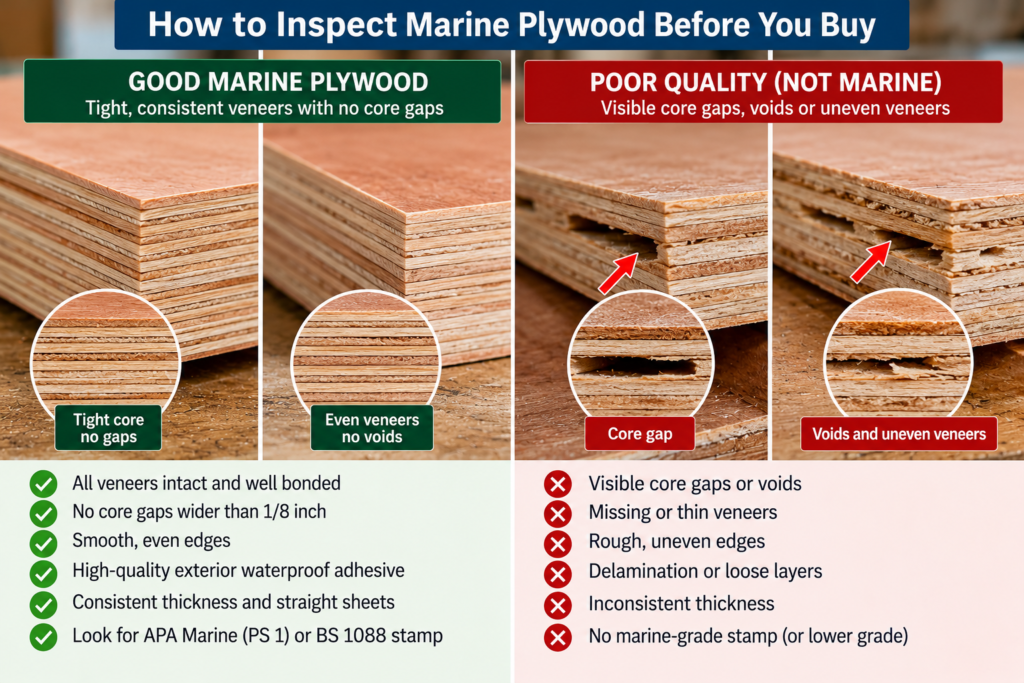
🧪 Test: How to Inspect Marine Plywood Before You Buy
Run this check on every sheet before you pay. It takes a few minutes per sheet.
Read the stamp. For APA marine, look for the APA trademark, the word MARINE and the face/back grade. For BS 1088, look for the standard number, the mill and the certifying body, plus any treatment marking. No stamp means no verified standard.
Inspect all four edges. Sight down each edge in good light. For APA marine, a core gap wider than 1/8 inch (about the thickness of two stacked US quarters) is outside the standard. For BS 1088, gaps aren’t permitted unless they’ve been repaired with a bonded veneer insert.
Count and compare plies. Ply counts should be consistent between sheets of the same product and thickness.
Measure thickness with calipers at several points around the edge. Compare the readings to what your plans need.
Check flatness. Lay the sheet on a flat floor. Severe warping or twisting suggests poor storage or uneven moisture.
Reject and document. Photograph any sheet you reject, with the stamp visible, in case you need to talk to the supplier.
If you buy from a supplier who won’t let you inspect edges, that tells you something.
Recommended Gear for Building With Marine Plywood
As an Amazon Associate, theplywood.com earns from qualifying purchases.
These are the consumables most plywood boat plans call for. Buy only what your plans specify. Weights and types of fiberglass cloth in particular vary by design.
Digital calipers for checking sheet thickness against your plans
Quick Answers
What is the best marine plywood for boats? The plywood your boat plans specify. In North America that’s usually APA marine-grade Douglas-fir. For lightweight stitch-and-glue boats it’s usually BS 1088 okoume.
Is okoume or meranti better for a boat? Neither is better in general. Okoume is lighter and bends more easily, which is why most kayak and canoe plans call for it. Meranti is denser and heavier. Use the species your plans were designed around, or ask the designer before you switch.
Can I use 6 mm plywood instead of 1/4 inch? Only with the designer’s approval. 6 mm is about 0.35 mm thinner than 1/4 inch. Because stiffness rises with the cube of thickness, small differences change how the panel performs.
Does marine plywood need to be sealed on a boat? Yes. APA marine plywood isn’t preservative-treated, and even BS 1088 panels, whose species must meet natural-durability requirements, still absorb water. Boat panels need a sealing system, typically epoxy plus a UV-protective topcoat, with every edge and hole sealed.
Is marine plywood void-free? Not under the APA standard, which allows core gaps up to 1/8 inch. BS 1088 doesn’t permit gaps except where they’ve been repaired with a bonded veneer insert. Either way, inspect the edges.
Is BS 1088 plywood worth the extra cost? It depends on the boat and current local prices. When your plans specify it, or when weight and a varnished finish matter, it usually is. For painted or glassed boats designed around APA marine fir, the fir is usually the better choice.