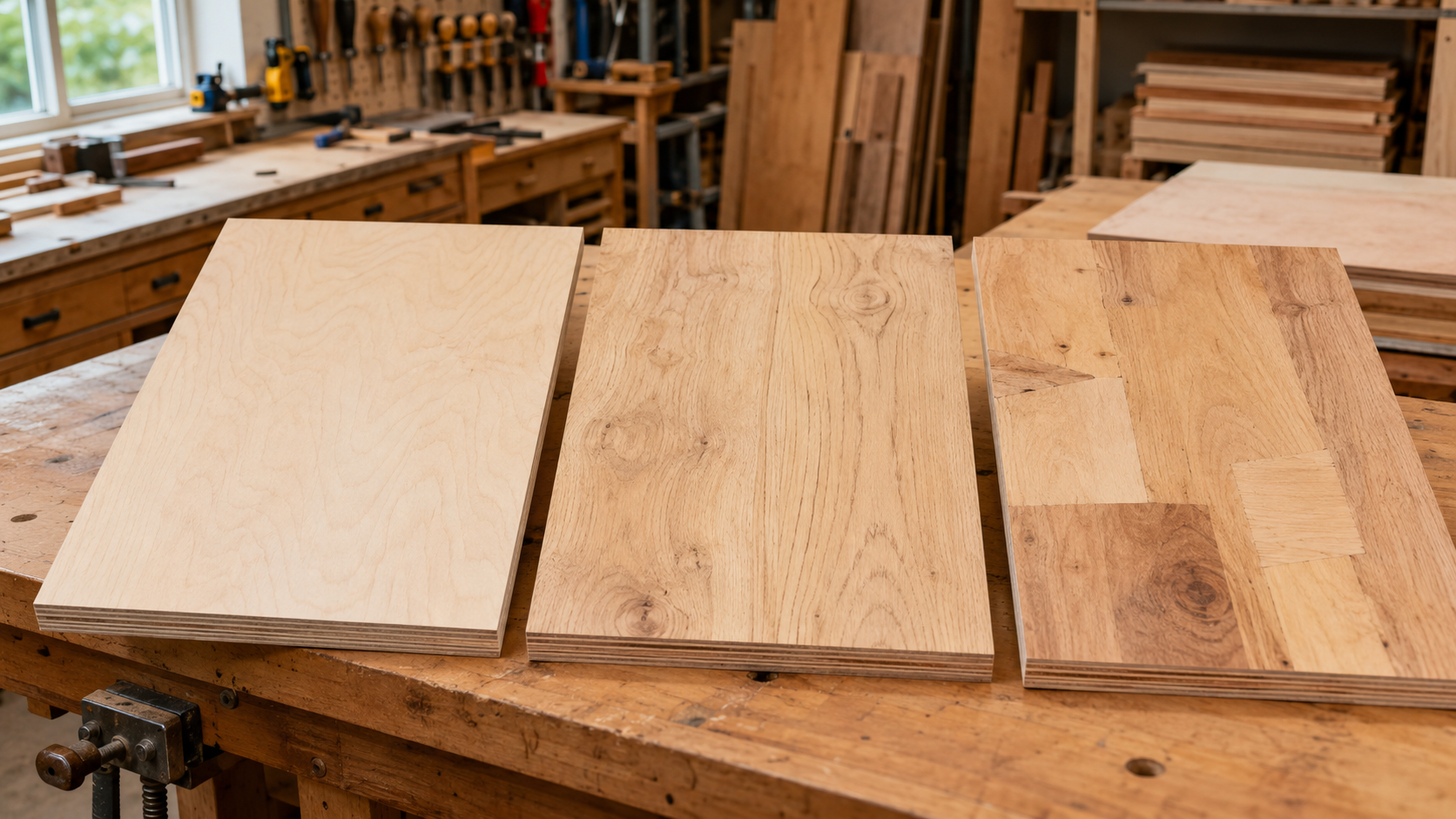
Hardwood plywood is sold by a two-part grade: a letter for the face veneer and a number for the back. The price gap between an A-1 sheet and a C-3 sheet of the same species can be substantial, so buying a higher grade than a project needs wastes money, while buying too low a grade for stained, visible work leaves repaired openings on display once finish goes on.
Here is how the system works under the current ANSI/HPVA HP-1-2024 standard, and where buyers most often get it wrong.
Excellent, well-matched, minor characteristics only
Cabinet doors, visible furniture surfaces
High
B
Good, small burls and pin knots allowed
Cabinet boxes, painted work, shelving
Moderate–High
C
Repaired openings permitted within species limits, more color variation
Utility cabinets, garage storage, hidden panels
Moderate
D
Sound face, no open defects; more color variation, rough grain, larger repaired or sound knots
Concealed cabinet parts, utility panels and appearance-neutral work
Economy
E
Sound face, no open defects; more and larger characteristics than D
Backing, shop fixtures, concealed panels
Economy
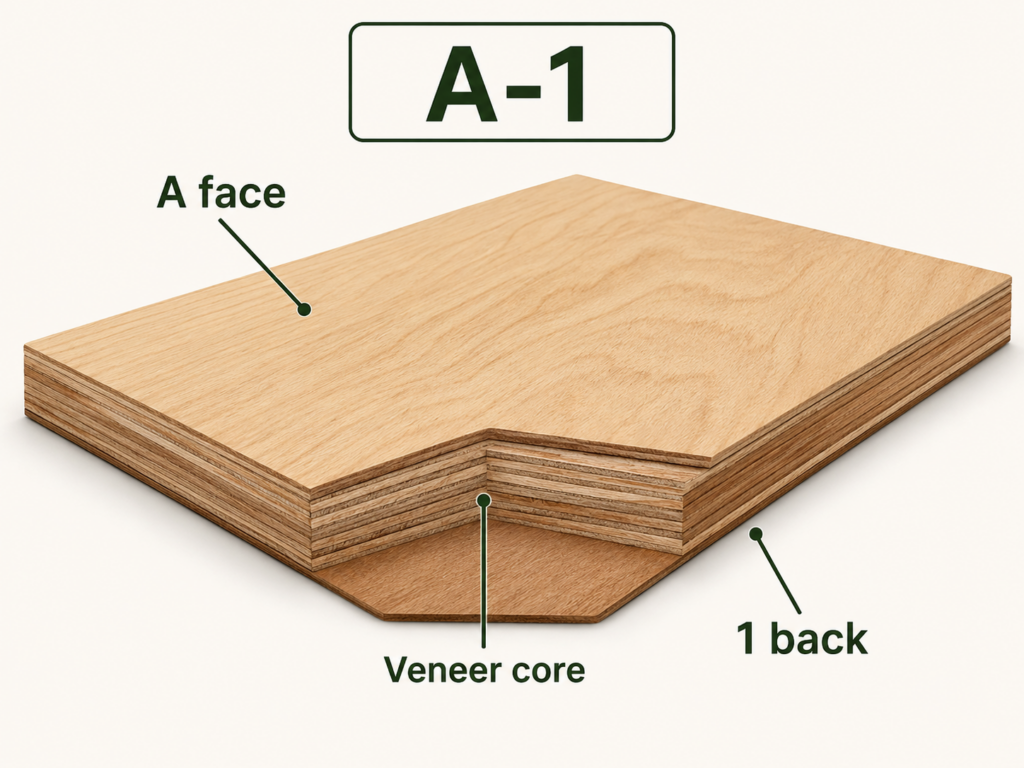
Back grades run from 1 (most restrictive) to 4 (least restrictive). An A-1 sheet combines a high-quality A face with the most restrictive back grade; a C-3 pairs a repaired face with a utility back. Actual pricing varies by region, supplier, species, veneer cut, and core construction, so treat these tiers as relative and price the exact panel spec locally.
Quick Answer: How Hardwood Plywood Grading Works
Hardwood plywood is graded under the ANSI/HPVA HP-1-2024 standard using a letter for the face veneer (AA, A, B, C, D and E, from most to least restrictive in appearance requirements) and a number for the back veneer (1, 2, 3, 4, most to least restrictive). A sheet marked A-1 has a high-quality face and the most restrictive back grade; C-3 has a repaired face and a utility back. These designations primarily describe veneer appearance rather than structural performance.
This distinction is where buyers can avoid unnecessary cost, and it comes up again below.
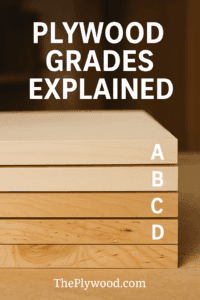
Face Grades: What Each Letter Actually Allows
The letter grade describes the face veneer, the thin decorative layer you see. The governing standard is ANSI/HPVA HP-1-2024, maintained by the Decorative Hardwoods Association. Softwood construction plywood gets graded by the APA with structural performance in mind; hardwood plywood face and back designations were built around appearance instead.
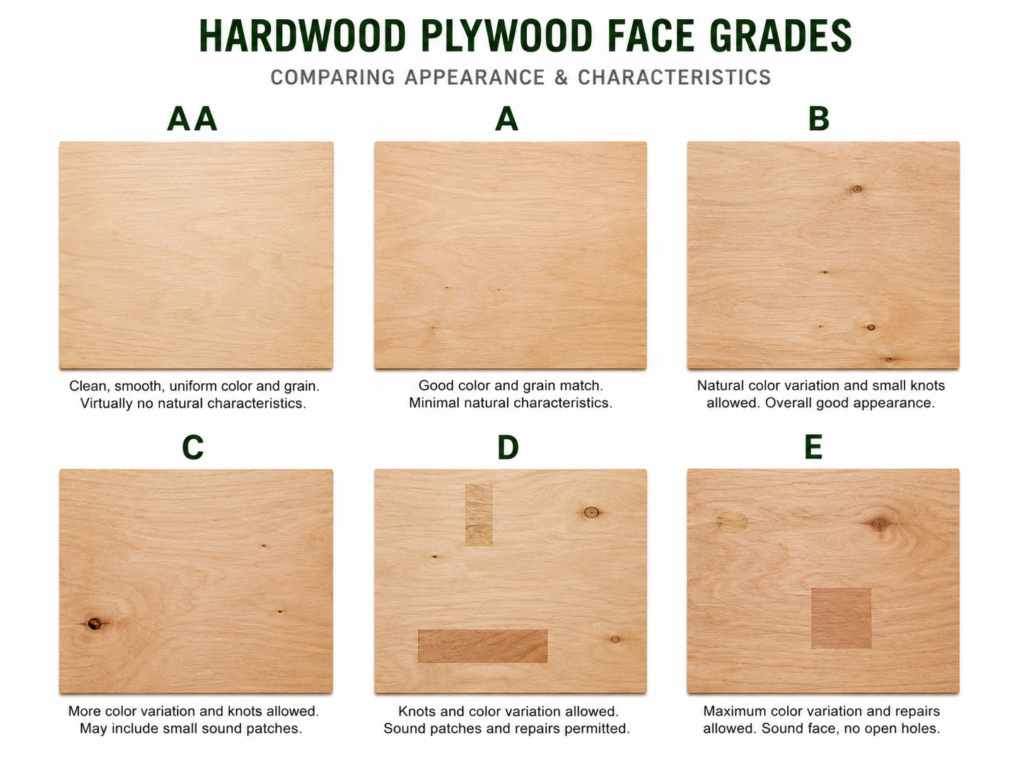
AA Grade
AA faces carry the tightest limits on veneer characteristics, with well-matched components across the sheet. The premium buys veneer selection and matching, not a different panel underneath. For most home projects an A face finished with care is difficult to tell apart from AA on smaller pieces. Where AA earns its cost is large uninterrupted surfaces, a waterfall countertop or a run of flush cabinet fronts, where the eye can compare grain continuity across several feet.
A Grade
A-grade faces allow only minor, well-matched characteristics such as small pin knots and slight color variation between veneer leaves. This is the workhorse for stained cabinet doors, furniture sides, and anything at eye level. Our guide to the best plywood for cabinets compares species options at this tier.
B Grade
B faces allow small burls, pin knots, and some sound tight knots within the standard’s limits. Under stain you’ll notice these characteristics. Under an opaque finish, many of them become much less noticeable after proper filling and priming, which is why B-grade maple and birch are commonly used for painted cabinet work.
C Grade
C permits repaired openings within species-specific limits, along with noticeably more color variation between veneer components. (Large boat-shaped patches are something the standard associates with specialty-grade faces, so “boat patch” isn’t the definition of C, but expect visible repairs and mismatched color at this tier.) C works for cabinet interiors, closet built-ins, and garage shelving. It’s a poor choice for stained, visible surfaces because repairs and color variation take finish unevenly.
D and E Grades
A common assumption is that D and E allow open holes and splits. Under HP-1-2024 they don’t. Both must still present a sound face free of open defects. What changes is tolerance: D permits greater color variation, rough grain, and larger repaired or sound knots than C, and E allows more and larger characteristics than D. These grades exist for concealed and appearance-neutral work, where paying for a prettier face buys nothing.
Back Grades: The Numbers Nobody Reads
The number covers the back veneer:
1 — The most restrictive back grade. Sound surface with most openings repaired, though natural characteristics and repairs are still permitted.
2 — Sound and smooth with repairs allowed. The most common back on cabinet-grade sheets.
3 — Wider tolerances; appropriate for backs that face a wall.
4 — Utility back with the loosest limits.
A grade-1 back is often unnecessary when the reverse side will face a wall. On a floating shelf or a bookcase, nobody sees the back veneer, yet A-1 carries a real per-sheet premium over A-2, and a kitchen’s worth of sheets multiplies it. Reserve 1-backs for doors, open shelving, room dividers, and anywhere both faces show. Ask a supplier to quote A-1 and A-2 side by side; the gap usually settles the question.
Core Types: The Grade Label Doesn’t Tell You This
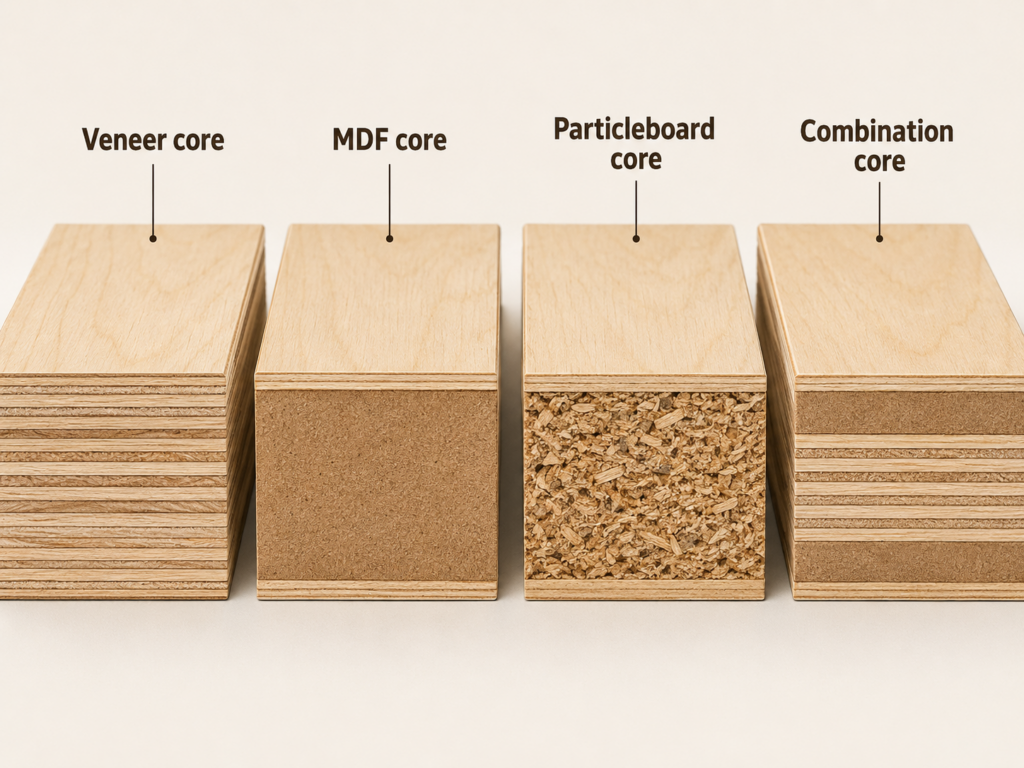
Two sheets can carry the same A-1 designation and behave differently in use, because the face/back grade says nothing about the core. HP-1-2024 recognizes several core constructions, and panel performance depends on core type, inner-ply quality, species, thickness, adhesive, and construction.
Veneer Core
Traditional cross-laminated plies. Generally the lightest option with strong screw-holding. The trade-off: core irregularities can telegraph slight ripples through a thin face veneer.
MDF Core
Flat, uniform, and the smoothest common substrate for high-gloss finishes. Heavier than veneer core at the same thickness, with weaker screw-holding at panel edges.
The budget core for cabinet boxes. Acceptable in dry interiors, but it swells badly with moisture. For anything near humidity, see our rundown of waterproof plywood types before committing to this core.
Combination Core
A veneer-core center with MDF crossbands under the faces. One well-regarded option when you want MDF’s flatness near the surface with less total weight, and worth a look for cabinet doors, though it’s a choice among good options rather than the automatic answer.
Lumber Core
Edge-glued solid strips at the center. Mostly found in imported panels and older material; historically favored for long shelving spans.
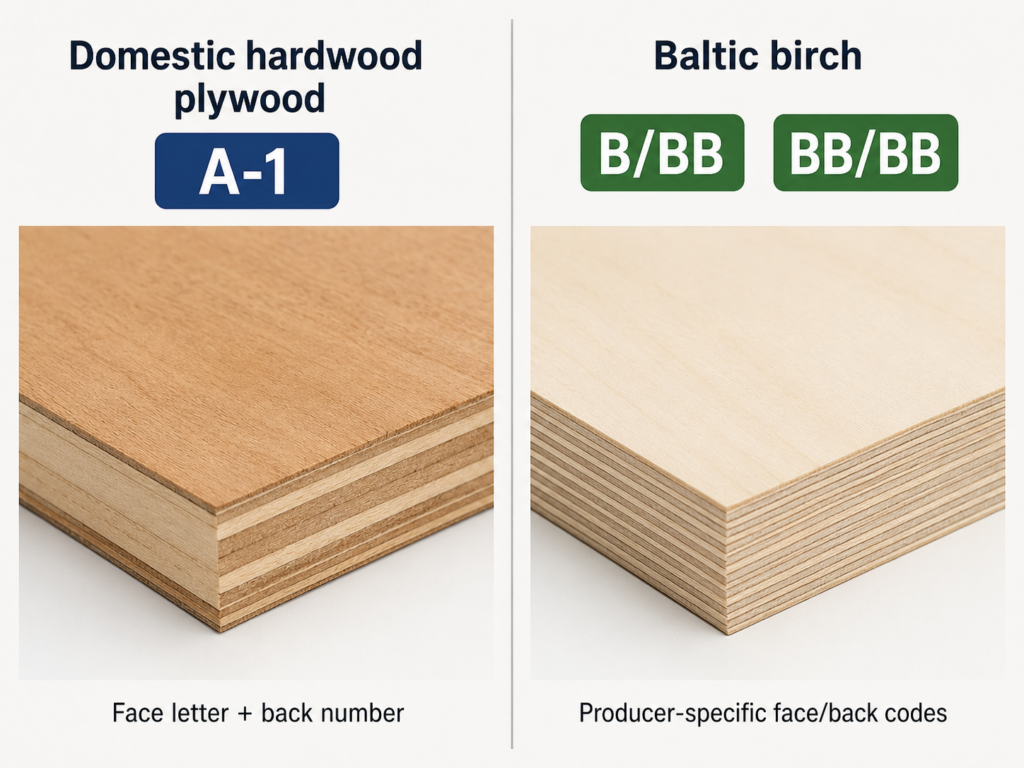
What About Baltic Birch?
Baltic birch does not use the ANSI letter-number system, and there’s no single universal retail code for it either. European producers grade under their own standards and supplier specifications, using designations such as S, B, BB, WG, and WGE. In North American retail, combinations such as B/BB and BB/BB are common, but their exact requirements depend on the producer and referenced standard. Always check the manufacturer’s grading documentation before buying. A “B/BB” Baltic birch panel and a “B-2” domestic hardwood plywood panel come from entirely different systems, even though the letters look similar. The dense birch-throughout core and generally low-void construction are what make quality Baltic birch attractive for exposed-edge work like drawer boxes.
Does Face Grade Determine Panel Strength?
Not by itself. The face and back grade codes primarily describe veneer appearance. Panel performance also depends on the core, inner-ply quality, thickness, species, adhesive, and construction. Decorative face veneers are thin, often in the neighborhood of 1/50 inch depending on the manufacturer, so the face contributes little to stiffness on its own. Do not use the face grade as a substitute for technical performance data. When load capacity or stiffness matters, for long shelf spans or heavy storage, request the manufacturer’s data for the specific panel.
Matching Grade to Project
Stained furniture and cabinet doors: A-1 (both sides show) or A-2 (backs hidden)
Painted cabinets and built-ins: B-2, maple or birch face
Cabinet boxes and interiors: B-2 or C-2
Shelving against walls: A-2 or B-3 depending on finish
Drawer boxes and exposed-edge work: Baltic birch, commonly BB/BB (confirm against the manufacturer’s grading sheet)
Shop fixtures, jigs, hidden panels: C, D, or E faces with 3 or 4 backs
One caution on labels: “cabinet grade” is a store term, not an HP-1 designation. What’s sold under that name varies, so check the actual face, back, and core spec. Our cabinet grade plywood buying guide goes deeper on what to look for on the rack.
Cutting these sheets cleanly is its own subject. An expensive A face chips just as easily as a cheap one under the wrong blade, so read our guide on how to cut plywood without splintering before breaking down sheets.
Where to Buy Graded Hardwood Plywood
Full 4×8 hardwood sheets are best bought from a local hardwood supplier, who can quote the exact face/back/core specification you need. For smaller panels and cutting supplies, online options work well.
This section contains affiliate links. If you buy through them, we may earn a commission at no extra cost to you.
Baltic birch project panels— pre-cut panels from 12×12 up to 24×48, practical for drawer boxes, CNC work, and small builds where full sheets don’t make sense.
Iron-on edge banding— matches the face species and conceals the core on visible edges. A household iron is the only tool required.
Fine-finish plywood blade— a high-tooth-count blade pays for itself the first time it saves an A-grade face from chip-out.
One warning for online plywood listings: check which grading system the listing actually cites. Plenty of “premium birch plywood” listings are ungraded imports that follow neither ANSI/HPVA HP-1 nor a documented European birch spec. If no grade or manufacturing standard is identified, treat the surface quality as unknown and inspect the specifications, reviews and product photos carefully before buying.
Frequently Asked Questions
What does A-1 mean in hardwood plywood?
A-1 means the sheet has an A-grade face veneer (excellent, well-matched, minor characteristics only) and a grade-1 back, the most restrictive back grade, with a sound surface and most openings repaired. It is a common choice when both sides of the panel will be visible, such as cabinet doors or open shelving.
Is higher-grade plywood stronger?
Not by itself. Hardwood plywood face and back grades under ANSI/HPVA HP-1-2024 primarily describe veneer appearance, not structural performance. Strength and stiffness depend on core construction, inner-ply quality, species, thickness, and adhesive. When load capacity matters, consult the manufacturer’s technical data for the specific panel.
What grade of plywood is “cabinet grade”?
“Cabinet grade” is a marketing term, not an official HP-1 designation. In practice it usually refers to A or B face grades with a 1 or 2 back. Check the actual face, back, and core specification rather than relying on the phrase.
Is Baltic birch graded the same as regular hardwood plywood?
No. Baltic birch is graded under European producer standards and supplier specifications, with designations such as S, B, BB, WG, and WGE, rather than the ANSI/HPVA letter-number system. A B/BB Baltic birch sheet is not the same specification as a B-2 domestic hardwood plywood sheet, so confirm details against the manufacturer’s grading documentation.
Can I stain C-grade plywood?
You can, but the repaired openings and color variation permitted in C-grade faces absorb stain unevenly and become visible after finishing. For stained, visible work, use A-grade faces. C-grade is better reserved for painted surfaces or hidden panels.
Hardwood vs Softwood: Strength, Cost and Uses by Admin February 27, 2026 Hardwood Hardwood vs softwood refers to the type of tree the lumber comes from. Hardwood comes from deciduous trees (broadleaf species), while softwood comes from coniferous…