Whether you want to cut detailed fretwork, craft custom children’s puzzles, or step up your DIY woodworking game, a scroll saw is an indispensable workshop tool. Unlike handheld jigsaws, which lack fine control, or band saws, which are limited by blade width, a scroll saw offers unmatched precision. It allows you to execute microscopic radius turns and delicate internal cutouts that other power tools simply cannot replicate.
This comprehensive guide covers everything you need to know to choose the right setup, optimize your workflow, troubleshoot common mechanical headaches, and select rewarding projects that perform beautifully on visual platforms like Pinterest.
What Is the Best Scroll Saw for Beginners?
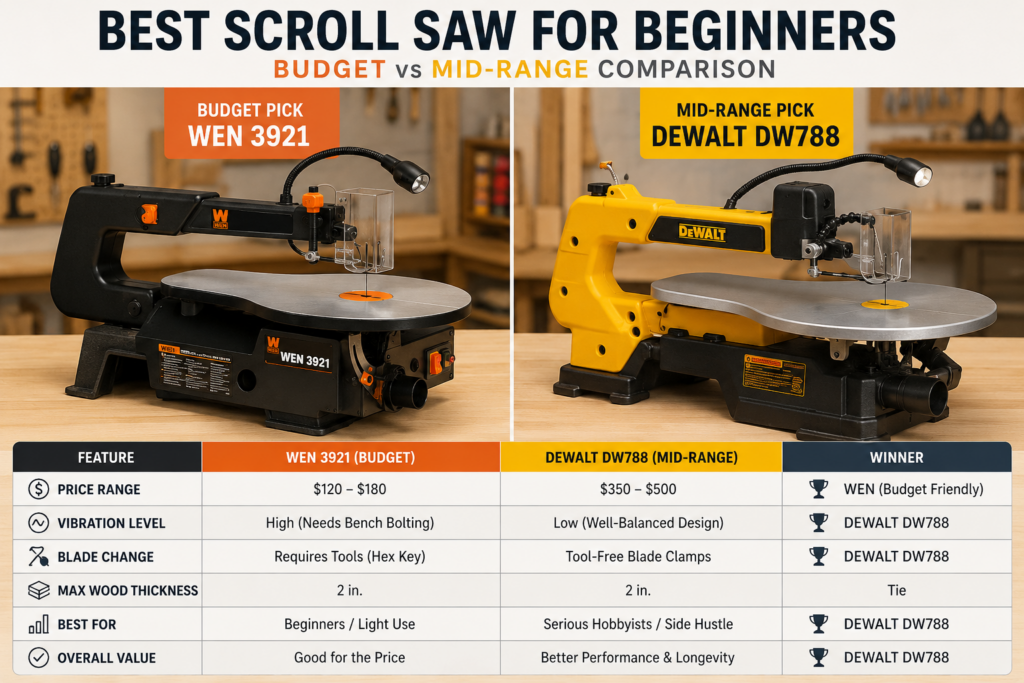
The best scroll saw for beginners is the WEN 3921 for budget-conscious buyers and the DEWALT DW788 for users who want a long-term machine with lower vibration and better blade control.
1. My Experience Using Scroll Saws: The Reality of Crafting
When I first brought home a budget scroll saw, I thought I was ready to instantly churn out master-level wooden puzzles and intricate wall art. The reality check was immediate. The machine shook so intensely that my hands went numb after fifteen minutes of runtime, the patterns blurred, and I snapped seven cheap, unbranded blades trying to force my way through a basic scrap piece of construction plywood. I nearly boxed up the saw and gave up entirely.
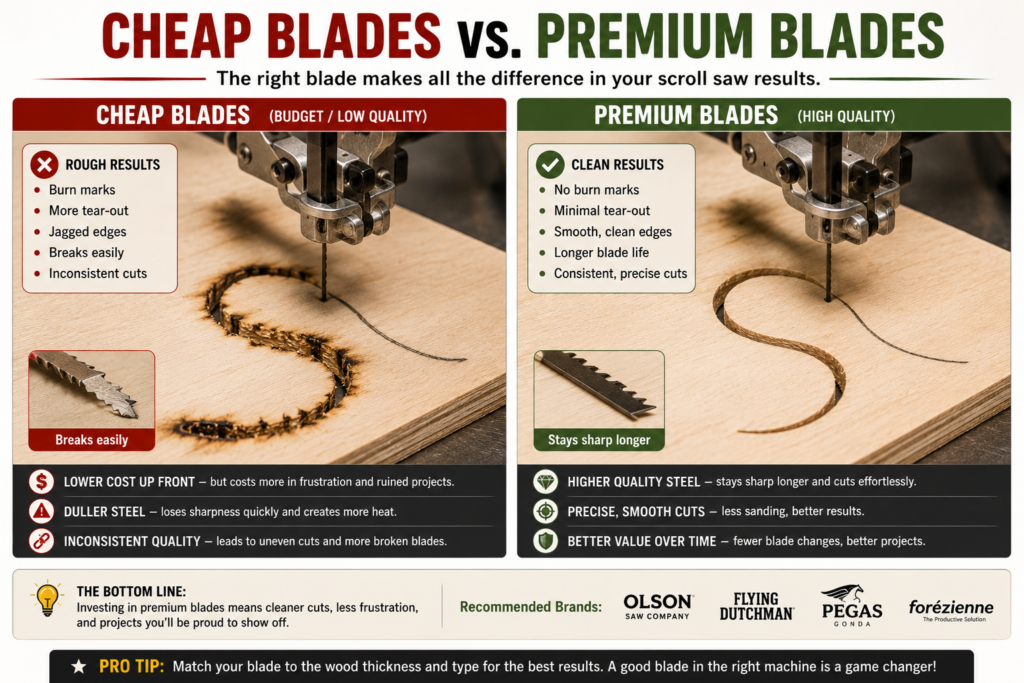
That frustrating experience taught me that success with a scroll saw relies heavily on the synergy of your setup rather than brute force. My first major breakthrough came when I tossed out the cheap multi-pack blades and swapped in a set of premium Swiss alternatives. Suddenly, the machine stopped aggressively binding, and I could actually track a straight line.
Later, upgrading from that initial vibrating entry-level model to a solid, parallel-link mid-range saw completely transformed my workflow. I also stopped using low-grade scrap and shifted to multi-ply sheets. The difference was night and day: smooth cuts, crisp edges, and significantly less time spent sanding down frayed edges. If your current setup feels like an uphill battle, understand that you don’t lack talent; you are likely just fighting uncalibrated machinery.
2. Quick Overview & Comparison Matrix
Before diving into the mechanical deep dive, look at how the market breaks down by skill level, cost, and project suitability.
Feature / Tier
Budget Tier ($120–$250)
Mid-Range Tier ($250–$600)
Premium Tier ($600–$1500+)
Primary User
Absolute Beginners / Casual Hobbyists
Serious Enthusiasts / Side Hustlers
Professional Artisans / Production Shops
Vibration Level
High (Requires bench bolting)
Low to Moderate (Well-balanced)
Virtually Nonexistent (Heavy cast-iron)
Blade Changing
Often requires custom wrenches/hex keys
Tool-free, quick-release clamps
Fast, lever-actuated tensioners
Best Wood Matches
Thin craft woods, softwoods under 1/2″
1/4″ to 3/4″ stable plies, soft hardwoods
Thick, dense hardwoods, complex fretwork
Top Machine Match
WEN 3921
DEWALT DW788
Pegas / Hegner
3. Understanding the Scroll Saw: What It Is and Core Uses
A scroll saw is a specialized tabletop cutting machine that uses a fine, short reciprocating blade that moves rapidly up and down through a fixed metal table hole to produce highly intricate, curved cuts. Unlike a band saw, the scroll saw is designed explicitly for delicate precision rather than rapid material dimensioning.
The defining feature of a scroll saw is its ability to perform piercing cuts (internal cutouts). By drilling a small starter hole inside a waste section of your workpiece, unhooking one end of the blade from the upper chuck, threading it through the hole, and re-attaching it to the saw, you can cut intricate designs out of the interior of the wood without breaking the outer perimeter or structural integrity of your workpiece.
Core Workshop Uses
Fretwork: Cutting detailed, lace-like geometric grids or artistic scenes out of thin panels.
Intarsia & Marquetry: Cutting different species of natural wood shapes that fit tightly together like a puzzle to create a multi-colored pictorial image.
Custom Lettering & Signage: Cutting out continuous script lettering for nursery nameplates or wedding decor. Perfect for those pursuing custom Plywood-for-Signs workflows.
Mechanical Toys: Fabricating functional wooden gears, rolling toy wheels, and interlocking clock mechanisms.
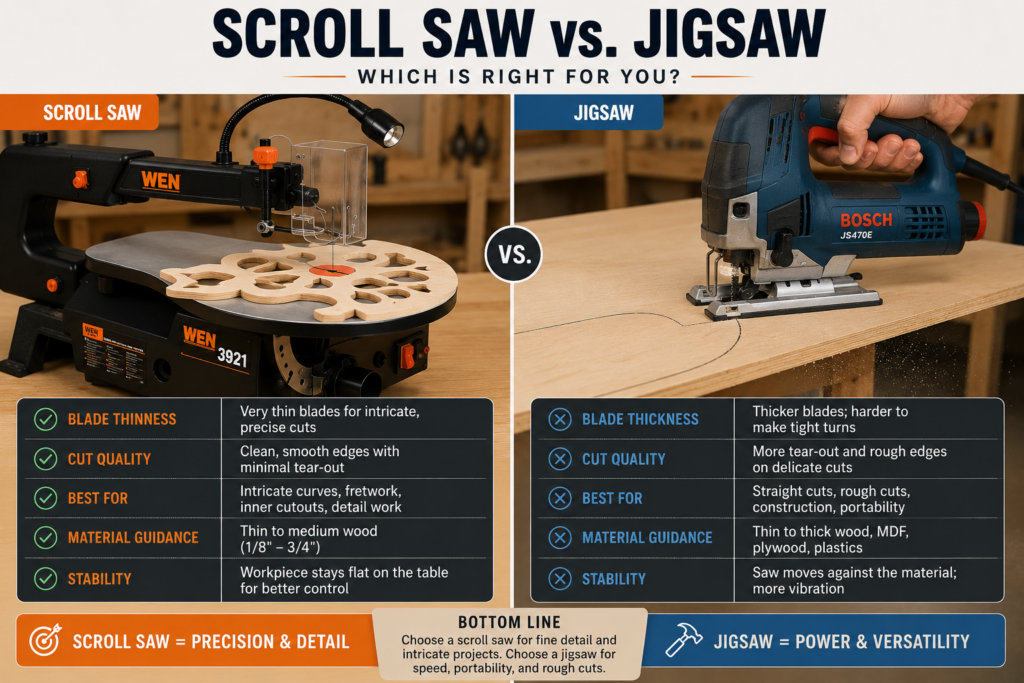
4. Head-to-Head: Scroll Saw vs. Jigsaw
Many homeowners and DIY beginners wonder if they can bypass buying a dedicated bench tool by using a standard handheld jigsaw. While both tools utilize a reciprocating up-and-down blade motion, they are designed for entirely different universes of work.
Precision Comparison: A jigsaw blade is thick and wide, secured only at the top chuck, leaving the bottom tip free to flex and wander when it hits tough wood grain. A scroll saw blade is microscopic by comparison, held under high mechanical tension at both ends. This dual-clamp system ensures the blade remains perfectly perpendicular to the table, allowing you to execute zero-radius hairpin turns smoothly.
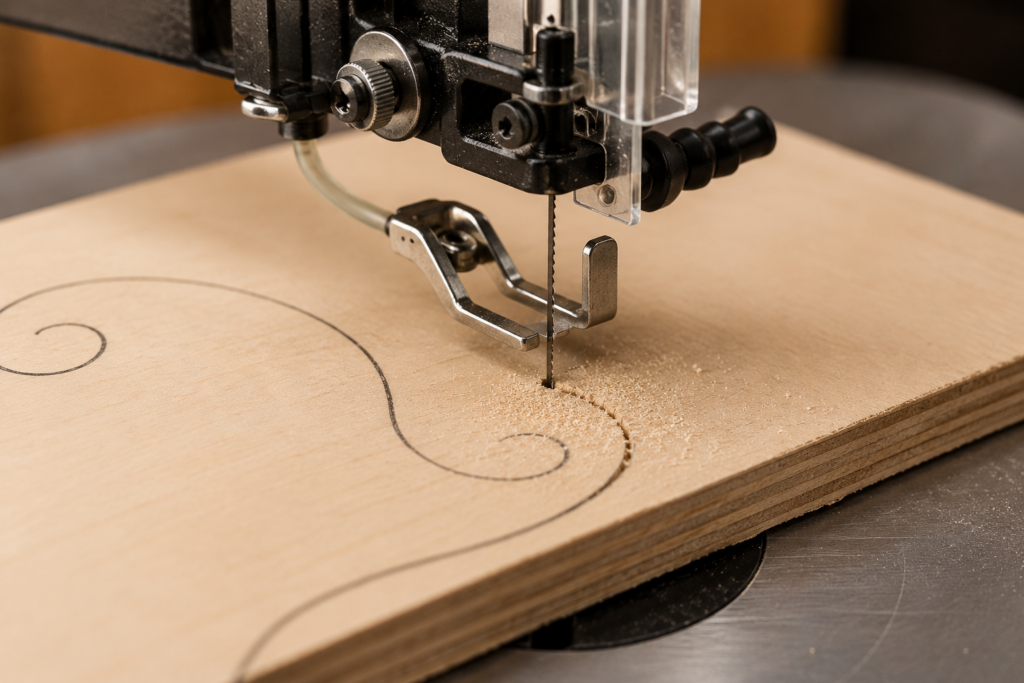
Plywood Cutting: When cutting thin material, a handheld jigsaw will violently vibrate the sheet, lifting it off the sawhorses and tearing the delicate exterior face veneers to shreds. A scroll saw holds the workpiece firmly against a flat table, supporting the wood fibers immediately surrounding the blade path to ensure a crisp, splinter-free edge.
Portability, Learning Curve, and Cost:Jigsaws are small, highly portable, budget-friendly power tools that you carry directly to a job site to quickly notch studs or rough-cut sheets down to size. They have a short learning curve but lack the capacity for fine art. A scroll saw is a heavy, stationary benchtop tool that costs more but provides a safe, highly controlled workspace where you can guide wood with your fingertips millimeters away from the blade. It serves as a foundational piece when exploring essential Woodworking Tools for Beginners.
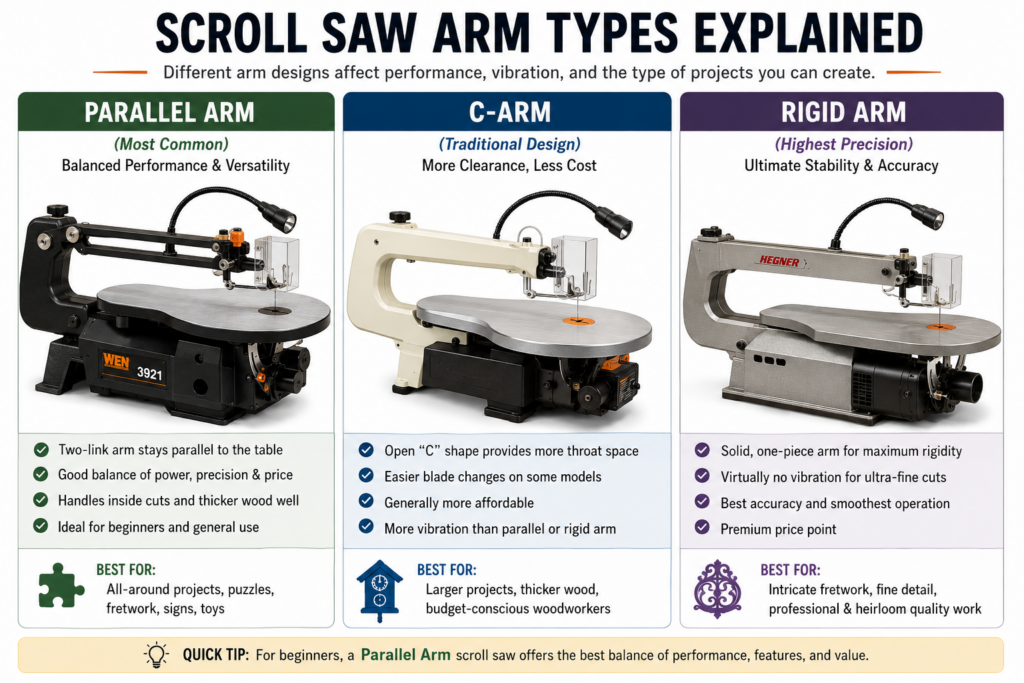
5. Scroll Saw Arm Types Explained
Before purchasing a saw, it is crucial to understand the mechanical design configurations on the market. The arm design directly impacts user comfort, structural vibration levels, and blade longevity.
Parallel Arm: This is the modern gold-standard configuration found in mid- to high-end scroll saws (such as the DEWALT DW788). Two parallel arms run from the back of the machine to the front, holding the blade chucks securely at their tips. Because the arms move in perfect tandem, the blade remains perfectly vertical throughout the entire up-and-down stroke. This minimizes front-to-back blade travel, drastically reducing user hand fatigue, reducing structural vibration, and extending blade life.
C-Arm: A classic, traditional design featuring a single solid “C” shaped metal arm that pivots from a single point at the rear. As the arm rocks up and down, the blade traces a very slight arc rather than a perfectly vertical line. While preferred by some professional fretwork production cutters for aggressive cutting speeds, the front-to-back motion can cause premature blade snapping if your tension isn’t precisely dialed in.
Rigid Arm: Commonly found on vintage cast-iron machinery or low-end budget entry-level units. These use an internal spring assembly inside the upper arm to pull the blade back up after the lower motor pulls it down. They are notoriously prone to high vibration and require a heavy, anchored workbench to keep them from walking across the shop floor.
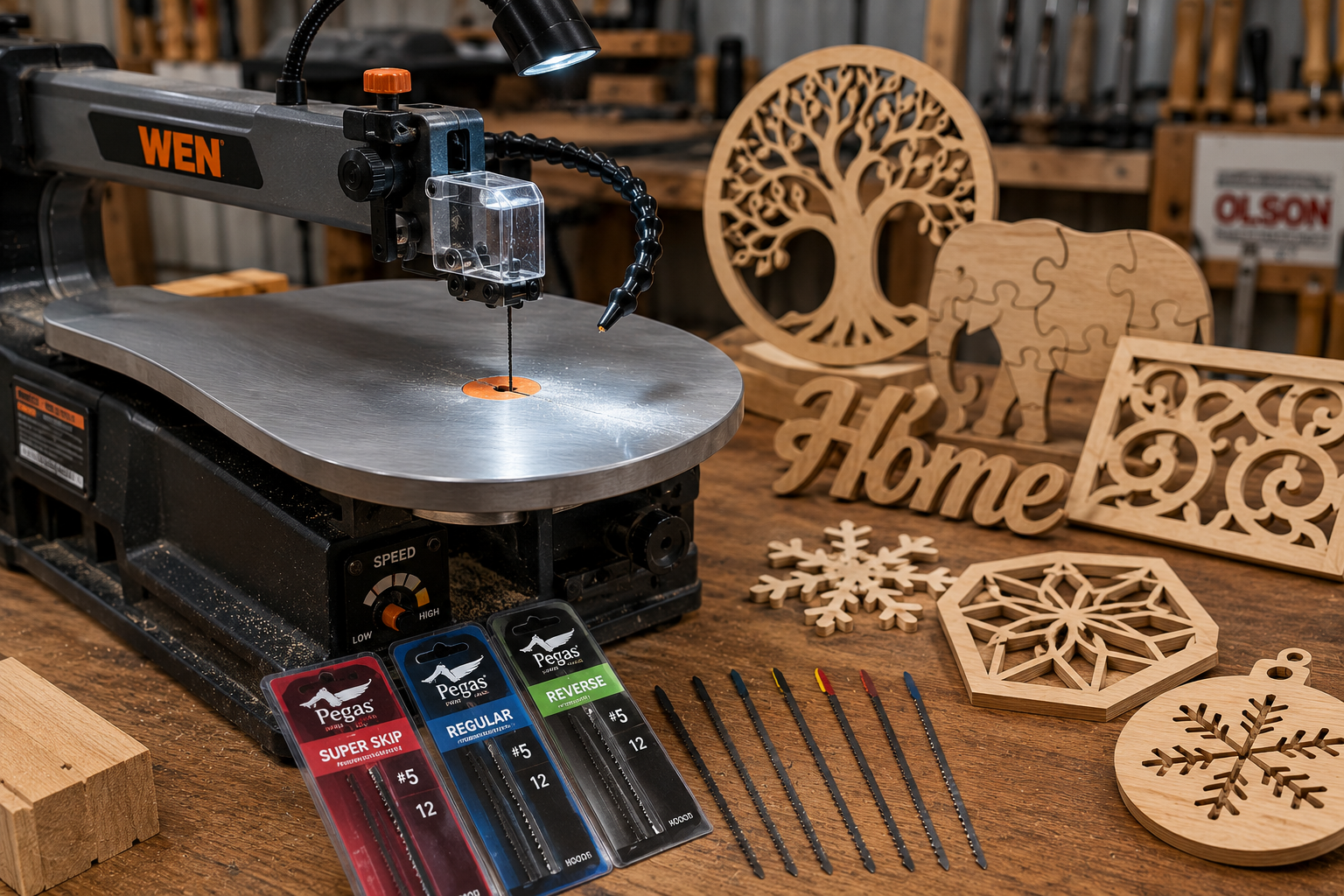
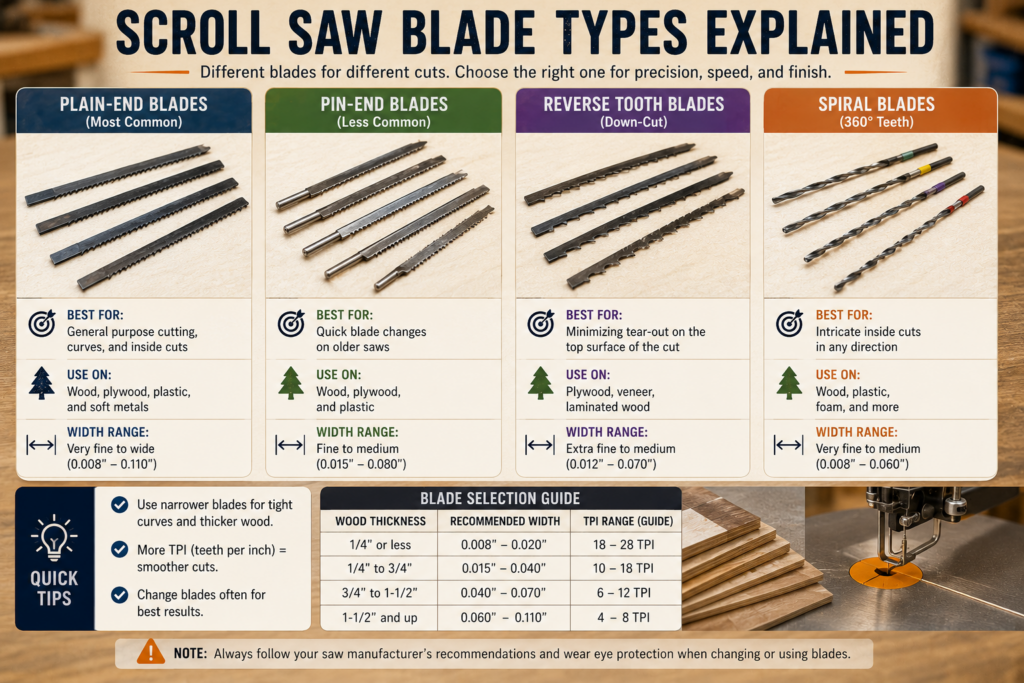
6. Scroll Saw Blade Types Explained
Choosing the correct blade type is arguably more important than choosing the saw itself. Placing a poorly designed blade configuration into a premium machine will still burn your stock and tear your project apart.
Plain-End vs. Pin-End Blades
Plain-End Blades: These are completely smooth on both ends. They clamp directly into the saw’s jaws using friction. They are the absolute industry standard for intricate work because they are incredibly thin and can feed through micro-sized drilled starter holes for internal fretwork.
Pin-End Blades: These feature a tiny metal cross-pin at both ends that hooks into slots on the saw arms. They are much wider and thicker and cannot fit through small starter holes, making them useless for highly intricate internal cuts. They are mostly limited to older or low-end budget saws.
Tooth Profiles
Skip-Tooth Blades: Every other tooth is missing on this profile, leaving wide gullets between the cutting edges. These open areas allow sawdust to clear out rapidly, preventing the blade from clogging and generating heat. This makes them an excellent all-around blade for cutting softwoods.
Reverse-Tooth Blades: The absolute holy grail profile for processing sheet goods. The top 90% of the teeth point downward, while the bottom 10% point upward. As the blade cycles, the bottom teeth cleanly cut the underside wood fibers on the upstroke, completely eliminating fuzzy tear-out and splintering on the back veneer layer.
Spiral Blades: These consist of a flat blade that has been mechanically twisted into a helix, meaning teeth face in all 360 degrees. This allows you to cut in any direction without ever rotating your workpiece. While excellent for massive signs that would otherwise hit the back throat of your saw, they leave a very wide, rough kerf and are difficult to control for razor-sharp corners.
Crown-Tooth Blades: Each tooth is shaped like a crown, with cutting edges facing both upward and downward. This unique geometry allows the blade to cut on both the downstroke and the upstroke. It cuts slightly slower but delivers an ultra-smooth, burn-free edge on delicate plastics, acrylics, and ultra-thin craft layers.
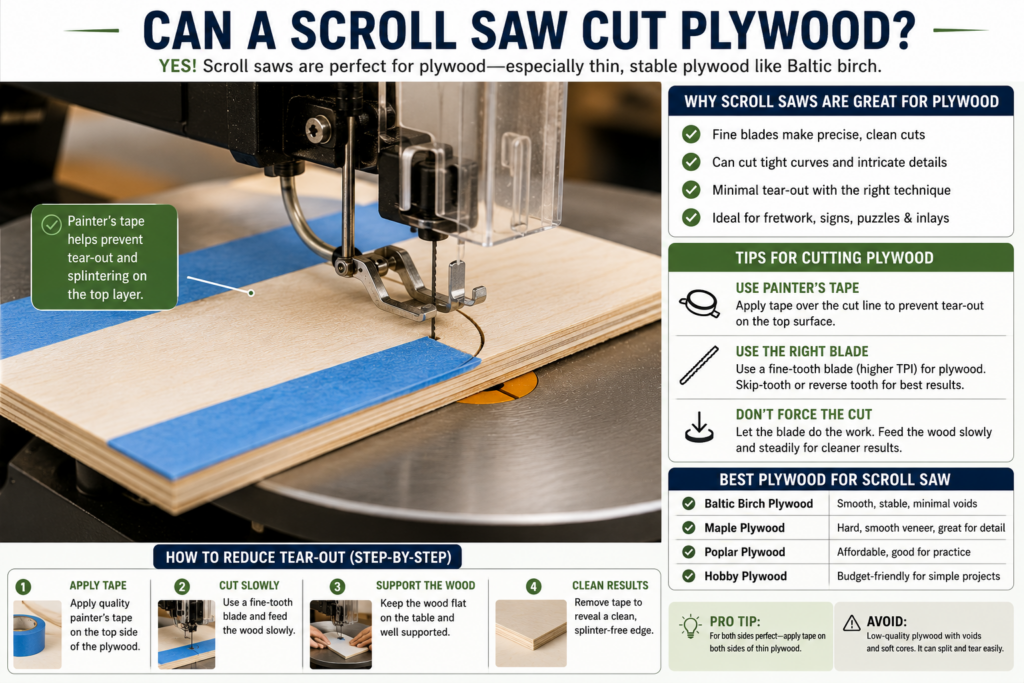
7. Can a Scroll Saw Cut Plywood?
Yes, a scroll saw can cut plywood beautifully, provided you use high-quality multi-ply Baltic birch rather than standard construction or cabinet-grade plywood. To prevent splintering and tear-out on the delicate veneer backing, you must use a reverse-tooth blade and run the saw at a moderate speed.
Baltic Birch vs. Cabinet/Construction Plywood
Standard plywood from local home improvement centers is constructed with softer interior core plies that often contain large hidden voids (air gaps) and thick pockets of gummy industrial adhesive. When a fine blade hits an internal void, it will violently skip or snap; when it hits a glue pocket, the friction melts the adhesive, instantly burning the wood and binding your blade.
True multi-ply birch sheets are entirely uniform, contain no internal voids, and are constructed with thin, identical plies of premium veneer that slice smoothly under the blade. Learn more about premium layer setups in our deep-dive overview of Cabinet Grade Plywood.
Overcoming the Tear-Out Challenge
Because plywood is made of alternating layers of wood grain running perpendicular to each other, the bottom face layer is incredibly prone to splintering as the blade punches downward. To combat this, you must use a reverse-tooth blade, drop your saw table to ensure the upward-facing teeth engage the bottom veneer layer, and apply blue painter’s tape along your cut lines to physically support the wood fibers. For a broader look at grading patterns, review our guide to Plywood Grades Explained.
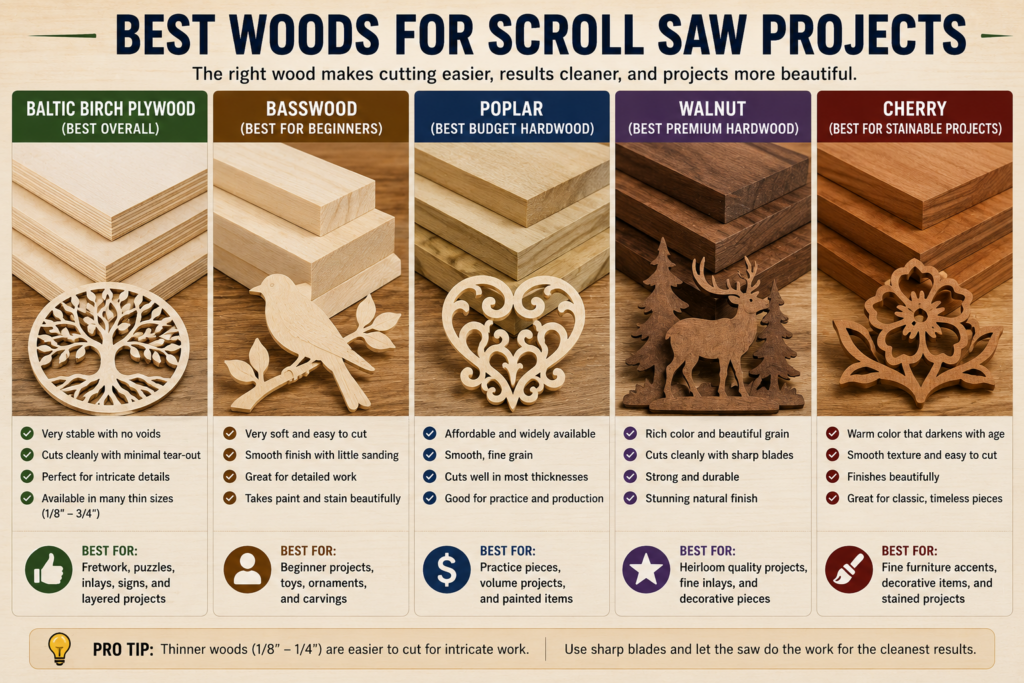
Understanding the material properties of your lumber keeps you from fighting your saw. Here is how the most common craft woods grade out on the workshop table:
Multi-Ply Baltic Birch: The absolute gold standard for structural stability. It won’t warp, split along the grain lines, or snap across narrow sections, making it perfect for custom script name signs, layered 3D wall art, and intricate children’s puzzles. Dive deeper into this material with our dedicated Baltic Birch Plywood Guide.
Basswood: Incredibly soft, lightweight, and sporting a virtually invisible grain pattern. Basswood offers almost zero mechanical resistance to a blade, making it the perfect low-stress training wood for absolute beginners learning how to steer a line. Check out how it ranks among other choices in our guide to the Best Plywood for Craft Projects.
Poplar: An affordable, accessible utility hardwood that features a straight grain and a uniform texture. It cuts cleanly but often contains green or purple heartwood mineral streaks, meaning it is best reserved for projects you intend to paint rather than stain.
Maple, Walnut, and Cherry: These premium domestic hardwoods create a stunning contrast in intarsia and jewelry boxes. However, cherry and maple contain high natural sugar content and are extremely prone to friction burning. When cutting these species, you must use brand-new, ultra-sharp blades and drop your saw’s speed dial down to a moderate setting.
9. Real Test: Cheap Blades vs. Premium Blades
To see how much blade quality actually impacts performance, we ran a controlled test cutting identical intricate patterns from 1/4-inch multi-ply birch.
Metric
Cheap Blades (Standard Retail)
Premium Swiss Blades
Blade Life
Low (Snapped frequently)
High (Lasted 3x longer)
Burning
More (Frequent scorch marks)
Less (Clean edges)
Sanding Required
More (Heavy fuzz/burrs)
Minimal (Smooth finish)
Accuracy
Lower (Blade deflection)
Higher (Tracked perfectly)
🧪 The Verdict: If you are on a tight budget, upgrading your blades delivers a bigger performance improvement than upgrading the saw itself. Don’t blame your machine until you’ve tried premium specialized blades.
10. Scroll Saw Cost Breakdown 💸
Setting up a specialized workshop station requires budgeting for both the initial machine purchase and ongoing consumable supplies. Here is a realistic look at what it costs to get started.
Item
Estimated Price Range
Entry-Level / Budget Saw
$120 – $250
Intermediate / Mid-Range Saw
$250 – $600
Advanced / Premium Saw
$600 – $1,500+
Premium Blades (Dozen Pack)
$5 – $30
Flexible LED Work Light
$20 – $60
Heavy-Duty Anti-Vibration Pad
$20 – $100
While the temptation to buy a budget tool is strong, casual users should factor in the cost of a high-quality anti-vibration pad to save their hands from fatigue. Professional users should view premium blades as a fixed operational cost, as high-end options save hours of secondary sanding labor.
11. Recommended Scroll Saw Gear & Buyers Guide
Investing in the right equipment saves hours of frustration. Breaking your gear into specific categories makes it easy to find exactly what your shop is missing.
Best Scroll Saws
DEWALT DW788 (Intermediate Champion): Widely considered the gold standard for serious hobbyists. It features a parallel-link arm design that drastically reduces vibration, with controls conveniently located at the front of the arm.
WEN 3921 (Best Budget Choice): An excellent, feature-rich entry-level saw. It offers variable-speed control and a unique dual-direction design that makes it easier to handle longer workpieces.
Pegas Scroll Saw (The Premium Choice): For the ultimate precision woodworker. This machine features a tilting head rather than a tilting table, meaning your workpiece always stays flat and stable while you cut bevels.
Best Scroll Saw Blades
Olson Reverse Tooth (Great for Multi-Ply Wood): The absolute best choice for processing sheet goods. The bottom teeth point upward, cleanly slicing the underside of the wood and preventing ugly tear-out.
Pegas Variety Pack (Best for Fine Fretwork): A premium selection. This pack lets you test different blade sizes (from ultra-fine #2 to robust #9) to find the perfect match for your material thickness. Be sure to reference our Plywood Thickness Guide to perfectly match your target material depth to the correct blade size.
12. Best Scroll Saw Accessories Worth Buying
Investing in targeted upgrades can dramatically minimize user fatigue, speed up production, and improve cut precision. Here are the top secondary tools seasoned makers add to their workstations:
Foot Switch: A momentary power pedal that lets you start and stop the motor with your foot. This keeps both hands firmly on the wood layout, maximizing safety during intricate turns.
Flexible Work Light: Fine lines require intense visibility. A bright, positional LED light minimizes shadows across your pattern layout.
Blade Organizer: A slotted storage container to keep your various blade sizes, tooth geometries, and spiral options sorted without tangling.
Anti-Vibration Pad: A heavy neoprene or rubber mat placed beneath the machine base to dampen structural oscillations and preserve fine motor control.
Pattern Book:Scroll Saw Pattern Book by Patrick Spielman is a classic resource packed with chess pieces, holiday ornaments, and structural templates to inspire your next build.
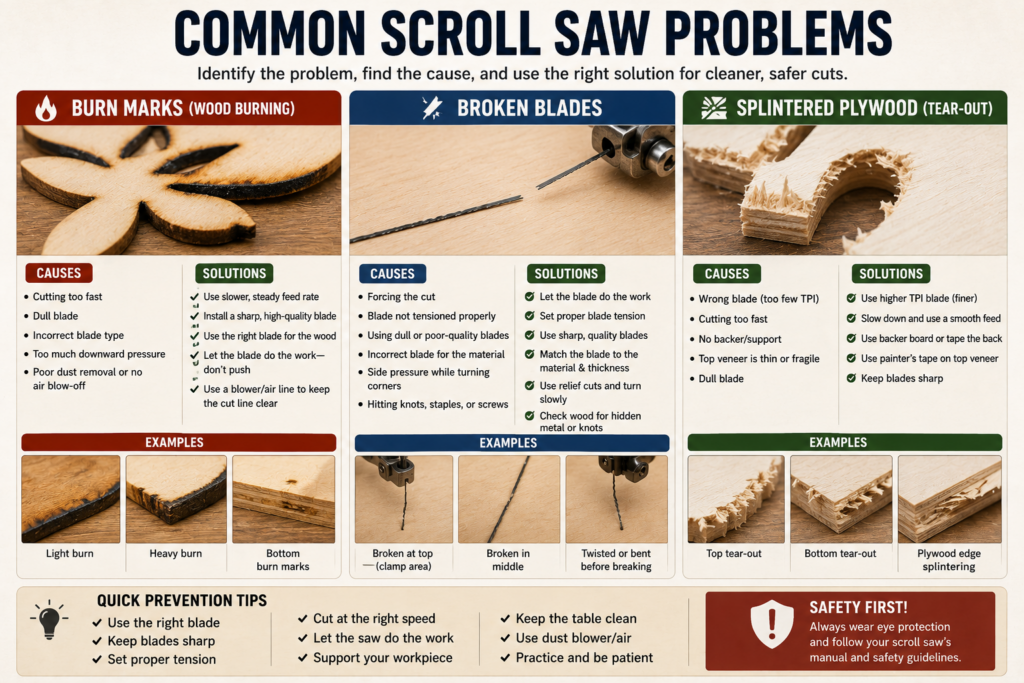
13. Common Scroll Saw Troubleshooting & Quick Fixes
Why Does My Scroll Saw Blade Keep Breaking?
Scroll saw blades usually break due to excessive tension (over-tightening the blade), feeding the wood too aggressively (forcing it into the blade), or using a blade size that is too small for the wood’s thickness.
Excessive Tension: Cranking the tension too tight snaps the blade under load. It should ping like a guitar string, not feel stiff as a rod.
Feeding Too Aggressively: Pushing the wood too hard into the blade rather than letting the teeth do the work.
Incorrect Blade Size: Using a blade that is too thin for dense or thick hardwood.
Why Is My Wood Burning?
Wood burns on a scroll saw when the blade is dull, the saw speed is set too high for hardwoods, or the user’s feed rate is too slow, which causes the blade to rub against the wood and generate extreme friction heat.
Dull Blade: Friction increases dramatically as teeth lose their edge. Change blades frequently (roughly every 30-45 minutes of continuous cutting).
Speed Too High: Reduce the SPM (strokes per minute) on your variable speed dial for hardwoods and plastics.
Feed Rate Too Slow: Moving the wood too slowly causes the blade to dwell in one spot, generating intense heat.
Why Are My Cuts Crooked?
Crooked scroll saw cuts are typically caused by loose blade tension, which allows the blade to deflect and bend inside the wood, or side-loading the blade by forcing the wood at an angle rather than feeding it straight.
Loose Tension: A loose blade will deflect and bow within the wood, resulting in an uneven vertical cut.
Blade Deflection: Pushing against the side of the blade instead of feeding it straight ahead.
Forcing the Wood: Let the blade clear the waste material naturally.
Why Does My Scroll Saw Vibrate So Much?
Lightweight Stand: If your saw isn’t bolted to a heavy workbench or a dedicated stand, it will walk and vibrate.
Loose Bolts: Check the motor mount and arm bolts regularly.
Entry-Level Machine: Budget saws lack the internal counter-balancing found in premium models.
Why Is the Bottom of My Wood Splintering?
Wrong Blade Type: Standard skip-tooth or crown-tooth blades tear fibers on the downstroke.
Solution: Switch to reverse-tooth blades, which have bottom teeth pointing upward to cleanly slice the underside of the sheet.
14. Common Beginner Mistakes ❌
Avoiding these classic procedural missteps will save your blades, your stock, and your sanity:
Forcing the Wood Forward: Pushing with heavy force bends the blade backward, causing internal deflection and ensuring your vertical edges are cut at an accidental, crooked angle.
Using the Wrong Blade Size: Trying to cut thick 3/4-inch walnut with a microscopic #2/0 fretwork blade will instantly snap the metal due to severe heat buildup.
Neglecting Proper Tension: Fearing blade breakage, beginners often leave the blade loose. A loose blade bends inside the wood, wanders wildly off-pattern, and snaps faster than a properly tensioned blade.
Running at Excessive Speed Constantly: Cranking your speed dial to maximum for every project acts like a blowtorch on hardwoods. Slow the stroke rate down to preserve the wood’s natural color.
Cutting Cheap Construction Materials: Trying to save money by scrolling through exterior-grade construction scrap results in endless blade binding, core void blowouts, and deep frustration.
Not Using Blue Painter’s Tape: Skipping the tape step means your paper patterns must be glued directly to raw wood, leaving a sticky, gummy residue that requires extensive sanding to clean off.
Ignoring Feed Direction: Always feed your material straight into the front face of the teeth. Never side-load the blade by pushing the wood hard against the smooth flank of the metal strand.
15. 10 Easy Scroll Saw Projects Anyone Can Make
If you are looking for design inspiration or want to create highly shareable projects for platforms like Pinterest, these beginner-friendly projects are perfect for scrap pieces of 1/4-inch or 1/2-inch multi-ply sheet goods.
Wooden Puzzles: Animal-shaped or custom-name puzzles for kids are excellent, high-margin sellers at craft fairs.
Christmas Ornaments: Intricate but small fretwork designs that make great holiday gifts out of scrap pieces.
Custom Name Signs: Script lettering for nurseries, bedrooms, or weddings.
Address Plaques: Bold, weather-resistant outdoor numbering mounted to a dark backer board.
Geometric Coasters: Quick cuts that make great, functional housewarming gifts.
Toy Cars & Trains: Classic, durable woodcrafting featuring rolling wheels that last for generations.
Decorative Boxes: Interlocking box joints or organic jewelry boxes with curved interior drawers.
Layered Wall Art: Stacking multiple distinct cutouts on top of one another for a beautiful 3D shadow effect.
Plant Markers: Fun, written- or engraved-stakes to label herbs in the home garden.
Fretwork Panels: Intricate lace-like geometric patterns to test your precision and patience to the absolute limit.
16. Who Should NOT Buy a Scroll Saw?
While the scroll saw is an incredibly rewarding tool to master, it is not the right choice for every workshop. You should skip buying a scroll saw if:
You Need to Dimension Lumber: If your primary goal is to rip long boards down to width, cut straight lines across large panels, or square up framing lumber, a table saw, miter saw, or circular saw is what you actually need.
You Value Speed Over Precision: Scroll sawing is a slow, meditative, and highly methodical craft. If you get impatient standing over a machine for an hour, slowly guiding a single intricate puzzle piece, this tool will likely frustrate you.
You Only Cut Straight Lines: The scroll saw is mechanically optimized for curves, waves, and internal cutouts. It is incredibly difficult to cut a long, dead-straight line on a scroll saw without a specialized fence setup.
You Lack Workshop Bench Space: While compact compared to a cabinet saw, a quality scroll saw is heavy, requires a dedicated footprint, and must be securely bolted down to function without excessive vibration.
17. Frequently Asked Questions (FAQ)
What do the numbers on scroll saw blades mean?
Scroll saw blades use a sizing scale ranging from ultra-fine numbers like #2/0, #1/0, up to standard whole numbers like #1, #3, #5, #7, #9, and #12. The smaller the number, the thinner the blade, the fewer the teeth per inch, and the tighter the radius turn it can execute. Larger numbers indicate thicker, wider blades designed for processing dense or thick hardwoods.
How do I transfer patterns onto the wood cleanly?
The cleanest, most reliable method is to apply a layer of blue painter’s tape directly to the wood surface. Spray the back of your paper pattern with a light coat of temporary spray adhesive, let it tack for 30 seconds, then press it firmly onto the painter’s tape. Once your cuts are complete, simply peel away the tape; the paper pattern comes off instantly, leaving your raw wood surface completely clean.
While not technically mandatory, a foot switch pedal is the single best safety and convenience upgrade you can add to your machine. It allows you to turn the saw on and off instantly without taking your hands or focus off the workpiece, which is incredibly helpful when executing highly complex internal cuts that require frequent blade changes.
What is the difference between a scroll saw and a band saw?
Band saws use a continuous, looping blade driven by two internal wheels and are designed for rapid resawing, thick contouring, and rough lumber dimensioning. Scroll saws use a short, fine, reciprocating blade held under tension at both ends, capable of piercing inside an enclosed perimeter hole for micro-level interior cutouts.
18. Conclusion
Mastering the scroll saw is an incredibly satisfying journey that bridges the gap between traditional woodworking and fine art. By setting up your machine on a stable foundation, investing in premium blades, selecting uniform materials like Baltic birch, and allowing the machine to cut at its own natural pace, you eliminate the common roadblocks that cause most beginners to quit. Pick a straightforward project, load a fresh reverse-tooth blade, and start making dust!
Best Dehumidifier for Basements: 5 Models Compared by Admin July 15, 2026 DIY Buying a basement dehumidifier looks simple until you realize the square footage number on the box was measured under conditions that look nothing like a…
Fluted Wood Panels: Costs, Types & Mistakes to Avoid by Admin April 12, 2026 DIY Fluted wood panels are decorative wall panels featuring vertical grooves that add texture, depth, and a high-end modern look to interiors. Commonly used for accent…