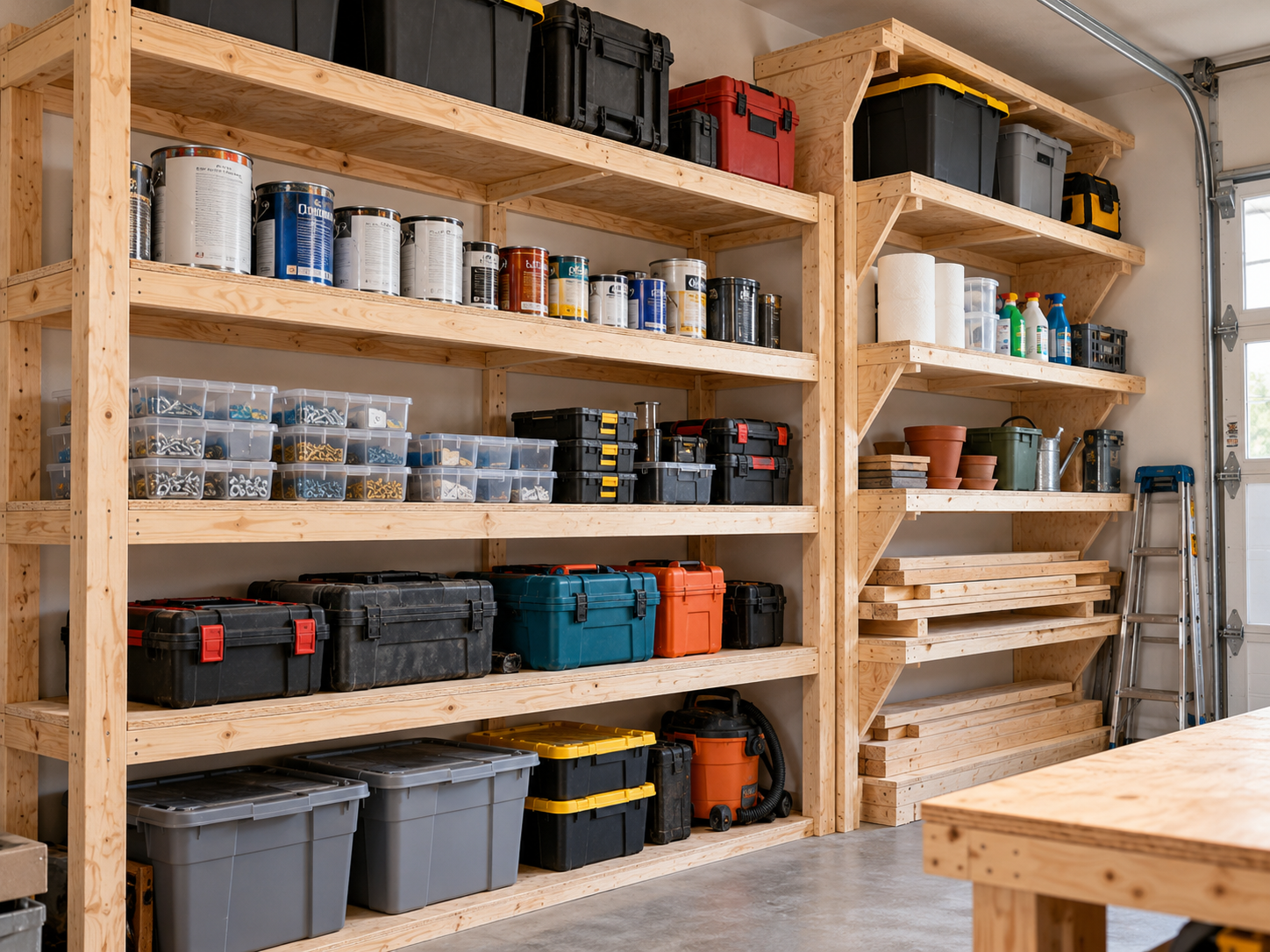
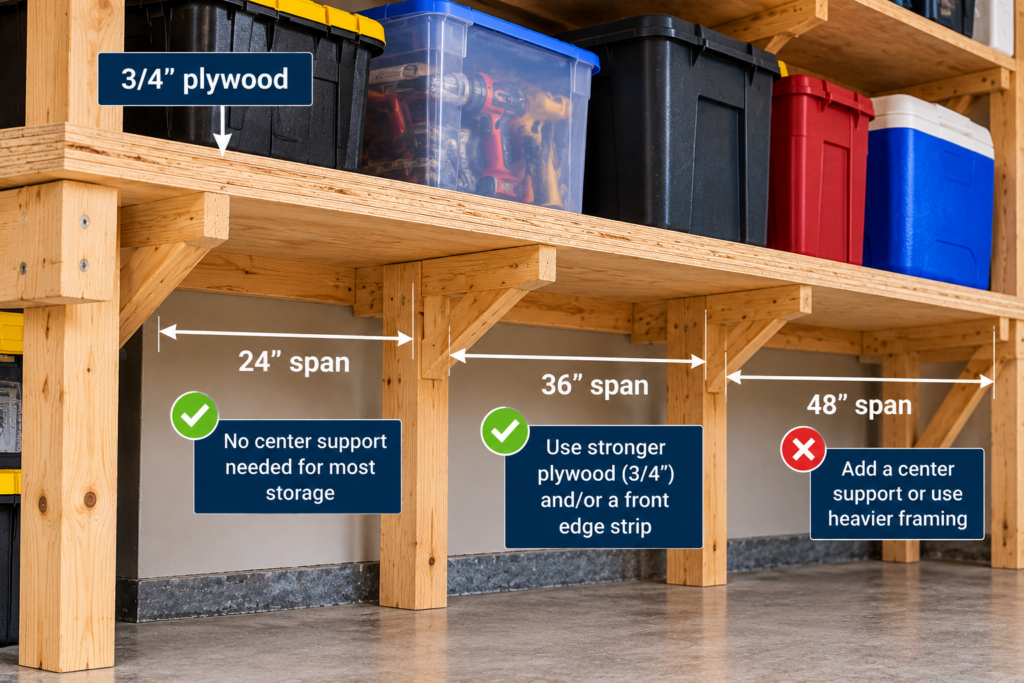
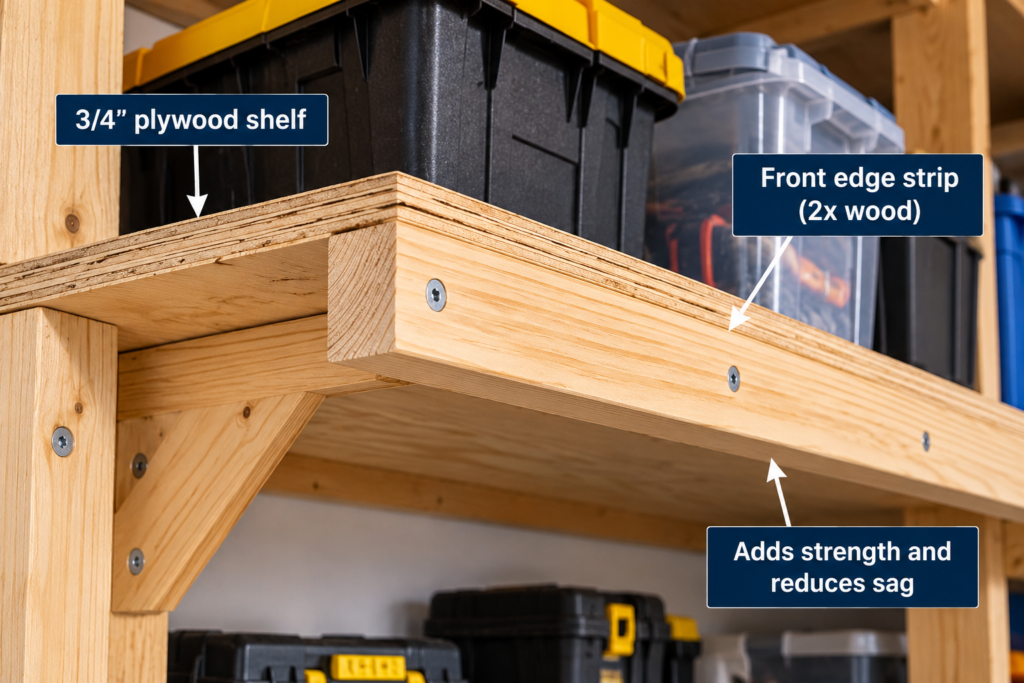
The best plywood thickness for garage shelves is 3/4 inch, with supports about 30 inches apart if the shelf has no reinforcement. Go wider than that, especially to the 36- to 48-inch gaps common between garage uprights, and a front edge strip becomes the difference between a flat shelf and a bowed one.
Below are the measured sag numbers behind that recommendation, how to work out your own load, and the garage setups where plywood alone isn’t enough.
Quick answer on plywood thickness for garage shelves
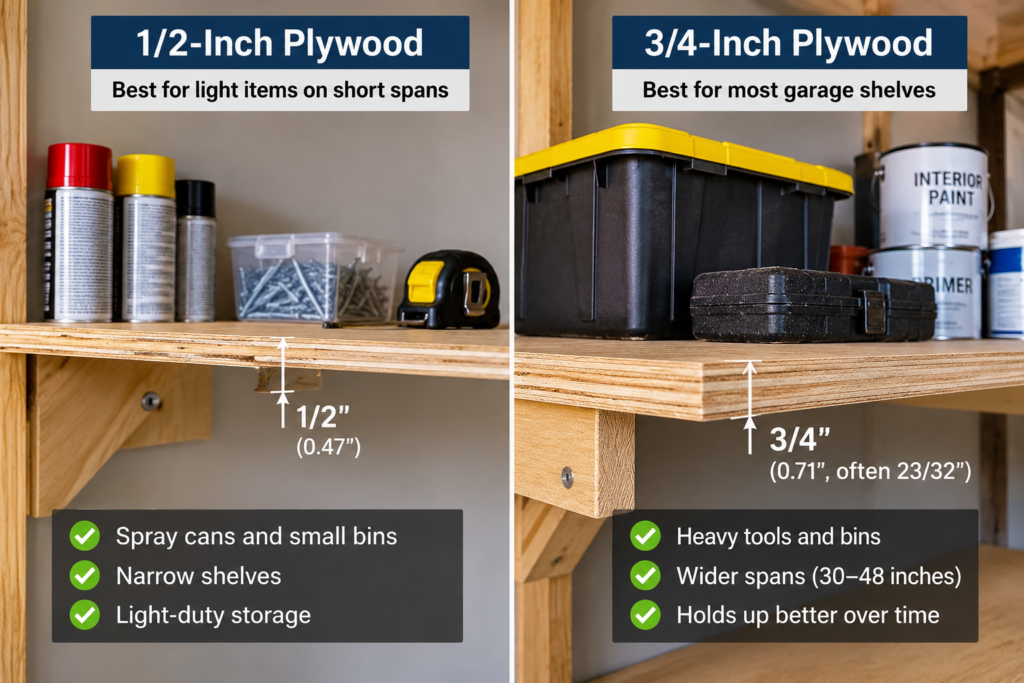
Thickness: 3/4-inch plywood, which is often stamped 23/32″.
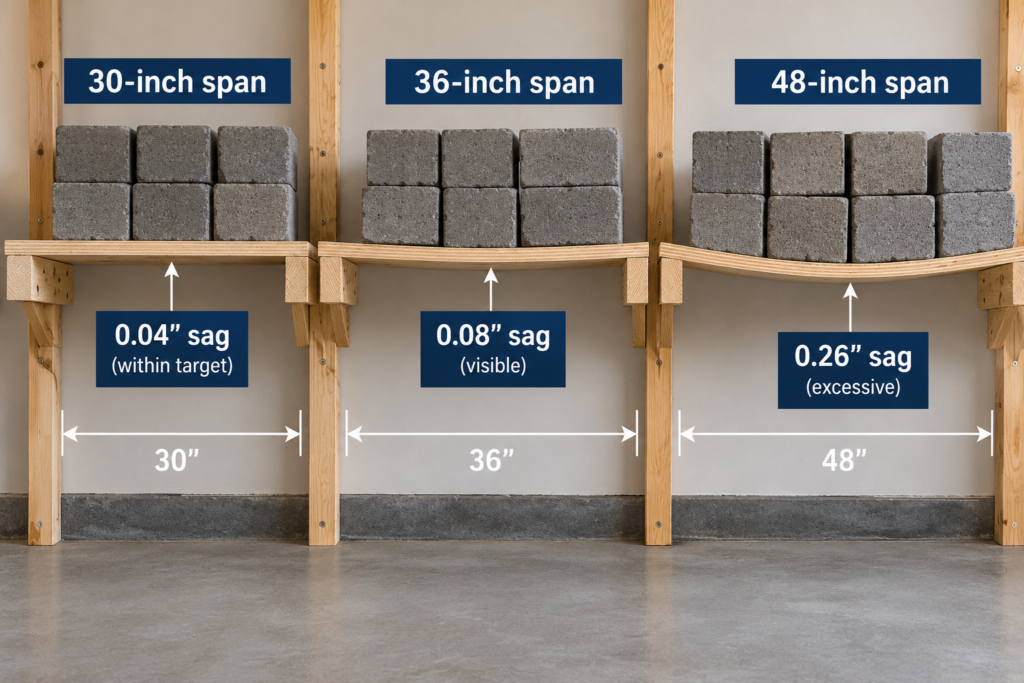
Up to 30″ between supports: bare 3/4″ plywood stays flat under heavy storage.
36″: fine for moderate loads. Add a front edge strip for heavy loads, or if you want the shelf to look flat.
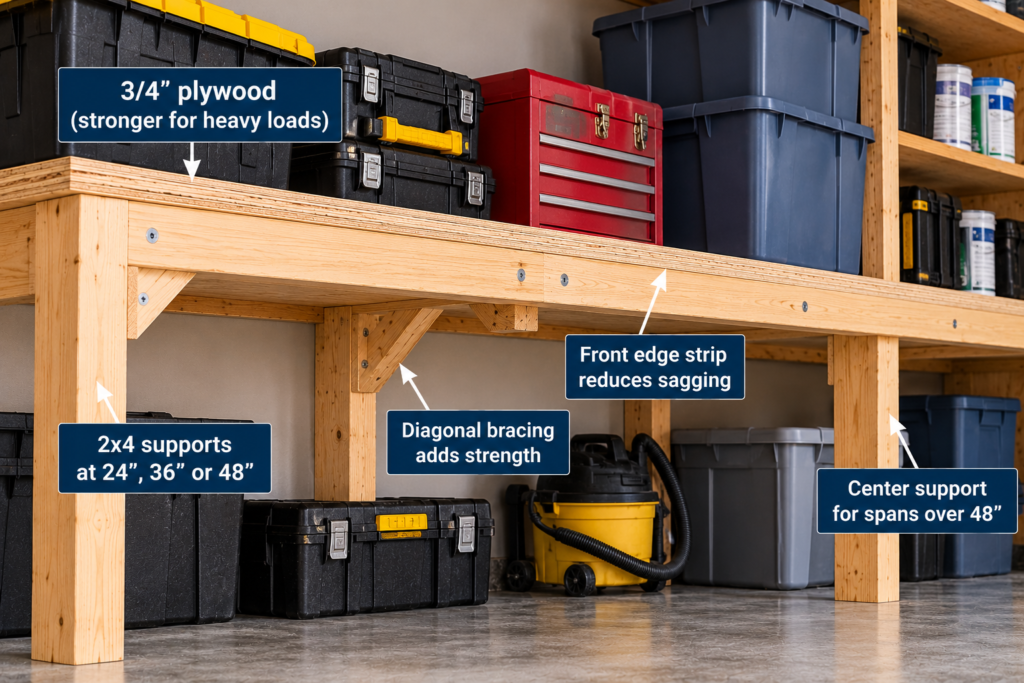
42–48″: use a front edge strip plus a rear cleat.
Over 48″: add a middle support instead of buying thicker plywood.
1/2-inch plywood: only for light items on short spans.
Plywood Thickness for Garage Shelves: Sag Chart at 40 lb per Foot
WoodBin built 3/4-inch pine plywood shelves, 16 inches deep, clamped the ends to their supports, and loaded them with 40 pounds per running foot of concrete block and steel. These sag figures were measured, not calculated.
Distance between supports
Bare shelf
+ front edge strip
+ front strip and rear support
Visible-sag target
Excessive sag
30″
0.04″ ✓
0.03″ ✓
0.02″ ✓
0.05″
0.13″
36″
0.08″
0.06″ ✓
0.05″ ✓
0.06″
0.18″
42″
0.16″
0.09″
0.08″
0.07″
0.21″
48″
0.26″ ✗
0.13″
0.10″
0.08″
0.24″
54″
0.35″ ✗
0.21″
0.15″
0.09″
0.27″
✓ = within WoodBin’s visible-sag target. ✗ = past its excessive-sag line. Everything else is visible but not excessive.
What this chart is, and what it isn’t. It shows measured sag for one tested setup:
3/4-inch pine plywood
16 inches deep
ends clamped down
load spread evenly
WoodBin’s own edging and support pieces
It is not a load-capacity rating. Other plywood grades, face-grain direction, loose shelf pins, different brackets, or a different shelf depth can all change the result. Use it to compare options, and build in some margin.
Why these numbers look better than a calculator’s. Our 3/4-inch plywood shelf span guide calculates a shorter safe span for the same load. That’s because it assumes an 11-1/4-inch-deep shelf resting loose on pins. The shelves here are deeper and screwed down at the ends, and both make a shelf stiffer. For a loose, shallow shelf, use that guide’s numbers instead.
How to Work Out Your Garage Load
The chart was tested at 40 pounds per running foot. Before you rely on it, convert your own storage to the same unit.
Add up the weight of everything that will live on one shelf. A bathroom scale works: weigh yourself holding a bin, then subtract your own weight.
Divide by the shelf length in feet. For example, 120 pounds on a 4-foot shelf is 30 lb per foot. The same 120 pounds on a 3-foot shelf is 40 lb per foot.
Compare the result with 40 lb/ft.
Below 40: your load is lighter than the test load, but you still need to check how strong the supports are and how the shelf is built.
Above 40: you’re outside what was tested. For an evenly spread load, sag rises roughly in step with weight, so 60 lb/ft would sag about one and a half times the chart figure. Treat that as an estimate, and use shorter spans or a reinforced shelf.
⚠️ Warning: These steps assume the weight is spread evenly. A few heavy cans grouped in the middle of the span bend a shelf more than the same weight spread across it. Put the heaviest items near the supports.
😬 Regret: WoodBin’s visible-sag targets assume a loaded shelf sags about 50% more over time. A shelf that looks only slightly low on day one will be noticeably bowed a year later.
Four Questions Before Choosing Plywood Thickness for Garage Shelves
How far apart are the supports? Under 30 inches, use bare 3/4″. From 36 to 48 inches, plan on an edge strip. Over 48 inches, add a middle support.
What’s your load in lb per foot? Use the steps above, and don’t guess.
Can you screw the ends down? In WoodBin’s 40 lb/ft tests, fixed ends sagged less than loose “floating” ends at every span.
Does the face grain run the long way? It should run along the shelf’s length. Ripping a 4×8 sheet lengthwise gives you that automatically.
Which Plywood Thickness Fits Which Garage Shelves
Choosing a plywood thickness for garage shelves comes down to span and load more than to the sheet itself.
1/2-Inch Plywood
Use it for light items on short spans: spray cans, small bins, or a narrow shelf over a workbench. APA’s Panel Design Specification (PDS-2020, Table 10) lists the bending stiffness of 3/4-inch sanded plywood at 355,000 lbf-in²/ft, against 140,000 for 1/2-inch. That makes 3/4-inch about 2.5 times stiffer, so a 1/2-inch shelf sags roughly 2.5 times as much under the same load. Our plywood thickness for shelves guide compares 1/2, 5/8, and 3/4 inch side by side.
3/4-Inch Plywood
This is the right choice for nearly every garage shelf. Expect the label to read 23/32 inch rather than a full 3/4. Our guide to CAT and PS 1 thickness labels explains why. The chart above is built on this thickness.
Doubled 3/4-Inch
For heavy storage where you can’t add supports, glue two layers face to face. Stiffness rises with the cube of thickness, so a fully bonded double layer is roughly eight times stiffer than a single one. The glue line is what makes this work. Two sheets that are only screwed together behave more like two separate shelves.
2×4 frame with uprights 48″ apart: This is the most common garage build and the hardest span for plywood. Glue and screw a 1×2 or 1×3 strip under the front edge, and run a rear cleat into the studs. If the shelves carry more than about 40 lb/ft, add a center upright.
Wall brackets on studs: The distance between brackets is your span. Brackets on every other stud (32″) keep bare 3/4″ plywood in its comfortable range. Brackets every 48″ need a front strip.
Deep 24″ shelves ripped from half sheets: WoodBin only tested up to 16″ deep. A deeper shelf is stiffer per foot of length, but it usually ends up holding more weight. Work out your lb-per-foot load rather than assuming the extra depth covers you.
Supports Do More Than Thickness
For garage shelves, supports matter more than plywood thickness. At a given load per foot, sag grows with the fourth power of the span. Cut a 48-inch span in half and the sag drops to about a sixteenth. No thickness upgrade comes close.
Front edge strip: Engineer Harris Hyman, writing in JLC, found that a front apron can extend the allowable span by 50% to 75%, provided it’s glued and screwed about every 6 inches.
Rear cleat: Hyman puts a second support at the back at roughly another 25% of span.
Screwed-down ends: At 40 lb/ft in WoodBin’s tests, fixed ends beat loose ends at every span.
Middle upright: This is the best fix past 48 inches.
🧪 Real test: In WoodBin’s shop test, the bare 48-inch shelf bent 0.26 inch, past the excessive line. A 1-1/2-inch pine strip screwed under the front edge cut that to 0.13 inch, without changing the plywood.
💸 Cost difference: A 1×2 or 1×3 strip and some screws generally cost a fraction of switching every shelf to doubled plywood. Check local pricing, but the strip is almost always the cheaper fix.
Picks for Stiffer Garage Shelves
Affiliate disclosure: theplywood.com is a participant in the Amazon Services LLC Associates Program and earns from qualifying purchases made through the links below, at no extra cost to you.
🛒 Water-resistant wood glue: bonds edge strips and doubled shelves, and is the safer choice in an unheated garage.
🛒 Heavy-duty shelf brackets: match the bracket depth to the shelf and check the rated load per bracket.
🛒 Digital caliper: confirms whether your “3/4” sheet is really 23/32″ before you cut cleats or dadoes.
🛒 48-inch level: lay it across a loaded shelf to measure sag you might miss by eye.
When Plywood Shelves Are the Wrong Call
Damp garages and wet slabs. APA’s Panel Design Specification (Section 4.5.2, Table 8) cuts plywood stiffness by 15% when the panel’s moisture content in service reaches 16% or more, so shorten spans in a damp garage. The same document (Section 2.4) notes that Exposure 1 and Exterior bond classifications describe how well the glue resists moisture. They don’t change stiffness, and they don’t make the wood rot-resistant. Keep shelves off the floor.
Ceiling-hung storage. That load depends on the joists and fasteners, not on shelf thickness. Use a rated overhead rack or have the framing checked.
Heavy single items. A compressor or a stack of tile puts all its weight in one spot, which the chart doesn’t cover. Put it on the floor or directly over a support.
Long spans you can’t support. Even with a front strip and a rear support, 3/4-inch plywood sagged 0.15 inch at 54 inches. Build a frame instead.
Common Mistakes With Plywood Thickness on Garage Shelves
❌ Spanning 48 inches with a bare 3/4-inch sheet. Measured sag was 0.26 inch at 40 lb per foot, which is past the excessive line, and it keeps creeping over time.
❌ Guessing the load. Paint, hardware, and tool cases add up fast. Weigh the load and convert it to lb per foot before you pick a span.
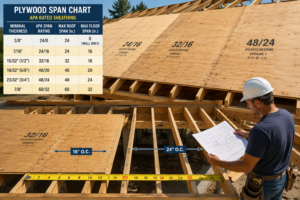
❌ Reading the span rating on the stamp as a shelf rating. A rating like 32/16 is for roof and floor framing, as our plywood span chart explains. It tells you nothing about how far a loaded shelf can span.
❌ Running the face grain across the shelf. APA’s Panel Design Specification (Section 4.1) notes that plywood is stronger and stiffer along its strength axis, which normally runs the length of the sheet. A shelf cut the wrong way gives up stiffness you paid for.
❌ Tacking on an edge strip with a few nails. Hyman specifies glue plus screws about every 6 inches so the strip works as part of the shelf. A loosely fastened strip can shift and add little stiffness.
❌ Forgetting the weight of the shelves themselves. A wall of loaded 3/4-inch shelves puts real dead weight on brackets and anchors. Check how much a sheet of plywood weighs before you size the hardware.
Plywood Thickness for Garage Shelves: FAQ
What plywood thickness is best for garage shelves? 3/4 inch. At 30-inch spans it stayed within the visible-sag target at 40 lb per foot. At 36 inches it sagged 0.08 inch, which you can see but is well short of excessive, so it’s fine for moderate loads. Add a front strip at 36 inches if the shelf is heavily loaded.
How far can 3/4-inch plywood span on a garage shelf? About 30 inches with no reinforcement under heavy storage. At 48 inches, a front strip and rear support brought measured sag down to 0.10 inch at 40 lb per foot. That’s under the excessive line but slightly above the visible target.
Can I use 1/2-inch plywood for garage shelves? Only for light items on short spans. By APA’s design values, it’s about 2.5 times less stiff than 3/4-inch plywood.
Do I need exterior plywood for garage shelves? Usually not. An Exposure 1 bond handles normal garage humidity. Neither bond type protects the wood from rot, so keep shelves off wet floors.
How do I fix garage shelves that already sag? Flip the shelf so the bow points up, then glue and screw a 1×2 or 1×3 strip under the front edge. If it still sags, add a middle upright.
Is 1-inch plywood worth it for garage shelves? Rarely. In WoodBin’s shop tests, a pine strip screwed to the underside of the front edge cut the sag of a 48-inch, 3/4-inch shelf roughly in half. That usually costs less than thicker panels. Save doubled or thicker shelves for loads well above 40 lb per foot.
Bottom Line
The right plywood thickness for garage shelves is 3/4 inch. Keep bare shelves to about 30 inches between supports for heavy storage, and add a front edge strip from 36 inches up. Work out your real load in pounds per foot before you decide whether you need more than that.
Related Posts:
Basement Laundry Room Shelves: DIY Plywood Sag Chart by Admin October 15, 2026 DIY The best budget basement laundry room shelves are 23/32-inch (3/4-inch nominal) exterior-glue plywood on steel brackets, with a bracket screwed into every wall stud. On…
Best Plywood for Garage Cabinets: Grade & Thickness Chart by Admin October 18, 2026 DIY Affiliate disclosure: ThePlywood.com is reader-supported. As an Amazon Associate, we earn from qualifying purchases at no extra cost to you. For most garage cabinets, the…