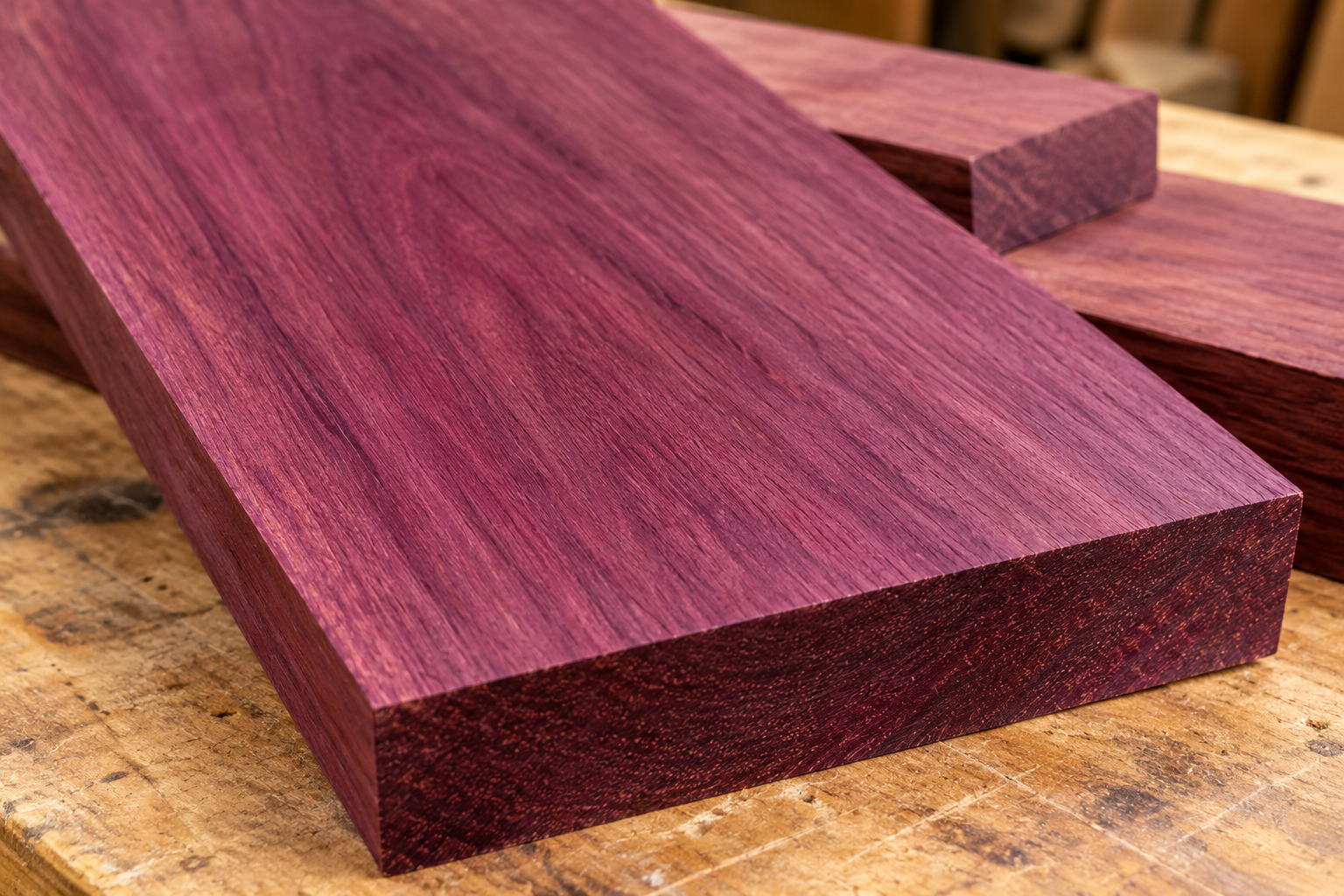
Purple Heart wood (usually written “purpleheart” in the lumber trade) is one of the few naturally purple woods sold commercially. It is also very hard, heavy, and fairly durable, and it changes color in ways that surprise first-time buyers. This guide covers what it is, how hard it is, how to keep the purple from fading, how to cut and finish it without ruining blades, and where it makes sense to use it.
Purple Heart wood comes from trees in the Peltogyne genus, native from southwestern Mexico through tropical South America. Freshly cut, it is dull brown. It turns vivid purple after exposure to air, then slowly darkens toward brown under UV light. At about 2,520 lbf on the Janka scale, it is much harder than oak or maple, resists decay reasonably well, and is hard on tools. The dust is a known irritant, so dust collection and a respirator are standard practice.
What Is Purple Heart Wood?
Purpleheart is not a single species. It is the trade name for lumber from the Peltogyne genus, which includes about 25 accepted species ranging from southwestern Mexico through tropical South America. Commercial purpleheart commonly originates in northern South America, including Brazil and the Guianas.
You may also see it sold as amaranth, violetwood, pau roxo, morado, or amendoim. Because several species are sold under one name, hardness, weight, and color can vary from board to board and supplier to supplier.
Why Purple Heart Wood Turns Purple (and Then Brown)
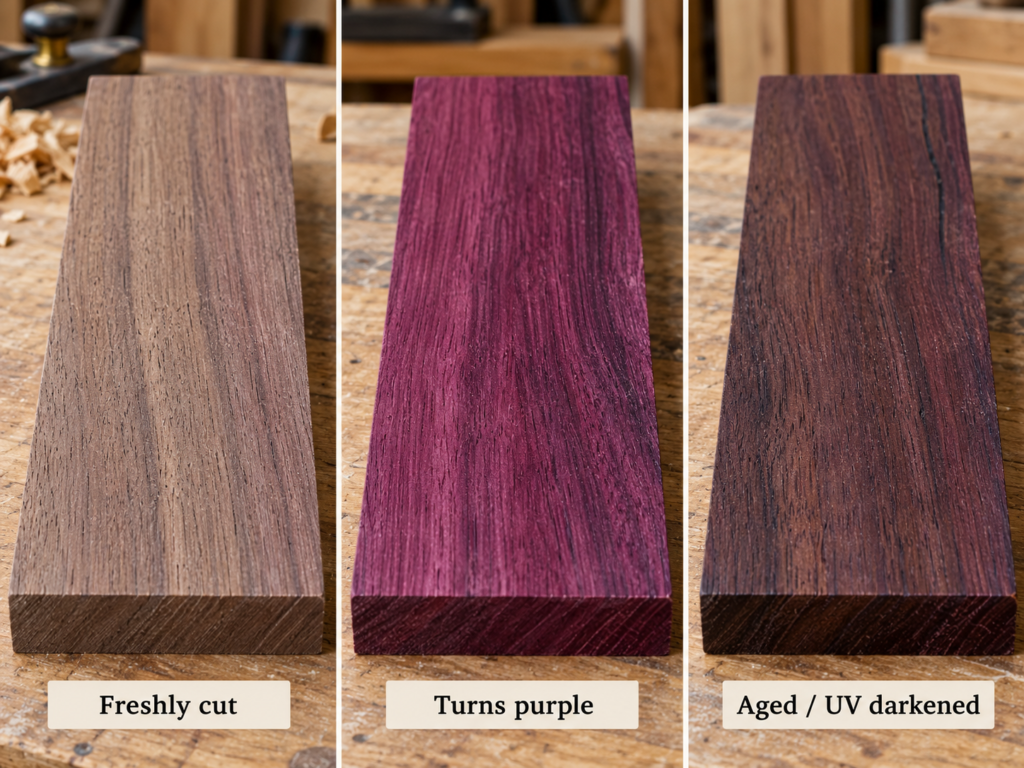
Purpleheart’s color comes from a chemical reaction with air and light:
Freshly cut: grayish or purplish brown.
Hours to a few days later: oxidation turns the surface deep purple.
Months to years in sunlight: UV exposure darkens it to a deep brown with a hint of purple.
Minerals in the wood can also cause uneven color. The pale sapwood usually contrasts strongly with the darker heartwood, so check for it when picking boards.
The color change happens at the surface. Planing or sanding an old, browned board exposes fresh wood that goes through the cycle again.
How to Keep Purple heart Purple
You can slow the browning, but you can’t stop it permanently.
Use a UV-resistant finish. Waterborne or UV-resistant film finishes are the most commonly recommended way to slow the shift to brown. Shop UV-resistant clear finishes on Amazon
Limit sunlight. Indoor pieces kept away from windows hold their color longer.
Test your finish first. Some suppliers report that solvent- or spirit-based finishes can dull the purple, and the wood’s oils can react with some finishes. Always test on scrap.
Let it oxidize before finishing. Applying finish right after milling can lock in the duller fresh-cut color. Many woodworkers let the surface turn purple first.
Purple Heart Wood Hardness and Strength
Purpleheart is much harder and stiffer than common domestic hardwoods.
Property
Typical purpleheart value
Janka hardness
≈2,520 lbf
Average dried weight
≈56 lb/ft³
Specific gravity at 12% MC
≈0.90
Bending strength (MOR)
≈22,000 psi
Modulus of elasticity (MOE)
≈2.94 million psi
Crushing strength
≈12,140 psi
Radial shrinkage
≈3.8%
Tangential shrinkage
≈6.4%
T/R ratio
≈1.7
Values are averages. Because several Peltogyne species are sold as purpleheart, individual boards can test higher or lower.
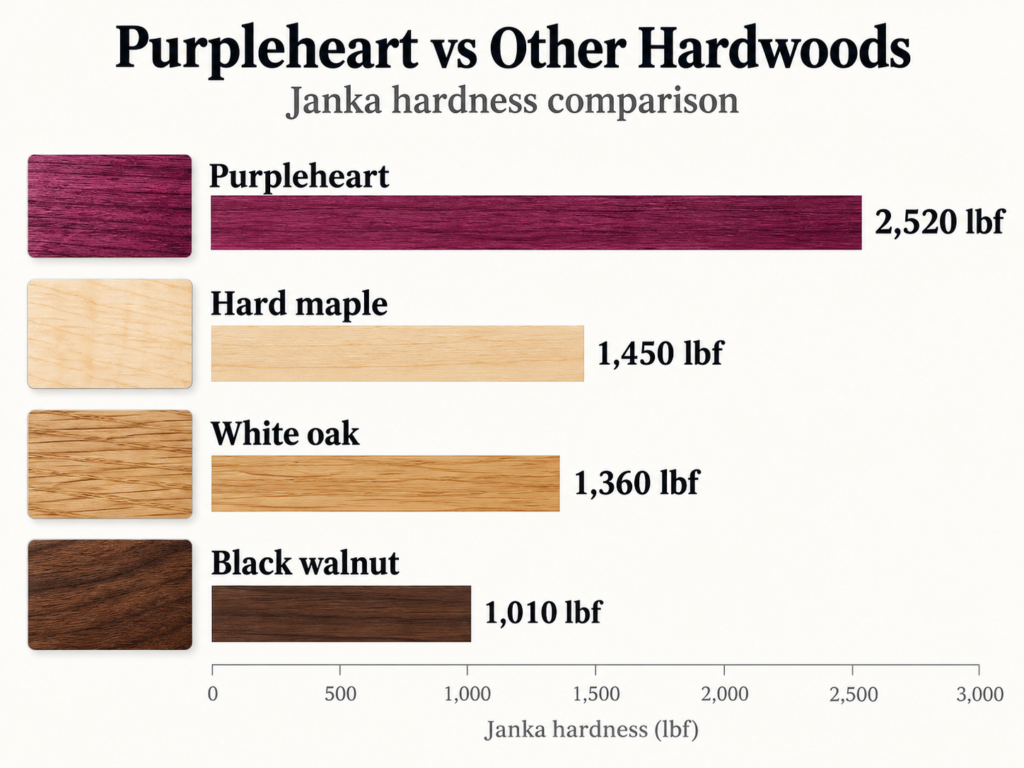
Purple Heart Wood vs. Other Hardwoods
Wood
Janka hardness
Purpleheart
≈2,520 lbf
Hard maple
≈1,450 lbf
White oak
≈1,360 lbf
Red oak
≈1,290 lbf
Black walnut
≈1,010 lbf
Purpleheart is roughly 1.7 times as hard as hard maple and about 2.5 times as hard as black walnut. That hardness makes it wear-resistant in floors and accents, and it’s also why it dulls blades quickly.
Is Purple Heart Wood Durable Outdoors?
Purpleheart is generally considered durable, but “rot-proof” goes too far.
The CIRAD Tropix technical sheet rates its fungal resistance as Class 2 to 3, durable to moderately durable.
The sapwood is not durable and is vulnerable to powderpost beetles.
The heartwood strongly resists preservative treatment, so you can’t easily improve its durability with treatment.
That durability, plus its strength, is why purpleheart has a long history in docks, bridge decking, freshwater pilings, trailer decks, and boatbuilding. For outdoor projects, use heartwood only and expect the surface to weather to brown or gray unless it’s maintained.
Working With Purple Heart Wood
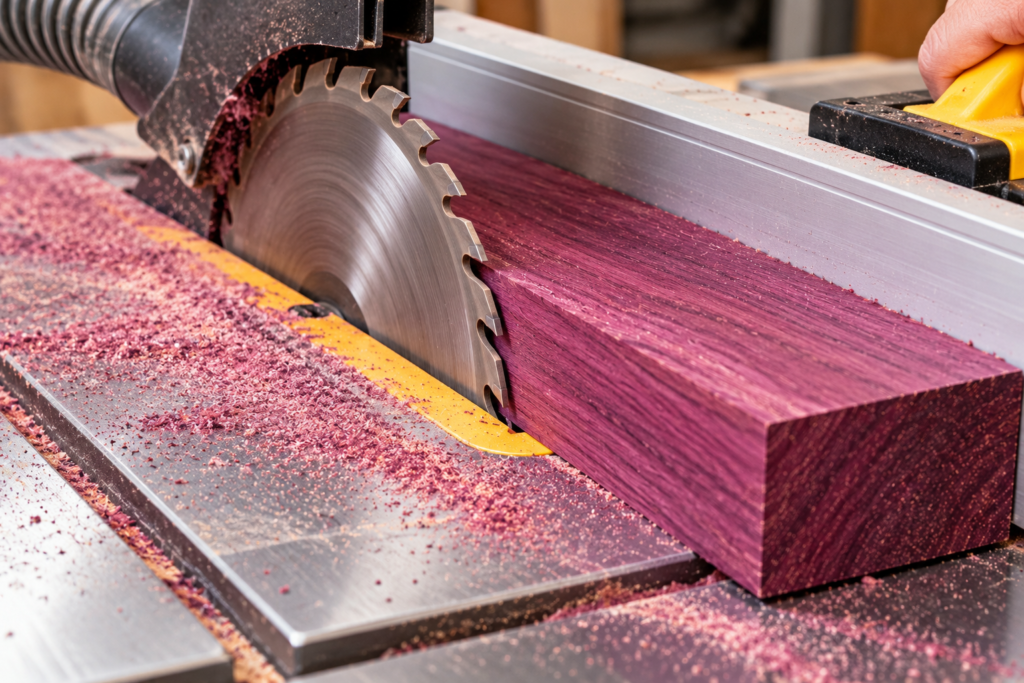
Purpleheart has a reputation for being difficult in the shop. Most problems come from heat and dull edges.
Slow the feed and avoid stalling. Heat from dull tools or high cutter speeds can cause resin buildup on blades and bits and leave burn marks.
Clean blades often. Buildup on the blade increases heat, which makes burning and further buildup more likely.
Drilling and Fastening
Pre-drill for nails and screws. The wood’s density makes splitting and snapped fasteners likely without pilot holes. Once installed, fasteners hold well.
Don’t skip grits. Purpleheart’s hardness makes coarse scratches stubborn to remove later. Sanding generates a lot of heat and fine dust, so work in lighter passes.
Gluing
Purpleheart generally glues well with standard woodworking adhesives when surfaces are freshly machined. Some woodworkers wipe the mating surfaces with acetone immediately before glue-up if the wood appears oily or resinous, but this is not always necessary. Follow the adhesive manufacturer’s recommendations and test questionable stock first.
Finishing
It finishes to a smooth, lustrous surface. The main concern is color retention (see above). Test any finish on offcuts first.
Health and Safety
Purpleheart is reported as a sensitizer. The most common reactions are eye and skin irritation, and nausea has also been reported. Severe reactions are uncommon, but sensitivity can build with repeated exposure.
Use dust collection at the source (saw, sander, router).
Wear long sleeves and wash skin after long sessions.
Common Uses for Purple Heart Wood
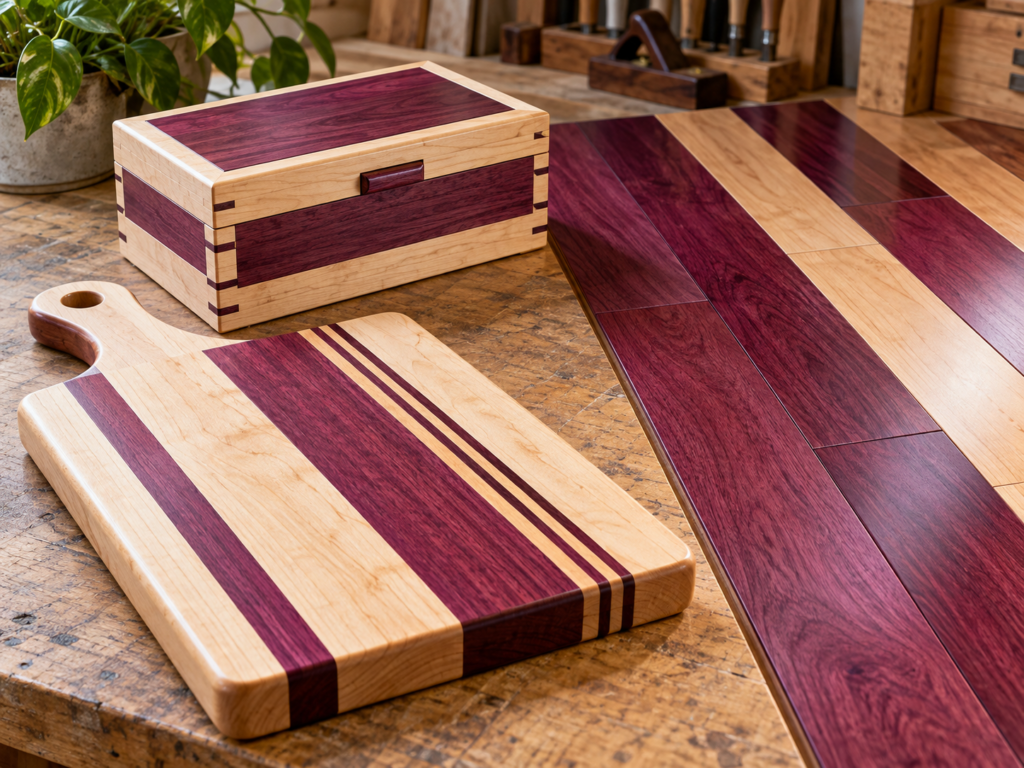
Accent strips and inlays in furniture, boxes, and cutting boards
Turned items such as bowls, pens, and handles
Flooring and feature strips in wood floors
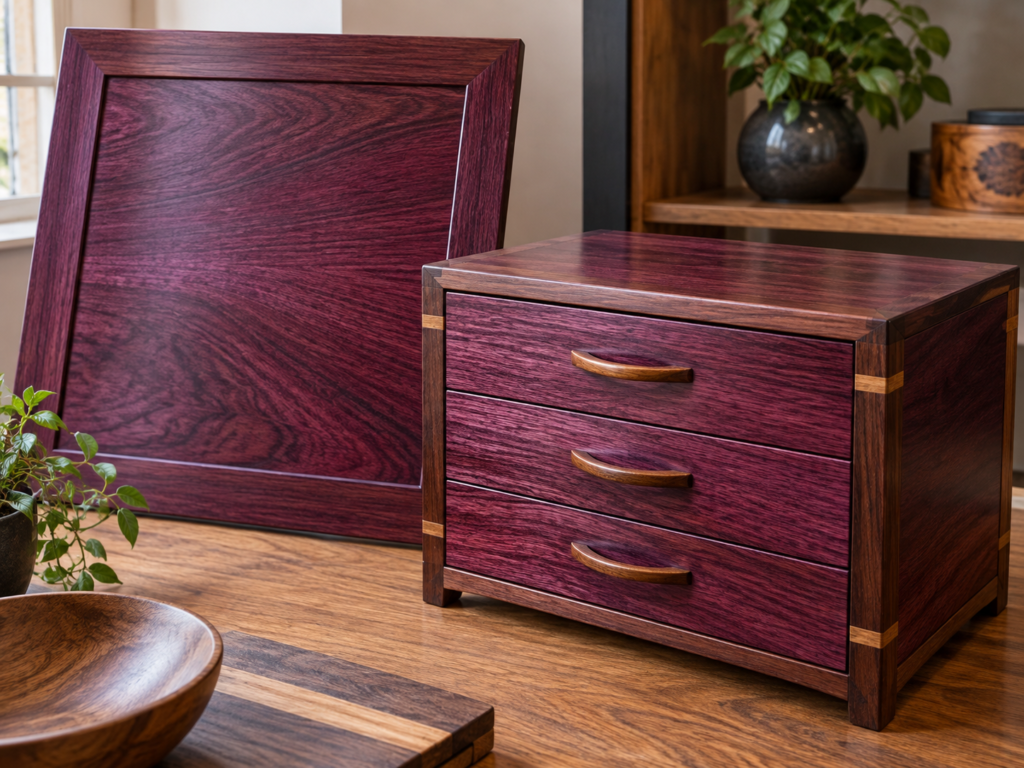
Furniture and cabinetry accents
Archery bows and billiard cue butts
Heavy construction: docks, bridge decking, trailer decks, boatbuilding
Decorative veneers and marquetry
Purpleheart is relatively expensive, so most woodworkers use it in small amounts as contrast against lighter woods like maple.
Is Purpleheart Good for Cutting Boards?
It’s widely used as an accent strip in cutting boards, usually alongside maple or walnut. Two cautions apply. It’s a known sensitizer, and its hardness can be tough on knife edges. If you or the end user has reacted to exotic woods before, use a domestic species instead.
Purpleheart Veneer and Plywood
Solid purpleheart is heavy and costly. For larger surfaces like cabinet doors or panels, purpleheart is sometimes available as decorative veneer, which can be applied over a stable core or bought as veneered panels. The same color-change and UV rules apply to the veneer.
Cost and Sourcing
Purpleheart is generally more expensive than domestic hardwoods like oak or maple, and less expensive than many rare exotics. Prices vary by thickness, grade, and region, so check local hardwood dealers and specialty lumber suppliers for current pricing.
Sustainability notes:
Purpleheart (Peltogyne spp.) is not listed in the CITES Appendices, according to CIRAD’s 2024 technical sheet.
Individual species vary. The IUCN Red List assesses Peltogyne purpurea, a Central American species, as Vulnerable.
When possible, buy from suppliers who can document origin and chain of custody.
Frequently Asked Questions
Is Purple Heart wood naturally purple? Yes. The color is natural, not stained. Freshly cut wood is brownish and turns purple after exposure to air, usually within hours to a few days.
Why did my purpleheart turn brown? UV light gradually darkens purpleheart to brown. A UV-resistant finish and keeping the piece out of direct sun slow the change. Re-sanding exposes fresh wood that will turn purple again.
How hard is Purple Heart wood? Purpleheart averages about 2,520 lbf on the Janka scale, compared with roughly 1,450 lbf for hard maple and 1,290 lbf for red oak.
Is purpleheart toxic? It’s not considered highly toxic, but it’s a reported sensitizer. The dust can cause eye and skin irritation and sometimes nausea. Use dust collection and a respirator.
Can Purple Heart wood be used outdoors? Yes, the heartwood has been used for docks, decking, and boats. It’s rated durable to moderately durable against decay. Sapwood should be excluded, and the color will weather to brown or gray outdoors.
Is purpleheart endangered? Purpleheart as a trade group is not CITES-listed, but at least one species, Peltogyne purpurea, is assessed as Vulnerable by the IUCN.
Related Posts:
Black Walnut Wood: Hardness, Cost, Uses & How to Buy It by Admin August 23, 2026 DIY Black walnut wood comes from the American Black Walnut tree (Juglans nigra), and it's the premium dark hardwood most people picture when they hear "walnut."…