A 3/4-inch plywood shelf, 11-1/4 inches deep, carrying about 20 pounds per running foot can span roughly 31 inches before it reaches the design limit for sag. With lighter loads you can stretch to about 39 inches, and with heavy loads the safe plywood shelf span drops toward 23 inches. Below are the full span chart, what changes the numbers, five ways to get more span from the same sheet, and the cases where plywood is the wrong choice.
Quick answer
Light loads (about 10 lb/ft): up to ~39″
Moderate loads (about 20 lb/ft): up to ~31″
Heavy loads (40–50 lb/ft): 23–25″
Anything longer needs a center support, a front stiffener, or thicker stock.
3/4-Inch Plywood Shelf Span Chart
These numbers come from the uniform-load, simple-beam formula in the American Wood Council’s Beam Design Formulas (Design Aid No. 6). The shelf is 11-1/4″ deep and sits loose on pins or cleats, and stiffness is set at 1.0 million psi, which is a conservative figure for softwood plywood.
The design limit used here is 0.02 inch of initial sag per foot of span. The Sagulator notes that sag becomes visible at roughly 0.03 inch per foot, but it recommends designing to 0.02 inch per foot or less so there’s room for more sag later.
Load on the shelf
Max span at design limit
Sag at that span
10 lb per foot
39″
0.065″
20 lb per foot
31″
0.052″
30 lb per foot
27″
0.045″
40 lb per foot
25″
0.042″
50 lb per foot
23″
0.038″
What happens when you go past the limit
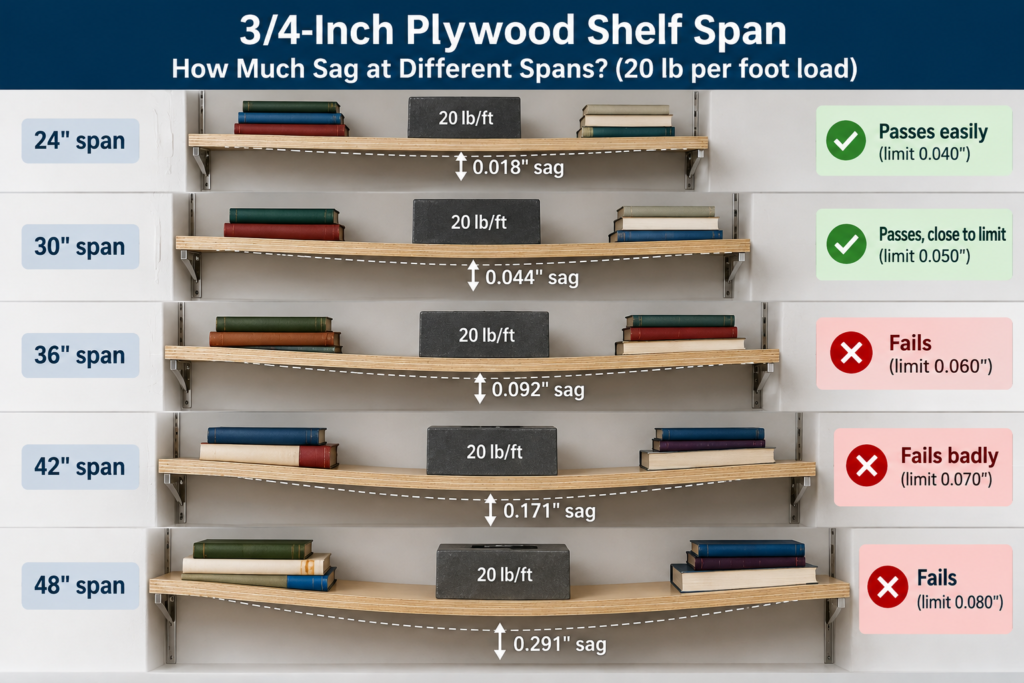
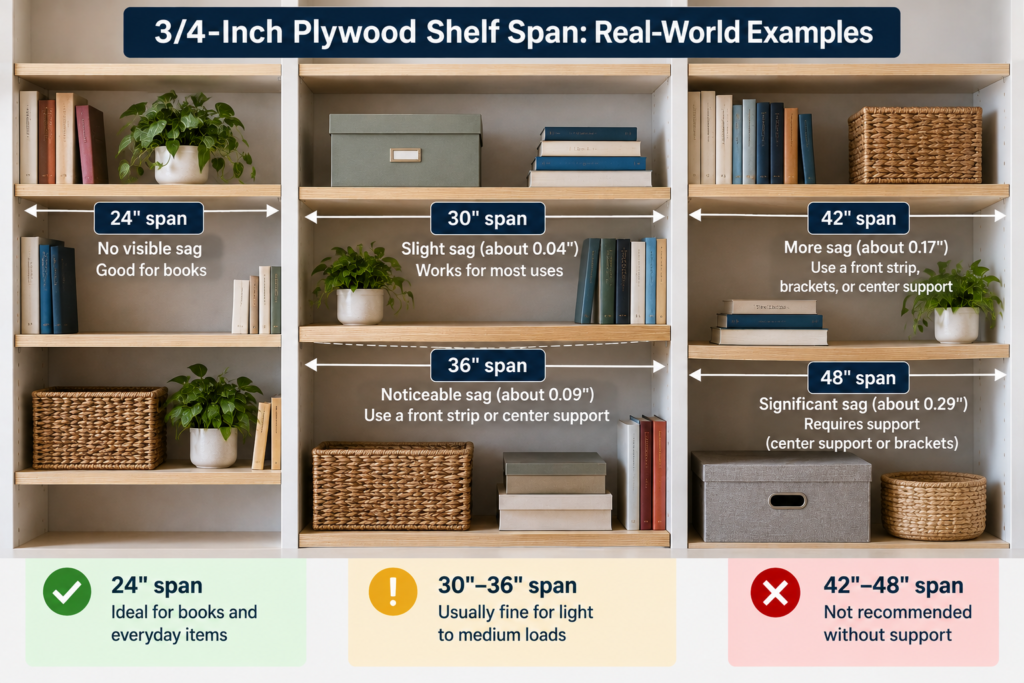
This is the same shelf at 20 lb per foot, at the spans people usually try to build:
Span
Calculated sag
Design limit
Result
24″
0.018″
0.040″
Passes easily
30″
0.044″
0.050″
Passes, close to the limit
36″
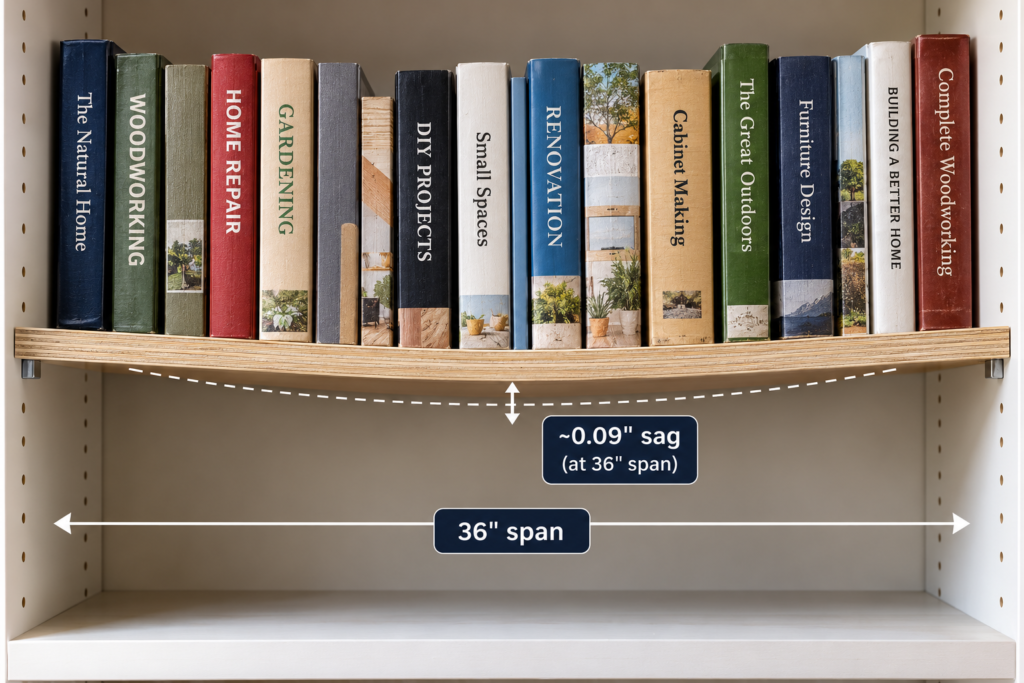
0.092″
0.060″
Fails; at the point where sag becomes visible
42″
0.171″
0.070″
Fails badly
48″
0.291″
0.080″
Fails; over 1/4″ of sag
Going from 30″ to 36″ adds only 6 inches, but the sag more than doubles. That’s because, under an evenly spread load, sag grows with the fourth power of the span (per the AWC formula).
How to Read the Plywood Shelf Span Chart
Weigh your load instead of guessing it. Put one foot of whatever will sit on the shelf on a bathroom scale, and use that lb-per-foot number to pick your row. According to the Sagulator, a fully loaded bookshelf commonly runs 20–40 lb per running foot. That’s more than most people expect.
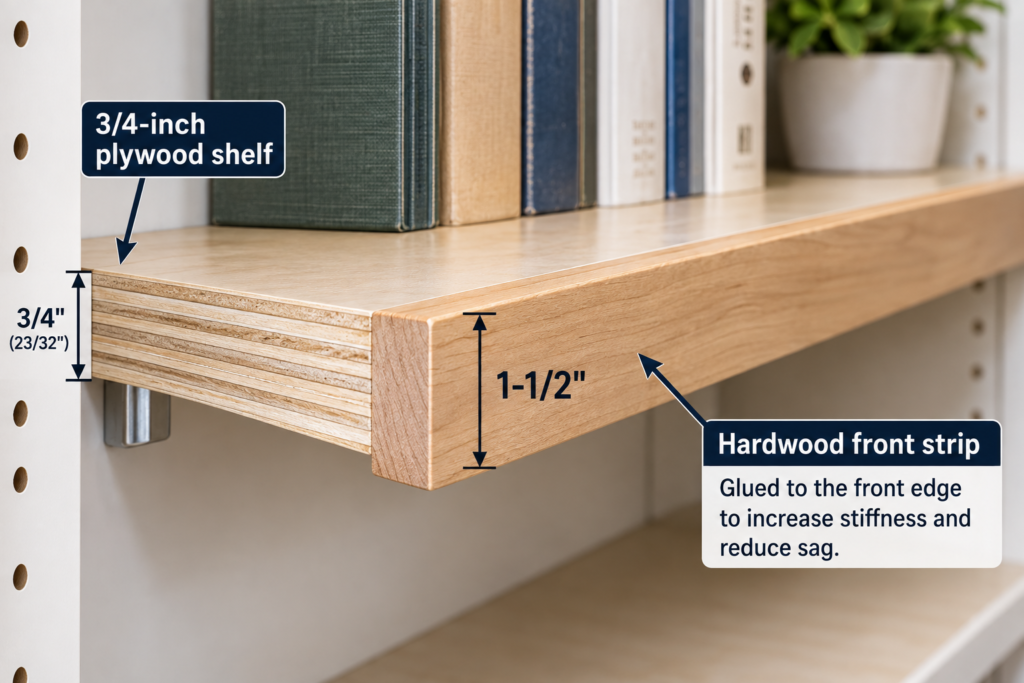
Your “3/4″ plywood is probably 23/32”. Stiffness depends on thickness cubed, so that missing 1/32″ means about 13–14% more sag. If you’re right at the limit, take an inch or two off the span.
A deeper shelf is stiffer, but it holds more. A 16″-deep shelf is stiffer than an 11-1/4″ one, but the extra depth usually fills up with extra load.
Hardwood and Baltic birch plywood are generally stiffer than construction fir or pine plywood. The chart is built on the conservative end, so a good birch panel will usually beat these numbers.
Sag keeps growing over time. Wood continues to deform under a load that stays in place, and the National Design Specification accounts for this creep. The American Wood Council notes that total long-term deflection can be about 1.5 times the initial deflection for seasoned wood and about 2.0 times for unseasoned wood. So a shelf that looks flat on day one can dip noticeably later. For how thickness affects this in general, see the plywood thickness vs. strength comparison.
5 Ways to Increase Plywood Shelf Span
1. Glue a hardwood strip to the front edge
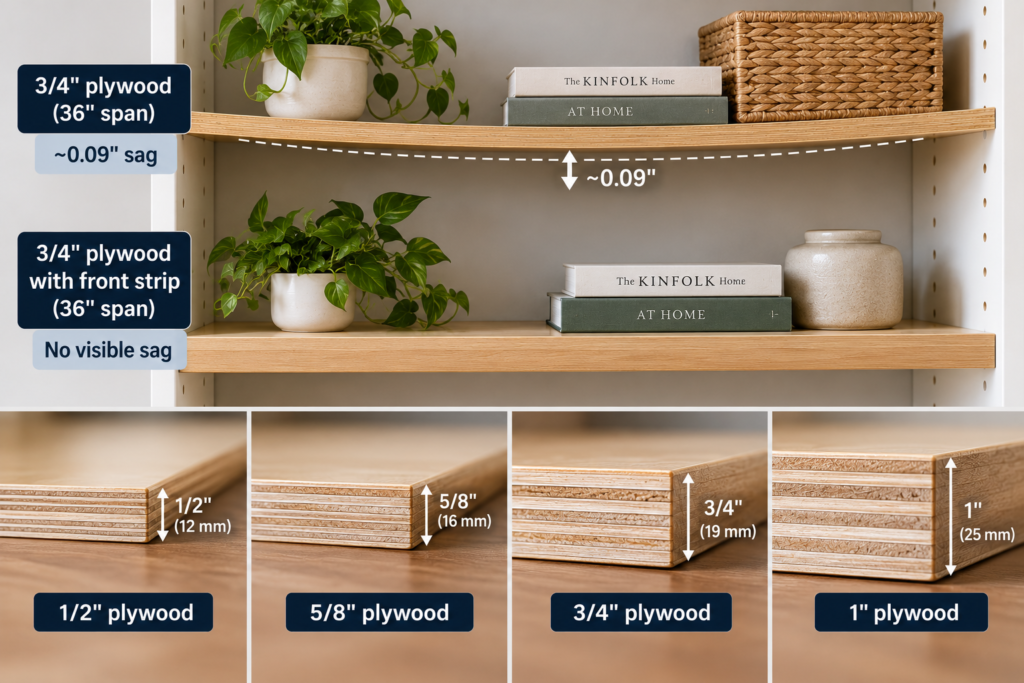
This is the cheapest fix and it does the most. Stiffness depends on height cubed, so a 3/4″ × 1-1/2″ strip glued on edge is about eight times stiffer than the same strip laid flat. Glue it; brad nails alone let it slip.
2. Add a back cleat
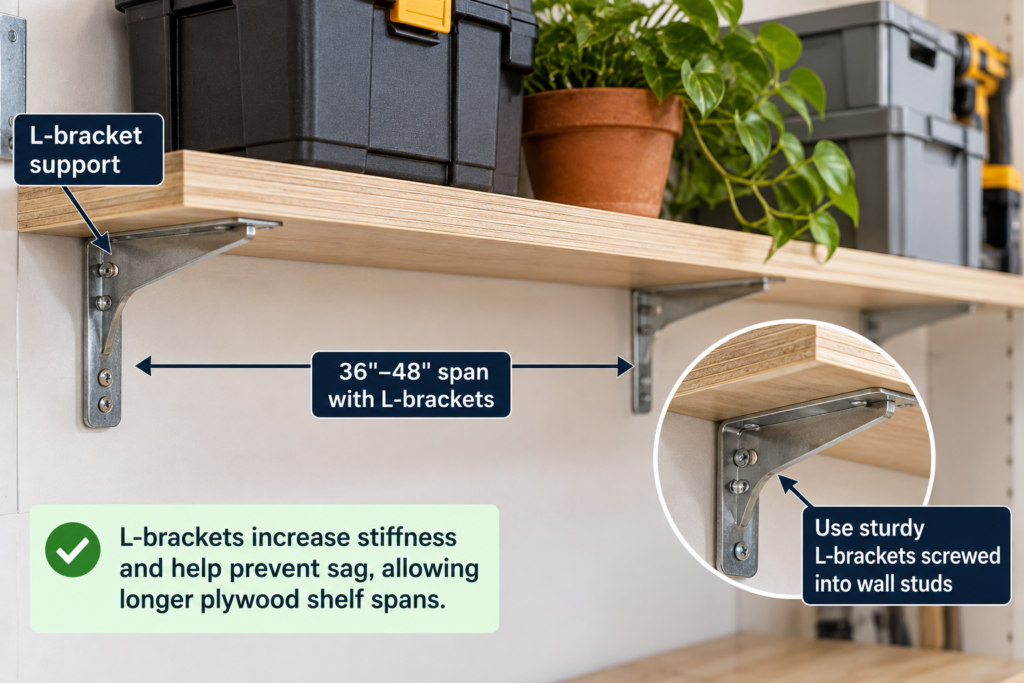
A cleat screwed into the case sides or the wall stops the back edge from dropping.
3. Fix the ends instead of setting them on pins
When a shelf is locked perfectly at both ends, the calculated sag is about one-fifth of a loose shelf’s (AWC Design Aid No. 6, fixed-end vs. simple-span cases). Real dados, screws, and cleats aren’t perfectly rigid, so expect a smaller improvement in practice.
4. Double up
Two layers of 3/4″ plywood glued together are roughly eight times stiffer than one layer. It’s heavy, but it works for long garage or pantry runs.
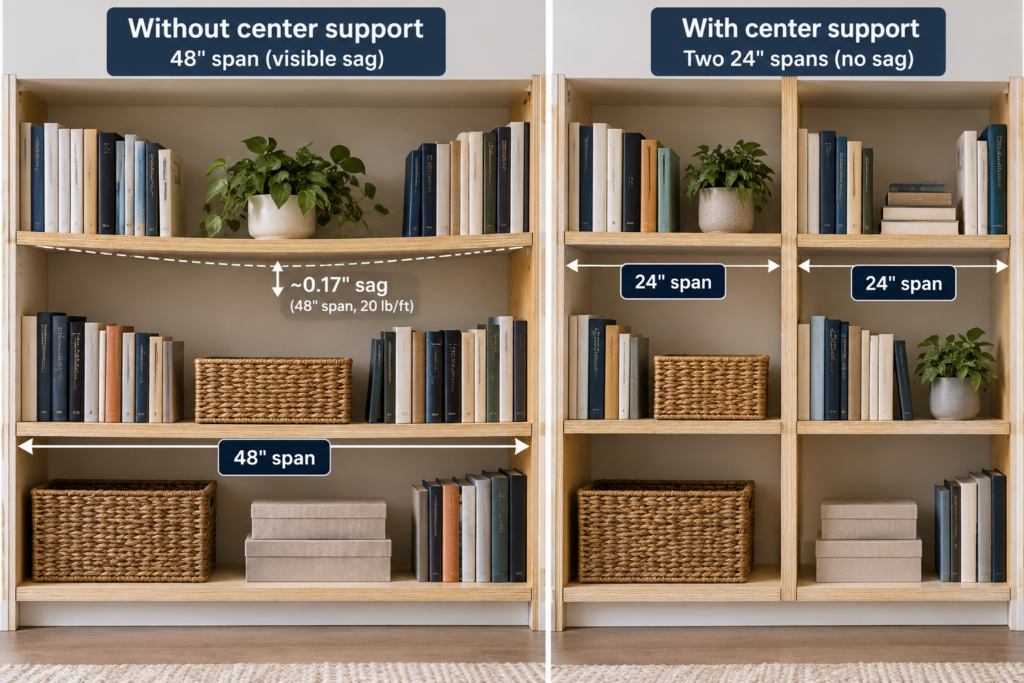
Splitting a 48″ run into two 24″ spans turns a failing shelf into one that passes easily. If the design allows a divider, this beats every other fix. To choose a panel thickness before you build, see best plywood thickness for furniture.
Recommended Tools and Hardware
Kreg shelf pin jig: drills pin holes that line up, so the shelf doesn’t rock on three pins.
Iron-on birch edge banding: hides the plywood edge but adds almost no stiffness. For stiffness you need a real hardwood strip.
5mm metal shelf support pins: use metal rather than plastic for heavier shelves, and follow the pin manufacturer’s load rating.
Bar clamps: needed to glue a front stiffener flat and tight.
Mistakes That Shorten Plywood Shelf Span
❌ Mistake: Building to the span that “looks right.” At 20 lb per foot, a 36″ shelf calculates to about 0.092″ of initial sag, roughly 53% above the 0.060″ design limit.
⚠️ Warning: Using plastic pins on heavy shelves. Pins bend or crack under a sustained load, and the shelf tips.
💸 Cost difference: Skipping the $5 front strip. The alternative is rebuilding a sagged built-in, which costs a full sheet of plywood and a day of work.
😬 Regret: Trusting a shelf that “passed” while empty. Load it, check it with a straightedge, and check again a few weeks later.
❌ Mistake: Using MDF or particleboard at plywood spans. Both are less stiff than plywood and creep more, so shorten the span or add a stiffener.
⚠️ Warning: Assuming a longer shelf will carry less per foot. A longer shelf just holds more books. The load per foot stays the same while the span grows.
When Not to Use 3/4-Inch Plywood Alone
Spans over about 36″ with any real load. Use a divider, a torsion box, or steel.
Floating shelves. The hidden bracket and the wall anchor carry the load, so shelf thickness matters far less.
Damp garages or basements. Moisture lowers stiffness and speeds up creep.
Commercial casework built to spec. That work follows ANSI/AWI 0641, which has its own shelf-length formula and load tests.
Checklist Before You Cut
☐ Weighed one foot of the actual load
☐ Found that load’s row on the chart
☐ Measured the real panel thickness (23/32″ vs. 3/4″)
☐ Took an inch or two off if you’re near the limit
☐ Planned a front stiffener for anything over 30″
☐ Chose metal pins or a fixed cleat for heavy loads
FAQ
What is the maximum plywood shelf span for 3/4-inch plywood?
About 31 inches for an 11-1/4″-deep shelf carrying 20 lb per foot. Lighter loads allow up to about 39 inches; heavy loads drop it to 23–25 inches.
Will a 36-inch plywood shelf sag?
At 20 lb per foot, yes. The calculated sag is about 0.09″, which is past the 0.06″ design limit and at the point where sag becomes visible. A glued front strip or a center support fixes it.
Is 1/2-inch plywood OK for shelves?
Only for short, light shelves. Its stiffness is less than a third of 3/4″ plywood’s.
Does edge banding stop sag?
Iron-on veneer banding doesn’t. A solid hardwood strip at least 1-1/2″ tall, glued to the front edge, does.
It’s generally stiffer and has fewer core voids, so it will usually beat these spans. A front stiffener on regular plywood often gets you the same result for less money.
Bottom Line
For 3/4-inch plywood under a normal bookshelf load, a safe plywood shelf span is about 30 inches, not 36. Weigh your load, read the chart, and for longer runs, glue on a hardwood front strip or add a center support. For subfloor and roof spacing, see the plywood span chart.
A 3/4-inch plywood shelf, 11-1/4 inches deep, carrying about 20 pounds per running foot will span roughly
Related Posts:
Rev-A-Shelf Cabinets: Best Pull-Outs & Prices by Admin April 18, 2026 DIY What is Rev-A-Shelf? Rev-A-Shelf is a cabinet organization system that adds pull-out drawers, trash bins, and storage inserts inside existing cabinets, improving accessibility and storage…